Category Archives: Green Initiatives / Environment

Flavour of Kodagu coffee at international contest

‘The Romance of Indian Coffee’ is the Indian entry to the Gourmand International (Book) Award this time

The jacket of the book ‘The Romance of Indian Coffee’ written by journalist P.T. Bopanna.

The Indian entry to the Gourmand International (Book) Award this time is on what until recently was a south Indian addiction: coffee.

With the coffee culture proliferating across India, thanks to chains like Starbucks, Barista and Café Coffee Day, the routine act of consuming the black decoction stirred in milk, as most people do, and with or without sugar – which again is a personal choice – has acquired an uber-cool image among the Gen Y.

Bengaluru-based journalist P.T. Bopanna has brought alive this unique trait in his book The Romance of Indian Coffee , now shortlisted for the Gourmand International Award, where it will vie for the top honours among coffee books from Brazil, France, China, Thailand, and the U.S., to name a few.

Hailing from Kodagu, which is the home of coffee in India, it was natural for Mr. Bopanna to feel inspired to write on the brew which has a universal appeal.

“My earlier works were Kodagu-centric, but I found a wider canvas in coffee which is also related to Kodagu,” said Mr. Bopanna.

“The book traces the history of coffee in India with interesting titbits about the brew and how its cultivation in the shade lends it a unique flavour, unlike coffee grown in the open in most other countries,” explained Mr. Bopanna, who believes that making coffee is an art. Notwithstanding the proliferation of coffee bars, the best filter coffee, he said, was still prepared in the bylanes of Chennai and elsewhere in Tamil Nadu.

The contribution of Ivor Bull, a British planter, who introduced intercropping and is a legend among the locals, has been highlighted in the book as also recipes for making coffee liqueur.

But ironically, he notes that Kodavas, who market home-grown coffee to the rest of the world and have spanned a coffee culture in India, have taken after the British and prefer tea!

There are entries from as many as 64 countries for the Gourmand awards, started in 1995 as a celebration of global cookbook and wine book publishing. The final results will be announced on May 28 at Yantai, China.

source: http://www.thehindu.com / The Hindu / Home> National> Karnataka / by R. Krishna Kumar / Mysuru – January 31st, 2016

Karnataka to establish Cauvery River Gallery

KaveryKF07jan2016

Bengaluru :

After flip-flopping for many months, there is a concrete sign of Karnataka getting its first river museum. On Wednesday, the state government took first baby steps to expedite on its dream project, Cauvery river gallery.

The gallery, expected to be thrown open to the public in six months from now will showcase cultural and socio economic aspects of the river. It will feature exhibits, detailed satellite images, multimedia displays, digital video-shows and real-time experience of cruising along the river which is around 765 km in length.

Originating in the Brahmagiri Hill in Kodagu, the river flows from the western ghats and descends into the eastern ghats in a south-easterly direction covering 320 km in Karnataka and drains itself into the Bay of Bengal. “The proposed gallery would be set up with the support of the National Academy of Sciences of India (NASI).

The government has already earmarked Rs 3.5 crore for the project. NASI would run it for first three years, train local personnel and then hand it over to the state government,” tourism minister R V Deshpande after signing an MOU with NASI on Wednesday said. By capturing the etymological, ecological, cultural, heritage, and social characteristics of the river, the gallery which would be set up in about 2500 sq ft area will also serve as a learning centre on the major south Indian river. The modalities are being worked out by the NASI, he added

Though the proposal was mooted by the Karnataka Knowledge Commission headed by K Kasturirangan, the government failed to find an appropriate place.

Initially, the commission had suggested establishing the gallery on the banks of the river Cauvery at Mysuru on the lines of Ganga Gallery at Allahabad and Brahmaputra Gallery at Guwahati. Later it was planned to establish the gallery in the premises of University of Mysore and also at a century old mansion on Kantharaj Urs Road in Mysuru.

source: http://www.timesofindia.indiatimes.com / The Times of India / News Home> Good Governanace> Karnataka / Manu Aiyappa / TNN / January 07th, 2016

From Here & There-Green wishes from Kodagu

Dr S V Narasimhan, a medical practitioner in Virajpet in Kodagu district, is perhaps better known as a bird enthusiast. An avid bird watcher, he has been carrying out an awareness campaign with focus on conservation for the past three decades.

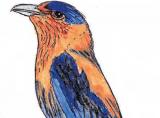
As part of the initiative, every year he sends hand-painted cards to over 1,000 people across the world. The card consists of meticulous painting of a bird or an animal with information about it, and conservation messages.

Here are some sample messages — “ We co-exist, can’t you?” by a tiger and a spotted deer; “It was we who filled the world with melodious music,” by common iora bird.

Narasimhan feels that all creatures are equally important for the survival of life on earth. He chose this signature campaign to motivate people to think about environment and our roles in conserving it. These wildlife message cards are individually handpainted and sent to people across the world, free of cost, during the wildlife week every year. In the last 32 years, he has painted 62,420 cards.

BirdKF08dec2015

This year alone, he painted 1,930 cards. In the process, he has painted more than 480 species of animals, birds and butterflies. One of his messages said, “Let us join hands to make our earth a greener place to live. This is the only place where all the elements of life can live in health, happiness and harmony.” He has also authored a bilingual book (Kannada and English) on birds called Feathered Jewels of Coorg.

To know more about the campaign, visit www.drsvnarasimhan.blogspot.in.

source: http://www.deccanherald.com / Deccan Herald / Home> Supplements> Spectrum / AP – December 08th, 2015

Springs of life

TalacauveryKF29nov2015

Springheads, the point where springs emerge, are to be treated carefully so that people using the waters do not cause pollution or damage.
by S. Vishwanath

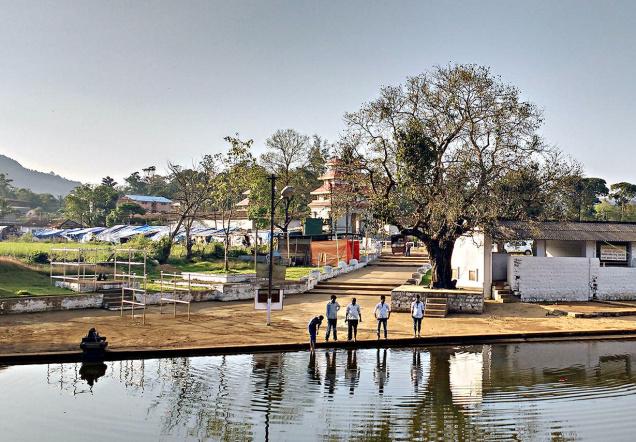
This part of the beautiful Sahyadri or the Western Ghats is lush green, thanks to a long spell of rain. Talacauvery is an hour’s drive from Madikeri in Kodagu district. Here the beautiful river Cauvery rises. On the day celebrated as Sankranti, the waters appear here in a small pool. It then disappears to reappear at Bhagamandala as a stream, meeting the Kannika and the unseen Sujyoti.

What appears in Talacauvery is a spring. On the upper reaches of the hills of the Brahmagiri, rainwater infiltrates and percolates into the ground. Filling up the aquifers, it forms the groundwater in the space.

Groundwater which emerges naturally onto the surface is called a spring. As Himanshu Kulkarni, a leading hydro-geologist, would say, springs are best treated and understood as groundwater.

In India springs have long suffered neglect in terms of research. Though they have been the lifeline for many communities, especially in the hilly regions of the Himalayas, the Western Ghats and the Eastern Ghats, not much effort has been put in to understand and model them better. Dr. Kulkarni points out many typologies for springs. In one particular case he shows how the recharge zone, where the water enters the aquifer, is on the other side of the hill from where the spring emerges.

The traditional watershed approach would fail to recharge the aquifer of this typology of springs because it would be addressing water flows and recharge in the same side of the hill without understanding the nature of the geology at the place. Instead of a ridge to valley approach to manage water, a valley to valley approach would have to be envisaged for such spring management.’ In simple language there is a recharge zone for a spring and the spring itself is in the discharge zone. Understanding, mapping and managing recharge zones is crucial to the health of the springs. For long Indians have trekked to the source of rivers and paid homage to the life-giver. They have in actuality been worshipping springs. It is time that we understood this source of water better and managed them better. That would be water wisdom.

zenrainman@gmail.com

source: http://www.thehindu.com / The Hindu / Home> National> Kerala / by S. Vishwanath / November 28th, 2015

M.C. Nanaiah seeks Rs. 100 Cr. for development of Kodagu

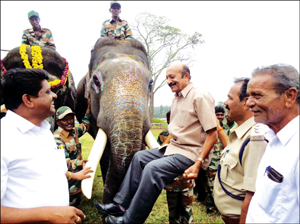
Former Law Minister M.C. Nanaiah enjoying a ‘JUMBO’ ride sitting on the tusk of an elephant at the Aane Utsava held at Dubare Elephant Camp in Kodagu yesterday.

NanaiahBF16nov2015

Kushalnagar :

Former Minister M.C. Nanaiah has urged the Government to release Rs. 100 crore for overall development of Kodagu district.

Speaking after inaugurating the 61st wildlife month and elephant day celebrations at Dubare Elephant Camp, near Kushalnagar yesterday, Nanaiah asked the State Government to take Cauvery River cleaning on the lines of Ganga River cleaning taken up by the Prime Minister.

Urging the Government to announce a special package for Kodagu, Nanaiah stressed on the need for initiating appropriate measures for ending man-animal conflict across Malnad region, which has seen an alarming rise over the past few years.

Calling for installation of solar fencing and construction of trenches in order to prevent elephant intrusions into farm lands and human habitats, he urged the Government to move the Supreme Court for taming wild elephants, which are causing havoc across Malnad region.

The former Minister then urged the government work towards conservation of Western Ghats, preservation of forest wealth and water bodies. He also urged the Govt. to regularise the services of Dubare Elephant Camp Mahouts who have been serving for years.

Karnataka Forest Industries Development Corporation Chairman T. Eshwar, in his address, said that the Corporation has sent a proposal to the Government on setting up a mega Bamboo Industry at Kushalnagar at a cost of Rs. 100 crore. Madikeri Division DFO Yedukondalu called upon the involvement of everyone in putting an end to man- elephant conflict.

source: http://www.starofmysore.com / Star of Mysore / Home> General News / Monday – November 16th, 2015

Forest dept may acquire land in Kodagu to reduce man-elephant conflict

ForestKF13oct2015

To reduce man-elephant conflict, especially in Kodagu, the Forest Department is keen to acquire land from people and has joined hands with Wildlife Trust of India (WTI) in this regard.

The department wants to acquire about two kilometre of land belonging to the Huvinkadu and Faith coffee estates, which is part of the Kutta-Tiranahalli corridor, which in turn is part of the Nagarahole-Brahmagiri elephant corridor link. “Elephants use this stretch and we want to acquire it to reduce man-animal conflict,” Manoj Kumar, Chief Conservator of Forests, Kodagu, told reporters here on Friday on the sidelines of a workshop on ‘Dealing with leopards and elephants in human-use landscape’ here organised by Wildlife Conservation Society-India Programme (WCSIP).

“Landowners are demanding Rs 20 lakh for an acre. Hence, we have approached the WTI to map the area, ascertain land width and find out if that is necessary because there is another route through Wayanad which is also frequented by elephants,” he said.

To further reduce man-elephant conflict, the Forest Department will soon hold meetings with officials in forest departments of Kerala and Tamil Nadu on how to strengthen the Nilgiri Biosphere Reserve. The 6,000-sq km biosphere reserve presently houses 6,000-odd elephants. The last meeting in this regard was held in December 2014.

“We will hold meetings with the deputy and assistant conservators of forests of the two states to assess ground reality and undertake research. There is a need to know how many elephants can the biosphere hold and for how long. It’s crucial since this is the only habitat left for elephants. That will also help strengthen corridors,” Kumar added.

Prithviraj Fernando, Trustee and Scientist at the Centre for Conservation and Research, Sri Lanka, stressed the importance of ensuring safe habitats for elephants. “Case studies in India, Malaysia and Sri Lanka have shown that elephant relocation has not been very successful. Relocation is temporary and shifts the problem from one area to another,” he said while speaking on human-elephant interaction.

Fernando, who has been working on elephant conservation in Sri Lanka for many years now, said there was a huge population of jumbos in the island nation, and 70 people and 250 elephants died in conflict every year.

Vidya Athreya, Senior Research Fellow at WCSIP, spoke on human-leopard interaction and Ranjeet Jadhav, a journalist at Mid-Day, Mumbai, spoke on ‘Reporting human-leopard interactions in Maharashtra: A case study’.

source: http://www.deccanherald.com / Deccan Herald / Home> City / DHNS, Bengaluru – October 10th, 2015

B’luru MP announces Rs.10 lakh for Conservation of Kodagu Mandhs

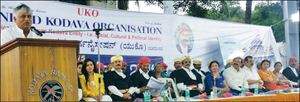
Mandya MP C.S. Puttaraju is seen addressing the gathering at the valedictory of ‘Jabhoomi Baalo-2015’ padayatra at Kodava Samaja in Bengaluru yesterday.

Bengaluru :

Rajya Sabha member from Bengaluru, Kupendra Reddy, has promised Rs. 10 lakh for conservation of Kodagu mandhs and revival of paddy cultivation across Kodagu district, said Mandya MP C.S. Puttaraju at the valedictory of ‘Jabhoomi Baalo-2015’ padayatra at Kodava Samaja in Vasanthnagar here yesterday.

Puttaraju said that he was authorised to announce this by MP Kupendra Reddy, who is currently in USA, on his behalf.

Stating that Reddy has announced Rs. 10 lakh for UKO’s cause as the first instalment, Puttaraju said Reddy has promised more funds for UKO’s various plans.

Stating that the people of Mandya were always indebted to river Cauvery, which originates in Kodagu, Puttaraju assured of extending all support for the protection of Kodava land, culture and its environment.

UKO Convenor Kokkalemada Manju Chinnappa, in his address, said that the funds provided by Kupendra Reddy will be utilised for conservation of Kodagu mandhs and other programmes. He also said that Puttaraju has handed over Rs. 10 lakh grant to UKO as the first instalment as promised by Reddy.

Karnataka State Handicrafts Development Corporation Chairperson Shantheyanda Veena Achaiah, former MLC Cheppudira Arun Machaiah, Kodagu District Congress President Biddatanda T. Pradeep, former Kodagu District BJP President Machimada M. Ravindra, Federation of Kodava Samajas President Mallengada Dada Belliappa, Bengaluru Kodava Samaja President Mandeda Ravi Uthappa, Vice-President Mukkatira Vani Nanaiah, Secretary Chennapanda Subbaiah, actress Prajwal Poovaiah, Madikeri Kodava Samaja President Moovera Shambu Pemmaiah, Ponnampet Kodava Samaja Secretary Chottekmada Rajiv Bopaiah, Kodava Sahitya Academy President Biddatanda S. Thammaiah, UKO office-bearers and others were present.

source: http://www.starofmysore.com / Star of Mysore / Home> Generla News / Monday – October 05th, 2015

Farmer on Padayatra to Bengaluru to ensure Kodagu remains green

Manju Chinnappa and team began walking from Talacauvery to Bengaluru to stress need to save the district’s ecosystem.

ManjuChinnappaKF04oct2015

This farmer has been walking for 11 days to take his fight against environment degradation in Kodagu district. Manju Chinnappa, 37, started his padayatra from Talacauvery on September 18. Chinnappa, a native of Hudikeri, started the movement after severe drought that affected Virajpete this year. A Bcom graduate, Chinnappa says, “Even from my early days, I wanted to work towards the preservation of the culture and tradition of my motherland. Over the years, the district has seen several atrocities on land, deforestation and cultural aggression. The main aim of this walkathon is to bring to the attention of the social and economic problems that Kodagu district faces today. I hope it motivates people to preserve the culture and sanctity of the native people.”

Chinnappa has managed to cover close to 25 kms everyday and en route he is celebrated by the people of that particular village who walk with him for a few kilometres to express their support. On Monday, he reached Mysuru. He also gives awareness talks on how to keep the heritage of the district alive.

A founder of the United Kodava Organisation that was formed in 2011 to focus on preserving the environment and heritage of the place, he says, “We know merely submitting a resolution to the state government might not bring much change. We wanted to make a noise through this padayatra to get the attention of as many people as possible. We hope to reach Bengaluru by October 4 and we want to submit a memorandum to the chief minister regarding our demands.” His plan is to cover a distance of 414 km considering he has taken a route inside Kodagu within the villages to spread his message. After reaching Bengaluru, the final leg will start at 9 am from Jnanabharathi campus (Bangalore University) where the local Kodava population will join him in the walk up to 20 kms that will culminate at the Kodava Samaja in Vasantha Nagar. The local Kodavas will come in their traditional dress to show their support to Chinnappa.
Chinnappa says, “In the name of tourism, several trees are being removed which has harmed the people living in that region. Our main resolution is to put pressure on authorities to stop the conversion of wetland not only in Kodagu but across the state. Many infrastructure plans by the state government have destroyed the ecology of the district completely and we want to draw everybody’s attention to this.”

The Kodava community in the city is all set to welcome Chinnappa. They have also started a Facebook page to update the information of padayatra from time to time.

Children are also taking part

Route plan

Talakaveri-Igguthappa Temple-Madikeri-Bayarambada-Virajpet-Gonnikoppa-Anechowkur-Hunsur bypass- Mysuru-Srirangapatna-Mandya-Chennapatna-Bidadi-Jnanabharathi-Kodava Samaj, Bengaluru

source: http://www.bangaloremirror.com / Bangalore Mirror / Home> Bangalore> Others / by Vandana Kamath, Bangalore Mirror Bureau / September 30th, 2015

Cauvery theerthodbhava on Oct 17

Madikeri :

The annual theerthodbhava of river Cauvery will occur at the holy pond at its birth place Talacauvery at 12.15am on October 17.

Cauvery water will spring at the ‘Kundike’ at the thula sankramana muhurtham.

Apart from devotees from Kodagu, a large number of people from Mandya, Mysuru and Bengaluru and also from neighbouring Kerala and Tamil Nadu are expected to witness the religious ceremonies.

source: http://www.timesofindia.indiatimes.com / The Times of India / News Home> City> Mysuru / TNN / September 12th, 2015

It flattered to deceive

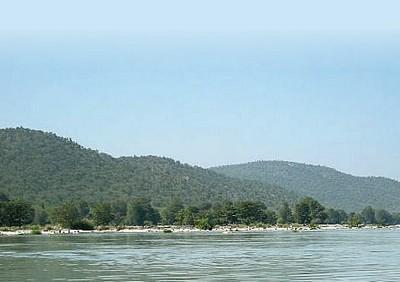
Cauvery — which is the lifeline of the people in south Karnataka and people living along the downstream in Tamil Nadu — has its origins in Kodagu which is the key catchment area of the river.

Kodagu received 33 per cent excess rains when the monsoon set in during June this year. It recorded a rainfall of 826.2 as against the normal of 622.4 mm. But the monsoon slackened during July and August.

In July, Kodagu received 360.2 mm of rains as against the normal of 904.7 mm, which is 60 per cent below normal whereas in August the district as a whole received only 289.4 mm of rains as against the normal of 597.7 mm which is 48 per cent below normal.

The cumulative rainfall deficiency for the period June 1 to September 6 is minus 31 per cent and against the normal of 2181.2 mm of rains, Kodagu received only 1,504 mm rainfall. The deficient rain was uniform across the district, resulting in depleting inflow into the KRS.

Likewise, the adjoining districts of Mysuru and Mandya through which the Cauvery flows, also received deficient rains during July and August, adding to the reduction in the inflow into the reservoirs.

source: http://www.thehindu.com / The Hindu / Home> National> Karnataka / by R. Krishna Kumar / Mysuru – September 07th, 2015