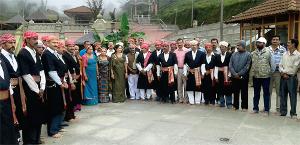
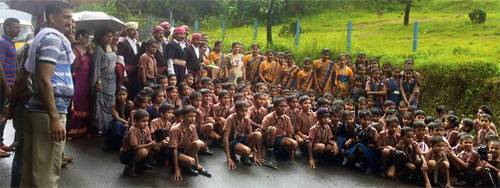
Manju Chinnappa and team began walking from Talacauvery to Bengaluru to stress need to save the district’s ecosystem.
This farmer has been walking for 11 days to take his fight against environment degradation in Kodagu district. Manju Chinnappa, 37, started his padayatra from Talacauvery on September 18. Chinnappa, a native of Hudikeri, started the movement after severe drought that affected Virajpete this year. A Bcom graduate, Chinnappa says, “Even from my early days, I wanted to work towards the preservation of the culture and tradition of my motherland. Over the years, the district has seen several atrocities on land, deforestation and cultural aggression. The main aim of this walkathon is to bring to the attention of the social and economic problems that Kodagu district faces today. I hope it motivates people to preserve the culture and sanctity of the native people.”
Chinnappa has managed to cover close to 25 kms everyday and en route he is celebrated by the people of that particular village who walk with him for a few kilometres to express their support. On Monday, he reached Mysuru. He also gives awareness talks on how to keep the heritage of the district alive.
A founder of the United Kodava Organisation that was formed in 2011 to focus on preserving the environment and heritage of the place, he says, “We know merely submitting a resolution to the state government might not bring much change. We wanted to make a noise through this padayatra to get the attention of as many people as possible. We hope to reach Bengaluru by October 4 and we want to submit a memorandum to the chief minister regarding our demands.” His plan is to cover a distance of 414 km considering he has taken a route inside Kodagu within the villages to spread his message. After reaching Bengaluru, the final leg will start at 9 am from Jnanabharathi campus (Bangalore University) where the local Kodava population will join him in the walk up to 20 kms that will culminate at the Kodava Samaja in Vasantha Nagar. The local Kodavas will come in their traditional dress to show their support to Chinnappa.
Chinnappa says, “In the name of tourism, several trees are being removed which has harmed the people living in that region. Our main resolution is to put pressure on authorities to stop the conversion of wetland not only in Kodagu but across the state. Many infrastructure plans by the state government have destroyed the ecology of the district completely and we want to draw everybody’s attention to this.”
The Kodava community in the city is all set to welcome Chinnappa. They have also started a Facebook page to update the information of padayatra from time to time.
The annual theerthodbhava of river Cauvery will occur at the holy pond at its birth place Talacauvery at 12.15am on October 17.
Cauvery water will spring at the ‘Kundike’ at the thula sankramana muhurtham.
Apart from devotees from Kodagu, a large number of people from Mandya, Mysuru and Bengaluru and also from neighbouring Kerala and Tamil Nadu are expected to witness the religious ceremonies.
source: http://www.timesofindia.indiatimes.com / The Times of India / News Home> City> Mysuru / TNN / September 12th, 2015
Cauvery — which is the lifeline of the people in south Karnataka and people living along the downstream in Tamil Nadu — has its origins in Kodagu which is the key catchment area of the river.
Kodagu received 33 per cent excess rains when the monsoon set in during June this year. It recorded a rainfall of 826.2 as against the normal of 622.4 mm. But the monsoon slackened during July and August.
In July, Kodagu received 360.2 mm of rains as against the normal of 904.7 mm, which is 60 per cent below normal whereas in August the district as a whole received only 289.4 mm of rains as against the normal of 597.7 mm which is 48 per cent below normal.
The cumulative rainfall deficiency for the period June 1 to September 6 is minus 31 per cent and against the normal of 2181.2 mm of rains, Kodagu received only 1,504 mm rainfall. The deficient rain was uniform across the district, resulting in depleting inflow into the KRS.
Likewise, the adjoining districts of Mysuru and Mandya through which the Cauvery flows, also received deficient rains during July and August, adding to the reduction in the inflow into the reservoirs.
source: http://www.thehindu.com / The Hindu / Home> National> Karnataka / by R. Krishna Kumar / Mysuru – September 07th, 2015
Two Sundays back, over 100 vehicles were parked in and round the Kodava Samaja club in Vasanthanagar in Bengaluru. There were shiny Sedans and rusty Jeeps, perky hatchbacks and burly SUVs.
For all their differences in name, colour and models, they had one thing in common: The light green triangular shape Coorg Wildlife Society (CWS) stickers plastered on windshields or bumpers.
“For decades, people of Kodagu have used the CWS as a moving identity card. It symbolizes the driver is proud of his place (Coorg) and also it offers a glimpse of their love and fascination with nature, It’s a great way to find common ground to begin a conversation, when Kodavas meet outside Coorg” said Jeeth Devaiah, strength and conditioning coach at Galen Gym, Airport road.
The CWS sticker was the brainchild of Pratap Chittiappa, chairman of Skanda Coffee, one of the founding members of CWS. In 1983, he influenced M/s Hindustan Thompson to design a crest that eventually turned into the bumper sticker in the 1990s. The members of the society began promoting the CWS by sticking it on their windshields and it gradually became a fad.
“Initially the fad was limited to Kodagu alone but now it shifted across the world. I even happened to see such stickers in cars driven by non-Coorgs in San Francisco some time ago,” Ajith Nanjappa, who pursued his MBA degree there recently said.
Sales of CWS stickers have eroded during the past decade. Buoyed by the popularity of CWS stickers, unauthorized vendors started marketing it in their own with giving it various colour combinations. “We sell roughly around 1,000 stickers per month for a prices ranging between Rs 25 and Rs 100. But the fad is dying now compared to what it was a few years ago. Now people have been switching to other stickers like Coorg warrior 1839, Coffeeland, among others,” said Ayub Zameer, a vendor at Madikeri.
“We had got it patented a few years ago to prevent misuse of our logo but it was tough to stop the illegal trade. Now we have decided to lodge a formal complaint to ensure only registeredd CWS stickers are sold,” said colonel CP Muthanna (Retd), president of the CWS, now with a membership of 920,
Tarun Cariappa, secretary of the NGO said the stickers which have registered trademark symbol ® are only the genuine ones. “We sell these stickers to general public for a nominal sum of Rs 30 at our office. The money will be used in promoting conservation activities. “People can buy online through our website at a cost of Rs 75,” he added
CWS activities however are not just limited to business of selling stickers. Formed in 1980, CWS is actively engaged in organizing programmes to increase awareness of nature, wildlife and environment in schools and colleges of Kodagu district. “CWS has a long history of campaigning to ensure that government policies and laws help safeguard Coorg’s wildlife. Our aim is to make Coorg a leader in the field of wildlife protection and restoration, a dream of the late brigadier CM Cariappa who was the moving spirit behind its establishment” said colonel Muthanna.
CWS has been in the forefront of an activism against the decision of the Power Grid Corporation of India Limited (PGCIL) to draw a 400kv power line from Yelawal in Mysore to Kasaragod in Kerala via Kodagu. “The project will see as many as 50,000 trees felled, affecting the ecology and increasing man-animal conflict. We will do everything to protect the nature,” said Cariappa.
source: http://www.timesofindia.indiatimes.com / The Times of India / News Home> City> Bengaluru / by Manu Aiyappa, TNN / September 11th, 2015
They have worked in the tea gardens of Assam but in Madikeri they are tending the Coffee plants. Labourers from Assam working in coffee plantations in Kodagu have become a common sight since the past two years.
It is in south Kodagu that more number of Assamese labourers find work in houses and estates.
A few days ago, nearly 200 people arrived from Assam and were divided in teams to meet the demands of the local agents.
According to the labour department officials, there are seven labour camps in and around Kodagu where these people stay.
A few big planters will host some of the Assamese labourers in their own camps in the estates.
In Kodagu, over the years, shortage of labourers have been very severe and existing workers have been demanding more salary and benefits. In 2011, the acute shortage of labour and the high demands of local labourers had put the planters in a spot.
Earlier, the planters were getting labourers from Sullia in Dakshina Kannada and Arasikere in Hassan district, but the Assamese labour comes much cheaper than the usual lot, the officials added.
A labour contractor from Dakshina Kannada, Rajappa Gowda, who takes labourers from Sullia and Puttur every week, says Kodagu has a heavy demand for labourers.
Many escape the labour work in the estates and get into more cozier jobs as servants at home-stays.
But the migrants tend to stay for longer as they get all the benefits, from schooling for their children and higher social security.
Former vice-chairman of Coffee Board of India, Bose Mandanna, told Express that though Assamese workers do not know the scientific work of coffee cultivation, those who settle here learn how to spray, borer tracing and other works. Since all migrants show records like BPL cards, voter IDs and other records, it is the responsibility of the officials to trace fake cards, he says.
However, according to Codava National Council president N U Nachappa, these workers are all Bangaldeshis possessing fake documents. He recalled the protests held early this year urging officials to verify the labourers’ antecedents.
A coffee planter from Gonikoppa told Express, “Since we are getting Assamese labour, demand for more salary from workers who come from far away places cease.”
Another planter from Suntikoppa in Somwarpet taluk said many estates would run into trouble if the Assamese labour did not flow into Kodagu.
The police department have asked all coffee growers to check the documents and collect photos of workers and their family members and submit copies to them without fail.
source: http://www.newindianexpress.com / The New Indian Express / Home> States> Karnataka / by Express News Service / August 24th, 2015
The rain deficit in Kodagu, the origin of Cauvery river, has become a major cause of worry for the farmers here.
As far as the monsoon is concerned, the rainfall seems to be following an erratic pattern.
Heavy rain lashed the district in the beginning of the monsoon causing havoc. Later, it slowed down causing a drought-like situation.
Generally, in the 90-day monsoon season, the rainfall was sufficient for farmers as it was enough to fill the Harangi reservoir. But this year, the situation is different.
Though Harangi is full, Krishna Raja Sagar (KRS) reservoir is yet to be filled as the crest gates in Harangi were opened only once.
Kodagu district received 60 cm of rain in the first 10 days of the monsoon causing floods.
In July and August, rainfall was deficient by 70 and 60 per cent respectively.
Cloud seeding was taken up in Kodagu six years ago, but it was not conducive with the weather here.
According to figures available with Express, the average expected rainfall in January was 5 mm, but the district received 0.3 mm; February – 3.2 mm (5.6 mm expected); March – 37.4 mm (14.7 mm); April – 133.4 mm (73.5 mm); May – 191.4 mm (146 mm); June – 804 mm (486 mm); July – 366 mm (938 mm) and till August 20 – 164 mm (250 mm).
This erratic rainfall seriously impacted the water requirements of paddy, coffee and pepper crops.
The total average rainfall from January to August should have been 2,100 mm, but Kodagu has recorded 1,710 mm. The district is facing a deficit of 300 mm rainfall.
A minimum of 600 mm rain is required on a weekly basis to fill the reservoirs in Kodagu.
source: http://www.newindianexpress.com / The New Indian Express / Home> States> Karnataka / by B C Dinesh / August 24th, 2015
With rains drenching the hilly, wooded landscape of the Kodavas, it is time to visit the Kodagu district in Karnataka, the birthplace of the mighty Cauvery.
Originating at Talacauvery, the Cauvery gently flows from the Western Ghats and in the process, traces a long journey of 800 kilometers in the South-Eastern direction and empties in the Bay of Bengal. With monsoon gaining vigour once again, the coffee land especially during the months of July and August, is at its best. It is a sublime experience to visit Madikeri and surrounding areas that are home to many a waterfall.
As these are located in dense jungles, one has to trek and walk a few kilometers to take a peek at silver cascades in both the Brahmagiri and Pushpagiri hill ranges. Both these hill ranges are home to many waterfalls but the Mallali Falls near Somwarpete and Irupu near Virajpete, attract many tourists before, during and after the monsoons.
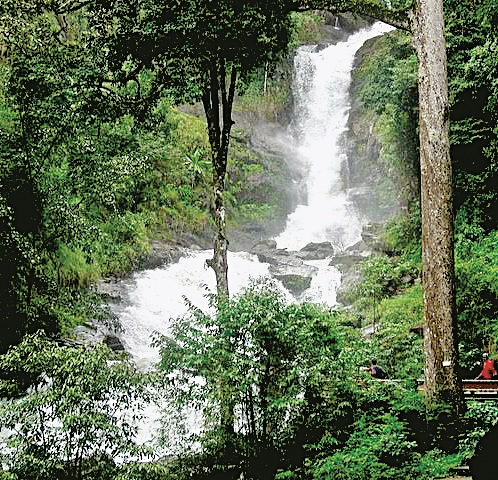
A fresh water cascade, the Irupu comes to life during the heavy downpour that is so common in these hilly ranges. This (also called the Lakshman Tirtha Falls) is situated on the highway to Nagarhole and just 20 kilometers away from the National Park. One has to walk at least half a mile to reach this place which is in the midst of a forest and far away from the cacophony of urban life.
Enjoying the sounds of the serene hill ranges and the gushing foamy waters, one can relax and forget all about urban stress. The roaring sound of the falls can be heard from a distance as one walks on the rocky twisting pathway with the chirping birds and the lush forests for company.
The pristine scenery resonates with the chirping of birds one has never heard before. The falls criss-crossing the hills and the forests tumble down from a height of just 150-200 feet while the spray of the gushing waters during monsoons is so intense that one can get easily wet. However, it is not safe to venture into the waters as the currents are strong. If you planned a visit before the monsoons, you can stand literally below the falls and get a soothing shower.
But do not miss visiting during the monsoons as Irupa falls from a cliff in all its mesmerising glory. If you are interested in visiting the nearby temple, you can take a peek as legends associate it with the visit of Ram and Lakshman when they were searching for Sita.
There are good spots to relax and enjoy, clean, wholesome vegetarian food but make it a point to place your orders in advance if you are visiting this place in a group. If you are carrying food and drinks, do not litter the place with plastic debris as it is a fragile ecology and home to many birds and animals.
Just two to three hours drive from Madikeri, one has to take the Virajpete route to reach this breathtaking place where the waterfall plunges from the Brahmagiri peaks in all its beauty and finally joins the Lakshman Teertha River. Since it is a very popular tourist spot, the place is easily accessible via tarred roads, concrete steps, viewing seats and affordable lodging and boarding facilities in and around the densely wooded ranges.
source: http://www.newindianexpress.com / The New Indian Express / Home> Cities> Bengaluru / by Meera Bharadwaj / July 30th, 2015
The then Deputy Commissioner of Kodagu, A. Bharath, had convened a meeting to discuss the revision of various privileges granted to the people of Kodagu.
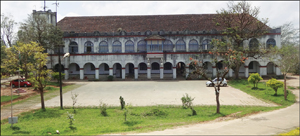
This important meeting was chaired by the then Revenue Minister B. Basavalingappa. The meeting was at the highly ornate meeting hall that was earlier a Palace, inside Madikeri Fort.
The Palace and the Fort were constructed by King Mudduraja in 1681 and renovated by King Lingarajendra Wadiyar II in 1813.
Myself and all the District Officers, political leaders and elite public were present at the meeting. As the subject was highly contested, people had assembled in large numbers and the hall was jam-packed.
The meeting started and DC Bharath introduced the subject and highlighted the objective of the meeting. He explained the need for the revision, as many of the privileges were outdated and were out of context. Afterwards, Revenue Minister Basavalingappa expressed the thinking of the Government and wanted the opinion of the public to facilitate issuing a revised order.
As the public were preparing to put forth their arguments, suddenly the Minister shot a question: “Who is the Divisional Forest Officer, Hunsur?”
I got up and after wishing him good morning Sir, introduced myself, ‘Sir, I am A.C. Lakshmana DFO Hunsur.’
Where is the land for rehabilitation of farmers from Nagarahole Wildlife Sanctuary? Where is the money for compensation? came the thundering questions from Basavalingappa.
I was surprised by the unexpected change in the topic of the meeting. By observing his anger, I could fathom his anger, at our proposal. We had proposed rehabilitation of nearly 1,000 people from Nagarahole, which he had rejected outright and ordered for eviction of farmers.
Most of these farmers were welcomed and settled under the “Grow more food campaign” of 1950s. They were granted suitable marshy wetlands in the forest for cultivation of paddy. At that time, there was an acute shortage of food in the country.
When I tried to support my proposals for rehabilitating the farmers in alternate lands and giving some incentives, he shot back: “Where is the land I say?”
I was stung by his pungent remarks but controlled myself. I explained that my predecessor Yellappa Reddy and Conservator of Forests B. Baliah had already earmarked 400 acres of forest land at a Northern corner of Thithimathi forest.
Not satisfied with my explanation, he put a stinging question: “Where is the money? You have asked for nearly Rs. 10 lakh as compensation.”
As government servants, we were never grilled in the public like this earlier by any Minister, and this was a strange situation I was facing.
He continued, “Do you pluck Rs.10 lakh from leaves of forest trees and distribute?”
I felt I am losing a good cause by being polite and submissive and if I do not defend now, the struggle for rehabilitation that was going on for the last six years will be lost forever.
I mustered all my courage and loudly blurted, “Sir, by rejecting our proposal, you are bringing discredit to Government of Karnataka.”
The packed assembly fell into pin-drop silence at this unexpected development. My heart started pounding hard.
Basavalingappa’s voice came piercing like a bullet, “Are you in your right senses while replying to a Minister?” he shouted in a thundering tone.
Me, a trusted blue-eyed boy of the forest department, felt being humiliated in the presence of public. I was defending the voiceless innocent animals and plants and supporting needy farmers. Suddenly, I felt that I should be vociferous and blurted back: “Sir, Karnataka government that was kind enough to release over 3000 acres to rehabilitate Tibetans nearby, if they say no to the local need for 400 acres, how can the Government get a good name?”
I paused for a moment and could see the Minister in a dilemma. I shot off a remedial answer, “Sir if I sell two rosewood trees from my division I can get Rs. 10 lakh. This investment is sufficient to keep all my animals, plants and the concerned farmers happy and at peace.”
The Minister was quick to order me to sit down. He added that we will discuss this matter in the DC’s chambers after this meeting. I felt he wanted to silence me.
I stood my ground firmly and said that as the matter is introduced here in public, it must be resolved here itself.
The Minister ordered in a raised tone, “Sit down.”
I politely disobeyed him and insisted, “Sir, you should solve the problem here and now.”
After seeing my stubbornness, he asked the DC to advise me. Bharath used his goodwill and friendship and cajoled me to sit. Reluctantly, I sat down and the regular meeting started.
After this meeting, we met at the DC’s chambers. The Minister shot another question, “How much of compensation have you recommended per family?”
I replied, “Rs. 5000, Sir.”
“Why have you asked only Rs. 5,000 per family?” asked the Minister; it was an awkward question to me.
I gave an awkward answer, “Sir, for asking Rs. 5,000 you scolded me that much, if I had asked for Rs.10,000 by mistake, you would have thrashed me in the meeting.”
Suppressing his anger and smile, he asked my name again. I replied, A.C. Lakshmana Sir.
Suddenly my stars and luck appeared to have changed, the Minister became cool and suggested that myself and the DC should meet him at Bangalore with a revised proposal.
The Minister could understand my strong support for wildlife sanctuary and the compulsion for supporting the farmers. It is the labour and sacrifice of such farmers that had made this country self-sufficient in food front during the “Grow more food” campaign of 1950s. [PS: Even now I have continued my relationship with these farmers rehabilitated at Channangi-Gudlur area of Thithimathi. Their suggestion is, we should have given 2.5 acres to each family.]
Now the farmers were sacrificing their three decades of hard work in favour of forest and wildlife conservation. The government was bound to support the farmers. After finishing the discussions, he shook hands with us and left for Bangalore.
Next day myself and the DC revised our recommendations increasing the compensation to Rs. 10,000 per family and took it to the Minster at Vidhana Soudha. We gave the letter to him at 11 am. A government order was issued and handed over to us by the Minister promptly by 4pm along with a cup of coffee. The coffee and the government order were both sweet and remained green with us.
Retrospectively, it is an interesting study. The Minister was close-fisted and conservative and hence might have rejected the recommendations for releasing the land and paying compensation. He was aggressive in expressing his displeasure openly at me, feeling that I am liberal or laxative in dolling out favours.
Once he was convinced that I was judicious, he had the conviction and greatness to revise his judgement. What is outstanding here is his statesmanship. The file went from Revenue to Forest and Finance and then back to Revenue and a government order issued in five hours.
I have the experience of working in the Secretariat as Secretary. I know the difficulties in taking quick decisions in an atmosphere where acts, rules, precedents, court orders, government orders bind the Secretariat staff and slows down the speed of disposal. In this backdrop, the administrative skill of Basavalingappa wins the admiration of every person.
After this memorable Madikeri incident, every time Basavalingappa passed through Hunsur, he used to send words for me and shared a cup of coffee at the PWD guest house. It was an everlasting friendly gesture on the part of Basavalingappa.
Basavalingappa left an indelible mark in whatever capacity he worked. Once when he was allotted a less known Environment and Ecology portfolio, as Minister he brought it to the forefront. He awakened the staff, officers, municipalities and industrialists about the need for a clean and green environment. He was a Minister five times and was always in an urgency to deliver.
Earlier, he was instrumental in bringing a legislation bringing dignity and hygiene to the pourakarmikas in Karnataka. It is a landmark legislation that other States and Government of India are struggling to copy. His vision and efficiency should be a model for everyone, particularly the politicians who are tending to be sloppy and lack vision. Basavalingappa fought aggressively for the upliftment of the deprived, downtrodden and socially backward people. He is called the ‘Ambedkar of Karnataka.’ This is the contribution of that firebrand Basavalingappa.
Good administration heaps plenty of benefits to society. The administration is a complex subject and is the result of good co-ordination and understanding between people involved in administration. Here the law of physics ‘Light travels in a straight line holds good.’ If anyone in the line has a dissent, the light will not pass through. This ends up in more correspondence, suspicion, delays and disappointments.
Here it is worth recalling the observation of a British officer who remarked as follows: The process of taking decisions in the Mysore Representatives during the rule of Rajarishi Nalwadi Krishnaraja Wadiyar, was summed “that the administration in Mysore is very good and can match the best administered States in the world. They discussed one subject yesterday at the Representative Assembly and orders are issued today.”
This efficiency is our heritage, let us revive the old glory and take Karnataka to be a model State not just in India but anywhere in the world. We should remember B. Basavalingappa and his valuable contributions to society.
[aclakshmana@yahoo.com]
Camp: New York
source: http://www.starofmysore.com / Star of Mysore / Home> Feature Articles / Sunday – July 05th, 2015
Mysuru-Kodagu MP Pratap Simha, who is also the member of Spices Board, has demanded setting up of a Spices Park in Kodagu district.
Pratap Simha, who was in Kashmir to attend the Spices Board meeting along with former Chief Minister and MP B.S. Yeddyurappa, urged the Board authorities to set up a Spices Park in Kodagu district, which is also famous for growing spices such as pepper and ginger apart from coffee.
Speaking to Star of Mysore, Pratap Simha said that Spices Board officials had agreed for a feasibility study and added that a team of officials would visit Kodagu in the coming days to conduct a study for setting up the Spices Park.
Setting up Spices Park in Kodagu would help pepper and ginger growers in Kodagu district and Cardamom growers in Sakaleshpur in Hassan to market and get good rates for their products, he added.
Our aim is to provide a sustainable market for the spices grown in this part of the region, he said and added that there is a proposal to start a Spices Park in Haveri which intends to provide a good market for chilli growers in the region.
But, for the growers to transport spices from Kodagu and Hassan districts to Haveri would be a problem and for that reason it was proposed to set up Spices Park in Kodagu, said Pratap Simha.
He said that the State Government has to provide 50 acre land for the Spices Park like it has been done in Haveri district.
Once the land is allotted, the work on Spices Park would commence after the proposal is approved by the Spices Board officials, Simha added.
Pratap Simha further said that issues pertaining to Saffron growers were also discussed during the meeting held yesterday in Srinagar.
He said that the Spices Board has decided to work towards providing assured market for Saffron within the country and also exporting the same throughout the world.
source: http://www.starofmysore.com / Star of Mysore / Home> General News / Thursday – July 02nd, 2015
The bacteria extracted grows in a minimal medium supplemented with petroleum crude oil (PCO) in sea water indicating that this is a halophile (organisms that thrive in high salt concentrations) and can be used effectively to clear oil spills in seas.
Mangaluru :
Can bacteria extracted from coffee pulp waste help clear oil spills? It can, says the team from NMAM Institute of Technology, Nitte which has won the Best Project Award for ‘Microbial Bioremediation of Effluents’ at the Joy of Engineering, Design and Innovation (Jed-i) project challenge.
The bacteria extracted grows in a minimal medium supplemented with petroleum crude oil (PCO) in sea water indicating that this is a halophile (organisms that thrive in high salt concentrations) and can be used effectively to clear oil spills in seas.
The team – Aparna K Mohan, Sandhya Kamath, Sanjana Chiplunkar and Shiny Martis B, all BE Biotechnology students of the college- won the challenge beating 19 other finalists which included teams from IITs and NITs. The annual challenge, conducted by Jed-i in partnership with the Indian Institute of Science (IISc), Bengaluru, is designed to identify and showcase the best final year engineering project.
Sanjana, one of the participants, said: “Actually, this was our mini project in the second year. When we got good results we continued with it. The bacteria (Brevibacterium sp. MTCC10313) was previously isolated from coffee pulp ad our seniors had done work and found out that it had caffeine degradation ability. Since it had ability we thought it could tolerate other stressful conditions, then we thought of this.”
Can this be implemented at ground level? “We built a bio-reactor with some waste water and we inoculated the bacteria and got the same results as we got in our lab. This will work in the real world,” she said.
The second place was won by the team of Pradyumna S V, Prateek R, Kunal A Mehta, Mohit Kumar Basu from Reva Institute Of Technology & Management for their project ‘Design, fabrication and Analysis of A Remotely Piloted Vehicle’ while the project ‘Robotic Wrist’ by team of Harish Pawar, Raghuveer Sarma M S, Amit Inamdar, Pooja Ambannavar, Priya Burlabaddi from B V Bhoomaraddi College of Engineering and Technology won a special mention.
source: http://www.timesofindia.indiatimes.com / The Times of India / Home> City> Mangaluru / by Stanley Pinto, TNN / June 25th, 2015
WELCOME. If you like what you see "SUBSCRIBE via EMAIL" to receive FREE regular UPDATES.
Read More »