Category Archives: Green Initiatives / Environment

Forest department says no to inter-state road

Kodagu Zone Chief Conservator of Forest Jagmohan Sharma has submitted a report to the State government that permission should not be given to proposed Ezhimal-Bengaluru inter-state road which would pass through Talacauvery Wildlife Sanctuary.

The proposed project (Ezhimal- Vellur- Padiyottuchal- Cherupuzha-Pulingome-Talacauvery) would pass through Mundrotu- Talacauvery- Bhagamandala, which is a part of the wildlife sanctuary known for biological diversity.

The officer, in his letter to the government on September 2, has said that the region is part of the Western Ghats, with evergreen forests and grasslands. The road construction, allowing public intervention would adversely affect the wildlife, and the government should reject the proposal of the Kerala government, the letter states.

Madikeri Division Deputy Conservator of Forest Shivashankar also opined the same. The road from Mundrotu to Talacauvery comes under Padinaalku Naadu reserve forest, where there is a rough stretch with a width of 7 to 10 feet.

To convert it as an inter-state road, it should be widened. In many places, new roads will have to be constructed between the mountains. It would impact the wildlife. Also, theft of trees would increase, the DCF has mentioned.

There is an alternative road to the proposed road already between Bhagamandala- Karike- Mundrotu. However, the only problem was that commuters would have to travel 39 km more than the proposed plan. Just to cut the distance, it was not fair to construct an inter-state road, which would cause danger to the ecology, he has opined.

Speaking to Deccan Herald, Shivashankar said that the report was submitted by DCF Hanumanthappa to the government before his transfer from the district.
DH News Service

source: http://www.deccanherald.com / Deccan Herald / Home> District / by Shrikanta Kallammanavar / Madikeri – DHNS, December 08th, 2014

Bethri project awaits Madikeri CMC approval

Karnataka Urban Water Supply and Drainage Board has prepared a report on Bethri water project to supply water from river Cauvery to Madikeri. The report has been sent to the Madikeri CMC for approval.

Bethri project was used for political purpose for the last several years. To take up the work on detailed project report for the Bethri project, the council nod is essential. As a result, the project is likely to be discussed in the CMC meeting on November 25. At present, Congress is ruling the CMC. Out of 23 members, the Congress has 10, BJP—8, SDPI—4 and JD(S)—1 members.

About project

River Cauvery takes its birth in Talacauvery situated on the foothills of Brahmagiri. From Bhagamandala, it flows to Bethri-Siddapura-Kushalnagar before reaching Mysuru. Bethri is situated 22-km from Madikeri. Supplying water from Bethri to Madikeri is the project. The project also aims at supplying water to eight villages including Kaggodlu, Biligeri, Badaga, Moornadu, Hakathuru, and Mekeri. Karnataka Urban Water Supply and Drainage Board engineers will prepared a detailed project report.

Estimate

According to sources, the project was initiated when Gundurao was the Chief Minister. The estimated cost of the project was Rs 1.23 crore. The estimated cost escalated to Rs 15 crore when S M Krishna was the chief minister. Inspite of it, the project never took off. Neither the coalition government nor the BJP government showed any interest in the implementation of Bethri project. Demanding the implementation of the project, Congress had staged a protest several times in the past. However, the BJP members in the council never allowed them to implement the project.

The BJP government gave nod for the Kundamestri project in 2010. With the Congress government in the State, the project has once again come to limelight. In fact, during his visit to Bethri, Urban Development Minister Vinay Kumar Sorake had promised to start the project and had directed Karnataka Urban Water Supply and Drainage Board engineer prepare a DPR. It is estimated that the project cost would be Rs 155.65 crore. Of which, 60 per cent of the share will be borne by the State government (Rs 93.39 crore), 30 per cent as loan from financial institutions (Rs 46.69 crore) and 10 per cent by the local body (Rs 15.56 crore).

source: http://www.deccanherald.com / Deccan Herald / Home> District / by Srikanth Kallammanavar / Madikeri – November 23rd, 2014

Kasturirangan report on ESZ: Public hearing in Madikeri tomorrow

Madikeri :

The State-level Expert team will be visiting Madikeri tomorrow to hold a public meeting with respect to the Kasturirangan Report, which recommends declaring 53 villages in Kodagu district as Eco-Sensitive Zones (ESZs).

The meeting is scheduled to be held at the Fort Mini Hall at the DC’s office at 3 pm.

There has been a wide range of protests by people of Kodagu and organisations demanding the State Government not to consider the Kasturirangan Report. The team is visiting Madikeri to hear public grievances on the issue.

Meanwhile, a few organisations under the banner of Kasturirangan Varadi Virodi Samithi have also planned to stage protests tomorrow.

Deputy Commissioner Anurag Tiwari said that it was an opportunity for the public to put forward their objections before the team. He added that the video recording of the meeting would be sent to State Government.

Tiwari has urged the people to maintain peace during the meeting and added that security would be beefed up around the meeting venue.

Kasturirangan Report also recommends for prohibition of mining and industrialisation, ban on chemical fertilisers and control over development works in areas declared as ESZs.

source: http://www.starofmysore.com / Star of Mysore / Home> General News / December 03, 2014

Expert panel to arrive at Madikeri today

Kasturirangan Varadi Horata Samiti Member Cheranda Nanda Subbaiah called upon people of Kodagu district to arrive at large number to express their opposition to Kasturirangan report, during the visit of State-level expert panel members, at Fort premises in Madikeri on Friday.

Speaking at a press conference here on Thursday, he said: “The people of the district should stop the recommendations of Kasturirangan report from implementing as it is question of our future generation. The draft published by the Central government is completely anti-people. Members of the various organisations and general public should express their objections before the expert panel members,” he said.

“The recomendation is made to identify Western Ghat and 10 km of nearby area as ecologically sensitive areas and ban mining and other activities in the region. So, opposing the reporting is our necessity and need of the hour. We have do demand to keep residential areas, farm land, coffee plantations, Devarakaadu areas of tribal out of the ecologically sensitive area. If we don’t get positive response from government’s side, we will continue our protest,” he said.

If they declare ecologically sensitive areas, C and D land, Baane lands will be declared as deemed forest. Buffer zones will also be declared. Later, where is the land for people for living? he questioned. The people of the district have same opinion about the Kasturirangan report and the government can not implement the recommendations of the report against public opinion. People from every village will come to Madikeri to submit their objection, he added.

Committee Member Bottangady Raju said that panel should make changes in the demands submitted by the people.

Ready to share woes

Various political party leaders and heads of organisations would submit memorandums to the panel members who will collect opinions of people who live in the areas which come under ecologically sensitive areas. Along with Kasturirangan Varadi Virodhi Horata Samiti, Congress, BJP and JD(S) leaders, MP Pratap Simha, MLA K G Bhopaiah, Appachu Ranjan, Zilla Panchayat President Shareen Subbaiah and many others will submit memorandums.

Congress District President B T Pradeep said that no development work can be started in 53 villages which would come under ecologically sensitive areas. It would make life hazardous for the people. JD(S) District President V P Shashidhar said that similar protest was conducted against Kasturirangan report at Kerala and the Central government had to drop many places from the list.

Concession should be given in Kodagu also. We will give a memorandum to the expert panel, he said.

DH News Service

source: http://www.deccanherald.com / Deccan Herald / Home> District / Madikeri, DHNS – November 27th, 2014

‘Submit report on ESAs by Nov 24’

MadkeriKF22nov2014

The High level Working Group of Western Ghats (HLWG) has identified 1,576 villages in Karnataka as Ecologically Sensitive Areas (ESA). Of which, 53 villages have been included in Kodagu district. Additional DC Abhiram G Shankar and DCF Manikanta have directed the officials from Forest and Revenue departments to submit the report on ESAs after conducting a survey by November 24.

Speaking at a training for the officials on Monday, the Additional DC said that the officials should visit the identified villages and submit a report. After compiling the reports submitted by the officials, a detailed report will be sent to the State government.

Teams have been constituted to identify natural landscapes. The district level committee will have DC and forest officials as its members, while the village level committee will have officials from revenue, forest and gram panchayat president as its members. The public and NGOs can give their representation on ESAs to the district level committee.

The Additional DC said, if need be, the survey would be undertaken after consulting Horticulture and Agriculture departments.

Villages
The villages identified as ESAs are Ayyangeri, Bettathooru, Bhagamandala, Chelavara, Cherangala, Galibeedu, Hammiyala, Kalooru, Karada, Karike, Kolagadalu, Kopatti, Kundachery, Made, Melchembu, Monnangeri, Mukkodlu, Naladi, Peroor, Sampaje, Sannapolikotu, Tannimani and Yavakapady in Madikeri taluk; Aanekadu, Athoor forest, Bageri forest, Jainkalabetta, Yadavanadu, Jainkalabetta 2, Kattepura, Kumaralli, Maralli, Malambi, Mavinahalla, Mulluru, Nidta, Soorlabbu and Yadavanadu forest -2 in Somwarpet taluk and Arekeri forest-1, Arekere forest-3, Badaga, Badagarakeri, Chennayana Kote, Devamacchi forest, Devanooru Hathugattu, Teggalli, Karadigodu, Kedamullur, Kurchi, Kutta, Kuttandi, Maldare, Manchalli, Nalakeri forest, Palangala forest, Parakattageri and Badaga in Virajpet taluk.

source: http://www.deccanherald.com / Deccan Herald / Home> District / Madikeri – DHNS, November 11th, 2014

‘Coffee plantation in Kodagu can not be considered as deemed forest’

Kodagu Circle Chief Conservator of Forest Jagmohan Varma has clarified that coffee plantation in Kodagu can not be considered as deemed forest. This is based on the government’s order that plantation in private property should not be considered as deemed forest.

Speaking to Deccan Herald, the officer said that the process of identifying deemed forest is under progress in the district, in the backdrop of the Supreme Court and State government’s order.

It is a common notion that a land with features of forest is deemed forest. But, as per the government order dated May 15, 2014, private plantation with any number of forest will not be considered as deemed forest. Therefore, there is no reason for coffee, cardamom, pepper and rubber planters to worry about, he assured.

Private forest

Explaining the word ‘private forest’ as defined in the government order, the Chief Conservator of Forest said that private forest is the land comprising of more than 50 trees per hectare land and each tree with a width of more than 30 cm. “The forest department along with revenue department is collecting details about private forests in the district. A district-level meeting chaired by Deputy Commissioner Anurag Tewari too has been convened. Village level inspection will be carried out soon,” he said.

Further, Jagmohan Varma said that the State government’s order describes a wide range of forests that exist in Kodagu, including Forest-Paisari which is considered as forest land.

According to Coorg Land and Revenue Regulation 1899, Section 143, Sub Section (1) (F), Forest-Paisari land has been notified as forest in 1901. Therefore, the recent order too considers Forest-Paisari as forest land.

The land that is mentioned as forest in government documents, will be considered as deemed forest. The government has given the instruction to all district administration to submit a detailed report on deemed forest in every district, within May 15.

What is deemed forest?

Deemed forest is the private and paisari land with forest like features. The Supreme Court while hearing Godavarman Thirumalapad case in 1995, had directed all the States to collect information about deemed forest. Following the order, the State government polled information about forest land and deemed forest.

However, the survey was not concrete, as the deemed forest list also comprised of paisari and empty (khulla) land and details like survey number and map too was not appropriate.

Therefore, re-survey has been taken up to prepare a comprehensive report on deemed forest in the State.
DH News Service

source: http://www.deccanherald.com / Deccan Herald / Home> District / by Shrikanth Kallammanavar / Madikeri – DHNS, November 06th, 2014

Union Forests Ministry approves Kushalnagar–Madikeri rail line survey

UnionForestsKF15nov2014
With this, Mysore–Madikeri project has taken a step forward

The Mysore–Madikeri railway line project has taken a step forward with the Ministry of Environment and Forests (MoEF) issuing clearance for the survey work between Kushalnagar and Madikeri.

Meeting
This was disclosed by Railway officials at the Divisional Railway Users’ Consultative Committee meeting here on Wednesday.

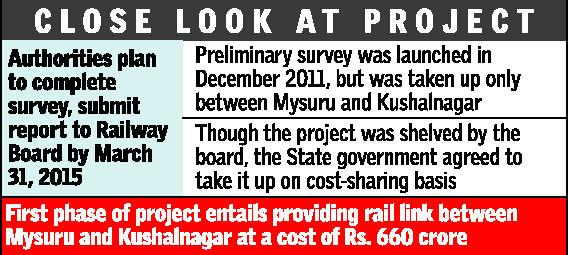
The environmental clearance was received last week and the authorities plan to complete the survey and submit the report to the Railway Board by March 31, 2015.

The preliminary engineering-cum-traffic survey for the railway line was launched in December 2011, but was taken up only between Mysuru and Kushalnagar and the partial survey report was submitted to the Railway Board. Though the project was shelved by the Railway Board on grounds of being commercially unviable, the State government has evinced interest in the project and has agreed to take it up on a cost-sharing basis, apart from providing land to the Railways.

The first phase of the project entails providing railway link between Mysuru and Kushalnagar at a cost of Rs. 660 crore. It will also connect Hunsur and Periyapatna.

Interestingly, the project was included in the Railway Budget 2010–11 under the ‘socially desirable rail connectivity’.

The first proposal for providing a rail link between Mysuru and Madikeri was mooted in 1881-82, according to the Mysore Gazetteer.

Another project

On the Shivamogga–Harihar railway line project, it was pointed out that the detailed survey for the new broad-gauge line had been completed. The 76-km project is expected to cost Rs. 832 crore and will be taken up on a cost-sharing basis between the Railways and the State government. Though the Railway authorities had sought 1,000 acres of land, it is yet to be acquired.

The work can commence, provided the State government hands over adequate land to take up the work on at least a 40-km stretch, according to the officials.

Divisional Railway Manager Rajkumar Lal, Senior Divisional Commercial Manager Anil Kumar, senior officials of different departments from the Railways, and stakeholders from various districts coming under the Mysore Railway Division were present.

source: http://www.thehindu.com / The Hindu / Home> News> National> Karnataka / by R. Krishna Kumar / Mysuru – November 06th, 2014

MoEF gives clearance for Kushalnagar-Madikeri railway line survey

The Mysore-Madikeri railway line project has inched a step forward with the Ministry of Environment and Forests (MoEF) issuing clearance for the survey work between Kushalanagar and Madikeri.

This was disclosed by the railway officials at the Divisional level Rail Users Consultative Committee meeting on Wednesday. The environmental clearance was received last week and the authorities plan to complete the survey and submit the report to the Railway Board by March 31st, 2015.

The preliminary engineering-cum-traffic survey for the proposed railway line was launched in December 2011 but was taken up only between Mysore to Kushalnagar and the partial survey report was submitted to the Railway Board. Though the project was shelved by the Railway Board on grounds of commercial unviability, the State Government has evinced interest in the project and has agreed to take it up on a cost-sharing basis apart from providing land to the railways.

The first phase of the project entails providing railway link between Mysore and Kushanlagar at a cost of Rs.660 crore and would also connect Hunsur and Periyapatana.

Interestingly, the project was included in the Railway Budget 2010-11 under the socially desirable rail connectivity and the first proposal for providing a rail link between Mysore and Madikeri was mooted in 1881-82, according to the Mysore Gazetteer.

Divisional Railway Manager Mr. Rajkumar Lal, Senior Divisional Commercial Manager Mr.Anil Kumar, senior officials of different departments from the Railways, stakeholders from various districts coming under Mysore Railway Division were present.

source: http://www.thehindu.com / The Hindu / Home> News> National> Karnataka / by R. Krishna Kumar / Mysuru – November 05th, 2014

Karnataka nixes Kerala plan for road via Kodagu forests

Madikeri :

The Karnataka forest department has turned down a Kerala government proposal to build a road through Kodagu forests for a smoother access to Bangalore.

The decision was taken based on a report submitted by the Kodagu wildlife division’s deputy conservator of forests.

It’s learnt that the Kerala chief minister had sent in a letter to his Karnataka counterpart, suggesting carving out a road through Mundrotu forests near Talacauvery in the district. In the letter, Oommen Chandy said the distance from Kerala’s Ezhimala in Kannur district to Bangalore through Talacauvery is 376 km, and wanted a 16km stretch from the state boundary to Talacauvery for a comfortable journey.

Some 43km stretch of the road is in Kerala and the rest in Karnataka.

The Kodagu wildlife division sent in a report to its headquarters, saying construction of a road through the forests was not desirable as Mundrot forests were home to many wildlife species. Of the planned 16km road, at least 8km stretch was to scythe through the reserve forest, presenting hunters and smugglers a chance to poach trees like rosewood, nandi and jackfruit, among many others.

The Karnataka forest department nixed the proposal and communicated it to the Kerala chief minister, it’s learnt.

source: http://www.timesofindia.indiatimes.com / The Times of India / Home> City> Bangalore> Namma Metro / TNN / October 31st, 2014

A purposeless power-line via Kodagu to Kerala

‘A case of spending money to benefit contractor, bureaucracy and politicians’

The following is the text of a talk delivered by Maj. Gen. S.G. Vombatkere (Retd.) at a meeting held at Kodava Samaja, Ponnampet, South Kodagu, on Tuesday, 21st Oct. 2014.

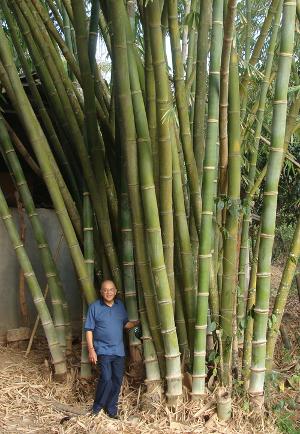
MajGenVombatkereKF02nov2014

by Maj. Gen. S.G. Vombatkere (Retd.)

Sri S. Gopal, dignitaries on the dais, Members of Kaveri Sene and Coorg Wildlife Society, and members of the august audience, I thank you for giving me this opportunity to say a few words about the 400 KV Double Circuit (D/C) HT line connecting Mysore with Kozhikode.

The 210-km 400 KV Double Circuit HT line connecting Mysore with Kozhikode is under construction by Power Grid Corporation of India Limited (PGCIL). It is said to be required to evacuate electric power generated by Kaiga Nuclear Power Station to supply North Kerala.

PGCIL claims that of 210-km, about 92-km in Kerala’s Wayanad District and about 63-km in Mysore District is completed, and 55-km through Kodagu District remains to be constructed. This “remaining” portion in Kodagu District is being opposed by the people of Kodagu, spearheaded by Kaveri Sene and Coorg Wildlife Society on grounds of environmental destruction that will adversely affect the Kaveri watershed which is the source of life-giving water to Karnataka and Tamil Nadu.

Also it will ruin coffee plantations due to tree-felling and intensify the human-animal conflict especially related to elephants, which is already claiming human lives in Kodagu. The objections of the Kodava people to this project are not new, but are several years old. I will speak on this issue and ask some questions concerning technical, environmental and governance matters.

Technical questions

Let us first examine whether this 400KV HT line is at all required. As on date, there are seven HT lines supplying power to Kerala, five from Tamil Nadu and two from Karnataka. These seven lines have a total capacity of 3,000 MW while the share of Kerala from the national grid is only 1,000 MW. Further, although the energy share of Kerala from the national grid is 9,350 Million Units (MU), Kerala is drawing about 11,350 MU from the existing seven HT lines. This shows that the existing seven HT lines are more than adequate for Kerala’s power needs from the national grid, and the proposed 400KV D/C HT line is not at all required.

Thus the question arises as to why PGCIL has constructed 155-km when the project is not necessary and also when the 55-km segment within Kodagu District is facing objections from the people of Kodagu. The environmental and social costs of the project have obviously not been taken into account.

Karnataka State officials have deposed before the National Green Tribunal (NGT), stating that the objections of Gram Sabhas are “belated,” “motivated” and are an “after-thought.” These statements are uncalled for, and show the dismissive attitude of officials towards simple people. The objections may be “belated” because village people did not get to know about the PGCIL project earlier. And if the village people are “motivated” in objecting to the project, their motivation is in preserving the environment which is a vital watershed for South India, saving their own coffee plantations which are their livelihood, and trying to mitigate the growing human-elephant conflicts. Thus, the question arises as to why our own officials have this attitude towards projects.

The 90-paise “disease”

The fact is that even though all officials are not corrupt, many officials are interested in getting large projects sanctioned and executed because a good portion of every rupee of public money spent does not go towards the project work but gets diverted into private pockets. When Rajiv Gandhi was the PM, he had estimated that 80-paise in the rupee went astray. Now, decades later 90-paise, possibly more, would be seen vanishing if an honest, transparent audit were to be made. When a project is estimated at Rs. X crores, X-crore 90-paise portions vanish. Some people indelicately refer to such standard practice as corruption. But if at least the project was a genuine requirement and was executed with quality and in time, one could still wink at the corrup… oops, sorry, the vanishing 90-paise. And this 400KV HT line is an unnecessary project as has been shown earlier.

Environment and Governance

The felling of trees in forest areas and in coffee plantations is harmful to the environment. PGCIL argues that felling a “mere” few thousand trees may not harm the environment. But this argument fails to address the cumulative effect of felling trees for different projects of roads, HT power lines, etc., in the Western Ghats which is an “eco-sensitive hot-spot” in India and even in the international context.

The Ministry of Environment, Forests and Wildlife (MoEFW) is busy giving clearances to any and every project and weakening the Environment Protection Act. When Article 48A of the Constitution reads, “The State shall endeavour to protect and improve the environment and to safeguard the forests and wildlife,” this attitude of MoEFW is condemnable.

The cumulative effect of this deforestation, especially in special regions like the Western Ghats and in particular Kodagu, is not at all a consideration for MoEFW, in the country’s mindless rush towards industrialisation at the cost of environmental destruction.

Kodagu District is special in two ways. One, its famed soldiers protect our country as a fundamental duty, in accordance with Article 51A(d), to defend the country. And two, its people are saving the source and vital watershed of Kaveri, and performing their fundamental constitutional duty “to protect and improve the natural environment including forests, lakes, rivers and wildlife” in accordance with Article 51A(g), doing what MoEFW should be doing but is actually doing the opposite. For all this, we all need to salute the people of Kodagu.

When the State, consisting of the Executive, the Legislative and the Judiciary, fails the People, the people have to resist and uphold the Constitution of India. In opposing this 400 KV Double Circuit HT line, we are performing our fundamental constitutional duty. Let us join together to do our duty!

Jai Hind!

source: http://www.starofmysore.com / Star of Mysore / Home> Feature Articles / Tuesday, October 28th, 2014