‘Team comprising police, reps from ULBs to keep tab on use of plastic’
Kodagu Deputy Commissioner Anurag Tiwari has issued an order banning the use of plastic bags and plastic cups with thickness of less than 40 microns that harm the environment.
He has instructed the police department and officials of urban local bodies to impose penalty to those who violate the rules by using the plastic bags of less than 40 microns in any part of the district.
In his order dated March 15, the Deputy Commissioner who is also the Chairman of the District Tourism Development Committee has said that the Kodagu district has sensitive environment and it is inevitable to ban the use of plastic bags to protect the environment.
Further, he has stated that the decision has been taken considering the Environment Protection Act 1986, Wildlife Protection Act 1972, the notification of the Environment and Forest Ministry of the Government of India dated February 4, 2011 and the notification of Karnataka Government dated October 20, 2010.
“A team of officials including those from police department and urban local bodies will be formed to keep a tab on the use of plastic usage. The team will pay surprise visits to shops and inspect them. Plastic bags if found will be seized and shop owners will be penalised,” Tourism Department Assistant Director Phanish has said.
He stressed that the first priority of the district administration is to control the sale of plastic bags.
The team will raid the shops based on suspicion and the team is expected to be formed after Lok Sabha elections.
As a large number of tourists visit Kodagu, instruction boards about the plastic ban will be placed in the entry points of the district. Tourist vehicles will be inspected and plastic bags if found, will be seized, he said.
It could be recalled that the use of plastic plates and cups was completely banned during the Akhila Bharatha 80th Kannada Sahitya Sammelana held at Madikeri in January. The initiative had received overwhelming response from people.
source: http://www.deccanherald.com / Deccan Herald / Home> District / by Srikanth Kallammanavar / DHNS – Madikeri, March 27th, 2014
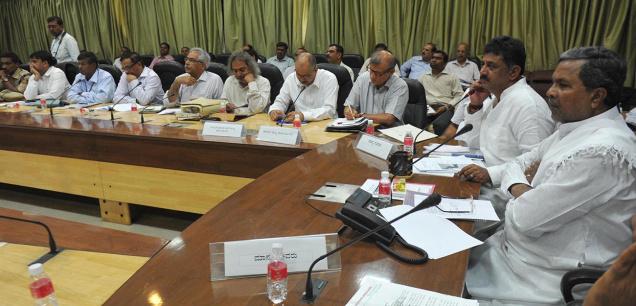
Chief Minister Siddaramaiah and Energy Minister D.K. Shivakumar at a meeting to discuss the power line project, in Bangalore on Tuesday /. Photo: Sampath Kumar G.P. / The Hindu
Expert panel to submit report in 15 days
Chief Minister Siddaramaiah has decided to constitute an experts’ committee to examine alternative possibilities to drawing a high-tension power line from the Kaiga nuclear power plant to Kerala through the catchment area of a tributary of the Cauvery in Kodagu.
The decision comes in the wake of prominent people from Kodagu opposing the project in its present form.
The proposed committee, to be headed by an expert from the Central Power Research Institute, will be given 15 days to look into the concerns of people of Kodagu and submit a report.
An assurance was given by the Chief Minister to legislators and environmental activists from Kodagu who met him at his home office here to seek a change in the route of the proposed power line pass, in public interest.
Coorg Wildlife Society president Col. C.P. Muthanna (retd.), who was part of the delegation that had more than a hour’s discussion with the Chief Minister, told reporters that the proposed committee would comprise wildlife ecologist R. Sukumar, Principal Chief Conservator of Forests, and water expert Rajendra Singh.
He alleged that the project, to be implemented by Power Grid Corporation of India Ltd., would result in devastation of 156 hectares of coffee estate and 104 hectares of paddy cultivation area near Virajpet besides 23 hectares of forests. “The area through which the proposed line is to pass has such a thick green cover that each acre of coffee plantation has 350 fully grown trees,” he said, and expressed concern that nearly 53,000 trees would have to be felled if the power line route was not changed.
He said that leaders from Kodagu had suggested that the power line be drawn underground through the “forest fire line” that runs for 23 km. This would also reduce the length of the power line, he said.
The Chief Minister assured the delegation of taking up the issue again for discussion after the experts’ committee submits its report, he said.
The former Speaker K.G. Bopaiah, MLA Appachu Ranjan and MLC M.C. Nanaiah were part of the delegation.
source: http://www.thehindu.com / The Hindu / Home> News> National> Karnataka / by Special Correspondent / Bangalore – April 30th, 2014
The works on a temporary project to supply water from Kundamestri is nearing completion. The water from Kundamestri is likely to be supplied to the citizens of Madikeri by the week end.
Sand bunds have been laid to store water. The collected water will be supplied to Kootuhole through pipes. After filtering the water at a Filter house at Stuart Hill, water will be supplied to the citizens.
Madikeri reels under water crisis every year, during summer. The works on Kundamestri project was initiated to mitigate the water crisis. However, owing to delay in release of funds, the works could not be completed. Now, the estimated cost of the project has escalated.
The Kundamestri project is being implemented by the Karnataka Water Supply and Sewage Board (KWSSB). It will take another year to complete the works.
KWSSB Executive Engineer Balachandra expressed confidence of completing the works soon. “The project has been taken up, keeping in mind the development of Madikeri in the next 50 years. When the water level declines in Kootuhole, water will be supplied from Kundamestri to Kootuhole,” he said.
source: http://www.deccanherald.com / Deccan Herald / Home> District / by Srikanth Kallammanavar / Madikeri – DHNS, April 27th, 2014
Senior scientist and expert on apple cultivation from Himachal Pradesh Dr Chiranjit Parmar expressed confidence that in Karnataka, especially Kodagu, apple cultivation will be successful as the weather here is suitable.
Parmar, who was on a State tour, told reporters here on Monday that efforts are on to grow apples in Tumkur, Bangalore, Uppinanagady in Dakshina Kannada and Somwarpet in Kodagu.
He said Karnataka is better than Himachal Pradesh for apples as the growers here will get the yield twice a year compared to the northern state where it is once a year due to snow.
“Since three years, efforts are on to grow apples in Karnataka and it has been successful as the weather is conducive,” he said.
Parmar tasted the apples grown in Sulimlathe of Abbukatte in Somwarpet in the district.
Apple growers of Kodagu C R Shivakumar and Krishna Shetty of Uppinangady accompanied Parmar during his tour.
source: http://www.newindianexpress.com / The New Indian Express / Home> States> Karnataka / by Express News Service – Madikeri / April 22nd, 2014
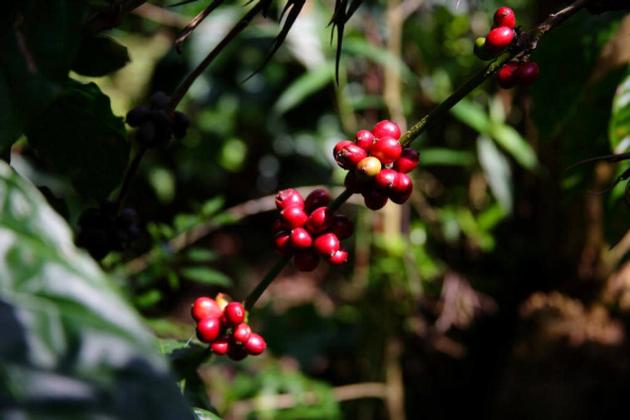
Coorg is all about coffee./ by Special Arrangement / The Hindu
Celebrating the bliss of Coorg with all its splendour
Kodaimelanadu or Kodagu or Coorg: the name itself conjures up images of verdure — gushing cascades, babbling brooks, green hills, gorgeous dales, gurgling rivers all together flaunting the munificence of Mother Nature. Oh! Add some coffee plantations. A compulsive coffee drinker like me cannot find a better place than Coorg for a sip of delight. After an hour’s drive from Mysore, our chauffer announces that we are entering Coorg.
The scenery is mesmerising. The winding roads take you through a maze of greenery. At every labyrinth, you meet a collage of colours which explode into shades of green, brown and yellow. The roads seem to have no particular destination. They just lead you from one part of paradise to another. As we squint though the green fabric, we pass plantations of coffee, cardamom and pepper which merge with forests, foliage and fauna. There are no villages, no people, no shops, and no cars. We deliberately slow down to take in the moment. It is an ode to nature. No wonder it has been attributed the sobriquet ‘Scotland of the East’.
Coorg is all about coffee with a fair amount of cardamom and pepper thrown in. As we drive in, the sylvan surroundings hit us. Our destination is Siddapur. After following the Orange County signage the car finally enters the resort. After a short break, we decide to take a tour of this secluded paradise. The whole district seems a tree shadowed coffee estate, dotted with a few market places with speedy bars, pork shops and elegant vegetable displays.
As we travel, we learn more about coffee: its history, its getting smuggled into India and the difference between arabica and robusta. There is an overwhelming feeling of seclusion. From a distance you can spot a coffee pod, but it is difficult to spot your immediate neighbour. All this time, I am in a clicking frenzy to capture the intricacies of nature.
Coorg is a paradise for bird-watchers and accounts for nearly 25 per cent of the avian population of the State. Our guide announces the names of each and every bird. At times he replies to their calls in a simulated tone. After spending a few hours, trying to know the avian diversity of Coorg, we head towards the splendid Abbey Falls. Tucked away between private coffee and spice estates, Abbey Falls offers a splendid backdrop for a weekend picnic. As one makes one’s way past stocky coffee bushes and tall trees entwined with pepper vines, the falls make a sudden and dramatic appearance as they cascade down into limpid pools to join the river Kaveri. A combination of unprecedented rain the previous night and the steep path make the trek difficult. An army of clouds envelopes the hill, a sight worth beholding.
I try out some Kodava food on my way back to the resort. The central dish of Kodava cuisine is meat, with a fine underpinning of rice. I taste the irresistible pandi curry, a subtle pork dish, cooked well by adding a local fruit, Kanchampali. This mouth-watering dish represents the specialness of Kadava dishes and is hard to find outside Coorg. The dry spices are roasted before grinding them, giving a toasty flavour to the thick curry. I return to my luxurious cottage after having a refreshing tour of the place. It is dark now, and the sky is clear. I step out of my room and walk towards the woods, on a stretch of road with no artificial light. The moon shines brightly and the trees are laden with millions of fireflies; the woods seem decked up for some fat Indian wedding.
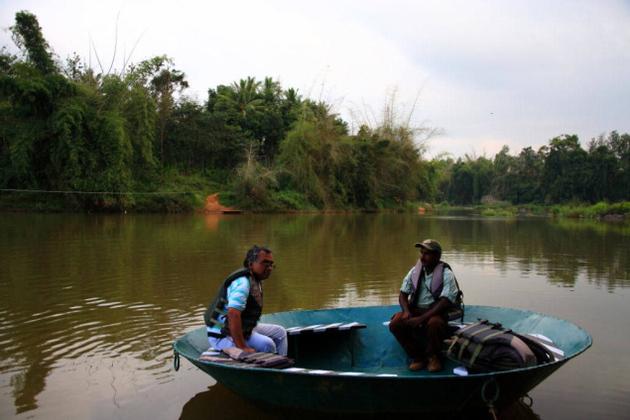
This is my first trip to the Western Ghats, and I very enthusiastic to discover them. Next day, at six in the morning, I spring from my bed to go deeper into the mist laden, verdant hills. Murthy, our guide ushers us through a forest which abuts the resort. It is Dubare Reserve which encompasses an area of 50,000 acres — the home of the pachyderms. Majestic rosewood, teak and other hardwood tree species stand around us like sentinels. Giant parasitic vines (that uncannily resemble monstrous creatures) are swathed around large banyan and other trees in a macabre bond. The forest keeps getting thicker and more enchanting. Walking fearlessly in the forest, brushing against the small vines and lopping branches out of the way, eyes constantly hovering to spot any wild animal, marking the footmarks of the elephants — turns out to be the most enchanting leg of the trip. The coracle drifts on the green waters, gauging the moods of the river and the pristine surroundings. / by Special Arrangement / The Hindu
We walk down to the Kaveri, the river flowing unmindful of the inter-State row over her waters. We take our seats on a coracle, to drift on the green waters, gauging the moods of the river and the pristine surroundings. “Sir, apart from this beauty, Coorg is gifted with a very rich history,” says our guide, adding, “The British gifted coffee to Coorg. The first estate was established way back in the 1850s by an Englishman John Frawler. Along with coffee, pepper abounds here, growing as a vine allowed to climb the shade trees. Coorg pepper is considered to be the best in the world, sir.”
He then tells us about the invincible Kodava people. “Coorgis are said to be descendents of the Greeks. Neither Tipu Sultan, nor the British could conquer this land.”
Coorg has a long history of battles. The Madikeri Fort is a living testimony to that. Built first as a mud fort by Mudduraja in the last quarter of the 17th century, it was later rebuilt in granite by Tipu Sultan who named the site Jaffarabad. In the North-east corner at the entrance are two life size masonry elephants, while a church stands in the south-east corner. The fort offers panoramic views of the city from its walls. The centuries-old Madikeri Fort with its stone ramparts also houses a prison. Among the other architectural treasures that Coorg boasts is the Omkareshwara temple built by king Lingaraja in 1820, in a mosque-like style, with an impressive central dome and four minarets, which are surrounded by Basavas, or sacred bulls. On the top of the dome sits a gilded ball with a weathercock.
Another splendid place to see is the Raja’s seat. It is a small pavilion with a garden surrounding it, offering a view of the green valley below. As the legend goes, the kings of Coorg spent their evenings here along with their consorts. The spectacular view from here of the melting sun, parrot-green fields and the far stretching mountains will take one’s breath away. We return to the Orange County Resort, a little break from this oasis of tranquillity. The last Kodava dinner by the lake under the bright sky is waiting for us: a luxurious setting created by candles, stars and sounds of silence. The next day I insert a packet of aroma rich Coorg Coffee in my luggage. As for the greenery, it is etched in my thoughts, to recollect in the days to come.
source: http://www.thehindu.com / The Hindu / Home> Features> MetroPlus> Travel / by Aakash Mehrotra / Delhi – April 20th, 2014
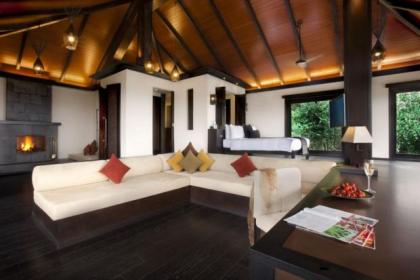
A dozen young women chatter as they furiously shear bright leaves from tea plants that stretch like a green carpet across the plantation. A room at Vivanta Hotels and Resorts By Taj, in Coorg, Karnataka, India
Their colourful saris and gold necklaces glisten in the sun as they fill huge brown sacks to be taken back to the on-site factory and weighed.
One lady even needs two burly men to help her lift the bag onto the scale, and I cannot help but gasp when the manager tells me that the sack weighs a whopping 80 kilograms.
In a time of technological advances, it’s hard to believe that such manual work goes into making a simple cup of tea.
But during a visit to the Glenlorna Tea Estate, in the heart of Coorg in southern India, I quickly discover that the old ways are definitely the best.
The fresh aroma of tea is overwhelming as I walk from room to room of the factory, where the tea leaves are dried, grounded and filtered ready for auction.
Tea plantations are a rare operation in Coorg, as production is mainly confined to the north of India because the weather conditions are better. But the importance of tea to Indian culture is evident no matter what part of the country you are in.
Visiting the nearby Cottabetta Bungalow, the first thing I am offered as I am greeted by the staff is a steaming pot of tea.
I have a new sense of appreciation for my brew after seeing the work that goes into my favourite beverage.
During a guided jeep tour of the plantations, I watch birds flutter between the 200-year-old trees that extend upwards from the dark coffee bushes that stretch for 1200 acres.
But it is a slight disappointment to learn from our guide that the luscious grounds cannot be explored on foot. He informs me that it’s for my own safety.
The region of Coorg is not the first choice for international tourists – particularly as it involves a treacherous seven-hour drive along heavily pot-holed roads from Bangalore airport.
But as I soak in the infinity pool at the Vivanta by Taj Hotel, I feel the knots in my muscles melt away while overlooking the rolling hills of the rainforest.
The resort has been open for less than a year and boasts 62 impressive cottages, which are dotted among the trees.
British rule in India may have ended in 1947 but its influences in the country have had a lasting impression – particularly with the introduction of tea as a popular choice of drink.
And after enjoying a fabulous stay in southern India, it’s safe to say the favour has been returned.
Knowing how much work and effort goes into creating the drink, I think I’ll appreciate my morning cuppa even more.
Cherry Wilson was a guest of Cox & Kings (www.coxandkings.co.uk) which has an 11-day/eight-night private trip to India priced from £1895 per person. This includes flights with BA, private transfers, a plantation and birdwatching tour, and accommodation with breakfast daily, including one night at the Taj Lands End, Mumbai, two nights at the Cottabetta Bungalow, three nights at the Vivanta by Taj Madikeri and one night at the Taj West End. For more info, visit www.tajhotels.com
source: http://www.eveningtimes.co.uk / Evening Times / Home> Lifestyle / Thursday – March 13th, 2014
EMPOWERED: Attending one of the seminars organised by IISR’s Cardamom Research Centre (CRC) at Appangala in Kodagu on spices cultivation was a turning point in Mrs. Prema Ganesh’s life./ Special Arrangement / The Hindu
Agriculture is no more a male dominated sector, as many women have shown that they are second to none in this field. “Women can be successful agriculturists, if they are supported with timely technological interventions by scientists and encouragement from family”, says Dr. M. Anandaraj, Director of the Indian Institute of Spices Research (IISR), Kozhikode.
Mrs. Prema Ganesh from Maragodu village, Kodagu District, Karnataka is a role model for other women in this field.
Several problems
When she ventured to take over her coffee and black pepper plantation in 10 hectares a decade ago, several problems started surfacing, especially the low productivity of crops, making agriculture a non profitable enterprise.Keen to overcome them, she happened to attend one of the seminars organised by IISR’s Cardamom Research Centre (CRC) at Appangala in Kodagu on spices cultivation.“It was a turning point in my life,” recollects Ms Ganesh.
The scientists at CRC assured full technological support to her ventures. A team from CRC visited her plantation and identified some major production constraints such as high plant density per unit area, prevalence of diseases and pests, problems like spike shedding in black pepper etc.They provided a complete package of practices to be followed including thinning of excess plant growth to maintain optimum spacing among them, adoption of basin management techniques like application of organic manures, micronutrient application, earthing up and mulching for various crops.“In the case of black pepper, special recommendations like basin irrigation at the rate of 40-50 litres of water at 4-5 times per vine at an interval of 5-7 days during May-June in case of delayed monsoon, regulation of shade by pruning the support trees to provide minimum 50-60 per cent exposure to sunlight were suggested,” says Dr. S J Ankegowda, Head, CRC, AppangalaFor diseases and pests, spraying of two rounds of Bordeaux during June and August/September and one round of drenching with 0.2 per cent Copper Oxy Chloride (COC), and need based application of insecticides were also recommended.Trees like balangi, palawan and silver oak were planted at a spacing of 15×15 feet (random) to provide adequate shade to the crops.In addition she readied several rainwater harvesting pits of 10 feet length, 1.5 feet width and 1.5 feet depth between the coffee plants.These pits also serve as compost pits where all the farm wastes are dumped for two years to decompose after which they are removed and applied as organic manure to coffee and pepper, substantially reducing the cost on purchase of farm yard manure.
Composed husks
Ms. Ganesh makes use of composed coffee cherry husk, a by-product of coffee pulping, after mixing with cow dung as an additional source of organic manure.Annually she spends Rs. 35,000 per acre as operational cost and gets about Rs. 25 lakhs a year as net income from both black pepper and coffee. Reducing manual labour was an important initiative by her.“First thing they did was to lay motorable roads inside the plantation. This has reduced the strain in carrying the harvested produce in bags by labourers.Before the roads were laid, a labourer would take about 30 minutes to carry the bag to the main road for loading it on the lorries.“The physical strain was quite heavy. But now this has considerably reduced since the vehicles can come into the plantation,” says Dr. Ankegowda.
Underground irrigation
Another initiative was the underground pipe-lining for irrigation. Today the entire plantation has well connected irrigation line ready for irrigation all through the year.For more details readers can contact Mrs. Prema Ganesh, Prema Estate, Maragodu Village, Madikeri, Kodagu district- 571 201, Ph: 08272-241555, or Dr. S. J. Ankegowda, Head, IISR Cardamom Research Centre, Appangala, Madikeri-571201, Karnataka, mobile: 09663069241 and phone: 08272-245451.
source: http://www.thehindu.com / The Hindu / Home> News> S & T> Science / Farmers Notebook> Karnataka / by M.J.Prabu / February 26th, 2014
Making a point: Cauvery Sene leader B.C. Nanjappa speaking at a seminar in Mandya on Thursday./ The Hindu
K.A. Ravi Chengappa, principal convener of Cauvery Sene, was speaking at a seminar on ‘Save Cauvery’, organised by the Karnataka Rajya Raitha Sangha and Hasiru Sene at Gandhi Bhavan in Mandya.
Criticising Defence Minister A.K. Antony and State Home Minister K.J. George for their “anti-Kodagu” measures, K.A. Ravi Chengappa, principal convener of Cauvery Sene, on Thursday called upon the people of Karnataka and Tamil Nadu to participate in a Save Kodagu campaign, beginning on February 24.
He was speaking at a seminar on ‘Save Cauvery’, organised by the Karnataka Rajya Raitha Sangha and Hasiru Sene at Gandhi Bhavan here on Thursday.
Mr. Chengappa alleged that the two Ministers were supporting the 400 kV high-tension power line project from Mysore to Kozhikode in Kerala via Kodagu. He said that if work was taken up it would destroy the ecological system in Kodagu. Work had begun on the project amid protests. Nearly 1 lakh trees in the catchments of Lakshmanathirtha and a few rivulets of the Cauvery would have to be axed to make way for the transmission line. Already 50,000 trees worth Rs. 350 crore, around 150 years old, had been axed, he said.
The authorities could have considered the existing routes to reduce the damage to the forests, he said.
‘Disastrous’
Alleging that the timber and land mafia was destroying forests, Cauvery Sene leader B.C. Nanjappa, who inaugurated the seminar, said the project would be disastrous for the people and for Kodagu district.
Resorts, tourism projects, development projects and sand extraction along the Cauvery and its rivulets had had a devastating impact on the ecological system in Kodagu, he said.
KRRS leader K.S. Nanjunde Gowda also requested the authorities concerned to take measures to protect forests.
Sene activist Ravindra Karyappa, KRRS leaders Nandini Jayaram, Shanbhunahalli Suresh and Konasale Narasaraju and zilla panchayat member Kempoo Gowda were present.
source: http://www.thehindu.com / The Hindu / Home> News> National> Karnataka / by Staff Correspondent / Mandya – February 21st, 2014
Four structures will be built at Dubare camp to accommodate eight jumbos.
Even as the forest department officials are preparing an action plan to capture 23 wild elephants that have turned out to be trouble makers in Kodagu-Hassan border area, preparations are made simultaneously for constructing kraal to tame elephants, at Dubare in Kodagu.
Dubare, surrounded by Cauvery river is well known for the elephant camp. Expert mahouts and kavadis tame and look after the elephants using the best of their abilities. As the land is surrounded by river, it is best suited for taming elephants.
The forest department has now planned to bring majority of the elephants that are captured in Kodagu-Hassan border areas, to Dubare for taming. Meanwhile, work on construction of kraal for taming elephants at Ranigate and Mathugodu camps are under progress and the department has plans to construct kraals at Bandipur in Mysore district and Sakrebail camp at Shimoga, said sources in the forest department.
Speaking to Deccan Herald mahout Dobi said that kraals are built using the tamed elephants in the camp. Wooden logs of eucalyptus available in Dubare forest are used in building the strong kraals, he said.
On the space availability at kraal, he said one kraal can accommodate two elephants, and the department has plans to construct four kraals in Dubare, enabling taming of eight elephants at a time. With expert mahouts and kavadis, a wild elephant can be tamed within four months.
Kodagu Circle Chief Conservator of Forest Brijesh Kumar Dixith said that people are largely facing problem from wild elephants at Shanivarasanthe in the border area of Kodagu district and Alur of Hassan district. The elephants which have at present taken shelter at Alur, might have created rampant in Shanivarasanthe. Therefore, officers from Kodagu circle too have been deployed in the operation to capture elephants, he said.
Speaking about the nature of elephants, he said elephants are emotional in nature. They share a strong bond between female, male and calves. They pass on the message to other elephants whenever they face danger. “As elephantas move in herds, there are all possibilities of one herd of elephants passing the message to other herds when they sense danger of humanbeings effort to catch them.
The department is studying all the possibilities and is planning to attack all the herds at a time in order to capture them. We are waiting for a right opportunity,” he said.
source: http://www.deccanherald.com / Deccan Herald / Home> District / by Srikanth Kallammanavar, Madikeri / DHNS – February 17th, 2014
It wil have puzzle garden, artificial caves, flowery clock, says DC Anurag Tiwari.
The Kodagu district administration has prepared a proposal of Rs 11.87 crore and submitted it to the State government, to beautify and develop Raja seat, a popular tourist destination in the city.
If the proposal receives the green signal from the government, then Raja Seat will perhaps become one of the most attractive gardens in the country. A large number of tourists visit Raja Seat to view the panoramic Western Ghat range and an enchanting sun set. But, the garden has been has been completely neglected, and stands as an eye sore. The musical fountain in the garden too is defunct. As a result, the number of visitors visiting Raja Seat has declined over a period of time.
Taking a note of this, the district administration has prepared a proposal to develop the garden. Maintenance of the garden will be handed over to the Horticulture department.
Speaking to Deccan Herald, Kodagu Deputy Commissioner Anurag Tiwari said that it has been planned to build a watch tower in the garden at a cost of Rs 1.12 crore. The proposed plan comprises of the construction of puzzle garden at a cost of Rs one crore, flowery clock, garden in Japan style, artificial caves, formation of waterfalls, glass house on the lines of the one in Lalbagh in Bangalore, snake ladder game at a cost of Rs four crore, construction of rope-way from Nehru Park to Raja Seat at a cost of Rs three crore, Bayalu Ranga Mandira at a cost of Rs 1.20 crore, and a tunnel aquarium.
A comfortable footpath, ponds, solar lights, garden lights, statues will be laid in the garden, if the government okays the proposal. With tourism being one of the major source of income in Kodagu after coffee business, measures will be taken to improve and explore tourism potential in the district, the DC said.
source: http://www.deccanherald.com / Deccan Herald / Home> District / by Srikanth Kallammanavar, Madikeri / DHNS – February 06th, 2014
WELCOME. If you like what you see "SUBSCRIBE via EMAIL" to receive FREE regular UPDATES.
Read More »