Category Archives: Green Initiatives / Environment

Pigeon drops dead in Kodagu, 4,500km away from home

Madikeri :

No one made much of it when a pigeon was found dead recently in Kakkabbe village near Madikeri. But it was no ordinary bird: there was a ring on its claw which aroused the interest of KM Chinnappa, environmentalist and director of Wildlife First Trust. It bore the inscription ‘SRPC 1110 Selam-7’.

Chinnappa immediately got around to tracing the bird’s origins. Turns out, the pigeon was a visitor from the Philippines and belonged to the Santolan Racing Pigeon Club there. It was a racing pigeon and was capable of flying continuously for 1,000 miles, as per records about such birds in America.

“It’s a wonder the pigeon flew 4,500km from the Philippines to Kodagu,” says Chinnappa.

Pigeons have a special ability to return to their place of origin even after flying for days on end. But it’s possible the pigeon from the Philippines got confused and lost its bearings due to interference from cell phone towers, claims Chinnappa.

Sometimes, pigeons also fly off track while trying to escape eagles, he adds.

The ring found on the pigeon was sent for analysis to the Bombay Natural History Society through bird expert Kripakara of Mysore.

source: http://www.timesofindia.indiatimes.com / The Times of India / Home> City> Bangalore> Namma Metro / TNN / February 14th, 2014

Karnataka plans eco-sensitive zones in forests

The State government has drawn up plans to create 32 in the forests, especially in Kodagu, Shimoga, Udupi, Dakshina Kannada, Chikmagalur and Mysore districts, for protecting both the people residing within the forests and wild animals.

After the Cabinet Sub Committee on Forest discussed these issues, Law and Parliamentary Affairs Minister T.B. Jayachandra, who chaired the meeting, said that this would be tabled before the State Cabinet and then sent to the Union government for approval.

Mr. Jayachandra said that the Union government had, in its guidelines to the States, suggested that there should be a 10-km zone near each human habitat where big construction activity, power lines of more than 11 kVA, big resorts and industries could not be allowed to come up.

However, small constructions such as homestays could be allowed.

He said that the zones could be just one, two or three kilometres away from the habitats.

Asked whether these guidelines were binding on the State government, he said that there was no law to regulate such activities in the State.

He said that the State forest officers would discuss the issue with the Union government and convince it of the workable alternatives, based on specific reasons.

Wherever it was difficult to implement the guidelines, the State government would strive to get relief to the people, he said.

Objection

The committee also discussed the situation arising out of a case filed by the Goa Foundation before the Green Bench of the Supreme Court at Chennai.

The committee decided to file an objection within 10 days to the demand of the Goa Foundation that the Kasturirangan Committee report, which was notified by the Union government, be implemented.

Mr. Jayachandra said that the notification had adversely impacted development activities worth Rs. 25,000 crore in the Western Ghats. Works of the Indian Institute of Science, the DRDO and a unit for the manufacture of unmanned aerial vehicles in Challakere of Chitradurga district had been stopped due to public protests.

source: http://www.thehindu.com / The Hindu / Home> News> National> Karnataka / by T. S. Ranganna / Bangalore – February 03rd, 2014

‘Protect Fragile Ecology of Kodagu’

Magsaysay Award winner Rajendra Singh at a seminar in Bangalore on Saturday | Nagaraja Gadekal

The ecology of Kodagu is under serious threat due to development projects, unregulated urbanisation and invasive tourism. This was the view of experts at a seminar ‘Protection of Kodagu ecosystem to save Cauvery’ held in the city on Saturday.

Eminent personalities like Magsaysay Award-winning ‘Water Man of India’ Dr Rajendra Singh and others spoke about the need to sensitise the State government on ensuring that the fragile ecosystem of Kodagu is not torn apart.

Rapid urbanisation and development projects, like the Mysore-Khozikode 400 KV High Tension power line, four-lane highway to Kerala through Kodagu, four-lane highway through Kodagu connecting Mattanur airport to Mysore and Bangalore and rail link to Kushalnagar being extended to Kerala through Kodagu will have a severe impact on the ecology of the district, they said.

The experts also talked about the 55-km stretch that has been earmarked for the Mysore-Khozikode 400 KV power line. Around 2,000 trees were felled in just a 5-km stretch. In the remaining 50-km stretch, including 30-km of coffee plantations, at least 50,000 trees will be felled, they feared.

The coffee estates are close to Devamachi reserve forests and the Nagarahole National Park.

The elephant menace in this area will become even more severe. This area in south Kodagu is also the catchment for Lakshmantheerta river which is the main water source for Mysore and an important tributary of Cauvery River. Such large-scale felling of trees in this area will definitely have an adverse effect on the water flow in the River. Land conversion for non-agricultural purposes and encroachment of sacred groves and river banks is contributing to severe stress on the environment.

Environmental activist B C Nanjappa urged the State government to stop encroachment and protect sacred groves. He said any activity other than grazing should be prohibited in sacred groves. Encroachments along the Cauvery river banks should be addressed urgently.

source: http://www.newindianexpress.com / The New Indian Express / Home> Cities> Bangalore / by Express News Service – January 26th, 2014

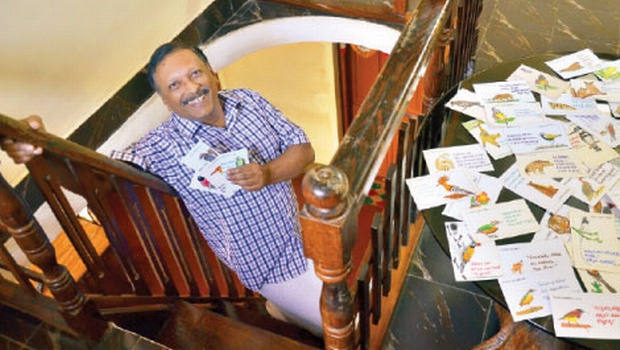
Postcards from Coorg

Photo: Jithendra M
Photo: Jithendra M

With its soft, rolling hills, green vistas cloaked in mist and charming houses flanked by coffee and pepper estates, Coorg is rightly called ‘Scotland of the East’.

And Dr S V Narasimhan knows the place like the back of his hand—from north (Somwarpet) to south (Kutta). And this is chiefly because of the demands of his hobby, bird watching, which he has sustained for the last 28 years, and his various other exploits in the field of conservation and wildlife that have made him a mini celebrity (he was Coorg Person of the Year 2013) in the land of the Kodavas.

Just two years shy of turning 60, Narasimhan reveals that birding happened almost by accident. “A friend of my friend kept needling me to accompany him for bird-watching. Finally, I agreed and once I went I was totally hooked,” he says.

“Also, on the same day, it so happened that I was presented with a Salim Ali book on birds and then there was no looking back,” he laughs.

Though bird watching and bird photography go hand-in-hand for most birders today, Narasimhan is content with just watching birds. Rather than a camera, it’s a binocular that he carts around. His two daughters are bird lovers too and accompany him on birding trips.

To say that he is devoted to his hobby would be putting it mildly. And here’s why—for the last 25 years or so, to commemorate India’s Wild Life Week that falls in the first week of October, Narasimhan has been sending out hand-painted cards featuring pictures of birds, butterflies and animals to a whole lot of people. “Every month, there was a small cultural function in our town, which is when the idea of giving people cards struck me. The first year I sent out 1,000 cards. My target has been 3,000 cards and the closest I came to achieving it is when I sent out 2,700 cards in one particular year,” he shares.

By any standard, it’s a mammoth undertaking and Narasimhan attempts the work in stages, by first selecting pictures of roughly 18-20 birds, animals and butterflies.

Then one outline of a particular picture is made on some 100 cards with the process getting replicated for the others as well. The painting happens in-between. The doctor is quick to point out that he may not a good artist, but a lot of love goes into each card. Recipients who acknowledge his cards are kept on his mailing list the next year as well.

His birding activities culminated in his book titled Feathered Jewels of

Coorg published by the Coorg Wildlife Society in 2004.

“It took me four and a half years to collect data for the book. I travelled to different parts of Coorg to acquaint myself with the Kodava names. The first edition was published in 2004 and the second in 2008,” he says. President of the Coorg Wildlife Society, Colonel C P Muthanna (retd) is all praise for Dr Narasimhan and his book, a bi-lingual guide (Kannada and English) to the birds of Coorg.

A show on Akashwani, in Madikeri, titled Kodagina Banadigalu had Naraimhan talk about Coorg’s rich wildlife. The reach of the show was tremendous with the programme running for 52 weeks, reveals the doctor, who says the bird with seven colours—Indian Pitta—is his favourite.

Besides birding, Narasimhan is also interested in astronomy. But with Coorg enjoying only two months of clear sky, it certainly puts a damper on this hobby. Nevertheless, he is quite happy with the knowledge gained, and explains the link between astronomy and birds.

“Birds migrate by looking at the constellations, they ignore the moon which changes every day, but rely on the stars which remain constant,” he says.

source: http://www.newindianexpress.com / The New Indian Express / Home> Magazine / by Sunita Raghu / January 25th, 2014

‘Karnataka needs a river rejuvenation policy’

Bangalore :

Magsaysay awardee Dr Rajendra Singh on Saturday said Karnataka needs a river rejuvenation policy.

Speaking at a seminar on ‘Protection of Kodagu’s Ecosystem to save River Cauvery’ organized by the Save Cauvery Forum, Singh, who is also known as the ‘Waterman of India’, said efforts should be made to evolve a consensus on the issue.

Singh emphasized that no change of title with regard to river land should be allowed. “Sand extraction should not be allowed in river base areas, and most importantly, sewers should be separated from rivers and treated water also kept away from rivers.”

Col CP Muthanna of Coorg Wildlife Society said the rural landscape of eco-sensitive Kodagu district has to be maintained. “The proposed Mysore-Kozhikode 400 kV power line should be taken through an alternate route as it will save 50,000 trees. There should be a moratorium on fresh licenses for tourist resorts. Strict regulations have to be imposed on land conversion and expansion of townships,” he said.

source: http://www.articles.timesofindia.indiatimes.com / The Times of India / Home> India> Kodagu / TNN / January 26th, 2014

Kodagu should be eco-sensitive zone: Wildlife society

Bangalore :

Kodagu district qualifies to be an eco-sensitive zone with its picturesque landscapes, coffee plantations, and more importantly as it is the principal catchment of Cauvery river, said members of Coorg Wildlife Society here on Thurdsay. The catchment area provides almost 50% of the total water flow into the river.

“It’s in national interest that the district gets the tag,” the members said. Its environment and ecology are under serious threat due to development projects for Kerala, urbanization and invasive tourism.

Tourism is flourishing in Kodagu but the need of the hour is a set of strong regulations, officials pointed out. “Tourist resorts are mushrooming here without proper clearances. They occupy pristine landscapes and consume massive amounts of water. There should be a cap on further licences for resorts until there is a proper evaluation on the carrying capacity for tourism in the district,” said Col C P Muthanna, president, Coorg Wildlife Society.

Land conversion and urbanization are other major threats to Kodagu. Plantations and agricultural lands are increasingly being converted for commercial purposes, affecting the landscape. “Kodagu is one lung space which is increasingly being clouded,” said Suresh Heblikar of Eco Watch, Centre for Environment and Sustainable Development. “Do not overexploit Kodagu in the name of development,” said Heblikar, urging the government to take care of all aspects while thinking of economic development of the region.

Main demands

* A stretch of 55 km through Kodagu has been earmarked for Mysore-Kozhikode power line. At least 2000 trees have been felled along the 5-km stretch of reserve forests. There is another 50-km stretch, of which 30km is coffee plantations, which has to be cleared for this power line. That calls for cutting of 50,000 more trees. This area, close to Nagarahole National Park, could now more instances of man-animal (elephant) conflict. Significantly, this area of South Kodagu is also the catchment of Lakshmantheerta river which is the primary water source for Mysore and an important tributary of the Cauvery. Ongoing work for this power line needs to be suspended with immediate effect.

* There are plans to connect Mattanur airport to Mysore and Bangalore through Kodagu with a four-lane highway, which again will involve massive tree-felling operations.

*A rail link between Kushalnagar and Kerala is being planned through Kodagu, for which funds have been sanctioned. The line may be extended once work is over on the announced stretch, which will destroy the landscape and affect indigenous communities of Kodagu.

* MoUs signed during the Global Investors Meet in 2012 needs to be reviewed and permission granted only to the projects which will benefit Kodagu without damaging its ecology.

source: http://www.articles.timesofindia.indiatimes.com / Times of India / Home> City> Bangalore> Power Line / TNN / January 17th, 2014

Kodagu should be eco-sensitive zone: Wildlife society

Bangalore :

Kodagu district qualifies to be an eco-sensitive zone with its picturesque landscapes, coffee plantations, and more importantly as it is the principal catchment of Cauvery river, said members of Coorg Wildlife Society here on Thurdsay. The catchment area provides almost 50% of the total water flow into the river.

“It’s in national interest that the district gets the tag,” the members said. Its environment and ecology are under serious threat due to development projects for Kerala, urbanization and invasive tourism.

Tourism is flourishing in Kodagu but the need of the hour is a set of strong regulations, officials pointed out. “Tourist resorts are mushrooming here without proper clearances. They occupy pristine landscapes and consume massive amounts of water. There should be a cap on further licences for resorts until there is a proper evaluation on the carrying capacity for tourism in the district,” said Col C P Muthanna, president, Coorg Wildlife Society.

Land conversion and urbanization are other major threats to Kodagu. Plantations and agricultural lands are increasingly being converted for commercial purposes, affecting the landscape. “Kodagu is one lung space which is increasingly being clouded,” said Suresh Heblikar of Eco Watch, Centre for Environment and Sustainable Development. “Do not overexploit Kodagu in the name of development,” said Heblikar, urging the government to take care of all aspects while thinking of economic development of the region.

Main demands

* A stretch of 55 km through Kodagu has been earmarked for Mysore-Kozhikode power line. At least 2000 trees have been felled along the 5-km stretch of reserve forests. There is another 50-km stretch, of which 30km is coffee plantations, which has to be cleared for this power line. That calls for cutting of 50,000 more trees. This area, close to Nagarahole National Park, could now more instances of man-animal (elephant) conflict. Significantly, this area of South Kodagu is also the catchment of Lakshmantheerta river which is the primary water source for Mysore and an important tributary of the Cauvery. Ongoing work for this power line needs to be suspended with immediate effect.

* There are plans to connect Mattanur airport to Mysore and Bangalore through Kodagu with a four-lane highway, which again will involve massive tree-felling operations.

*A rail link between Kushalnagar and Kerala is being planned through Kodagu, for which funds have been sanctioned. The line may be extended once work is over on the announced stretch, which will destroy the landscape and affect indigenous communities of Kodagu.

* MoUs signed during the Global Investors Meet in 2012 needs to be reviewed and permission granted only to the projects which will benefit Kodagu without damaging its ecology.

source: http://www.articles.timesofindia.indiatimes.com / The Times of India / Home> City> Bangalore> Power Line / TNN / January 17th, 2014

3-day Flower show at Balyatri Estate near Madikeri from tomorrow

BalaytreEstateMPos31jan2014
Madikeri :

An eye-catching flower show has been organised from Jan. 26 to Jan. 28 from 10 am to 5 pm at the Yousuf Ali Khan memorial flower garden at the premises of Balyatri Coffee Estate near Boikeri on Madikeri-Suntikoppa Road in Kodagu.

The estate belongs to former Rajya Sabha member F.M. Khan. Briefing the press on the annual flower show, Khan said that “over 90 varieties of flowers and fruits have been grown in the garden which is the only private flower garden in the country. The garden took shape about 50 years ago and for the last 15 years the flower show is being organised annually for the public. The garden houses Philia, Lorsper, Khel, kelen chus, cactus, dahlia, daisy, roses, pinks, kupia and other exotic varieties including bonsais.

He said that horticulture was bifurcated from agriculture when Indira Gandhi was the Prime Minister to boost the growth of horticulture which has not happened to the desired level yet. Continuing, he opined that Congress needed young leaders like Rahul Gandhi and Priyanka.

However he felt that Rahul should address more public rallies instead of closed-door meetings to reach the masses.

source:http://www.starofmysore.com / Star of Mysore / Home> General News / January 25th, 2014

Kodagu should be eco-sensitive zone: Wildlife society

Bangalore :

Kodagu district qualifies to be an eco-sensitive zone with its picturesque landscapes, coffee plantations, and more importantly as it is the principal catchment of Cauvery river, said members of Coorg Wildlife Society here on Thurdsay. The catchment area provides almost 50% of the total water flow into the river.

“It’s in national interest that the district gets the tag,” the members said. Its environment and ecology are under serious threat due to development projects for Kerala, urbanization and invasive tourism.

Tourism is flourishing in Kodagu but the need of the hour is a set of strong regulations, officials pointed out. “Tourist resorts are mushrooming here without proper clearances. They occupy pristine landscapes and consume massive amounts of water. There should be a cap on further licences for resorts until there is a proper evaluation on the carrying capacity for tourism in the district,” said Col C P Muthanna, president, Coorg Wildlife Society.

Land conversion and urbanization are other major threats to Kodagu. Plantations and agricultural lands are increasingly being converted for commercial purposes, affecting the landscape. “Kodagu is one lung space which is increasingly being clouded,” said Suresh Heblikar of Eco Watch, Centre for Environment and Sustainable Development. “Do not overexploit Kodagu in the name of development,” said Heblikar, urging the government to take care of all aspects while thinking of economic development of the region.

Main demands

* A stretch of 55 km through Kodagu has been earmarked for Mysore-Kozhikode power line. At least 2000 trees have been felled along the 5-km stretch of reserve forests. There is another 50-km stretch, of which 30km is coffee plantations, which has to be cleared for this power line. That calls for cutting of 50,000 more trees. This area, close to Nagarahole National Park, could now more instances of man-animal (elephant) conflict. Significantly, this area of South Kodagu is also the catchment of Lakshmantheerta river which is the primary water source for Mysore and an important tributary of the Cauvery. Ongoing work for this power line needs to be suspended with immediate effect.

* There are plans to connect Mattanur airport to Mysore and Bangalore through Kodagu with a four-lane highway, which again will involve massive tree-felling operations.

*A rail link between Kushalnagar and Kerala is being planned through Kodagu, for which funds have been sanctioned. The line may be extended once work is over on the announced stretch, which will destroy the landscape and affect indigenous communities of Kodagu.

* MoUs signed during the Global Investors Meet in 2012 needs to be reviewed and permission granted only to the projects which will benefit Kodagu without damaging its ecology.

source: http://www.articles.timesofindia.indiatimes.com / The Times of India / Home> Cityu> Bangalore> Power Lines / TNN / January 17th, 2014

BCIL launches Global Rainforest Research initiative in Coorg, Karnataka

BCIL has signed up with the Centre for Rainforest Ecology [CRE] for a collaborative platform that will be created at Zed Acres in the lush Kopatti valley of Coorg, a 20-minute drive from Madikeri.
zedacres-coorgKF29Jan2014
This rainforest patch of BCIL is over 70 acres with 4 mountains, and two perennial, roaring streams that form part of the campus. The rich flora and fauna at Zed Acres marks the rare tertiary stage succession rainforest that Zed Acres is. The Company had acquired this land in 1997 only because of its receiving 24 feet of annual rainfall, or over 7200 mm.

The CRE, headed by Gowrishankar, a core environmentalist, is a rare organisation dedicated entirely to training experts on high-end ecology and rainforest programme at the Post Masters levels for specialized professionals in biology, taxonomy, herpetology, ornithology and other upper reaches of scientific research. Says BCIL’s Dinesh, who created the collaboration, “As an environmentalist myself, I have worked with the Whitaker farm and Romulus Whitaker and his son for many years. Gowrishankar is a fine researcher who will know how to guide the highest values on such biodiversity research at Zed Acres.”

Dinesh envisages the further populating of Zed Acres with a very responsible, and eco-conscious, tourism initiative that will host extremely discerning nature-lovers at the tastefully designed set of chalets that Zed Acres will launch early next year. Plans are afoot for completion of the facilities that will offer a truly out-of-the-world, deep-ecology experience of this rainforest patch.

source: http://www.zed.in / ZED / Home> ZED Updates