Category Archives: Green Initiatives / Environment

Coorg Butterflies Make their Annual Tour to Silent Valley

Aralam Wild Life Sanctuary, one of the most precious evergreen forests in the state, is witnessing the breath-taking annual migration of butterflies from the Coorg hills. The wintering butterflies, mostly of Albatross species, breeze by the rivulets in the forests like gentle patch of yellow clouds, making their way to Nilambur forests and to Silent Valley, apparently guided by an unknown collective memory passed on to generations.

The amazing migration of the butterflies is better seen in the morning and when the sun gets hot by noon, they stop moving. As many as 40,000 Common Albatross butterflies can be seen in a single flock in the morning, says V C Balakrishnan of Malabar Natural History Society (MNHS) and a regular visitor at Aralam during this season. The Great Orange Tip, Lesser Gull and Plain Pussin butterflies can also be seen following the Albatross migration, he said. Many varieties of butterflies of Daniane sub species were seen congregating in the Aralam Sanctuary in the season. Lakhs of butterflies roosting on trees in the forests is a sight of a lifetime, Balakrishnan said.

Experts say that the butterfly migration through this stretch of Western Ghats is known to start from the evergreen forests in Coorg where these butterflies generally lay eggs on a particular tree locally known as Choota Maram or Asthi Maram (Drypetes Venusta). The butterflies fly through Aralam to Nilambur and to Silent Valley forests. “However, not much is known about when these butterflies would return to Coorg,” Balakrishnan said.

A group of nature lovers and butterfly enthusiasts would annually visit the sanctuary to witness the wonderful natural phenomenon every January. The Kerala Forests and Wildlife Department conducts joint explorations with MNHS during the season to survey butterflies. Many new species have been identified during these explorations. “We have been regularly conducting butterfly surveys during the season for the past eight years,” said Harikrishnan Nair, Wildlife Warden, Aralam Wildlife Sanctuary.

A total of 242 species of butterflies were spotted at Aralam, the highest among the forests in the state. This makes a big share of the total of 320 butterfly species found in the entire state. “The thick evergreen forests and the rich diverse flora at Aralam make perfect home for the butterflies. However, the maximum number of butterfly species is recorded here because we conduct regular surveys and scientifically categorise it,” the Wildlife Warden explains.

source: http://www.newindianexpress.com / The New Indian Express / Home> States> Kerala / by Express News Service – Kannur / January 13th, 2014

Lit Buffs Throng Honey Stalls, But Shun Booze

Writers and literature lovers visiting this hilly town are clamouring for honey, and staying away from its liquor stores and bars.

Bee-rearing is popular in and around Madikeri, and stalls selling honey are doing brisk business during the 80th all-India Kannada Sahitya Sammelana. The three-day gala ends on Thursday.

About 20 shops in the vicinity of the literary carnival trade in honey. On a normal day, they sell 30 to 50 kilos. Over the past two days, sales have doubled.

Ashok, Secretary of the Coorg Progressive Beekeepers Co-operative Society, said, “Each shop has asked for 500 boxes. Each box holds 12 one-kg bottles.”

Despite the demand, vendors have not hiked their prices. “A kilo of pure honey in a sealed bottle costs `220. The price is `180 otherwise,” Ashok said.

Honey production peaks between March and June. “This is actually off season. We are struggling to meet the demand,” he said.

There are 1,100 bee-keepers in and around Madikeri, and 6,000 in Kodagu district.

Chandappa, head master of a government school in Bijapur district and a conference delegate, said, “We don’t get honey in our districts. That’s why we are taking home some.”

The visiting writers and literature buffs aren’t giving good business to liquor shops, though.

Thimmappa of National Wines on the Madikeri main road feels the guests are not the drinking type.

“On normal days, we sell seven to eight boxes of whiskey, with each box containing 12 bottles. Since Monday, the number has come down to four or five,” he said.

Traffic diversions for the literary carnival have also had a negative impact on the liquor business, he said.

Madappa, another liquor shop owner, said visitors from North Karnataka don’t drink.

“A small number come for wine and ask about the percentage of alcohol in it,” he said.

The weather is not helping the liquor business either. “It has become warm over the past week, and that is one of the reasons our customers have just one or two pegs of whiskey,” said Madappa.

The temperature in Madikeri on Wednesday afternoon (4pm) was 26 degree Celsius, not warm at all by the standards of northern Karnataka districts, where temperatures touch 40 degrees. Madikeri has about 30 liquor stores and bars.

Pure for sure?

Rajashree, owner of a honey shop in Madikeri, offered tips on how to test the purity of honey. “Take a cup of water and put a drop of honey in it. If the honey is pure, it goes to the bottom, but if it is adulterated, it spreads,” she said. The second trick is to use paper. “Dip a piece of paper in the bottle. If the honey is pure, the paper will not get wet,” she said.

source: http://www.newindianexpress.com / The New Indian Express / Home> States> Karnataka / by Rashmi Belur and Ashwini M. Sripad – Madikeri / January 09th, 2014

Farmers to get 50 per cent subsidy for solar fencing

The government will provide 50 per cent subsidy to farmers to put up solar fences on their farms, said Minister for Forests B. Ramanath Rai on Thursday, as an obstacle against entry of wild animals and to reduce man-animal conflict

During his visit to the Karnataka Pradesh Congress Committee (KPCC) office here, the Minister told presspersons that the department had put up elephant-proof trenches and installed solar-powered fences around some stretches of the reserve forests and national parks. “This is part of the Karnataka Sustainable Forest Management and Bio-diversity Conservation Programme. However, if farmers want to get solar fences installed by private companies, we will grant them 50 per cent subsidy,” he said.

The Minister said his department was not against development. However, only such projects that will directly benefit people will be permitted. People who submit applications for land in deemed and reserve forests should keep in mind the various rules governing forests in the State.

The Minister said the process of resolving the confusion over the C and D categories of land (degraded forest land) had commenced. “According to the law, there is no provision to regularise encroachments on forest land after April 27, 1978. However, we have received over one lakh applications seeking regularisation of land. A Cabinet subcommittee has been formed to study the issue and take a decision,” he said.

Posts to be filled

He said 700 posts in the department would be filled shortly. “The department is also encouraging farmers to grow sandalwood. We are giving away saplings at Re. 1 and Rs. 2 each to farmers. These farmers will also get an incentive of Rs. 10, Rs. 15 and Rs. 20 for each sapling annually, in the first, second and third year respectively, to ensure its growth,” the Minister said.

source: http://www.thehindu.com / The Hindu / Home> News> National> Karnataka / by Special Correspondent / Bangalore – January 03rd, 2014

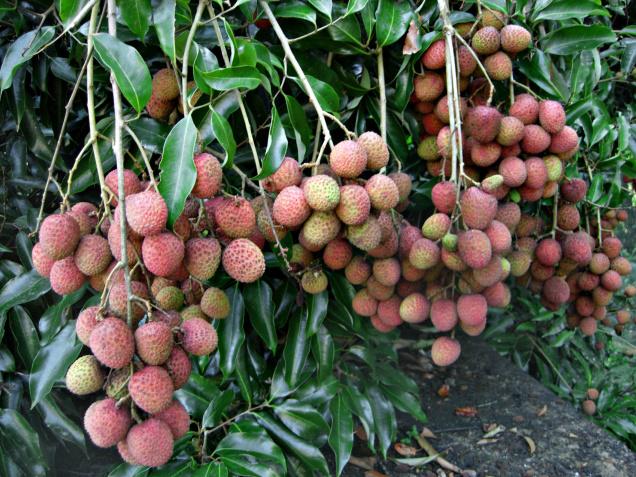
‘Good potential for litchi cultivation in Kodagu’

Litchi grown in Kodagu during the off-season can be marketed across the country, says an expert.

Growers in Kodagu, faced with pest attacks on coffee and diseases in cardamom, orange, and banana crops, had something to look forward to during the Litchi Field Day organised by the Central Horticultural Experiment Station (CHES) at Chettalli in the district recently.

About 50 progressive growers attended the event. A field visit to litchi orchards of the CHES in Chettalli gave the growers exposure to cultivation methods. CHES scientists apprised the growers about the soil requirements, fruiting, flowering pattern, and yield of litchi.

P.C. Tripathi, head of the CHES, made a presentation on the prospects of litchi cultivation in Kodagu. He said litchi matures in the off-season, during November-December period, in Kodagu, unlike in traditional cultivation areas in north India where it matures during May and June. As this was the off-season, the fruits were in demand in the market. He told The Hindu that litchi grown in Kodagu during the off-season could be marketed across the country.

The current price of litchi is around Rs. 150 a kg. Litchi cultivation had picked up in Kodagu in the last four years, he said. A grower had planted 900 plants in Chettalli area, he said.

Income from litchi cultivation could augment the annual income of growers who were left to fend for themselves due to the volatility of coffee and pepper prices, Dr. Tripathi said. A small litchi tree could yield between 30 to 50 kg of fruits while bigger ones could yield more than 2 quintals, he said. India is ranked second in the world in litchi production, after China. In India, litchi is grown on nearly 75,000 hectares with a yield of 4.83 lakh tonnes. Bihar, West Bengal, Uttar Pradesh, Jharkhand and Uttarakhand are the major litchi growing States in the country. At the programme, growers raised queries on profitability and feasibility of litchi cultivation.

Planters including N. Bose Mandanna, Col. Kumar (retd.), B.D. Manjunath, Vijay Devaiah and Shambhu Chengappa participated in the programme. Scientists of the CHES, Indian Institute of Spices Research, Appangala, near Madikeri; Coffee Board, Chettalli; and Krishi Vijnana Kendra, Gonicoppa, as well as government officials were present.

source: http://www.thehindu.com / The Hindu / Home> News> National> Karnataka / by K. Jeevan Chinnappa / Madikeri – December 26th, 2013

Apiculture park to come up in Kodagu

An apiculture park will be set up at Bhagamandala in Kodagu district to revive apiculture in Karnataka, Horticulture Minister Shamanur Shivashankarappa said on Thursday.

He told reporters here that the park would come up on six acres at Bhagamandala. The department would distribute 20,000 boxes to Jenu Kurubas, a tribe that has expertise in honey cultivation and extraction.

According to him, Rs. 60 lakh had been earmarked in the current fiscal to promote apiculture. “At present, the honey production is around 800 metric tonnes but it is possible to increase it to 8,000 metric tonnes per annum. Besides awareness, training would be imparted to the local tribe to promote apiculture. There is a lot of scope for promoting apiculture in Uttara Kannada, Dakshina Kannada and other Malnad districts,” he said.

Neera Policy

The minister said the department has submitted a proposal to the Finance Department to announce a policy on neera.

“An amendment to the State Excise Act is necessary to allow the tapping and selling of neera in the state. Already, steps have been taken to promote value-added products from the neera like palm syrup, palm jaggery and palm sugar. Now it is up to the Finance Department to table a bill in the State Legislature to pass the Neera Policy,” he said.

Proposal Submitted

He said the state government has submitted a proposal to the Union government seeking release of Rs. 100 crore to revive coconut plantations in several districts.

“Thirty per cent of the coconut plants have perished due to pests and failure of monsoon. The department is educating the farmers of rain-fed areas to go for alternative crops,” he said. According to him, the department has given Rs. 12,000 per acre to farmers for loss of coconut plants.

Auction Centres

Shamanur said two flower auction centres set up in Tumkur and Davangere would be inaugurated soon. The Department of Horticulture has provided the infrastructure but it would be managed by the Karnataka Agricultural Marketing Department.

“Floriculture is no longer a profitable venture following competitions from the African countries. In recent years, Kenya and Ethiopia have emerged as leading flower export countries after the European countries. Despite this, many flowers are being exported from Karnataka thanks to the department’s support. Fifty per cent subsidy is being given to entrepreneurs under the National Horticulture Mission to promote floriculture,” he said.

Census

He said the census of horticulture crops’ areas under cultivation and production were in progress in Bagalkot, Belgaum, Bellary, Chitradurga, Davangere, Gulbarga, Hassan, Kolar, Mysore, Shimoga and Tumkur districts. According to him, Rs. 5 crore had been earmarked for the purpose. “Nearly 50 per cent of the work has been completed,” he said.

source: http://www.newindianexpress.com / The New Indian Express / Home> States> Karnataka / by Express News Service – Bangalore / November 22nd, 2013

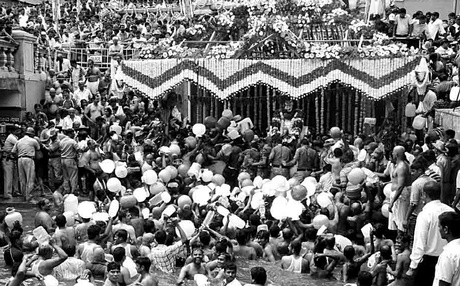
Lakhs throng Talacauvery

Devotees thronging Triveni Sangama at Talacauvery in Bhaghamandla on Thursday | Express photo

The Madikeri- Bhaghamandla- Talacauvery Road was jampacked from early Thursday as lakhs of devotees arrived for the ‘theerthodbhava’ near Brahmakundike.

It is believed that every year on this day at a specified time water from the Cauvery springs up in the form of a small fountain from ‘Brahmakundike’ at Talacauvery. And this water from this temporary fountain is considered to be holy.

A team of archakas, led by Ananthesh Kedilaya, announced the arrival of theerthodbhava at 12.01 pm, following which they sprinkled the holy water on the devotees near the Bramhakundike.

Kodagu police had enforced strict monitoring around the region to ensure that people do not enter Bramhakundike until after the theerthodbhava to prevent any untoward incidents such as a stampede.

SP M N Anucheth was seen standing near the pond and personally supervising arrangements with his subordinates.

Cultural programmes were performed by various artistes throughout the day. Ninada from Ponampet sang Kodava devotional songs while B A Ganesh from Shanthalli rendered Kannada devotional songs. Padmanabha and team from Melkote played the Nagaswara and Ramanajneya Bhajana team from Madikeri sung bhajans.

For the second consecutive year, the temple committee provided lunch for the devotees. MLA K G Bopaiah and Kodagu ZP vice-president B Usha Devamma supervised the catering arrangements.

The theerthodbhava was witnessed by the temple Thakka’s Kodi Madappa, Kodi Motaaiah, Balladka Appaji, MP A H Vishwanath, Deputy Commissioner Anurag Tiwari and others.

source: http://www.newindianexpress.com / The New Indian Express / Home> States> Karnataka / by Express News Service – Madikeri / October 18th, 2013

Encroachers volunteer to vacate forestlands in Kodagu dist

There is good news for the Forest department, which is striving to clear encroached forestlands. Villagers, who had encroached upon Subraya sacred grove, in Korangala village, near Bhagamandala, have voluntarily decided to vacate the land and have submitted a letter of consent in this regard.

On survey number 106, behind Subramanya temple, in Korangala, there is sacred grove of 59.34 acres. Six persons, who had encroached upon 8.70 acres of land, have decided to vacate it voluntarily.
N S Bojappa (two acres), N J Somanna (1.5 acres) N N Kalappa (1.50 acres), J S Subraya (two acres), B N Lokanath (1.5 acres) and N N Jnanashekar (0.20 acre) have handed over the land to the Forest department. In a meeting held in front of Nangaru Ainmane, the villagers handed over a letter of consent to ACF C Shashi. Following the development, T B Somappa (0.50 acre) and K D Seetha (two acres), who had encroached upon Ayyappa sacred grove at Sannapulikotu, have also decided to vacate the land.
Speaking to Deccan Herald, J S Subraya said, “Our ancestors had encroached upon the sacred grove land, knowingly or unknowingly, and we were cultivating coffee and cardamom. The forest officials brought the issue to our notice. So, we decided to vacate the land and help conserve forests.”

There are approximately 13,371 acres of sacred grove lands in Kodagu district. Some of them have been encroached upon by local farmers. There is no exact statistics on the encroachment.

However, we can identify the encroached land, said Shashi. “We are trying to convince the villagers to vacate the land on their own. Basavanna Devara Bana Samithi had issued notices to farmers, through its lawyer, urging them to vacate the encroached land at Valnoor-Thyagathur Basavanna Sacred Grove.

Now, we have written letters to all sacred grove committees, seeking details and have asked them to vacate encroachers. If the encroachers fail to vacate voluntarily, we have to do it legally,” he said.

source: http://www.deccanherald.com / Deccan Herald / Home> District / by Srikanth Kallammanavar, Madikeri / DHNS / October 24th, 2013

Govt gives green signal for high-tension power lines

Amidst opposition from the environmentalists, the State government has given green signal to the Kodagu district administration to re-start the work on Mysore-Kozhikode 400 KV high-tension electricity supply lines.

In a letter written to the the Kodagu DC, State Forest, Environment and Ecology Dept Principal Secretary S Sivashailam has said, “If the electricity wire, that passes through 55 km area in Kodagu is laid above 15 metres above the ground, it would not harm the elephants. Therefore, the electricity wire laying work can be re-started.” It can be noted that normally electricity wires are laid 9 metres above the ground.

The letter, has evoked opposition from the environmentalists. Recalling the recent High Court judgement which had directed the government to re-consider all the work that passes through elephant corridors, an environmentalist said that Lingapur, Maldare, Thithimathi, Kanur, Nalkeri, Kutta and surrounding areas where the proposed hi-tension wire passes through, are habitats of elephants. Several trees will have to be cut for laying the hi-tension wire, which will adversely affect the animal habitat, the environmentalist said.

Following the opposition from the environmentalists, Deputy Commissioner Anurag Tiwari had written to the government on October 21, requesting the government to re-consider the matter. In reply, forest department principal secretary has directed the DC to start the work.

Government’s letter

The letter by the forest department chief secretary, states further, “the State government while giving permission to the work on March 1, 2012, had imposed a condition to the Powergrid Corporation that the hi-tension wire which passes through reserved areas of elephants in Kodagu and Mysore, should be laid six metres above the normal height.

The elephants even if they raise their trunk, can not reach the wire at 15 metres height. Therefore, laying wire at this height, would not harm elephants.”

Further, the letter clarifies that the High Court in its judgment on October 8, too has imposed a condition that the electricity wire should be in such a height that elephants should not be able to reach it. Hence, laying wire at 15 metres height would abide by the HC directive too.

The 120 km long 400 KV hi-tension wire from Mysore to Kozhikode will pass through 55 km land in Kodagu. Of this, 4.45 km is forest land, while the remaining is private land and plantations.
The wire laying work has been completed from Mysore to Lingapur (Mysore-Kodagu border) on the one side, and from Kozhikode to Manandavadi (Kerala-Kodagu border) on another side. As the work faced severe opposition from environmentalists in Kodagu, the work was halted for sometime. If the project is implemented, it would provide 520 MW power to Karnataka and 260 MW to Kerala from Koodankulam nuclear power plant.

source: http://www.deccanherald.com / Deccan Herald / Home> District / by Srikanth Kallammanavar, Madikeri / DHNS / October 24th, 2013

Lakhs throng Talacauvery

Devotees thronging Triveni Sangama at Talacauvery in Bhaghamandla on Thursday | Express photo

The Madikeri- Bhaghamandla- Talacauvery Road was jampacked from early Thursday as lakhs of devotees arrived for the ‘theerthodbhava’ near Brahmakundike.

It is believed that every year on this day at a specified time water from the Cauvery springs up in the form of a small fountain from ‘Brahmakundike’ at Talacauvery. And this water from this temporary fountain is considered to be holy.

A team of archakas, led by Ananthesh Kedilaya, announced the arrival of theerthodbhava at 12.01 pm, following which they sprinkled the holy water on the devotees near the Bramhakundike.

Kodagu police had enforced strict monitoring around the region to ensure that people do not enter Bramhakundike until after the theerthodbhava to prevent any untoward incidents such as a stampede.

SP M N Anucheth was seen standing near the pond and personally supervising arrangements with his subordinates.

Cultural programmes were performed by various artistes throughout the day. Ninada from Ponampet sang Kodava devotional songs while B A Ganesh from Shanthalli rendered Kannada devotional songs. Padmanabha and team from Melkote played the Nagaswara and Ramanajneya Bhajana team from Madikeri sung bhajans.

For the second consecutive year, the temple committee provided lunch for the devotees. MLA K G Bopaiah and Kodagu ZP vice-president B Usha Devamma supervised the catering arrangements.

The theerthodbhava was witnessed by the temple Thakka’s Kodi Madappa, Kodi Motaaiah, Balladka Appaji, MP A H Vishwanath, Deputy Commissioner Anurag Tiwari and others.

source: http://www.newindianexpress.com / The New Indian Express / Home> States> Karnataka / by Express News Service – Madikeri / October 18th, 2013

State prepares for biggest elephant capture operation since 1971 ‘khedda’

OUT OF PLACE?: In Alur taluk, a herd of 25–30 elephants inhabit a tiny 5-sq. km forest patch circumscribed by agricultural fields that they routinely raid, according to M.D. Madhusudan, a member of the Karnataka Elephant Task Force./  File photo / The Hindu
OUT OF PLACE?: In Alur taluk, a herd of 25–30 elephants inhabit a tiny 5-sq. km forest patch circumscribed by agricultural fields that they routinely raid, according to M.D. Madhusudan, a member of the Karnataka Elephant Task Force./ File photo / The Hindu

At least 25 wild elephants are set to be caught in Alur taluk of Hassan district

With a green signal from the Karnataka High Court on Tuesday, the Department of Forests now sets about planning its biggest ever operation to capture wild elephants since the State’s last ‘khedda’ in 1971, when 47 animals were captured.

At the very least, this would mean the capture and taming of around 25 elephants in Hassan’s Alur taluk, the epicentre of human-elephant conflict in the State. The Karnataka Elephant Task Force in its report to the High Court in September 2012, identified two regions — Alur and Tumkur district’s Savandurga — as “elephant removal zones” for the “unacceptable levels” of conflict they encountered.

The department, however, places “the outer limit” for the number of elephants to be captured at 150 and hope to extend the ‘removal zone’ to parts of Kodagu where human-elephant conflict is intense. “The actual number we capture will be much less, but we’ll have to take a call on areas such as Kodagu based on an assessment of conflict levels and perceptions of people here,” said Principal Chief Conservator of Forests (Wildlife) G.S. Prabhu.

‘Extreme measure’

Members of the task force don’t quite agree. Removing wild elephants from a natural landscape is “an extreme measure” and one that should be done with the “greatest judiciousness”, said M.D. Madhusudan, scientist with the Nature Conservation Foundation and task force member. Only two areas have been identified by the task force as potential “removal zones” and Kodagu is not one of them, he said.

Alur was an anomaly of sorts and justifies the approach, he explained. The conflict in Alur was intense, and the elephant population was ecologically unviable. “Here, a herd of 25–30 elephants inhabit a tiny 5-sq. km forest patch circumscribed by agricultural fields that they routinely raid.” Between 1986 and 2011, elephants killed 46 people and injured over 240, according to the task force report, creating a “fear psychosis among people that hampers their ability to work and live normal lives.”

The situation in Kodagu was not adequately studied yet, said Raman Sukumar, chairman of the Centre for Ecological Sciences, Indian Institute of Science. “We first need to assess the conflict situation in Kodagu, understand the dynamic of elephants here (are they transitory, for instance) before we decide on a course of action.”

Meanwhile, the Department of Forests has set aside Rs. 4 crore to create kraals to restrain elephants captured, which typically take a year to tame, and new elephant camps. “The project can only begin in January, after the rain,” Mr. Prabhu said, and added that the department would be using a combination of methods that incorporate elements from traditional ‘khedda’ (stockade traps) and also modern-day chemical tranquilising.

BACK TO THE WILD

Even as it prepares for a large-scale capture of elephants, the department, ironically, admits that its 10 camps, which together have 91 elephants, are too crowded.

“We are looking at the possibility of returning around 30 of these back to the wild,” Mr. Prabhu said.

source: http://www.thehindu.com / The Hindu / Home> News> National> Karnataka / by Divya Gandhi / Bangalore – October 13th, 2013