Category Archives: Green Initiatives / Environment

‘Agri budget aimed at attracting youth to farming’

somwarpetKF04apr2013With more number of farmers drifting away from agriculture due to the lack of basic facilities, the government has presented a separate agriculture budget to retain farmers in the farming sector, said District-in-Charge Minister Appachu Ranjan.

He was delivering presidential address at Krishi Utsav jointly organised by Krishi Utsava Management Committee, Taluk Panchayat, Pragathi Bandhu SHG, at Balagunda village near Somwarpet on Monday. He gave a call to the farmers to have knowledge of various government schemes that are exclusively designed for the welfare of farmers. The new generation youth lack interest in farming and are turning their faces towards the urban life. But the situation will change and the same youth will return to villages to take up agriculture, Appachu Ranjan hoped.

He said “the small farmers should cultivate crops that are suitable for the local climate. The crops should be grown and supplied based on the public demand.”

Inaugurating the Krishi Utsav, national award winning progressive farmer Nirmala Prakash expressed concern over the increased use of chemical fertilisers and pesticides in agriculture.

Understanding the impact of these harmful chemicals, the farmers should come forward to adopt organic farming, she said.

Zilla Panchayat President B Shivappa, Taluk Panchayat President G B Somaiah, Sri Kshetra Dharmastala Rural Development Project Director Radhakrishna Rao and others were present.

source: http://www.DeccanHerald.com / Home> District / Somwarpet, DHNS / March 18th, 2013

‘Demand for bamboo is on rise’

BambooKF30mar2013Bamboo cultivation will fetch good income for the growers, said Chief Conservator of Forest Keshavamurthy.

Speaking at a workshop on bamboo organised by the Bamboo Society of India, Kodagu Model Forest and Forest College, he said the bamboo can be grown inside the coffee estates as well. Bamboo is used in furnitures, as a fodder for animals and in preparations of medicine. The demand for bamboo is on rise in the international market.

He said that bamboo is grown on five lakh hectare land in the State. The demand for bamboo is 26.26 lakh tonne. Bamboo sticks are used in the preparation incense sticks. Along with growing ginger, farmers can also grow bamboo.

Forest College dean Dr N A Prakash also spoke. Additional Principal Chief Conservator of Forest (retd) Dr K Sundar Naik also spoke. Bamboo growers Dr L C Sona, Sanjeev, Ahammed and Sandeep spoke.

source: http://www.DeccanHerald.com / Home> District / Gonikoppa, DHNS / March 29th, 2013

Big bird day : Bird-watching event all over Kodagu

Mysore, Feb. 23 :

Big Bird Day (BBD), a major bird-watching event will take place across the length and breadth of Kodagu district tomorrow in which more than 25 teams of ornithology enthusiasts have enlisted to assimilate data about the winged creatures.

The “Big Bird Day” is an initiative that was initially started by the ‘Delhi Bird Watchers’ in 2004. The underlying concept of this initiative is “Bird Watching” for the entire day in order to accumulate the highest possible number of species in the region. This year it has become a Pan-India event for the first time. There are more than 200 enlisted teams, making this the largest BBD event for the first time. There are close to 1500 participants all over India. Birders go individually or in small groups, watch birds in certain areas and report the sightings by the end of the day, according to Dr. Bishan Monnappa, a well known orthopaedic in Virajpet and an avid photographer, who is BBD Co-ordinator for Kodagu.

“Despite Kodagu being a difficult terrain, a lot of volunteers have come forward to participate in this event. It will be an educative event which is non-competitive and non-commercial,” said Dr. Monnappa

This event will provide valuable scientific data regarding the rich avian life of India. Pending the success of this event, future plans are to be implemented to cover those areas with the assistance of the Forest Department. Contact Dr. Bishan Monnappa at bishancm@yahoo.com

source: http://www.StarofMysore.com / Home> General News / February 23rd, 2013

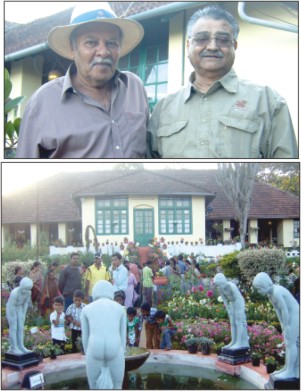
His name is F.M Khan


Caption: 1) F. M. Khan with SOM Editor-in-Chief K.B.Ganapathy 2) Garden in front of the house with a fountain.

It was a fortuitous visit. Being Sunday, I decided to drive to Kodagu with a couple of my friends with a double intent — visit the coffee estate, this being the coffee picking season and to enjoy God’s rest day Sunday with good food in one of those innumerable resorts and holiday homes. And on our way back via Madikeri, at Boikeri, about 8 kms on Mysore road, I saw a frayed, grayed wooden sign-post with the legend Balayatrie Estate with a colourful flex board announcing the flower show. Instantly, I knew what it was — the annual flower show conducted by the owner of the estate F.M. Khan, a former Congress Rajya Sabha member and a good friend of former Chief Minister of Karnataka R. Gundu Rao.

For courtesy, I asked my friends if we could visit the show even as I swerved the vehicle to the kachcha road into the estate. A few metres inside and there were nearly 20 cars parked in two parking lots. Men, women and children were there enjoying the flower garden in front of the house with a dysfunctional fountain surrounded by angelic figures (see picture). There were many burqa-clad ladies among others. I wondered if there would come a day in our country when a fatwa would be unleashed to prohibit growing of certain varieties of flowers, as it happened in Kashmir where a fatwa was issued prohibiting playing of certain kind of songs and music by an all-girls band!

Poor Rock Band girls and their families are in hiding now. What a secular country this. Sometimes, I wonder if secularism in this country is applicable only to Hindus and not to other religious groups. A re-look into the definition of this nebulous word ‘secular’ or ‘secularism’ is needed because this word finds a place in our Constitution following an amendment, which was not there otherwise. Let it be.

To revert to F.M. Khan’s flower show, I have nothing but admiration for his efforts, a labour of love. I learn he has been holding this private flower show since 1998 and people are enjoying it thoroughly, for, after all, who would not love flowers. Flower saplings too were there for sale but when I went much of it was sold. Khan’s youngest daughter, who obviously must have taken total responsibility for the show, too was there at the sales point with a receipt book and a visitors’ book.

The name F.M. Khan was as familiar in Karnataka as in Delhi in the late 80s — during the period of Emergency — like R. Gundu Rao then and Shah Rukh Khan today in Bollywood. F.M. Khan and Gundu Rao were two names the Congress (I) party members in Karnataka respected as much as feared for they really did matter in politics of the day — thanks to their intimacy to Sanjay Gandhi the Terrible of the Emergency days. In fact, these two from Karnataka were the blue-eyed boys of Sanjay Gandhi.

It was Gundu Rao who went to the Bangalore Race Club and ‘trapped’ photographs of a few IAS officers who should have been in the Vidhana Soudha. And it made all-India news. I was in Poona then.

As for F.M. Khan, he was like a young stallion, a rising star. Sadly, he faded into oblivion as fast as he rose in politics. If my memory serves me right, I think he was also the Treasurer of the party.

Mrs. Indira Gandhi had visited this house and stayed there after she lost power, post-Emergency and it was big news. I was looking for a plaque somewhere outside the house commemorating the visit of such a great leader but could not find one. I also forgot to ask Khan or his daughter about Indira Gandhi’s visit.

The house, a typical British bungalow with tiled roof, is rather old, may be a hundred-year-old and looked its age needing restoration. The surroundings with service buildings too looked as if in need of care and maintenance. As I strolled around, I was mentally visualising the old glory and the flamboyant life the family, including F.M. Khan, led in the past as one of the richest coffee planters of Kodagu.

Times have changed and the young, debonair F.M. Khan too has changed — has become old like me, but a senior.

In his heydays in politics, he was confident and assertive. Always on short fuse. But now he seemed to have mellowed. He still carries that aristocratic bearing on his feeble shoulders. Heard, he was once mortally sick, but has bounced back. As visitors were trooping into the garden, he was standing at the steps giving a gentle welcome smile with a twinkle in his eyes, apparently feeling happy and nice about what miracle he has done with the flower show spreading happiness and fragrance.

My friends did not know him though they had heard his name. As a courtesy, I acknowledged his presence and wished him simultaneously introducing myself. He seemed to have recognised me. “Would you mind if I took a picture with you?” He smiled in approval (see picture) and as I took leave of him he said, “I am extending the show by a day till tomorrow. Would you publish it in your Kannada paper Mysooru Mithra?” I kept my word, of course.

Yes, I met our own F.M. Khan and reminded myself how nature and time, together, ravage man and all his creations.

Tailpiece: If only R. Gundu Rao had not overplayed his role and got expelled from the party at a critical time after losing the State elec-tion, I am sure, both he and F.M. Khan would have risen in the party and F.M. Khan would be playing the role of another Khan from Karna-taka, the present Minister for Minority Affairs K. Rehman Khan in Congress. With the sudden tragic death of their Godfather Sanjay Gandhi, their political fortunes faded for ever. Sadly, Gundu Rao too died young.

e-mail: kbg@starofmysore.com

source: http://www.StarofMysore.com / Home> Abracadabra…. Abracadabra /by K. B. Ganapathy / February 09th, 2013

And what about traditional healers?

All the medicines he gives are derived from herbs, collected from the forests and not chemically spiked.

The steady stream of patients has been increasing over the years for this ayurvedic practitioner, whose knowledge has been handed down the generations

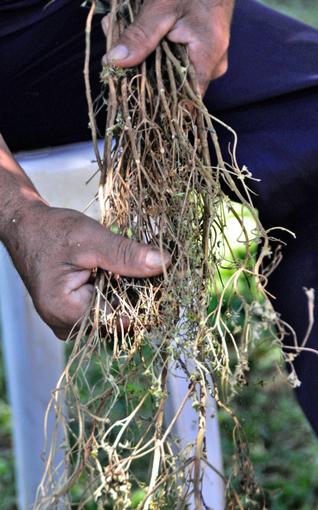
The sick and anxious queue up every day at the clinic of a popular ayurvedic pandit in a north Kodagu village, hoping to find a solution to their ailments, and many undertake an arduous journey to reach this remote place nestled in coffee plantations.

His medicines — mostly herbs, powdered and packed in plastic covers — are handed out along with a pamphlet providing details about dosage and diet. The steady stream of patients has been increasing over the years for this ayurvedic practitioner, whose knowledge has been handed down the generations, but not through any formal method.

All the medicines he gives are derived from herbs, collected from the forests and not chemically spiked, he claims, telling patients to test them for heavy metals or steroid if they so wish.

“Most come after allopathic drugs fail to provide relief. Many come with faith in traditional knowledge,” he says.

There are thousands like him, claiming to use remedies handed down generations in a State that has rich biodiversity. Sources in the Department of Ayurveda, Yoga and Naturopathy, Unani, Siddha and Homoeopathy (AYUSH) estimate that there could be around 40,000 to 50,000 traditional healers, mostly in rural areas, in the State.

However, without a recognised degree, the medicines they prescribe have not gone through the rigours of modern testing methods.

The role of the traditional healer is thus a matter of debate. Lack of government-monitored system to test their medicines and validate their practice has also not helped.

No recognition

Officially, their role in the health system has not been recognised either by the Karnataka Medical Council or by the AYUSH Department. According to a senior official in the Drug Controller’s Office, prescribing allopathic medication without medical qualification is illegal under the Drug Rules and it is also illegal to prescribe ayurvedic drugs without recognition by the Directorate of AYUSH. AYUSH Department sources said that though no time-frame has been set, there is a loud thinking in the government to address issues pertaining to traditional medicine and healers as this knowledge is considered an important element in society that should not be lost.

source: http://www.TheHindu.com / Home> News> Cities> Bangalore / by Sharath S. Srivasta / Bangalore, December 04th, 2012

Kodagu villagers teach Wayanad a lesson in tiger conservation

Kozhikode :
Just two days after the controversial killing of a tiger in Wayanad, the villagers of Nidugumba in Kodagu district, just across the border in Karnataka, have given their counterparts in Wayanad a lesson in handling a man-animal conflict.

The villagers on Tuesday swiftly rescued a tigress which had strayed into a coffee plantation and got its feet entangled in a barbed-wire fence, without baying for its blood as it happened in Wayanad.

According to Karnataka forest officials, the entire community headed by the owner of the coffee plantation, Sullimada Muthanna, ensured that there was no mobbing of the struggling tiger. The villagers stood guard on the tiger till forest officials from the Nagarhole Tiger Reserve arrived and took control of the situation.

“The villagers were very cooperative. There was no violent mob baying for blood and the tigress was tranquilized swiftly,” Bandipur Tiger Reserve director Kumar Pushkar told TOI. With 10-12 tigers per 100 sq km, Nagarahole is known to have ones of the highest tiger densities in the country. It also produces a surplus of animals each year.

The animal was soon untangled from the fence and transported to the Mysore Zoo where it is currently under medical care.

Leading tiger ecologist and director of ScienceAsia, Ullas Karanth, said that the situation in Kodagu stands in stark contrast with the recent tragic outcome in Wayanad when a cornered tiger was first tranquilized and then shot dead amidst chaos created by a local mob.

“The restraint and positive conservation attitude of the Kodagu villagers is exemplary. They responded positively and acted as the guardians of the tiger. Other communities along the Western Ghats, including Wayanad, should realize that the tiger is a very precious heritage of ours. The government also has to develop more professional ways of dealing with such situations,” he said.

Meanwhile, Wayanad Prakrithi Samrakshana Samithi president N Badusha said that historically, the people of Wayanad have coexisted peacefully with wild animals. “But over the last two months, certain vested interests, backed by political parties and religious institutions, have created a mass hysteria which has created animosity among people against animals. This hysteria has taken over even the people who usually speak up for the animals,” he said. Badusha added that even his son was attacked and house stoned for the pro-conservation stand taken by him.

source: http://www.m.timesofindia.indiatimes.com / by K R Rajeev, TNN / December 06th, 2012

Tribals empowered to collect minor forest produces: Rameshwar Oraon


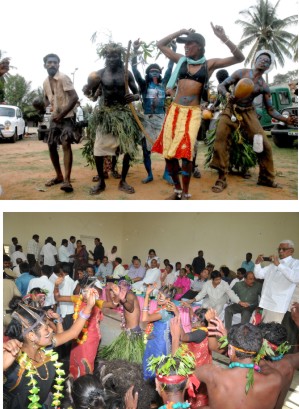
Rameshwar Oraon, Chairperson, National Commission for Scheduled Tribes, addressing tribals at Dr. B.R. Ambedkar Bhavan in Hunsur yesterday, accompanied by other members of the Commission. Pictures centre and right show the tribal dances performed to welcome the Central team.

Mysore, Nov. 9 (RK&RNN)
Tribal people have every right to collect and sell Minor Forest Produces (MFP) and no one could interfere with this, observed Rameshwar Oraon, Chairperson, National Commission for Scheduled Tribes.

Addressing members of the tribal community at Dr. B.R. Ambedkar Bhavan in Hunsur after visiting several Haadis in H.D. Kote taluk of Mysore district yesterday, he said the Union Government was taking steps to fix a minimum price for the MFP to avoid exploitation from middle men.

He also added that The Scheduled Tribes and Other Traditional Forest Dwellers (Recognition of Forest Rights) Act, 2006 made all tribal people living in the forest eligible for title deeds of their lands and urged Adivasis to take benefits due to them.

He also elicited the opinion of tribal people and others who participated in the meeting on whether they were getting the benefits given by the Centre.

Stating that the tribals would be given compensation four times higher than the existing value of the land if the same was acquired for any government purpose, Oraon added that the Centre was planning to bring legislation in this regard.

Many of those present complained that they were denied benefits like schools, angan-wadi centres, drinking water and ration under the Public Distribution System (PDS) to which Oraon replied that he would take up the issue with the State Chief Secretary at a meeting scheduled to be held today and added that he would also discuss it with Deputy Commissioner and CEO of Mysore Zilla Panchayat.

Food security to tribals

It is reported that Rameshwar Oraon has directed the District Administration to provide food security to tribals and adivasis living in the periphery of forests through Fair Price shops and also urged the District Administration to provide them alternative land for agriculture.

Stressing for education to tri-bal children at Ashraya Schools from first to seventh standards, Oraon instructed ADGP Chikkanur to withdraw false cases filed against tribals and also called for making arrangements for selling of products manufactured by tribals through Lamp Societies at good prices.

He directed early completion of probe into the missing cases of Jiyamballi Raju and Hunsekoppa Bheemasena besides ensuring avoidance of harassment of tribals by forest officials.

A traditional welcome was accorded to the visiting team by tribals who performed folk dan-ces following which Prasanna, Convenor of South India Cell for Human Rights Education and Monitoring (SICHREM) and Vaddaragudi Chikkanna gave a presentation of problems being faced by tribals.

The team consisting of Rameshwar Oraon, Commission members Kamala Kumari, B.L. Meena, Jt. Secretary Aditya Mishra, Dy. Director K.D.Bansar, SC/ST Regional Office (Bhopal) Asst. Director R.K.Dubey and others who arrived from Bangalore in the morning drove straight to Morarji Desai School Hostel in Hunsur for an inspection.

Dy. Commissioner P.S. Vastrad, ZP CEO Dr. Ajai Nagabhushan, SP R.Dileep, MLAs Chikkanna and Manjunath, Asst. Commissioners, Tahasil dars and other officials provided necessary information to the team.

source: http://www.StarofMysore.com / Home> General News / November 09th, 2012

Birds of the same feather

Kodagu, straddled on the Western Ghats, boasts of more than 300 varieties of birds. This pristine area abounds in an assortment of rare flora and fauna as well.

One of the unique selling propositions for coffee grown in these environs is that the berries develop under dappled sunlight filtered through friendly shade trees, to a medley of melodious sounds of numerous feathered bipeds.

It is claimed that these ‘happy’ berries are imbued with the finest qualities of the salubrious sylvan surroundings. Just as in a popular commercial for a Scotch that says, “as you sip their whiskey you hear hundred pipers playing,” the coffee planters in this area market their produce with the hype that the consumers could listen to chirping of birds as they savour the brew which is famously known as: the cup that cheers but not inebriates!

When it comes to these bright coloured feathered bipeds, there are two medical doctors in Kodagu who have evocatively captured the images of local birds in all their splendour, through different art forms.

Besides their medical profession, they are well-known ornithologists as well. The first, Dr S V Narasimhan, has brought out a bilingual (English and Kannada) book titled ‘Feathered Jewels of Coorg’ in which he has painstakingly colour-sketched 310 birds of this region.
He has meticulously described each species giving their popular English names along with their scientific Latin names. Also included are the names of each species in Kannada as well as in Kodava languages.

However, Narasimhan’s efforts go far beyond just documenting bird-life in Kodagu. He is actively involved in bringing about environmental awareness and wildlife conservation in a unique way. Every year, Narasimhan hand-paints thousands of postcards of birds and animals of Kodagu with specific messages composed by him pertaining to our milieu.
He then mails them free of cost to a host of recipients.

His modest request, however, is for postage stamps so that he could distribute his hand-painted postcards to even more beneficiaries to spread his message on conservation and protection of wildlife, so very crucial to our environment. Narasimhan has, as on date, hand-painted 56,590 cards in a span of 28 years! I am sure it’s a world record. I am one of the lucky beneficiaries this year.

Aim and shoot

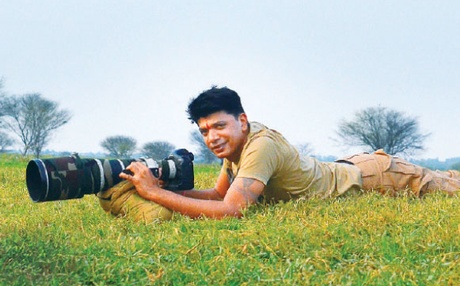
The other doctor, Dr Bishan Monnappa, an orthopaedician, is a keen photographer. He brilliantly captures wildlife in their natural habitat through powerful cameras. His high-definition photographs of birds of various plumages are simply spectacular.

Dr S V Narasimhan and Dr Bishan Monnappa are popularly known as ‘Bird-men of Kodagu’. They are extending their healing touch beyond humans to the wellbeing of Mother Nature as well.

Now, who can resist drinking coffee that has bird songs recorded in its brew!

source: http://www.DeccanHerald.com / Home> Supplements> Spectrum / by C.P. Belliappa / November 06th, 2012

DOC CREATES AWARENESS ON WILDLIFE CARDS


Mysore, Oct.7
People who love environment, find a way to preserve it and also create awareness among the laymen on conserving it. Many take out rallies, conduct environment-related programmes, plant saplings and adopt animals. However, a family physician of Virajpet, Kodagu district, has found a unique way of bringing nature closer to mankind — he sends free hand-painted postcards containing wildlife messages to public as part of Wildlife Week.

An avid birder and nature lover, Dr. S.V. Narasimhan has been sending such postcards since 28 years. Author of ‘Feathered Jewels of Coorg,’ a fieldguide to 310 species of birds found in Kodagu, he has been spreading wildlife conservation messages through his unique hand-painted wildlife message cards.

This year, his message is ‘Life on Earth – a Large Extended Family.’ Till now, he has made 56,590 cards with 1,270 this year. About 8,340 people have received his cards all these years.

His Special Wildlife Messenger of this year is the Indian Pitta (Pitta brachyura), a medium-sized, stubby-tailed bird that is mostly seen on the floor of forests or under dense undergrowth, foraging on insects in leaf litter and often more easily detected by their calls. Indian Pittas breed mainly in the Himalayan foothills from northern Pakistan in the west and possibly up to Sikkim in the east. They also breed in the hills of central India and in the northern Western Ghats. They migrate to all parts of peninsular India and Sri Lanka in winter. Their seasonal movements are associated with the monsoon rains. For more such wildlife cards, visit http://drsvnarasimhan.blogspot.com

source: http://www.StarofMysore.com / General News / October 07th, 2012

Karnataka explores cloud seeding to increase water in Cauvery

Bangalore, OCT. 2:

The State Government is exploring cloud seeding method to increase water inflow in the Cauvery basin.

“Cloud seeding has been planned in Cauvery catchment areas – Kodagu and Hassan,” Water Resources Minister Basavaraj Bommai told reporters.

“The government has already set aside Rs 5 crore for this and will shortly call for both technical and financial bids,” he added.

The State is taking the assistance of Indian Institute of Tropical Meteorology (IITM), Pune. The institute is to offer technical assistance. Water Resources Development Organisation (WRDO) has been roped in to be the nodal agency to coordinate the cloud seeding project. Earlier in July, the State government had decided in favour of cloud seeding in the Cauvery basin, but abandoned it as the catchment area experienced good rains.

“Since the State is in a precarious position now due to the Supreme Court and the Cauvery River Authority (CRA) orders, we have revived the cloud seeding project,” Bommai said.

Water inflow into Krishnaraja Sagar (KRS) is 10,000 cusecs and outflow is around 9,000 cusecs.

Current storage level at KRS is estimated at 68 TMCft. Bommai said, “For drinking water and irrigation needs in the Cauvery basin we need around 150 TMCft.”

anil.u@thehindu.co.in

source: http://www.TheHinduBusinessLine.com / Home> Industry & Economy> Government & Policy / The Hindu’s Bureau / Bangalore, October 02nd, 2012