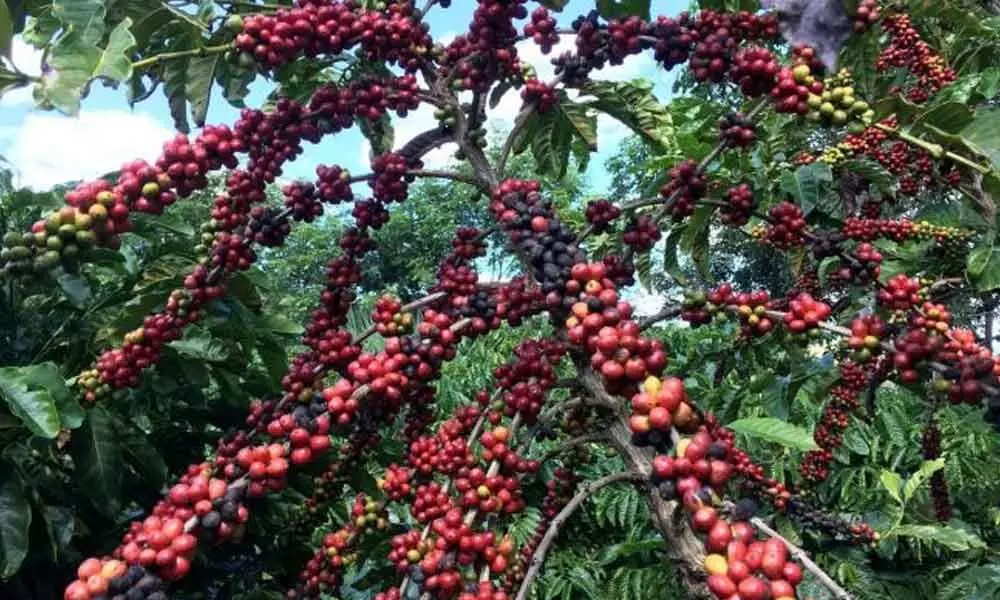
Pesticides residues were found in a huge amount in the coffee powder exported to European countries. Following this, the Coffee Board has directed the farmers to control the use of pesticides on crops.
The European countries have informed that the pesticides are detected in the coffee powder and advised not to export similar products again. In this context, the Coffee Board has warned the farmers that the European countries and other importers will ban the import of Indian coffee if a similar quantity of chemical components were detected again in the products.
The pesticide Chlorpyrifos has been detected in an excess amount in the coffee powder exported from the country. Instead of Chlorpyrifos, another pesticide Phenthoate 50 EC can be used by mixing 400 millilitres of it in 200 litres of water with 200 millilitres of glue.
The Coffee Board had recommended the use of “Chlorpyrifos 20 EC at the dosage of 600 ml in 200 litres of water along with 200 ml of any wetting agent may be used just prior to the flight periods or during the early part of the flight period,” as a “last resort.”
The Kodagu coffee growers have been demanding free electricity supply to up to 10 HP pump sets installed in coffee estates across the district.
Karnataka CM Basavaraj Bommai (Photo | Special arrangement)
Madikeri :
The state government has announced a subsidized power supply to up to 10 HP pump sets installed in coffee estates in Kodagu. The decision was announced by chief minister Basavaraj Bommai during the Zero Hour of the state Legislative Assembly. The request for the same was raised by Kodagu MLA Appachu Ranjan.
The Kodagu coffee growers have been demanding free electricity supply to up to 10 HP pump sets installed in coffee estates across the district. While assurances had been extended by the state, the same had not been sanctioned. On Tuesday, MLA Appachu Ranjan raised the issue during the Zero Hour of the legislative session and he was supported by MLA KG Bopaiah, MLA CT Ravi and MLA Kumarswamy.
The legislators argued that the district supplied Cauvery water to the state, but it has been neglected. They argued that while tobacco and areca nut estates are eligible for power subsidy, coffee has been neglected and ignored.
Following these discussions, CM Basavaraj Bomai said, “Power subsidies extended by the state are increasing every year and it adds up to Rs 12,000 to Rs 14,000 crore. However, we understand the problems of the coffee growers, and following the discussion with the power minister and other ministers, the state will grant a subsidy to the power supply to up to 10 HP pump sets installed in coffee estates. However, terms and conditions will be released to control misuse of the same.”
source: http://www.newindianexpress.com / The New Indian Express / Home> States> Karnataka / by Express News Service / March 22nd, 2022
Maverick & Farmer Coffee opens its doors to all the coffee lovers in Bengaluru, offering a farm to cup café experience. The café serves a collection of coffee from the brand along with international cafe food. With the distinction of being the world’s first café painted with coffee, the place is a haven for coffee enthusiasts.
The centrally located café, with a serene open-air seating area, spans over 5000 sq. ft. overlooking the green expanse of the Rbanm’s Grounds. As you enter, along with the waft of freshly ground coffee, you come upon a wall that dons an interactive art experience.
Created by muralist and mixed media artist Jessica George who captures the essence of the café in a larger than life format. The coffee flower, cherry, beans and the espresso extraction are brought to life with splashes of vibrant colour with a coffee swing perched at one end that makes for a great photo opportunity.
Homegrown coffee brand is one of India’s few bean to cup companies. With decades of experience and a legacy in coffee farming, the brand conducts experiments in its estate in Pollibetta, Coorg that serves as a laboratory where some of the most inventive brews are conceptualised by the best minds in the business.
Novel flavour profiles and tasting notes are thus brought to the café with brews and blends like the – Cinnamon Almond Coffee, The Parama Cappuccino, Vietnamese Coffee, The Coffee Cherry Soda, made from the fruity part of the coffee cherry, this drink is refreshing, fruity and contains antioxidant, The Clarified Cappuccino, an 8 oz cappuccino made with the perfect milk-espresso ratio is ‘clarified’ using a technique borrowed from a different stream of food science.
What the drinker experiences is a near-clear ‘cappuccino’ infused with some fruit flavours and rosemary and last but not the least, The cold smoked coffee, served in a carafe filled with fruit-wood smoke (wood from their estate in Coorg), made using a unique and indigenously developed process to infuse cold smoke into harvested coffee cherries.
Ashish D’abreo, founder-partner at Maverick & Farmer Coffee, said, “The idea is to create something maverick, while sticking to the traditional Indian technique of coffee making. We grow and roast our own coffee to create artisanal blends using unique methods and techniques. Our in-house experiments like cold smoking and fermenting break the mold to give you a burst of fresh flavour profiles.”
Along with exceptional coffee, the cafe serves international cuisine – from The Square Burgers, Pastrami Sandwich, Pulled Pork Sandwich to Chocolate Banana Cake and Apple Pie; it’s the perfect space to hang out and unwind with a cup of coffee and terrific food.
Sreeram G, founder-partner, who has a background in advertising and branding, talking about the experience at Maverick & Farmer Coffee, said, “We aim to serve perfection in brewing to a third-wave of coffee drinkers in the city. The café tells you the story of how our coffee travels from the heart of Coorg to swanky Bangalore. It showcases our myriad coffee creations using some pretty cool single-serve brewing equipment. The food menu is light and complements our coffees while the open space of the café ensconced in greenery charms you with old Bangalore vibes.”
source: http://www.fnbnews.com / FnbNews.com (Food and Beverage News / Home> Top News / by Fnb News Bureau, Bengaluru / March 16th, 2022
The story of the coffee in India began in 1670, thanks to a Sufi named Bada Budan who was responsible for bringing it to the country.
Two hundred years after that, and with the intervention of British entrepreneurs, coffee was already becoming an important and commercial crop, planted in more than 40 estates, including the Nilgiris Biosphere.
This evolution led to the creation of The Coffee Board, an organization in charge of facilitating research, marketing, and distribution of coffee plants to the indigenous communities of the district. For a farmer, a day starts with a dark roasted coffee concoction mixed with jaggery.
Robusta and Arabica are the two types of coffee cultivated by farmers in The Nilgiris district. The coffee plantations grow at an elevation of 3500ft above sea level.
They are shade-grown and are intercropped with various crops like Silver Oak, Mango, Jackfruit, Millets, and Spices. The indigenous communities use traditional agricultural practices to grow and harvest coffee.
Bio-Organic inputs such as Panchakaaviya and Poochiverati, a concoction made by themselves are used in coffee cultivation. The producers use leaf litter as manure.
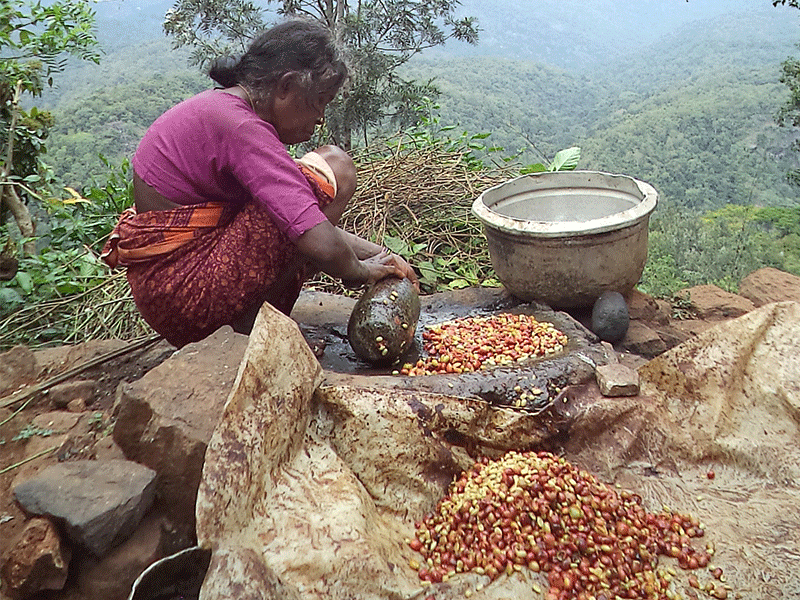
The harvest which is usually between November and March has seen a huge change recently due to varied rainfall, and it’s quite often hindered by Wild Boars and Elephants. Monkeys are also a huge problem for the villagers. The harvest is done usually by the family members who carefully strip the cherries which are then sorted and pulped manually.
Pulping in a few villages has been made easy by the coffee board by providing machines to help with the process.
There is also a provision at the Production Units of Aadhimalai where the community can use the pulping machine and the drying yard. The Coffee parchment is then dried on the rooftops and in the front yards of their houses and is roasted manually as need be.
The rest of the coffee is then sold to Aadhimalai which is an indigenous community-owned Producer Company.
The community farmers sell coffee in every possible form, be it Coffee Parchment, Cherries, Dried Cherries, or Green Beans. The average yield of Coffee in the community-owned farms would come to around 35 tons. A premium price is paid to the producers.
The coffee has a certification PGS (Participatory Guarantee System). The Keystone Foundation plays a big role in facilitating the PGS certification which is a peer review system. The coffee at Aadhimalai is then marketed through Last Forest Enterprises as Roasted Beans and Coffee Powder. However, most of the coffee is sold as parchment to other dealers.
These processes have enabled the farmer to get the best price in the market.
Aadhimalai Pazhangudiyinar Producer Company Ltd
Aadhimalai Pazhanagudiyinar Producer Company Limited (APPCL) has been initiated to anchor livelihoods of indigenous communities by encouraging traditional organic food farming, handicrafts, livestock rearing, sustainable harvest of forest produce, conservation of natural resources, thereby securing the well-being of the landscape, value addition of harvests and trading. It is a company completely owned by the indigenous communities, one of the first of its kind at a national level.
Last Forest Enterprises
Last Forest is a social enterprise that was incubated by Keystone in the year 2010. Through its operations, the company supports indigenous communities to sustain themselves by empowering their skill sets and bringing economic growth.
Keystone Foundation
Keystone Foundation works with the indigenous people and local communities as their primary stakeholders and extends to various aspects of socio-ecological development that are categorized under Community Wellbeing, Biodiversity Conservation, and People and Nature Collectives.
source: http://www.slowfood.com / Slow Food / Home / by Jestin Pauls / March 08th, 2022
The board that greeted us at the end of our 200km-odd journey from the heart of Bengaluru said School Estate. But that wasn’t our final destination, is what we realised soon. That would be School Thota, a division of School Estate, and a few hundred metres into the estate, we saw a smaller board directing us to it.
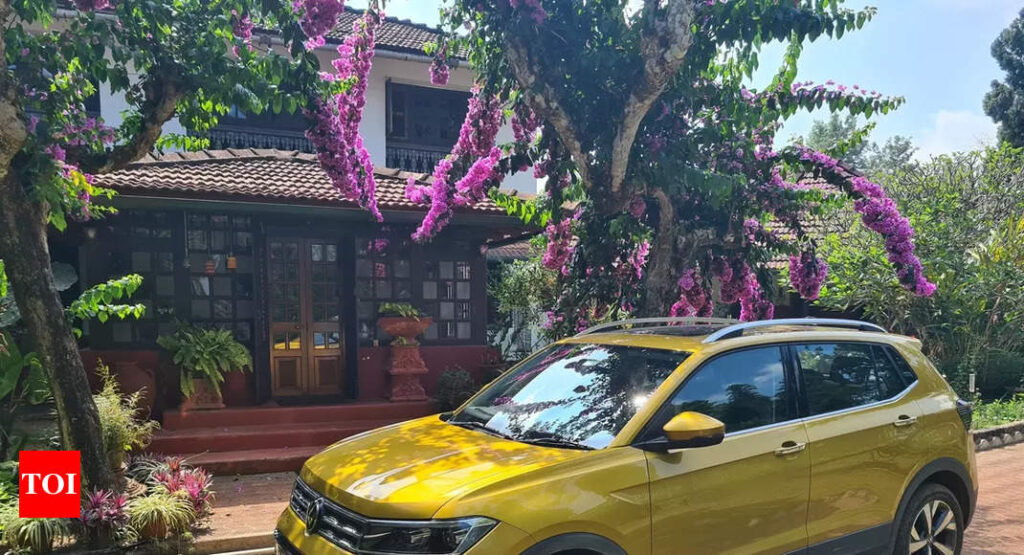
Thota roughly translates to garden in the local Kannada language. Of course, like many other places around India, there is a local language (not dialect) just for Coorg too. There are many further distinctions and groups within locals here, such as Kodavas, to which the family that owns School Thota belongs. Surely, there are many equally beautiful plantations and homestays in Coorg. But what caught our fancy on this particular drive of Volkswagen’s impressive new Taigun is the story of a German reverend who is associated with the early history of this place, including the reason why it ended up being called School Estate.
Georg Richter was the principal of a local Mercara High School. He was instrumental in mobilising local leaders in the field of education. Under his guidance, they came together and collected money to purchase around 350 acres of land for Rs 3000 back – a princely sum back in the 1860s. The aim was to fund the school with yield from the coffee and other plantations, hence the name School Estate. Since Richter was in charge, the house on the property also was built to his liking. While earlier it was only a makeshift place for the occasional visitors, the subsequent owners kept the core structure intact and built a seemingly European-style Indian home first for themselves and now extended to guests interested in soaking in nature and School Thota’s heritage.
Coorg is one of the places that still rely on roads for its connections. The drive from Bengaluru to its centre, Madikeri, is a mix of choc-o-bloc metropolitan roads followed by a busy but reasonably fast Mysore highway that you leave after Srirangapatna for a more picturesque country road interspersed with short stretches of busy towns. It was a mix that helped the versatility of the Taigun shine through. Volkswagen offers this made-for-India SUV in two engine and three gearbox options. While we took what was on paper, the smaller 1.0-litre TSI (114bhp/178Nm) coupled with a six-speed torque converter gearbox revealed the variety of traffic and road conditions. One of the biggest clichés busted was it doesn’t tire under relentless highway driving. A frugal fuel consumption figure meant we could do the entire stretch without a fuel stop en route.
Coorg roads are typically narrow and twisty, and the agile Taigun seemed up for some confident driving. Patches of bad roads were dealt with ease, as the Taigun feels planted on the move, just like its bigger stablemates. The solid German connection is there to see.
Inside School Thota, we had many glimpses of the European connection too. Its current owners – the Aiyappa family, is led by 81-year-old Saraswathi, who runs the show along with her son Kushalappa. Together not only do they manage half of the School Estate (the other half bought by another local family a few generations ago) but also keep the homestay’s heritage intact.
“The doors of this homestay are the original ones,” said Saraswathi Amma. She also pointed out that they were much larger than the entrance door, which was an extension added to the School Thota structure after the Indian family took over. “Typically, Germans are taller, which explains the bigger doors. Moreover, for us, we bend or hunch a bit and enter the house. This is also about showing respect to the house, which is a temple of sorts for us,” she pointed out. Keeping tradition alive is one of the motives of such homestays around Coorg so that you can see many old artefacts and even furniture tastefully retained here. At School Thota, even a European-style fireplace reminds you of the kind of the early occupants of this structure.
Coorg is an extremely ecologically sensitive area, and its locals try hard to maintain the balance between earning from the soil and keeping it sustainable. Plantations are not only home to various kinds of flora and fauna but also the livelihood for many locals. Agriculture in today’s times can be challenging, but families running the show have tried to improvise and keep the fire going in their Indianised versions of the colonial way of life. A few have even managed to hold on to the original way of life, just like a Taigun does by keeping a Volkswagen badge’s core values intact in an SUV that’s completely at home in India. Its Volkswagen genes are unmistakably apparent despite being born and brought up in India.
It took a visit to this place to reiterate and experience this first hand. Lesson learnt by going back to school… auf wiedersehen.
Contributed by Girish Karkera, Consulting Editor – Times Auto · Bennett Coleman and Co. Ltd.
Disclaimer: The article has been produced on behalf of Volkswagen by the Times Internet’s Spotlight team.
source: http://www.timesofindia.indiatimes.com / The Times of India / Home> Spotlight / by Girish Karkera / March 10th, 2022
From an abandoned barren land to a green lush private sanctuary, author Pamela Malhotra recounts the transformation.
Bengaluru :
Pamela Malhotra’s From the Heart of Nature (`599, Penguin Random House) documents the story behind the creation of a private forest sanctuary in India. More than just the struggle, Malhotra also recounts how she connected with animals and trees both at a physical and spiritual level.
What was the turning point in your life?
My husband Anil and I shared that love of wildlife and that dream. This realisation initially came while living in the USA in the late 1970s and early 1980s, which is why we established our first small wildlife sanctuary on the Big Island of Hawaii in 1979. When we came to India in January of 1986, we were quite upset by the deforestation we saw, especially in the Himalayas. We had gone to Haridwar and fell in love with the Himalayas. So, we purchased land in the Uttarkashi region to help reforest that area.
How did you zero-in on Kodagu?
There were land ceiling laws in the state (then Uttar Pradesh – now Uttarakhand) that limited a family to owning just 12 acres of land. There was not enough land for establishing a forest wildlife sanctuary through reforestation. Also, we had visited Nagarhole National Park in Jan 1986, where the then-Wildlife Warden of the Park urged us to establish our forest wildlife sanctuary in his home district of Kodagu. As a result my husband Anil travelled throughout southern India to see what he could find, finally finding suitable land in Kodagu. Purchasing larger pieces of land was possible here if the land was deemed ‘plantation’ and the purchaser was an agriculturalist which my husband was.
What were the initial struggles that you faced?
Accessing the land. It was almost impossible to bring in any kind of building materials for our home in the beginning due to the poor roads. So, my husband put loads of rocks and other road material into these dirt roads to help give us drivable access which was also a big boon for the local people. Another major challenge was the legal maze encountered in the district since lands were divided into several different categories, often with different rules/laws applying to different categories in terms of purchase and ownership. Acceptance by the local people was also initially a challenge, although the older generation did understand the importance of maintaining forests and not killing off all the wildlife. The most distressing challenges have been illegal logging and poaching of wildlife.
The sanctuary is spread across 300 acres, what are the kinds of species that are found there?
Hundreds of species have made the sanctuary their full-time home and/or come visit frequently. A short list of species found here includes 100s of species of butterflies and birds including Great Indian Hornbills and Malabar Grey Hornbills, Bengal tiger, Asian leopard, Asian elephant, sloth bear, dhole (Indian wild dog), Gaur (Indian bison), species of deer (sambar, cheetal, muntjac/barking deer) etc. So diverse are the species found here that one Oxford scientist dubbed our sanctuary ‘Noah’s Ark’.
You first purchased the land for the sanctuary in 1992, to create a private sanctuary. How did you decide on writing a book?
I hope to sow the seeds of love of nature in the hearts and minds of all who read the book, and to create a sacred perspective when viewing and dealing with nature.
source: http://www.newindianexpress.com / The New Indian Express / Home> Cities> Bengaluru / by Monica Monalisa, Express News Service / March 02nd, 2022
A typical plantation walk in one of Coorg’s large coffee estates, in fact, is nothing short of a treat to all five senses.
New Delhi:
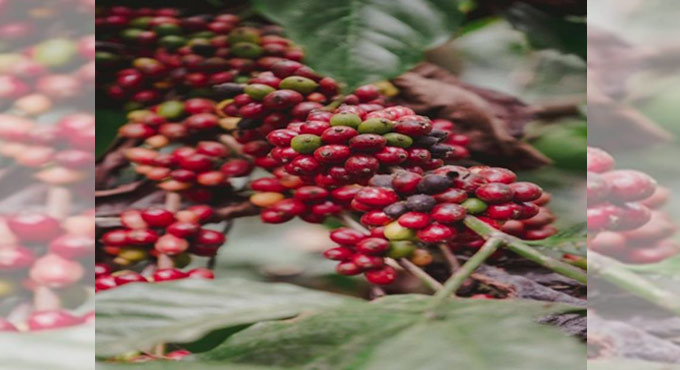
In India’s coffee heartland Coorg, which is at a driving distance from the city of Bengaluru and nestled in the densely forested Western Ghats, February is the season to find abundant coffee trees laden with small crimson and green berries that hold inside them two green beans each. It is in these Karnataka-based coffee plantations, that many of the flavourful and aromatic coffee beans originate, before they are dried, roasted and ground into the perfect cup of coffee in your hands.
Coorg, locally known as Kodagu, can often be found on the bucket lists of seasoned travellers for its tranquil setting, biodiversity, delicious Kodava cuisine and large-scale cultivation of Indian coffee. A forthcoming luxury destination, the southern hill station has unmatched experiences that go beyond tourism-as-usual.
For those interested in experiencing first-hand, the crop-to-cup process of coffee in India, the local hospitality options do offer plantation walks and trails that have you immersed in the native experience.
In an ecologically diverse and sensitive region like Coorg, threats to the forest ecosystem are aplenty, and are prone to multiplication with additional construction to support the consumerist traveller’s lifestyle.
The homestay experience, then, comes as the perfect fit for the region and is growing by the year. Allowing one to lodge up in close proximity to the natural environment and coffee crops within the estates themselves, while observing all Covid-19 precautions, options on Airbnb in Coorg are something new-age travellers must check before heading to the beautiful southern coffee county.
A typical plantation walk in one of Coorg’s large coffee estates, in fact, is nothing short of a treat to all five senses.
As one walks along a narrow network of tracks lined by trees of Robusta and Arabica coffee species, along with cultivations of arecanut, pepper and cardamom, the calls of Coorg’s diverse bird species are unmistakable in the background. According to Ganesh H R, a local bird expert popularly termed the Bird Man of Coorg, over half of India’s overall bird species can be found in the region, along with birds like White-cheeked barbet, Malabar barbet and Malabar grey hornbill that are endemic to the region. The place is also a great spot for serious bird-watching.
Surrounded by a tall canopy and clear blue skies difficult to find in urban jungles, walkers are greeted with the smell of flowering coffee shrub and ripened coffee berries along the way. In some trail experiences, enthusiasts may be invited to participate in coffee berry harvest — picking bunches of red and green berries off the branches onto a wide-based container below.
In experiences bookable on Airbnb, such as the farm-to-cup experience on FiveFarms Coffee, one can step into the shoes of a coffee grower and help with jobs like transplanting young plants from the nursery, checking for fragrant coffee blossoms or picking ripe red berries. The beans are then dried in the sun before processing it mechanically into the final product. Visitors can also experience roasting and take back roasted batches of beans.
source: http://www.telanganatoday.com / Telangana Today / Home / by IANS / February 27th, 2022
The Arabica Parchment coffee price has soared to an all-time high of Rs 16,200 per 50-kg bag on Thursday, in Somwarpet and Chikamagalur markets.
Madikeri:
The Arabica Parchment coffee price has soared to an all-time high of Rs 16,200 per 50-kg bag on Thursday, in Somwarpet and Chikamagalur markets. A large-scale destruction caused by snowfall to the similar coffee variety in Brazil, the largest producer of the crop, has come as a blessing in disguise for the growers here.
According to traders, normally, this coffee variety commands a price of Rs 10,500 to 11,500. Similarly, the cost of Robusta Parchment has touched Rs 7,600 per bag. The last time when Arabica coffee reached the highest price was in 2014 when it sold at Rs 9,600-Rs 9,800 per bag. The price saw a downward trend and touched Rs 6,000.
The prices of Arabica Cherry and Robusta Cherry have seen a marginal rise in price. They command a price of Rs 7,500-7,600 and Rs 3,800-Rs 4,100 per bag respectively. Growers in Kodagu, Chikkamagaluru and Hassan are elated over rise in the prices of coffee, despite problems of shortage.
Coffee was bought and exported by the government through the Coffee Board before growers were allowed to sell their produce directly in the open market since 1992, following protests by them.
December to April is the time for coffee harvesting and 90 percent of growers sell the produce before the beginning of the rainy season due to the price fluctuations and lack of warehousing facilities. The total annual coffee production in the country is approximately 3.6 lakh tonnes. Most of the Arabica growers have already sold their produce.
Speaking to The Hans India, a coffee exporter and promoter of AWIT Innovations (P) Ltd in Kushalnagar, Rajiv Kushalappa said that the price fluctuations are likely to increase in the near future due to prevailing international market conditions. According to him, the rise in the price was fallout of crop loss in Brazil following heavy snowfall. Ratan Machaiah, a coffee grower in Gonicoppa, said that the cost of production of coffee has increased significantly in recent years and growers are in a distress.
The wages of labourers, cost of fertilisers, pesticides, etc., have doubled over the past decade, but the price remains the same. The growers are gambling on unpredictable climatic conditions year after year. He has urged the government to support the growers by announcing a special package.
source: http://www.thehansindia.com / The Hans India / Home> News> State> Karnataka / byCoovercolly Indresh / Hans News Service / February 10th, 2022
If you are fond of roaming and live in India, you can visit many of the best places in India. If you are a coffee lover, today we are going to tell you about places in India where you will enjoy visiting and you would love to go there again and again.
* Wayanad is a beautiful place in Kerala. People often go for a walk here. However, apart from romance, this place is one of the coffee places in India. You can enjoy the lush green coffee plantations here if you want.
* Coorg is considered to be the pride of Karnataka, although it is home to many coffee gardens that produce Arabica and Robusta. In that case, if you are planning to visit here, the month of November will be the best. Well, everyone must go here once.
* Chikmagalur in Karnataka is the best place. It is famous among tourists for its beautiful views. Coffee was first introduced in India during the British Raj, situated a few hours away from Kurdish. There are a variety of coffee gardens.
* Arku is a beautiful place in Andhra Pradesh which is also excellent for sightseeing. Thousands of tribals here depend on coffee cultivation. If you are ever going to Arku, be sure to taste the organic coffee grown by the locals here.
* Yarcaud is in Tamil Nadu and is called the jewel of South India. In fact, there are many coffee gardens, so if you ever visit here, you must take advantage of the coffee garden once. It is also said to be home to MSP coffee, the first Indian owned coffee plantation ever.
source: http://www.english.newstracklive.com / News Track / Home / by Arpit Birtharia / January 13th, 2022
TATA Coffee Grand celebrates the unique sounds of the harvest festivity this Pongal along with its ‘Shik Shik Shik’ campaign
Coimbatore :
TATA Coffee Grand, the coffee brand from the house of Tata Consumer Products continues its celebration of bringing out the emotions and excitement associated with coffee in Tamil Nadu. In line with this, the brand has released a festive film celebrating the various sounds that reflect the unique spirit of Pongal with the ‘Sounds of Tamil Nadu’ campaign of Tata Coffee Grand.
The vibrant film is a montage of various visuals and sounds that are associated with the Pongal festival; the crunch of sugarcane, the clink of children’s anklets, and the musical echoes of the ‘kulavai’ among others. Replete with sumptuous Pongal delicacies, family gatherings, and a splash of rich hues that the Tamil culture is well-known for, the film concludes with the thought, ‘How can any festive meal be complete without coffee and the emotions associated with it?’
Talking about the film, Puneet Das, President – Packaged Beverages (India and South Asia), Tata Consumer Products said, “Our campaign of Tata Coffee Grand launched last year, synonymizes the word ‘Coffee’ with the sound i.e. Shik-Shik-Shik – which represents the sound heard when the Tata Coffee Grand jar or pack is shaken! We have gone a step ahead this year and have extended the ‘shik shik shik’ proposition to the sound of the Pongal festivities, to capture the excitement of the festival along with the emotions of drinking coffee. These festivities are not just reflected in the visuals but also in the unique sounds that reverberate throughout the harvest season. In highlighting this, we are happy to launch our new film which doubles up as a feast to the senses and has a distinct sound design that celebrates the festive taste of Tamil Nadu”.
Commenting on the campaign idea, Sonali Khanna, Executive Director and Branch Head, Lowe Lintas South said, “Pongal is a festival that the people of Tamil Nadu hold very close to their hearts, resulting in a joyous tapestry of celebratory sights and sounds. What’s striking is that many of the authentic sounds of Pongal are expressed as triplets. This is exactly the same aural mnemonic we have used to bring our product USP to life: the ‘Shik Shik Shik’ of the packet representing the Tata Coffee Grand crystals. The wonderful interplay of musical triplets, the rich festive hues, and the catchy sound of the pack, all come together seamlessly. To create a film that is as aurally arresting as it is visually resplendent.”
source: http://www.covaipost.com / The Covai Post / Home / by Covai Post Network / January 14th, 2022
WELCOME. If you like what you see "SUBSCRIBE via EMAIL" to receive FREE regular UPDATES.
Read More »