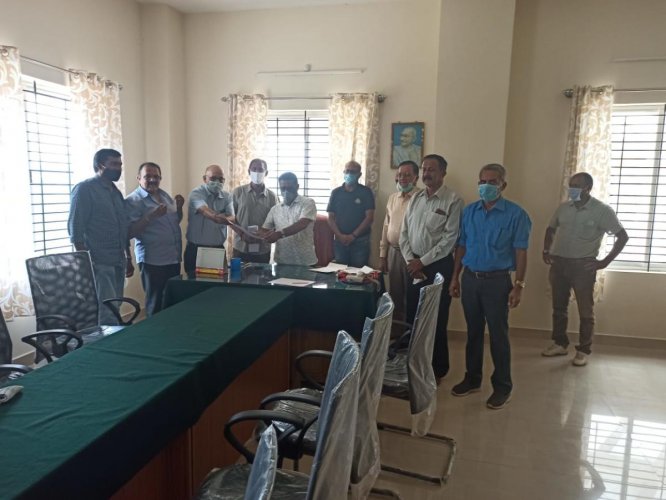
Members of Kodagu district Growers’ Federation submit a memorandum to MLA Appachu Ranjan. DH Photo
Coffee growers in the district have demanded special package from state government, as planters are facing hardships in the wake of Covid-19 lockdown.
Members of the planters’ association have submitted a memorandum to the MLAs of the district in this regard and have urged chief minister to come to their rescue.
Kodagu district is affected by floods for past two years and the lockdown has worsened the situation, they said and pointed out that harvesting of coffee and pepper in most of the plantations had come to a standstill, resulting in the loss of crops.
It is feared that next year’s yield too will be lost as the growers are finding it difficult to maintain of their plantations.
The growers urged the government to provide special package for the coffee growers.
Vegetable and plantain cultivators too sought assistance from the government, stating that most of the cultivators in the district have been dependent on Kerala market. But, due to the lockdown, the fruits are getting rotten and has led to a huge loss.
The government should announce support price and should procure ‘Nendra’ banana and other fruits from the farmers, the growers said and also requested the government to waive the interest on the loans availed by them.
“A committee of elected representatives should be formed towards formulating plans to encourage farmers to take up cultivation in barren lands,” the memorandum stated.
source: http://www.deccanherald.com / Deccan Herald / Home> State> Mangaluru / by DHNS, Madikeri / May 08th, 2020
The Karnataka district is a rich blend of history and hospitality
Coorg coffee is grown at a high altitude and under a well-defined two-tier mixed shade canopy / Picture: Karen Anand
I recently visited Coorg in southern India. And as my dear husband keeps saying, I immerse myself so wholeheartedly wherever I am that I invariably want to move there… or at the very least make plans to revisit very soon! Coorg is no exception.
About 250km from Bangalore, it’s an area with a sense of nobility and belonging, of dense forests, coffee plantations and some spectacular estates. The terrain is very, very different from the rest of south India. As you take the gentle climb from the plains to Coorg, or Kodagu as it is now known, you have beautiful mountainous rocks, areca palms that produce betel nut, palm trees and then paddy — it’s a really stunning scape that looks like a painting at every glance.
The capital of Madikeri or Mercara as it was called before, looks like a town like any other town in India, but as you dig a little deeper, visit the vast estates and eat with locals, you find a generosity of spirit, an unbelievably high education level (almost 100 per cent literacy) and a joy of preserving traditions… and that includes food.
Coffee and spices
Kodavas look physically very different to people from Karnataka and the neighbouring Tamil Nadu. They are traditionally warriors, hunters and now landowners. Their livelihood is mainly coffee and this area of just 5,000sq km is the largest coffee-producing area in India. History has it that there was a gentleman called Baba Budan who brought coffee beans to the Chandragiri Hills in Chikmagalur from Yemen in the 17th century. Then the British came in the 19th century and found that this was a crop that could be exploited since conditions for growing coffee were pretty perfect. That was the birth of widespread coffee plantations and coffee farming in this area.
Coorg coffee is grown at a high altitude and under a well-defined two-tier mixed shade canopy. Among the bigger evergreen trees are tall jackfruit, rosewood and wild fig trees which protect the coffee from seasonal variations in temperature and also enhance the soil by providing nutrients from deeper layers. The second layer is pepper, cardamom, cloves, orange and banana. It also protects the coffee from the harsh rays of the sun in summer. Conditions are similar in Colombia and Kenya, considered the best coffee-producing regions in the world.
Coorg is known for “spicy” food. There are lots of spices in their spice mixes — pepper, cardamom, cloves and the tiny bird’s eye chilli known as parangi. Spices are roasted and ground, which gives complexity and density of flavour to their dishes, both vegetarian and meat. Although Coorg is known for the famous pork dish, pandi curry, which is a specialty, there are a host of vegetable dishes that use local vegetables like bamboo shoot, wild mushrooms and a kind of red-leafed spinach, all quite delicious and different.
The method of most of their cooking is roasting and dry-grinding spice combinations, which are thrown into a pot of meat or vegetables with a little black vinegar from the kachampuli, a very sour mangosteen-like fruit which is dried till it’s black and from which an intensely sour vinegar is made. Rice is the staple grain and is eaten as is or made into dumplings with coconut and steamed (kadambuttu), rice rotis and rice cakes (paputtu).
Contrary to what I have up to now believed about food in five-star hotels, the cuisine at the rather magnificent and spanking new Coorg Wilderness Resort exceeded all my expectations. It was beautifully served and tasted like real home cooking. From painstakingly researched local recipes to produce wondrous Coorg lunches to the perfect Chicken 65 and velvety fish molee, chef Ranjan and his team nailed it every time. It poured while we were there but the resort itself is something quite fantastic in terms of space and facilities. So if you do want to experience the wilderness, want to have a memorable lunch set in the middle of a forest and come back from a plantation visit to the comfort of a heated bathroom floor and a glass of Paul John single malt, this is the destination for you.
Plantation life
A one-stop shop in Madikeri for all things Coorg is the utterly delightful AINMANE (www. ainmane.com). Thamoo Poovaiah and his partner Narendra Hebbar started the shop four years ago. They source local products like coffee and chocolate made from south Indian cacao beans. You’ll get a brilliant espresso here and have the opportunity to try many blends before you buy.
They produce and package pickles and squashes (passion fruit is a local delicacy), spices and the most extraordinary honey. The problem with Coorg coffee is that half the world’s great brands use Coorg beans in their roasts and blends. The Coorg plantation owners themselves seem content to sell their raw green Arabica and Robusta beans and leave it to others to create the magic, do the marketing and reap the benefits.
We went to Petu Kariappa’s enchanting 100-acre estate called Harangal in Madapur — by Coorg standards this is small. He is one of the few farmers who successfully grows the much-sought-after “diva” of coffee beans, Arabica. The beans are much more difficult to grow than the better yielding and bigger bushes of Robusta. Like many growers, he washes, removes the pulp and dries his beans and sells green coffee to bigger companies who then cure, roast and blend.
We also visited Sadat Sathak, the young man behind Old Kent Estates. One of India’s oldest coffee plantations, it was developed in the 1800s by lieutenant colonel W.R. Wright, an army officer in British India. After his death in 1898, the property remained with his family until 1964 when it was bought by its present owners. Sadat has studied abroad, speaks fluent Italian and has an MBA. It shows. He already successfully exports his beans to Italian coffee companies. The stunning little British-style bungalow has been restored and converted to a boutique hotel with spacious cottage accommodation (the bathrooms are large and built with skylights designed to allow you to have a private spa-like experience) and an English country garden.
We had lunch at the much-talked-about Evolve Back (aka Orange County Resort). It does all it promises in keeping with tradition and nature. And I must say for a 25-year-old property, it has sustained and still gives an excellent level of hospitality.
The rain unfortunately hampered our plans to see more but I will go back and so should you.
Karen Anand is a culinary consultant, food writer and entrepreneur. In recent times her name has been synonymous with farmers’ markets. Follow her on www.facebook.com/karenanand
source: http://www.telegraphindia.com / The Telegraph, online edition / Home> Travel / by Karen Anand / November 02nd, 2019
Coffee Growers Association President M B Devaiah said that the association will make proper arrangements for the storage of coffee if the District Central Cooperative Bank provides a loan of Rs 1 crore.
Addressing reporters in Madikeri on Wednesday, he said that following the lockdown, coffee growers in the district are not able to sell the coffee they have cultivated.
He further said that the raw coffee has not been supplied to the coffee processing unit in Hunsur, in the required quantity.
“Therefore, coffee warehouses have been given to coffee growers on rental basis, to store coffee. Still, there is a shortage of warehouses. A request has been made to provide APMC godowns in Madikeri and Gonikoppa for the growers to store coffee, free of cost.
Also, there is a requirement of an interest free loan of Rs 1 crore, through the DCC bank. The chief minister should come to the rescue of coffee growers,” he said and added that transport facility should be provided from Hunsur.
source: http://www.deccanherald.com / Deccan Herald / Home> State> Karnataka Districts / by DHNS, Madikeri / April 08th, 2020
An excerpt from Harish Bhat’s book “An Extreme Love of Coffee”. Harish Bhat is the author of the bestselling book “Tatalog” and chairman of Tata Coffee Ltd.
Author Harish Bhat. Harish is chairman of Tata Coffee Ltd. and brand custodian of Tata Sons Pvt. Ltd.
Three shrines of coffee have I now foreseen, three goddesses that nurture our love for the bean. From river to ocean, each shows you the way. Find me these shrines, and then will I say: Here’s my treasure, let it fill up your day.
Rahul read the lines aloud to Neha for the tenth time that morning. What did they actually mean? Both of them looked at each other silently and acknowledged that they were stumped. Totally clueless.
Outside, dawn had broken and they could hear the high-pitched charr-charr notes of a single woodpecker breaking the stark silence of the coffee plantations around them. Inside, most of the coffee beans had fallen off the bed and were strewn all over the floor. It had been a memorable night and now they knew for sure that coffee was a great stimulant.
But where was the stimulant that would help them figure out this puzzle, one written by a mysterious monk who had died long ago, leaving a great treasure hidden? Where were these three shrines that the monk had spoken of? Where exactly should they begin?
Pooviah brought them their morning coffee in an elegant tray with a pot and two cups of white bone china. ‘Sir, I used those pink coffee beans you gave me to make coffee for Madam and for you today. The smell of this coffee is getting better with each passing day, Sir.’
The old woman’s coffee! In the midst of all the other excitements of the past two days, Rahul had nearly forgotten about this. ‘Yes, yes, Pooviah, please pour coffee for us.’
The walnutty flavour came back to them once again. Superb! As they sipped the coffee, Neha leant back and read the puzzle once again. Suddenly, she could clearly see the author himself, the venerable monk. He appeared vividly in her mind. Orange-robed monk, fat, bald and peaceful, walking somewhere. Where was he walking to? And then, behind the monk, she saw flowing waters. A few words from the puzzle swam in front of her now-dilated pupils: From river to ocean, each shows you the way.
She sat up with a start. ‘Rahul, listen. Listen to me. We need to go to a river, one that will show us the way to the first shrine. That’s what the monk meant when he wrote “from river to ocean”. The river first, and then the ocean will show us the way. That’s why he put those words in his note, to give us a clue. I can see him in my mind, Rahul. He is walking by that river, right over there, right now.’
Rahul glanced at the lines once again. What Neha said made sense. They had nothing else to go on anyway. Then, he remembered something, a local guidebook kept in their room that he had briefly gone over yesterday. It spoke of a river nearby. He went into the room, brought out the small guidebook, turned a few pages, and began reading aloud:
The Kaveri is the patron goddess of all coffee growers in Coorg. Flowing through the beautiful coffee plantations and nurturing them like her own special children, the Kaveri is the great river of this region. Originating in the foothills of the Western Ghats, the river meanders through the region of Coorg and the vast Deccan plateau before it eventually flows into the Bay of Bengal. The Kaveri quenches this region’s thirst for water and makes it one of the most fertile lands known to mankind. From these lands of the Kaveri come some of the finest coffees the world has ever known.
Rahul turned to Neha. ‘Neha, I think you are absolutely right. We must go to the Kaveri. That’s where we will begin.’
He continued reading the guidebook.
The Kaveri is not merely a river, but a goddess who is worshipped by everyone in this coffee growing region of Coorg. The unique coffee of Coorg springs from the sweet waters of this sacred river. Coffee requires a lot of water for its flowering, and the Kaveri provides it in abundance. The varieties of coffee grown on the fertile banks of the Kaveri are known for their robust body, light acidity and soft liquor, making them some of the most sought-after beans in the world.
Rahul paused here, absorbing this beautiful description of the coffee. ‘Robust body, light acidity, soft liquor, wow! I must taste these coffees from the banks of the Kaveri.’ Then he saw something in the guidebook which made his pulse quicken. He read it out in hushed tones:
There are many shrines built for the Kaveri, to worship and celebrate this goddess, who is the presiding deity of the region. The best known shrine is located at the source of the river called Talakaveri. The river originates near this shrine, as a spring, and the water then flow underground to emerge as the magnificent Kaveri some distance away. The road to Talakaveri is surrounded by coffee plantations and suffused by the intoxicating aromas of coffee. Many monks and holy people visit this shrine throughout the year.
Rahul turned to Neha. ‘We must go to Talakaveri, Neha. I am sure that is where our Japanese monk has left directions for us. He must have visited this shrine and left something there. This is a shrine of the river that nurtures coffee, and so it is a shrine of coffee itself. That is what the monk must have meant. This is where our search must begin.’
Excerpted with permission from An Extreme Love of Coffee: A Novel, Harish Bhat, Penguin India. Read more about the book here and buy it here.
source: http://www.thedispatch.in / The Dispatch / Home> Book House / by Harish Bhat / March 30th, 2020
Tata Coffee Limited, a subsidiary company of Tata Consumer Products Limited announced the launch of its e- commerce platform www.coffeesonnets.com.
The website debuts with three unique variants of luxury single origin specialty coffee named ‘The Sonnets – Voice of Our Estates.’ Through this online platform, Tata Coffee aims to make its finest estate coffees available to consumers across India. These single estate coffees are processed uniquely with great care, undergoing intense sensorial evaluations by expert tasters. Only the finest and the rarest coffees are carefully selected to be used in The Sonnets range of coffees, showcased this season.
The coffees are directly sourced from two of Tata Coffee’s 19 estates located in Coorg region of Karnataka. These estates- Goorghuly and Woshully are recognized for growing some of the best Arabica Coffees in the country.
Speaking on the occasion, Chacko Thomas, MD & CEO, Tata Coffee Limited, said, “The Sonnets-The voice of our estates’ aims to give coffee lovers across the country access to some of our finest estates’ coffees through our e-commerce platform. Each variant in these reserve single origin handpicked coffees belong to a single estate and are not a blend. Since they are grown in specific regions using unique processing techniques, this makes them special and truly limited-edition coffees. The Sonnets promise a once in a lifetime sensory experience in a cup.”
The Sonnets come in three different flavors and roast profiles (light roasted, medium roasted and medium-dark roasted) Gold Honey, Red Honey and Yellow Honey.
The e-commerce site www.coffeesonnets.com is designed to give customers a smooth buying experience of these luxury coffees in a few simple steps. The homepage introduces the customers to Tata Coffee and its 100 years of heritage, has comprehensive information on the products, links to latest blog posts and stories from the estates and other relevant information pertaining to online purchases.
source: http://www.indiaretailing.com / Progressive Grocer India/ Home> Food> Food & Grocery> Retail Hub / by India Retailing Bureau / March 05th, 2020
Family tragedy prompted Kambihalli Estate’s revival in Karnataka
In addition to growing coffee, the women of Kambihalli Estate also run Halli Berri cottages, a luxe homestay. (Christabel Lobo)
When Nalima Kariappa took over the day-to-day management of her family’s 200-acre coffee estate in Chikmagalur, in the southwestern Indian state of Karnataka, after her husband’s death in 2007, she never imagined just how far the family business would come.
“Frankly, I wanted to close and go after my husband was diagnosed with cancer. At the point that he was preparing the estate’s affairs, we had decided that we would sell and go settle in Mysore or Coorg,” says Nalima. “But toward the end, I think he got emotional and sentimental and said no.”
Nestled in the foothills of the Baba Budangiri mountain range, the Chikmagalur district is a densely forested region in which coffee plants flourish. Legend has it that Baba Budan, a revered Sufi ascetic, smuggled seven unroasted seeds of the coffee plant from Mocha in Yemen on his journey back to India in 1670. Until then, coffee cultivation was exclusive to the Middle East and the sale of seeds was strictly forbidden; only roasted or ground beans could be exported.
Baba Budan’s first coffee farm started a practice in India that thrives in estates like Nalima’s Kambihalli centuries later. Today, the state of Karnataka is the largest producer of coffee in the country, with Chikmagalur the second most productive district in India, growing an estimated 78,000 tons of coffee in 2018-19.
While most of India’s coffee estates are now owned by large corporations, a few still belong to families like the Kariappas, who are hoping to keep the tradition alive.
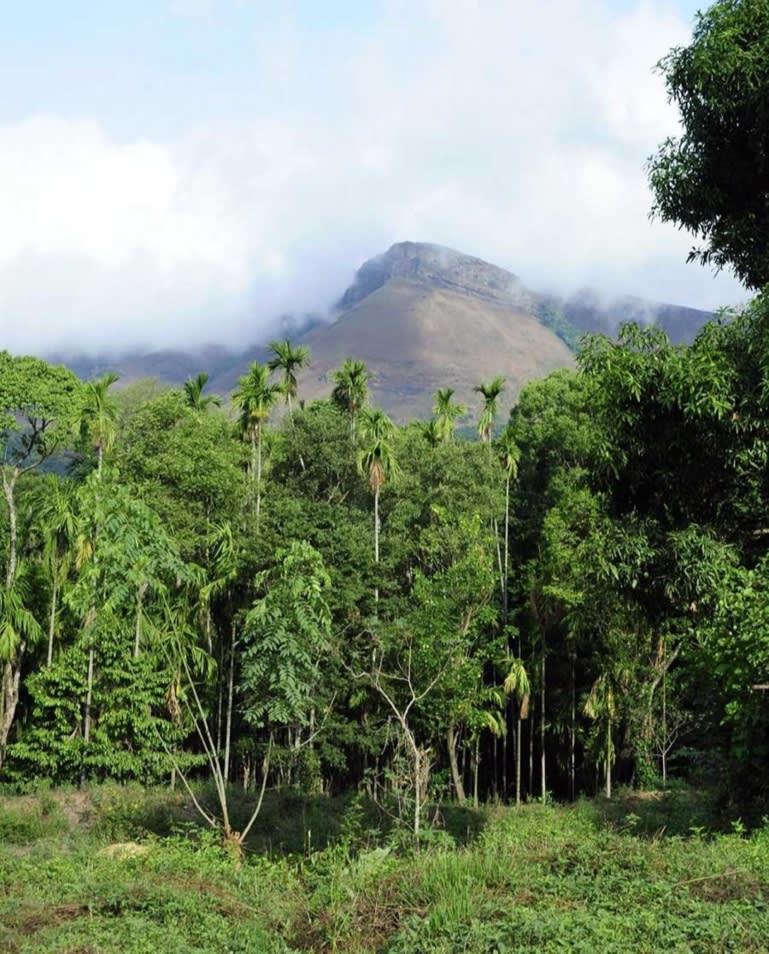
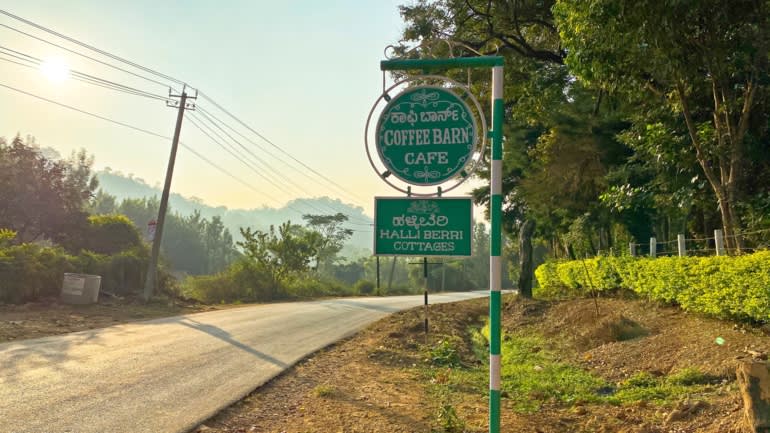
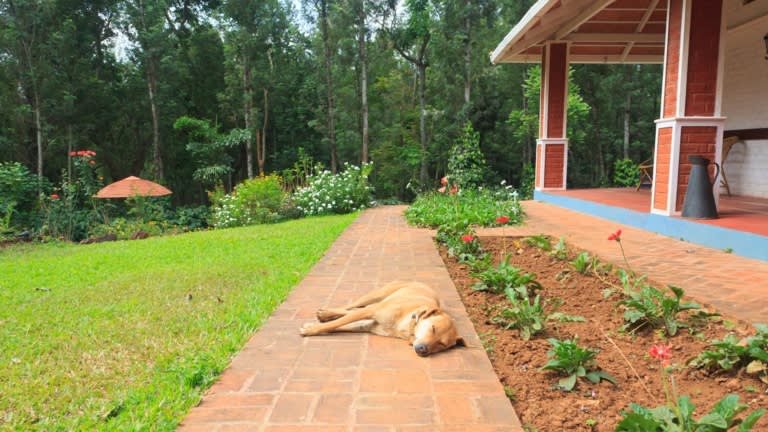
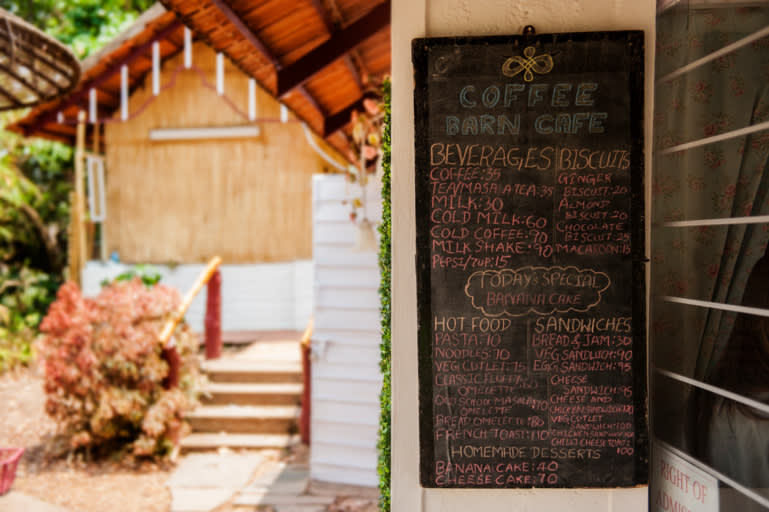
Top: Nestled in the foothills of the Baba Budangiri mountain range, the lush estate also grows Areca palms, cinnamon and cardamom plants. Middle: A sign for Coffee Barn Cafe, a casual spot along the main road run by the Kariappa women. Bottom: Lucky, one of the estate’s two guard dogs, takes a mid-afternoon nap. (Top photo courtesy of Halli Berri; middle and bottom photos Christabel Lobo)
In 1948, after cashing out of his inheritance, the grandfather of CP Kariappa, Nalima’s husband, moved from his hill station hometown of Kodagu, formerly known as Coorg, and headed north to Chikmagalur, where he purchased 40-50 acres of lush, fecund land to open the Kambihalli Estate.
Named after the iron-rich soil that the area is known for — kambi is iron in the local Kannada language, halli means village — the estate grew over the years to its current size of almost 180 acres.
As a result of her husband’s untimely death, Nalima and her three daughters — Maanavi, Anusha and Tejini — found their way along an uncharted path. In 2008, they opened the Coffee Barn Cafe, a casual spot along the main road for travelers. It was around the same time that they had their coffee beans certified by the Rainforest Alliance, an international nonprofit focused on ensuring that farmers meet adequate international standards of environmental, social and economic sustainability.
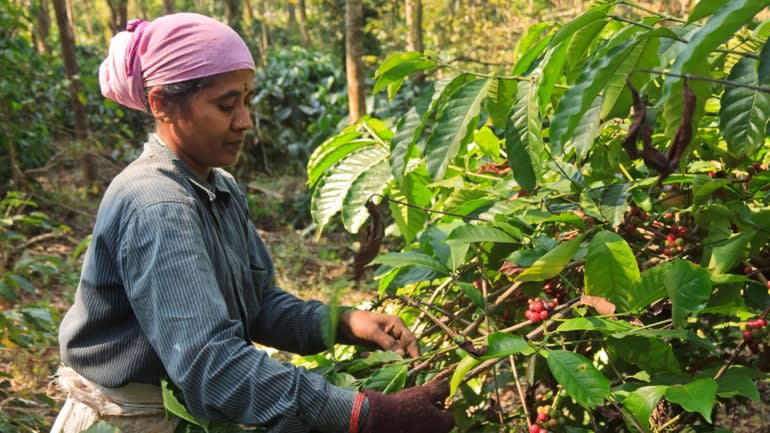
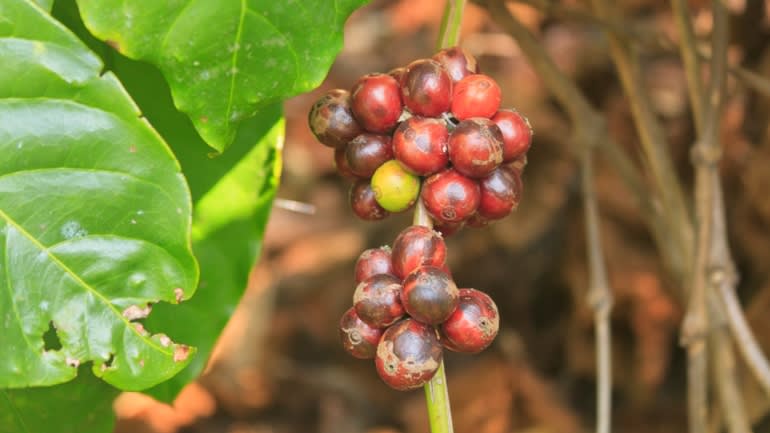
Top: A permanent worker deftly picks cherries. Kambihalli has a permanent workforce of approximately five people that work year-round. Middle: Ripened robusta cherries ready to be picked during harvest. Bottom: Fresh-brewed cups of coffee are not the only thing on Coffee Barn Cafe’s menu. Customer favorites include their homemade cheesecake and cookies. (Top and middle photos Christabel Lobo; bottom photo courtesy of Halli Berri)
In 1948, after cashing out of his inheritance, the grandfather of CP Kariappa, Nalima’s husband, moved from his hill station hometown of Kodagu, formerly known as Coorg, and headed north to Chikmagalur, where he purchased 40-50 acres of lush, fecund land to open the Kambihalli Estate.
Named after the iron-rich soil that the area is known for — kambi is iron in the local Kannada language, halli means village — the estate grew over the years to its current size of almost 180 acres.
As a result of her husband’s untimely death, Nalima and her three daughters — Maanavi, Anusha and Tejini — found their way along an uncharted path. In 2008, they opened the Coffee Barn Cafe, a casual spot along the main road for travelers. It was around the same time that they had their coffee beans certified by the Rainforest Alliance, an international nonprofit focused on ensuring that farmers meet adequate international standards of environmental, social and economic sustainability.
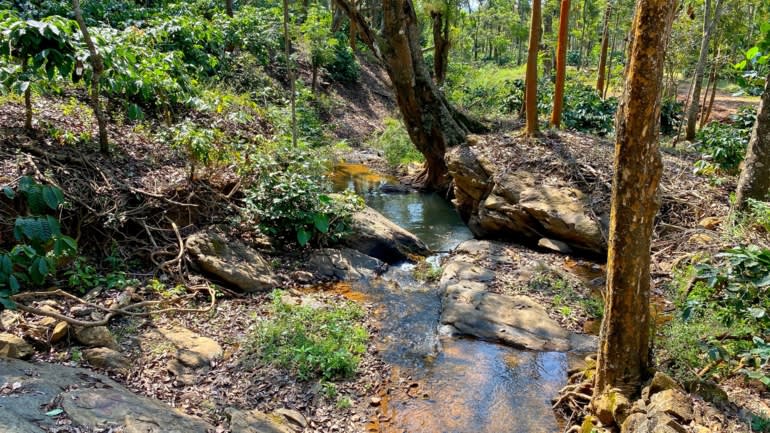
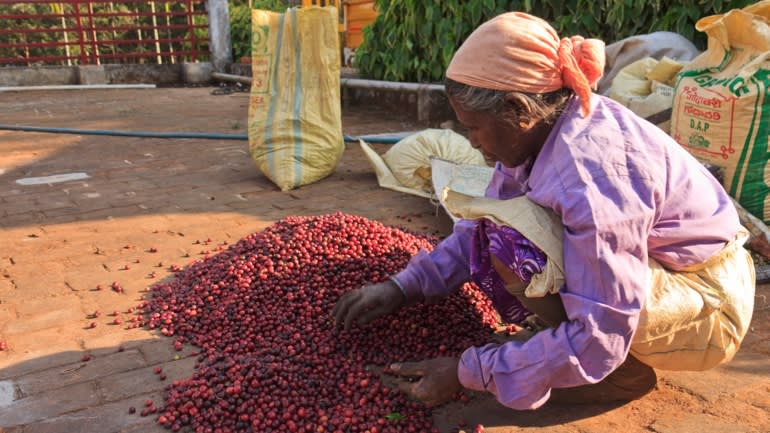
Top: The 200-acre estate offers well-marked trails, many that run along the river, for visitors to explore. Bottom: Manual sorting for underripe or overripe cherries is always carried out before the day’s harvest can be weighed and processed. (Christabel Lobo)
India is one of several countries where coffee plants grow under the shade of a verdant rainforest canopy. These trees not only prevent soil erosion but provide an additional source of income for coffee farmers — intercropping with pepper vines, areca palms, cardamom, cinnamon and orange trees is common practice.
The canopy promotes a thriving and diverse ecosystem for wild animals and birds to inhabit. Sambar deer, leopards, peacocks, wild boar, giant flying squirrels and 32 species of migratory birds call the Kambihalli Estate home.
During harvest season, typically December to March, the estate is abuzz with activity from dawn till dusk. Contract workers begin hand-picking ripened berries, commonly known as coffee cherries, averaging approximately 1,000 kg per day. This cumbersome process begins after green, unripe cherries from arabica coffee plants have turned a bright or dark red color, signaling peak ripeness.
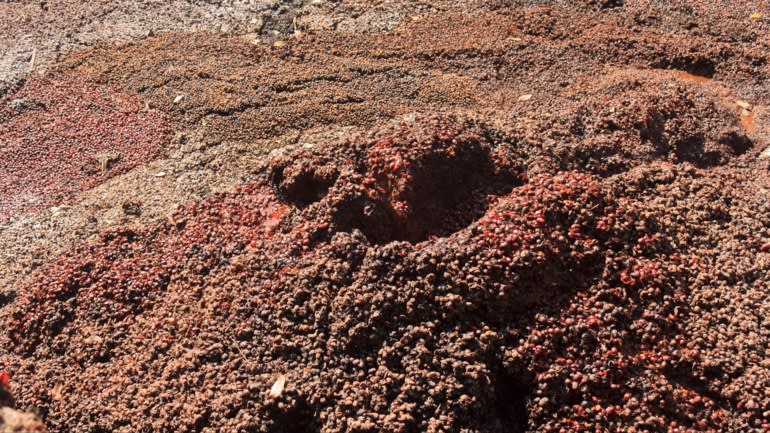
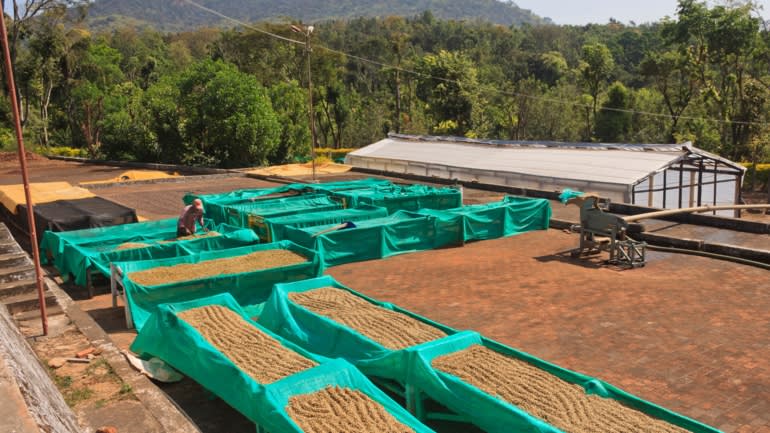
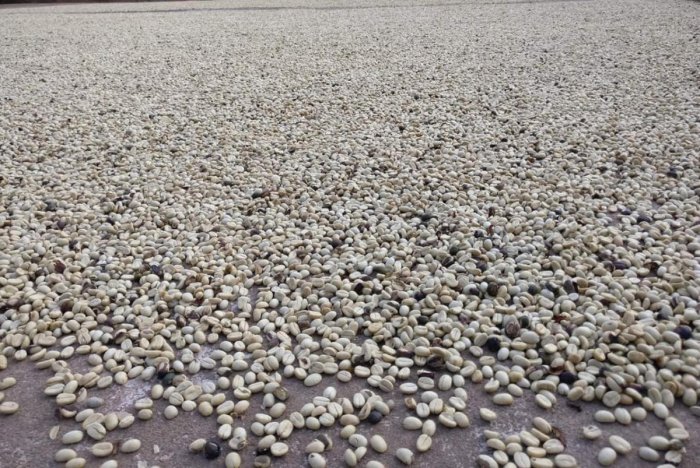
Top: The skin and pulp collected during processing ends up in a huge pile that is eventually converted into manure used to fertilize the soil for next year’s harvest. Bottom: Separated coffee beans are left to dry out in the sun for several days before they can be de-hulled and sent off-site to be roasted and packaged. (Christabel Lobo)
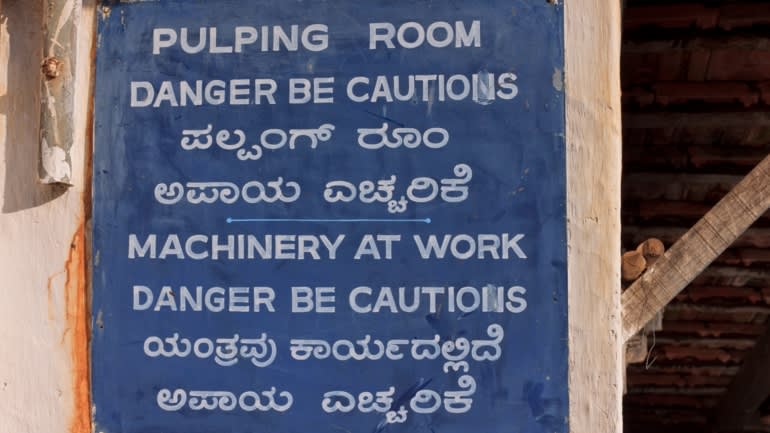
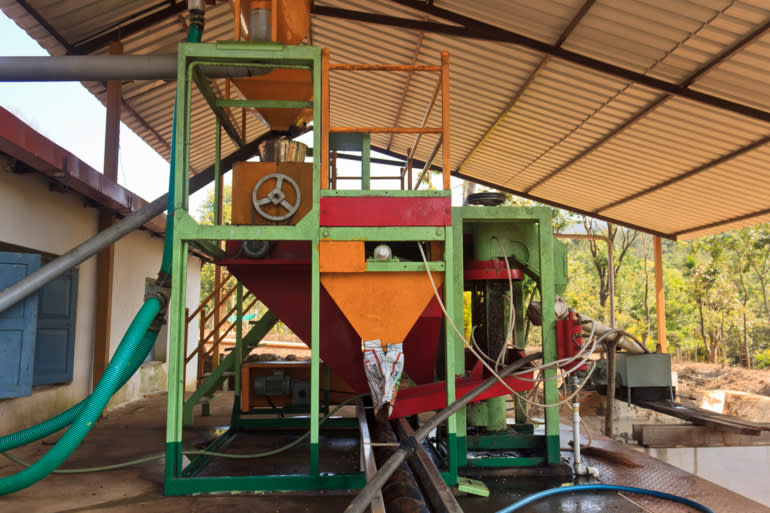
Once picked, the ripe cherries are immediately processed to ensure quality and freshness. Unripe or overripe ones are separated by hand before the day’s harvest can be weighed. Kambihalli makes use of the wet-process method, separating the beans from the skin. This results in a cleaner coffee that is fruitier in flavor, and overall is a less labor- and resource-intensive process.
The skin and pulp collected during the process are eventually converted into manure and used to fertilize the soil for another year of growth. The separated coffee beans, now referred to as washed, are then left to dry in the sun for several days. Finally, they go through hulling, where the dried husks are removed before being sent off-site, where they are graded, roasted, powdered and packaged.
Kambihalli sells its robusta beans in the wholesale market, while its arabica beans are marketed as Halli Berri, which plays on the term “coffee berry.” (It is not meant to have any connection with the actor Halle Berry.) Served throughout the estate and sold at their on-site cafe, a freshly brewed cup of Halli Berri’s single origin ground coffee has a slightly acidic flavor profile with notes of cinnamon, citrus and nuts — all thanks to the iron-rich soil and intercropped plants.
Top: Kambihalli uses a wet-process method to separate the beans from the skin. The day’s harvest, after being weighed, passes through the pulping room where the bean is separated from the skin and pulp. Bottom: The machine used to separate the coffee bean from its skin and pulp. (Christabel Lobo)
It has not been easy, of course. Infestation by white stem borers, pests notorious for attacking the stems of arabica plants, early on in Nalima’s tenure led to a drastic decrease in annual coffee production, which she says is just now starting to recover.
“From 10 loads — each load is 10 tons — we’ve gone down very drastically to producing just three loads,” she says, attributing it to her lack of experience in coffee farming. “We lost a lot of acreage to the infestation. As a result, we had to cut everything down and start planting robusta instead.”
Today, Kambihalli grows an equal amount of robusta and arabica coffee plants; arabica ripens faster and tastes better but robusta is more resilient to insect attacks. According to the Rainforest Alliance, diversification is the key to helping farmers protect themselves from market volatility and the increasing effects of climate change.
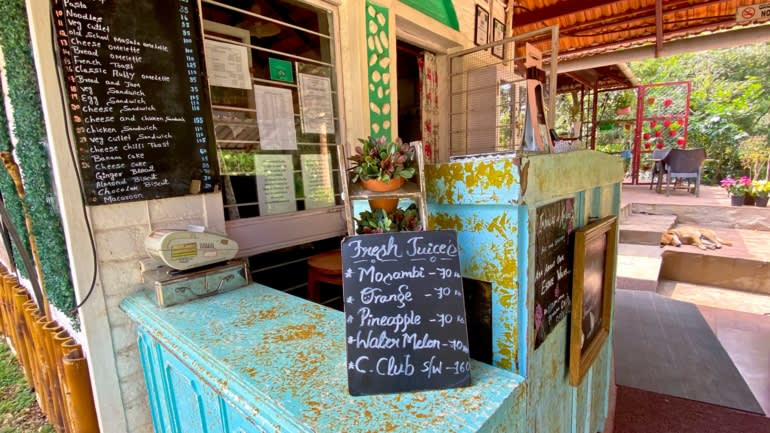
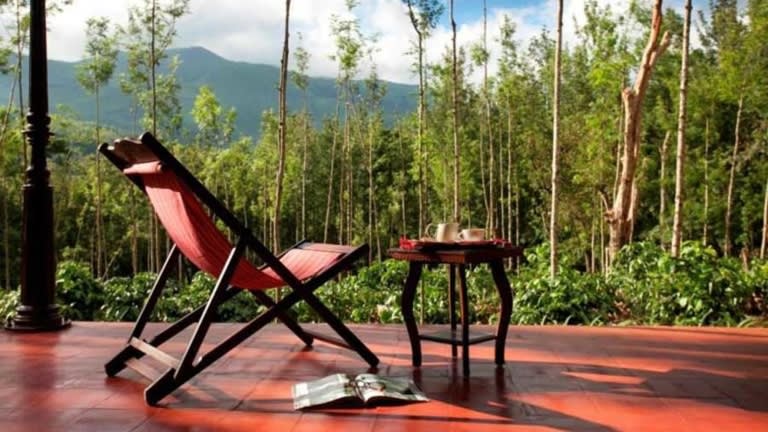
Top: Fruit from the local farmers market is used to make the selection of seasonal fresh juices on offer at Coffee Barn Cafe. Middle: The colonial-style cottages at Halli Berri are bright, TV-free spaces with distinct handmade Athangudi-tiled floors. Bottom: A cozy private veranda overlooks the verdant rainforest canopy with the Baba Budangiri mountain range in view in the distance. (Top photo Christabel Lobo; middle and bottom photos courtesy of Halli Berri)
Charan Kumar of the Indian Coffee Board says that while most of the coffee made in the Chikmagalur region is exported, the board is pleased Kambihalli chooses to sell its arabica within the country. However, “As India currently stands fifth in terms of worldwide coffee production, many [producers] still choose to sell directly to the wholesale market for a guaranteed source of income.”
Halli Berri is also the name of the luxe homestay which the Kariappa women run on-site. “Whenever relatives came, or guests came, we would put them up there, and they would love it,” says Nalima of the colonial-style cottages with rustic details and antique furnishings initially built for her daughter Anusha. “People started asking to book rooms, and I said, ‘Why don’t we just start doing that?'”
In 2010 they converted part of the property into a getaway for up to 18 guests, which is not just TV- and WiFi-free but emphasizes sustainability: Solar lights are used on the garden pathways at night, while the bathrooms utilize recycled water and are stocked with homemade soaps, shampoos and shower gels.
A series of trails through the expansive property offers visitors a chance to be mindful — the only guaranteed sounds are of the birds playfully chirping, frogs croaking, brooks babbling and the wind rushing through the treetops.
“I never even thought that we would make it this far,” Nalima says with a sigh as she reflects on Kambihalli’s success. “I’ll admit I was a little bit weary. But thanks to the support of our family and through word-of-mouth, we’ve made it work.”
As harvest season comes to a close, Nalima’s plans for the year include a focus on bean specialty and taste. “If we put a little more effort into the use of organic fertilizers, we found that we’re getting a better taste that our customers thoroughly appreciate. So even if I am a little brand, my coffee can be far superior, which I think is the way forward for us.”
source: http://www.asia.nikkei.com / Nikkon Asia Review / Home> Life / by Christobal Lobo, Contributing Writer / March 25th, 2020
Coffee growers are happy as the market rate of Arabica parchment has reached a record rate of Rs 10,000 for a bag of 50kg. The rate has been the highest in the last eight years.
As on Wednesday, a 50kg bag of Arabica Parchment coffee was sold between Rs 10,400 to Rs 10,500, which according to the vendors, is the highest rate for Arabica parchment.
The cost of Robusta Parchment has increased to Rs 7,000 per bag. The last time when Arabica coffee reached the highest rate was in 2014. It was Rs 9,600 to Rs 9,800 per bag then. Later, the price moved downward and had touched Rs 6,000.
Arabica cherry costs Rs 4,000 per bag while the rate of Robusta cherry is Rs 3,200 to Rs 3,400 per bag.
Growers in Kodagu, Chikkamagaluru and Hassan have expressed their happiness on the improved market rate of coffee, despite problems of shortage of labourers and feasibility issue in the maintenance of the plantation.
The vendors said that the rates of Arabica parchment might increase further. Expecting the same, the growers who have stored coffee in ABC and other curing centres have decided to sell coffee after it hits an all-time high.
The increase in the rate of coffee was due to a significant decrease in production in Brazil and Columbia. There was a plunge in the production of coffee in Chikkamagaluru, Kodagu and Hassan districts as well, owing to floods. This has created an increase in demand.
Even though the market rates have increased, the quantity of coffee production is significantly less compared to previous years. The growers who grew 50 bags of coffee in the past have ended up producing only 10 bags of coffee.
“The coffee plants have been damaged due to the water-logging of the plantation. It might take another four years to restore the coffee plantations to its original condition,” said coffee grower Nanaiah.
Coffee vendor Abdul said that around 60% of coffee growers have sold their coffee. Those who had stored coffee have reaped benefits.
source: http://www.deccanherald.com / Deccan Herald / Home> States> Mangaluru / by Adithya K A / Madikeri – March 04th, 2020
Visitors are encouraged to make their own blends, including weighing, mixing, roasting and grinding.
The plantations offer homestays and resort, perched on stilts. (Photo: The Tamara Coorg)
The lashing rain from the night before had simmered to a soft drizzle this morning. The clouds had parted, and the sundeck of our wooden cottage, perched high on stilts, afforded a resplendent view of coffee country Coorg. The freshly bathed dimpled-green Western Ghat hills rolled away as far as the eyes could see. Acres and acres of coffee and spice plantations dotted the landscape, intermingling with lush forests. The gushing sound of a waterfall drifted in from close by, blending with the rustling of leaves. Below us, as our resort’s plantation was waking up, we set out to witness first-hand the journey of coffee — from bean to cup.
With tall silver oak, teak, rosewood and other trees lending shade to coffee shrubs in the plantations, Coorg offers a gorgeous setting to observe the process of coffee production. Karnataka alone accounts for 70 per cent of the coffee produced in India, with the south-western districts of Coorg (locally Kodagu) and Chikmagalur producing the lion’s share. India, by some accounts, produces the finest shade-grown coffee.
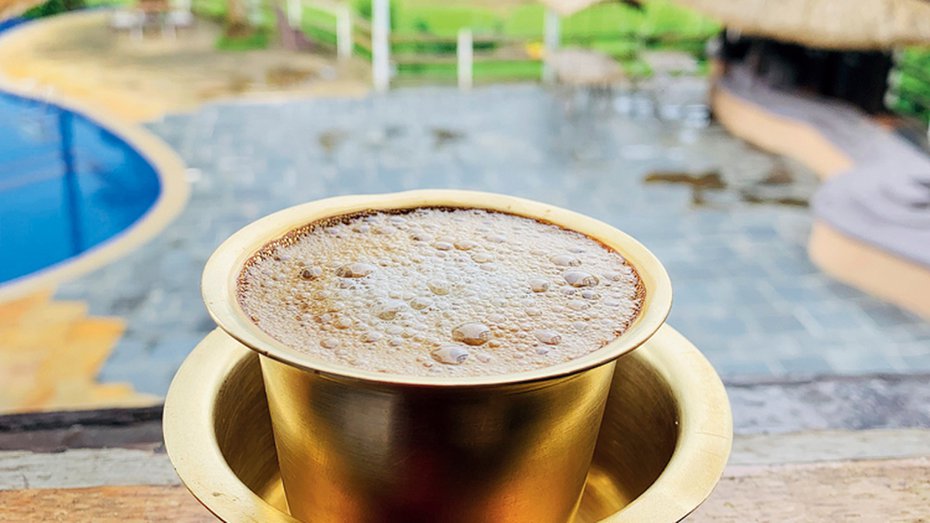
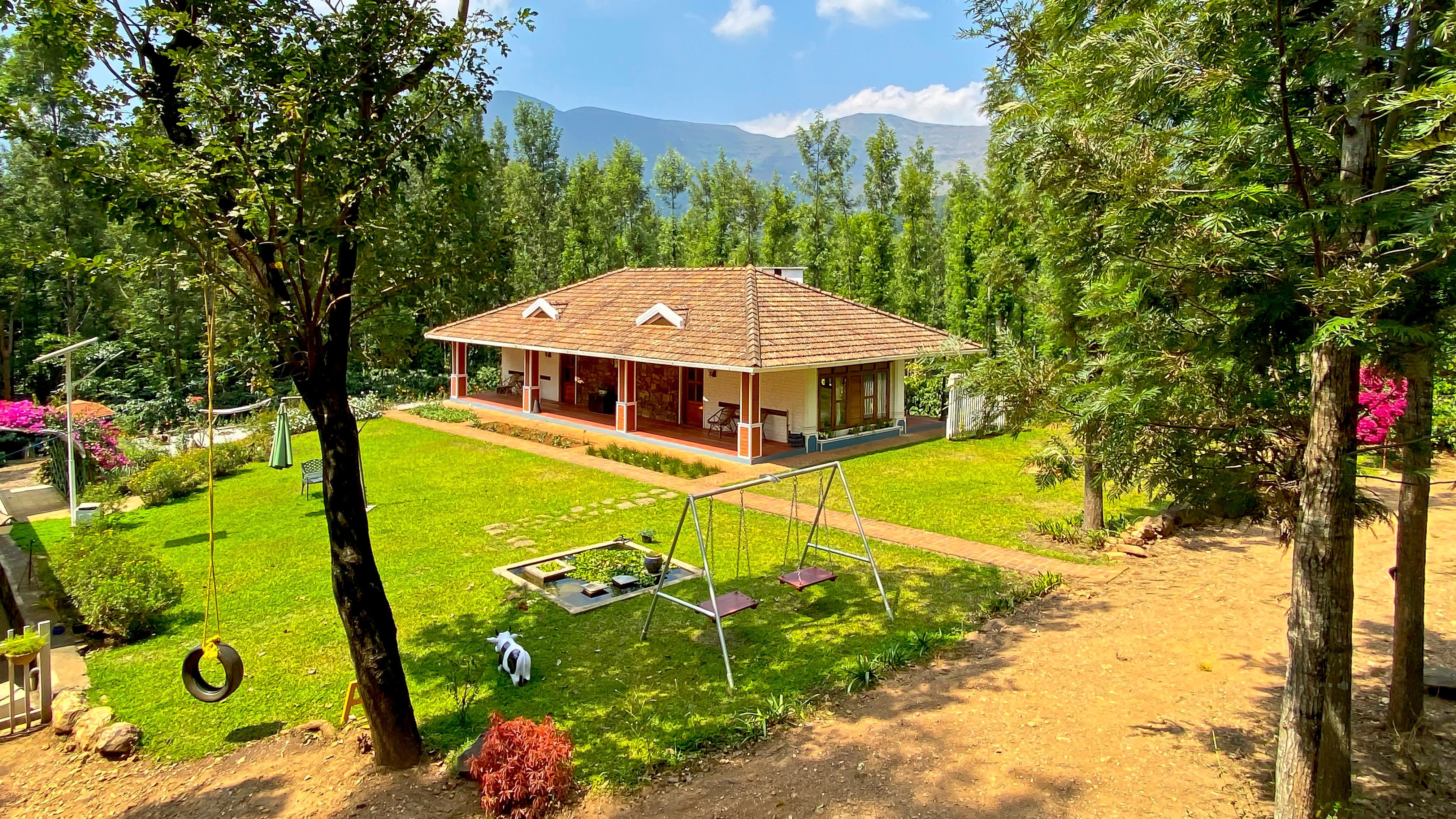
Many of the plantations have homestays and resorts for anyone wanting to sample the plantation life. The deep dive into the coffee culture at our resort, sprawled over a 180-acre estate, begins right at check-in. You’re welcomed with steaming tumblers of delicious bellada coffee (Karnataka-style filter coffee with jaggery). The cottage-style wooden villas, in traditional Kodagu architectural style — sloping roofs, perched high on stilts — are placed at respectful distances from each other, for immersion into a planter’s private yet lavish lifestyle.
Umbrellas in hand, we follow our guide, through thick foliage and unending rows of coffee shrubs. Sharing interesting nuggets about the native flora that grows with wild abandonment, he points out the two main coffee varieties of Coorg — the hardy, disease-resistant Robusta and the better-quality, tastier, smoother and more expensive Arabica. A number of spices are often intercropped with coffee, such as peppercorn, cardamom, clove and nutmeg that help the coffee acquire lovely aromatics while adding a few prized cash crops in the planter’s kitty.
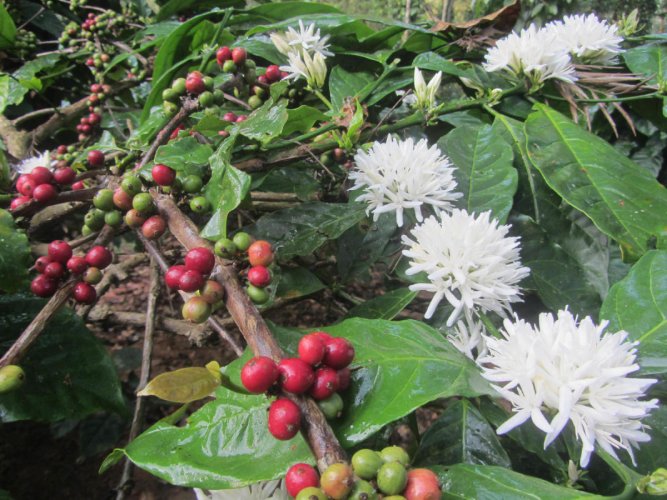
Each year, the life cycle begins with pearly white blossoms in February-March. Natural showers and sprinkler irrigation are crucial for their yield, which determine the amount of coffee harvested the following year. The blossoms turn into green berries and, then, a deep red when ripe, which are handpicked from November to February.
The walk is followed by a coffee-processing experiential programme at the little museum in the resort grounds. The ripe berries are dried and pulped to obtain the seed — aka coffee bean! The beans are sorted, blended and roasted in a traditional roaster. Encouraged to make our own blends, we weighed and mixed different percentages of the varieties according to our taste, put them in the roaster and hand-ground the divinely aromatic roasted beans into a fine powder — to be had as a hot brew right there, or carry back as a souvenir.
Back home, whenever I’d sip on my blend, I’d reminisce about the time I crafted it, and the scrumptious Coorgi lunch that followed, that rainy, misty afternoon.
Satarupa Paul is based in Delhi and writes on food and travel.
source: http://www.indianexpress.com / The Indian Express / Home> Eye / by Satarupa Paul / February 29th, 2020
Three-day event at Bangalore Palace to be organised by London-based International Coffee Organisation
Madikeri:
Bengaluru will host the fifth edition of the World Coffee Conference (WCC), a high-profile international event, between Sept. 7 and 9 in 2020. Earlier editions were held in the UK, Brazil, Guatemala and Ethiopia.
The three-day event that will be held at the sprawling Bangalore Palace will be put together by London-based International Coffee Organization (ICO), Ministry of Commerce and Industries, Coffee Board of India and India Coffee Trust (ICT), which is a forum for coffee growers and exporters.
The event is themed ‘Sustainability Through Consumption’ and will celebrate all things of coffee in an immersive experience with the conference addressed by international speakers, coffee exhibition, buyer-seller meets, competitions and awards, skill building workshops, amongst many others.
ICT President Anil Kumar Bhandari told reporters in Madikeri yesterday that the prestigious WCC coming to India for the first time means huge international recognition for Indian coffee. The Who’s Who from the world of coffee will be descending on Bengaluru for this event. This will give a fillip to the Indian cuppa in the global market. Over Rs. 15 crore is being spent to organise the conference, he added.
The participants will include the world’s leading coffee brands and café chains, retailers, roasters, equipment manufacturers, coffee organisations from round the globe, policy makers, industry captains, exporters, manufacturers and a whole host of players associated with the commodity.
Conference attendees
Around 3,000 international delegates from 80 countries, 2,000 Indian delegates, over 1,00,000 coffee growers and exporters, representatives of HORECA (Hotel/Restaurant/Café sector) and hundreds of coffee connoisseurs are expected. There will be more than 100 speakers, 150 exhibitors and over 300 business-to-business and business-to-consumer meeting.
Coffee being the world’s most favourite beverage with 2.5 billion cups consumed every single day is produced in about 70 countries most of them belonging to the developing countries like Africa, Latin America and Asia. India is the sixth largest producer of coffee in the world, accounting for about 5 percent of world coffee production.
Innovation to conference
At the conference, the Coffee Board of India and the International Coffee Organisation (ICO) will bring in innovation to the conference and expo by crowd-sourcing ideas from citizens. They will look at ways that will make Indian coffee a brand that is recognised worldwide and formulate ways to make India a sustainable destination for coffee.
Methods will be explored to make coffee farmers stakeholders in the value chain as this will have a positive impact on the 25 million families who depend on coffee cultivation the world over. “This is a great opportunity that India has got and the organisers will welcome to India participants from more than 80 countries for the expo and conference,” Bhandari said.
Connecting with growers
India is also emerging as the major coffee consuming country. The Government of India has also a strong focus on increasing coffee plantation and the global community also desires to connect with coffee growers in India and Asia and WCC-2020 offers an opportunity to explore India and Asia to the global coffee community.
Bengaluru is the coffee capital of India and produces nearly 70 percent of India’s coffee that is produced in Kodagu, Malnad, Hassan and Chikkamagalur. As the theme of WCC-2020 is sustainably through consumption because the world coffee production is increasing and having a negative impact on coffee prices, this can be offset by increasing consumption, therefore consumption is the key to sustainability. The focus will be on economic, agriculture, commercial, environmental, social and cultural impact.
source: http://www.starofmysore.com / Star of Mysore / Home> News / December 31st, 2019
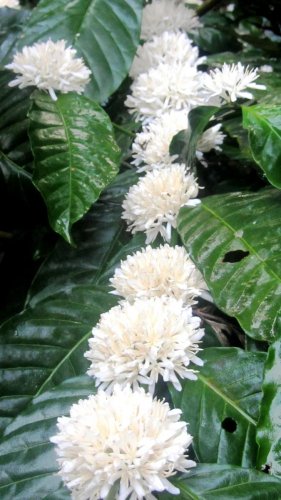
Coffee cherries and flowers. Photos by Author and Adithya K A
Coffee pervades the lives of people in Hassan, Chikkamagaluru and Kodagu districts. From the decades-old jaggery coffee to the current flavoured ones, coffee as a product has seen a huge transformation. What has remained unchanged is its association with almost anything momentous in our lives.
The journey of coffee to India is well- documented and etched in our memories through the story of Arab traveller Bababudan bringing seven coffee beans to Chikkamagaluru in 1670 AD. He sowed these seven seeds in Chikkamagaluru’s Bababudangiri hills (Chandradrona Parvatha). Today, India is world’s third-largest producer of coffee.
The earliest and most prominent coffee planters of the yesteryears in the country were the British. They introduced the system of check-rolls which is an attendance register of the labour. They maintained a diary which explained the daily activities in the estate to which the owner signed every day. These rather important systems are intact and in place even today, and any estate that you visit here will show you daily records from as back as 50 years ago!
These documents serve as important pieces of information for future generations. The British were particular about closing the accounts by the end of March wherein the savings and loans availed by the labourers were tallied. This tradition continues to this day.
Other customs that we have inherited are the practices of maintaining lush green and colourful gardens at our homes, rearing about half a dozen hunting dogs and possessing rifles and pistols for safety from wildlife.
Blossom shower
Coffee plantations receive blossom shower (rains) around March every year. Coffee estates that blossom with white flowers are a sight to behold. While this is a visual treat for us, this also guarantees a good crop for the coming year.The joyous mood is also seen before coffee picking when the entire family thanks god and prays before picking the berries.
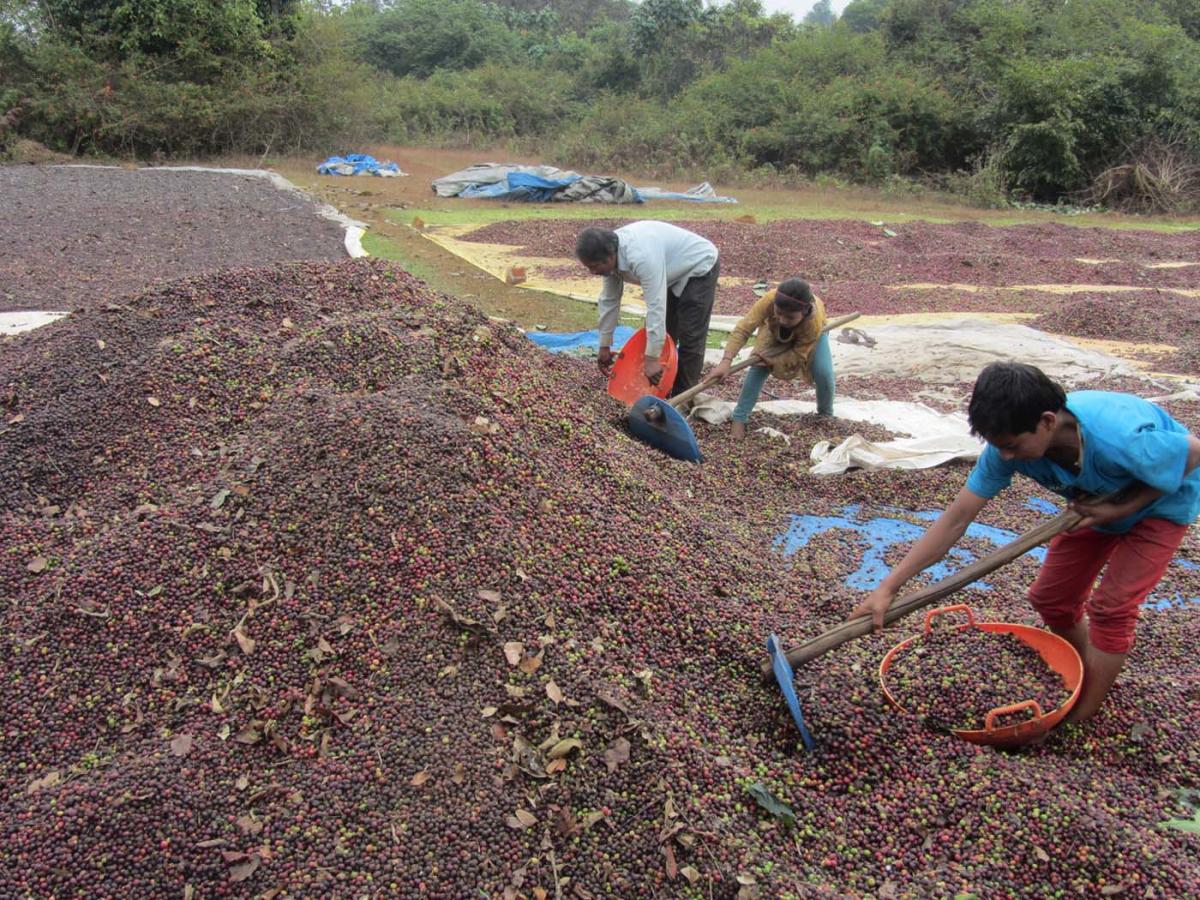
Cherries being dried
The book Bettadindha Battaligey by H N Nagegowda beautifully traces the history of coffee in India and also the culture associated with it.
Coffee estates coexist with thick and lush green forests in these Western Ghats districts. These estates are also home to a rich variety of endangered flora and fauna. Each year, hundreds of varieties of birds migrate to coffee estates. These plantations nurture forest species which act as nesting grounds for these birds.
Estate owners take an active interest in increasing the number of trees that they have on their lands. Artificial lakes and tanks in the estates quench the thirst of animals including elephants and tigers.
The vibrant culture of coffee land in the state could also be traced to the presence of major rivers such as Cauvery, Tunga, Bhadra, Nethravathi and Hemavathi.
A majority of the labour force in Karnataka’s coffee estates hails from Dakshina Kannada. Of late, a healthy influx of migrant labourers from Assam can be seen in the estates. The estate owners provide accommodation and healthcare facilities to the labourers.
The monsoons of 2018 and 2019 played unimaginable havoc in the lives of growers in the core coffee zones of Kodagu and Chikkamagaluru.
They lost all their lands overnight to mudslides and torrential rainfalls. Despite this, they are trying hard and not giving up in their quest to rebuild everything that they lost.
However, their spirit to endure and rebuild is shattered due to the failure of markets. Coffee growers are going through their worst crisis ever where they are not able to make ends meet because coffee prices have crashed to record lows.
Prices have collapsed to as low as what it was 26 years ago while the cost of inputs like fertilisers and machinery has skyrocketed.
Also, the price of spices like pepper which are grown as intercrops has fallen to 60% lower than the price received half a decade ago. As a result, the growers are saddled with neck-deep debts.
Key driver
There is a misconception that the consumption of coffee leads to health problems such as gastritis. This problem arises when one consumes coffee that is blended with a high quantity of chicory.
As per the Coffee Board of India statistics, coffee is grown in 4,00,000 hectares of land in the country. Karnataka grows 70% of the country’s total coffee production, with its annual production of up to 2.75 lakh metric tonnes. About 65% is robusta variety while 35% is of the arabica variety. The country exports 75% of the yield. India is home to 2,20,825 coffee growers of which 98.5% are small-scale growers. The economy of Kodagu, Chikkamagaluru and Malnad regions of Hassan district is heavily influenced and dependent on the coffee industry. It is the key driver of the economic activities of these regions.
Karnataka Growers’ Federation (KGF)which was formed in 1985 brings the coffee growers in one platform and works towards their welfare while also representing them in international platforms. This apex organisation is well networked with 21 regional organisations. KGF is headquartered at Sakaleshapura, Hassan district with a membership of 50,000 women and men.
U M Thirthamallesh, president of Karnataka Growers’ Federation said that the coffee price crash is mainly due to the surplus supply of coffee into India from international markets. Southeast Asia, he claims, has unfair market practices, low labour standards and excessive state subsidy which are all in violation to World Trade Organization norms while Indian Coffee growers follow all international norms by the book.
Coupled with this is excessive addition of the additive chicory into coffee which results in the substandard taste of the coffee. Labour shortage and disease are other problems that have affected the coffee industry.
Value addition
In an effort to overcome challenges, the coffee community is also paying attention towards the value addition of coffee. In the process, some brands have become popular. They’re involved in the preparation, marketing and sales of coffee powder; garlands made using coffee beans; coffee chocolates and coffee-based wine. In some areas, specialised coffees, like organic coffee and tribal coffee are also being tried.
Copsy Coffee Powder which is produced at Arehalli Co-operative Society and 7 to 7 Coffee which is produced by a group of women at Women’s Coffee Promotion Council, Sakaleshpura are some well-known local brands.
Another brand which has caught the attention of coffee connoisseurs is Talacauvery Eco-Coffee Works which is based out of Kodagu. This coffee is produced by an all-women self-help group called Sri Rajarajeshwari Self Help Group in Kargunda.
A vibrant culture has evolved around coffee in the last three centuries in the coffee land of the state rooted in self-reliance and innovation.
source: http://www.deccanherald.com / Deccan Herald / Home> Spectrum> Spectrum Top Stories / by Poornima Kanahalli / December 14th, 2019
WELCOME. If you like what you see "SUBSCRIBE via EMAIL" to receive FREE regular UPDATES.
Read More »