From setting up his own business to embracing different cultures and understanding spirituality — Marc Tormo tells CE that India has helped him…
Marc is a travel and nature enthusiast
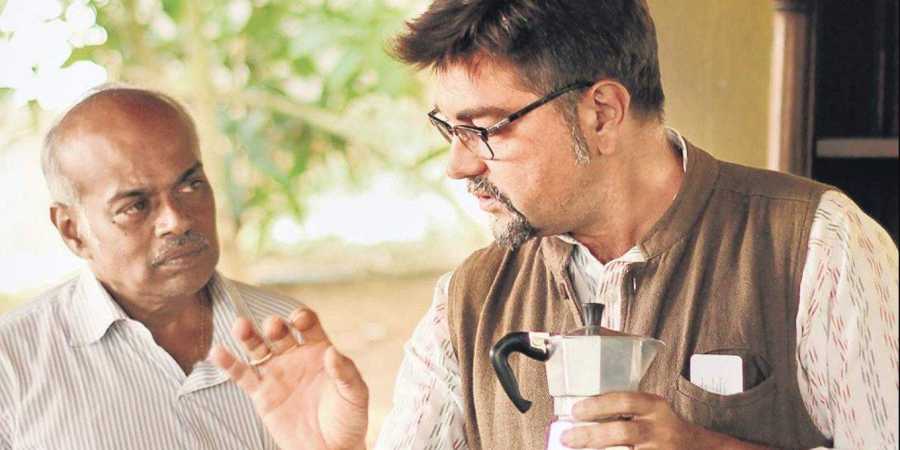
How far can one go in search of coffee? Apparently, from Spain to India. Marc Tormo did exactly that in 1997 when he moved to Auroville in Puducherry. CE talks to Tormo, the founder of Marc’s Coffee in Auroville, about his love for coffee, opening up to spirituality and raising kids in India
What brought you to India?
I come from a place called Catalonia in Spain. I was into the business of coffee there where I had a speciality coffee shop. I came to India a few times when I was 19 years old to understand about coffee and I found out about coffee plantations in the southern part of India. People were not aware of the entire process of coffee-making. I understood this method and helped people trace the journey of the coffee they were drinking. Finally, in 2008, we launched Marc’s coffee here in Auroville. Before setting up the coffee place, I had to put in a lot of research on not just coffee but the farmers, their psyche among other things. After setting it up, it took us five years to pick up speed. But it was a pleasant cultural change. Europe is more materialistic. People here are spiritual. Auroville allows me to explore that part as well. My children were born and raised here. India is now second home. Plus, we have a cosmopolitan environment here at Auroville. There are Koreans and Spaniards and many others here.
How do you keep in touch with your roots?
My children can speak Catalan very well which is the dialect from the region I come from. They have learned Tamil, French, Catalan, Spanish and English. We make it a point to visit Spain every year. I like to keep all the goodness of the Spanish culture. People from my region are adventurous and entrepreneurial. I would like to retain all that. But spirituality is something I understood after living in India.
How do you and your family spend time together?
I love to cook, especially for my family. We all spend time cooking. I like making paneer butter masala, khichdis and chapatis. We make a mix of Spanish and Indian cuisines at home. We travel a lot. I take them on my trips to coffee plantations. But this is not just so that they understand coffee but also they understand people and cultural diversity wherever they go. I like to spend time gardening with my children.
What are your interests apart from coffee?
I love to sing, I love to listen to music and be with nature. Life in Auroville lets me enjoy all of this. I can work and be in the midst of nature and pursue my interests.
Auroville is considered to have deep spiritual roots. What is your experience of spirituality?
Auroville has taught me the concept of unity with diversity. We have people from different cultures living here. It has helped me understand the inner meanings. One of the things living in Auroville has helped me with is understand myself and have a holistic view of anything.
One half of India is populated with tea lovers. Have you ever thought of shifting your beverage loyalties?
I have nothing against tea. But I feel coffee has not been studied enough. I chose to focus on coffee. Coffee needs a lot of support to reach everybody so that everyone understands coffee. That is why I chose coffee.
What are your favourite destinations in India?
I love the Western Ghats. Wayanad, Coorg, Mysuru and Chikmaglur are some of my favourite destinations. I am a coffee lover and a nature lover. I like to see wildlife.
Marc will be conducting a Coffee workshop till December 9 at Old Kents Estate, Coorg
source: http://www.newindianexpress.com / The New Indian Express / Home> Cities> Chennai / by Veena Mani / Express News Service / December 07th, 2019
Coffee lovers are discovering new coffee destinations from within the cities all the way to the countryside, including the heartland of coffee in India – Coorg. This workshop provides an excellent opportunity to learn from a certified Q-Grader & connoisseur Marc Tormo, Roastmaster from Barcelona, who has more than 20 years of experience in the international coffee movement.
Harvest with the locals, learn about how coffee is sustainably cultivated in India while gaining a deeper appreciation of roasting techniques and experience the subtle notes hidden in the beans. Learn exciting brewing techniques and impress your friends with your barista skills creating art from the rich froth of your latte.
So, don’t miss the change to grab this opportunity with both hands! Because, this is a unique platform for all coffee lovers, coffee enthusiasts, those trying to make an entry into the coffee world, or simply those trying to impress their guests!
Date: 06th-09th December 2019
Venue: Old Kents Estate, Coorg
Price: Rs 30,000 ++ (all-inclusive stay in a spacious English cottage with a private garden)
For Reservations: Call 9789896454
source: http://www.hungryforever.com / Hungry Forever / Home> Events / by Christina George / November 29th, 2019
The winners of the 2019 Nobel Prize in Economics in the screen grab — Abhijit Banerjee, Esther Duflo and Michael Kremer (AP file)
– Michael Kremer, a Harvard University professor, was the co-Founder of ‘Precision Agriculture Development’ or PAD
– It advised the Coffee Board to pilot a missed-call enabled service to help coffee farmers in Karnataka
___________________________________
Bengaluru:
India’s Coffee Board, a state-run body that promotes coffee production and drinking, shares a slice of history with Michael Kremer, who won the Nobel Prize in Economics along with Esther Duflo and Abhijit Banerjee.
Kremer, a Harvard University professor, was the co-Founder of ‘Precision Agriculture Development’ or PAD, which advised the Coffee Board to pilot a missed-call enabled service to help coffee farmers in Karnataka. The IVR call service can give precise advise to the grower from scientists at Central Coffee Research Institute.
“Under his guidance and leadership, Team PAD have been working with Coffee Board of India and the coffee ecosystem for more than one year now. Thanks to the stellar efforts of Michael, Shawn, Madhur, Niriksha and Team Coffee Board, we have been able to have a positive impact on the lives of 15000 coffee farmers using a simple missed call service, free of cost to coffee farmers,” said Srivatsa Krishna, Chief Executive Officer of Coffee Board, in a statement to the media.
The service, Coffee Krishi Taranga, gives registered growers a weekly advisory on critical farm operations and daily market statistics through an automated push call when a farmer places a missed call on the helpline (080-37685000) run by the Board. It has helped growers improve productivity, profitability and environmental outlook, and will be expanded to cover 50000 growers shortly, according to the Coffee Board.
The PAD’s journey in India begun as an academic experiment in Gujarat with cotton farmers in 2011, when Narendra Modi, then chief minister of Gujarat, encouraged testing a similar service in his state called Krishi Tarang, said Srivatsa. “On behalf of the entire Indian coffee ecosystem, the finest shade-grown, hand-picked rainforest Coffees in the world, we congratulate Dr.Kremer and thank Team PAD for their contributions,” said Srivatsa Krishna.
source: http://www.livemint.com /Live Mint / Home> Explore / by Nidheesh M.K. / October 15th, 2019
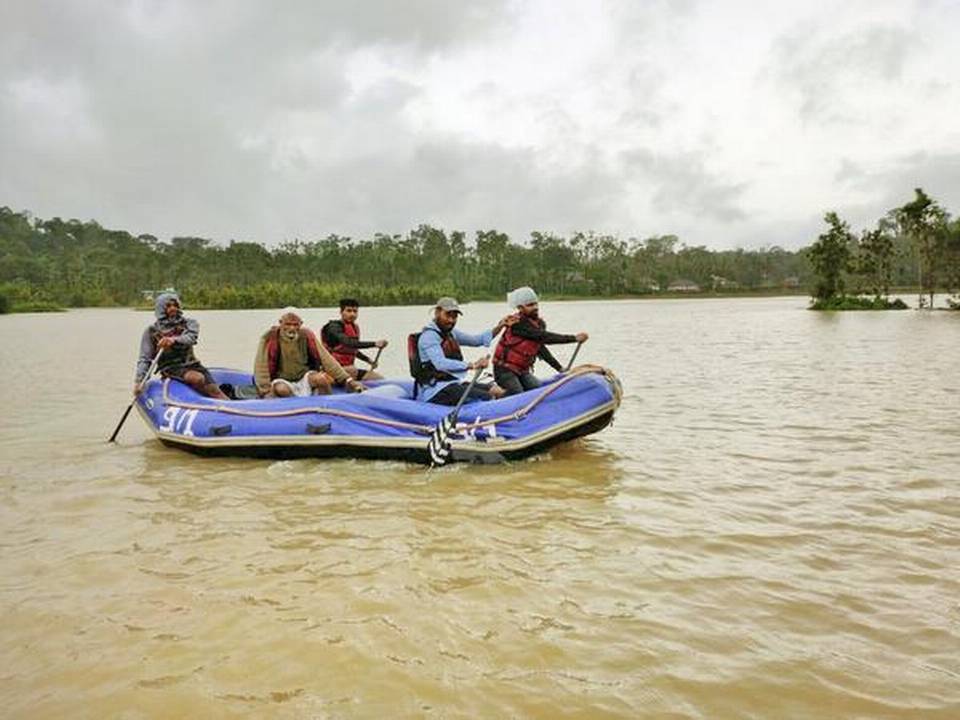
In action: For the people of flood-hit region, the presence of rescue personnel has infused a strong sense of security. | Photo Credit: Special Arrangement
Rescue prersonnel tread treacherous terrain in flood-affected Kodagu
Wading through slush, climbing slippery slopes, and battling inclement weather from dawn to night without respite is a matter of routine for the rescue teams stationed in the flood-affected Kodagu.
Rain may have abated but the search for missing persons continued at Thora village late on Wednesday as well, when the rescue teams recovered a body of a person buried in the mud.
The teams include three units of the National Disaster Response Force (NDRF), a column of the Indian Army, and Garuda — the State Commando team under the Centre for Counter Terrorism, apart from personnel of the Fire and Emergency Services, Civil Defence Quick Response Team, KSRP, and the local police, and hundreds of volunteers. For them it is the second consecutive year of battling a natural calamity in the district.
Thora, the toughest
A senior member of the Garuda team who was part of the mission said Thora was the worst affected this year and was comparable to Jodupala in 2018 in terms of the treacherous nature of the terrain. “There were other places too in Kodagu where people were affected by the overflowing river. But in terms of landslips and mud, Thora reminded one of Jodupala,” said the official. He said it was an impossible situation with a river of mud flowing down the hills and one was not sure if the ground beneath the feet was stable.
The team camped at a place nearly a kilometre away from the main road on sighting a few shreds of clothes and other signs of human habitation, which was otherwise obliterated. “Based on the assessment of the ground situation, we zeroed in on a specific point to dig out the mud and found the buried body,” said the Garuda force member.
The trek back was equally dangerous as they had to carry the body on a stretcher for nearly a kilometre in a terrain where their legs would sink knee deep in mud. They made it back to the base camp late in the night. This was just one of the many missions undertaken during the week when Kodagu was inundated.
For the people of the region, the presence of rescue personnel in their orange outfit — as in the case of the NDRF — has infused a strong sense of security. The Kodagu district administration had ensured the deployment of rescue teams and conducted a few rescue drills before the advent of the southwest monsoon in June. As the first signs of the unfolding crisis emerged, with water rising owing to heavy rain, the rescue teams swung into action to evacuate people to safety.
source: http://www.thehindu.com / The Hindu / Home> News> States> Karnataka / by R. Krishna Kumar / Mysuru – August 15th, 2019
‘They are stuck in their home State owing to NRC procedures’
The ongoing verifications for National Register for Citizens (NRC) in Assam have stopped thousands of workers from returning to the coffee estates of Karnataka. The Assamese workers left the estates in March-April, ahead of the parliamentary elections, and a majority of them are yet to return.
In Hassan district alone, more than 10,000 people from Assam are employed in many estates. Similarly, they work in estates of Chikkamagaluru and Kodagu districts. For the last 15 years, the estates in the three districts have been dependant on workers from northeastern States, Odisha and Madhya Pradesh.
Estates suffer
The final draft of the NRC was published in July 31, 2018. Many workers, whose names did not figure in the draft, were worried. They left to resubmit documents to claim citizenship. B.N. Jagaish Shetty, manager of IBC company-owned Hasirugudda Estate in Belur taluk, said last year more than 100 workers from Assam were in the estate. Now, there was none. “A few of them had returned very late and by then, we had made alternative arrangements. They must have gone to other estates,” he said.
The final NRC is expected to be published on August 31 and people are worried about leaving their native until then. U.M. Thirthamallesh, president of the Karnataka Growers’ Federation, said 25 Assamese were working in his estate and they had not yet returned. “The last communication I received was that they would come back after Bakrid (August 12). I hope they return as our estates are dependant on them,” he said.
This year owing to decrease in rainfall, the demand for labour is minimum. Anticipating dip in production, estate-owners are trying to manage with the available workforce. “But if the workers delay further, the activities in the estates will suffer,” he added.
“Coffee production has always been dependant on outsiders. In the past, there were workers from Dakshina Kannada. Later, it was Tamil Nadu. Many of them settled here over the years,” said B.A. Jagannath, planter and former member of the Coffee Board. People from Assam are stuck in their home State because of the NRC procedures and the floods. They will not return until their citizenship issue is settled, he said.
source: http://www.thehindu.com / The Hindu / Home> News> States> Karnataka / by Sathish G. T / Hassan – August 05th, 2019
The foreign pest, which is thought to have arrived in India through trade routes, devours tender leaves and stems, completely destroying plants.
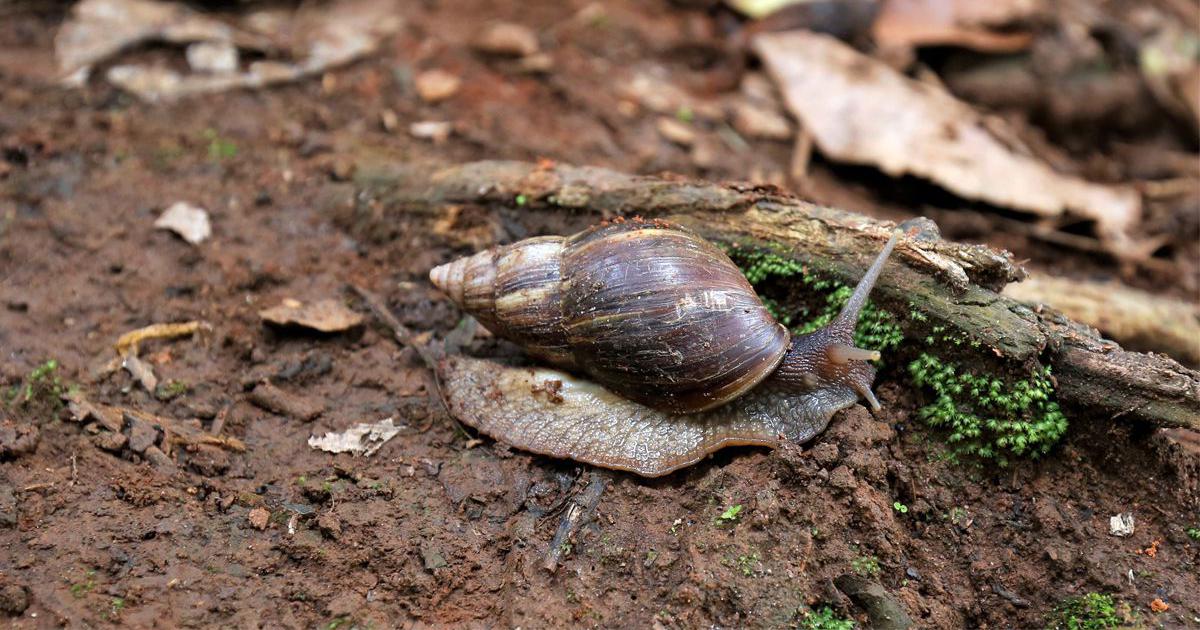
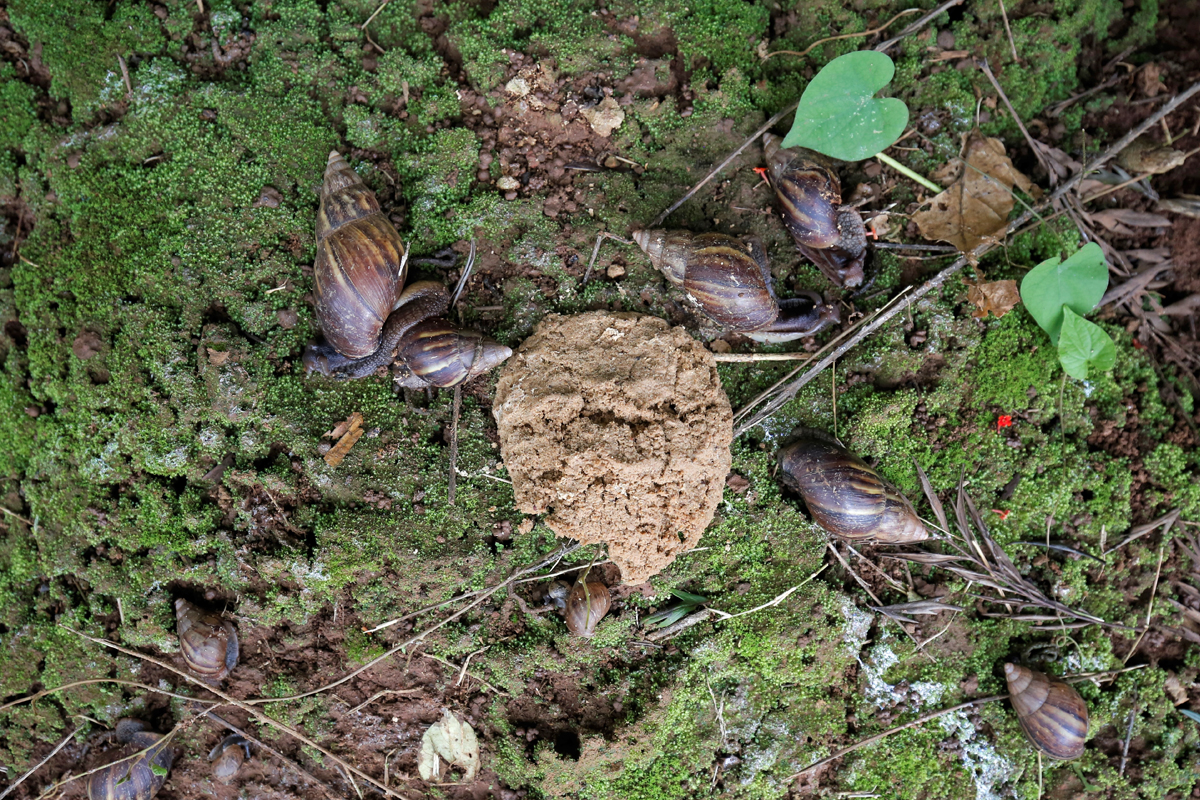
A giant African land snail, Achatina fulica, in a coffee estate in Kodagu district, Karnataka. | Abhishek Chinnappa/Mongabay
The monsoon rains have arrived late this year in the verdant hills of Kodagu – commonly known as Coorg – in Karnataka, the coffee capital of India. For some planters, it’s a mixed blessing. A delayed monsoon is bad news in the Western Ghats mountain range, where farmers and planters have found themselves at the receiving end of extreme weather events triggered by climate change. Last year in August, unprecedented rains and floods harmed crops and coffee plantations, affecting many lives and livelihoods.
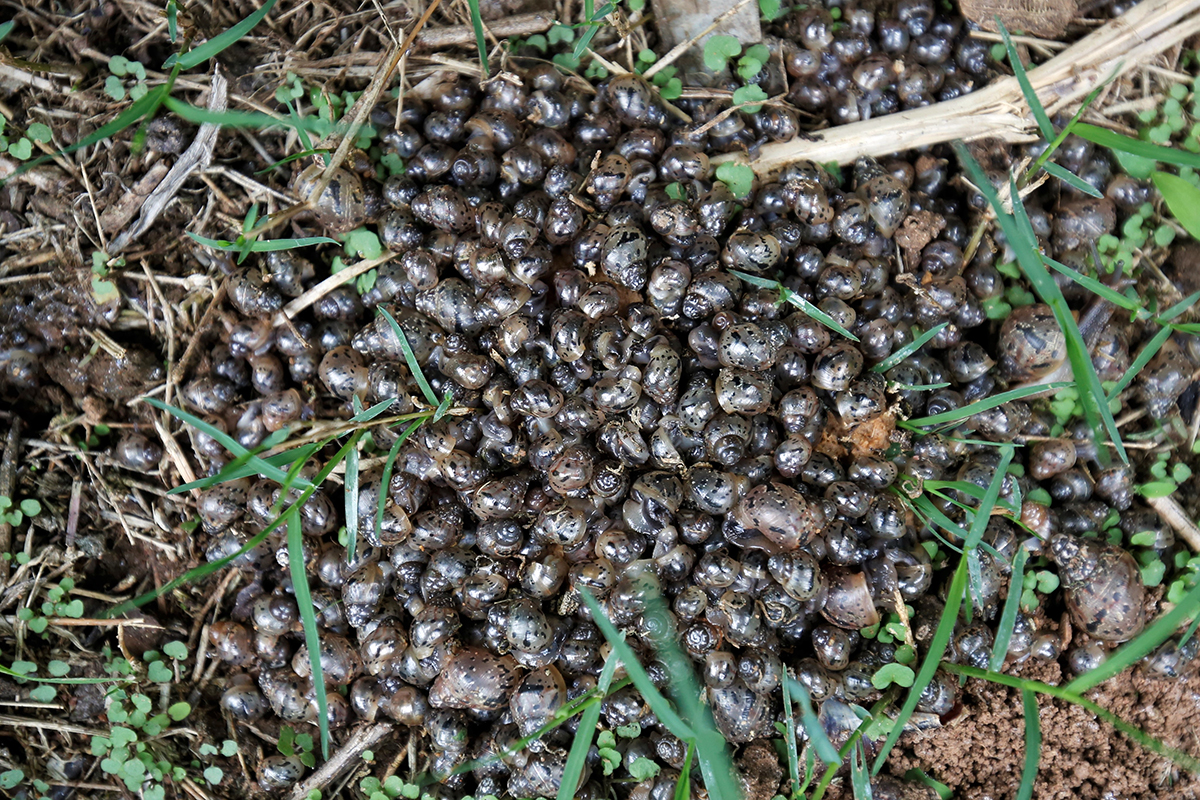
In recent years, the rains have brought another problem with them – an infestation of giant African land snails that have caused massive losses to some 40-45 plantations spread over 300 acres of land in Northern parts of Kodagu.
The foreign pest, which is thought to have arrived in India through trade routes, attacks young coffee plants and devours tender leaves and stems, completely destroying the plants. These giant snails, whose shells can grow up to 20 cm in length, are not picky eaters. They eat over 500 plant species and adapt easily to different ecosystems, researchers have found.
Giant African land snail, an invasive species, infest a coffee plant in Kodagu, Karnataka. Planters lose up to Rs 12,000 per acre in efforts to get rid of the pest. Credit: Pradeep Kumar/Mongabay
A fast breeder, this snail has emerged as a major problem for planters in the Shanivarasanthe area of Somwarpet taluk in Kodagu. “They multiply in large numbers within a short span of time,” said Pradeep B Shekar, who owns 40 acres of a coffee plantation.
The giant African land snail, locally known as shanku hoola or conch worm due to the shape of its shell, appeared in Kodagu for the first time in 2012-’13 in 50-60 acres of coffee plantations in Shanivarsanthe. The local plantation owners fought the infestation and thought they have ridden themselves of the pest.
But in 2017, the snails reappeared, wreaking havoc in an expanded area of 300 acres belonging to some 40-45 plantations. The planters say the pest attack costs them an additional expense of between Rs 10,000 and Rs 12,000 per acre, mainly due to the efforts to contain them. This shrinks their profit margins from the produce.
source: http://www.youtube.com
Invasive species
The International Union for Conservation of Nature lists the giant African land snail Achatina fulica as one of the worst invasive species in the world. An invasive alien species is “a problematic species introduced outside its natural, past or present distribution,” the International Union for Conservation of Nature says. “They may lead to changes in the structure and composition of ecosystems, detrimentally affecting ecosystem services, human economy and well being.”
African snails spread to new locations via trade routes, piggybacking on agricultural products, equipment, cargo and plant or soil matter. While there is no consensus on how they found their way into the pristine landscape of Kodagu, it is certain that these pesky visitors have come with no exit plan.
Giant African land snails in their early development stages inside a coffee estate in Handli village, Kodagu district. These fast-breeding snails have a lifespan of almost 15 years and can produce approximately 1,000 eggs in that period. Credit: Abhishek Chinnappa/Mongbay
Achatina fulica is one of the four species of giant snails belonging to the Achatinidae gastropod family native to Africa. It is classified as an obligate-outcrossing hermaphrodite, which means that just one externally fertilised snail can establish a population. These snails reproduce in large numbers.
The snails begin laying eggs at six months of age and can lay around 100 eggs in their first year, and up to 500 in the second year. Their life expectancy is around five years, and one snail can produce up to 1,000 eggs by then. The shell length of these snails ranges from 5 cm to 10 cm, though some adults may exceed 20 cm, and their average weight is about 32 gm.
Effective solution
Despite the destructive potential of the giant shells, the planters in Kodagu have been successful in tackling the infestation. They have reduced the infestation by about 90%, a remarkable achievement given that people in the neighbouring state of Kerala have been fighting this pest unsuccessfully for close to three decades.
The Coffee Board of India has emerged as the unlikely hero in this battle with the African snail. Researchers at the Central Coffee Research Institute in Balehonnur in Chikmagalur district of Karnataka and research sub-station in Chettalli in Kodagu devised a bait for the snail, in a method they dubbed “catch and kill”.
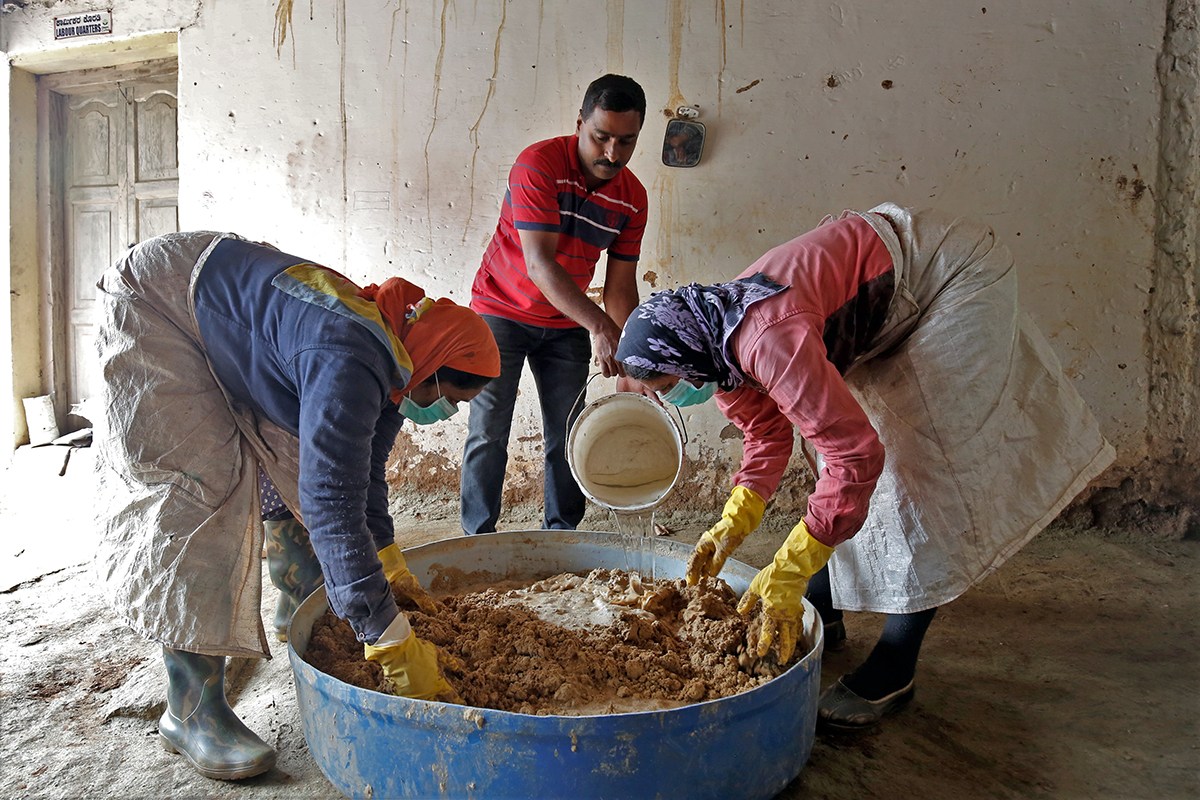
“The bait is made of rice bran, jaggery, castor oil and a chemical, thiodicarb,” explained Vishwanath Hadagalli, junior liaison officer of Coffee Board at Shanivarsanthe. “These are mixed together and balls of it are placed between four coffee plants.”
Researchers at the Central Coffee Research Institute in Chikmagalur district of Karnataka devised a successful catch-and-kill method to control the snail’s invasion. A bait made of rice bran, jaggery, castor oil and a chemical, thiodicarb, is used to lure and kill the pests. Credit: Abhishek Chinnappa/Mongabay
The researchers experimented with methomyl, a broad-spectrum insecticide, but it has been banned because the cost to the soil is too high. Thiodicarb is considered a less harmful insecticide that is effective against in killing the giant snails. “We tried every method available in the literature to get rid of these pests and this bait was found to be the most effective,” said Manjunath Reddy, assistant entomologist, coffee research sub-station at Chettalli, Kodagu.
In 2015, the Coffee Board used this bait and killed as much as 30 tonnes of snails. Encouraged by this, the Board, with active participation from Karnataka’s Horticulture Department and the Planters Association of Shanivarsanthe, upped their act through regular awareness meetings and distribution of bait kits to all the affected planters. The kit consists of a pair of gloves, 25 kg of rice bran, 100 gm of Larvin branded thiodicarb, 3 kg of jaggery and 100 ml castor oil. It costs Rs 1,000 but is distributed among the farmers at a subsidised rate of Rs 100.
Co-ordinated operation
“This has to be a collective effort,” said Pradeep Kumar, an affected farmer from Handli village in Shanivarsanthe. “If one affected farmer doesn’t participate, the infestation cannot be contained.” Hadagalli said there’s 90% success in eliminating these pests from Kodagu farms. “While we did not maintain records properly for the years 2014, 2015 and 2016, dead snails weighing 24 tonnes were collected in 2017, which came down to eight tonnes in 2018,” he said. “We expect much lower infestation this year.”
The Coffee Board also came up with the innovative idea of buying back the dead snails. It initially offered Rs 4 per kg of dead snails, which has since been increased to Rs 8 per kg. “The dead snails are disposed of in a pit that’s one-and-a-half feet deep,” said Hadagalli. “Salt is put over the dead ones to ensure even the last of the caught snails are dead and then buried.”
This burial is a precautionary measure against the spread of any disease through the snails. The giant snails are known to serve as intermediate hosts of several parasites that cause diseases in pets, free-ranging vertebrates and humans. They are hosts of rat lungworm Angiostrongylus cantonensis, which causes Eosinophilic meningitis in human beings.
Workers prepare a concoction to bait the giant African land snails inside a coffee estate. Co-ordinated efforts of farmers and officials have recently helped curb the infestation. Credit: Abhishek Chinnappa/Mongabay
Kerala experience
“In the past 5-6 years, seven children and at least one adult have been reported to have contracted meningitis through contact with giant African land snails,” said TV Sajeev, a scientist at Kerala Forest Research Institute, which who has been involved in the eradication of these snails in Kerala.
Although the fight against the snails has been largely successful in Kodagu, the experience is Kerala, where these creatures are seen as a nuisance, has been different. There have been as many as 223 outbreak points from 12 districts out of 14 in the southern state.
There is a cogent reason for this, said Sajeev. “The chemical used in the bait is not suitable for areas where there is human activity. These chemicals are found to be harmful, especially to aquatic organisms,” he said. “The case of Kerala, where the infestation is in towns and villages, is very different from that of an estate.”
Sajeev said one of the main problems that an invasive species brings with it is the invitation to use strong chemicals to eliminate them. Research has shown that exposure to chemicals like thiodicarb can be detrimental to human and animal health. The Kerala Forest Research Institute has been spraying an organic decoction of tobacco mixed with copper sulphate on snails that are lured with crushed papaya and cabbage leaves as bait.
Another big challenge in Kerala, said Sajeev, is the difficulty in organising people in these areas to work in tandem. “In Kerala, more than the destruction of agricultural crops, snails are a nuisance because they are seen in and around houses,” he said, adding that it is nearly impossible to get all the people in these houses to work together against the snails.
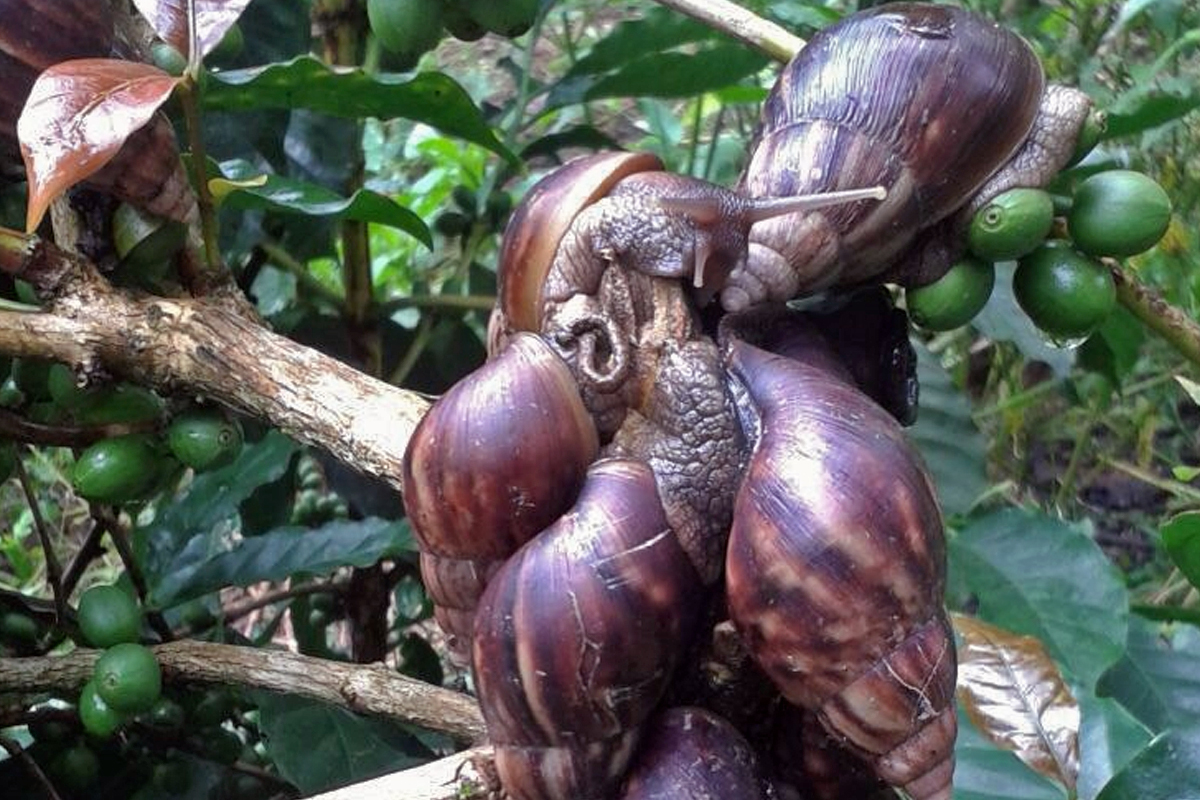
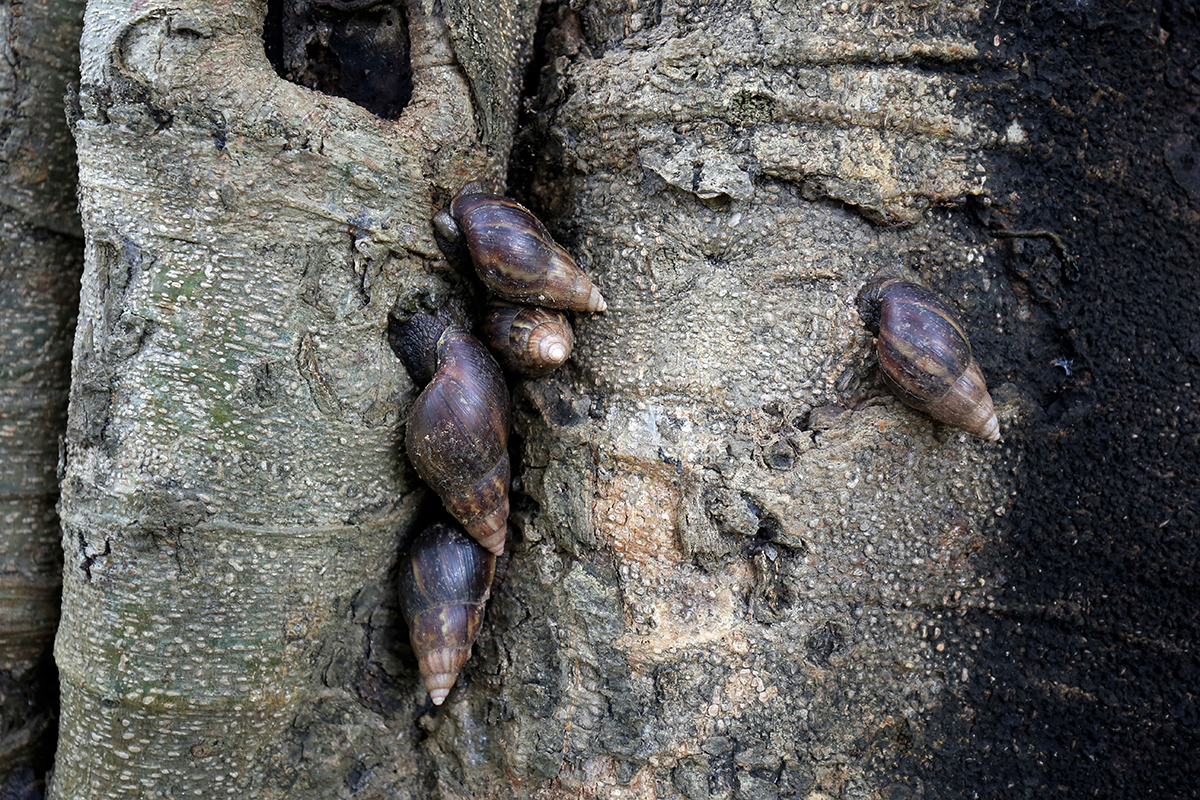
An escargatoire of giant African land snails on a ficus tree inside a coffee estate in Kodagu. While the infestation seems to be under control in the estates of Kodagu, Kerala is yet to find a solution. Credit: Abhishek Chinnappa/Mongabay
This article first appeared on Mongabay.
source: http://www.scroll.in / Scroll.in / Home> Pest Control / by Arathi Menon / August 05th, 2019
The Union Government is expected to soon set up a task force that will engage with various stakeholders in the coffee sector, examine the issues faced by it and make suitable recommendations to the Union Commerce Minister.
According to Jeffry Rebello, chairman of the coffee committee of the United Planters’ Association of Southern India, the industry representatives held detailed discussions with Commerce Minister Piyush Goyal recently on the issues faced by the sector.
This included the need for better research, permitting growers to add value, bringing down the percentage of chicory permitted to be mixed with coffee and schemes of the Coffee Board.
“We had presented a memorandum too. The Minister had announced that a two-member team will be formed and it will meet the stakeholders. The team is expected to submit its report to the Minister by August 31,” he said.
Welcoming the announcement on the task force, Mr. Rebello said it is likely to be set up soon after the Budget session of the Parliament, he said.
source: http://www.thehindu.com / The Hindu / Home> Business / by Special Correspondent / Coimbatore – July 27th, 2019
App-solutely smart: In the case of white stem borer, growers and the Board have validated 90% accuracy. | Photo Credit: Reuters
Apps fed with data help forecast weather, predict leaf rust
For the 3.5 lakh coffee growers in India, 98% of whom are small-scale, challenges affecting production include labour shortage, climate change and pest attacks.
One way to manage these is by adopting technology, which the Coffee Board is trying to bring about for the growers.
Last year, Eka Software Solutions took up a pilot project for the Coffee Board of India on machine-learning based applications. According to Shuchi Nijhawan, vice president – agri business for Eka Software, the Board and the company took up three areas to try machine learning based apps. One was addressing the white stem borer problem, another was weather forecasting, and the third, predicting leaf rust.
Machine-learning
“Based on the data, photos provided, we created a machine learning algorithm to forecast each of these issues (for a grower). We worked with 20 liaison officers of the Board and they coordinated with the growers.
“The success of the app depends on the data fed in. In the case of white stem borer, the growers and the Board have validated 90% accuracy,” she says. Eka’s digital platform for agriculture aggregates data from different sources and applies the algorithm to provide insight to the coffee growers.
Srivatsa Krishna, chairman of the Coffee Board, adds that though there is no exact data, it is learnt that in the last 10 to 15 years white stem borer would have brought down Arabica production by 25-30%. “The growers do need solutions for such issues.”
“Despite the Coffee Act having been around for more than seven decades, farmers have zero technology. The only way to increase productivity is by bringing in technology,” he says. Even before smartphones became popular, coffee growers had checked prices on the London and New York exchanges almost on a daily basis.
Hence, adopting technology should not be difficult for them. The Board has plans to scale up the analytics technology for adoption by more farmers.
Currently, 90% of the estates depend on labourers for most of the work and there is not much technology adoption among coffee growers in cultivation or to increase production.
“If someone is ready to do it [technology] for us, we will adopt it. It will help increase yield,” says Sundar Subramanium, executive director of Mother Mirra Coffee Plantations. Ms. Nijhawan says the company is exploring partnerships for other crops too. “Indian farmers want such technology services. There are several agriculture institutes and cooperatives in the country that have a lot of data. I see a huge potential for these technologies.”
source: http://www.thehindu.com / The Hindu / Home> Business> Industry> Green Shoots / by M Soundariya Preetha / June 02nd, 2019
Chowrira Pemmaiah (72), the man who spearheaded the fight for coffee open market, passed away yesterday at a hospital in Mangaluru.
A bachelor, Pemmaiah fought for the open market for coffee, which was under the control of Coffee Board and succeeded in getting the open market.
Pemmaiah served as the President of Hodduru Mandal Panchayat in the 80s and became popular through his efficient administration. He also served as the President of Moornad Educational Institutions and took it to the top.
Last rites were held this afternoon at Hoddur near Moornad, according to family sources.
source: http://www.starofmysore.com / Star of Mysore / Home> News / May 27th, 2019
– Issues notice to producer of Civet Cat Coffee in Kodagu; files
Police complaint
– Plaint closed as there is no evidence of cats being reared and
tortured for poop
Mysuru:
The Coffee Board has issued notice to Coorg Consolidated Commodities regarding what it calls ‘unauthorised sale of Civet Coffee’. The notice has been issued by Deputy Director, Extension, Coffee Board, to Thamoo Poovaiah who markets Civet Coffee in Kodagu.
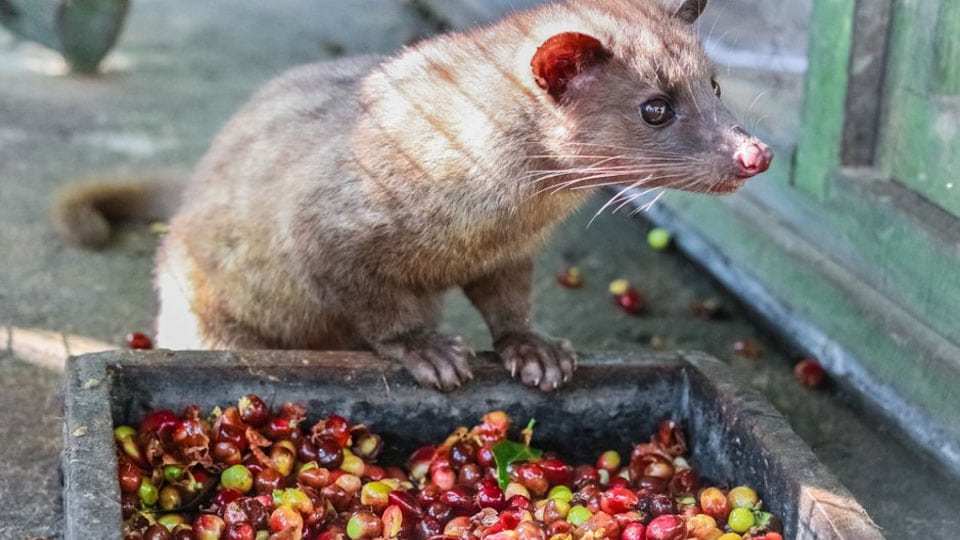
India, Asia’s third-largest producer and exporter of coffee, has been producing the world’s most expensive coffee, made from the poop of Civet Cat, on a small scale in Kodagu district. The Civet Coffee, also called as Luwark coffee, is expensive because of uncommon method of producing such a coffee. It is produced from the coffee beans digested by Civet Cat.
The faeces of this cat are collected, processed and sold. It is highly priced because it is claimed to be more nutritious and high cost involved in sourcing the animal dropping, wastage during processing and quality certification.
The Coffee Board notice, the copy of which is with Star of Mysore, states that the sale of Civet Coffee is banned under Wildlife Act. “It is surprising how can you brand and sell Civet Coffee when you don’t own wild cats in your estate. You are procuring raw coffee in the form of faeces of wild cats which is sold by persons who are known to you,” the notice states.
The Coffee Board has asked Thamoo Poovaiah, who is the managing partner of Coorg Consolidated Commodities that markets the Civet Coffee in brand Ainmane, to provide the names and addresses of those persons who supply Civet Coffee to him.
Police complaint
In addition to sending a notice, the Coffee Board also filed a complaint against Thamoo Poovaiah with the Kodagu SP for allegedly rearing Civet Cats to produce Civet Coffee. The complaint mentions that a well-known animal rights activist has alleged that worldwide, Civet Cats are confined and force-fed coffee cherries for them to produce poop. The complaint alleges that even Thamoo Poovaiah rears Civet Cats in confinement to produce the expensive coffee. Rearing such cats in cages is illegal and punishable under Wildlife Act as it is one of the most endangered species in the world.
Complaint closed
Following the complaint, the case was transferred to Madikeri Rural Police Station and the Police, armed with a search warrant issued by Madikeri Additional Civil Judge and JMFC Court, conducted an inspection of Poovaiah’s estate near Kadagadalu along with Coffee Board and Forest Dept. officials. The team discovered that Civet Cats are not reared at the estate and the case has been closed now and the same has been communicated to the Court.
Reacting on the Coffee Board notice and the subsequent lodging of the case, Poovaiah told SOM that his firm procures Civet Cat poop through legal means and in no way the endangered species are confined and tortured as alleged by Coffee Board.
‘False and malicious complaint’
“This is a false and malicious case. If at all there is a violation in the Wildlife Act, the Forest Department must take action. Why is Coffee Board involved in this? Actually, Coffee Board should be promoting rare coffee produce such as Civet Coffee which are famous worldwide rather than harassing growers who are popularising such exotic coffee,” he said.
“In reply to the Coffee Board notice, I have set them a legal notice asking clarification on their move and how could they act autocratically in collusion with some animal rights activist that they have not named. Their move to lodge complaint and search my premises will amount to defamation and I am ready to take them on in the Court of law,” Thamoo Poovaiah added.
source: http://www.starofmysore.com / Star of Mysore / Home> News / May 25th, 2019
WELCOME. If you like what you see "SUBSCRIBE via EMAIL" to receive FREE regular UPDATES.
Read More »