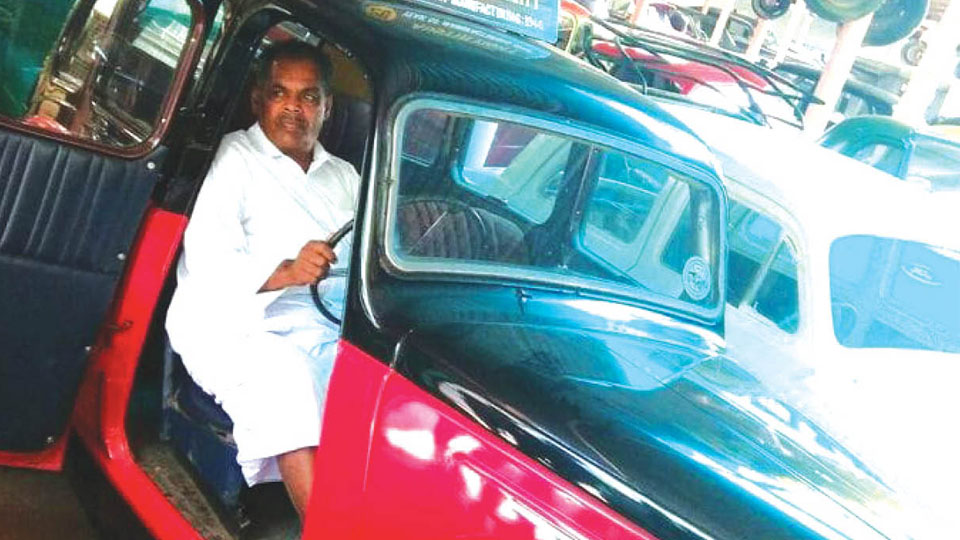
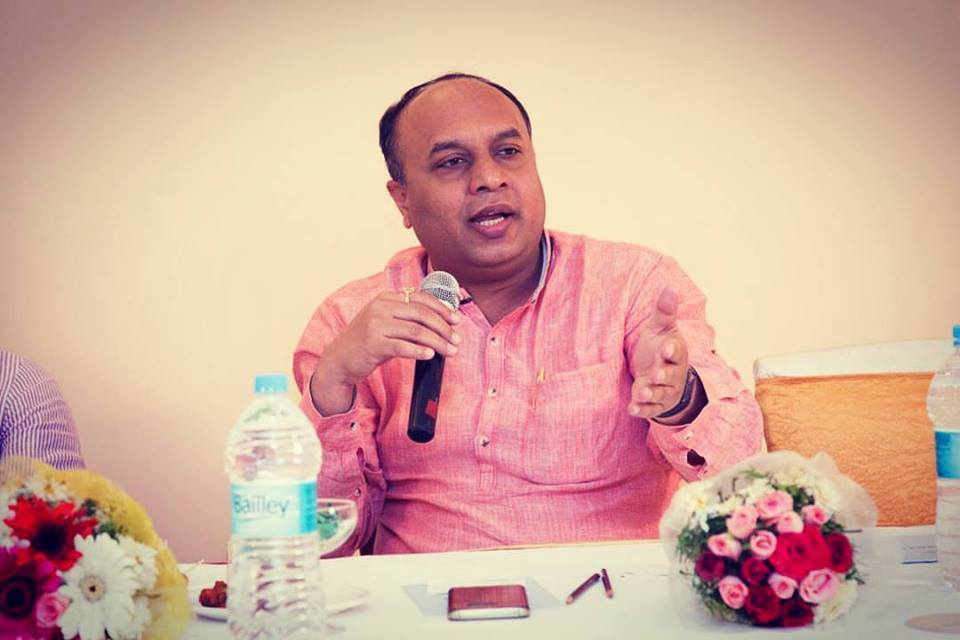
A farmer and a vintage car collector died after a tree branch fell on him at Nellihudikeri village near Siddapura in Kodagu district yesterday.
The deceased, 67-year-old P.C. Ahmed Kutti Haji, was working in his Mubarak Estate along with his son Ashraf at around 11.30 am. Due to heavy rain and wind, a branch of a banyan tree fell on Ahmed Kutti. He was immediately rushed to a hospital. But he succumbed to his injuries in the hospital. Kodagu Deputy Commissioner P.I. Sreevidya has announced Rs.5 lakh compensation to his family. She sent the cheque through the Tahsildar.
With his death, Kodagu has lost a collector of Vintage ‘beauties
Ahmed Kutti Haji is a coffee planter and also an industrialist. He has a huge collection of vintage cars which he threw open to public. Collecting vintage cars was a hobby for Ahmed who has 86 of them and over 15 vintage petrol jeeps. Not to stop there, he also has 20 old two-wheelers, a 125-year-old bicycle and a 200-year-old bullock cart. The oldest car in the collection is 1925 model.
Normally vintage car collectors eye Bengaluru to add cars to their collection. Changing the trend, Ahmed focussed on old workshops in Kodagu and surrounding areas to hunt vintage ‘beauties.’ After picking them, Ahmed gave old cars a fresh coat of paint and tuned them to working condition.
Almost all foreign cars owned by Ahmed were manufactured between 1925 and 1965. Barring Dharmasthala, no other place in the State has such a wide collection of vintage cars.
With his death, Kodagu has lost a vintage automobile enthusiast.
source: http://www.starofmysore.com / Star of Mysore / Home> News /June 10th, 2018
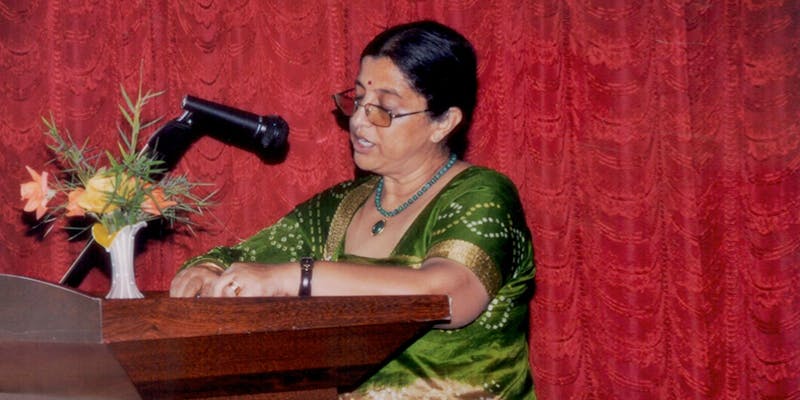
Ganga is the trustee and adviser to The Coorg Foundation, an independent social wing of Tata Coffee that has been working towards promotion of the welfare of the local community of Kodagu.
Ganga Chengappa
An organisation is not just known for the products it makes, but also the impact it has on the society at large.
Corporate social responsibility (CSR) is today every large organisation’s focus. As William Clay Ford Jr said, “Creating a strong business and building a better world are not conflicting goals – they are both essential ingredients for long-term success.”
Tata Coffee, too, goes by this way of doing business. One of the largest integrated coffee plantations in the world, it doesn’t only grow, curate, and market coffee but also plays a big role in community development with its independent social wing, The Coorg Foundation, established in 1994.
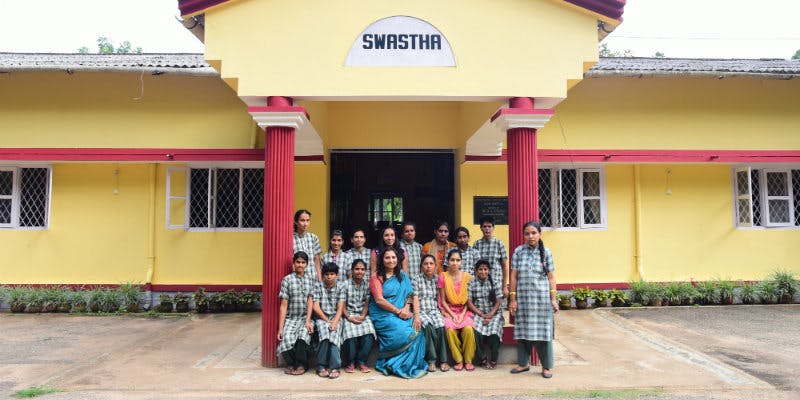
Its initiative is to empower thousands of women who are employed in the estates, who can earn their livelihood now and lead a financially independent life. Similarly, Swastha, an institution for the mentally and physically challenged children, helps them express their special creativity with vocational training in informal skills. The students also learn the intricacies involved in making envelopes, files, greeting cards, screen-printing and tailoring, which makes them economically independent.
In a conversation with YourStory, Ganga Changappa, trustee and adviser to The Coorg Foundation, Tata Coffee Ltd., talks about empowerment of women workers, skill development, Swastha and further plans for the development of the community.
YourStory: Can you tell us a little about yourself and your journey with The Coorg Foundation?
Ganga Changappa: I am a special educator with over 28 years’ experience in special education, and over 38 years in social work. In 2003, I set up an institution in Coorg called Swastha, a centre for special education. Today, we have two centres – one for special education and rehabilitation and another for training and rehabilitation for boys above 18 years. Initially, we started with 20 students and, in 14 years, the number has grown to 375. Currently, I manage the functioning of these centres.
After initiating the community-based rehabilitation programme that aims at bridging the gap between the differently abled and mainstream children, and to link them with the available services in the Somwarpet taluk, we also conducted several rehabilitation workshops. We succeeded in rehabilitating 150 children by imparting job-based skills. We have successfully trained children for Special Olympics and 10 children represented the country in Australia, the Netherlands and the US and won several prizes. We have also successfully conducted Go-Get in – a sports meet for abled and differently abled children every year.
YS: Can you tell us about the formation of The Coorg Foundation, its goals and its mission?
GC: In 1994, Darbari Seth, the Chairman of Tata Coffee, visited Kodagu district as part of his visit to the estates of the erstwhile Consolidated Coffee Limited. Rechristened as the Tata Coffee Pvt. Ltd in 2000, the company has 13 estates spread across the district of Kodagu. Although coffee estates dot the other districts of the Western Ghats also, the highest concentration can be found in Kodagu. The former Chairman of Tata Coffee felt the need for holistic development of the district. It was with this in mind that The Coorg Foundation was formed. The vision was based on the five pillars of Sports, Education, Environment, Healthcare and Culture.
YS: How have you worked towards women’s empowerment and in what sectors?
GC: My first stint towards women’s empowerment started even before my career with special education. As a newlywed in Munnar, Kerala, I believed women workers or the women of the district could be empowered with soft skills to help improve their livelihood. Self-help group or a ladies’ group was the catalyst that could bring about these changes.
As my husband was working with Tata Tea in Munnar, there was an opportunity within the agriculture sector. The company, being the major stakeholder in Munnar, I floated the idea of a special school with the managers’ wives on the estates. This, at once, empowered women like us and gave us an opportunity to make a difference. Starting a special school in Munnar came with its own challenges, but allowed us to further empower a whole host of women. Starting with the staff and support staff, the women of the district got new opportunities to work and augment their families’ income. This also changed the outlook of the local people, as earlier the only women working were in the tea fields, so this added a dash of inspiration for the rest of the ladies in the district.
The core of our mission, however, was to educate and empower the differently abled, given that there were limited resources for them in the district. The school was co-educational so gave equal opportunities to girls and boys. The crowning glory would be the vocational training and practical skills imparted, beyond basic education. This empowered differently abled girls of the district to stand on their own two feet, thereby becoming a boon to their families that otherwise would neglected them.
YS: How have lives of women changed through your empowerment programme?
GC: There are several examples of women who have transformed their lives through our empowerment programmes. There are two that stand out for me, especially.
Rekha was born with cerebral palsy and after two unsuccessful operations on her lower limbs, which were defective, she was left feeling frustrated and had little hope for her future. This was around the time that Swastha started and she applied for a seat for the skill development programme. She took courses at our vocational training centre and equipped herself with skills in screen printing and the making of different kinds of stationery. Once she completed her course, given her skill levels and interest, we were able to offer her the role of an instructor.
Suma was a quiet and shy 17-year-old when she first came to Swastha. Given the lack of opportunities for a hearing- and speech-impaired student, she sought a training course to give her practical education. The tailoring course gave her the skills and added to her confidence. She went on to teach some of our other hearing- and speech-impaired students who went on to complete Class X, an incredible feat in these parts.
Subsequently, she got married and moved to Mysuru, where she continued her tailoring. Currently, she is working as a tailor in Bengaluru with a premier garment manufacturer.
YS: What are your future plans?
GC: I have been working on this idea of taking special education and rehabilitation services to every individual and every community. By empowering communities to deal with the differently abled, we can create a society of tomorrow where we are respected for our differences and not judged on the same. My aim is to spend my life trying to bring this conversation to the public and to make society more inclusive for the differently abled. I hope I can make a small difference to the community of those with special needs and therefore the world at large. To this extent, I have been working on a ‘community-based rehabilitation programme’ in Kodagu district. My hope is to break the barriers of institutional solutions to the problem and rather have a community-based approach that can solve the problem at a grassroot level and that which can be replicated the world over
source: http://www.yourstory.com / YourStory.com / Home> Her Story / by Rekha Balakrishnan / May 21st, 2018
United Coffee Association of India (UCAI) and Coffee Board of India are to organise ‘The National Barista Champioship 2018’ in Bengaluru at Orion East Mall, Bengaluru.
The champioship spread over three days – April 18 – 20 is likely to see participants from various parts of the country competing.
For the Barista Champioship, United Coffee Association of India (UCAI)—a representative stakeholder in the Indian Coffee industry comprising of green coffee traders, manufactures of roast and ground coffees, along with coffee machinery manufacturers and dealers of equipment, cafes, coffee labs and coffee professionals—have to come together.
According to R Srikanth Rao, Vice President, United Coffee Association of India, “The competition has three rounds of elimination. Each barista would be preparing and presenting four cups each of espressos, milk beverage and signature drink which will be evaluated and judged by certified jury to identify the best in the various categories of beverages.”
The preliminary round will be on April 18 and 19 and the semifinals and finals would be on April 20. The head Judge for the competition would be Joe Hsu, who is international representative from World Coffee Events. The winner of National Barista Competition would represent India at the World Barista Championship to be held at Amsterdam, during June 2018.
source: http://www.thehindubusinessline.com / Business Line / Home> News / by Anil Urs / Bengaluru – April 13th, 2018
With coffee running in the blood lines of the family the Mother Mirra Group has owned coffee plantations for four generations.
Sundar Subramaniam, executive director of Mother Mirra Group of companies releasing their company product in Coimbatore. (Photo: DC)
Coimbatore:
His family is introduced as the ‘first Asians’ to own a plantation in Asia. Ironically, it took several years and four generations of entrepreneurs of the ‘Mother Mirra Group of Companies’ to foray into retail coffee market.
Speaking to DC, Mr. Sundar Subramaniam executive director of group said, “way back in the 1930s, my great grandfather Mr. PPR. Subramanian Chettiar owned and managed estates in Malaysia at a time when only British and Scots owned coffee plantations. Since then on, my family is in the business of supplying coffee powder and roasted beans from our estates in Coorg to different parts of India. Entering into the domestic filter coffee market is a dream come true for my father Mr. S. Subramanian, who is a third generation entrepreneur of our family.”
With Mirras Coffee the company has entered the domestic filter coffee market. Two options of coffee powder were launched in Coimbatore recently. Mirras Premium blend is a combination of 85 per cent coffee and 15 per cent chicory while the Mirras Gold variant is a combination of 53 per cent coffee and 47 per cent chicory.
Available in 200 grams sachets, for a cost that is affordable, the traditional filter coffee tastes just like home-made coffee, sticking to the tag line of the product ‘idhu namma veetu kaapi’.
The product is available across big and small stores and supermarkets across the city. The firm has a strong dealership network in Tamil Nadu and Puducherry. “We have partnered with 350 dealers across both the regions. In a year’s time we are hopeful of capturing 3.50 per cent to 4 per cent of the filter coffee market,” Mr. Sundar Subramaniam said.
The company already has a strong market hold in the wholesale filter coffee market segment with regular consignments of their coffee powder delivered across India. Karnataka and Tamil Nadu is where the company does thriving business. The coffee is customized for their wholesale clients.
With coffee running in the blood lines of the family the Mother Mirra Group has owned coffee plantations for four generations.
It is home where three generations of employees have worked and it has to its credit more than seven decades of experience of growing and producing coffee powder. At the product launch in the textile city, one-year-old master Shiv Ram Alagappan, the founders’ grandson, gracefully received the first packet of coffee.
source: http://www.deccanchronicle.com / Deccan Chronicle / Home> Nation> In Other News / by Lakshmi L Lund, Deccan Chronicle / April 08th, 2018
The blossom showers and the subsequent backing showers are crucial for a good crop. – NS
Bengaluru :
For the beleaguered growers of robusta coffees in Karnataka, the largest producer of the bean, the ongoing spell of rains has raised the hopes for next crop year starting October 2018.
The low pressure and depression off the West Coast has brought rains to several parts of the key coffee growing regions of Kodagu, Chikmagaluru and Hassan among other districts in Karnataka, which accounts for over 70 per cent of the coffee produced in the country.
Crucial showers
The pre-monsoon showers are crucial for blossoming of the coffee floral buds. The blossom showers and the subsequent backing showers are crucial for a good crop. Traditionally, the robusta and arabica areas should receive pre-monsoon showers by March 15 and April 15, respectively, for a good blossom, growers said.
“For the growers who had taken up irrigation through sprinklers for robustas from late February and where coffee has blossomed, the current spell of rains are acting as backing showers,” said HT Pramod, Chairman, Karnataka Planters’ Association. The rains will be of some help for the growers, who have harvested a poor robusta crop this year.
“The current spell of rains are good for the coffee sector as a whole. However, the rainfall has not been uniform and several robusta areas in Kodagu have not received the rains. The forecast is that it would rain for the next two days and we are hoping for some good showers,” said N Bose Mandanna, a grower in Suntikoppa.
Coffee growers have suffered from a poor crop and bearish price trend this year. Robusta growers have seen their crop shrink by up to 40 per cent in several areas on account of erratic rainfall last year.
source: http://www.thehindubusinessline.com / Business Line / Home> News> Specials / by The Hindu Bureau / Bengaluru – March 16th, 2018
The Supreme Court delivered its historic verdict on Friday that the state of Karnataka will get 14.75 TMC or thousand million cubic feet more water, in addition to the 270 TMC awarded by the Cauvery Water Disputes Tribunal (CWDT) in 2007. The Cauvery water sharing dispute has been a bone of contention between Karnataka and Tamil Nadu since the time of the British Raj.
This verdict is a clear victory for the poll bound Karnataka. However, Karnataka’s victory is mainly credited to Brijesh Kalappa who quit his cabinet rank post for the case.
Brijesh Kalappa is an advocate in the Supreme Court and Former Additional Advocate General, Haryana. He is an alumnus of the National Law School of India University and has also been a Legal Advisor to the Government of Karnataka (with the rank of Minister of State.) He has a sustained interest in public affairs even from his student years. He is a former journalist and has a wide range of interests including reading and travelling. On the professional front, he has worked with several legal luminaries on subjects of importance in civil, criminal, water and electoral laws and has individually represented governments, eminent individuals and major industrial houses. He is gifted with the prowess for distinctive sharp-edged analysis and has the advantage of surmounting well accepted beliefs by his inquiring nature. He is also the spokesperson of the Indian National Congress.
As a Legal Adviser, Kalappa could not appear on behalf of the State of Karnataka. The Cauvery Water Dispute had been very close to his heart, more so since he hailed from Kodagu. Thus he expressed his desire to re-join legal practice in order to continue to appear for the State of Karnataka when the prospect of the final hearing in the Cauvery Dispute before the Supreme Court loomed. The Chief Minister Siddaramaiah understood its significance, since he belonged to the basin area of the Cauvery River and thereby consented. Kalappa therefore resigned from the position of Legal Adviser to the Government of Karnataka/Chief Minister and re-entered the legal team that he was a part of for a decade and a half.
Kalappa had written a detailed post sharing his experience of appearing in the Cauvery case
In this interview, Kalappa has an exclusive chat with The Indian Jurist regarding the latest victory of Karnataka in Cauvery River dispute and his all over experience throughout the case.
The Indian Jurist: Sir, First of all Congratulations for the victory in the Cauvery Judgment. To begin with- you quit your position as the cabinet minister to concentrate on this case. So what exactly gave you the courage and the motivation to do so?
Brijesh Kalappa: In 2007, when the Cauvery Water Dispute Tribunal award has come, at that time I was very much a lawyer and then I had also prepared the SLP and had worked in regard to the Cauvery case. From 2007 onwards we kept waiting that the Supreme Court will hear the matter and finally when the Supreme Court actually decided to hear the matter on a day-to-day basis in 2017, ten years later, I had been by then appointed as legal advisor to the Chief Minister of Karnataka and Mr.Siddaramaiah was kind enough to have conferred me the rank of minister so at that time my first instinct was that we should succeed in Cauvery just like we had succeeded in Krishna earlier. I was the Advocate on Record for the State of Karnataka in the Krishna Water Disputes, where Karnataka was the beneficiary of the greatest possible award of 524.256 m for the Almatti Dam and enhanced share of the share of Karnataka from 734 to 910 Tmc.
TIJ: Though there has been a reduction in the share of Tamil Nadu but now Karnataka is obligated to release a monthly share. So this in turn does benefit Tamil Nadu and is not complete loss for the state?
BK: No, certainly it is not a loss for Tamil Nadu and I would actually look at it this way that as far as Tamil Nadu is concerned, it is important only if they have a workable order- doesn’t matter if they receive 500 TMC from Karnataka every year. But if Karnataka has refused to give them 500Tmc and they are running to Court every year then what is the joy of having an order like that. It should be a workable order. If it doesn’t work then there is no point. Tamil Nadu will also not enjoy the sweet success of having an order which isn’t going to be implemented. The thing which is important is to have something which is implementable.
TIJ: In one of the media interactions with the reporters at Vidhan Soudha, Karnataka Chief Minister Mr.Siddaramaiah stated that the verdict was not in full accordance with the plea and only some relief had been sought. So are you satisfied with the judgment?
BK: As far as the complete requirements are concerned they are certainly not fulfilled. One can see straight off that Karnataka people could have had much more. But I think there has to be a sense of give and take. We also have a sense that this is final because after the Supreme Court where else can you appeal? You can only go to God next.
TIJ: The major grouse of Karnataka was that the farmers in the Cauvery basin were restricted by curbs on the water usage. So how far this judgment would be beneficial for the farmers now?
BK: The victory is straightaway for farmers. About a lakh and half farmers are going to be benefitted straightaway and as far as the Bengaluru city is concerned, I think the needs of Bengaluru city, which was considered as of the most unlivable city after Cape Town (South Africa), that will finally be resolved.
TIJ: So how has been your experience throughout the entire case these years? You might have been receiving both brickbats and bouquets as well in the case?
BK: See, when you appear in a case like this, a daily assessment is made about your performance. The Cauvery Case is not about the final order, like as if it were to happen in a single day, For instance whenever there is distress, fate is ours to release say maybe 15 cu ft or 20 cu ft of water, many people don’t understand the outcome or implications of this, they would immediately say that the legal team have totally failed us and then there will be burning of effigies and people sending us very vicious WhatsApp messages and people making very horrible comments and mainly these people have lived of the state for so long but what they forget that this is an ongoing case and it is going on, at least as far as I am concerned, for a decade and a half. Suppose they say look Rs 1 Crore has been given to “X” lawyer then public says ‘look at this lawyer they have received such a huge amount’. But 1 Crore rupees over 15 years is nothing or 2 crore rupees a year means nothing because once you are living in Delhi, the living standards are very high there and how much a lawyer earns is very high. So in comparison to all of that what you are actually earning is probably less than a techie who is working in a top software firm. But people will say, “No-No Look at the kind of money these guys are making”. So this is the kind of campaign which really hurts you. But the overall point is that there must be satisfaction in what you do and satisfaction comes from within. So once you understand that this all blaming is just people’s frustration then you are okay with it. Even the normal client, when fails to get justice, he will always blame the lawyer and he will not say anything against the judge or anyone else. So we think of it in that sense. I have personally received both brickbats and bouquets during these years. I have endeavored to treat both with equanimity. This is actually what Lord Buddha says. There is much more to do, miles to go before we sleep. Threats to our environment ought to be thwarted, greater concern for water usage implemented and selfish concerns repelled.
TIJ: So finally this landmark judgment has held that a river is no one’s exclusive property; it is a national property and not a state owned. Will this judgment become a basis for all the other water disputes as well?
BK: This is indeed a wonderful law which has been laid down by the Supreme Court because the previous law had always been laid down under a reference for under such circumstances. So this is a particular law in regard to equitable apportionment which has been now laid down and it’s of course a high point as far as the law in regard to equitable apportionment is concerned. And further, everybody will certainly look at this judgment for all times to come.
source: http://www.theindianjurist.com / The Indian Jurist / Home / by Naazish Fatima / February 19th, 2018
A documentary film about the elephant-man conflict in Karnataka posits that solutions to loss of life due to elephant attacks can only come through co-existence. Not everybody agrees, though. We look for some answers.
There is a moment in Elephants in the Coffee when Naveen Cariappa (his family has farmed an area in Coorg for more than three generations) talks about how media, officials and conservationists rush to the site of an elephant death, but remain silent when a coffee plantation worker is killed as a result of conflict with the very same elephants. The lament encapsulates the kernel of the 58-minute documentary – that the solution to such man-elephant conflict lies not in taking sides, but in pursuing solutions that encourage a peaceful co-existence between both parties.
Created by author, documentary filmmaker and cultural explorer Bhaskar Krishnamurthy and journalist-turned-educator Tom Grant, Elephants in the Coffee looks at the fragile relationship between elephants and humans, and has been shot mainly around Nagarahole National Park and the coffee estates skirting it.
Krishnamurthy, who was in the city for the screening (he is based in the US) says this, his first film on the subject, was born out of a desire to understand what happens as human population grows and elephant habitat shrinks. “Are we at the threshold of cutting our relationship with animals? The more plantation workers die as a result of this conflict, the more tolerance for wildlife is going to reduce. And that doesn’t bode well,” he says. Grant adds: “Cariappa represented an important duality, or internal conflict, among farmers. He loved elephants and nature. He worked with people in the national park to help improve the situation for elephants. But when they began destroying his crops and threatening his workers, he had to seek solutions. He found no reasonable measures by which he, as a small farmer, could protect his farm from crop raiding elephants. In our minds, he is a symbol of the Indian farmer who is being forced to change his attitude toward an animal he once saw as a benevolent god. Now he, as many others, see the elephant as a menace that must be addressed.”
There are others. PC Bopanna, a farmer describes how he survived after an elephant pelted him to the ground, but today, hobbles along on a crutch, his leg badly damaged in the incident, even multiple surgeries later.
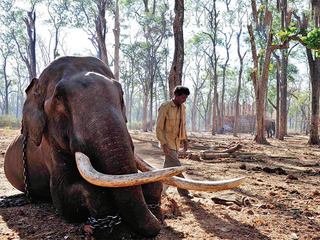
Then there is the other side – of elephants losing their habitat, of majestic creatures being robbed of their homes and reduced to residents of tiny spaces once they’re marked as violent and aggressive and eventually, captured. Krishnamurthy speaks with feeling of the 60 elephants housed in captivity in Karnataka, and how they may be alive, but living regimented lives like that for the rest of their days “is no life at all”.
Fences have not worked, as illustrated by viral videos of an elephant slipping under a railway crossing barrier at Chapramari Wildlife Sanctuary earlier this year.
Elephants in the Coffee also shows how elephants outsmart all kinds of barriers, trampling them with ease. As the film makes clear, ‘If you make a 20-foot-long moat, the elephant will walk till the 21st foot and cross over there’. Successful models have been few, such as the SMS-based warning system developed by Dr Anand in Valparai to warn workers when an elephant is in the area, or the SMS messaging system at Tata Coffee, demonstrated in the film by biologist Karthic Krishnan.
Conservationist Padma Ashok is also of the opinion that co-existence is the only way forward. She opines that solutions need to be thought of by people local to the area, by taking into consideration the topography, landscape and geographical features of the area. “From the elevation to the length of the river in that area, everything matters. And you need a combination of two-three solutions to tackle the problem, because elephants are able to outsmart most,” she says.
Not everyone agrees, though. Praveen Bhargav, former member of the National Board for Wildlife, believes harmonious co-existence is “one of the greatest myths in conservation”, a utopian idea that “rarely works in the long term with most conflict-prone large mammals”. He advocates “site-specific solutions driven by scientific knowledge and a deep understanding of the social context”. He adds: “Loss of a family member is tragic but it must be seen in perspective. In Karnataka alone, more than 10,000 people have lost their lives in road accidents in 2015 while around 15 people have died due to elephant conflict. Large swathes of elephant habitat have been fragmented/lost due to agriculture, human settlements, encroachments, dams, highways, resorts etc which is a major driver of conflict.
There is no magical solution but conflict can be minimised by spatially separating humans and large wildlife to the extent possible by deflecting developmental projects, preventing ad-hoc grants of public lands by the revenue department, incentive-driven voluntary resettlements and innovative ideas for creating viable buffers around reserves involving local communities. In some specific cases, marooned, isolated population of elephants may have to be moved out to minimise conflict.”
Krishnamurthy believes the biggest problem is a lack of education. People have no idea what impact a cup of their coffee is having in the wild. He suggests the promotion of sustainable wildlife products, say by giving “a premium to the coffee you drink”. “At least that way a part of it will go back to wildlife conservation.” He would also like more stringent requirements for ownership of coffee estates and homestays that have mushroomed indiscriminately in these areas over the past few years. “So many of them are owned by people living, say, in Bengaluru. Maybe one way to minimise the number of such estates is to lay down laws that owners have to have strong roots in Coorg,” he explains. And to ensure better welfare of the captured elephants, mahouts need to be treated better and paid more. “Otherwise they’re losing interest and daily wage labourers who are paid a pittance and have no interest in forming a relationship with the animal, are taking their place.” The best answer, though, he believes, is technology. “Even the SMS warning service is eventually a human intervention. Instead, I’m sure that in Bengaluru we can develop technology to identify elephant movement and tracking, where there is no need at all for a person to physically go out there and do it.”
For Grant, the solution also lies in people considering the cost of their cup of coffee. As he puts it: “Americans drink an average of three cups of coffee each, but they have little idea how coffee is grown. India is one of the top exporters of coffee. And now Tata has a joint operating agreement with American coffee giant Starbucks. Yet no one in America who drinks coffee knows that India’s elephants are locked in a struggle for survival with the people who grow coffee.”
The answer isn’t that people stop drinking coffee, he emphasises.
Rather, “if every coffee drinker gave a penny for elephants with every cup, we could solve this problem in an instant”.
source: http://www.bangaloremirror.indiatimes.com / Bangalore Mirror / Home> Opinion> Sunday Read / by Sowmya Rajaram, Bangalore Mirror Bureau / April 30th, 2017
Subsidies to planters from the government might not be renewed and Coffee planters need to look inward and adopt to newer technologies and strategies to enhance the quality and quantity of Indian Coffee, Srivatsa Krishna, CEO and Secretary of the Coffee Board said on Thursday.
Speaking at the plenary session of the India International Coffee Festival (IICF) here, he said the Board had recommended continuation of only two types of subsidies to the sector and it was up to the government to approve them or not.
He said that the Coffee Board is making every effort to enhance both production and quality of Indian Coffee. But the planters need to embrace innovative methods and information technology for their own well being and should reduce dependence on the government.
Mr Krishna said the Karnataka government had also initiated inquiry into allegations of coffee planters encroaching government and forest land to increase their acreage.
He said that the Coffee Board will initiate a branding exercise for Coffee in the second quarter of 2018. It had held consultations with some top branding companies and highlighted the need for securing GI tag for some specific premium brand of Coffee to ensure that the Indian Coffee is known world over.
The Coffee Board Secretary said considerable efforts have been made to enhance the productivity of coffee from 500 kg per hectare to one tonne per hectare, but still more inclusive approaches should be taken by the planters to further increase the productivity and go in for premium coffees to enhance exports.
MORE UNI CNR MSP CS 1506
source: http://www.uniindia.com / UNI, United News of India / Home> Business Economy / Bengaluru – January 18th, 2018
The International Coffee Festival brings growers, sellers, and lovers together in the same mug
Coffee love is serious love, and Bengaluru knows how to keep up with it. Just last month, Coffee Santhe celebrated your favourite brew with a three-day carnival. It had the best estates in India showcasing their blends and coffee-related demonstrations to coffee-related food and art.
Cut to the present. Coffee love is hogging the limelight yet again, thanks to the ongoing India International Coffee Festival (IICF) 2018. The expo, which is in its seventh edition, organised by India Coffee Trust – an NGO formed by various stakeholders of the Indian coffee fraternity, is on till Friday. And the event is dotted with different kinds of activities – from panel discussions to exhibitions by various growers.
Today, for instance, you can flaunt your knowledge of coffee at a quiz. Or, sit down for a workshop about the ‘Role of Sustainability in Post-Harvest Processing with the Right Processing Equipment to Secure the Right Quality, Type and Quantity of Coffee’ by Carlos Brando of Pea Marketing.
Over two days, you can listen to coffee experts and policy-makers talk about the trends in the coffee market, innovation in the production and packaging segment, startups making coffee ‘cooler’, alternate brewing techniques, and how to turn India into a ‘Coffee Nation’.
Jose Sette, executive director of International Coffee Organization, will speak about ‘Global Coffee Outlook – addressing challenges to meet future demand’; Dr Joseph K Kimemia, chairman of African Fine Coffee Association, will talk about ‘Initiatives on Promotion of African Coffee’; Dr Peter Baker, director of Climate Edge UK, will share his thoughts about ‘The Changing Climate for Coffee – farming in a time of extremes’; Sanjay Khajuria, senior VP (Corporate Affairs), Nestle India, will discuss the topic ‘Creating Shared Value –
How responsible business and communities work together’. The fest will also felicitate the best in the business.
Anil Kumar Bhandari, president of the India Coffee Trust, says that the coffee industry owes a lot to the country’s café culture that has grown rapidly in the past decade or so. “I need to give a little background into this festival. We started this expo in 2002, which begun in tacit with the Coffee Board, commerce industry, and ICT. However, we never asked for funds from the government because we didn’t want the show to come with strings attached.
There are only 4-5 large corporate houses that are part of this trust. Initially, it was started by a bunch of coffee growers like me, and the idea was to generate domestic consumption of coffee, and to help the growers market their coffee better. In India, 98 per cent of coffee growers are small, which means they farm on less than 10 acres. Now in 2002, the industry across the world suffered a massive slump because the global market was saturated. There was no strength in the industry to combat this deep depression. It is at that time that we considered generating a new idea – something that will increase domestic consumption – instead of the going to the government to ask for waivers and subsidies.” And this where cafes have come into play.
However Bhandari also adds that the coffee drinking habit remains mostly out of home, but “yes, it created a whole new lifestyle. Before the modern version of cafes, the smaller places had no focus, no identity, barring a few landmark places.”
Yes, the expo is quite industry-oriented. It is an ideal networking ground for people engaged in the growth, production, packaging, and promotion of coffee, or are planning to make a career switch in the direction. Nonetheless, platforms such as these provide common man a chance to learn what goes into bringing their latte, espresso, cappuccino, or the humble filter coffee to their tables.
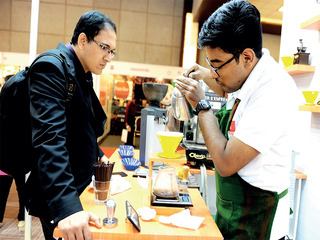
Besides these talks and coffee quiz, an exhibition is being held across two halls – Kalinga 1 and Siddhartha. On showcase are a range of coffee beans and blends, with Coffee Board of India itself displaying and selling 15 varieties (light, medium, and dark) hailing from Coorg to Chikmagalur, Araku Valley, Nilgiris and Wayanad. Plus, you can sift through coffee filters, including a cute, ceramic one. Needless to say, there’s a lot of coffee for you to sip on, from the regular instant brews to the speciality. Moreover, a few vendors will also teach you the method to making a cuppa of your choice.
Two stalls are interesting. One is selling coffee paintings – painting with coffee powder (see pic on left). It is the handiwork of Himabindu, an IT professional who’s currently on sabbatical. She has put up 30 paintings, and had managed to sell quite a few by Wednesday afternoon. The second one will have you scratch your head as it promises to print your selfie on coffee broth. The set-up will be fully operational today.
If you want to take your coffee expertise a notch up, you can enquire about the ‘Q Grader Arabica Training & Certification’ programme, which will take off towards the end of February. Or drive down to coffee estates in the state and learn about the bean-to-cup process there. You can get information at the tourism stalls.
Catch IICF 2018, January 18-19, at The Lalit Ashok, Kumara Krupa High Grounds Details: iicf.in
source: http://www.bangaloremirror.indiatimes.com / Bangalore Mirror / Home> Entertainment> Lounge / Bangalore Mirror Bureau / January 18th, 2018
The growing coffee industry in India has given rise to conflicts between humans and elephants leading to deaths of both humans and these huge mammals.
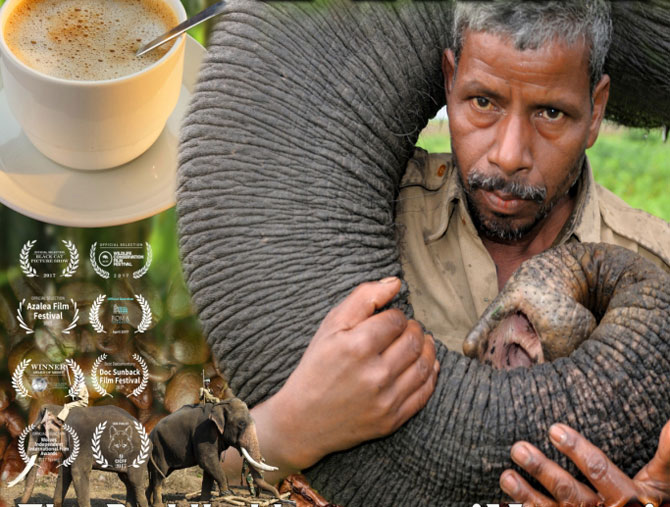
Poster of the movie ‘Elephants in the Coffee’
Having a cup of coffee is a routine activity for many. Have you ever thought is your cup of coffee fatal for anyone? The growing coffee industry in India has given rise to conflicts between humans and elephants leading to deaths of both humans and these huge mammals. A documentary by international photographer, author and explorer D. K. Bhaskar and journalist Dr Thomas Grant ‘Elephants in the Coffee’ offers an insight into this topic. The screening of this internationally acclaimed documentary has been organized at BNHS Hornbill House on Friday, 19th January at 6:00 PM followed by a discussion with Mr. Bhaskar.
The Documentary:
Celebrated as the elephant God in India, elephants are now seen as a ‘menace’. ‘A god that became a menace’ reads the tagline of this documentary which is catchy and strong yet could implore an array of ideas. Shot mainly around the Nagarhole National Park in Karnataka and surrounding coffee estates, this 58 minute documentary sheds light on the relationship between humans and elephants.
The documentary explores and highlights the views of all involved stakeholders including villagers, coffee estate owners, naturalists, government and even the mahouts or elephant care takers. This documentary has garnered national and international appreciation and multiple awards at film festivals.
‘Elephants in the Coffee’ has been produced by CLIC Aboard, a non-profit organization established by Mr. Bhaskar which works to connect students in US and India through photography.
The team which worked on this documentary included three student associates from CLIC apart from Dr. Grant, Mr. Bhaskar and others. For more details regarding the film, visit http://www.elephantsinthecoffee.com/
The documentary will be screened at BNHS on Friday, 19th January at 6:00 PM. Mr. Bhaskar would later engage in a discussion session to throw light on the film, the human-elephant conflict and related topics. The screening is free and open to everyone.
Details in a nutshell:
What: Screening of ‘Elephants in the Coffee’
When: Friday, 19th January
Time: 6:00 PM
RSVP: Siddhi Shelar – s.shelar@bnhs.org / 022-22821811
source: http://www.mid-day.com / Mid-Day / Home> Mumbai / by mid-day online correspondent / January 10th, 2018
WELCOME. If you like what you see "SUBSCRIBE via EMAIL" to receive FREE regular UPDATES.
Read More »