Category Archives: Coffee, Kodagu (Coorg)

Karnataka coffee growers in a fix over wage hike

The new structure suggests 10% hike in the basic daily wage

Bengaluru :

Amidst the prevailing volatile price trend, an imminent wage hike of over 10 per cent is seen inflating the cultivation costs for the coffee growers of Karnataka, which accounts for more than two-thirds of India’s output.

Negotiations of wage hike have been completed recently between the growers and labour unions and the Karnataka government is expected to notify the new wages soon.

As part of the new wage structure, the basic daily wage is fixed at ₹305 — up 10.10 per cent over the current ₹277.41, said N Bose Mandanna, a member of the committee that negotiated the new wage structure. Including the other social costs, the total outgo for a worker would be in the range of ₹450-470 per day, he said.

Total outgo up
Labour wages account for around 60 per cent of the cultivation costs in the coffee sector, followed by fertiliser and fuel which constitute 35 per cent, Mandanna said.

“The wage hike is going to affect the growers badly,” said HT Pramod, Chairman, Karnataka Planters Association, the apex body of the growers in the State.

To offset the wage hike impact, the government should help the growers by reducing the interest costs. “We have urged the government to reduce the interest on loans up to 25 lakh at 3 per cent and above 25 lakh at 6 per cent,” he said. Pramod further said the impact of the wage hike could be more on growers of arabica, where the cost of production and pest incidence is higher and the productivity is low compared to robustas.

Global production
The revision in wages, after a gap of around four years, is happening at a time when the prices globally have been volatile and at multi-year lows.

The prevailing bearish trend in prices is largely attributed to a surge in global output, which is seen heading for a record in 2017-18 (October-September) at 158.8 million bags (of 60 kg each), about 0.7 per cent higher than last year’s 157.7 million bags, according to the latest estimates of the International Coffee Organisation released on Tuesday.

Production of arabicas is projected to reach 97.3 million bags — down 1.1 per cent from the 2016-17 season.

Robusta production in 2017-18 is seen at 61.5 million bags, up 3.7 per cent over last year, mainly on account of rebound in output of Vietnam, the largest producer of the variety. The prospect of a hike in global output is seen resulting in a bleak outlook for rebound in prices.

“We don’t have any hopes of getting a better price this year,” said DM Purnesh, a large grower in Chikmagalur.

Back home, the harvest of arabicas is almost over, while that of robustas has commenced in the key growing regions of Kodagu and Chikmagalur.

For 2017-18, the State-run Coffee Board sees a 12 per cent increase in total output at 3.5 lakh tonnes with output of arabicas estimated at 1.03 lakh tonnes and robustas accounting for the rest. Growers and the trade, based on the harvest and marekt arrivals, estimate arabica production to be around 90,000 tonnes, while that of the robusta could be much lower than the Board’s estimates.

source: http://www.thehindubusinessline.com / Business Line / Home> Economy> Agri-Business / by Vishwanath Kulkarni / January 11th, 2018
Hanging out with Huang at Bengaluru

ChefAnthonyKF09jan2018

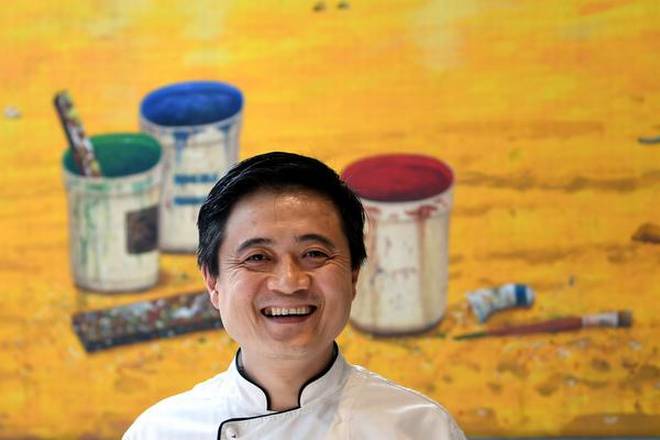
Chef Anthony Huang admits that Bengaluru played a big role in his culinary story

There are not a lot of things this small-made man with a big heart can’t whip up in his kitchen. Bengaluru-bred Anthony En Yuan Huang, is an alumnus of St. Joseph’s High School and Christ College and currently Executive Chef at JW Marriott Bengaluru.

After the recent success of creating and curating a coffee-infused menu, drawing inspiration from the Kodava cuisine, and hosting it in an exclusive Coorg food festival, the chef talks about his love for coffee, his culinary journey and where his cooking is taking him.

The idea was to keep working with the hotel’s concept of going local, explains Huang. “It only seemed fitting that we visit Coorg, which has some of the best coffee plantations in Karnataka, and try to capitalise and use the fabulous produce the State has. We did some research and found coffee actually goes well with food and doesn’t have to necessarily be looked at as a beverage. That’s where we started thinking about exploring the opportunity.”

After experimentation, Huang found that coffee, with its robust flavour, lends itself extremely well to grills, roasts and meats. “We chose to use coffee with our barbecues since its finest flavour comes when you’re roasting it. However, we did not tamper with the cuisine itself – pandi curry remains a pandi curry. We used coffee in various forms, including expresso, roast and coffee extract after decoction with higher antioxidants.”

So where did his interest in cooking begin? Huang fails to recollect the exact moment because he is a third generation chef, albeit the only one with formal training in the family. “It was always in the blood. As a child I’ve always watched mom and grandmom cooking. They come from a line of wedding caterers in China. I have tons of memories with food and I guess it came very naturally to me.”

He adds that at one point in his life, “Like all kids, I also wanted to be a pilot, a vet or a farmer. Eventually, fate won. I was a typical Bengalurean guy hanging around everywhere except college. But I did want to be a chef. I missed my deadline to apply for hotel management. I went to Christ College anyway to put in a word with the principal. I did not expect in my wildest dreams that he would call me in a few days and allow me to join.”

He pauses to pop a yummy hot rasgulla in his mouth and continues: “The Bengalurean in me remained and I continued to bunk college. But I was the first graduate to get though Oberoi School in their campus interview. I got through OCLD which is like the IIT of hotels. I scraped through attendance and the rest is history.”

Huang went on to work in Oberoi Hotels in Delhi, Mumbai and Bengaluru before moving on to propping up free-standing restaurants that were not doing so well. “I wanted something challenging. I went on to Hyatt and then came to Marriott. This is my fourth year here and I’m loving it.”

He admits that Bengaluru played a big role in his culinary story. “Given the fact that I studied in St Josephs and Christ, I grew up as a hard core Bengalurean. He’s the most easy-going guy in the country. He accepts anything in his stride. A third person can come join our table and he will be welcomed. We, as a city, accept people the way they are. That has been drilled into my DNA since school and it has thought me in my professional line to take every input and add it to my development.”

A lot of that reflects in Huang’s food.

“Nothing is wrong – as long as I’m comfortable with it. As long as I’m happy with every plate that has my name on it, I’m cool with it. I don’t have to go by the rule book. Had I not looked at food that way, this coffee trail would have never happened. However, I’m also quite a purist. I like to keep things authentic.”

Ask him what his signature dish is and he says, “That depends on my mood and the ingredients I have around me. I’d like to take a walk and see what’s available. I believe in freshness. I like to also keep it simple. You will never find my food hiding behind a lot of fluff or garnish. If there’s something on my plate, it means it’s meant to be eaten and adds value to the dish’s taste and enhances the way it looks.”

While a large part of his life was spent as an Asian chef with Vietnamese and Chinese cuisines and he dabbled a bit with French food, “Deep down in my heart I’m an Indian chef. I love South Indian and North Indian food. I love my biryanis. When I’m at home I’m mostly cooking that for the family.”

Describing the psyche of a chef, Huang says, “They are driven by passion and work with their heart. When you choose to work in this artistic field, it is equivalent to falling in love with someone. Cooking has a lot to do with emotions.

“Never ask a chef who’s in a bad mood to cook for you.”

source: http://www.thehindu.com / The Hindu / Home> Life & Style> Food / by Allan Moses Rodricks / January 08th, 2018

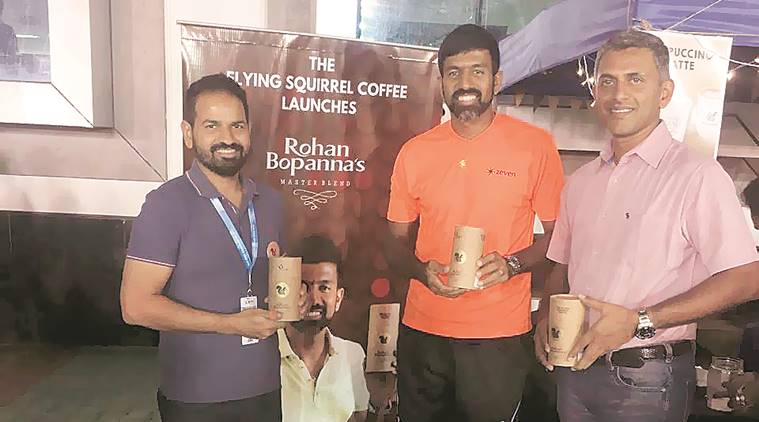
Rohan Bopanna serves home-grown brew at Tata Open

Rohan Bopanna with Ashish D’Abreo (right) and Tej Thammaiah (Express Photo)

At the ATP-250 Tata Open Maharashtra underway at Balewadi, Rohan Bopanna makes it a point to be there at the coffee counter where his own coffee brew is being sold.

Rohan Bopanna, coffee connoisseur. Such an introduction may not ring too many bells, but the tennis star not only grows coffee at his farm in Coorg, he also gifts tennis legends the home-grown brew. At the ATP-250 Tata Open Maharashtra underway at Balewadi, Bopanna makes it a point to be there at the coffee counter where his own coffee brew is being sold. “I am truly well-versed in the nuances of cultivation, processing and blending coffee beans,” writes the champion of the 2017 French Open Mixed Doubles on a flyer at the coffee counter.

Earlier, he had announced the launch of the brew — the Rohan Bopanna Master Blend — on Twitter, posting, “I bring to you a very special part of me from my very own coffee estate in Coorg.” Bopanna has joined hands with the Flying Squirrel – a brand involved in micro-lot cultivation and processing coffee using artisan methods — to set up the counter at the Tata Open.

Ashish D’Abreo, who launched Flying Squirrel with his college friend Tej Thammaiah, says the response to Rohan Bopanna Master Blend has been quite positive. D’Abreo and Thammaiah have been blending, roasting and brewing coffee beans for over five years. “We roast the coffee for 15 minutes before sealing each pack,” says D’Abreo. He then shares some important information for those who enjoy filter coffee: it has to be consumed within a month of roasting.

“Tej owns a coffee estate at Pollibetta in Coorg. So, we experimented with the beans at Tej’s estate… we developed and processed them to arrive at different variants of the coffee,” says D’Abreo. Today, they supply coffee powder online and have also set up a cafe at Bengaluru. It was during a meeting with Rohan Bopanna, which took place over a month ago, that they realised their common goals and decided to experiment with the coffee beans grown at Bopanna’s farm at Madapur in Coorg.

The first variant, Rohan Bopanna’s Master Blend, was launched on January 1. “It is an all Arabica variant, comprising a few differently processed beans, all of them from Bopanna’s farm,” says D’Abreo. He shared that when world no. 6 Croatian Marin Cilic visited the counter with Bopanna, he tasted the coffee while posing for fans. For Nilufer Solai, who came from Mumbai to watch her favourite tennis players in action, the coffee counter was a hit. “…I could buy the beans and have some refreshing coffee,” she says.

source: http://www.indianexpress.com / The Indian Express / Home> Sports> Tennis / by Anuradha Mascarenhas / Pune / January 05th, 2018

Coffee Board to open coffee cafes

A project in PPP model for opening India Coffee House outlets in the district has been proposed by the Coffee Board, board member Manukumar said.

Addressing reporters here on Thursday, Manukumar said that these coffee houses will be similar to that of the cafes in metropolitan cities. It has been planned to launch the outlets in Kemmannugundi Cross, Seethalaiahnagiri, Devirammana Betta, Horanadu, Shringeri and Taluk office premises. A survey in this regard is in progress. The price of the coffee served in these outlets will be lesser as compared to other cafes, he said.

“While the land will be given by the government, the Coffee Board will construct the cafes and the management will be handed over to private organisations,” he said.

Subsidies for planters

The coffee board has provided Rs 9.10 crore for coffee planters between April 2017 till date towards mechanisation, warehouses, water facilities and transplantation. A subsidy amount of Rs 2.2 crore has been released by banks to 900 coffee planters towards interest, he said.

Research is on to control the menace of white stem borer. Kits have been distributed to farmers to control snails in coffee plantations, he said.

The Coffee Board has recommended maintaining a ratio of 51:49 for coffee – chikori mixing and a letter in this regard has been sent to the Food Safety and Standards Authority of India (FSSAI).

The board has also requested the Central government to provide subsidy to encourage coffee planters.

A memorandum has been submitted to the state government to bring white stem borer and wild snail in the ambit of Karnataka Pest e Control Act, he said.

Board office bearers Pradeep Pai and M L Kallesh were present.

source: http://www.deccanherald.com / Deccan Herald / Home> District> Chikkamagaluru / DH News Service – December 14th, 2017

Coffee industry seeks review of GST

CoffeeBeansKF07nov2017

The high GST rate, besides bringing down instant coffee consumption, would also have a significant impact on the coffee farmers of South India

New Delhi / Bengaluru :

The coffee industry has sought a review of the GST rates on instant coffee and the curing process, while stating that such high rates would hurt consumption and, eventually, growers’ realisations.

Coffee growers are under pressure as the volatile trend in global prices, which directly influence local prices, has already kept their realisations in check.

The GST on instant coffee has been fixed at 28 per cent, while the curing or dry processing of the beans attracts a levy of 18 per cent.

Parity sought with tea

Making a case for reduction in GST on instant coffee, The India Coffee Trust, represented by various stakeholders from the sector, has appealed to the Prime Minister’s Office to bring it down to 18 per cent, on par with the instant tea.

Anil Kumar Bhandari, President, ICT, in a letter to the PMO, said the high GST rate, besides bringing down instant coffee consumption in the country, would also have a significant impact on the coffee farmers of Karnataka and South India, since instant coffee manufactures will source less raw coffee from them.

According to the ICT, of the 3.46 lakh tonnes of raw coffee produced in the country, about 2.78 lakh tonnes is exported, while the rest is consumed domestically.

Of the 0.78 lakh tonnes consumed domestically, about 50,000 tonnes is used in the form of roast and ground, while the remaining 28,000 is consumed as instant coffee.

South India accounts for the bulk of the coffee consumption, though off-take has picked up in the northern States in recent years.

The Trust said instant coffee is largely consumed by poor consumers and the cost per cup is lower when compared to the roast and ground.

It also said that higher tax would impede the development of the coffee habit in North and East India.

Seeking a cure

Meanwhile, the All India Coffee Curers Association has demanded the withdrawal of 18 per cent GST levied on coffee curing.

Curing involves dry processing and grading of green coffee beans.

As curing is an investment-intensive process, the majority of coffee growers normally outsource the dry processing of the green beans to curing works, where they are processed, graded and sorted.

“Any levy on curing would eventually hit farm-gate prices, thereby reducing growers’ realisations. The government should withdraw the levy,” said AN Devaraj, President of the All India Coffee Curers Association.

Farm-gate price worries

Coffee growers are concerned about how the impact of the GST levy on curing will influence farm-gate prices, even as the early harvesting of the arabica variety has begun in parts of Kodagu and Chikmagalur, the main growing regions.

“The GST on curing may impact farm-gate prices. With the season yet to start in full swing, it is too early to quantify the impact,” said HT Pramod, Chairman of the Karnataka Planters’ Association.

Arabica prices are hovering between ₹7,000 and ₹7,200 per 50-kg bag for the parchment, while arabica cherry prices are in the ₹3,700-4,000 per bag range, lower than last year.

“We are waiting for clarity on this issue. No sale of coffee from the new crop has taken place as growers are not in a hurry to sell as prices are low,” said N Bose Mandanna, a grower in Kodagu.

source: http://www.thehindubusinessline.com / Business Line / Home> Economy> AgriBusiness / by KR Srivats & Vishwanath Kulkarni / October 30th, 2017

Subsistence coffee farmers in India unite to transform lives

Speciality coffee products, support and shared value are key to success

Ten years ago, the residents of Kabada Boddaput — in southeastern India’s remote Araku valley — were impoverished subsistence farmers, living in mud huts and getting by on the millet, yams, pumpkin and greens they grew on their one- to five-acre plots.

Cash was scarce and emergencies meant borrowing from friends and family — debts that might take years to repay. “It was a very terrible situation,” recalls Sanyasi Gullela, a farmer. “There were not enough clothes and no money for cattle.”

But life has changed dramatically for Kabada Boddaput’s tribal farmers — along with around 13,000 others in the Araku valley — since they began cultivating coffee, encouraged by the Naandi Foundation, a Hyderabad-based philanthropic organisation.

Last year, Mr Gullela earned Rs105,000 ($1,640) from coffee, which he grows on 1.3 of his three acres of land, and additional funds from the pepper vines coiling around the surrounding shade trees. In recent years, these earnings have financed four cattle for ploughing and an auto-rickshaw for his son. His neighbour has purchased a second-hand tractor.

Daily life has improved, with the newfound cash used to buy more nutritious food, such as lentils, and new clothes. Some locals have upgraded their mud homes with cement and tiles. “Nowadays, I have a lot of choices,” says G. Tirupati Rao, who grows coffee on two of his 3.5 acres. “What we want we can easily buy from the market. Earlier, we had to compromise.”

While around the world coffee has developed a reputation for bringing few tangible benefits to those toiling to grow it, the view in the Araku valley is different. The crop — grown bio-dynamically without costly fertilisers or agrochemicals — has become an unlikely stepping stone to socio-economic progress for some of India’s most neglected and marginalised peoples. “Coffee has given dignity to farmers,” says Chiranjeevi Naidu, a board member for the Small and Marginal Tribal Farmers Mutually-Aided Co-operative Society, set up in 2006 to process the coffee grown through the Naandi project.

The Araku valley has a history of coffee production dating back to the colonial era, when British planters grew thousands of acres. After independence, India’s government-run Coffee Board took over the plantations, employing local people. And the board gave coffee seeds to farmers, although few flourished in the absence of other support.

But many Araku farmers were eager to keep trying. “They said: ‘Anything that was valuable in India, the British took control of, so coffee must be valuable’,” says Manoj Kumar, Naandi’s chief executive officer.

Naandi’s corporate donors were less enthusiastic, he recalls. “I’ve never heard of anyone coming out of poverty through coffee,” one told him. But Mr Kumar — who had rather stumbled into the coffee business when he was asked in 2004 to develop “livelihood projects” to help Araku farmers — was undeterred. Naandi promised technical support with cultivation and offered to market the farmers’ produce overseas.

Since then, Naandi’s agricultural experts have taught Araku’s novice growers to produce top-quality organic coffee, some of which is being sold as “speciality” coffee to select roasters and traders from Japan, Korea, and Europe. These high-end buyers — who taste and rate each lot before purchasing — are willing to pay up to Rs700 per kg for the best of the beans. The bio-dynamic agriculture practised by the Araku farmers is labour intensive but requires no costly cash inputs. Farmers enrich the soil through mulching, using leaves, fallen fruits and other freely available organic matter. They use inexpensive, herbal soil additives to enhance soil fertility and fight pests.

They have learnt the discipline of harvesting beans only when they are bright red and fully ripe. For these efforts, co-op members last year received a guaranteed price of Rs375 per kg of top quality, fully-ripened beans.

From that, the co-op — where the beans are processed within 12 hours of being harvested — deducts Rs90 per kg for transport and processing, with Rs280 per kg profit left for the farmer.

This compares with Rs90-Rs110 per kg that Indian farmers typically receive for bulk coffee to be sold on the New York Commodity Exchange.

“If you want to do sustainable coffee at scale, it has to be speciality coffee,” says Mr Kumar. “When they buy, they pay more than anyone else will pay.”

Problems remain, especially in finding enough buyers willing to pay a premium for all the high-quality coffee the Araku farmers can produce. Last year, co-op members grew 100 tonnes of coffee, but Naandi is working with another 7,000 farmers whose saplings will mature soon, and other villages are pleading to join the initiative.

Mr Kumar believes Araku’s coffee output could easily rise to 500 tonnes or more. But the total world market for speciality coffee was just 10m tonnes in 2011 — although it is said to be growing fast — and speciality coffee buyers tend to buy in small lots from diverse regions around the world. “I don’t have enough high-quality buyers,” Mr Kumar admits.

To expand the market for its own speciality coffee, Naandi recently raised $5m from its Indian philanthropists for Araku Originals — its dedicated, for-profit, coffee marketing arm — to market its wares in Europe.

Araku Originals has opened a flagship store in Paris and is also selling its coffee though 34 other gourmet food shops and other upmarket retail outlets across France. The coffee that does not make the grade as speciality coffee is sold as organic, fair trade coffee elsewhere in Europe. “We are a benevolent link to the international market,” Mr Kumar says. “It can’t just be procured and dumped.”

Despite the challenges, Mr Kumar is convinced that coffee can be made a sustainable cash crop for farmers — but only if those involved across the industry are willing to share the profits more generously.

“You need a very clear-cut, shared-value business model with the farmer,” he adds. “Otherwise, it won’t work.”

source: http://www.ft.com / Financial Times / Home> Agricultural Production / by Amy Kazmin / September 24th, 2017

Would you drink a Rs. 25,000 coffee if you knew what it was made of?

We can only wonder why the rich love this

CivetKF22sept2017

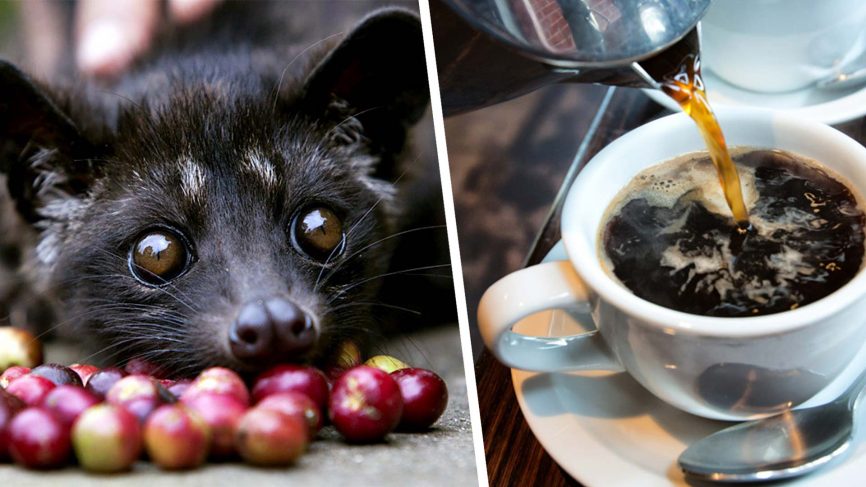
Before you take a sip of Civet coffee, the world’s most expensive coffee, there are two things you should know: 1) A single kilo of it costs between ₹20,000 to ₹25,000; for those who don’t buy their own groceries – that’s approximately 25 times (2500% more) of what your everyday brew retails at, and 2) It is made from the droppings of the Civet cat.

That’s right, droppings as in that smiley brown emoji you love sending your sibling.

Though it is a common drink of the elite in both the richest parts of the Middle East and Europe, you won’t have to go too far to take a sip. Civet coffee is made right here in India, in Karnataka’s Coorg and Chamarajnagar districts. Its high price comes from the uncommon (to say the least) method that is involved in its production.

There’s a reason why the most expensive coffee in the world derives it’s name from the civet cat, a largely nocturnal creature that resembles any child a raccoon and a cat may have some day. The end of the civet’s digestive process is the beginning of the coffee’s life cycle.

When the civet eats the flesh of the coffee cherries, the natural enzymes in the animal’s stomach enhances the flavour of the eaten bean within those cherries. The bean is then found in the poop of the civet, processed and, after a routine check, packaged. The fact that it has been through the civet’s digest tract is what apparently makes it nutritious and its steep price tag attributed to the high cost that goes into sourcing the animal and quality certification.

However, unlike other countries where civets are caged and fed forcefully, India uses a more natural method: the waste of wild civets is collected from coffee plantations that stand at the edge of the forests in Coorg and Chamarajnagar. That’s great news for farmers too because though we’re no coffee experts ourselves, we’re going to guess that locally sourced organic coffee bean-laden poop fetches a better price than the cage manufactured variety.

source: http://www.gqindia.com / GQ / Home> Live Well> Drink / by Tracy Ann / September 20th, 2017

With output rising, India is now a hub for instant coffee

Coffee Board to finalise estimates after consulting stakeholders
GenericCoffeeKF21sept2017

Coonoor :

India is becoming a manufacturing hub for instant coffee after Brazil and Peru, said Y Raghuramulu, Director of Research, Coffee Board.

In his presentation on coffee at the 124th UPASI annual conference here, he said the country is doing extremely well on the export front

The total volume of export between April and August this year stood at 1.78-lakh tonnes, up from 1.63-lakh tonnes in the corresponding period the previous year.

The country has moved from bulk exports to value-added coffee exports, he said. “We are consistently importing more for re-export. Imports are mainly for value-addition and re-exports by EOUs with duty free under FTP.”

Import volumes during 2015-16 stood at 65,618 tonnes and the re-export volume at 67,283 tonnes. This surged to 78,042 tonnes and 79,254 tonnes the following year. Value-wise, the imports were estimated at ₹927 crore (₹802 crore) in 2016-17 and re-export at ₹ 1,346 crore against ₹1,147 crore in the previous year.

Green coffee exports account for 70 per cent of the total export volume, with specialty green coffee exports inching its way from 3.20 per cent between April and August last year to 3.80 per cent during the corresponding months of this year. Value-added coffee exports have stagnated at around 25 per cent.

Reverting to production, Raghuramulu said: “USDA has forecast India’s production at 3.3-lakh tonnes, but the Coffee Board is yet to release the estimate for 2017-18. The board is in consultation with various associations for finalising the estimates. We do not want to release as in earlier years and come out with a revision.”

The board has undertaken a couple of fresh initiatives, such as the revamping of India Coffee House, brand ambassadors to promote Indian coffee and organising outreach programmes.

“We are looking to franchise at least 10,000 vending machines in the medium-term. Our initiatives will indirectly benefit small coffee growers. We have also initiated discussions with small growers to form producer organisations to help them achieve better returns.”

source: http://www.thehindubusinessline.com / Business Line / Home> AgriBusiness / by L N Revathy / September 13th, 2017

Eight O’Clock Coffee aims for younger drinkers with new infused blends

EightOClockCoffeeKF20sept2017

Dive Brief:

Eight O’Clock Coffee has expanded its line of infused Arabica coffees with three new products designed to appeal to younger and more adventurous java fans, according to a news release.

Joining its already established Relax Decaf and Alert Hi-Caffeine coffee blends is an offering blended with acai berries, another with turmeric and cinnamon, and a third featuring a fruit and herbal concoction rich in vitamin B6.

Established in 1859 as the house blend for the Great Atlantic & Pacific Tea Company, Eight O’Clock Coffee is now a subsidiary of India-based Tata Global Beverages, which also owns Tetley tea in the U.K. and Good Earth Tea in the U.S.

Dive Insight:

Eight O’Clock Coffee is far from the first coffee brand to offer infused and functional blends. There have long been various flavor-infused coffees in the marketplace, and now there are wine-infused and THC-infused coffees for that extra buzz. VitaCup produces a line of vitamin-infused coffees sold in pods for one-time use with specialized machines.

Tata Global Beverages has applied several marketing tools to reinvigorate its Eight O’Clock Coffee brand since acquiring it from Gryphon Investors in 2006. The former A&P grocery chain in-store coffee brand was sold to the private equity firm in 2003.

Tata pulled out all the stops last year with a marketing campaign promoting whole bean coffee to consumers, and in 2012 joined with Green Mountain to launch Eight O’Clock K-cups for Keurig coffee machines. That move is credited with helping Eight O’Clock Coffee take a 7% share of the single-serve market within two years.

The popularity of packaged coffee has been growing recently, primarily due to double-digit growth in the single-serve format. Ready-to-drink varieties are also becoming a popular choice and pose a challenge to the Eight O’ Clock brand as consumers increasingly prize convenience. It’s unclear if the health and flavor benefits of turmeric and cinnamon, or the trendy flavor of acai will win millennials over to taking the time to brew coffee.

Tata clearly plans to continue efforts to better position Eight O’Clock Coffee within the very competitive packaged coffee marketplace, and these infused products are one more example. Whether they will resonate with younger coffee drinkers — who are typically more receptive to trendy formulations and packaging — is something Tata along with other companies will closely follow in the months ahead.

source: http://www.fooddive.com / FoodDive / Home / by Cathy Siegner / September 19th, 2017

World’s costliest coffee made with cat-poop is now available in India. Here’s where you can get a hot cuppa

Take your love for cats to the next level by consuming their faeces. Yes, coffee made out of cat poop is now available in India.

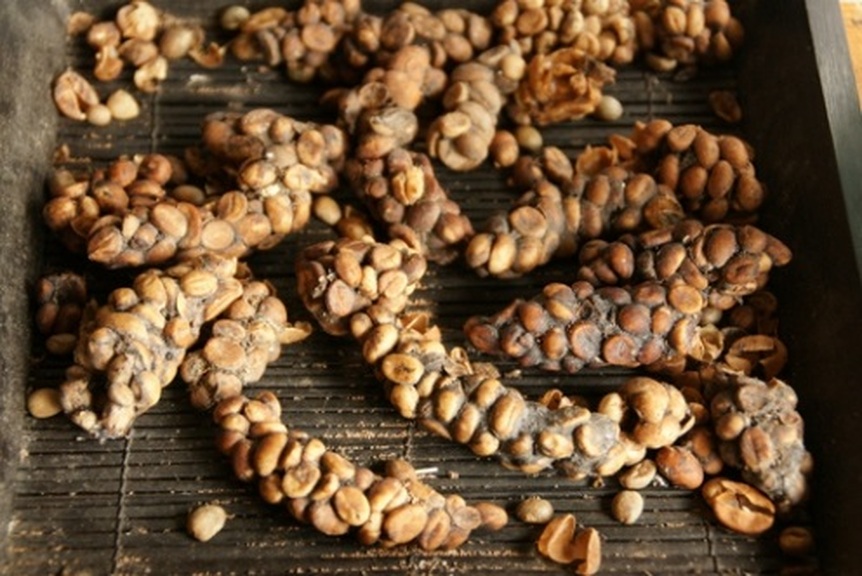
What happens when you take your love for cats to the next level? You consume their faeces. Yes, you read that right. Civet coffee is the most expensive coffee in the world and is made from the excreta of civet cats. India has recently delved into the production of this purr-fect coffee and we’re pretty excited. The production will start at a very small scale at Coorg in Karnataka. Being the third largest producer of coffee, we gotta try out everything that’s out there, right. If you’re wondering what this coffee looks like, here you go:

CivetKF18sept2017

Here’s the icky part: The coffee is made by getting the civet cat to ingest coffee beans. Then the cat’s poop is collected and processed. Why would someone do that, you ask? And WHY is this cat-poop thingy the most expensive coffee on the planet? Well, this coffee is considered more nutritious than other varieties of coffee and there are a lot of certifications involved too. The cat eats the flesh off of the coffee berries and not the actual bean plus the enzymes in the cat’s stomach enhance the bean flavour and that’s why this coffee is such a big hit all over the world!

A startup called Coorg Consolidated Commodities is producing this cat poop coffee and they’ve also decided to open up a café to serve this coffee locally! This coffee is presently being sold locally under the name ‘Ainmane’ and is available only at the Club Mahindra Resort at Madikeri for Rs 8,000 per kg.

source: http://www.inuth.com / inUth.com / Home> Lifestyle> Food / by Fukres / September 14th, 2017