As the divisions of Coffee Day – the B2C service Cafe Coffee Day, in B2B the Coffee Day Beverages, Coffee Day Exports and Coffee Beans is sold to customers
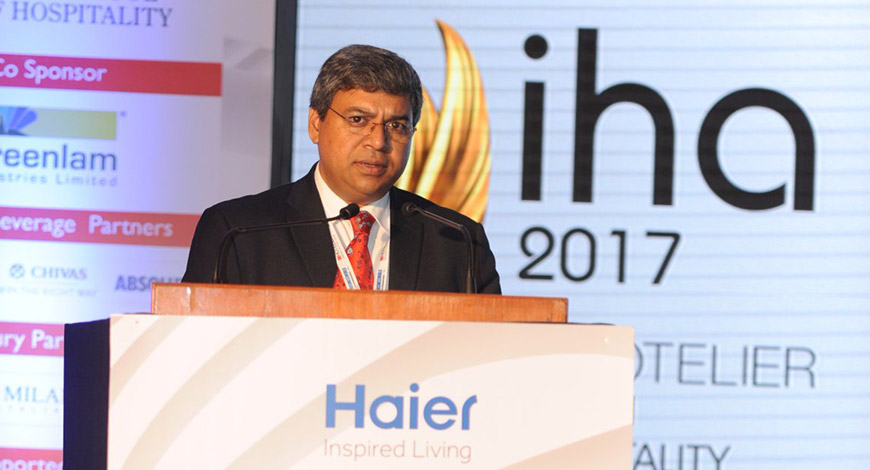
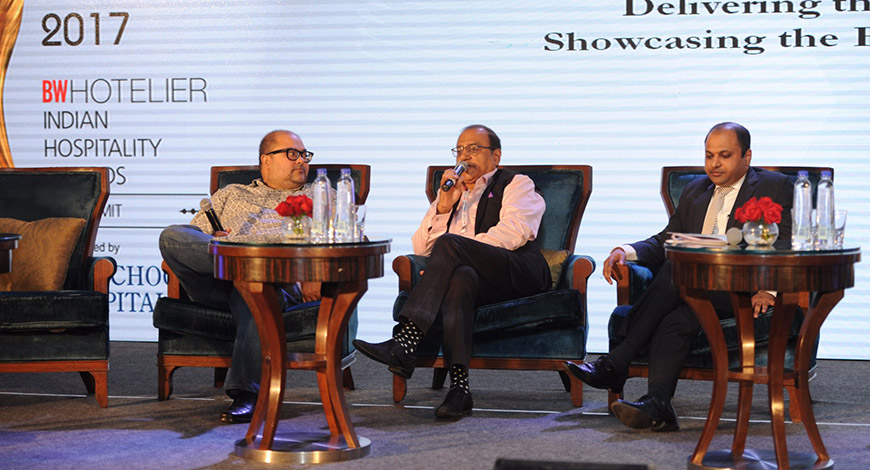
The caffeine buzz has caught up in all cities in India closing the generation gap which once drank tea and coffee. At the BW Hotelier Indian Hospitality Awards & Summit 2017 at The Leela Ambience Hotel, Gurugram, a session on “Showcasing the Best of Indian Coffee” moderated by Bikramjit Ray, Executive Editor of BW Hotelier, the panelists spoke about the growing importance of coffee in the contemporary times.
The session was opened by Abhrajyoti Chatterjee, from Coffee Day who mentioned how their brand intends to serve coffee with passion. Coffee Day is a brand which exports coffee to Europe, Middle East, EU and many other places. They even have 1500+ acres of area for the production of coffee.
As the divisions of Coffee Day – the B2C service Cafe Coffee Day, in B2B the Coffee Day Beverages, Coffee Day Exports and Coffee Beans is sold to customers. Their brand has 41000 coffee machines in India with presence in over 1000 cities. Every year Coffee Day expands in nearly 100 cities. The machines like BMF, Indus, Sienna, Orion are the several machines which produce coffee. It also has divisions such as Coffee Day Lounges and Express Outlets in India.
The national coffee brand has a presence in 28 states, 127 cities and 665 technicians. Their huge setup which is only a backup and then we have our various outlets across India. The variations of coffee are like morning java, classic roast, filta fresh, arabica and robusta blend.
During the session it was discussed how the idea of coffee and tea could be interchanged in the earlier days. However, India is the fifth largest producer of coffee in the present times.
The session covered by Vishrut Gupta, Director Food & Beverages, Pullman New Delhi Aerocity Delhi and Sanjiv Mediratta, Group Advisor, F&B Soution and New Business Strategy, Coffee Day discussed how they are bringing a new experience for millennial in coffee. The idea of an expresso was mixing coffee with chocolate powder. More people are educated about coffee at present.
The QSR has had an impact on the purchase of coffee on people. The taste for coffee being lighter or stronger is understood by people. People liking to click more pictures with coffee is also gaining more customers for this beverage. The automatic machines also gives people the right experience of coffee.
Innovation was always present in food; but was lesser for beverages. Whether expresso, americano or latte, the youth being more exposed to the world is aware of the global trends of coffee.
source: http://www.businessworld.com . BW – Business World / Home / by Anisha Aditya / March 24th, 2017
“Boredom at work sets in soon nowadays. This is probably the reason why IT professionals opening restaurants is on the rise,“ says Ashish D’Abreo (40), on the logic driving him to pursue three diverse professions.
“Boredom at work sets in soon nowadays. This is probably the reason why IT professionals opening restaurants is on the rise,“ says Ashish D’Abreo (40), on the logic driving him to pursue three diverse professions.
When not building brands as a creative director of an ad agency (Origami Creatives), D’Abreo is either blending barista for his artisanal coffee startup (The Flying Squirrel) or delivering dialogues on stage as a freelance theatre artist over weekends.
Mind you, this jack of all trades has met with enough success in each sphere. His 15-year-old ad agency has clients like Chai Point, Caratlane.com and Bluestone.com. After gaining foothold in the online space, his coffee company recently ventured into the offline market with a microroastery café.
The avid coffee drinker has been dabbling in theatre for over a decade. This weekend too, he is performing in a play called `Park’ at Ranga Shankara. “When I was with Rafiki Theatre, I would act in 2-3 productions. Since my plate is full today , I just invest in one production at a time with Sandbox Collective,“ says D’Abreo, an MBA graduate from St Jose ph’s Colle ge of Commerce.
Question is how did a copywriter arrive at this triangle of work in the first place? “Idea was that when we can ideate for other brands, why not our own,“ says D’Abreo, who launched his coffee startup in 2013.Little did he know that the hobby of selling gourmet coffee from his friend’s plantation in Coorg would scale up one day.
D’Abreo traces the roots of his success in being an ad-man. “At my ad agency, we played each other’s roles all the time -be it design, layout, press visits, photoshoots or menial desk work. All streams flowed into each other seamlessly . Brainstorming sessions, where we switched from vodka to jewellery brand in a split second, coached me to juggle efficiently,“ says D’Abreo.
Each chosen profession gets a fair share of his time every day. “My play rehearsals are usually in the morning. By midday, I start looking into the online coffee orders and the micro roastery. Post-lunch, I dedicate time to my creative agency,“ says D’Abreo, who advocates the joint venture entrepreneurship module for those who wish to add professions to their career repertoire.
The father of a six-year-old also lists communication, support from family and time-management as requisites. Of course, travel and cooking often for family add brownie points besides working as his stress-busters.
“One is constantly trying to wear different thinking hats. However, it’s in this challenge that your life runs like a well-oiled machine and becomes interesting. This juggle is nirvana for me,“ he notes.
source: http://www.tech.economictimes.indiatimes.com / ET Tech / Home> Technology News> Latest Technology News> People / by Smita Balram / ET Bureau / March 22nd, 2017
The budget by Chief Minister Siddaramaiah on Wednesday presented a few goodies to Kodagu district. Though the budget has not fulfilled major expectations of the people, it has not disappointed the people as well.
Though the budget announced formation of 49 new taluks, the people of the region have been disappointed that Kushalnagar in Somwarpet taluk and Ponnampet in Virajpet taluk haven’t made it to the list.
As Kodagu experiences heavy rainfall, the roads get damaged often. A total of Rs 50 crore has been earmarked as a special package for the development and widening of roads. The budget has announced development of airstrip at Madikeri. As a large number of VIPs arrive in Kodagu district for relaxation and to tour, they have to come to Kodagu via the road from Mysuru airport. The development of airstrip will boost tourism in the region. A 3D mini planetarium at a cost of Rs 5.75 crore has been announced for Madikeri. The budget has also promised to set up a prison at Virajpet.
In addition, a blood seperation unit has been sanctioned to district hospital in Madikeri, which was one of the long-pending demands of the region. Without a separation unit in Kodagu, the patients would travel to Mangaluru and Mysuru hospitals for treatment. The setting up of the unit will help the patients suffering from anaemia, said DHO Dr O R Srirangappa told DH.
In addition, the budget has set aside fund for the modernisation of canals of Harangi Reservoir in Kushalnagar. A sum of Rs 200 crore has been set aside for the development of Jenukuruba, Koraga, Soliga, Kadukuruba, Erava community members. The budget has announced framing of special rules for appointment of tribal communities living in forests and on the periphery of forest, to the posts of guard, watcher and other ‘D’ group posts, which is a welcome move, felt tribal leaders.
‘Disappointing’
The coffee planters who had availed loans from co-operative societies were expecting the chief minister to announce loan waiver. However, failure to announce loan waiver has disappointed the growers. No special package was announced to check human-elephant conflict in the region. The proposal on coffee museum and package for conserving river Cauvery has not found their place in the budget.
What they say
District JD(S) unit president M Sanketh Poovaiah termed the budget disappointing. There was no proposal on loan waiver. At a time when farmers have been ending their lives due to debts, the government should have announced loan waiver. No measures have been announced to arrest elephant menace in the district, he said.
DCC president T P Ramesh said the budget has announced welfare programmes for farmers, women and deprived class. Special emphasis has been given for the welfare of women. In addition, the honorarium for Asha workers have been hiked.
Stating that the budget is anti-farmer, district BJP unit president B B Bharathish said the state government should have announced loan waiver. “Though we were demanding an airport, the government has announced only a airstrip to Madikeri, which will benefit only the rich,” he said.
MLC Sunil Subramani said no special package was announced for the district. The burning issues in Kodagu did not find any place in the budget. He said the budget is disappointing.
Avinash, a software engineer in Madikeri, said there is a recognition at the national-level for coffee from Coorg. However, the demand for a coffee museum in Madikeri has not been materialised so far.
source: http://www.deccanherald.com / Deccan Herald / Home> District / by Aditya K A / DHNS- Madikeri, March 17th, 2017
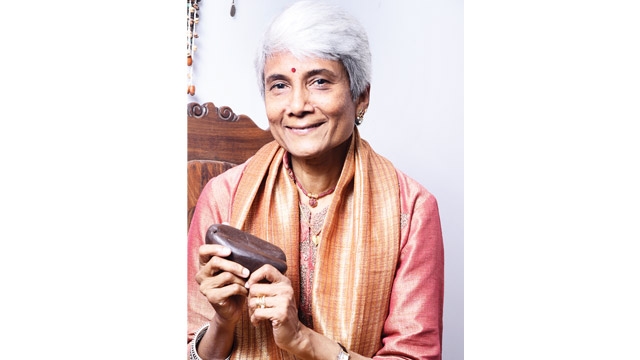
Sunalini Menon started out as an assistant cup taster for the Coffee Board of India in 1971
The journey of Asia’s first female coffee expert, Sunalini Menon, is one of beating the odds while consuming copious amounts of coffee, says Phorum Dalal
“But she is a woman, and will be married off soon,” a panel argued.
The year was 1971, and the dilemma was whether to give the candidate a job of an assistant cup taster on the Coffee Board of India.
She had topped the written examination and oral tests, competing with PhDs and coffee experts, but the hesitation was due to her gender.
The person in question was Sunalini Menon, who spent the next 25 years, sipping, slurping and spitting coffee, identifying flavour notes, and determining the quality of the drink for coffee growers in India.
“The slurping is to expose the sip to oxygen and open its flavours, and spitting is to avoid consuming so much coffee,” the tiny figured lady explains with a broad smile when we meet her in Coorg.
Her melodious voice has us in rapt attention, as she excitedly spoke of Block no. 19, Tata Coffee’s micro lot from the Nullore estate, selected last year by Starbucks for sale under the Reserve Brand in USA.
Menon, who consults several traditional coffee growers, has carved a niche for herself. She closely worked on the micro lot (cream of the crop with artisanal properties, usually sold in small quantities for a higher price) that put Indian coffee on the global map.
The seed was sown in childhood. “In the summers, we would go to Polachi in Coimbatore and visit the tea plantation my uncle was posted at. Labourers picked tea and put it through steaming, drying and rolling processes. During tastings, the tea master would use a penny to weigh the tea. Tasters would slurp, sip and spit out the liquid,” says Menon.
Imitating them, the kids would take the leftover tea “gargle and make horrendous noises,” laughs Menon.
After a degree in dietetics, while applying for scholarships in New York Institute of Dietetics, Menon saw Coffee Board of India’s job ad for an assistant cup taster, and “memories of sipping, slurping and spitting came flooding back.” As no woman had ever held the post, she was sure she wouldn’t make it, but soon she completed the board’s two-member team.
The board sent her to Witnerthone near Zurich for a year-long intensive course in coffee tasting in 1976, followed by a six-month review training in 1982.
“My hosts exposed me to a lot of international coffees from Peru and Costa Rica, and also sent me to Germany. This was an eye opener, and palate too, because at the time, India didn’t have such exotic coffees. I learnt to identify characters and use my palate to decipher coffee”. When she returned, her boss had retired and she took over to become India’s first cup taster.
Friends and family would tease her, “Your job is to take coffee breaks. What fun’.
The sensorial method, though, involved a lot: focusing on fragrance, aroma, flavour, aftertaste, acidity, mouthful, sweetness, balance, uniformity, overall taste and cleanliness of the cup to determine the coffee’s quality.
“One that secures 80 or above is considered a speciality coffee,” explains Menon, adding that the science and chemistry behind the cup can also be evaluated individually to provide accurate results. “But so far, a holistic scientific value hasn’t been arrived at to conclude on the cup rating. Till it does, I guess we tasters will have a job,” says Menon.
After the market liberalised in 1996 and growers could sell their own coffee, the board shifted focus to research and training. Menon moved to Japan, where her husband was posted, but coffee growers coaxed her to return and continue independent quality checks and research on their plantation.
“Coffee has come a long way in India, primarily a tea growing country. The British introduced the coffee plant from Ethiopia. A drink for the elderly and usually consumed at home, it didn’t have a special aura. But the vision of grandmothers using the dabba filter to brew their cup has become a fad after Café Coffee Day (CCD) launched in Bengaluru in 1996,” recalls Menon.
That’s why, Block No 19 is special. Indian coffee being selected for a limited edition sale by an international company will encourage more plantations to work on micro lots. This milestone has opened a door to make artisanal Indian coffee a stand out,” says the woman who has paved way for women tasters in India. As for her poison, it’s “a blend of robusta and Arabica beans. Black please,” she signs off.
source: http://www.dnaindia.com / DNA India / Home> Lifestyle / DNA Sunday Team / Sunday – March 05th, 2017
Not only do they handle business in acres, but also take utmost care to manage the crop sustainably. Care T Acres, a private initiative begun in 1998, has been helping coffee planters in Kodagu manage their properties. This initiative has become a boon to many planters who are unable to look after their estate.
“Care T Acres has stopped planters from selling their property and moving away from Kodagu,” says Nanjappa Kuttaiah, a coffee grower. With eight partners — Bose Mandanna, N K Chinnappa, N P Machaya, K M Cariappa, K Ajit Appachu, Aruna Biddappa, B Ram Bopaiah and K M Appaiah — the team comprises competitive planters with a combined experience of over 300 years!
The beginnings
Kodagu, the coffee haven that contributes to over 40% of India’s coffee production, has a lot of estate owners staying overseas. While selling the property has sentimental issues, maintaining them from overseas is illogical. This is where Care T Acres steps in, with the role of prime mover being Managing Director, N K Chinnappa. So, how did ‘Care T Acres’ come into existence? Among the founding members, Late Arun Bidappa was a well-known coffee trader. However, he needed expertise in maintaining his estate, which he developed with the help of expert planter Bose Mandanna.
Arun’s estate was the first property that received tendering from ‘Care T Acres’. “He (Arun Bidappa) said, ‘I help you trade your coffee, why don’t you help me look after my estate?’” recalls Bose. This conversation got the best planter friends together and thus began ‘Care T Acres’ with a maxim that “no one should neglect or sell their estate in Kodagu,” as Bose states.
The initiative is currently managing 600 acres, all under the constant supervision of Chinnappa — who grooms them like brides-to-be. The bottle green coffee plants nurtured by him are shaped like woven skirts. “Chinnappa’s way of raising and nurturing estates is a win-win proposition,” notes Nanjappa.
Professional care & support
The service (for estates that are more than 30 acres) begins with the client signing a five-year contract. Once done, the company starts looking after the ailing estates and fosters them like their own. When a grower approaches them, the team members visit the estate and analyse it. Then, the operations required to revive the estate are prioritised and the ‘surgery’ begins. “The person who can take care of his estate very well will not come to us. It is always the owner unable to manage his property who comes to us. In many cases, the grower would be suffering financial loss. So, the foremost ‘operation’ would be to clear the debt,” explains Chinnappa.
The team acts not just like a doctor but also that of an antibiotic as the second step towards betterment would be to develop proper infrastructure. Drying yards, labour line, proper cut roads, pulping yard and irrigation facility are developed to make the estates sustainable and self-reliant. Simultaneously, the grooming session begins — coffee plants are pruned, nourished, irrigated and shades are regulated to produce better yield.
With constant efforts, the estate breathes a new life. While they work for remuneration in the first two years, they sign up for a 30% profit from the third year. “I might be getting 70% of the profit, but that is equal to 150% of what I was earning before. Also, you get the profit without having the headache of managing it,” opines Nanjappa.
Another grower, Dalia Chengapa, has her estate being cared for by the company since 2007. She recalls how the estate owned by her father, Late A T Chengapa, lost its focus after he fell ill. “My father was a wonderful planter and he looked after the estate properly. But after his health deteriorated, the estate needed support. My sister Ramona and I stayed in different cities, and we did not have the practical knowledge for growing coffee. My father was unable to guide us as he was unwell. That is when we approached ‘Care T Acres’,” she recalls. While her estate incurred loss before the team took over, it is now making good profit.
Nanjappa’s story goes on the same lines. His mother passed on and the 45- acre estate in Suntikoppa that she looked after relied on him for tending. He had known that ‘Care T Acres’ turned the estates around and yearned for their support; eventually the deal was sealed. “Eight competitive planters, financially trustworthy and among the best planters in the district took over my estate and it was a blessing at the right time,” he says. Chinnappa started the work here and looked at two primary problems. Firstly, he pruned the coffee plants in a better way — there were more branches and nodes earlier, which reduced the picking cost. “When pruning is done properly, the plant flows down and it becomes easy to pick berries. The yield also increases,” explains Chinnappa. Secondly, the roads were laid for convenient movement.
The estates cared for by the team improve their pepper yield as well. With a systematic auction and tendering system in place, planters get an optimal price for pepper. The team has taken up risks as challenges and revived many estates. However, Mandanna explains, “While we have gone beyond limits and put money from our pockets to revive the estates, there are instances where we have rejected a few. These estates are uncultivable and there would be no absolute hope for coffee.” Chinnappa adds, “It is not just about profits but it is about leaving a legacy behind.”
One can contact the team at rkpagastya@gmail.com.
source: http://www.deccanherald.com / Deccan Herald / Home> Supplements> Spectrum / Prajna GR / November 22nd, 2016
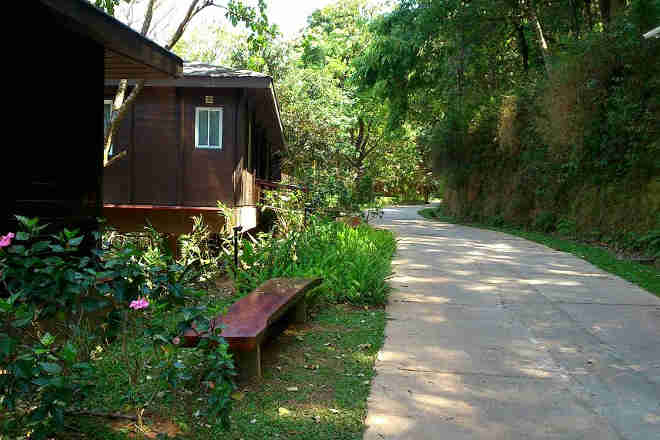
Ibnii Coorg is nestled on 120 acres of which 50 acres is being used for coffee plantation
Ibnii Coorg, an eco luxe resort located in Coorg (Kodagu) district of Karnataka, has become the first hospitality project in India to receive the IGBC Platinum certification for energy and resource-efficient, sustainable, cost-effective buildings.
source: http://www.financialexpress.com / The Financial Express / Home> Lifestyle> Travel Tourism / by Steena Joy, Madikeri / February 21st, 2017
Ibnii Coorg, an eco luxe resort located in Coorg (Kodagu) district of Karnataka, has become the first hospitality project in India to receive the IGBC Platinum certification for energy and resource-efficient, sustainable, cost-effective buildings that impose minimal stress on the environment. The resort is also gearing to get its LEED (Leadership in Energy & Environmental Design) certification by April.
The Indian Green Building Council (IGBC), part of the Confederation of Indian Industry (CII) was formed in the year 2001.The rating systems are based on the five elements of nature (Panchabhutas) and are applicable to all five climatic zones of the country.
Ibnii Coorg is nestled on 120 acres of which 50 acres is being used for coffee plantation. The resort has just finished with its first coffee harvest. Speaking exclusively to FE Online, Dr Sherry Sebastian, director, Ibnii Coorg, informed, “In the last 60 years, no pesticides have been used on this land. So it is an ecological and biodiversity hotspot. Very few trees were cut during construction of Ibnii Coorg. We are also very actively involved in rainwater harvesting as we have three large water catchment areas. We harvest nearly five million litres of water every year. Apart from a waste management plant, we have a state-of-the-art Sewage Treatment Plant (STP) too to further minimise our dependency on fresh water. The treated water is used for landscaping and other utilities. Ibnii is also a vehicle free zone with only electric buggies used for internal movements. Guests are encouraged to walk around the resort.”
The resort also has introduced other ecological initiatives such as an inhouse tailoring facility where many articles are created out of recycled materials like shopping bags out of used cement sacks and bubble wraps; use of steel fruit and vegetable crates in the kitchens instead of the conventional plastic crates; use of drop pops in the restaurants in place of finger bowls for washing hands. The resort is also part of a new project with Madikeri town for making a road using recycled plastic from the resort.
Ibnii Coorg also has TieCop, its Environment Conservation Programme.
Dr Sebastian added, “We also want our supply chain to be eco sensitive – so we source only from vendors who have the same sensitivity towards the environment. Presently, we source the coffee for the resort from Halli Berri, a fourth generation all woman owned concern coffee estate in Chikmagalur with a similar vision towards sustainability, but soon we hope to be able to use our own coffee. We have a vegetable garden where we source most of the vegetables for our salads. Another bigger vegetable garden is being created which is expected to give us around 14 tonnes of vegetables.”
The resort has a robust waste segregation system where the organic waste is used in a vermicompost to generate high-yield, organic manure which is in turn used in the green house to grow fresh organic vegetables and fruits.
source: http://www.financialexpress.com / The Financial Express / Home> LifeStyle> Travel Tourism / by Steena Joy ,Financial Express, B2B / Madikeri – February 21st, 2017
Some of the coffee tasted bland, others were a bit over-the-board bitter. The 33-year-old Arshiya Bose, social entrepreneur and owner of Black Baza Coffee who was in Kochi recently to hold a coffee-tasting session, says that there is no short cut to making a good cuppa of coffee.
So, Arshiya takes her students on a trip on the perfect ways of making coffee. At the end of the session, she introduces them to the Black Baza Coffee, which is warm and has the lure of a refreshing evening drink. What’s unique with this coffee is not only the way it is processed, but that the beans are grown in the most fertile of soils in India – right next to the Kodagu and B R Hills in Karnataka, where the river Cauvery flows in all its glory.
Karnataka-based Arshiya Bose is currently on a mission to promote this coffee, which is grown under large tree canopies, right next to the river beds. According to her, Indians have forgotten the taste of original and eco-friendly coffee, and has hence taken it upon herself to bring back the lost glory.
“Indians drank one of the most unique coffees in the world. In the past, the coffee beans, especially in Karnataka, were grown under forest covers and under shades of trees.
However, constant deforestisation forced our farmers to grow coffee directly under the sunlight,” she said. According to her, this method was detrimental to the environment (as it encouraged deforestisation), and also led to early maturation of the coffee beans, which supposedly also lead to a compromise in quality and taste.
For this, Arshiya got in touch with farmers who were growing coffee beans in Karnataka.
“ This is how we zoomed in on Kodagu and B R Hills. We said we would buy their produce and sell it across the country, if they were willing to heed to the eco-friendly norms. They agreed. So, they started growing coffee under available trees and were given the responsibiltiy to look after it too,” says Arshiya.
Right now, Arshiya’s Black Baza Coffee, named after the small bird of prey found in heavenly dense forests of South and South East Asia, is sold across the country. In Kochi, it is available at Pepper House Cafe.
source: http://www.newindianexpress.com / The New Indian Express / Home> Cities> Kochi / by Princy Alexander / Express News Service / February 05th, 2017
Coffee growers in Karnataka, who went through a rough patch recently, are happy, thanks to a huge drop in production and supply from major coffee-growing countries in the global market.
Growers in Kodagu, Chikkamagaluru and parts of Hassan are upbeat after coffee prices hit a five-year high despite the state registering a low yield this time due to severe drought and demonetization.
According to a senior official in the coffee board, Bengaluru, severe drought in major coffee-producing countries like Brazil, Vietnam and Indonesia has resulted in poor yield and quality issues. As a result, there’s a great demand for Indian coffee, 70% of which is produced in Karnataka.
According to Kabir, a leading coffee dealer in Madikeri, Kodagu, coffee prices are rising for the past fortnight and the trend is expected to continue till April. A 50-kg bag of Robusta variety, produced mostly in the state, costs Rs 4,000 while Arabica costs Rs 9,600. Last year, the average price of Robusta was Rs 3,000 and Arabica Rs 4,600.
The prices have picked up in the retail market too after remaining at a low for the past five years. The prices range between Rs 150 and Rs 200 a kg.
Coffee board former vice-chairman Sannuvanda M. Kaverappa added that a shortfall of 2.08 million bag of 60 kgs each in the international market this year will lead to a rise in coffee prices in India.
“About 70% of Indian coffee will be exported and the rest will meet the domestic demand,” he added.
B S Jairam, president, Karnataka Grower’s Federation (KGF), said the Robusta yield has been good this season in the state compared to Arabica.
“Most growers are in distress owing to poor yield. The drought, labour crisis and demonetization have virtually pushed growers to the wall. The marginal current price rise will definitely not compensate for losses over the years,” said Karnataka Planters’ Association chairman M M Chengappa.
(With inputs from G Rajendra in Madikeri)
source: http://www.timesofindia.indiatimes.com / The Times of India / News> City News> Bangalore News / by Manu Aiyappa Kanathanda, TNN / January 26th, 2017
As Karnataka roils over the Kaveri water dispute, the underlying cause is lowered climate resilience of the agro-forestry ecosystem in Kodagu’s coffee plantations
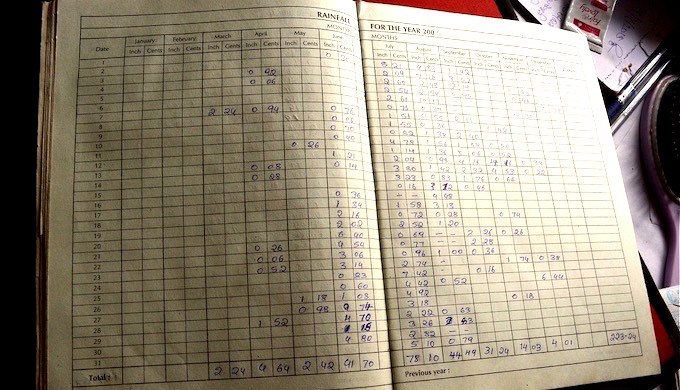
Coffee farmer B. B. Thammaiah’s rainfall record (Photo by S. Gopikrishna Warrier)
Coffee planters in the hill district of Kodagu in Karnataka are meticulous in keeping rainfall records in their estates. For some, the data goes back for decades. Their numbers tell the story of changing rainfall patterns, an indicator of climate change. The changing patterns also have an impact on the way they grow coffee, which has an effect on climate resilience in the hills and the plains.
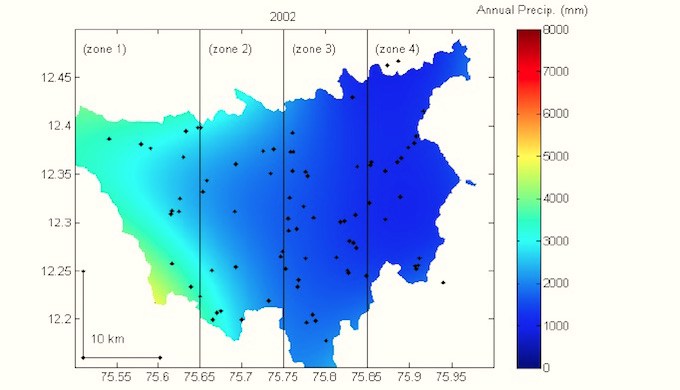
Due to the presence of this decentralised network of rainfall measuring stations, it is easier to obtain a nuanced picture of the precipitation trends for Kodagu, earlier known as Coorg, than in other parts of India. The average annual rainfall varies from above 5,000 mm in the western edge of the district to 1,200 mm in the east.
This data was used as part of the baseline survey by an international collaborative project to study the unique coffee agro-forestry system of Kodagu district. The College of Forestry at Ponnampet in Kodagu, as a participant in the Coffee Agro-forestry Network (CAFNET) project, has analysed the rainfall data of over 60 years from 116 coffee farms.
“Keeping meticulous rainfall data is part of the culture we inherited from the British,” said C.G. Kushalappa, university head for forestry and environment sciences at the College of Forestry.
The CAFNET report noted that the length of the rainy season had decreased by 14 days over the past 35 years. It also noticed a strong fluctuation in annual rainfall with an apparent cycle of 12 to 14 years.
Low rainfall in coffee land
Whether it is due to being the lowest point in this cycle or an El Nino changing rainfall patterns, 2015 and 2016 have been years of low rainfall in Kodagu. This is the second year of deficit rainfall in Kodagu. During 2015, it was deficient by 19%. As a result, the storage in the Krishna Raja Sagara dam reservoir, built across the Kaveri River immediately downstream of Kodagu district, has a 31% deficit this year.
On the ground measurements by coffee grower K.K. Naren in Kunda village near Ponnampet confirms this. “Our normal rainfall is 90 to 100 inches (2,200 to 2,500 mm). This year we have got 38 inches, whereas by this time we should have received 70% of the year’s rain.”
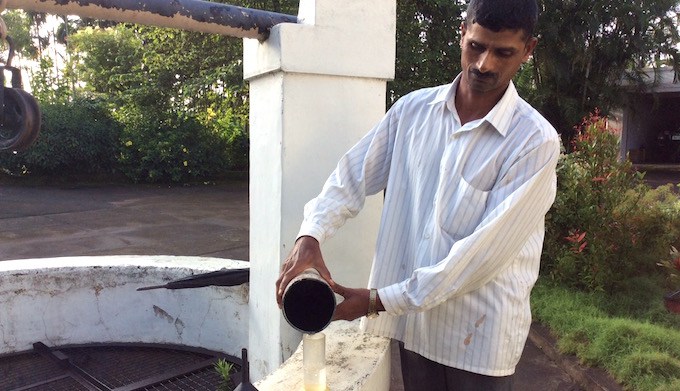
A farm worker measures rainfall in K. K. Naren’s coffee farm. (Photo by K. K. Naren)
Coffee planters are confused by the erratic rainfall of recent years. “Rain and weather patterns have become increasingly unpredictable in recent years,” said M.B. Ganapathy, head of plantations for Tata Coffee. “Even though the quantum does not seem to have changed, the rainfall is not well distributed any longer. There are long dry periods followed by heavy rain and high-velocity winds. This has made farm management difficult for us.”
Blossom showers affected
According to coffee farmer B.B. Thammaiah of Kolagadalu village, the erratic rainfall has meant that blossom showers, which usually take place between February and April, are missing in some years. This has an impact on coffee production, since this helps coffee flowers to blossom, ensuring good yields later in the year.
There is an ecological impact of this, according to Kushalappa. When the blossom showers became erratic, coffee farmers started irrigating during these months. For traditional coffee cultivation, it was a combination of mixed-shade trees plus blossom showers that gave a good yield. When the blossom showers were replaced by irrigation, the shade from the trees did not matter. The farmers’ dependence on the native trees decreased, resulting in their proclivity for letting the native trees die. These trees are being replaced by silver oak.
See: Bringing coffee back into the shade
There is also an issue of ownership that is leading to the clearing of forests. Thammaiah’s farm is in Kolagadalu village, not far from the western crest of the plateau deep in a forested valley. His farm receives more than 5,000 mm of rainfall every year. While in the valley floor he continues to grow rice as his forefathers did, he cultivates coffee in the shade of the forest trees. Though the forest may not be as thick as it was during his grandfather’s time, he plans to conserve it.
The landscape of Thammaiah’s farm is typical of what the people of Kodagu inherited. While historically joint families cultivated the rice paddies where they owned the land, they used the forest for collecting mulch and firewood and grazing cattle. The families do not have property rights over the trees, which belong to the government.
Economics of silver oak
Silver oak, on the other hand, can be planted, cut and sold. M.C. Cushalappa, a coffee farmer from Siddhapura, said that silver oak yields a two-fold benefit to coffee farmers. One, it can supplement the family’s income in times of need. Two, its straight trunk can be used as a support for pepper vines, which bring more additional income. With no ownership and no economic stake on the native trees, farmers do not have an incentive to keep them alive.
Cushalappa’s family has paid the price of the native trees to the government and obtained ownership over them. “This encourages me to maintain the native tree species in my farm, unlike most of the other farmers in Kodagu.”
The coffee agro-forestry system of Kodagu is of immense importance ecologically; not only does it provide climate resilience to the hill communities but provides water to millions downstream through the Kaveri. The current acrimony over the waters of the Kaveri between Karnataka and Tamil Nadu have led to violent protests.
There is a problem though. Unlike in other parts of the country where the forests are fully under the control of the forest department, in Kodagu they are under the combined control of the department and thousands of coffee farmers. It means that it is difficult to give them a protected status. It is not as if the forest department it always the best protector; but uniformity in control has the potential to improve conservation practices.
Geographical location of coffee farms where rainfall data has been collected for 70 years and a map of rainfall distribution generated with these data points as an exmple for the year 2002. ( Image by College of Forestry, Ponnampet)
“The majority of forests in Kodagu are not notified and hence for their upkeep thousands of coffee farmers have to be incentivised,” a forest department official said, speaking on condition of anonymity. “About 90% of the catchment of the Kaveri river before the Krishna Raja Sagara reservoir is in Kodagu. There is need for a mindset change so that the farmers conserve the native trees and biodiversity.”
Through the CAFNET study, the ecosystem services could be quantified. “We looked at the role of native trees and silver oak to study their hydrological impact. Our team studied how much of the rain was intercepted, how much came through the stem, how much got run off, and how much got recharged,” noted Kushalappa.
The magic of native trees
The study found that increasing the proportion of exotic species such as silver oak in the shade cover composition had little impact on rainfall interception since trees intercept less (1% to 6%) than coffee plants (9% to 22%). Although there are lower quantities of water from native tree plots going to rivers than from the exotic tree plots, the higher contribution of evaporated and transpired water from native trees have a positive impact on the microclimate. Further, large canopy and deep-rooted systems of the native species help in the percolation of water to deeper aquifers, mainly during the monsoon.
Thus, native trees held the rainwater as it fell torrentially, and released it gradually into the rivers. At the same time they created a climate-resilient environment in the farms.
The mixed agro-forestry systems also helped in sequestering carbon. The CAFNET studies showed that Arabica coffee grown under the shade of mixed species sequestered more than the reference forests. Arabica coffee grown under silver oak sequesters marginally less than Robusta grown under native trees. Robusta grown under silver oak sequesters substantially less than the other combinations.
The missing blossom showers could be adding to the reasons for coffee farmers opening their canopies. On the flip side, the farmers’ actions could result in more carbon in the atmosphere, making rainfall more erratic in Kodagu.
source: http://www.indiaclimatedialogue.net / India Climate Dialogue / Home> Impacts / by S. Gopikrishna Warrier / December 27th, 2016
Tata Coffee, part of the $100-billion salt-to-software Tata conglomerate, announced post-market hours on Monday that it would set up a green field instant coffee facility of 5,000 MT capacity in Vietnam at a cost of $50 million (about Rs 350 crore).
source: http://www.profit.ndtv.com / NDTV PROFIT / Home> Markets / by Sandeep Singh / December 20th, 2016
WELCOME. If you like what you see "SUBSCRIBE via EMAIL" to receive FREE regular UPDATES.
Read More »