Category Archives: Coffee, Kodagu (Coorg)

Tata Coffee reappoints Hameed Huq as MD

The Board of Directors of Tata Coffee Ltd at its meeting held on November 07, 2013, have reappointed Mr. Hameed Huq as Managing Director on the expiry of his present tenure of office viz from January 03, 2014 to March 31, 2015.

Shares of Tata Coffee Ltd was last trading in BSE at Rs.1054.65, down by Rs.78.40 or 6.92%. The stock hit an intraday high of Rs.1154.95 and low of Rs.1020.

The total traded quantity was 1.69 lakhs as compared to 2 week average of 0.42 lakhs.

Source: Equity Bulls

source: http://www.equitybulls.com / Equity Bulls / Home> Stock Report / November 07th, 2013 (2013-11-07)

From berry to brew…

CoffeeKODAGU21sept2014
Coffee was once a closely guarded Arabian secret until Baba Budan, a Sufi mystic, smuggled seven beans from Yemen and scattered them on the hills of Chikmagalur, from where it spread to the rest of India…Anurag Mallick and Priya Ganapathy spill the beans on the story of coffee, the world’s most popular brew.

It was Napoleon Bonaparte who once grandly announced, “I would rather suffer with coffee than be senseless.” Sir James MacKintosh, 18th century philosopher, famously said, “The powers of a man’s mind are directly proportional to the quantity of coffee he drank.” In The Love Song of J Alfred Prufrock, when T S Eliot revealed, “I have measured out my life with coffee spoons,” he hinted at the monotony of socialising and the coffee mania of the 1900s. German musical genius J S Bach composed the ‘Coffee Cantata’ celebrating the delights of coffee at a time when the brew was prohibited for women.

“If I couldn’t, three times a day, be allowed to drink my little cup of coffee, in my anguish I will turn into a shriveled-up roast goat,” cried the female protagonist! French author Honoré de Balzac wrote the essay ‘The Pleasures and Pains of Coffee’ to explain his obsession, before dying of caffeine poisoning at 51. Like Voltaire, he supposedly drank 50 cups a day! So, what was it about coffee that inspired poets, musicians and statesmen alike?

Out of Africa

Long before coffee houses around the world resounded with intellectual debate, business deals and schmoozing, the ancestors of the nomadic Galla warrior tribes of Ethiopia had been gathering ripe coffee berries, grinding them into a pulp, mixing it with animal fat and rolling them into small balls that were stored in leather bags and consumed during war parties as a convenient solution to hunger and exhaustion! Wine merchant and scientific explorer James Bruce wrote in his book Travels to Discover the Source of the Nile that “One of these balls they (the Gallas) claim will support them for a whole day… better than a loaf of bread or a meal of meat, because it cheers their spirits as well as feeds them”. Other African tribes cooked the berries as porridge or drank a wine prepared from the fermented fruit and skin blended in cold water.

Historically, the origins of the coffee bean, though undated, lie in the indigenous trees that once grew wild in the Ethiopian highlands of East Africa. Stories of its invigorating qualities began to waft in the winds of trade towards Egypt, North Africa, the Middle East, Persia and Turkey by the 16th Century. The chronicles of Venetian traveller Gianfrancesco Morosini at the coffee houses of Constantinople in 1585 provided Europeans with one of the foremost written records of coffee drinking. He noted how the people ‘are in the habit of drinking in public in shops and in the streets — a black liquid, boiling as they can stand it, which is extracted from a seed they call Caveè… and is said to have the property of keeping a man awake.’

It was only a matter of time before the exotic flavours of this intoxicating beverage captured the imagination of Europe, prompting colonial powers like the Dutch, French and the British to spread its cultivation in the East Indies and the Americas. Enterprising Dutch traders explored coffee cultivation and trading way back in 1614 and two years later, a coffee plant was smuggled from Mocha to Holland. By 1658, the Dutch commenced coffee cultivation in Ceylon (Sri Lanka). The word ‘coffee’ is apparently derived from qahwah (or kahveh in Turkish), the Arabic term for wine. Both the terms bear uncanny similarity to present day expressions — French café, Italian caffè, English coffee, Dutch koffie or even our very own South Indian kaapi. A few scholars attribute ‘coffee’ to its African origins and the town of Kaffa in Ethiopia, formerly known as Abyssinia. However, the plant owes its name “Coffea Arabica” to Arabia, for it was the Arabs who introduced it to the rest of the world via trade.

As all stories of good brews go, coffee too was discovered by accident. Legends recount how sometime around the 6th or 7th century, Kaldi, an Ethiopian goatherd, observed that his goats became rather spirited and pranced after they chewed on some red berries growing in wild bushes. He tried a few berries and felt a similar euphoria. Excited by its effects, Kaldi clutched a handful of berries and ran to a nearby monastery to share his discovery with a monk. When the monk pooh-poohed its benefits and flung the berries into the fire, an irresistible intense aroma rose from the flames. The roasted beans were quickly salvaged from the embers, powdered and stirred in hot water to yield the first cup of pure coffee! This story finds mention in what is considered to be one of the earliest treatises on coffee, De Saluberrima Cahue seu Café nuncupata Discurscus, written by Antoine Faustus Nairon, a Roman professor of Oriental languages, published in 1671.

Flavours from Arabia

Coffee drinking has also been documented in the Sufi monasteries of Yemen in South Arabia. Arabic manuscripts dating back to the 10th Century mention the use of coffee. Mocha, the main port city of Yemen, was a major marketplace for coffee in the 15th century. Even today, the term ‘mocha’ is synonymous with good coffee. Like tea and cocoa, coffee was a precious commodity that brought in plenty of revenue. Hence, it remained a closely guarded secret in the Arab world. The berries were forbidden to leave the country unless they had been steeped in boiling water or scorched to prevent its germination on other lands.

In 1453, the Ottoman Turks brought coffee to Constantinople, and the world’s first coffee shop Kiva Han opened for business. As its popularity grew, coffee also faced other threats. The psychoactive and intoxicating effects of caffeine lured menfolk to spend hours at public coffee houses drinking the brew and smoking hookahs, which incited the wrath of orthodox imams of Mecca and Cairo. As per sharia law, a ban was imposed on coffee consumption in 1511. The Grand Mufti Mehmet Ebussuud el Imadi was hailed when he issued a fatwa allowing the consumption of coffee, by order of the Ottoman Turkish Sultan Selim I in 1524.

Though subsequent bans were re-imposed and lifted at various points of time according to the whims of religious politics and power, coffee pots managed to stay constantly on the boil in secret, or in the open, for those desirous of its potent influence. Given the fact that Sufi saints advocated its uses in night-time devotions and dervishes and Pope Clement VIII even baptised the bean to ward off the ill-effects of what was regarded by the Vatican as ‘Satan’s drink’ and the ‘Devil’s Mixture of the Islamic Infidels’ till the 1500s, it is easy to see why coffee is nothing short of a religion to some people.

Coffee enters India & beyond

Surprisingly, India’s saga with coffee began in 1670 when a Muslim mystic, Hazrat Dada Hyat Mir Qalandar, popularly known as Baba Budan, smuggled seven beans from Arabia and planted them on a hillock in the Chikmagalur district of Karnataka. The hills were later named Baba Budan Giri in his memory. From here, coffee spread like bushfire across the hilly tracts of South India.

In 1696, Adrian van Ommen, the Commander at Malabar, followed orders from Amsterdam and sent off a shipment of coffee plants from Kannur to the island of Java. The plants did not survive due to an earthquake and flood but the Dutch pursued their dream of growing coffee in the East Indies with another import from Malabar. In 1706, the Dutch succeeded and sent the first samples of Java coffee to Amsterdam’s botanical gardens from where it made further inroads into private conservatories across Europe. Not wishing to be left behind, the French began negotiating with Amsterdam to lay their hands on a coffee tree that could change their fortunes. In 1714, a plant was sent to Louis XIV who gave it promptly to the Jardin des Plantes at Paris for experimentation. The same tree became the propagator of most of the coffees in the French colonies, including those of South America, Central America and Mexico.

The importance of coffee in everyday life can be gauged by the fact that its yield forms the economic mainstay of several countries across the world; its monetary worth among natural commodities beaten only by oil! It was only in 1840 that the British got into coffee cultivation in India and spread it beyond the domain of the Baba Budan hills.

Arabica vs Robusta

Kodagu and Chikmagalur are undoubtedly the best places to know your Arabica from your Robusta and any planter worth his beans will trace coffee’s glorious history with pride. The strain that Baba Budan got was Coffea arabica and because of its arid origins, it thrived on late rainfall. Despite its rich taste and pleasing aroma, the effort required to cultivate it dented its popularity. The high-altitude shrub required a lot of tending, was susceptible to pests, and ripe Arabica cherries tended to fall off and rot. Careful monitoring at regular intervals affected production cost and profitability.

Till 1850, Arabica was the most sought-after coffee bean in the world and the discovery of Robusta in Belgian Congo did little to change that. Robusta (Coffea canephora), recognised as a species of coffee only as recently as 1897, lived up to its name. Its broad leaves handled heavy rainfall much better and the robust plant was more disease-resistant. The cherries required less care as they remained on the tree even after ripening. Its beans had twice the caffeine of Arabica, though less flavour, which was no match for the intense Arabica. It was perceived as so bland that the New York Coffee Exchange banned Robusta trade in 1912, calling it ‘a practically worthless bean’!

But in today’s new market economy, the inexpensive Robusta makes more commercial sense and is favoured for its good blending quality. Chicory, a root extract, was an additive that was introduced during the Great Depression to combat economic crisis that affected coffee. It added more body to the coffee grounds and enhanced the taste of coffee with a dash of bitterness. Though over 30 species of coffee are found in the world, Arabica and Robusta constitute the major chunk of commercial beans in the world. ‘Filter kaapi’ or coffee blended with chicory holds a huge chunk of the Indian market. Plantations started with Arabica, toyed with Liberica, experimented with monkey parchment and even Civet Cat coffee (like the Indonesian Luwak Kopi — the finest berries eaten by the civet cat that acquire a unique flavour after passing through its intestinal tract), but the bulk of India’s coffee is Robusta.

As the coffee beans found their way from the hilly slopes of the Western Ghats to the ports on India’s Western Coast to be shipped to Europe, a strange thing happened. While being transported by sea during the monsoon months, the humidity and winds caused the green coffee beans to ripen to a pale yellow. The beans would swell up and lose the original acidity, resulting in a smooth brew that was milder. This characteristic mellowing was called ‘monsooning’. And thus was born Monsooned Malabar Coffee.

Kodagu, India’s Coffee County

Currently, Coorg is the largest coffee-growing district in India, and contributes 80% of Karnataka’s coffee export. It was Captain Lehardy, first Superintendent of Kodagu, who was responsible for promoting coffee cultivation in Coorg. Jungles were cleared and coffee plantations were started. In 1854, Mr Fowler, the first European planter to set foot in Coorg, started the first estate in Madikeri, followed by Mr Fennel’s Wooligoly Estate near Sunticoppa. The next year, one more estate in Madikeri was set up by Mr Mann. In 1856, Mr Maxwell and Mcpherson followed, with the Balecadoo estate. Soon, 70,000 acres of land had been planted with coffee. A Planters Association came into existence as early as 1863, which even proposed starting a Tonga Dak Company for communication. By 1870, there were 134 British-owned estates in Kodagu.

Braving ghat roads, torrid monsoons, wild elephants, bloodthirsty leeches, hard plantation life and diseases like malaria, many English planters made Coorg their temporary home. Perhaps no account of Coorg can be complete without mentioning Ivor Bull. Along with District Magistrate Dewan Bahadur Ketolira Chengappa, the enterprising English planter helped set up the Indian Coffee Cess Committee in 1920s and enabled all British-run estates to form a private consortium called Consolidated Coffee. In 1936, the Indian Cess Committee aided the creation of the Indian Coffee Board and sparked the birth of the celebrated India Coffee House chain, later run by worker co-operatives. With its liveried staff and old world charm, it spawned a coffee revolution across the subcontinent that has lasted for decades.

Connoisseurs say Coorg’s shade grown coffee has the perfect aroma; others ascribe its unique taste to the climatic conditions and a phenomenon called Blossom Showers, the light rain in April that triggers the flowering of plants. The burst of snowy white coffee blossoms rends the air thick with a sensual jasmine-like fragrance. Soon, they sprout into green berries that turn ruby red and finally dark maroon when fully ripe. This is followed by the coffee-picking season where farm hands pluck the berries, sort them and measure the sacks at the end of the day under the watchful eye of the estate manager.

The berries are dried in the sun till their outer layers wither away; coffee in this form is called ‘native’ or parchment. The red berries are taken to a Pulp House, usually near a water source, where they are pulped. After the curing process, the coffee bean is roasted and ground and eventually makes its journey to its final destination — a steaming cup of bittersweet brew that you hold in your hands.

The ‘kaapi’ trail

In India, coffee cultivation is concentrated around the Western Ghats, which forms the lifeline for this shrub. The districts of Coorg, Chikmagalur and Hassan in Karnataka, the Malabar region of Kerala, and the hill slopes of Nilgiris, Yercaud, Valparai and Kodaikanal in Tamil Nadu account for the bulk of India’s coffee produce. With 3,20,000 MT each year, India is the 6th largest coffee producer in the world.

Recent initiatives to increase coffee consumption in the international and domestic market prompted the Coffee Board, the Bangalore International Airport and tour operator Thomas Cook to come together and organize coffee festivals and unique holiday packages like The Kaapi Trail to showcase premium coffees of South India. Coffee growing regions like Coorg, Chikmagalur, B R Hills, Araku Valley, Nilgiris, Shevaroy Hills, Travancore, Nelliyampathy and Palani Hills are involved in a tourism project that blends leisure, adventure, heritage and plantation life.

At the Coffee Museum in Chikmagalur, visitors can trace the entire lifecycle of coffee from berry to cup. In Coorg and Malnad, besides homestays, go on Coffee Estate holidays with Tata’s Plantation Trails at lovely bungalows like Arabidacool, Woshully and Thaneerhulla…
The perfect cuppa

Making a good cup of filter coffee traditionally involves loading freshly ground coffee in the upper perforated section of a coffee filter. About 2 tbs heaps can serve 6 cups. Hot water is poured over the stemmed disc and the lid is covered and left to stand. The decoction collected through a natural dripping process takes about 45 minutes and gradually releases the coffee oils and soluble coffee compounds. South Indian brews are stronger than the Western drip-style coffee because of the chicory content. Mix 2-3 tbs of decoction with sugar, add hot milk to the whole mixture and blend it by pouring it back and forth between two containers to aerate the brew.

Some places and brands of coffee have etched a name for themselves in the world of coffee for the manner in which coffee is made. The strength of South Indian Filter coffee or kaapi (traditionally served in a tumbler and bowl to cool it down), the purity of Kumbakonam Degree Coffee, the skill of local baristas in preparing Ribbon or Metre coffee by stretching the stream of coffee between two containers without spilling a drop… have all contributed to the evolution of coffee preparation into an art form.

With coffee bars and cafes flooding the market and big names like Starbucks, Costa, Barista, Gloria Jean’s, The Coffee Bean, Tim Horton’s and Café Coffee Day filling the lanes and malls in India along with local coffee joints like Hatti Kaapi jostling for space, it’s hard to escape the tantalising aroma of freshly brewed coffee. And to add more drama to the complexities of coffee, you can choose from a host of speciality coffees from your backyard — Indian Kathlekhan Superior and Mysore Nuggets Extra Bold, or faraway lands — Irish coffee and cappuccino (from the colour of the cloaks of the Capuchin monks in Italy) or Costa Rican Tarrazu, Colombian Supremo, Ethiopian Sidamo and Guatemala Antigua. And you can customise it as espresso, latte, mocha, mochachino, macchiato, decaf… Coffee is just not the same simple thing that the dancing goats of Ethiopia once enjoyed.

source: http://www.deccanherald.com / Deccan Herald / Home> Supplements> Sunday Herald / September 21st, 2014

Coffee and Mist: A Monsoon Journal from Coorg

CoffeeKF18sept2014

Bangalore :

When I was much younger, Coorg was a little squiggle on the map of Karnataka, its shadowy presence acknowledged by half-remembered geography lessons, coffee and by a certain gown-like drape of a certain Mrs Mundappa’s sari. The latter especially stood out eking out a visual cue for Coorg. Many years later in college, Coorg was one of the many places that people called home in the multicultural melting pot that was Delhi University. And almost all of them had an unbelievably high tolerance for fiery meat dishes. This naturally led to a conversation about the Pandi Curry or the famous spiced pork curry of the region. Some Coorgi folk actually believed that this dish was the sacred rite of passage for all meat lovers. Since a good Pandi Curry eluded me and those I sampled remained greasy blots in my food memory, just like the dish, with time, the place faded from the memory.

Five years later, as I crossed a bridge over the Cauvery, with the familiar highway markers announcing ‘Welcome to Kodagu District’ in, I felt a sudden rush of excitement as those half-remembered impressions flooded in.

In a few kilometres after the gateway town of Kushalnagar, the run-of-the-mill state highway suddenly transformed into a winding hilly road. Monsoon is not regarded as a favoured time to visit this region and yet, whenever I have travelled across South India, it has been under the aegis of the rain gods. Somehow, I have always enjoyed this off season experience which drives away the tourist hordes and returns the place to its quietude. The rain-washed land shorn of its summer dust has a fresh and dewy sheen. Coorg was no different and my first glimpse of the lush and wild forested tracts interspersed with the vast coffee plantations, was through a gap between passing rain clouds. As the sun cast its errant late afternoon beams across the road, the coffee bushes glistened, cementing this as a lasting snapshot of the place.

Coorg or the Kodagu district is the least populous of the 30 districts of Karnataka which make it one of the few places where the wilderness per square kilometre is far more than the human population around these parts. Also, since large tracts of this district are privately owned by the coffee planters (Coorg is India’s most important coffee-growing district), that ensures that the forest cover remains unspoilt and thus the region supports an extraordinary biodiversity. This also prevents any unnecessary development in an area which draws hundreds of holidaymakers. As a result there is the growth of a new hospitality industry—one which thrives on homestays and extremely luxurious boutique properties helmed by the plantation owners.

As we made our way through the bumpy non-roads a little above Suntikoppa into the Old Kent Estate, the Coorgi terrain enveloped us in her musky, squelchy and coffee-scented bosom. An idyll in the middle of 200 odd acres of coffee, cardamom and pepper crops, the Old Kent Estate is a renovated version of quintessentially English coffee bungalow. 21st century comforts are juxtaposed against coffee plantation walks and traditional Coorgi food. This is the template for most Coorgi homestays or resorts. We spent our days walking around misty hill roads. Like many other places, Coorg has also been more about the ‘in between’ journeys rather than the popular tourist spots. An initial sightseeing experience at the Abbey Falls left us a little scarred. Buffeted by the jet spray of the fairly impressive waterfall and trampled by nearly five score camera-happy tourists who braved precarious rocks and moss-sodden perches in order to get the perfect shot, we did a quick about turn just as we got a glimpse of the waterfall. The tourist legions had left in its wake reams of orange Haldiram bhujia packets, while the all-round wetness had led to a proliferation of leeches and you were lucky if you left Abbey Falls without a bloodsucker in tow. Thereafter we drove around aimlessly, tracking the natural beauty of the rolling hills and stopping where we pleased. Lured by ambling cows, little bridges over gurgling streams and picturesque sunsets, we were masters of our own itineraries.

A strange fact I discovered is that although this is the land of coffee with green beans hanging from every bush that you see by the highway, a good cuppa is not all that easy to come across. The best coffee of the region is actually packed off to the auction houses and sold off to foreign buyers. They return to India via the circuitous international coffee chain route with a 100 percent markup and are served in branded cups or as freeze-dried packs of Arabica and Robusta with esoteric descriptions on their labels.

Apart from the plantation homestays, it is rather unlikely that one will find Coorgi coffee at a roadside stall. A single ambitious shop in Madikeri has forward integrated into a cafe and this was where we had our first traditional Coorgi coffee, made with local beans and sweetened with jaggery­—a perfectly heartwarming brew. However, we managed to wrangle many a cuppa from the kitchen in our estate. And while we took in the changing light across the coffee bushes, we drank deeply of the brew of the land.

While coffee is an integral aspect of Coorgi cuisine, a plentiful bounty of the land, so is meat. Traditionally the Kodavas (the indigenous locals who had settled in the region thousands of years ago) were fierce hunters who subsisted on game that they caught and the produce of the land. This included a limited number of vegetables and resulted in a largely meat-based diet. And it is the meat from the wild boar hunt that forms the region’s greatest delicacy—the Pandi Curry. While we tasted our delightful Pandi Curry in a restaurant with a jaw-dropping view across a valley, most Pandi curries are best had in traditional homes accompanied by banter and snowy akki rotis.

I discovered that the true beauty of Coorg lies outside human settlement and in its fragrant coffee and delectable food. Everything is born of the soil, including its people. It rains as I walk under bulbous jackfruit, hanging from mossy branches. I pick an occasional green berry off a coffee plant and watch kingfishers create a sudden gash of blue across the green canvas. This is a Coorgi monsoon. And it is like no other that I have seen.

source: http://www.newindianexpress.com / The New Indian Express / Home> Cities> Bangalore / by Diya Kohli / September 18th, 2014

How Starbucks is localizing to crack the Indian coffee chain market

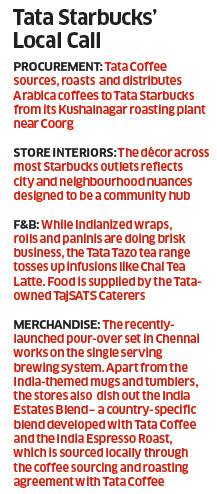
In January 2011, when Starbucks chairman and CEO Howard Schultz made his maiden India visit to sign the 50:50 JV with Tata Global Beverages, hopping over to Asia’s largest coffee maker Tata Coffee’s 8,258 sq feet roasting facility at Kushalnagar near Coorg made perfect sense. After witnessing the plant first hand, his team pointed out that the coffee at the roasting facility matched the global espresso blend that Starbucks prides itself on.

(The store in Horniman Circle…)

So for the first time ever in Starbucks’ history, the company pinned its faith on a partner-owned roasting facility, outside the five plants it owns across the world, including one at Amsterdam. Local coffee, global taste.


WHAT’S IN STORE

That set the ball rolling for a slew of localization initiatives which the JV kickstarted from October 2012, as it launched its very first outlet in Mumbai. The store in Horniman Circle, which can accommodate 120 people, has hand-carved wooden screens, tables of solid Indian teak, painted vintage trunks and old leather-bound books, harking back at Mumbai’s mercantile past.

As for the grub, there’s Konkani Twist or a Reshmi Kebab Roll, jostling for mouth-share with the standard Blueberry Muffin or the Classic Breakfast Chicken Sandwich—all coming from the Tata-owned TajSATS, India’s largest provider of meals to domestic and international airlines. While the coffee variants are largely untouched, the beans and espresso blend at the heart of the coffee are locally sourced. Even the Tata Tazo tea range throws up a spice-infused Chai Tea Latte—distinctly Indian. Similarly, when Starbucks opened shop in Delhi’s Connaught Place in February 2013, the ropework design of the store stood out as a local theme, along with food offerings, such as Murg Kathi Wrap and Murg Tikka Panini.

The Pune store, on the other hand, honours the rich copper culture of the city through copper artifacts and even has a traditional Indian swing for customers to sway. While certain elements in its food kitty are customized to suit local taste-buds, things are no different when Starbucks launched its 50th store in the country at Chennai earlier this month, which is the only outlet vending a ‘pour-over set’ single brew serving merchandise, typical of the filter coffee culture down south.

Procurement, store decor, F&B, merchandise— across locations , Tata Starbucks has set out to garner neighbourhood connect, to create what its CEO Avani Davda claims as the “third place” between the office and home. Unlike rival Cafe Coffee Day, which operates across multiple formats on a franchisee model, Tata Starbucks prefers operating the third place on its own, with an average covered floor area of 1,000-1,200 square feet. Much of that is governed by homegrown research that points to a more leisurely cafe culture in India than the west, where it is an on-the-go, grab-a-bite, kiosk-led approach with tiny outlets located near workplaces. That explains why Starbucks gets about a fourth of its revenue here from food as against 20% globally.

Though Davda’s cuppa of choice is Sumatra or a vanilla latte in the morning, she would any day welcome the growing consumption of Chai Tea Lattes from her stores. Unlike in most countries, Starbucks realized that India is largely a tea-drinking nation and has now solidified that beverage selection on its menu. It has also launched the India Estates Blend – a country-specific blend developed with Tata Coffee, and the India Espresso Roast, which is sourced locally through the coffee sourcing and roasting agreement with Tata Coffee.

LATE, YET RELEVANT

As the local theme gains momentum, Starbucks’ late entry into the country’ Rs 1,200 crore coffee chain market must not be overlooked. When it finally entered in 2012 after a botched entry in 2007 with Future Group’s Kishore Biyani , the domestic market was nearing saturation, with quite a few players snapping up prime properties in the top ten cities.

Though the JV never compromised on real estate, Starbucks President, China and Asia, John Culver said forging a sense of community will be key, while inaugurating the Horniman Circle outlet. Surely, the $14.89 billion Starbucks has also drawn lessons from the localization bids of other food retail chains, particularly KFC and McDonald’s. While the former ranks Paneer Zinger and Veg Twister as its top-sellers, McDonald’s McAloo Tikki and Masala Grill scorch the tables.

But since such chains operate across multiple formats, some of them even resort to differential pricing across different formats or locations, to cater to a broader consumer base. But Starbucks is clear about its premium pricing and aware of its international brand following.

TataStarbucksKF09aug2014

“We now have an average customer who is very well informed, and has exposure to international brands and experiences… although price and convenience play a part in their spending decisions, they are also more and more influenced by a brand’s values,” says Manmeet Vohra, Director-Marketing & Category, Tata Starbucks.

THE NAYSAYERS

The Indianizing influence, particularly from a brand like Starbucks, has its own share of skeptics though. “People line up outside Starbucks for a global gourmet coffee experience with knowledgeable staff (partners) and baristas who can toss up the Starbucks experience…. unfortunately, the company has adopted a cookie-cutter approach (in India)….it’s like Zara saying it’ll sell salwar-kameez in India,” observes Harminder Sahni, Founder and MD, Wazir Advisors.

As a counter, Davda claims that a career at Starbucks starts with learning about coffee, often through coffee tasting and roasting events. “Our baristas are trained for specific periods by certified baristas, and each partner undergoes the training before undertaking their respective roles,” she says. Keeping the debate alive, former VPMarketing of Tata Coffee and brand consultant Harish Bijoor observes that Starbucks must not dilute its international flavor in order to grow in India.

“It must not become an Indian cafeteria from an American cafe,” says Bijoor, adding that strong brands are often inflexible. Even marketing guru Jagdish Sheth dismisses the ‘think global, act local’ approach of Starbucks, pointing out the new trend as ‘think local, act global’, with a slew of examples, such as Haldiram’s, Dabur and Pathak Pickles from India now riding high overseas with very ethnic offerings.

BANKING ON THE HOOD

But Tata executives, like Davda and Vohra, remain steadfast in their commitment to serve local communities and grow the business case around regions and neighbourhoods. It goes to explain why each outlet supports the surrounding ecosystem.

In Mumbai’s Horniman Circle store, for instance, Starbucks maintains the adjoining heritage park while in Gurgaon’s HUDA Metro Station store, partners take time out for regular cleanliness drives. Pradeep, one such partner, works the counter in Delhi’s Hamilton House branch at Connaught Place and keeps watch as the outlet’s assistant manager. Amid rope chandeliers and the surrounding wood, steel and concrete surfaces that resonates the character of the Lutyen’s-era building, Pradeep helps fellow partners with orders, calling out names of consumers alongside the order on delivery.

Right next to where he stands, about one-fifth of the food section has local offerings—”Chatpata Paratha Wraps and Tandoori Paneer Rolls are the highest selling food items in this outlet,” claims Pradeep. Though Davda will be happy to see local grub flying off the tables, for Tata Starbucks, food accounts for just 25% of its Rs 16 crore revenue. It is the core beverage category that Davda will be watching closely after ensuring that the beans at least are sourced and brewed in India.

source: http://www.articles.economictimes.indiatimes.com / The Economic Times / Home> Magazines> Corporate Dossier / Moinak Mitra, ET Bureau / July 25th, 2014

12th Plan outlay for Coffee Board by month-end

Nirmala Sitharaman plans to have a meeting of all stake-holders of the coffee industry in Bangalore and for the Tea Industry in Guwahati.

Bangalore :
Union Ministers have assured Karnataka coffee growers that the 12th Five-Year Plan for the Coffee Board would be announced by August end.

In their meeting, coffee growers told Minister of Commerce Nirmala Sitharaman that the 12th Plan outlay for coffee is overdue by about two years and many small and large growers are eagerly awaiting the Plan proposals as they have held back some investments because of the impending notification.

After patiently hearing growers’ problems, she assured them that the notification will be made by the end of August. The growers also have urged Union ministers to revisit the Kasturirangan Report and remove plantations from the preview of the act for Karnataka and Tamil Nadu, just as it has been done for Kerala. The members of the delegation that met the Union Ministers included D Govindappa Jayaram, chairman, and K Kurian, vice-chairman, of the Karnataka Planters Association; MS Jayaram, president, Thirthamallesh, secretary, Nanda Belliappa and MS Boje Gowda of the Karnataka Growers Federation; Peter Mathias, president, and Ullas Menon, Secretary-General, United Planters Association of Southern India.

The planters’ delegation was in New Delhi from July 29 to August 1 to discuss issues with Commerce Ministry officials and Nirmala Sitharaman. The delegation also met newly-elected MPs from Karnataka and apprised them on various issues. Pollution control norms for pulping were also brought to the ministers’ attention. Growers urged them to consider studies done by the University of Agricultural Sciences, Bangalore. Ministers assured the delegation that SCTL for growers above 10 hectares would be looked into. They also said that recoveries of loans which have become non-performing assets and those before the Debt Recovery Tribunal would not be brought under the SARFAESI Act for any plantation lands.

Meetings
Nirmala Sitharaman suggested plans to have a meeting for all stake-holders of the coffee industry in Bangalore and for the Tea Industry in Guwahati.

She also suggested that the Rainfall Insurance Plan will be modified to include all plantation losses caused due to heavy rainfall, drought or heavy pest attacks, such as white stem borer or stalk/bean/leaf rot (Koleroga) etc. She also said she would explore ways of including research scientists from the agricultural department for doing research on coffee, as well as getting some funding from the Agricultural Ministry for the same.

The Ministers also assured help in getting the approval of the National Horticultural Package (for Pepper) for Karnataka.

source: http://www.thehindubusinessline.com / Business Line / Home> Agri-Biz / The Hindu Bureau / Bangalore – August 03rd, 2014

Tata Coffee receives accolades at the Golden Peacock Awards 2014

Tata Coffee Limited, India’s coffee producer and exporter of gourmet coffee, announced its win at the Golden Peacock Awards 2014, for excellence in ‘Environment Management’ in the ‘Beverages’ category. Golden Peacock Environment Management Award (GPEMA) is the coveted recognition that organisations across India strive to achieve for environment management.

The award was presented as part of the two-day ‘ 16th World Congress on Environment Management’ in New Delhi on July 11 and 12, 2014. Tata Coffee was declared the winner amidst a distinguished gathering of business leaders, jurists, academics, environmentalists, economists, legislators and policy makers. Present as Guest of Honour was Atul Chaturvedi (IAS), Chairman – Public Enterprises Selection Board.

Hameed Huq, Managing Director, Tata Coffee Limited said, “It is a proud moment for the company to be applauded on a national platform such as the Golden Peacock Awards 2014. Tata Coffee has consistently been committed to environment protection and we rely and coexist with nature at our coffee plantations. We promote eco-tourism and sustainability. We are constantly improving the quality of coffee through sustainable practices and agronomy solutions.”

Tata Coffee has been revered for excellence in ‘Environment Management’ based on its system by conservation of water and energy resources and effective utilisation of renewable energy resources. Tata Coffee is also known as a carbon-negative company as it upholds its biodiversity conservation practices.

Tata Coffee has 19 coffee estates in India which produce varieties of Arabica and Robusta coffees. The plantations adopt sustainable practices in irrigation, water management, and pest control. The plantations have set up bee hives to increase the dwindling bee population and bee activity, which, in turn, will serve the purpose of cross pollination, especially for the Robusta coffee.

Sustainable practices have their benefits, including important certifications: among these, the Utz Kapeh certification, which validates that coffees from the Tata Coffee plantations have not been exposed to harmful chemicals and processes, and the Rainforest Alliance certification, which validates the company’s sourcing and growing practices. Tata Coffee was also the first plantation company in the world to get SA 8000 certification, which recognises a company’s fair employment practices.

This year’s awards were declared by the Awards Jury under the Chairmanship of Justice P. N. Bhagwati, former Chief Justice of India and Co-Chairmanship of Justice and UN Human Rights Commission and co-chaired by Justice (Dr.) Arijit Pasayat, Chairman, Authority for Advance Ruling (Customs, Central Excise and Service Tax) and former Judge, Supreme Court of India & former Chairman, Competition Appellate Tribunal of India & Authority for Advance Ruling (Customs, Central Excise & Service Tax) and Lt Gen J S Ahluwalia, PVSM (retd), President, Institute of Directors.The award for the Environment Management System (EMS) is a powerful tool to evaluate oneself in an ecological sphere.

source: http://www.hospitalitybizindia.com / Hospitality Biz India.com / Home> F&B Overview> F&B / by HBI Staff, Mumbai / Wednesday – July 16th, 2014

Record coffee bean output likely

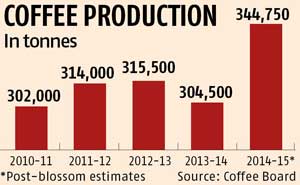
Despite widespread attack of the White Stem Borer (WSB) pest in all growing regions, the Coffee Board, a estimates India’s coffee production for 2014-15 at a record 344,750 tonnes – an increase of 13.2 per cent over the final estimate for 2013-14.

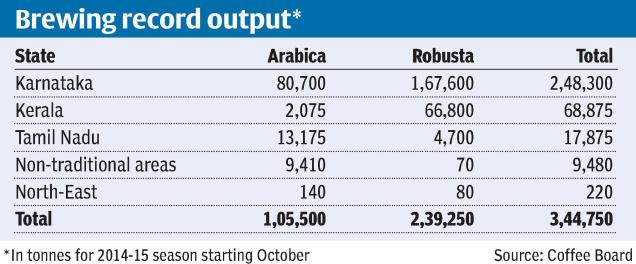
Although the Board projected an all-time high output of 347,000 tonnes for 2013-14, the final production came down to 304,500 tonnes, with 102,200 tonnes of Arabica and 202,300 tonnes of Robusta beans. Compared to 315,500 tonnes in 2012-13, the production was down by 3.5 per cent. For the current year, the pest has already affected 50 per cent of the Arabica plantations and the production loss could be the worst ever, if the monsoon continues to play truant. The Board has projected Arabica output at 105,500 tonnes and Robusta at 239,250 tonnes for 2014-15 crop.

“Our estimates are based on the conditions that prevailed during post-blossom period in April. The blossom showers were adequate this year, though the distribution was not uniform and there was a slight delay in receiving the backing showers in certain pockets. This year is an “on-year” for Robusta crop and the conditions are very good for the crop presently. The pest could come under control if there is a very good shower in the remaining months of monsoon. However, it will be known only in September, when we come out with post-monsoon estimates,” Jawaid Akhtar, chairman, Coffee Board, told Business Standard. He said last year, the Robusta crop suffered losses due to a heavy monsoon between July and September, after two months of drought earlier in the year. However, this year, the conditions might change with the monsoon rains in July and August.

CoffeeProductionkf17jul2014

Akhtar said coffee areas were facing long dry spell, followed by blossom showers. Agreeing with the Board, Ramesh Rajah, president, Coffee Exporters’ Association, said the Robusta crop has in excellent condition and depending on how the rains continue in the remaining days, the final production would vary. As WSB is rampant this year, the production of Arabica could come down by 10,000-15,000 tonnes, he said.

Planters have expressed surprise over the estimates for the current year. “Last year was an ‘on-year’ for Arabica and still it suffered losses due to WSB initially and later with heavy monsoons. This year, it is an ‘on-year’ for Robusta. With WSB surfacing, the Arabica production at the most could be in the range of 60,000 tonnes,” said Nishant R Gurjer, former chairman, Karnataka Planters Association.

source: http://www.business-standard.com / Business Standard / Home> Markets> Commodities> Food & Edible Oils / Mahesh Kulkarni / Bangalore – July 14th, 2014

Coffee Board projects record crop next season

ChartKF13jul2014

Growers sceptical due to prolonged dry period, borer menace

Chennai :
The Coffee Board has projected a record crop of 3.44 lakh tonnes (lt) for the new season beginning October, but growers are sceptical about the estimates.

According to the Coffee Board’s post-blossom estimate, Arabica output will be 1.05 lt and Robusta 2.34 lt. (The estimate of crop made after the coffee plant blossoms and spikes develop on the plant is the post-blossom estimate.)

This is against a revised estimate of 3.04 lt this season ending September (1.02 lt Arabica and 2.02 lt Robusta).

“I think this output could be difficult to achieve, especially with regard to Arabica. This is because even in best-maintained plantations, there is heavy infestation of the white stem borer,” said Anil K Bhandari, former president of the United Planters’ Association of Southern India, and an exporter.

Other opinions
“Such levels of production cannot come from the original area under coffee in the country. This year, most planters are complaining that their output will be down by at least 40 per cent as far as Arabica is concerned. In my own estates, the output will drop to 10 tonnes from 40 tonnes,” said Bose Mandanna, former Coffee Board Vice-Chairman and a planter in Kodagu, Karnataka.

Due to a prolonged dry season, the menace of the white stem borer, which has been wreaking havoc in coffee plantations over the past decade, is a serious threat this year.

“Maybe, the estimate put out by the Coffee Board was the situation prevalent during blossom. After that, there has been a tremendous loss in the estates due to the borer menace,” said Bhandari.

This year, coffee estates are reported to have received timely showers for blossoming of the coffee flower. Follow-up showers, required for growth of the plant, were also good before the borer menace spread panic.

According to the Board estimate, Karnataka will contribute 72 per cent of the coffee production next season, up from nearly 70 per cent this season. Output in Karnataka will be 2.48 lt (80,700 tonnes Arabica and 1.67 lt robusta) against 2.11 lt this season (78,440 tonnes Arabica and 1.32 lt Robusta).

Kodagu’s contribution will be 43 per cent with 20,150 tonnes of Arabica and 1.13 lt of Robusta (21,040 tonnes Arabica and 90,820 tonnes of Robusta). Last year, its contribution to the country’s coffee production was 36 per cent.

Fears of drought

“It is almost like a drought situation in Kodagu. It is unlikely that the district will provide so much coffee this year,” Mandanna said.

“It is likely that the Coffee Board could revise the estimate downwards after taking into account the effect of monsoon and other things. It should carry out another estimate later and put it out during October-November. That could perhaps reflect a correct picture,” Bhandari said.

According to plantation industry sources, for the last few years, the Coffee Board has been putting out a higher projection of the crop in its post-blossom estimate.

“This has been happening for sometime now. They come out with a higher figure and then revise it. Who gains from such estimates,?” a source wondered.

Last year, the Coffee Board initially estimated the crop at a record 3.47 lakh tonnes before pegging it finally at 3.04 lakh tonnes.

This season’s production estimate was lowered after heavy rains in the growing areas led to wet feet in coffee plants resulting in the roots growth freezing. This led to coffee berries falling off the plant, leading to loss.

“The Board has to revise its methodology in estimating the crop. Then, perhaps it could be nearer to reality,” the source said.

source: http://ww.thehindubusinessline.com / Business Line / Home> Markets> Commodities / by MR Subramani / Chennai – July 08th, 2014

Coffee Board finds a way to tackle arabica stem borer

Kochi :

Coffee Board has achieved a breakthrough in its research to combat white stem borer attack, which has become the single largest threat to the survival of arabica coffee cultivation in India.

Management of this devastating pest has been increasingly difficult due to the vagaries of Nature and shortage of skilled work force. It has threatened to bring down arabica crop to 65,000 tonne this year.

Among the various control measures currently available, pheromone technology is the latest one which can be adopted easily. The Central Coffee Research Institute (CCRI) has been working on the refinement of the pheromone technology and had identified the existence of female sex pheromones and some attractants known as kairomones, within the plant itself. Kairomones are the chemicals released by host plants that attract the pests towards them.

Earlier, Coffee Board through a tie up with Bio Control Research Laboratories (BCRL) succeeded on the production of the male pheromone compound. The Board is now providing traps baited with this pheromone at 50% subsidised rates to the coffee growers. The traps help the growers to monitor the borer emergence and assess the spread of the flight season which are crucial to initiate the control measures.

Coffee Board had launched a collaborative research programme with BCRL in 2012 to identify the role of female sex pheromones and kairomones in mating and infestation process.

The studies conducted by BCRL scientists revealed the existence a female sex pheromone compound. A plant volatile from attacked plants, which attracted the stem borer, was also identified.
Preliminary field studies using combinations of these two in traps attracted maximum beetles when compared to the male pheromone alone.

These findings offer scope for improving the pheromone technology, which could form the basis for a breakthrough in eco-friendly stem borer management. Further field trials to arrive at the optimal and cost effective combinations are under way, according to an official statement from Coffee Board.

Source: http://www.articles.economictimes.indiatimes.com / The Economic Times / Home> News> Economy> Agriculture / by ET Bureau / July 08th, 2014

Kodagu & Chikmagalur RCFs constituted to strengthen research on coffee

Bangalore :

The Coffee Board has included enterprising and eminent growers along with associations in its Regional Consultative Forums (RCFs) in order to strengthen research on coffee.

Jawaid Akhtar, Chairman, Coffee Board, told Business Line that these RCFs have been formed covering all the major coffee growing regions in the country.

Following have been nominated for regional consultative forum for Kodagu district of Karnataka.

Enterprising/ Eminent Coffee Growers – N Bose Mandanna, Subramanya Estate, Suntikoppa, Gautham Basappa, Madapura B Estate, Madapura, Sampath, Senior General Manager, Tata Coffee Ltd. Pollibetta, B.B.Chengappa, Palthope Estate, Srimangala, B.D.Manjunath, Manasavana Estate, Kumboor, Madapura post, S.B.Jayaraj, Panya Estate, Suntikoppa, N.M.Subbanna, Yelneergundi Estate, Sanivarasanthe, P.D.Khalista, Flora Estate, Abbur village, Somwarpet taluk, P.S.Subramani, Sajjan Estate, Kothur village and Post, Near Ponnampet, A Ponnappa, Group Manager, M/s BBTC Ltd., Sidapur.

Scientists/ Experts in the field of agriculture – Director, Central Horticulture experimentation station Chettalli, Associate Director, College of Forestry, Ponnampet, Deputy Director, Cardamom Research Station, IISR, Appangala and Joint Director (Horticulture), Govertment of Karnataka, Madikeri.

Growers Associations – president, Coorg Planters Association, Madikeri, Representative of KGF Kodagu District, President, Kodagu District Small Growers Association, Siddapur.

Invitees – Chairman, Coffee Board – Permanent Invitee, Board Members from Coorg district and Director of Research, CCRI

Convener and Deputy Director -Research, CRSS, Chettalli.

For the Regional Consultative Forum for Chikmagalur & Hassan districts following are the members nominated.

Enterprising / Eminent Coffee Growers – H.B.Rajagopal, Kerehucklu Estate, Balehonnur, H.M.Deepak, Kanachur Estate, Hanthur PO, Mudigere taluk, Dr Anand Titus Pereira, Kirehalli Estate, Sundakere post, Saklespur, H.T.Mohan Kumar, Dimbada Estate, Hurudi post, Saklespur taluk, Ashok Kurian, MD, Balanoor Plantations & Industries, Bangalore, Dr M S Sreenivasan, Advisor, M/s.ABC Plantations, Mudigere, The General Manager, IBC Group of Estates, Saklespur, B.M.Mohan Kumar, Malleswara Estate, Balupet, Saklespur taluk, Ajay Thippaiah, Kerehaklu Estate, Aldur, Tousif Ali, Coffee Planter, Aldur.

Representative of Growers Associations – Chairman, Karnataka Planters Association, Chikmagalur, President, Karnataka Growers Federation, Saklespur, President, Hassan District Planters Association, Saklespur

Scientists/ Experts in the field of Agriculture – Associate Director, Zonal Agril.Res.Stn. (UASH, Shimoga) Mudigere, Dy.Director, Regional Spice Res. Stn., Donigal, Saklespur, Jt.Director (Horticulture), Govt. of Karnataka, Chikmagalur,

Invitees – Chairman, Coffee Board – Permanent Invitee, Board Members of Chikmagalur & Hassan districts, Director of Research, CCRI

Convener, Joint Director (Research), CCRI and all Divisional Heads of Research Dept. and JDE, Hassan, DDE, Hassan & DDE, Chikmagalur will attend to the RCF meetings to be held at CCRI and make presentation of their findings.

source: http://www.thehindubusinessline.com / Business Line / Home> Markets> Commodities / by Anil Urs / Bangalore – July 03rd, 2014