Get ready to battle for the best espresso at the National Barista Championship to be conducted by Coffee Board in January 2014. K Basavaraj, head of quality control division and the convener of the championship said, “Till last year, the championship used to be conducted by the Speciality Coffee Association of India (SCAI). The Coffee Board has now taken over from this year because we have the expertise, and the championship can be organised better.”
The championship is organised to identify people with the best barista skills. “We invite individuals who are working at various cafe chains to participate in this competition. Even house wives or people who know the art can participate. These people can get an entry into the competition if they know the espresso method of brewing,” explained Basavaraj.
According to him, today there are many youngsters who are taking interest in the job of a brewmaster and many have become professionals in coffee making. “This competition will, in a way, give them recognition. They can also be placed in top cafes. Many previous barista champions are now working in Dubai and such other places. The 2014 championship will be conducted as per the rules and regulations of World Barista Championship 2013. This competition coincides with the India International Coffee Festival, which will probably be held on January 21st and 22nd 2014. A couple of international jury members will select the finalist. This will also give the winner a good international platform,” he said and further added, “We have a another competition named Latte Hot Championship where the best design on the coffee will win the prize.”
Whether this national level championship will lead the participants to World Barista Championship? “We are yet to discuss about it, which will be done after this championship,” he said.
To participate
Go to www.indiacoffee.org for the application form. If interested, submit your entries before January 3, 2014 to participate in the qualifying round which is to be held on January 16, 17 and 18. Registration cost: `500.
source: http://www.newindianexpress.com / The New Indian Express / Home> Cities> Bangalore / by A Sharadhaa / Bangalore – December 10th, 2013
Born into a family, that owns coffee plantations in Coorg, city boy Vikram Dasappa, had a natural affinity to Coorg coffee and felt that it is one of the oldest and the best coffees in India. Eligible bachelor boy who chose to become a restaurateur, instead of running the family coffee business, shares, “Our family has been in the business since past three generations and we have the oldest and best kept coffee estates in Coorg. On my various travels around the world, I explored a lot of night clubs, lounge bars and pubs and always wanted to own one of my own. But owing to Bengaluru’s early nightlife deadline, opening a night club didn’t seem like a very clever proposition. Food has been growing steadily in the city and that’s why I decided to bring an International food chain here.”
Recognising the city as a social melting pot, a brand like Nando’s seemed to pique the foodies interest. “I was always very passionate about the hospitality industry. I also love travelling and have been to many cities around the world with a group of friends and family. This year we went to explore Europe and went to Croatia, Greece, Italy, Hungary, London and Montenegro. It was also my mom Gayathri’s 60th birthday, so 25 of us from my family went onboard the Royal Caribbean cruise. We also took out time and tried some rock climbing in Montenegro. Last year we went to Bangkok, Dubai, Malaysia and Singapore with friends. On one of my trips to Budapest, I went cycling across the country, which is the best way to explore new places. Highlight of my trips is trying out new cuisines, especially Italian and meeting new people,” says Vikram, who runs two Nando’s restaurants in the city, adding, “The first time I tried the Peri-peri chicken at Nando’s in London, I was hooked onto it and one of my cousins mentioned about the franchise. I have taken the franchise licence for Karnataka state.”
Recalling a recent trip to London, Vikram adds, “I love Nobu for its interesting Japanese cuisine. Whenever I like a dish, I always try and have a word with the chefs to get an idea on whatever goes into making it. I’m always exploring more options of world cuisine, with plans to bringing in more international chains to India. I also love Prosecco and have also tried a lot of exotic range of cognacs from Venezuela. Another of my favourites is Frangelico. I take my golf breaks whenever I can. We had gone to take part in the golf tournament at the 107 year old Belur golf club. I have also taken golf holidays in Colombo and South Africa.”
source: http://www.deccanchronicle.com / Deccan Chronicle / Home> Lifestyle> Offbeat / DC / by Namita Gupta / November 28th, 2013
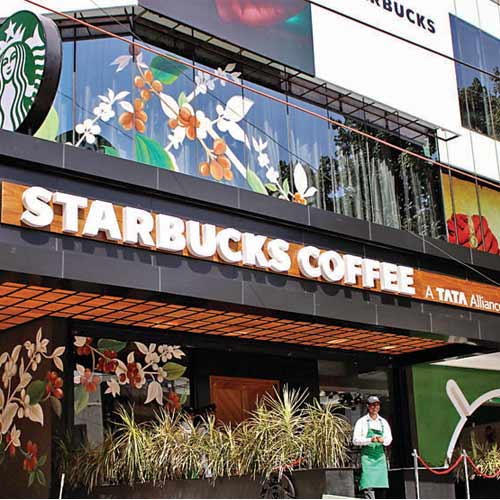
Local flavour: Tata Starbucks recently launched the Indian Estates blend./ Photo by Janak Bhat
Innovation has been the watchword for coffee brand Barista Lavazza, and this is highlighted in Amore, an art-themed menu for India. The menu pairs food and coffee, and the selections are presented using pop art. The company regularly does thematic menu launches. Last year it tied up with fashion designer Rina Dhaka to launch Milano Collezioni, a fashion-inspired menu. The art work for Amore was done by Arrested by Art, a Delhi-based art boutique. And, Barista Lavazza is not the only coffee outlet that is introducing new concepts and innovation to woo Indian customers, particularly the youth.
Tata Starbucks recently launched the India Estates blend, an addition to its Indian Espresso Roast blend. Sourced and roasted in India, this blend is part of the company’s strategy to deliver locally relevant experiences to its customers. The company recently introduced Pumpkin Spice Latte, a Starbucks classic. And, to complete the experience, it is offering a wide range of merchandise, including a mug designed specifically for India. Internationally, Starbucks’s country and city mug series is quite popular.
Cafe Coffee Day (CCD) introduced Friends of Frappe, a new menu comprising beverage and bite-sized snacks focused on the Indian market. The special menu offers Bestie Combos, which pairs a snack and beverage like Amore does.
With coffee culture becoming popular in the country, the number of cafes has been growing fast. At least 200 outlets have been opening every year, for the past five years. The market is estimated to be worth Rs.1,000 crore, and growing at around 15-20 per cent annually. It is said that India can take another 2,000 cafes in the near future.
Santhosh Unni, CEO, Costa Coffee India, said coffee shops “have become the favoured hang-out zone for the youth and the preferred meeting place for a wide profile of people”. “It highlights not just a shift in taste, but a cultural shift as well, where young, affluent Indians are more interested in global trends than ever before,” he said. “The increase in disposable income and shifting lifestyle preferences are the key drivers of the growth being witnessed in the Indian coffee market.”
Traditionally, India is tea-drinking, with the coffee to tea ratio being 1:7. India consumes only 80gm of coffee per capita, as against six kilo per capita in Italy. The current boom in India is coming from two distinct trends—middle-class consumption and out-of-home consumption.
“Consumer acceptance is actually driving the growth in consumption, as well as the café culture,” said Nilanjan Bhattacharya, COO (India and SAARC), Barista Lavazza. “Globalisation, expanding base of the middle class, rising disposable incomes, changing lifestyle patterns, coupled with exposure to international trends through films, advertising, youth community sites and personal blogs are all factors which are driving this trend and the shift in consumption patterns.”
Tata Starbucks sees a huge opportunity in sourcing and roasting local premium Arabica coffees for international consumption. Tata Coffee ensures that the coffee supplied to Tata Starbucks is 100 per cent locally sourced and roasted. Tata Starbucks is a joint venture of Starbucks Corporation and Tata Global Beverages.
All the major players in the Indian cafe market are trying to maximise the customer’s experience in the cafe. CCD has around 30 outlets uniquely designed to hook the youth. The company is active on social media, using the platform to gather feedback from customers. It also holds coffee-tasting sessions for customers.
Avani Davda, CEO, Tata Starbucks, said the “Starbucks Experience” is built on three basics: “our products, our places and our people”. “Our offerings, in-store experience, and store design reflect the community gathering place that Starbucks is known for,” she said. “Customers come for coffee, stay for the inviting warmth and return for the very human connection.”
K. Ramakrishnan, president (marketing), CCD, said the company had coffee plantation trails at its resort—The Serai in Chikmagalur, Karnataka. Tata Coffee, too, is popularising coffee plantation trails at some of its exquisite estate bungalows in Karnataka.
Costa Coffee launched Costa Laughaccino, a stand-up comedy series by leading artists from India and the US. They also organised Costa Rhythm and Brew, where the likes of Leslie Lewis, Rabbi Shergill, Indus Creed and Indian Idols performed at Costa cafes.
Barista Lavazza reached out to the customer with its Click-a-Coffee photography contest. The best 100 photographs chosen by ace photographer Pradeep Dasgupta will be brought out as a coffee table book. The company also has Friendship Jam, an event for music lovers and amateur bands. The company has been hosting Penguin book launches. The first book to be released was Shobhaa De’s Sethji. Barista Lavazza also brought out a new coffee, named after the book’s title character, for the launch. During the launch De tweeted: “Sethji coffee—go for it guys. It’s seriously yummmmm. Even the book reads better after a mug or two of the brew….”
Visibility, too, is top on the list for the cafe chains. “We have established our outlets at different locations such as places of tourist interest and hill stations to catch the attention of the customers,” said Ramakrishnan. “CCD has outlets all over, from religious places such as Vaishno Devi, Haridwar and Rishikesh to places near Metro stations in Delhi. We also have outlets in Austria and the Czech Republic.”
And, the coffee boom is good news not just for the well-heeled. Costa Coffee’s special HR initiative provides employment to the physically challenged, including the hearing-impaired. The company invests in special training for these employees. Store managers, shift managers and many in the senior management are schooled in sign language to ensure better coordination with the special employees. Currently, 15 per cent of Costa Coffee employees are special, and the company plans to raise it to 25 per cent by the end of next year.
EXPANSION PLANS
Cafe Coffee Day: First cafe at Brigade Road, Bangalore, in 1996. More than 1,500 cafes today. Target: 2,000 cafes by 2015.
Tata Starbucks: Born in October 2012. Has 25 cafes across Mumbai, Delhi and Pune. Probable next stop: Bangalore. Also looking at Tier-II cities.
Costa Coffee: Came to India in 2005. 100th store opened at Carter Road, Mumbai. Target: 300 cafes by 2015. Recent cafes: Chandigarh, Ludhiana, Agra and Jaipur. Coming soon: Hyderabad. Looking closely at Tier-II & Tier-III cities.
Barista Lavazza: First store at Basant Lok, New Delhi, in February 2000. Aiming at Tier-II and Tier-III cities. Recent cafes: Patiala, Surat, Visakhapatnam, Jaipur and Nagpur.
source: http://www.week.manoramaonline.com / The Week / Home> Business / by Abhinav Singh / Monday – November 25th, 2013
Leading bourse National Stock Exchange (NSE) today gave its approval to merger of Alliance Coffee with its listed parent firm Tata Coffee saying the amalgamation does not violate provisions of securities law.
Tata Coffee in September had announced that its board has approved the merger of Alliance Coffee with itself, consequent to which the draft scheme of amalgamation was filed with stock exchanges for necessary approval. (NSE also said that Sebi’s…)
In a communication to Tata Coffee, NSE said it is granting its ‘no-objection approval’ to the proposed scheme and this observation letter will be valid for six months starting today, within which period the company would have to file the scheme with the High Court for further clearance.
Another bourse, BSE granted its no-objection to the scheme on November 21.
NSE also said that Sebi’s observations on the scheme requires Tata Coffee to display ‘fairness opinion’ submitted by it on the website of listed firm.
“We have perused ‘draft scheme of arrangement’ and related documents submitted by Tata Coffee including the confirmation of the company secretary that the scheme so submitted does not in any way violate, over-ride or circumscribe the provisions of securities laws or stock exchange requirements,” NSE said.
“Accordingly, we do hereby convey our ‘no-objection’ with limited reference to those matters having a bearing on listing /delisting/ continuous listing requirements within the provisions of the Listing Agreement, so as to enable the company to file the scheme with the High Court,” it added.
According to norms, companies seeking to execute merger or de-merger strategies need to obtain ‘no-objection certificate’ from stock exchanges.
source: http://www.articles.economictimes.indiatimes.com / The Economic Times / Home> Markets> Commodities> Exchanges / by PTI / November 25th, 2013
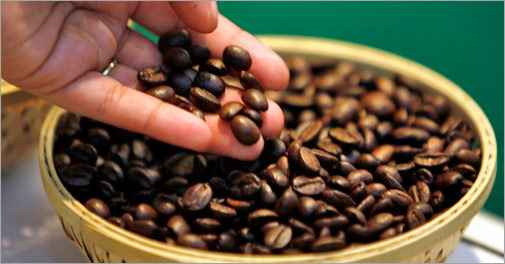
PHOTO: Reuters
The Coffee Board will take up growing coffee, on a pilot basis, in Darjeeling, where it has found some areas to be good for coffee cultivation.
The Board will grow coffee in an area of 500 hectares, and is in discussions with the West Bengal government for this.
“Darjeeling is a very suitable area for coffee,” Board Chairman Jawaid Akhtar told BUSINESS TODAY. The Board’s survey last year has also found a few pockets of Himachal Pradesh suitable for growing coffee.
The areas under coffee cultivation were expanding with about 3500-4000 hectares coming under coffee in Andhra Pradesh every year. “We have also identified some new places in the traditional areas of Karnataka, Kerala and Tamil Nadu for expanding coffee,” Akhtar said.
The Board, meanwhile, is building capacity in the Indian coffee industry to ensure the coffee beans exported into the European market met the highest standards for the espresso coffee.
“Most of our coffee goes to Italy, where more than 90 per cent of people drink Espresso. Hence, we are educating the coffee community on the finer aspects from harvesting to processing so that our beans are of the highest standards and buyers overseas are satisfied,” Akhtar said.
In the global markets, he said, the Board was positioning Indian coffee a high quality coffee grown in sustainable environment. The coffee grown in Western Ghats was of superior quality as the beans from this region have a distinct aroma and taste. He appealed to coffee growers in this region not to shift from Arabica to Robusta to overcome short-term hardships.
“India grows both Arabica and Robusta, and our Robusta gets 40 per cent premium over the average international price for Robusta. If we grow only Robusta, this premium will be hurt.”
The planters, Akhtar said, were growing coffee under tough conditions, and he appealed to them to follow the best practices as recommended by the Coffee Board. Instead of looking at only coffee for income, they should also grow fruits and spices, and maximise the estate income.
The post blossom forecast for 2013-14 had estimated coffee production to be at 3.47 lakh tonnes. However, the production in the ensuing harvest season is likely to drop by about 10 per cent due to drought in March-April followed by heavy rains from May to August.
The Coffee Board, meanwhile, is also pushing for increase in domestic consumption which is about one lakh tonnes now.
(*The headline of an earlier version of this story was changed to better reflect the copy.)
source: http://www.businesstoday.intoday.com / Business Today / Home> Sectors> Agriculture> Story / by K.R. Balasubramanyam / Bangalore – November 23rd, 2013
Planning to open two more stores in the city by year-end. Coorg coffee on menu.
Coorg and Chikmagalur will soon find a mention in Starbucks stores worldwide.
The US coffee chain is planning to sell arabica coffee sourced from the estates of Coorg and Chikmagalur in its global stores.
Called India Estates Blend, this medium roast coffee was launched last month to be sold in packages of 250 gms at the 30 Starbucks stores in Mumbai, Pune, NCR and Bangalore.
It is sourced, roasted and packaged in India.
John Culver, group president, Starbucks China and Asia Pacific, channel development and emerging brands, says the company would “take this Indian coffee to our 17,000 stores globally.”
Explaining that Starbucks is evaluating plans to make India Estates Blend available globally, Culver says they source coffee from 30 countries.
“Over the last year, we discovered there is very high quality arabica available in India. So it will be good to take India coffee, blend it with other coffees, and sell in the global stores.”
Operational through a 50:50 joint venture between Tata Global Beverages and Seattle-based Starbucks Corporation, Tata Starbucks has also set up a coffee roasting and packaging plant at Kushalnagar in Coorg with a capacity to produce 375 metric tonnes.
India Estates Blend is the second blend brought out by the firm after the India Espresso Roast, that is sold at their outlets across India.
Culver wants India to be one of the top 5 markets for Starbucks globally. Speaking during the launch of the group’s flagship outlet in Bangalore, Culver says Bangalore reflects “our commitment to expand across India.”
Entering India in October 2012, the company operates 29 other stores across NCR, Mumbai and Pune.
Starbucks is planning two more stores in Bangalore before December-end, at Phoenix Market City and Orion Mall. The management believes they can build a ritual of Starbucks in the daily lives of Indians.
Brand consultants feel despite the cluttering in the market in Bangalore, which is the home for Cafe Coffee Day, Starbucks will establish its niche, simply on the basis of its image.
A cuppa numbers
India is a leading exporter of coffee. In the coffee year October 2012-September 2013, India exported 3 lakh tonnes of coffee, as per the Coffee Board. The US and EU are main markets for Indian coffee.
The per capita consumption of coffee in India is low, at 90 grams. In Brazil, another leading coffee exporter, per capita consumption is 6 kg, as per data by Care Research.
The organised cafe market across India boasted sales of Rs 1,246 crore in 2012, and is expected to touch Rs 2, 222 crore by 2017, as per consulting firm Technopak.
The number of cafes in the country will grow from 1,950 last year, to 2,900 by 2017.
Price of coffee minus taxes, can range from Rs 70-80 for a simple cappuccino or latte, to over Rs 180-200 for flavours like hazelnut, or cinnamon, or caramel.
Currently, Cafe Coffee Day is the leading player with 1,498 outlets across India. It has plans of reaching 2,000 outlets by 2015.
source: http://www.dnaindia.com / DNA / Home> Bangalore> Report / by DNA Correspondent, Place:Bangalore, Agency:DNA / Saturday, November 23rd, 2013
India is the only major market in the world where Starbucks has been able to source and roast coffee beans locally. New York :
Starbucks CEO Howard Schultz has voiced his admiration for industrialist Ratan Tata’s “grace” and wisdom, saying he was moved by the business icon’s words during the launch of the coffee chain’s flagship store in Mumbai last year.
“At the celebratory dinner the night of the Mumbai (store’s) opening, Ratan Tata offered a toast that really moved me,” Schultz writes in an essay in the book ‘Reimagining India: Unlocking The Potential of Asia’s Next Superpower’, edited by global consulting firm McKinsey.
Schultz recalls that while describing Starbucks’ India launch and Tata’s remarks at the celebrations later to a gathering of his company officials in the US, he even began to cry and was overpowered by emotion.
“A few weeks after returning from the opening of our Mumbai store, we held one of our big open forum meetings where we get the entire company together. And as I tried to describe that moment for everyone, something came over me. I started to cry. It just hit me emotionally.
“In India, we’d had a chance to do something extraordinary, something truly world class. And I am excited that we have a chance to grow and give back in a land where so much opportunity lies ahead and to contribute to making it a little better place than the one we found,” Schultz said.
Tata’s remarks on the night of the Mumbai opening were “perfect and so heartfelt,” Schultz said in the essay, adding that he considers Tata to be a “man with so much grace.
“I could sit and listen to Ratan Tata for days on end. He has so much wisdom and insight not only about India but about the world,” he said.
The book is a compilation of over 60 essays on India’s challenges and opportunities written by CEOs, academicians, economists and historians, including Wipro chief Azim Premji, Microsoft founder Bill Gates and India’s chess legend Viswanathan Anand.
In his toast, Tata had said in his “dry, understated way” that the Tata group has had a bit of success in the various endeavours it has undertaken over the years.
“We have partnered with some good global companies. But I have never had the kind of recognition I have received from this relationship with Starbucks. People I have never met stop me on the street just to congratulate me.
“And what I have learnt from this relationship is that Starbucks is far more than just a company that sells coffee,” Tata had said.
Schultz said his company has developed an “incredible relationship” with the Tata organisation and he cannot imagine bringing Starbucks to India without the assistance it has received from Tata.
Schultz also said India is the only major market in the world where Starbucks has been able to source and roast coffee beans locally.
The company worked with Tata officials on an India-only espresso roast designed specifically for the Indian market.
Schultz said people in Starbucks’ coffee department were not “exactly thrilled” when he told them he was looking at a different approach to sourcing coffee and roasting process under the partnership with Tata for India.
“They were more sceptical when I said we want to create a different blend of coffee for India,” he said, adding that his team was incredulous when he said the India blend was not going to be roasted by the Starbucks team, a first in Starbucks’ 42-year history.
Schultz said to get the blend he wanted for India, “we’d have to share with Tata some of the family jewels — roasting secrets we’ve perfected over four decades and guarded very closely.
“It was a real test of our trust in our new partner,” he said, adding that teaming with Tata to come up with an Indian roast was a huge step for Starbucks.
source: http://www.thehindubusinessline.com / Business Line / Home> Companies / by PTI / New York – November 19th, 2013
Govindappa Jayaram from Kodagu district has been elected as Chairman and K Kurian from Chikmagalur district as Vice Chairman of Karnataka Planters’ Association.
Jayaram and Kurian got elected at the 55th Annual General Meeting of the Karnataka Planters’ Association.
The following have been elected to executive committee of KPA: Chikmagalur District – H.T. Pramod, Shirish Vijayendra, Mahesh Shashidhar.
Kodagu District – A.A. Ponappa, N. Bose Mandanna, M.A. Sampath (Corporate Seat).
Hassan District – V. Murali (Corporate Seat) and Baba P.S. Bedi.
Small Growers seat – Kodagu District – Dr M.M.Chengappa.
source: http://www.thehindubusinessline.com / Business Line / Home> Industry> Agri-Biz / by Anil Urs anil.u@thehindu.co.in / Bangalore – November 17th, 2013
Interview with Chairman, Coffee Board Jawaid Akhtar
After coffee producers in Brazil and Vietnam used mechanisation and genetically improved plants to increase crop yields, Indian coffee growers are trying to replicate their success. However, many allege the Indian government has not provided adequate incentives to increase crop yields or protect these from diseases such as the white stem borer. On the sidelines of the UPASI-KPA Coffee conference in Bangalore, Jawaid Akhtar, chairman of the Coffee Board, spoke to Antonita Madonna on these allegations and on the focus of the commerce ministry. Edited excerpts:
Growers allege, unlike their counterparts in Brazil, they have not been provided adequate incentives. How would the Coffee Board address that?
Brazil and India cannot be compared so easily. The methods used by them cannot be correlated with India’s, as the plantations in the two are very different. In Brazil, the higher crop yield is not as much the result of incentivisation as of the use of new varieties, new agronomical practices, etc. Production in India is increasing, but at a very slow pace due to several constraints. The drastic difference between the progress in India and in Vietnam and Brazil is because the soil is less conducive here. Vietnam and Brazil have volcanic soil. In India, coffee is not grown under direct sun, but under the cover of trees. So, productivity suffers, but quality increases.
Second, coffee growers have to show more dynamism. They have to put in more effort and use better inputs. What it requires is more water, more use of agrochemicals, etc. The Board is regularly working on research. We also disseminate the findings of these studies among growers. It is an ongoing programme.
What research and development is the Board doing?
We are working on finding new varieties that are high-yielding, pest- and drought-resistant.
Some three-four varieties are in the pipeline on the arabica side, as problems, including the white stem borer, are more prevalent in arabica. We had also introduced a variety of arabica coffee four years before. Robusta, on the other hand, is yielding in some places even after 80 years.
To replicate the success in Brazil here, growers have been seeking the Board’s help in research and tools. Is the Board working on that, too?
The mechanisation in Brazil cannot be correlated with that in India because in Brazil, there is no shade. Also, unlike the undulating terrain of the Western Ghats in India, the land in Brazil is plain.
The 20-ft high harvester they use in Brazil cannot be used in India, as coffee does not grow in the open here. Our plantations are different.
How is the Coffee Board encouraging more acreage for coffee?
We have seen production rising in non-traditional areas, but in traditional areas (Kerala, Karnataka and Tamil Nadu), it is not. Now, we have identified more areas where coffee production can be increased and are trying to include that in the 12th Plan.
With a depreciating rupee, is the board planning to increase exports?
There are schemes for exports already. But you can export more only if there is more production. We export 70 per cent of whatever is produced. But we offer incentives for areas to which much coffee doesn’t find its way, despite these being good markets for coffee. For instance, in the 11th Plan, we had five countries—the US, Canada, Australia, New Zealand and Japan. Now, in the next Plan, we will include other markets such as South Korea and two other countries. We are in discussions with other countries as well.
We are also trying to promote brand-building. So, we’ll give incentives to export value-added coffee in retail packs. The value-add maybe anything from roasting green beans or making instant coffee. Our instant coffee market is very robust. Almost all the value-added coffee that goes from India is instant coffee. Now, we’re the second-largest producer of instant coffee, after Brazil.
Any plan to introduce the Coffee Board’s own brands?
No, there is no such plan. All these plans were shelved 20 years ago and there are no plans to revive those. Now, it is a free market and we encourage private businesses. That is why we have introduced so many programmes to train manpower and tasters so that private people can run businesses.
Is the Coffee Board working on increasing awareness or building brand equity for Indian coffee?
We are, of course, working on positioning Indian coffee better in the international market. We participate in international trade fairs, advertise, get media coverage, arrange Indian coffee tasting sessions in international locations, invite roasters, make them taste Indian coffee, etc. All these efforts are already reaping rewards. Our average price of robusta is about 40 per cent higher than the international average. There is a very large international market for this premium Indian coffee.
source: http://www.business-standard.com / Business Standard / Home> Companies> Q & A> by Antonita Madonna / Bangalore – November 14th, 2013
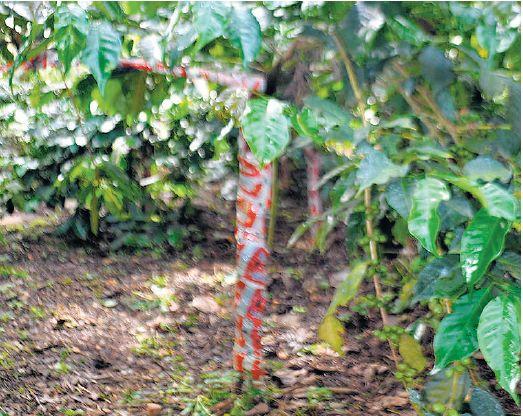
Better solution: An arabica plant stem wrapped with cellophane tapes to prevent it hosting the white stem borer on a coffee estate in Kodagu. / The Hindu Results are good, says Coffee Board; some planters raise environmental concerns
An ingenious method has been found to control the ruinous white stem borer in coffee estates where the arabica variety is grown. But coffee planters are split over the effect of the solution with some even questioning its impact on the environment.
According to A.K. Bhandari, coffee planter and former President of the United Planters Association of Southern India, wrapping the stem of the arabica plant with cellophane, called poly wrap, helps in containing the borer menace. The wrap prevents the female beetle from laying eggs in cracks and crevices of the plant.
“We came across this solution some two-and-a-half years ago when some planters used old plastic to wrap the stems. It prevented the borer from laying eggs and controlled the spread of the pest,” he said.
Coffee white stem borer, Xylotrechus quadripes, is a pest found in arabica coffee causing huge yield loss. A blackish brown coloured beetle, it can also be found on rosewood, sandalwood and teak.
Ten to 12 days after the female beetle lays the eggs on the stem, the larvae enter the woody tissue and burrow up to the roots. This leaves the plant impaired and the only known solution is uprooting the plant totally and burning it.
“Poly wrap physically stops the insect from laying eggs on the plant. Growers had, at one point of time, wrapped plants with old fertiliser bags. Now, they have begun to use strip wraps and the results have been good,” said Jawaid Akhtar, Coffee Board Chairman.
History traces the borer menace to 1837 and the first reference was made in 1838 by H. Stokes, Mysore Commissioner. In 1868, the Madras Commissioner had reported the ravages of the borer in Mysore and Coorg.
YIELD LOSS
“We have been suffering from the borer menace for over a decade now. It has affected arabica production. In some estates, nearly 50 per cent of plants had to be uprooted,” said Bose Mandanna, a grower in Kodagu and former vice-chairman of Coffee Board.
The borer menace has resulted in arabica production stagnating around one lakh tonnes annually for almost a decade after rising to a record 1.21 lakh tonnes in 2001-02 (October-September) season. Its share in total coffee production (robusta makes up the rest) has decreased from over 50 per cent in the 1980s to around 30 per cent now.
This year, out of the estimated 3.47 lakh tonnes production, arabica output has been pegged at 1.11 lakh tonnes. However, growers expect it to be lower than 90,000 tonnes.
“The poly wrap seems to be working very well. Most of the growers have reported 99 per cent success. About 10 estates can be taken and the experiment tried for 2-3 years,” said Bhandari.
The Coffee Board had sent an advisory on the poly wrap but not much progress seems to have been made.
“Labour shortage is the reason why poly wrap has not picked up. Also, there was short-supply of wraps. That has ended now as supply is ample. Results are encouraging and the wrap does not affect the plant’s growth,” said Akhtar.
But, there are voices of dissent too.
“The poly wrap was tried in small pockets and it has not been successful when tried on a large-scale. It prevents plants from growing. The bark growth is stunted and we feel this is not a scientific solution,” said the Karnataka Planters’ Association Chairman, Nishant Gurjer.
Some of the corporates involved in growing coffee have now begun to experiment the method. “We have begun the poly wrap on Coffee Board’s suggestion and are assessing the results,” said an official of Tata Coffee at its Margolly estate in Kodagu.
However, concerns are being raised over its effect on the environment.
“When the poly wrap gets old, it could lead to environment problems since it won’t disintegrate easily,” said Mandanna.
Gurjer agrees. “Plastic will add to the mechanical damage to the plants,” he said.
Other growers say that until a better solution is found, the poly wrap method should continue.
source: http://www.thehindubusinessline.com / Business Line / Home> Industry> Agri-Biz / by M. R. Subramani subramani.mancombu@thehindu.co.in / November 07th, 2013
WELCOME. If you like what you see "SUBSCRIBE via EMAIL" to receive FREE regular UPDATES.
Read More »