Category Archives: Coffee, Kodagu (Coorg)

Govt mulls branding Indian arabica coffee

Ministry willing to commit resources, expertise for purpose; discusses proposal with Coffee Board
CoffeeKF09sept2013
The Ministry of Commerce and Industry is considering creating an Indian mild arabica coffee brand for the promotion of arabica coffee in international markets. It had discussed the idea with the Coffee Board and was coming out with a brand initiative under the public-private partnership (PPP) model, said a senior ministry official.

“We don’t want Arabica coffee to die out because of the impact it has on the environment of the Western Ghats. The Indian mild arabica coffee is very highly priced. The only way to get better prices for our coffee is to brand it, package it and promote it in foreign markets,” said J S Deepak, additional secretary in the commerce ministry. Addressing the 120th annual conference of the United Planters’ Association of Southern India (Upasi) here on Tuesday, he said, “The ministry is willing to commit resources and expertise required for promoting an Indian mild Arabica brand.”

Planters participating at the conference feel the move is significant, owing to the dwindling acreage and production of arabica coffee in India. For 2013-14, production was estimated to decline to about 80,000 tonnes from 98,600 tonnes in 2012-13, said Nishant R Gurjer, chairman of the Karnataka Planters’ Association. Gurjer said the move to create an Indian brand for arabica would go a long way in preserving and promoting arabica coffee.

Deepak said the government was concerned about the white stem borer attack on arabica gardens and a solution to this would be found by the Coffee Research Institute soon. On Upasi’s demand for reconstituting commodity boards (coffee and spices), Deepak said the proposal was in the final stages and the new boards would be announced very soon. “The ministry has taken the suggestion of Upasi for including members of plantation associations on the new boards and it would make necessary changes in the new boards,” he said.

He assured the plantation sector the ministry would provide all help, including the help from Indian Brand Equity Foundation, for branding of Indian spices. On the delay in approving 12th Plan schemes for various commodities, he said the proposals were pending with the finance ministry. He expressed hope these would be approved by the end of September. “It is a matter of great concern for us. Most of the subsidy schemes will be continued in the 12th Plan,” he added.

source: http://www.articles.timesofindia.indiatimes.com / The Times of India / Home> Markets> Commodities> Other Commodities / by Mahesh R Kulkarni / Coonoor – September 03rd, 2013

Growers find novel ways to keep away wild elephants

Wild elephant menace in the coffee plantations in various parts of Kodagu has been increasing every passing day. The reason for the increase in the elephants entry into coffee plantations is the jackfruits and bananas grown in the coffee plantations, which draw attention of the elephants in search of food. In order to save their coffee plantations from elephants, coffee growers have begun to destroy banana and jackfruit yields in their plantations
ElephantKF07sept2013
Wild elephant menace is rampant in Aiguru, Kandanakolli, Kodlipet in Somwarpet taluk and Srimangala, Ammathi, Ponnampet in Virajpet taluk. Forests in these areas mostly comprise of teak wood which is why elephants are falling short of food. In addition, the water pits dug to supply water to coffee plants too are inviting elephants to enter coffee plantations to drink water. Repeated requests of the villagers to the forest department to chase elephants back to the forest have gone futile. It can be recalled that a two wheeler rider was killed by a wild elephant near Aiguru a fortnight ago.

Disappointed over the lukewarm response from the forest department and the failure of solar fencing, now the coffee growers have found their own ways to keep away the elephants by destroying fruit bearing plants like banana and jackfruit in their estates. One can view jackfruits piled up on the roadside near Aiguru on the way from Madikeri to Somwarpet. Growers hope the elephants to hog these jackfruits instead of entering into their plantations.

In fact, some of the growers have also made attempts to cut jackfruit trees, but could not as they do not posses the trees rights. In many estates, the coffee growers have cut the banana plants.

Speaking to Deccan Herald, coffee plantation labour Murugesh said that with the broken solar fences, the coffee growers have no other option but to cut jackfruit and banana plantations.

source: http://www.deccanherald.com / Deccan Herald / Home> District / by Srikanth Kallammanavar / Madikeri, DHNS / June 20th, 2013

Coffee planters moot first private research body

R&D outfit to focus on developing high yielding clonal strains, resistant to White Stem borer, Leaf Rust
CoffeeKF06sept2013
In an effort to increase productivity of Indian coffee, major plantation associations in India have mooted a proposal to set up a privately-funded research organisation. The main objective of the research outfit is to develop new clonal strains for both Arabica and Robusta coffee.

Plantation associations such as the United Planters’ Association of South India (Upasi), the Karnataka Planters’ Association (KPA), the Karnataka Growers’ Federation, the Hassan District Planters’ Association and the Waynad Coffee Growers’ Association have decided to form the first-of-its-kind private sector initiative, Coffee Growers for Research, to to develop new high yielding and pest-resistant varieties, a KPA official said. These associations together have formed a joint action committee, which is in the process of finalising the structure of the research outfit.

“Over the last many years, coffee production in India has stagnated around 300,000 tonnes, while many other countries like Brazil, Ethiopia, Honduras and Vietnam have achieved manifold rise in coffee yields. We (India) need to catch up with world leaders in coffee production in the coming years, or else, we will be left at the level we are presently,” D Govindappa Jayaram, vice-chairman, KPA, told Business Standard on the eve of 120th annual conference of Upasi, here on Monday.

For example, the yield of coffee has increased 94 per cent in Brazil to 1,257 kg per hectare (ha) in 2011 from 649 kg per ha in 1971. Similarly, Vietnam has achieved a 540 per cent jump in yield to 2,188 kg per ha in 2011 from 342 kg per ha in 1971. While India’s yield has declined three per cent to 838 kg per ha in 2011 from 861 kg per ha in 1971. The need to form a private sector research body for coffee was felt by the planters as the government-funded research wing, under the aegis of the Coffee Board of India, has not done enough research in developing high yielding coffee varieties, which are resistant to white stem borer, leaf rust, tolerant to berry borer in Arabica variety, Jayaram said.

The last new variety released by the Coffee Board was the Chandragiri variety about five years ago, which was released by Brazil’s IAPAR in 1959. The joint action committee, in its proposed submission to the government, has highlighted several challenges faced by the coffee sector such as over-production in major coffee producing countries, escalating cost of inputs, especially the very high cost of labour, and the inability to introduce large scale mechanisation. The need of the hour is to improve productivity and production of coffee, he added. The new research outfit will be completely self-funded will start with a corpus of Rs 2-3 crore, Jayaram said, adding the new research body would focus on selection of good mother plants from various plantations across the country.

The committee is also focusing on introducing a special scheme with incentives for production of Arabica coffee as Arabica coffee area was drastically declining, he said.

The committee is of the view that the only way is to provide positive research and development that can directly contribute to achieving higher yield. The development of good seed material and clones with high yield, which are resistant to pests and diseases, drought resistant and have positive attributes in the cup is a matter of great urgency and importance, the Upasi said in its latest report on plantation sector.

For the Robusta variety, the committee said there was a need to develop clonal strains which were high yielding, good in the cup, drought tolerant to cope with climate change, resistant to shot hole borer and suitable for drip irrigation and mechanisation.

Development of indigenous machinery which help in efficient management of various cultural operations; R&D at the Coffee Research Station and substations to world standards and restoration of the Coffee Evaluation Committee and Mechanisation Committee are some other initiatives mooted by various plantation associations.

source: http://www.business-standard.com / Business Standard / Home> Markets> Commodities> Food & Edible Oil / by Mahesh Kulkarni / Coonoor (TamilNadu) – September 02nd, 2013

Birds, frogs and civet coffee in Madikeri

What comes to mind when you think of Kodagu or Madikeri? Coffee, homestays, waterfalls, elephant camps, Tibetan settlements, meaty-pork stews? How many of us know that Kodagu, unlike the other districts of Karnataka, is home to a range of wildlife species? And in particular, birds and reptiles?
KodaguKF06sept2013
I found the answers in a plantation located in Galibeedu village, Madikeri. I visited a 25-acre plantation, in which coffee, pepper, cardamom and vanilla are cultivated for a two-day stay. It is run by a North Indian couple who quit their jobs 20 years ago to develop this piece of land into an eco initiative that can be enjoyed by all.

The plantation is dense with coffee and other spices grown under the inter-cropping method. Guests are accommodated in tents and a handful of cottages. Locally grown organic food is served to them. The entire plantation is run on solar power, bringing it as close to the nature as possible.

The plantation also serves Civet Coffee, which is made out of beans that are defecated by the civet, a wild cat, that feasts on ripe coffee berries. The beans are washed, sundried and roasted to yield maximum aroma. Due to the enzymatic activity and the touch of amino acids in the Civet’s gut, these beans acquire unique flavours—making it less bitter, more aromatic and hence one of the most expensive and exclusive kinds of coffee in the world.

The night called for a few pleasant surprises—the deafening sounds of the crickets followed by a soothing array of fireflies. Though their charm might be ephemeral, they have a magical effect on you. I tried so hard not to blink, fearing the loss of a few glints. The minimally-lit tents with below 10-watt bulbs paved a perfect setting for this magical moment.

The plantation is an ornithologist’s delight. I spotted the Malabar Whistling Thrush, Woodpeckers, Racket Tailed Drongos, Fly Catchers and Kingfishers among several tiny birds. The plantation is also home to stick insects, hibernating butterflies, tree frogs and leaf frogs. Some belonged to the Lateralus family and are endemic to the Western Ghats region. The frogs were a sight to behold; they changed colours, had shiny-green skin, big, bulgy eyes and had perched themselves on twigs as if waiting for us to visit them.

My two-day stay passed away in a blur and I decided to walk down to the much talked-about stream surrounded by birds about five kilometres away before departing. As I trekked down, the clouds got thicker and darker. I spotted a flock of birds, all different in colour and kind, perched on a tree. It suddenly began to drizzle and the birds in search of shelter, flew from one tree to the other at once. The swarming birds flew low, making it one of my most colourful memories—tints of hidden orange and blue, reds and greys exposed—a flying rainbow indeed.

Ignoring the rain and time, I soaked and hiked at my own pace. When I got back, I was the only one for breakfast and I had missed out on my last dig at the sumptuous avocados too! Oh well!! What more can one ask for when you had the experience of a flying rainbow?

source: http://www.deccanherald.com / Deccan Herald / Home> Supplements> Spectrum / by Aishwarya Madineni, DHNS / September 03rd, 2013

The rain quotient

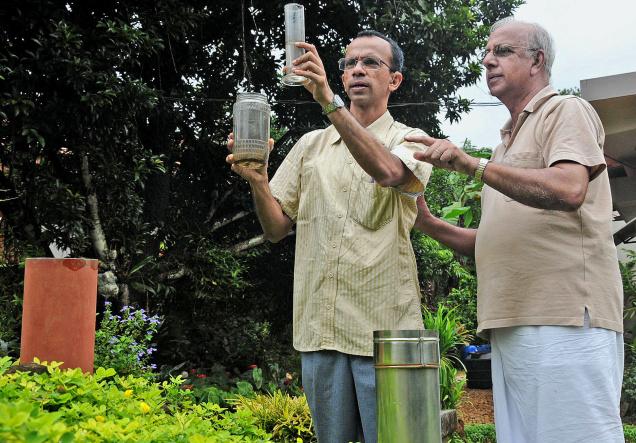
Rain Man: Abraham Tharakan with his son, Bobby /  Photo: K.K. Mustafah / The Hindu
Rain Man: Abraham Tharakan with his son, Bobby / Photo: K.K. Mustafah / The Hindu

Abraham Tharakan’s family has been recording rainfall since the late 1950s. He talks about his family’s unique engagement and its relevance in these times. Shilpa Nair Anand learns about the family’s unique engagement and its relevance in these times.

Rain is on everyone’s mind this year, every millimetre and inch of rain is a conversation piece. But a family in Muvattupuzha is ‘into’ rainfall and has been recording it for close to 50 years.

There is a story to how Abraham Tharakan’s family got interested in rains, specifically in measuring rainfall. His grandfather, his namesake, a native of Thaikattussery, moved from the traditional coconut and paddy cultivation into plantation agriculture. He bought land in Kothamangalam in the late 1920s or early 30s for this purpose.

“My father, also Abraham Tharakan, had the green thumb. He started cardamom, coffee and rubber plantations. And then in the 1950s he heard about coffee plantations in Coorg,” Abraham Tharakan reminisces. A huge photograph of his late father dominates the drawing room in the house in Muvattupuzha. A smaller oil painting of his grandfather rests on a corner table.

Abraham Tharakan’s family has been recording rainfall since the late 1950s. It started out as a planter’s necessity in Coorg, which it still is, Tharakan says. He shows records of the rains in Muvattapuzha from 1988. If you are wondering how much rainfall Muvattupuzha received in July 1989, all you need to do is refer to his meticulously well-kept records. It rained 150 days in 2002 as compared to the 124 days in 2001; in 2010 Muvattupuzha got 4. 25 inches of rain in one-and-a-half hours and the same year it got 7.75 inches over a 24 hour period. “I had records of rain in Kothamangalam from the 1970s too. Some of those were lost when we shifted here.”


Dedicated notebooks

The ‘records’ are maintained in notebooks dedicated to recording rainfall. Some of the books are informal notebooks. But the records since 2000 are in a specific notebook, which he bought from Coorg. “When Kodavas buy property, one of the first records they ask for, even before the land deed, is the rain chart. Their conversations start with ‘how much did you get?’”

The record-keeping started with his father, during his days in Coorg. He remembers seeing his first rain gauge as a 10-year-old. “There was hardly any irrigation there and planters solely depended on rain. Coffee is a one time crop and untimely rain can damage the crop. The idea behind monitoring weather conditions was to help agricultural operations,” he says. When his father returned to Thaikattusserry (Alappuzha) he installed a rain gauge there. Father and son would exchange notes on the rainfall received, something which he does today with his sons, Ebbey and Bobby. The coastal belt gets less rainfall as compared to the high ranges, he says. “If Muvattupuzha gets an average of 110 inches of rain then Kochi would get an average of 90 inches of rainfall,” says this engineer-turned planter.

As we chat, his son informs him that Kothamangalam has already recorded 13 inches of rainfall till July 8. When Tharakan talks about the rain it becomes clear how little we know about it. “There is a difference between getting four inches of rain and three-and-a-half inches.” An agriculturist needs to know the pattern of rainfall received. He shows the rainfall patterns of 2010 and 2011, during the monsoon, and the chart for 2012. The charts show a clear deficit of rainfall during the June-July period.

“If someone had been monitoring rainfall then the power shortage could have been anticipated and corrective measures could have been taken before it was too late.” He is not only talking from a planter’s point of view.

He is against the attitude of taking rain for granted, “you cannot sit back thinking it will rain because it rained the year before. There is all this talk about the water table and rain water harvesting…but how much do we know about rain?”

He even records the number of days it rains each year. Ebbey and Bobby measure the rainfall and make the records.

“My sons go on the Net for accurate weather forecasts. If it rains more in November rubber tapping is affected. This way we know what the weather is going to be; so we can be prepared. The Indian Meteorological Department is very accurate and so are the satellite pictures in The Hindu. The various websites are extremely helpful. Information is more detailed; it is very different from what it was in my time.”

He has not missed a single day of recording rainfall. Outings are planned in such a way that they don’t hamper the recording, his wife says. There is always somebody around to monitor rainfall.


Another cause

Abraham Tharakan is a member of the All Kerala Parents’ Association of the Deaf. The cause of the deaf is close to his heart as both his sons are hearing impaired. He counsels parents of similar children. He moved to Kerala from Mysore in 1976. He was at the All India Institute of the Hearing Impaired aiding them in their treatment. Both his sons look after the estates; they are perfect examples of assimilation. Ebbey and Bobby even have driving licenses.

How it works

The rain gauge is a cylindrical metal pipe with a funnel inside with a container placed under it to collect rainwater which is then measured.

The gauge is not high-tech. The rainwater once collected in the gauge is then measured using a cylindrical measuring glass used specifically to record rain.

The previous day’s rain is measured every morning at 7 a.m.

Of the rain gauges he uses, one is ‘made in Coorg’. He has installed two in his garden, but he finds the ‘Coorg’ one more reliable.

He bought one from Kochi but he is not sure about its accuracy because there is a variation in the sizes, which, he believes, might hamper accuracy.

source: http://www.thehindu.com / The Hindu / Home> Features> MetroPlus / by Shilpa Nair Anand / Kochi – July 14th, 2013

India’s coffee consumption set to recover in 2013-14

IndiasCoffeeKF23aug2013
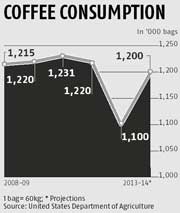
According to USDA, consumption in India has been hovering around 1.2 million bags for last 5 years; slipped to 1.1 mn bags in 2012-13

India’s coffee consumption is set recover to 1.2 million bags (72,000 tonnes) in 2013-14, a modest rise of nine per cent compared with 1.1 million bags (66,000 tonnes) in 2012-13, according to the United States Department of Agriculture (USDA). Before falling in 2012-13, average annual consumption in India stood at about 1.2 million bags through five consecutive years, USDA said in its latest report ‘Coffee: World Markets and Trade’.

Typically, USDA’s estimate is lower than the estimate provided by the Coffee Board of India, which is yet to publish the latest consumption figures. “Consumption of coffee in India is always debatable. The Coffee Board of India always projects a higher number, while it is low in the case of USDA,” said Ramesh Rajah, president, Coffee Exporters Association of India. Coffee consumption in India is growing at an average one-two per cent annually.

Compared to 2012-13, consumption has shown signs of growth. It is estimated consumption would rise despite near-flat production levels. USDA has pegged domestic coffee bean production at 5.2 million bags (312,000 tonnes) for the crop year starting October. On an average, India’s annual bean production stood at 5-5.2 million bags in the past three years.

For 2013-14, USDA has projected exports from India at 3.75 million bags, the same as that recorded last year. Of the estimated production of 5.2 million bags this year, the share of Arabica is pegged at a record high of 1.7 million, while that of Robusta is pegged at 3.5 million bags.

“World coffee production in 2013-14 is forecast at 146 million bags, down by 4.4 million bags from the previous year, primarily due to Brazil’s Arabica trees entering the ‘off-year’ of the biennial production cycle and, to a lesser extent, Central America and Mexico continuing to struggle with coffee leaf rust,” USDA said. Global bean exports are pegged below last year’s record, while consumption is expected to rise modestly.
CoffeeConsumptionKF23aug2013

“In India, higher input costs, along with the elimination of subsidies for fertilisers and diesel, have increased production costs for growers. Labour expenses, which could account for more than 50 per cent of the cost of cultivation, continue to escalate, while greater off-farm employment opportunities have created labour shortages,” USDA said.

Adoption of mechanisation has been slow and limited to a few plantations, primarily due to uneven terrain and small and fragmented growing areas.

source: http://www.business-standard.com / Business Standard / Home> Markets> Commodities> Food & Edible Oils / by Mahesh Kulkarni / Bangalore – July 15th, 2013

An Inside Look at India’s Coffee Growers

Coffee’s rich history in India

There is a world of spice growing alongside the coffee plantations in Coorg, and it is indeed a site worth seeing.

Cruising at an altitude of 35,000 feet, on a flight back to the U.S., I knew I had left a part of me in Madikeri, Coorg, India. I have never experienced the raw beauty of nature the way I did on this trip. I can go on about this for hours, but I will let the photographs speak for themselves. Get yourself a nice cup of steaming coffee, it is going to be a long post.

Click here for the Inside Look at India’s Coffee Growers (Slideshow)
http://www.thedailymeal.com/inside-look-indias-coffee-growers-slideshow

Supposedly, Turkish law in the late 1400s made it legal for a woman to divorce her husband if he failed to provide her with her daily quota of coffee. I’m not sure of the authenticity of this, but coffee has always been a serious beverage, which you do not want to mess up with. Perfect ripened beans are processed, dried, and then roasted at perfect temperatures to give us the cup of bliss that we enjoy every morning. (In my case, multiple cups of bliss.)

It was in the 17th century that coffee came to India, when Bababudan smuggled eight beans and planted it in the hills of Chikmagalur, Karnataka. Now, thanks to the British who helped cultivation of coffee in South India, both coffee Arabica and coffee Robusta are cultivated in Coorg. The rainforest provides a perfect canopy to grown coffee in shade. There is a world of spice growing alongside the coffee plantations in Coorg, and it is indeed a site worth seeing… pepper creeper embracing the tall redwood and silver oak, almost like green pillars towering the sky with cardamom bushes alongside. Picture this… and it is pouring because it is the monsoons, probably the wrong time to visit a rain forest. For me, there would have been no better time than this…
I managed to take some pictures between the long bouts of rain, but the picture of the wet rain forest that I carry in my memories could not be captured from a lens and is truly priceless. I cannot say I did justice to the beauty of this place; you have to see it to believe it.

Among all the different types of coffee I tasted there, “bella coffee,” or coffee made with jaggery, was indeed the best and I am not sure how many cups or gallons I had; my father-in-law was my partner in crime, looking at the rain pouring, the cloud playing hide and seek to reveal the rich mountains… and a cup of coffee. What more can anyone ask for?

Simi J. enjoys cooking and celebrating the pleasure that food brings to our lives.Visit Simi at Turmeric N’ Spice. http://www.turmericnspice.com/

source: http://www.thedailymeal.com / Home> Drink / by Simi, Special Contributor / August 14th, 2013

Tatas to focus on beverages ‘power brands’

TataKF03aug2013
The brands that will be given a global push are Tetley, Tata Tea, Himalayan and Eight O’ Clock Coffee

The beverage arm of the $100-billion (Rs 6 lakh crore) Tata Group has prepared a blueprint that will see it devote its attention to four “power brands” in its quest to achieve a turnover of $5 billion (Rs 30,000 crore) in the next three years.

The list will include products such as Tetley, Tata Tea, Himalayan and Eight O’ Clock Coffee, which will be given a global push. At the same time, the Rs 7,271-crore Tata Global Beverages (TGB) will not take its eyes off regional products either, pushing these aggressively in their home markets. On this list are brands such as Kanan Devan, Chakra Gold and Gemini in South India, Vitax in Poland and Joekels in South Africa.

The blueprint, explains TGB Managing Director Harish Bhat, is in keeping with company Chairman Cyrus Mistry’s vision to invest significantly behind the firm’s brands. At the company’s recently-concluded annual general meeting in Kolkata, 44-year-old Mistry, who became chairman last year, said that the foundation for investment behind the firm’s products had been laid. “It is crucially important to grow our brands in India and overseas. There is also a need for innovations which need funds,” he said.

TGB derives 65-70 per cent of its revenues from international markets and the balance from India.

Tetley, one of the products on the global power list, already sells in a number of markets outside its home turf of the UK. This includes India, where it competes with Twinings and Brooke Bond Taj Mahal from Hindustan Unilever. Tata Tea, an Indian product, meanwhile, has been taken to markets such as Canada and West Asia, while plans are afoot to take Himalayan packaged water, also an Indian product, which was acquired in 2007 by the company, to Southeast Asia in the near term.

Bhat declines to indicate whether new products would be added to the global or regional list through new acquisitions. Outgoing Vice-Chairman R K Krishna Kumar, at the TGB AGM, had hinted that the company was looking at a new acquisition. He had said, “TGB will make a major acquisition and be a truly worldclass company, not in the tea or coffee space but in new beverages.”

As things stand, TGB derives nearly 70 per cent of its revenues from tea, 20 per cent from coffee and five per cent from water. The plan is to take the contribution of water and coffee to 10 per cent and 25 per cent, respectively, in the next three years, Bhat said. Tea’s contribution, on the other hand, would come down to about 60 per cent, he added.

TGB proposes to achieve this by pushing its joint ventures with PepsiCo and Starbucks aggressively in the next few years. “A total of 18 stores have been opened so far by Tata Starbucks in Mumbai and Delhi. This count will go up as we move forward,” he said.

On the joint venture with PepsiCo (called NourishCo), Bhat indicated that in-house brands Tata Water Plus and Tata Gluco Plus were doing well.

“Tata Water Plus has seen higher growth than Himalayan packaged water (in the June quarter). But this is in the markets of Tamil Nadu and Andhra Pradesh, where the brand is currently present. The plan will be to take it to other markets in the country,” he added.

source: http://www.business-standard.com / Business Standard / Home> Companies> News / by Viveat Susan Pinto / Mumbai – August 03rd, 2013

Coffee Board ups output forecast to 3.47 lakh tonnes

CoffeeBlossomKF03aug2013
‘Crop to drop by 20% due to weather-related problems’, says KPA
Bangalore :

Despite rampant white stem borer (WSB) menace and long days of dry period after blossom, coffee production is set to increase by 28,800 tonnes (9.05 per cent) over the final estimate of previous year 2012-13 (3,18,200 tonnes).

The Coffee Board, which released the post-blossom crop forecast, said for the year 2013-14, coffee production is estimated at 3,47,000 tonnes.

Of the total estimate, the arabica and robusta break up is 1,11,000 tonnes and 2,36,000 tonnes respectively. Arabica production has shown an increase of 12,400 tonnes (12.88 per cent) over the final estimate of 2012-13, while robusta increased by 16,400 tonnes (7.47 per cent).

By the states, the production gain has mainly come from Karnataka to the tune of 18,890 tonnes (8.21 per cent) and non-traditional areas (NTA) with 1,780 tonnes (28.57 per cent) while Kerala has shown an increase of 6,350 tonnes (9.89 per cent) and Tamil Nadu by 1,755 tonnes (10.10 per cent) compared to the previous 2012-13 season’s final estimate.

“Due to the drought like conditions (April-May), the crop setting in arabica and robusta has been severely effected. Also there were many incidences of WSB in arabica plantations.

The Karnataka Planters’ Assocation (KPA) estimates that there will be a drop of 20 per cent due to this weather-related problems, said Nishant R. Gurjer, Chairman, KPA.

In Karnataka, all the three districts recorded increase in production over the previous year with an almost equal share of arabica and robusta. Kodagu district recorded the highest increase of 14,420 tonnes (12.02 per cent) which is mainly accrued from robusta (11,620 tonnes or 11.77 per cent) and arabica gained by 2,800 tonnes (13.15 per cent).

Hassan district recorded an increase of 3,535 tonnes (10.84 per cent) which has come from both arabica (2,635 tonnes or 14.02 per cent) and robusta (900 tonnes or 6.52 per cent).

While Chikmagalur showed an increase of 935 tonnes from Arabica, the robusta production showed a decline of 2,940 tonnes (-7.30 per cent) over the previous year final estimate.

“Due to prolonged and unprecedented drought of over 50 days, there has been a spurt in the WSB pest that has devastated the arabica plants. We have also been unable to carry out the regular operations like spraying and manuring on time due to lack of rains in May. As for robusta, due to severe constraints of power and water resources, we were unable to cover our entire area for blossom and backing irrigation. We feel the blossom estimate may have to be revised further downward in view of prevailing conditions,” said Sahadev Balakrishna, Partner, Netraconda Estates, Chikmagalur.

“The arabica production regained in 2013-14 season in Karnataka mainly because of the biennial bearing nature of arabica as last year’s final estimate was low,” said the coffee board official.

The blossom showers are reported to be normal in all most all the coffee growing zones, while there was a delay in backing showers in certain pockets were reported. “In general good crop condition and better husbandry practices have helped to invigorate production in Karnataka. The crop forecast for Karnataka is placed at 86,735 tonnes of arabica and 1,62,380 tonnes of robusta totalling 2,49,115 tonnes,” the official explained.

Kerala coffee zones also have received adequate and timely blossom and backing showers. There was no adverse effect on crop was reported.

Accounting this, the post-blossom estimates for the 2013-14 is placed at 70,550 tonnes, which is an increase of 9.89 per cent (6,350 tonnes) over the previous 2012-13 final estimate of 64,200 tonnes.

Tamil Nadu post-blossom forecast is placed at 19,125 tonnes which also showed an increase of 1,755 tonnes (10.10 per cent) mainly in Pulneys and Shevroys region against the previous year final estimate of 17,370 tonnes.

In non-traditional areas of Andhra Pradesh and Orissa and north eastern region, the post-blossom forecast is placed at 8,210 tonnes against previous final estimate of 6,405 tonnes.

The higher forecast has come mainly from Andhra Pradesh and Orissa due to increase in bearing area.

2012-13 production was 3,18,200 tonnes

The final coffee production 2012-13 estimate is 318,200 tonnes, an increase of 2,700 tonnes (0.86 per cent) over the post monsoon estimate of 315,500 tonnes and an increase of 4,200 tonnes (1.34 per cent) over the previous year’s 2011-12 final estimate of 314,000 tonnes.

The Coffee Board, which released the final crop estimate for 2012-13, said of the total final estimate, the share of Arabica is 98,600 tonnes and that of Robusta is 219,600 tonnes.

The production of Arabica has shown a marginal decline of 1625 MT (-1.62 per cent) while Robusta increased by 4,235 tonnes (2.01 per cent) over the post-monsoon estimate made before crop harvesting in 2012. The loss in Arabica production and the production gain in Robusta has mainly come from Karnataka.

The final crop estimate for Karnataka is placed at 230,225 tonnes with a break up of 77,425 tonnes of Arabica and 1,52,800 tonnes of Robusta. The final production in Karnataka has shown a marginal increase of 3,020 tonnes (1.33 per cent).

The Arabica production has marginally declined in Chikmagalur (-1.32 per cent), Kodagu (-1.87 per cent) and Hassan of (-1.96 per cent) districts, while Robusta production shown an increase in Chikmagalur (8.33 per cent), Kodagu (1.15 per cent) and in Hassan (0.55 per cent) districts.

In Kerala, the final estimate of 2012-13 is placed at 64,200 tonnes with an increase of 375 tonnes (0.59 per cent) from the post monsoon estimate of 63,825 tonnes.

Tamil Nadu final production of 2012-13 is placed at 17,370 tonnes which is a marginal decline of 380 tonnes over the post monsoon estimate of 17,750 tonnes.

In the Non-Traditional Areas and North Eastern Region, the final estimate of 2012-13 is placed at 6,405 tonnes against post monsoon estimate of 6,720 tonnes which showed a marginal decline of 215 tonnes in Andhra Pradesh.

source: http://www.thehindubusinessline.com / Business Line / Home> Industry> Agri-Biz / by Anil Urs anil.u@thehindu.co.in / Bangalore – July 22nd, 2013

Tata Coffee – Change in Directorate

Tata Coffee Ltd has informed BSE about the following changes have been made to the Company”s Board:

1. Mr. R. K. Krishna Kumar, Chairman and Director of the Company has relinquished office as a Director on his attaining the age for superannuation.

2. Mr. Harish Bhat, Director has been appointed by the Board of Directors as Chairman of the Board with effect from July 26, 2013.

3. Mr. T. Radhakrishnan has been appointed as Executive Director- Instant Coffee Operations with effect from July 26, 2013.

source: http://www.moneycontrol.com / Home> Moneycontrol> Markets> Announcements> Plantations> Tea & Coffee / Source: BSE / July 26th, 2013