Category Archives: Coffee, Kodagu (Coorg)

Indian robusta bowls over Boston roasters

Bangalore :

Indian robusta coffees have been received well at the Specialty Coffee Association of America meet held recently at Boston, US.

“With Boston being in close proximity to major coffee roasters in the US, the event was attended by a sizeable crowd,” Jawaid Akhtar, Chairman, Coffee Board told Business Line.

“Robustas are generally known to be harsh, but when American roasters tested our coffees, they were amazed to discover the mildness and aroma of Indian coffees,” he said.

The Coffee Board had taken up space at the specialty coffee association and visitors tasted liquid coffee, instead of coffee samples from different regions.

At the event, a session on “Emerging Markets in Specialty Coffee: India” was also held to educate the US roasters. The one-hour session mainly focused on why specialty coffee needs Indian robustas. The session was attended by about 70 roasters from the North America, Europe, Australia and New Zealand.

Sunalini Menon, CEO, Coffeelab Ltd, talked about the distinct characteristics of Indian coffee and coffee growers’ representative Nishant Gurjer, Partner, Kaapi Royale Coffee, and Chairman of Karnataka Planters’ Association (KPA), spoke about the farm practices of cultivating coffee in India. The moderator of the event was Andrew Hetzel, consultant, CafeMakers.

The Indian delegation had, besides the Coffee Board Chairman and the KPA Chairman, quality control expert Sunalini Menon, M.P. Devaiah of Allana Sons, Bharat Mandanna of BBTC, Jacob Mammen of Bhadra Group, Kurien who was representing Small Coffee Growers Association, Kerala, and US coffee trader Joseph John.

For the last three to four years, the Coffee Board has been focussing on the US market. “Roasters in US are increasingly using robustas in their blends, it is here we are focusing our attention to penetrate the most important market in the world,” said Gurjer.

Creating awareness of the Indian coffee in the US has led to gaining some ground in the market. Indian coffee exports to US are currently averaging at around 6,000 tonnes and is the 14th important market. Exports have doubled in the last five years. In 2008-09 exports stood at 2,556 tonnes.

source: http://www.thehindubusinessline.com / Business Line / Home> Industry> Agri-Biz / by Anil Urs anil.u@thehindu.co.in / Bangalore, May 21st, 2013

Brewed on this

The Kapi Trail, a joint effort by the Bangalore International Airport Limited (BIAL), Thomas Cook, Karnataka Ministry of Tourism and Coffee Board of India, is a unique tourism experience that allows travellers to experience coffee plantations of the South, in a different way.

Caffeine kick

“Our idea was to use the flavours of coffee and the whole coffee tourism experience as a trigger point to encourage people to explore South India,” says Rene Baumann, vice president, BIAL. “And since the airport brings in people from all over the world. This initiative would spotlight south India in a different way,” Baumann explains.

The big picture

The trail offers packages that cover Bangalore, Mysore, Coorg and Chickamagalur. One can learn about the history of coffee and the processing of the bean; engage with the local culture, traditions and cuisine or stay in ancestral homes and plantations. For the sporty holiday maker, there are scenic mountain treks and cycling tours.

Culture vultures can opt for heritage walks with visits to ancient temples and palaces – the 18 m tall Gomateswara statue, the largest monolithic in Asia at Sravanbelgola, to the only Hoysala temple still active at Belur. Wild life buffs are definitely spoiled for choice. They can get a taste of the wilderness via jeep safaris or visit The Tholpetty and Bhadra sanctuaries in the region. The Tholpetty forest, part of the Nagarhole wildlife sanctuary, is also a tiger reserve. One can go on a guided forest trek or understand where your bean really comes from, with a visit to a plantation pulp house and drying yard.

The Namdroling monastery in Bylakuppe, Coorg and the coffee museum in Chickmangalur are also worth a visit.

Packages start at `26,400 upwards.

Details: bangaloreairport.com; kaapi.trail@in.thomascook.com

source: http://www.newindianexpress.com / The New Indian Express / Home> Cities> Hyderabad / by Express Features – Hyderabad / May 02nd, 2013

For these migratory tribals, livelihood, not voting, counts

Thousands of tribals in HD Kote and Hunsur haadis are likely to ignore the May 5 Assembly election as they have temporarily migrated to Kodagu and Wayanad to work in coffee estates. It is unlikely that they will come back to vote as there is a strong feeling that their exercising franchise has helped little in bettering their lives.

There are 115 haadis in H D Kote and about 30 in Hunsur with a total population of about 30,000.

The tribals here are predominantly agricultural labourers and with the region facing severe drought and agricultural activities still to resume, there is hardly any job on offer for them. Even forests are almost shut for them and they are hardly able to lay their hands on minor forest produce.

With no other choice, a majority of young and middle-aged men and women have left in search of greener pastures, leaving elderly parents at home to take care of their children. The tribals say that despite them casting their votes in successive elections, not much has changed in their lives. “Moreover, it’s a matter of bread and butter. We cannot give up a day’s wages and come just for the sake of voting,” said Raja from D B Kuppe haadi.

While many tribals have shifted their base to coffee estates as early as December and will return on May, those located on the borders of Kerala and Kodagu travel to their work places daily. Tribals are preferred for weeding and tree pruning as they are experts in it and get wages ranging from `150 to 300 daily.

Srikanth of the Tribal Joint Action Forum said that the tribals’ long-pending demands like title deeds for their cultivating lands, places of worship and graveyards, better health facilities and quality teachers who can bridge language barriers of their children among others are still to be met.

Most importantly, the poor tribes are upset over a series of attacks on fellow tribes by forest staff while collecting minor forest produce and over the problems they face in burying dead bodies. Graveyards of tribal clans are located inside forests and they have to brave deep trenches to carry dead bodies for burial. However, he feels that most tribals may not stay away from voting as they are conscious about voting rights and will find their way to polling booths if they have encouraging employers. Sources in the district administration said they are trying their level best to convince tribals to vote by holding talks with community leaders.

source: http://www.newindianexpress.com / The New Indian Express / Home> States> Karnataka / by Vincent D’Souza – Mysore / April 30th, 2013

Coffee and the selfish gene

Caffeine in nectar hooks bees. / The Hindu

How did coffee become more popular in south India and tea in the north? History appears to give the reason. Legend has it that in the late 16th century while Haji Baba Budan was returning from Haj through Yemen, he found people boiling coffee beans in water and enjoying the “decoction”. He then smuggled a handful of the (forbidden to export) beans with him and planted them on the Chikamagalur hills in Karnataka and the locals took to it with elan. Soon, coffee plantations appeared in Kodagu and the Nilgiris, and we all were hooked on to the morning coffee. Tea, on the other hand, was introduced later (early 19 century) by the colonial British who copied it from the Chinese and planted it in Assam and Darjeeling. This colonial drink soon became popular among the subjects in the plains as well. Coffee and tea are thus external entrants into the Indian taste buds.

But why are we hooked on to coffee and tea? The answer comes from science, which tells us that they both contain the mood- altering and addictive drug caffeine. While this is a proximal answer, the ultimate question is why at all do these plants go to the trouble of making the molecule in the first place. After all, it takes metabolic energy to do so. The answer appears to be “to deter herbivores”, or as a defence chemical. Note that the raw bean or leaf is bitter to taste, and the animal would shy away, leaving the plant alone to grow and flourish.

Recent findings add another dimension to the tale. It has been found the caffeine is found not only in the bean or the leaves but also in the nectar that the plant produces and packs a drop or two in its flowers. And why it would do so and what this stored caffeine does in the flower nectar has been investigated by a group of researchers from U.K. and published in the March 8, 2013 issue of Science.

They note that while plant-derived drugs like caffeine and nicotine (the drug in the tobacco plant) are lethal in high doses, they do generate pleasant effects when taken in very low doses. But then why in the floral nectar? Is it in order to “hook on” bees and other pollinating insects? To understand this, the researchers first measured the levels of caffeine in the nectar of three plants, Coffee arabica, C. liberica and C. canephora, to which bees make a bee-line for (pardon the pun), and found the amounts to be less than a thousand-fold that of the sugar present in the bean — just a teasing touch.

They hypothesised that the caffeine in the nectar could affect the learning and memory of the foraging pollinators. Could it be that they would come to these flowers, enjoy the nectar and in the process take away and dispense the pollen, thus breeding these plants in preference to those that do not store caffeine in their nectar? In order to test this, the researchers took the trouble of training individual bees to associate a floral scent with sugar reward. In one set the bees would go to the containers with sugar solution, and in another set the sugar solution spiked with a bit of caffeine. And they found that the bees would consistently return to the caffeine sugar scent even three days later. In other words, caffeine acted as a memory enhancer. The bees were hooked onto caffeine.

The researchers went further ahead and investigated the biological mechanisms behind the mode of action of the caffeine. The bee brain contains what are called projection neurons or nerve cells that have a protein surface (a receptor) that normally binds to the molecule adenosine. When these nerve cells are adenosine-bound, the behaviour of the bee is one of quiet and calm. However when caffeine is brought in, it kicks out the adenosine and attaches itself to the receptors at the end of the sensory neurons. The effect is to stimulate the neurons, increase memory, and wake up and excite the insect.

In effect then, caffeine has two roles in the plant. One is defence against the predator goats and cows, while the other is to entice the pollinating insect by drugging it and tweaking its memory so that it pollinates this plant in preference to other pants that do not pack the drug in their nectar. The researchers conclude by stating that “our experiments suggest that by affecting a pollinator’s memory, plants reap the reproductive benefits arising from enhanced pollinator fidelity”.

In plainer English, one can say that the trick the coffee plants play is another example of the ‘selfish gene’ idea, namely, use any ruse to help propagate my genes over other competitors, and do so for generations; and if it takes caffeine to entice and tweak the memory of the pollinator, so be it.

source: http://www.thehindu.com / The Hindu / Home> S&T> Science / by D. Balasubramanian / April 17th, 2013

Karnataka coffee belt gets good blossom showers

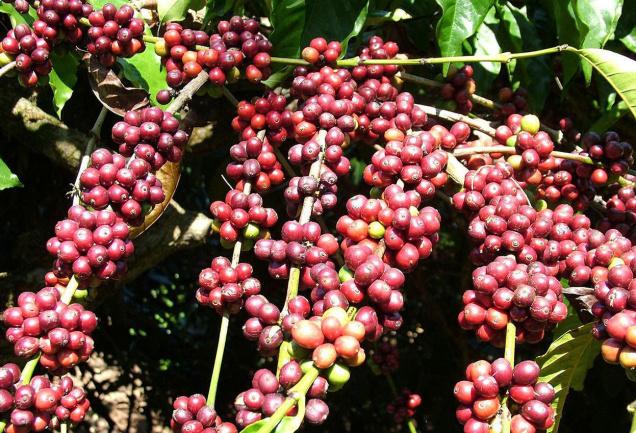
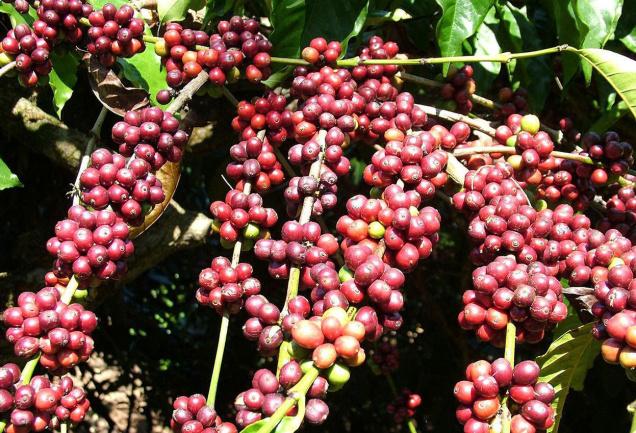
Bright outlook: Ripened coffee berries at a plantation in Karnataka. /.  (a file picture.) / The Hindu
Bright outlook: Ripened coffee berries at a plantation in Karnataka. /. (a file picture.) / The Hindu


Bangalore :

Coffee-growing regions of Kodagu, Chikmagalur and Hassan in Karnataka have received good blossom showers.

“Blossom shower in the coffee belt in Karnataka is very good this year. Very good for Arabica as compared to poor to patchy rains last year,” Bose Mandana, a senior coffee planter from Suntikoppa in Kodagu told Business Line.

MARCH SHOWERS

“Rain in February, especially during mid-harvest, was worrisome, but March shower has been heavy and this has made us comfortable for the next three to four weeks,” he added.

In Kodagu rains have been good in Napoklu zone comprising Murnad, Madikeri and Napoklu whereas Gonikoppal zone, which comprises Virajpet, Gonikoppal, Kutta and Balale, needs additional showers.

For robusta, south Kodagu got early showers in February and now has received moderate March showers.

In Chikmagalur and Hassan districts, March rains have been well distributed. “Due to timely showers and moisture status being good, many planters have begun applying manure in their estates. This year, they have been able to save on irrigation,” said Mandana.

According to Nishant Gurjer, Chairman, Karnataka Planters’ Association and a grower from Chikmagalur said “Early rains in February and subsequent rains in March have been good for overall crop production.”

“Rains in the last two months have been good for robusta. Stressed period for Arabica was cut short and there was initial apprehension among the growers over early rains. But March rains, however, have been beneficial,” he added.

Last crop year (2012-13), the Coffee Board had estimated the post-blossom estimate at 3,25,300 tonnes (arabica 1.04 tonnes and robusta at 2.21 tonnes).

As for the final crop forecast, the Board has estimated 3,15,500 tonnes, of which Arabica is 1,00,225 tonnes and robusta at 2,15,275 tonnes.

source: http://www.thehindu.com / The Hindu / Home> Industry> Agri-Biz / by Anil Urs anil.u@thehindu.co.in / Bangalore, March 15th, 2013

‘Coffee has not affected environment’

MuthannaKF29mar2013Coorg Wildlife Society president Col (retd) C P Muthanna said, coffee cultivation, which is considered as the lifeline of the people of Kodagu, has not harmed the environment in any way. No restrictions should be imposed on farming practices, which are being followed for more than a century, he said.

Speaking to presspersons here recently, he said, in the wake of opposition to Dr Madhav Gadgil committee recommendations, the Centre had constituted a committee headed by Kasturirangan. “Members of the society met Kasturirangan committee members recently and raised objections against a few recommendations made in the Madhav Gadgil report, he said.

“We will accept a few recommendations made by Gadgil on the need for conserving rivers, flora and fauna on the Western Ghats. However, the point that horticulture crops, especially coffee, affects bio-diversity badly is unaccepted. Coffee is being grown under huge trees in Kodagu. Along with coffee, growers also plant fruit bearing trees,” Muthanna said.

He said: “We are opposed to the recommendation on restriction on use of pesticides. Without the use of pesticides, coffee cannot be grown. There is a need to create awareness on the ill-effects of excessive use of pesticides and convince growers to go for alternative methods to save the plants. However, the recommendation that there should not be a single-crop pattern on private lands in Western Ghats region has created fear in the minds of the farmers.”

Muthanna said, the society will welcome the recommendation to declare Kodagu as an eco-sensitive zone. Conversion of agriculture land for other use should be banned. It should clearly mention that farmland and coffee plantations should not be used for non-agriculture activities.

“We welcome the recommendations of the committee on giving forest rights to forest dwellers as per Forest Rights Act. Instead of allowing the forest dwellers to reside inside the forest, they should be allowed to reside on the periphery of the forest. If they are allowed to reside inside the forest, the authorities will not be able to provide basic facilities to forest dwellers,” he said.

Society vice-president B A Poonaccha, secretary Shyama Appanna and others were present.

source: http://www.DeccanHerald.com / Home> Dsitrict / Madikeri, DHNS / March 28th, 2013

Karnataka coffee belt gets good blossom showers

coffeeKF16mar2013
Bright outlook: Ripened coffee berries at a plantation in Karnataka. (a file picture.)

March rains have been well distributed

Bangalore , MARCH 15:
Coffee-growing regions of Kodagu, Chikmagalur and Hassan in Karnataka have received good blossom showers.

“Blossom shower in the coffee belt in Karnataka is very good this year. Very good for Arabica as compared to poor to patchy rains last year,” Bose Mandana, a senior coffee planter from Suntikoppa in Kodagu told Business Line.

MARCH SHOWERS

“Rain in February, especially during mid-harvest, was worrisome, but March shower has been heavy and this has made us comfortable for the next three to four weeks,” he added.

In Kodagu rains have been good in Napoklu zone comprising Murnad, Madikeri and Napoklu whereas Gonikoppal zone, which comprises Virajpet, Gonikoppal, Kutta and Balale, needs additional showers.

For robusta, south Kodagu got early showers in February and now has received moderate March showers.

In Chikmagalur and Hassan districts, March rains have been well distributed. “Due to timely showers and moisture status being good, many planters have begun applying manure in their estates. This year, they have been able to save on irrigation,” said Mandana.

According to Nishant Gurjer, Chairman, Karnataka Planters’ Association and a grower from Chikmagalur said “Early rains in February and subsequent rains in March have been good for overall crop production.”

“Rains in the last two months have been good for robusta. Stressed period for Arabica was cut short and there was initial apprehension among the growers over early rains. But March rains, however, have been beneficial,” he added.

Last crop year (2012-13), the Coffee Board had estimated the post-blossom estimate at 3,25,300 tonnes (arabica 1.04 tonnes and robusta at 2.21 tonnes).

As for the final crop forecast, the Board has estimated 3,15,500 tonnes, of which Arabica is 1,00,225 tonnes and robusta at 2,15,275 tonnes.

anil.u@thehindu.co.in

source: http://www.thehindubusinessline.com / Home> Industry> Agri-Biz / by Anil Urs / Bangalore, March 15th, 2013

The right blend of coffee and tourism

Fascinating trails

Coffee lovers and those with wanderlust have something to rejoice over. Bangalore International Airport Limited (BIAL), in collaboration with the Ministry of Karnataka Tourism and Thomas Cook (India) Ltd, recently launched the Kaapi Trail, a tourism product which allows one to experience coffee in its homeland with a single click.

The trails will cover coffee regions like Coorg, Chikmagalur, BR Hills and Araku Valley and offer three types of tourism packages – heritage trail, wild trail and leisure trail.
Depending on the package chosen, travellers will visit coffee plantations, stay in carefully handpicked homestays, go for jeep safaris in the wild and on cycling tours and more importantly, experience the local culture, traditions and cuisine.

Interestingly, this project had its beginnings place last year itself, when the City airport was full of little kiosks selling different varieties of coffee for domestic and foreigners to get a taste of the South.

“Last year, the promotion began as a way of introducing people to the pleasures of coffee drinking and to strengthen the diversity of tourism attractions of the state. Trails like this have been successful world over. The Scotch trails, for example, combine scotch whiskey with the wonderful landscape of Scotland. This is our version of it with the common thread of coffee,” says Hari Marar, President, operations, BIAL.

For Jawaid Akhtar, chairman, Coffee Board, this move will make Bangalore the gateway to South India.

He points out the benefits of this trail – “This will not only increase the coffee grower’s income and the occupancy of the homestays in the coffee regions. But the microclimate in which Indian coffee is grown will be exposed to tourists,” he shares.

“We need to take this product to tour operators around the world and get it incorporated into brochures. This will ensure that tourists see it as a part of the Indian offering,” informs Madhavan Menon, managing director, Thomas Cook (India) Ltd. He adds, “We’re not trying to create a new genre of products but a new destination.”

In fact, this is the first time that tourism and coffee are coming together, and the convenience aspect of having a readymade travel plan is truly a big step forward.

“It’s great that this concept has germinated into a product. This is chance for Karnataka to show that coffee’s a way of life in this part of the world; it’s integrated in our culture. We live coffee, drink coffee and dream coffee,” wraps up Arvind Jadhav, additional chief secretary, Karnataka State Tourism.

source: http://www.DeccanHerald.com / Home> Supplements> Metrolife / DHNS / January 15th, 2013

Starbucks, Tata Coffee open roasting plant in Karnataka

US-based Starbucks Coffee Company and its Indian partner Tata Coffee today inaugurated a roasting and packaging plant in Karnataka that will cater to the domestic as well as select overseas markets in future.

“In a key partnership milestone between Starbucks Coffee Company and Tata Coffee Ltd, the two companies today inaugurated a roasting and packaging plant in Kushalnagar in Coorg, Karnataka,” the two firms said in a joint statement.

This facility will enable roasting and packaging of green coffee beans for Starbucks stores in India and select markets around the globe in future, it added.

Commenting on the development, Starbucks Coffee President (China and Asia Pacific) John Culver said: “This deepens our sourcing relationship with India’s coffee farmers and further demonstrates our long-term commitment to sourcing high quality arabica coffee.”

The facility is spread across 8,258 sq ft and has an installed production capacity of 375 MT. The plant has three major sections – green coffee storage and handling, roasting, and packing and dispatch.

“The plant leverages our combined strengths and passion for sharing the finest quality coffees with customers. This momentous occasion signifies a milestone development in our relationship with Starbucks as we roast and package our locally sourced espresso roast and prepare to export roasted and packaged coffees to select markets,” Tata Coffee Managing Director Hameed Huq said.

Earlier this week, Starbucks had said India will become one of its top five global markets in the long-term and will continue to expand aggressively here. It did not share any timeframe to achieve this target.

The company, which missed its target of opening 50 outlets in the country by 2012 at an investment of Rs 400 crore, however, remained non-committal on by when it would be able reach the milestone.

Tata Starbucks, the global coffee giant’s equal joint venture with Tata Global Beverages for the Indian market, has opened its 7th outlet in the country at Connaught Place here.

The JV had opened its first outlet in India in October 2012 in Mumbai, where it currently has four cafes. Last month, Tata Starbucks opened two more outlets at the Indira Gandhi International Airport here.

source: http://www.business-standard.com / Home> Companies> News / by Press Trust of India / New Delhi, February 08th, 2013

Local bean helps Starbucks serve cheaper cuppa


Mumbai , JAN. 29:
Next time you have Starbucks coffee in any of the neighbouring countries in South-East Asia, know that you are paying more than at home. Coffee prices at Starbucks in India are lower, thanks to its local sourcing arrangement with Tata Coffee.

“Starbucks prices in India are definitely lower than in Singapore and Malaysia. In fact, India is the only country where Starbucks is sourcing beans for its coffee chain. At the same time, the Starbucks experience in India can be compared to any of its outlets across the world,” said Meera Harish, Vice-President, Sales and Marketing, Tata Coffee.

Starbucks in India is at an advantage than in other countries where it has to import its coffees.

“There are cost advantages, as Starbucks can avoid freight charges involved in getting coffee from Europe or the US. The operating costs too are lower for Starbucks when it sources locally,” said Harish.

SOURCING DECISION

Sourcing coffee from India was not just based on Starbucks’ decision to forge a joint venture with Tata Global Beverages (the parent company of Tata Coffee).

“Starbucks was impressed by the quality of our coffee and Tata Coffee having Asia’s largest plantation. That is why Starbucks decided to source its coffee from us and also export it out of India,” claims Harish.

After its sourcing pact with Starbucks last year, Tata Coffee has also set up a new roastery at Kushalnagar in Madikeri district of Karnataka. The roastery can be scaled up depending on the demand from Starbucks. Tata Coffee is the country’s third largest exporter of instant coffee. But unlike Tata Global Beverages, which is a B2C player catering to the retail trade, Tata Coffee continues to remain a B2B company supplying to private labels across the world.

“Tata Coffee is basically a commodity player in the B2B segment and supplies to private labels. Today, our biggest global market is Russia followed by Japan. There are new challenges for the company as it would like to expand to new geographies,” said Meera Harish, who recently moved from Titan Industries within the Tata Group.

Purvita@thehindu.co.in

source: http://www.TheHinduBusinessLine.com / Home> Industry> Marketing / by Purvita Chatterjee / Mumbai, January 29th, 2013