Category Archives: Coffee, Kodagu (Coorg)

Starbucks Coffee takes giant strides in India along with Tata Beverages

Tata Global Beverages Limited and Starbucks Coffee Company have announced a joint venture — Tata Starbucks Limited.

This is one of the biggest joint ventures shared between the second-largest branded tea company in the world and the iconic international coffee brand.

The 50/50 joint venture will own and operate Starbucks cafés which will be branded as Starbucks Coffee “A Tata Alliance.”

The retail stores will be developed in cities across the country, starting with Delhi and
Mumbai, in the year 2012.

Through a separate coffee sourcing and roasting agreement, Starbucks and Tata Coffee Limited will work towards developing and improving the profile of India-grown Arabica coffees around the world by elevating the stature of Indian coffee through joint marketing efforts, as well as improving the quality of coffee through sustainable practices and advanced agronomy solutions.

Together, the JV will enable an expanded range of beverage offerings for Indian consumers. As a first step, the companies have agreed to jointly leverage assets and innovation to offer a premium tea product branded, Tata Tazo. The JV will operate cafés under the Quick Service Restaurant (QSR) category. This partnership will enable the introduction of the unique Starbucks Experience to Indian consumers.

“The joint venture with Starbucks is in line with Tata Global Beverages’ strategy of growing through the inorganic growth focussing on strategic alliances in addition to organic growth,” stated R K Krishnakumar, VC, Tata Global Beverages.

He added, “It opens up exciting business opportunities and new formats for Tata Global Beverages. Starbucks brings unique retail expertise as well as a shared sense of business values. We are excited about the opportunities the alliance presents to innovate in the retail space and bring new beverage experiences to more consumers in India, leveraging the global in-home expertise of Tata Global Beverages and the global out-of-home expertise of Starbucks.”

Through an initial financial commitment, Starbucks will work with Tata to support ‘Swastha’, a school for children with special needs (in partnership with the Coorg Foundation) and aim to increase its capacity and outreach into the rural communities in the coffee-growing region of Karnataka. Tata Coffee and Starbucks also plan to work together on initiatives including the promotion of responsible agronomy practices and the provision of training local farmers, technicians and agronomists to improve their coffee-growing and milling skills, along with exploring community projects which could positively impact the communities in the coffee-growing regions where Tata is active.

source: http://www.fnbnews.com / Top News/ our Bureau, Bangalore / Thursday, February 02nd, 2012

Tata Global Beverages Forms JV With Starbucks Group

Tata Global Beverages Limited through its subsidiary, Tata Coffee Limited has formed 50:50 JV – Tata Starbucks Limited with Starbucks group.

The first cafe will open by August-September and will be named – Starbucks Coffee – A Tata Alliance. The JV plans to open 50 outlets in the initial phase, beginning with Mumbai and Delhi and expand into other cities and Tier-II towns. The initial investment will be R400Cr ($80Mn).

Luthra & Luthra Law Offices advised Tata for the deal.

According to MOU, Starbucks will set up stores in the Tata group’s retail outlets and hotels, besides sourcing and roasting coffee beans from Tata Coffee’s Kodagu facility.

Starbucks, which runs over 16,000 stores worldwide, has been in talks with the Future Group, Reliance and Jubilant for an entry into India, but none of those discussions fructified.

Headquartered in Seattle, Starbucks operates in more than 50 countries. It has been sourcing coffee beans from India for the last seven years. Starbucks sells a wide variety of coffee and tea products with a range of complementary food items, primarily through retail stores.

Tata Global Beverages Limited engages in the development, marketing, and distribution of tea products. Tata Coffee Limited engages in growing, curing, manufacturing, marketing, retailing, and exporting coffee and tea in India and internationally.

The company produces more than 10,000 MT of shade grown Arabica and Robusta coffees at its 19 estates in South India and its two Instant Coffee manufacturing facilities have a combined installed capacity of 6000 metric tones.

It exports green coffee to countries in Europe, Asia, Middle East and North America. In 2006, Tata Coffee acquired Eight ‘O Clock Coffee Co., a segment leader in the US coffee retail market for US$ 220 million.

Last August, Tata Global acquired 31% stake in US-based Rising Beverages, which is known for vitamin water based products. It had also signed a MoU with Kerala Ayurveda to form a joint venture for product development.

In 2010, the company formed a joint venture firm with Pepsico – NourishCo Beverages, to produce non- carbonated ready to drink beverages.

In this segment major players include Barista (200 outlets), Cafe Coffee Day (1,040 outlets) and Costa Coffee and others (100).

source: http://www.dealcurry.com / Home> Category: Mergers & Acquisitions> Industry: Agro/ Food & Beverage / by Charmi Gutka/ January 31st, 2012

Nescafe plan: Going beyond the Cup

New Delhi, JAN. 5:
Nestlé India has rolled out the India leg of its global Nescafe Plan by setting up a coffee demonstration farm and training centre in Kodagu district, Karnataka.

Nescafe Plan is the Swiss MNC’s ambitious global initiative to bring under one umbrella coffee farming, production and consumption activities — one that it says will “help it optimise its coffee supply chain.” In 2010, when the world’s biggest coffee buyer had unveiled the Plan, it had announced an investment of CHF 500 million (Rs 2,811 crore).

Mr Jawaid Akhtar, Chairman, Coffee Board of India, inaugurated the coffee demonstration farm at Bindhu Estate, Kodagu.
Nestle will be training farmers in using technology and best practices for sustainable production of high quality coffee.

Mr Antonio Helio Waszyk, Chairman & Managing Director, Nestlé India, said, “In the Nescafe Plan, our team will work with coffee farmers as well as other experts and the Nestlé R&D Centre in France to combine the traditional wisdom amongst the coffee farmers in India with the benefits of modern science to make coffee farming more successful and sustainable.”

Nestlé, which purchases 10 per cent of the world’s supply of green coffee every year, had launched the Nescafe Plan in 2010 in Mexico. Under the Plan, the Swiss MNC had said it would double the amount of coffee it sources from farmers directly to 180,000 tonnes in the next five years.

The idea in India, it says, is also to improve penetration of its instant coffee brand Nescafe amongst consumers and expand the market.

Mr Nandu Nandkishore, Nestlé Executive Vice-President and Zone Director for Asia, Oceania, Africa and West Asia , said, “By working with farmers in this way, we know where the coffee comes from, and they know they have a partner who will give them competitive prices for high quality produce.”

chitra.n@thehindu.co.in

source: http://www.thehindubusinessline.com / Industry & Economy / Our Bureau / New Delhi/ New Delhi, January 05th, 2012

Bean Brigade

In the film Casablanca, coffee is one of the things that Ingrid Bergman professes to miss the most about the city of Casablanca. Benjamin Franklin considered coffee to be one of the most valuable luxuries on the table. Black or frothy, sweet or bitter, this steaming cup has been the centre of numerous conversations, meetings and banters.

From being a traditional beverage consumed in South India, coffee has evolved into a trendy cuppa with a national presence. Keen to tap the widespread opportunities, the coffee industry in association with the Coffee Board of India will be hosting the three-day India International Coffee Festival 2012 in Delhi.

The fourth edition of the IICF will bring together the coffee fraternity. The last three editions were held in Bengaluru. “The festival will provide an opportunity for the industry to unveil outstanding coffees and blends, apart from showcasing products associated with the coffee industry,” says Anil Bhandari, president, India Coffee Trust, and member of the Coffee Board of India.
Apart from the exhibitors, workshops with coffee professionals at the IICF will aim at providing an interactive experience that deals with various aspects associated with coffee, from roasting to espresso-making and filter coffee brewing among others.

The IICF 2012 will be held from January 18 to 20 at The Lalit.

source: http://www.IndianExpress.com / Express Features Service/ Thursday, January 05th, 2012

Instant coffee exports surge on demand from Russia, East Europe

New Delhi, JAN. 2:

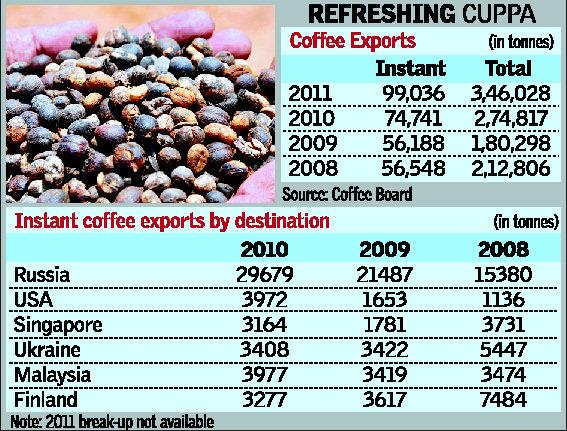
India’s instant or soluble coffee exports have surged by about three-fourths in the past three years on rising demand from the Russian Federation, Eastern Europe, South East Asia and the US. This is mainly on account of consumers in recession-affected Russia and Eastern Europe switching over to cheaper varieties of instant coffee, mainly white or private labels from the branded ones, to cut costs.

The Russian Federation is the largest market and accounts for a third of Indian instant coffees exports. Indian coffee is sold in bulk mainly to private labels in Russia and Eastern Europe. Companies, such as CCL Products (India) Ltd and Tata Coffee Ltd, are major exporters of the instant variety to these countries.

EXPORT PERMITS

For calendar 2011, the export permits for instant coffee issued by the Coffee Board till December-end marginally fell short of the one lakh tonne mark. Total coffee exports registered a 20 per cent growth in quantum to 3.46 lakh tonnes in calendar 2011, over 2010. In rupee value terms, exports grew 63 per cent to Rs 4,859 crore for 2011 over the previous year, while in dollar terms, they were up 65 per cent at $1.05 billion.

“There is a lot of demand for the low-priced instant varieties in Russia, East Europe and Asia,” said Mr Ramesh Rajah, President, Coffee Exporters Association. “Indian companies have been aggressive in pricing their products, which has helped them expand their reach in these markets,” he added

Indian firms import a lot of low-priced raw coffee, mainly the Robusta variety from Vietnam and East Africa to re-export them after converting them into instant coffee. The import of raw coffee for re-exports has shown 18 per cent growth in 2011 at 53,440 tonnes over the previous year. Besides, capacity addition by NKG Jayanti and Vayhan Coffee in recent years has aided the exports, he added.

MARKET SHARE

However, the challenge for Indian firms is to retain their share in these markets as competition grows from Brazil and Ecquador. “With rising costs, the Indian companies will have to fight hard to maintain current level. If they manage to retain their market share, it will be a fantastic achievement,” Mr Rajah said.

India’s instant coffee exports to Russia have close to doubled in the past three years, whereas these have more than trebled to the US.

However, in markets such as Ukraine and Finland, the Indian exports have come down in recent years.

vishwa@thehindu.co.in

source: http://www.TheHinduBusinessLine.com / Agri-Biz / by Vishwanath Kulkarni / New Delhi, January 02nd, 2012

Getting The Brew Right

The Tata Coffee chief gets the brew right to claim the No. 2 title
RANK 2 (MID SIZE COMPANIES)

RANK:2(MID-SIZE COMPANIES)
HAMEED HUQ, MANAGING DIRECTOR, TATA COFFEE (Jagadeesh NV)

On a cool November Sunday morning, a threesome waits to tee off on the first hole at the Karnataka Golf Association course in Bangalore. Hameed Huq is convincing one of his partners, a tea drinker, to shift to coffee: the one his company makes. The 60-year-old, Assam-born managing director (MD) of Tata Coffee has spent 35 years in the coffee business. Coffee is a passion, though he admits to drinking just 3-4 cups a day. He is also a Tata Group lifer; the past 13 in Tata Coffee. “For 10 years, growth stagnated,” says Huq. “It is a commodity business, where revenues and growth are volatile.” Tata Coffee is a B2B coffee business — branded coffees are owned by Tata Global Beverages — and subject to the vagaries of the commodity cycle. When he took over as MD in 2007, the company’s revenues from the plantation business were Rs 250 crore. Production cycles were unstable, and quality was not the greatest. His first steps: stabilising the cycle, improving quality and entering the market for specialty, gourmet coffee.

“Our buyers are mostly in the US, though the former Soviet Union countries are a big export market,” he says. His clients include Costa Coffee, Starbucks and Atlantic Coffee. As environmental sustainability is a big factor in developed country markets, green coffee is an area Huq has directed the company to get into; margins are anywhere between 6 and 20 per cent, he says. He is a great believer in technology too. That is only natural; he has studied the processes in Colombia, the world’s biggest coffee exporter.

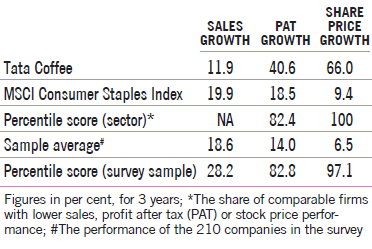
So how did his firm manage to do so well? “How do you drive a commodity business that has no consumer brand?” he asks. “You take out the volatility.” Tata Coffee, which has about 8,000 employees, bought Eight O’ Clock Coffee, the third-largest whole-bean coffee firm by volume in the US. The move has been good for the bottom line, besides giving Tata Coffee a foothold in the US, which contributes about Rs 800 crore in revenues annually. The other Rs 500 crore coming from domestic sales. Whatever Huq has done, it appears to have worked. Sales have grown three times since 2007 and the company’s market cap has grown five times.

The immediate future, however, looks a little grim. Revenues are sluggish, due to the 2008 crisis. Sales in the former Soviet Union countries do not provide high margins. “People are a problem,” adds Huq. “We still need workers, and too many are migrating out of plantations.” Tata Coffee is investing in its workers. For instance, it is ensuring that the living standards of workers and their families are at a level comparable with workers in developed countries. The next three years will be difficult. Recovery from 2008 is likely to be slow and long. If there is a 2011 European crisis, it might be longer. Huq may need to drink more than his 3-4 cups a day, and the coffee will have to be stronger.

(This story was published in Businessworld Issue Dated 26-12-2011)
source: http://www.businessworld.in / Home> Business> Corporate / by Srikanth Srinivas / December 17th, 2011

Coffee Board partners BIAL to promote S. Indian coffees

BANGALORE, DEC. 5:

Bean display: Representatives from coffee regions – Araku Valley, Bababudangiri , B R Hills, Chikmagalur, Kodagu, Nilgiris, Sheveroy Hills, Travancore and Nelliyampathy and Pulneys.

To increase local consumption and for showcasing coffees from South India, the Coffee Board has partnered Bangalore International Airport Ltd and the Karnataka Tourism Department.

As part of the promotion, coffees from Araku Valley, Bababudangiri , B.R. Hills, Chikmagalur, Coorg, Nilgiris, Sheveroy Hills, Travancore, Nelliyampathy and Pulneys are being showcased.

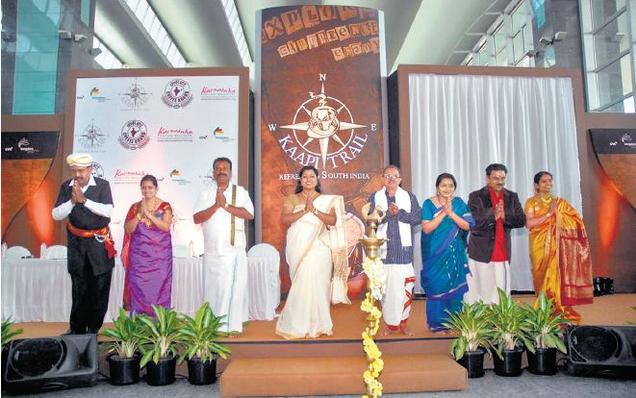
For the first time coffees from various regions are being displayed as part of a 10-day coffee festival, Kaapi Trial, at the Bangalore International Airport. The event will give passengers an opportunity to interact with coffee experts and experience live coffee-making demonstrations and cupping.

According to Mr Jawaid Akhtar, Chairman, Coffee Board, “The festival will help enhance and promote knowledge of the region and coffee-drinking habit of the State that is core to its heritage.”

“As part of the promotion, the coffees, specially selected from the regions, have been carefully blended and brewed to extract their best flavour.

Special blends will be created to give a different coffee experience,” he added.

“This is for the first time that an Indian airport is hosting a coffee festival of this magnitude. The 10-day long extravaganza will exhibit different facets of South Indian coffees, giving passengers an opportunity to explore in a unique way,” said Mr Sanjay Reddy, Managing Director, Bangalore International Airport Ltd.

“We believe that efforts such as these will go a long way in establishing Bangalore as a gateway to the South of India and bring economic prosperity to this region.

By the end of the festival, we hope to engage with over two lakh passengers and make them coffee experts,” he added.”

source: http://www.thehindubusinessline.com / Agri-Biz / by Anil Urs / December 05th, 2011

‘Nature walk in coffee land’ reaches Madikeri

Madikeri, Dec 4, DHNS:

The ‘nature walk in coffee land’ organised to create awareness on environment from Bababudangiri reached Madikeri on Sunday.

The jatha was led by Krishnamurthy Pushpanath. The jatha reached Sampigekatte at 9.30 am.

The jatha was welcomed by skating children with flowers. District Congress Committee President B T Pradeep, Jaya Karnataka district president Rabin Kuttappa, Kodagu Growers Federation member B T Dinesh, Madhu Bopanna and others were present.

The jatha passed through Gandhi Maidan in Madikeri. After garlanding the statue of Gandhi, Krishnamurthy said, “There is a need to protect Western Ghats and Malnad to check global warming. It is our duty to protect Western Ghats.

There is a need to create awareness among the public on the need to protect Western Ghats from destruction. With the global warming, there has been increase in temperature by one or two degree every year. The increase in temperature will affect coffee. If this continued, then coffee plants may not survive by 2030.”

Kodagu Growers Federation’s Dr Pradeep said “the coffee plantations absorb carbon dioxide. Hence, the coffee growers are protecting the nature. The Centre should support the coffee growers.” The jatha left for Bhagamandala from Madikeri.

source: http://www.deccanherald.com / Home> District / Monday, December 05th, 2011

Upasi annual meet delayed, but sees many youngsters taking part

COONOOR: Oct 23rd
Ministers give it a miss at the last minute

The Annual Plantation Conference hosted by the apex association in the South – The United Planters Association of Southern India (Upasi) appears to be losing its sheen in recent years.

Union Ministers, who have confirmed participation, have in the last 4-5 years given the event a go at the last minute leaving Upasi to find either a local Member of Parliament or the Chairperson of one of the commodity boards stand-in to inaugurate the conference.

This year, the association postponed the event by more than a month to October 23 and 24, hoping to get the Union Commerce Minister, Mr Anand Sharma, participate in this annual conference.

People in the know of developments say that for the first time in the history of Upasi has the conference been postponed by over a month. (It has for the last four-five decades been conducting the event by mid-September as a ritual).

When this did not materialise, the association sought time from the Union Minister for Rural Development, Mr Jairam Ramesh, and the Minister for Labour and Employment, Mr Mallikarjun Kharge. Though Mr Jairam Ramesh had confirmed his programme, it is learnt that he could not make it at the last minute.

The postponement of the conference, it now appears has not brought about the desired effect.

The association even departed from its usual format of arranging the commodity outlook session a day-ahead of the annual conference.

Over dependence on the elected representatives and ministers, missing schedule-deadline in the conduct of the annual meet seems to have taken its toll on the attendance at this year’s meet with more than half the members giving it a miss.

YOUNG MINDS

A visible, yet welcome change was the presence of plantation owners’ children taking part in all the deliberations this year, eagerly listening to the older generation.

Mr M.D. Balakrishna, former Upasi President (1988-89) and a coffee planter from Chikmagalur, said, “Earlier, the meets were orderly, for the corporate brought their professional work culture in managing the events and organising them. The annual meets used to be held much early, before the crop year commenced. Now only few corporates are in the sector; many have withdrawn. With their absence, the onus is on the plantation owners and few service providers to managing the meets annually.”

Plantation owners have two issues on hand – manage the trade body and manage their estate besides coping with the changing national and global policies. This has delayed the younger generations to actively involve on both platforms.

Many plantation owners’ children do work in different industries such as banking, managing cafes or at different value chain of commodity processing before going back to managing their estates. This has also delayed them to take a plunge in serving the trade bodies.

Talking about the diverse talent younger generation is bringing to the trade bodies, Mr Marvin Rodrigues, Vice-Chairman, Karnataka Planters’ Association (KPA) and a planter from Hassan, said, “youngsters are coming back to the plantation sector after having worked at industries. For me, managing labour shortages on the estate has taught me good HR skills.”

Mr Bose Mandana, former Vice-Chairman of the Coffee Board and a coffee planter from Kodagu, said: “We have come long way to reach a stage in managing our trade bodies ourselves. When total export controls were in place, we had limited or no role to play in marketing the produce. Now, we are free to manage, but problems are plenty.”

source: http://www.thehindubusinessline.com / L.N. Revathy > Anil Urs / October 23rd

Coffee Board to conduct study on consumption pattern

. BANGALORE, OCT. 14:

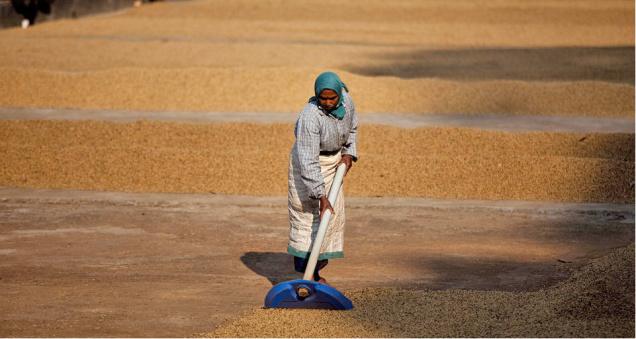
Market research: A labourer dries coffee beans in a field in Coorg, Karnataka. The Coffee Board has invited proposals from market research agencies to carry out a study this year on coffee consumption and attitude to coffee drinking.

The Coffee Board, with a view to capturing the fast changing demographics of coffee drinking in the country, is initiating a study ‘Coffee Consumption and Attitude to Coffee Drinking’.

“The board is planning to carry out a detailed market study with a help of reputed market research agency to understand the patterns of domestic consumption and the attitudes towards coffee consumption,” said a senior Coffee Board official.

“The proposed study titled ‘India coffee market study-2011′ is mainly to capture the key areas of consumption patterns in both urban and rural India with a deliverables of penetration, volumes consumed, and variety of coffee consumed, share of throat, socio-economic groups, awareness of additives,” he said.

As a step towards this, the board has invited proposals from reputed market research agencies to carry out the study this year.

Through the study, the board is expected to collect information from the instant coffee manufacturers, café chains and their growth pattern, roasters and retail segment.

The study comes in the light of increasing domestic consumption. According to the Coffee Board data, country’s coffee production for crop year 2010-11 stood at 302,000 tonnes and provisional domestic consumption for 2010 is estimated at 108,000 tonnes.

The official said: “This year along with other routine market data study, the image of the beverage in the minds of consumers with respect to quality, variety, price, additives, awareness of additives such as chicory, positive and negative associations related to consumption as well as drivers and barriers to coffee consumption is also to be captured.”

The Coffee Board has been conducting such studies since 2001 when it hired Brazilian coffee marketing consultant Carlos Brando to boost domestic consumption and its outcomes have been shaping domestic strategies, especially in non-coffee market areas.

source: http://www.thehindubusinessline.com / agri-biz / by Anil Urs / October 14th, 2011