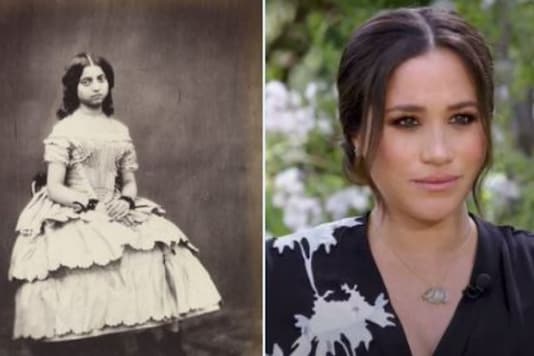
Dr Priya Atwal, a historian, took to Twitter and spoke about the little-known life of Princess Gouramma of Coorg who was adopted by Queen Victoria as one of her godchildren.
The history of Princess Gourumma of Coorg was shared on Twitter by Dr Priya Atwal.
While Meghan Markel’s revelations into the British Royal family has once again triggered the debate of race in UK, a historian from India has claimed that Meghan is probably not the first woman of colour to be a part of the monarch family. While there is mention of Queen Charlotte’s (1744-1818) black ancestry, Queen Voctoria had her imperial godchildren too, according to the Victorian historian. Dr Priya Atwal took to Twitter amid raging debate about Meghan’s acceptance in the Royal family and spoke about the little-known life of Princess Gouramma of Coorg.
“Princess Gouramma (1841-64) was brought to Britain in 1852 by her father, the deposed Rajah of Coorg. The Rajah campaigned to win back his family wealth from the East India Company, but also asked Victoria to adopt his daughter, believing the Queen would give her a good life (sic),” Atwal wrote. It was Princess Gouramma’s father, Rajah of Coorg, who offered her to the Queen after baptising her with the hope that she would be brought up with “aristocratic guardians and secure her a good marriage”. Victoria readily accepted the idea and adopted Princess Gouramma. But princess of Coorg wasn’t the only one. Queen Victoria had several ‘godchildren’ whom she adopted from royals from the empire.
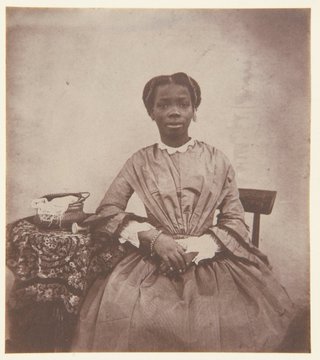
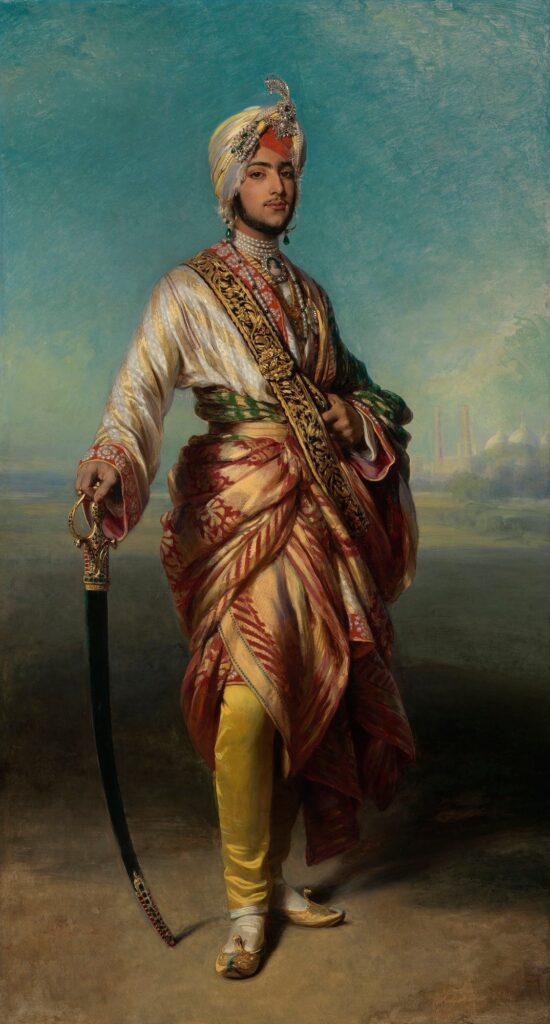
Duleep Singh and Sarah Bonetta Forbes were among these godchildren of the Queen.
_______
Dr Priya Atwal@priyaatwalAs a historian of Victorian royalty, I am fascinated by some of the parallels between #MeghanMarkle’s current situation and the little known story of Princess Gouramma of Coorg. A thread
1/12
_________-
But facing racial attacks never stopped for the Queen’s godchildren even after being adopted. Atwal says their lives weren’t easy. Duldeep and Sarah ‘were both feted and treated as racialised others in Victorian Britain’. “And their lives were pored over in a newly-emerging popular press,” Atwal writes. “As I’ve found in my research, for her it was a good way to learn about her new territories and project a benevolent image of her family.”
_______
Dr Priya Atwal@priyaatwal·The Hindu Rajah offered up Gouramma to be baptised as a Christian & hoped Victoria would bring her up as an adopted daughter with aristocratic guardians and secure her a good marriage. Incredibly, Victoria was keen about the idea & readily agreed. 4/12
Victoria took multiple young royals from around the empire as wards/godchildren – inc. Duleep Singh & Sarah Bonetta Forbes. As I’ve found in my research, for her it was a good way to learn about her new territories & project a benevolent image of her family. 5/12
_________
Gouramma faced a different struggle. She was pressured to become the model Anglicised princess. Even though the Queen had accepted her into the family, she had banned Gouramma from maintaining any contact with her family. The curtailment of ties again had racial undertones. According to Atwal, this was supposedly to prevent her from slipping into “native” or “heathen ways”. “She was moved from foster family to family as her caretakers struggled with the cost and demands of raising a royal ward.” The struggle of a new life was too much for the young princess who even tried to run away many times. It was the unwanted attention and being under scrutiny all the time that added to her woes. “In this I find her parallels with Meghan most intriguing: Gouramma often spoke of dearly wishing for more privacy & living independently – even to become a household maid – so she could be free of scrutiny. Yet her actions were attributed to her “innate Oriental weakness (sic),” Atwal writes.
Meghan too has spoken about the unwanted attention from media that has deprived her of any privacy in personal life. Meghan, who married Prince Harry in 2018, said she told the royal family she was struggling and needed professional help but was told “that I couldn’t, that it wouldn’t be good for the institution.” She even suggested that the Buckingham Palace was “perpetuating falsehoods” about her and Prince Harry. Asked by Winfrey how she felt about the Palace hearing her speak out, Markle replied: “I don’t know how they could expect that after all of this time we would still just be silent if there’s an active role that The Firm is playing in perpetuating falsehoods about us.”
By Prof. A.V. Narasimha Murthy, former Head, Department of Ancient History & Archaeology, University of Mysore
Mahatma Gandhi was always impressed by Kodavas who are hard-working and play a major role in protecting India’s borders. In fact, there are many Kodavas who held and still hold top positions in Defence Forces like the Chief of Army Staff.
Here we recall Gandhiji’s visit to Kodagu. He was camping at Madras (now Chennai). There was a rumour that Gandhiji would visit Bangalore and Mysore. At that time, Pandiyanda I. Belliappa (people lovingly called him ‘Gandhi’ later due to the Mahatma’s visit to his house) was a prominent Congress leader and he was also bringing out a newspaper called Kodagu. He requested Gandhiji to sanctify Kodagu by his visit.
Gandhiji agreed and along with Veeranna Gowda Patil who was the Chairman of Harijana Sangha and others arrived at Gonikoppal on the evening of 22.2.1934. Immediately, he expressed a desire to visit Harijanakeri (where Harijans live). Gandhiji visited Kaikeri, a small village near Gonikoppal. His first programme was to visit the houses of Harijans where more women had gathered than men and Gandhiji spoke for a short while.
The women gathered there collected Rs.25 among themselves and gave it to Gandhiji. He had been garlanded and those garlands were auctioned which fetched Rs. 3. During that time, there was an earthquake in Bihar and Gandhiji spoke about the agony of people and requested contribution, however small it may be and the women immediately gave away their gold ornaments.
From there, Gandhiji went to Ponnampet and visited Sharada Ashram (Sri Ramakrishna Ashram) and collected Rs. 22 and one ana. From there he went to Thithimathi and collected Rs. 39. Then he went to Hudikeri and addressed a gathering of 800 persons. Chendira Thammayya, who was the President of Taluk Board, welcomed Gandhiji and collected Rs. 72 and 13 anas and gave it to Gandhiji.
Local school students collected Rs. 2 and one ana. From there Gandhiji returned to Ponnampet and again visited Sri Ramakrishna Ashram where he was welcomed by Shambavanandaji. Gandhiji established Harijan Welfare Sangha and he was given a fund of Rs. 220.
While addressing the gathering there, he said that he could not think of living without Dharma. “My Dharma depends upon the support given by men and women who are equal partners. Here, caste should not make its entry at any cost. Dharma means coming closer to God and whatsoever we do should be dedicated to God and this should be nothing but like the clean air we breathe in,” he said.
From there, Gandhiji went to Virajpet where a Muslim leader spoke from the dais in Urdu language. This brought great joy to Gandhiji. He said Hindus and Muslims should live in harmony.
He went to Basavanahalli in Somwarpet and on his way he camped at Siddapura where he was given a donation of Rs. 7. From there he went to the house of coffee-planter Manjunathayya where women donated their ornaments. One woman gave her jewels in the presence of her husband. Gandhiji asked this husband,“What do you say about this donation?” He replied that the ornaments belong to his wife and she is free to use it in whatever manner she wants.
Gandhiji felt happy and asked that man his age and thirty years was his reply. Gandhiji said, “At your age I was not a wise man as you are. Wisdom came to me later.” Everybody burst into laughter. In his short speech, Gandhiji asked them to work hard and make Kodagu prosperous.
Later, Gandhiji went to Madikeri and reached near Raja’s Seat. Over 4,000 persons had gathered there and gave a donation of Rs.760. Gandhiji was given a donation of Rs.82 for Bihar earthquake victims.
He said, “Though travel to Kodagu was tiresome, I am enticed by the natural beauty. Another thing which has given me satisfaction is that there is no untouchability in Kodagu. But Harijans are losing precious land and this should not happen hereafter.”
That night Gandhiji stayed at Madikeri in the house of C.P. Nanjappa. Nanjappa’s wife donated a silver cup and a saucer while Nanjappa donated a gold necklace. The tea-tray made of wood was auctioned and it fetched Rs. 9. In Nanjappa’s house a prayer meeting was held and I.C. Subbayya announced that Rs.2,000 has been given as donation.
Gandhiji stayed that night in Subbayya’s house. He woke up at 2.45 am and wrote letters to Manilal and Susheela. The letter contained a short note — “Tonight we are in Kodagu. It is a small place and its population is 150 thousand. Tomorrow by about six, we descend down and go to Mangalore.”
Meanwhile, some prominent Congress leaders wanted to discuss some political developments in Kodagu. Gandhiji did not permit them and said “I am happy here because there is no untouchability. I have come here to see the activities of Harijans.”
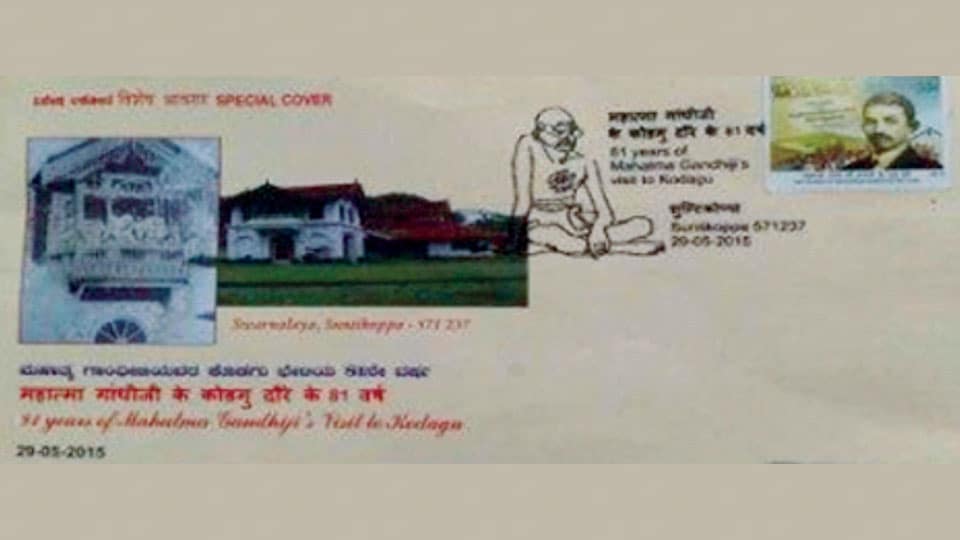
Gandhiji’s visit to Kodagu is special and was worthy of remembrance. This incident had happened about 86 years ago. To commemorate Mahatma Gandhi’s visit, a postal cover was released on May 29, 2015.
source: http://www.starofmysore.com / Star of Mysore / Home> Columns / by Prof. A.V. Narasimha Murthy, former Head, Department of Ancient History & Archaeology, University of Mysore / January 16th, 2021
The two major ethnic groups of Kodagu, Kodavas and Arebhashe Gowdas, are like kith and kin and have contributed immensely for Kodagu land, opined Rangayana Director Addanda C. Cariappa.
He was speaking on the occasion of staging of Arebhashe play ‘Sahebru Bandavre!!!’, organised by Karnataka Arebhashe Samskruthi-Sahitya Academy in association with Rangayana Mysuru at Kiru Rangamandira, Rangayana here, yesterday.
“When I took charge as Director here, during Bahuroopi Theatre Festival, it was a feast to watch Kodavas and Arebhashe Gowdas dancing in their traditional attire. Now, Arebhashe play is being staged here in Rangayana. I would like people to come in large numbers to watch and support Kodava, Tulu and Kannada plays,” he said.
“By just stopping speaking a particular language, one can effectively kill a particular section of populace and their unique culture. If you stop speaking Arebhashe language, there will not be Arebhashe Gowdas. Similarly, Kodavas cannot survive without Kodava language and Kannadigas without Kannada,” he added.
Virajpet MLA K.G. Bopaiah, President of Kodagu Gowda Samaja Thontabailu Manohar and Academy Chairman Lakshminarayana Kajegadde, Rangayana Jt. Director V.N. Mallikarjunaswamy and others were present on the occasion.
source: http://www.starofmysore.com / Star of Mysore / Home> News / January 16th, 2020
The 10th Annual Codava National Council (CNC) Thok Namme (Gun Carnival) will be held Dec. 18 at 10.30 am at Kolakeri in Napoklu to mark “World Minorities Rights Day.”
Gun is a part and parcel of Kodavas and to showcase the valour and rich folkloric cultural heritage of the community. The Thok Namme is scheduled to be held at Cauvery Estate of Appachira Rammi Nanaiah in Kolakeri.
All participants are requested to carry their guns to the ceremony. This programme is intended to showcase warrior-hood tribal traits of the community. As pet the schedule, a mass worship of guns will be performed on the banks of River Cauvery. The ritual will be led by CNC President N.U. Nachappa, followed by Thok Paat (folkloric weapon prayer).
Later, a shooting competition for men, women and children will be held followed by a public meeting. Prize distribution will be held and traditional Kodava food will be served to all participants.
Gun right, a clarification
In the wake of Kodagu Deputy Commissioner Annies Kanmani Joy issuing orders to all gun holders in Kodagu to surrender the same due to the forthcoming Gram Panchayat elections, the CNC has clarified that gun licence is different and gun exemption is different.
During elections, under the directions from the Election Commission of India, all District administrations, Collectorates and Commissionerates will issue orders to all gun licence holders to surrender their weapons by depositing it in the nearest Police Station till the completion of election process to facilitate smooth electoral exercise as well as to maintain peace and tranquillity. “This order will not and does not apply to a Kodava community member as the community is exempted from Indian Arms Act to possess firearms or guns. This was clarified in 1994 during the period of Chief Election Commissioner of India T.N. Sheshan who reformed India’s electoral system.
Sheshan made it clear that the exemption certificate holders and also those who consider weapons as sacred and gun as an article of worship, this order of depositing the guns during elections will not apply, the CNC stated.
source: http://www.starofmysore.com / Star of Mysore / Home> News / December 12th, 2020
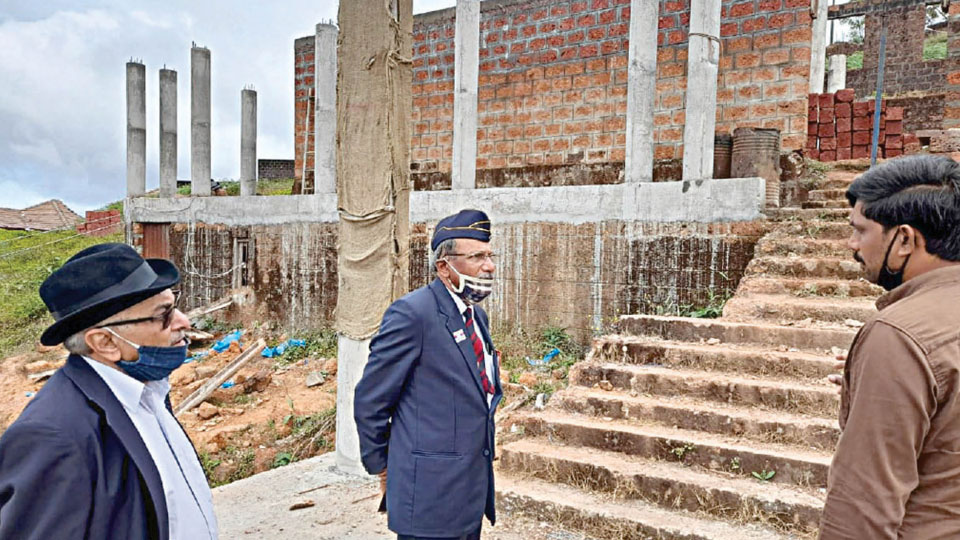
With the works on Kodava Heritage Centre near Vidyanagar on the outskirts of Madikeri having resumed recently, Madikeri Kodava Samaja President Konganda S. Devaiah and Field Marshal K.M. Cariappa – General K.S. Thimayya Forum Convenor Col. Kandrathanda C. Subbaiah visited the site on Monday and inspected the ongoing works.
The two received inputs on the design of structures coming up at the site, the architectural outlook of Ainmane and the nature of works in progress.
The contractor said that the works have been taken up at a cost of Rs.1.56 crore and the collapsed walls of structures are being rebuilt.
Pointing out that red stone pillars, which do not have the capacity to bear the roof load are being replaced with concrete pillars following directions from the PWD, the contractor said the roof for Ainmane is being designed with the concept of Mundmane. Also the repair works of steps leading to the overhead tank is underway and a View Point is being built atop the water tank. The View Point will have iron canopy instead of jungle wood roof-cover as it was found that the iron cover was better considering the geographical location of the site.
Continuing, the contractor said that the Heritage Centre will have two Ainmanes, with the first one being built now and the other later. The PWD has give nine months time to complete the works, the contractor said and added that he was hopeful of completing the works by March 2021 itself.
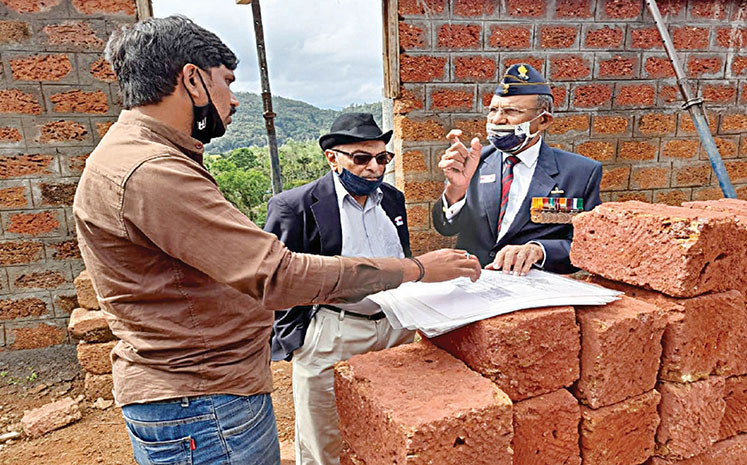
After receiving inputs from the contractor K.S. Devaiah and Col. Subbaiah went through the blueprint of the project and took note of the roof design, amphitheatre, View Point, Mundmane, water pond and other features. Devaiah asked the contractor to build the structure strictly in accordance with the characteristics of Ainmane and to maintain quality in works.
Col. Subbaiah asked the contractor to get a blueprint of the complete project from private agencies. Asking the contractor not to deviate from Kodava customs and traditions in the construction of structures, he said that the contractor too must have the self-satisfaction of having executed quality works.
Speaking to Mysooru Mithra, the sister publication of Star of Mysore, Col. Subbaiah said that he inspected the works and interacted with the contractor.
Noting that more inputs on the project will be sought from PWD and Tourism Department officials following which the project will be discussed in detail with Kodagu Deputy Commissioner (DC), he said that he will hold talks with Kodagu District In-charge Minister too later. Thereafter, the DC will be appealed to convene a meeting of officials of all concerned departments and efforts will be made to ensure that all works on Kodava Heritage Centre are wholly completed, he added.
source: http://www.starofmysore.com / Star of Mysore / Home> News / December 08th, 2020
Nammuru Nammoru Samaja Seva Trust, Mysuru, observed Martyred Freedom Fighter SubedarGuddemane Appaiah Gowda Memorial Day at an event held at Jaladarshini Guest House recently.
Veteran writer Dr. C.P. Krishnakumar (CPK) inaugurated the programme by showering petals on the portrait of Appaiah Gowda.
Speaking on the occasion, CPK said that the year 1857 is a very significant year in the history of freedom struggle. Pointing out that the 1857 Sepoy Mutiny was the first major battle in the fight for the country’s independence from the Britishers, he said that we have read about great freedom warriors such as Mangal Pandey and Tatya Tope who laid down their lives.
Noting that the first independence revolution took place in 1837, 20 years before the sepoy mutiny of 1857, the veteran writer said that many great freedom fighters such as Tipu Sultan, Rani Chennamma, Sangolli Rayanna, Parampara of Kodagu, Kalyanaswamy, Guddemane Appaiah Gowda, Kedambadi Ramegowda and Kudiya brothers had laid down their lives much earlier fighting the Britishers.
Recalling that the people of Kodagu revolted when the Britishers divided the then Coorg State into Kasaragod, Puttur and Sullia and brought them under Madras Province, he said that warriors from Kodagu such as Nanjaiah, Kedambadi Ramegowda and Guddemane Appaiah Gowda are an inspiration for generations to come.
Noting that Appaiah Gowda led the ‘Katukai battle’ (Amara Sullia Dange) against the British in 1837, Dr. CPK said that he was one of the greatest heroes Kodagu has produced. Stating that Appaiah Gowda was a symbol of patriotism, self-respect and pride of Kodagu, he said that Appaiah Gowda, who was hanged by the British in front of Madikeri Fort in 1837 for leading protests against colonial power, did not want outsiders to have a say in the affairs of Kodagu.
He urged the Government to set up an Authority for sensitising the public on the sacrifices made by Appaiah Gowda and all other great freedom fighters of the times and on the significance of Amara Sullia Dange (Sullia rebellion).
Trust President Satish Gowda, Vice-President Kumar Gowda, Gen. Secretary A. Ravi, Dist. Vokkaliga Assn. Vice-President Gururaj, Director Ravi, Dentist Lokesh and others were present.
source: http://www.starofmysore.com / Star of Mysore / Home> News / November 03rd, 2020
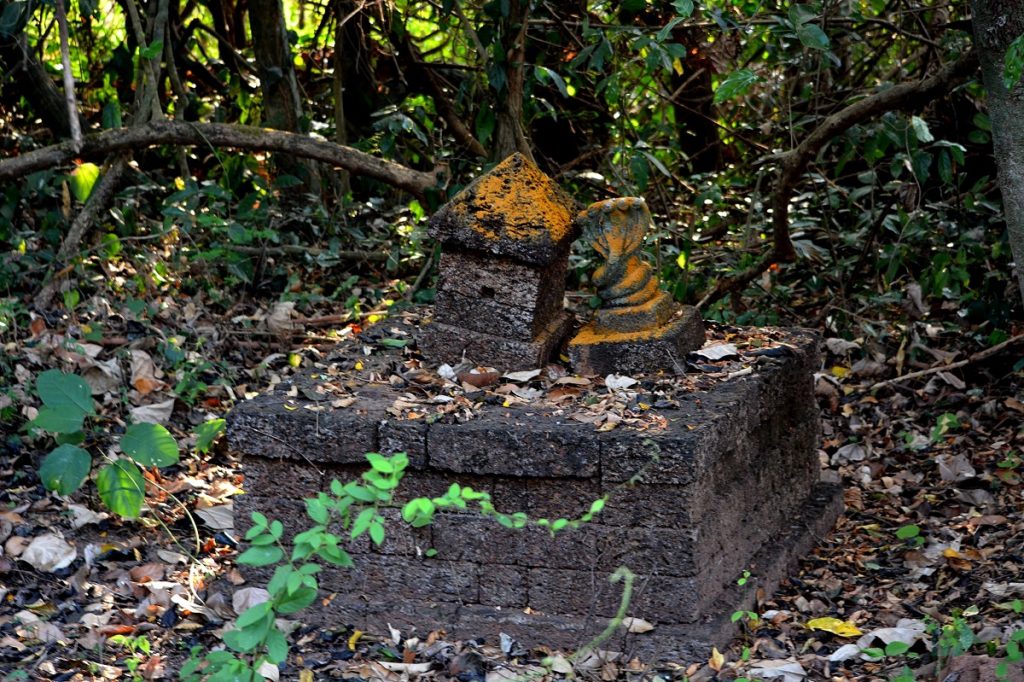
A sarpakaavu, or traditional sacred space for snakes, in Kerala. Photo: Manoj Karingamadathil/Wikimedia Commons CC BY SA 3.0
Underlying cultural and religious beliefs in serpent deities has played a role in protecting iconic animals such as snakes and other species dwelling inside the Western Ghats’ sacred groves. But these beliefs are eroding among youth and economic pressures are eating into the groves, threatening their very existence. Experts call for greater state government protection to preserve the groves’ legacy for the benefit of posterity.
For millennia, local communities in India have maintained sacred groves where they managed natural resources and many of these are tied to their cultural and religious beliefs. In the Western Ghats, such groves are relatively undisturbed patches of evergreen forests that sometimes have a pond, stream, or well that ensures perennial water supply. Often located outside of protected areas, sacred groves are rich in biodiversity, housing many threatened and endemic species of plants and animals. In many cases, these fragments are the only relict forests that remain outside the protected area system.
The mountain chain of the Western Ghats along the western coast of India is older than the Himalayan mountains; in 2012, 39 sites in the region were inscribed on the World Heritage Sites list by the United Nations Educational, Scientific and Cultural Organisation (UNESCO). While India boasts the highest number of sacred forests globally, with estimates suggesting at least 100,000, the Western Ghats is endowed with a large concentration. Although many are undocumented, Kodagu district in the southern state of Karnataka alone was estimated to have 1,200 sacred groves.
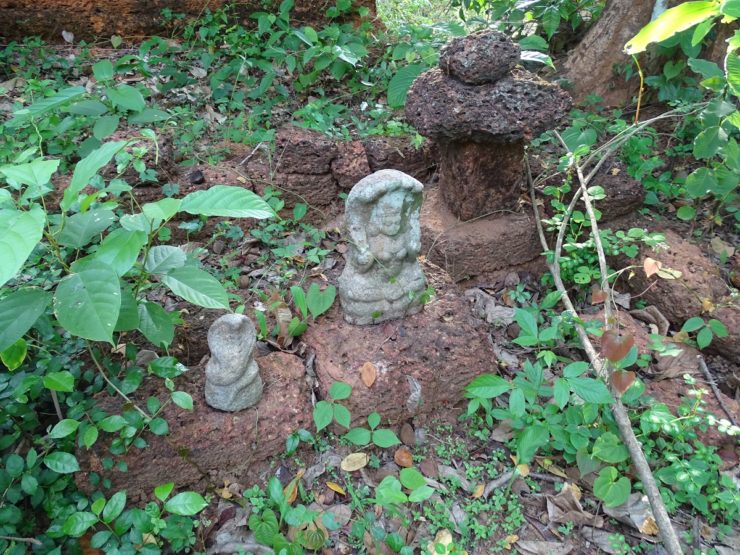
Many of these verdant groves are associated with gods and are named after deities. The worshipping of serpent gods known as nāga plays a central role in many groves in Kerala known as sarpakaavu in Malayalam (snake garden or grove), and often house idols of serpent deities.
Worshipping involves unique rituals that are performed in sarpakaavu and temples with serpent deities. One common ritual involves pouring a preparation of water, milk, rice powder, and turmeric on the deities and devotees call this offering as ‘Noorum palum’, said Dileepkumar R., director of Indriyam Biologics Pvt. Ltd., Jayakumari Kunjamma, senior research fellow at the University of Kerala who has also authored a book on snake worship in Kerala, and Divya S. chief scientific officer of Indriyam Biologics Pvt. Ltd.
Sacred groves: a refuge for snakes
In a study published last year, researchers surveyed visitors of 30 sacred groves in Kannur and Kasaragod districts in the state of Kerala and Kodagu (Coorg) in Karnataka. They found that visitors were less likely to harm snakes inside the groves than outside. And, a large proportion of visitors who did not harm snakes even outside of the groves worshipped snake deities.
Felix Yuan, the lead author of the study and doctoral student at the University of Hong Kong had expected a “fair number of people would not harm snakes inside the groves” given the role of snake deities in the region, but he was surprised by the results. An overwhelming 96% of the visitors surveyed showed pacifist attitudes towards snakes encountered inside the groves, whereas only 60% had the same reaction outside of the groves. The reverence towards snake deities and pacifism towards snakes pervaded all the sacred groves regardless of whether they had idols of snake deities present or not.
“The broader implications of this study lie in the intricacies of the relationships between sacred natural sites and local communities,” explained Yuan, “where the reverence for a specific plant or animal can potentially result in its protection despite the ongoing degradation of other ‘natural’ qualities of these sites.”
Visitors tend to live in harmony with snakes inside the groves (sarpakaavu). Dileepkumar, who frequently visited sarpakaavu in Kerala since childhood, said that if people spotted snakes, they would not touch the creatures, leaving them to slither around the groves freely.
V.C. Balakrishnan, who has also grown up in Kerala, had on some occasions, encountered snakes in the sarpakaavu. “I will just wait for them to pass by,” he said.
Serpent god worship and the role of taboos
At the heart of the conservation of snakes in the groves lie taboos, which are essentially an interplay of devotion and fear, according to U. Prashanth Ballullaya, co-author of the study and a doctoral student at the Central University of Kerala. Local communities believe that their ancestors created the sarpakaavus to provide shelter to snakes, he said, adding that snakes, especially cobras, were considered divine.
Fear also plays a prominent role. Harming snakes is a sin, Ballulaya gleaned from the surveys. If anyone harms snakes inside the groves, they will be cursed and more snakes will emerge, said some visitors. One of the repercussions of killing snakes according to traditional beliefs is that the family could be deprived of progeny and hence there is a cultural practice of worshipping the habitats of snakes among communities in the Western Ghats, explained T.V. Ramachandra, professor at the Indian Institute of Science (IISc), Bengaluru. “Later, gradual transitions to worshiping idols with snake inscriptions happened and eventually, temples with concrete structures replaced these,” he said.
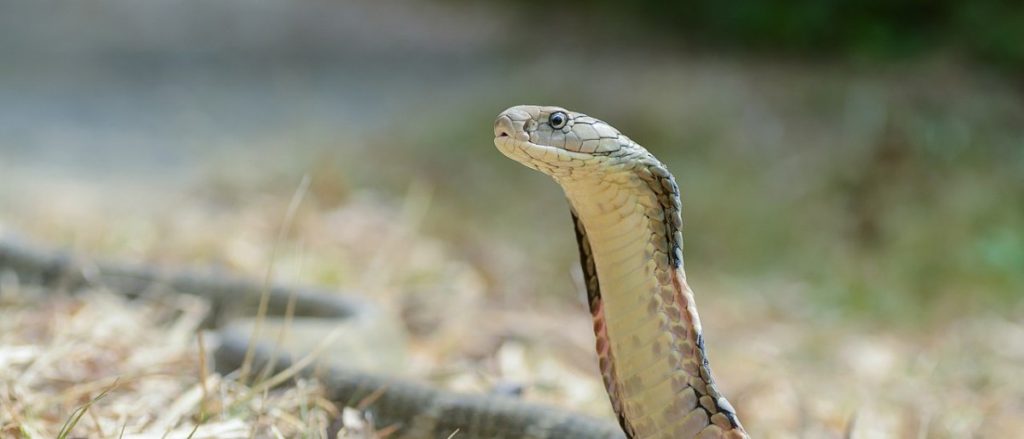
A king cobra. Credit: Rushenb/Wikimedia Commons, CC BY-SA 4.0
Shonil Bhagwat, professor at the Open University, United Kingdom, said “a ‘healthy’ fear of wild animals is good because that discourages people from going to parts of sacred groves, naturally creating ‘no go’ areas.” He believes that “these so-called ‘fences of fear’ can help protect biodiversity within sacred groves by simply keeping people out of the groves, or at least some parts of the groves.”
Communities in the rural highlands of the Western Ghats in Kodagu and adjoining urban lowlands in Kasaragod were surveyed and the results were published in 2019. Researchers found that both urban and rural communities did not abuse the groves by cutting trees, dumping waste, hunting small animals, taking soil and foliage, and damaging termite mounds. And those with nāga deities, who are not only highly revered but also feared, were rarely abused.
The protection of snakes was extended to other taxa as well. Palatty Allesh Sinu, assistant professor at the Central University of Kerala and co-author of the community perception study was surprised to learn that “even taking a leaf from the sacred groves is considered a taboo or abuse of the land.” Believers told him that “the organic matter is food for insects, which is food for frogs and snakes!” Because of this snake-centric food chain, Sinu and his team were forbidden from collecting insects from the groves.
Rural communities had stronger cultural and religious beliefs than their urban counterparts, who valued groves also for their environmental benefits. Although the reasons for this are difficult to answer, said Sinu, one farmer told him “our agriculture, economy and lives are bound to these forests around us … When there was no access to a temple, these forests and local deities living inside the forest were the resort for us. When the upper castes have direct access to Gods, the backward caste people did not have.”
Erosion of beliefs
Community-preserved sacred groves in the Western Ghats are facing mounting pressures over the past decades. Many are shrinking in size or have disappeared altogether. At the time of its formation in 1956, Kerala boasted more than 10,000 sacred groves, but in 2015, only around 1200 remained, according to a report prepared by the Kerala State Assembly Committee on Forest, Environment, and Tourism. A global Nature study published in May reported that reptilian phylogenetic diversity in the Western Ghats is under very high levels of human disturbance.
“Earlier thesarpakaavu was a symbol of divinity and sanctity and it was with only utmost reverence that one was allowed to enter its premises,” said Dileepkumar, Kunjamma and Divya. “People were afraid to touch the trees let alone cut them. But the scenario has almost completely changed with the term ‘sarpakaavu’ being reduced to a mere social terminology. The infuriating demand for more land to accommodate the growing population coupled with the placid attitude of today’s generation has diminished the values of biodiversity and conservation,” they rued, adding that most people view the groves as wastelands, which could be used for construction.
Researchers have observed that youths are losing interest in sacred grove traditions. The loss of oral traditions that narrated stories behind the groves has been cited as one factor. Bhagwat believes that awareness of sacred groves and nature conservation should start early. “If children are introduced to the creepy crawlies that live in sacred groves and maintain a healthy forest ecosystem, they will learn to like this real, everyday nature that is found in landscapes where people farm, live and work,” he said.
V.C. Balakrishnan, who is the secretary of the NGO Society for Environmental Education in Kerala (SEEK), also stresses the role of educating youth to ensure the protection of the groves. SEEK, he explains, holds many camps on the importance of the sacred groves and biodiversity.
On 25 September, Dileepkumar R. joined forces with a group of snake experts and developers and launched a mobile app called SnakeHub, which is dedicated to education and conservation. Currently, the app is a social responsibility initiative of Indriyam Biologics Pvt. Ltd., a Department of Scientific and Industrial Research recognised medical startup working on snakebite management and mitigation, but the group plan to register a society and keep it as an independently functioning body under the organisation. With 114 snake species, Kerala is the top three states in India in terms of species number (after Tamil Nadu, which has the highest, followed by West Bengal) and more than half of these are endemic to the Western Ghats, said Vivek Sharma, head of SnakeHub App.
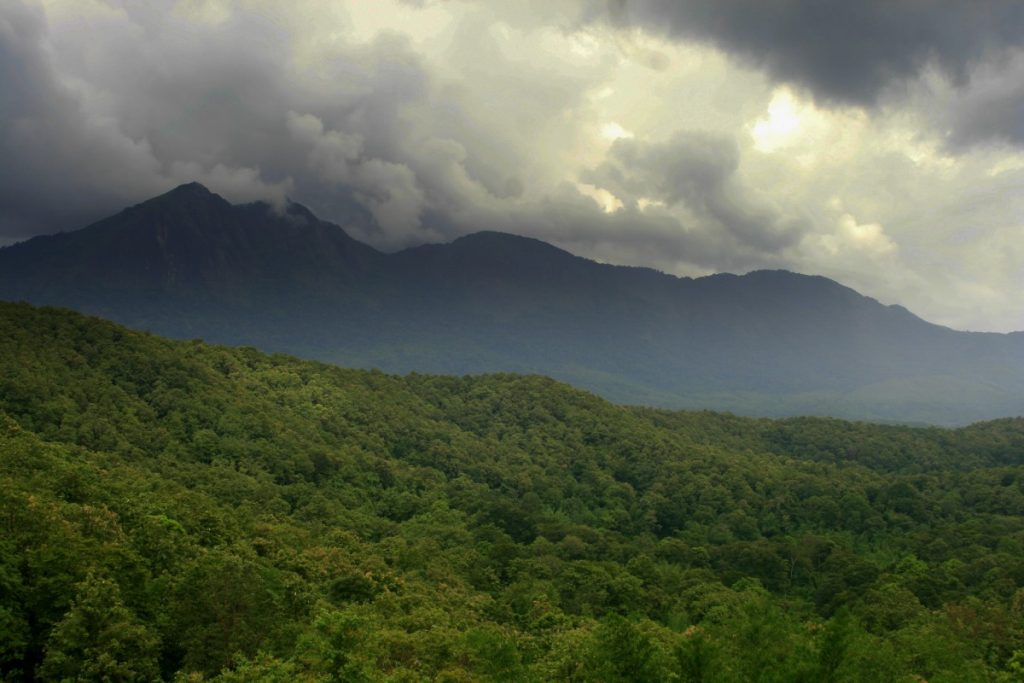
A part of the Western Ghats. dotcompals/Flickr, CC BY 2.0
In both English and Malayalam, the app is the first on snakes in the state of Kerala. Apart from providing biological and ecological information on all of the species, the app also covers snakebites including a list of hospitals equipped to treat bites. “Snakebite is an important objective in our work and based on requirements, we will add facilities to provide snakebite-related solutions and education materials,” said Sharma.
Their goal is to expand the scope of the app to the rest of India in other regional languages to cater to rural communities. India accounts for almost half of the total number of annual deaths from snake bites worldwide. Earlier this year, a study estimated that over the last 20 years, 1.2 million people died from snake bites nationwide. Most of the deaths occurred in rural areas and farmers were most at risk especially during the monsoon season.
“Sanskritisation” and commercialisation
Over the years, there has been a trend towards “Sankritisation” of the groves, which involves the conversion of animistic deities in the sacred groves to mainstream Hindu gods and goddesses, explained Bhagwat. This phenomenon, he said, paves the way for cement structures such as temples and other buildings to be constructed in the groves, which compromises the conservation value of the groves because natural features such as trees disappear. “The only way to solve this problem is to make the custodians of sacred groves aware that trees are important to protect biodiversity within the groves,” Bhagwat said.
“The sacred groves are losing their sanctity and some of the groves are becoming temples for commercial purposes,” said Balakrishnan, explaining that the owner can earn an income through money offered to the deities.
es are taking over in urban areas and even creeping into the hinterlands. According to Sinu, some sacred groves are under the direct control of the state while others are privately owned. “Sadly, both want to generate money out of it,” he lamented. “Selling the land is a way,” he said. “So, they first relocate the deities including snake god through a ceremonial ritual and free the land.” Many owners are in the process of relocating deities, noted Sinu, adding that the ceremony is a costly affair amounting to about Rs 4 lakh (Rs 400,000).
Ramachandra of IISc echoes these concerns. Cemented buildings have become commercial spots, he said, revealing that many sacred groves that are under the revenue department have undergone large-scale conversion to other land uses such as villas and resorts in Kodagu. He attributes these conversions to a lack of knowledge among the bureaucracy of the ecological and hydrological significance of the groves, which has sustained the livelihood of communities in the region for centuries.
Dileepkumar, Kunjamma and Divya believe that people fail to realise that their exploitation of the groves could pave the way for their own doom. “With the sacred groves being deconstructed, the snakes that were taking refuge in the grove vegetation enter into human colonies leading to a conflict between snakes and humans thereby posing a threat to both snakes and humans alike,” they warned.
A sarpakaavu in Kerala. Photo: Manoj K/Wikimedia Commons CC BY SA 3.0
How to protect the sacred groves?
Apart from cultural beliefs, the coexistence of snakes and humans hinges on the preservation of the ancient sacred groves of the Western Ghats.
Experts believe that state governments must play a greater role in protecting the sacred groves of the Western Ghats. Earlier this year, the Kerala state government launched a program “Pachathuruthu” to cultivate ‘green islands’ in degraded land in a bid to preserve biodiversity. For the initiative, “they are planting trees that can give shade, shelter, and food for birds and other animals,” Sinu said. “We have over 1500 sacred groves in Kerala along the west coast. Why not declare them as natural sanctuaries?”
Ramachandra proposes that the Karnataka and Kerala Forest Department should assign heritage status to all the sacred groves of the Western Ghats under section 37(1) of the Biological Diversity Act 2002. Such a move, he argues, will ensure the conservation of these ecologically fragile regions.
Conservation of the groves should be initiated at both the community and government level, according to Dileepkumar, Kunjamma and Divya. “Snake groves are an inherent part of Kerala culture and conserving them must be our obligation. For implementing the conservation strategies initiated by the government, a special task force must be employed to ensure the protection and maintaining the status quo of the snake groves.”
Balakrishnan said that the forest department had funded building fences around the sacred groves a few years ago. “These sacred groves are to be protected surely because they are rich in biodiversity and they are the wealth of our future generations.”
This article was first published on Mongabay India .
source: http://www.science.thewire.in / The Wire, Science / Home> Science> Environment / October 29th, 2020
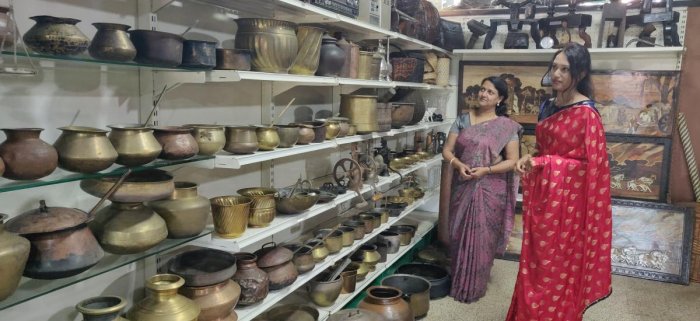
Visitors look at the vast range of antique utensils and other items exhibited from the collection of Ponnacchana Madhu in Madikeri on Friday.
She was speaking after inaugurating the exhibition of antique items from the collection of Ponnacchana Madhu at Coffee Krupa building near Raja Seat in Madikeri on Friday. The exhibition a part of Janapada Dasara, was organised by Taluk Janapada Parishat.
“The items that were used by our ancestors had scientific applications. Some utensils in the older days were designed to improve the health of people. Unfortunately, the young generation is forgetting the significance of the livelihood of their ancestors,” she added.
Zilla Janapada Parishat president B G Anantashayana said that the folklore was close to nature. Folklore is a form of knowledge. But, the modernity has been taking us away from this knowledge, he added.
Taluk Janapada Parishat president Anil H T said that Ponnacchana Madhu, the exhibitor, had collected rare items in the last three years.
These items will be on display till October 26. The work by Madhu and Preethu couple is laudable, he added.
Collector and Exhibitor Ponnacchana Madhu said that he purchased old items in the households, after convincing the elders in the houses. Many tourists have been willing to purchase them from me. However, they are not for sale. The collection began with an old lamp contributed by an old lady called Arifa Munavar, a scrap dealer in Madikeri.
Taluk Janapada Parishat Treasurer Ambekal Navin Kushalappa, Parishat Directors Savita Rakesh and Veenakshi were present.
Exquisite collection
The collection showcases traditional weapons, a 120-year-old mud bowl, an ancient lamp from a temple in Tamilnadu with 84 diyas, puja items, African dolls, bronze items, utensils, coffee grinding machines and so on.
The agricultural equipment are an added attraction.
source: http://www.deccanherald.com / Deccan Herald / Home> State / by DHNS, Madikeri / October 17th, 2020
The Codava National Council(CNC) has urged the Government to include Codava tribe in the list of Scheduled Tribes (ST) of the Indian Constitution.
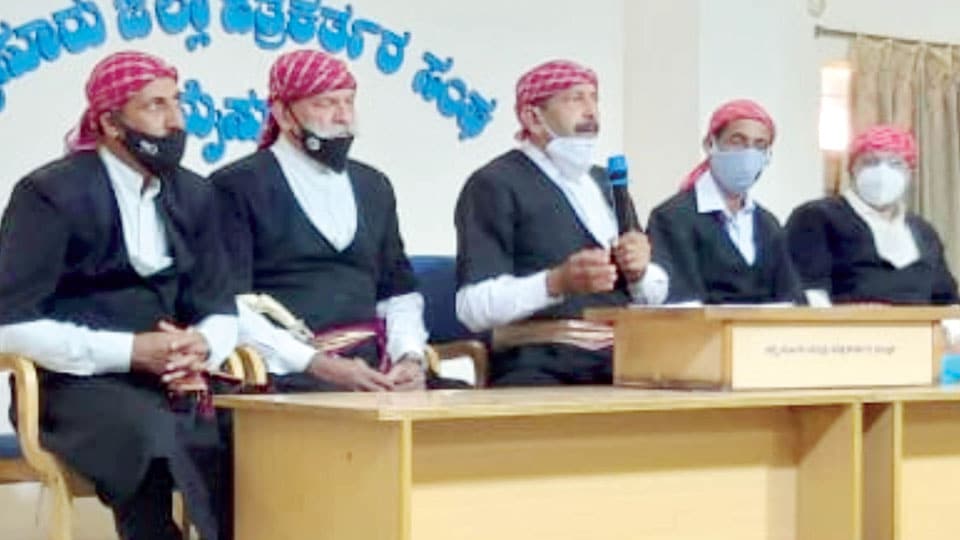
Addressing a press meet at Patrakarthara Bhavan here this morning, CNC President N.U. Nachappa maintained that ST tag for Codava tribe and Geo-political autonomy are synonymous for Codavas. Urging the Government to declare Codava tribe as a primitive tribe, he said that Codava tribalism must be measured through the ‘Emic approach’, an ethnographic study of Codava tribe.
Pointing out that one of the seven fundamental rights enshrined in our Constitution clearly upholds Constitutional remedy for the aspirations of the people, Nachappa argued that the Union and Karnataka Governments should concede Codava aspirations of ST tag as a Constitutional remedy.
Noting that as a result of CNC’s relentless efforts and innumerable petitions to the Union Government, the Central Government directed the State Government to conduct an ethnographic study on Codava tribalism, he said that subsequently, the Karnataka Government entrusted this responsibility to Mysuru based Karnataka State Tribal Research Institute (KSTRI).
Stating that Codava tribe has its own extraordinary tribal characteristics, he maintained that ST tag is a must for their historical continuity and for protection of Codava land, language, cultural heritage, folkloric identity and traditional habitation. Also, the tag was important for their economic and political empowerment, he said.
Accusing KSTRI Director T.T. Basavanagouda of attempting to derail Codavas demand for ST tag through dubious means, Nachappa said that a representation has been given against the actions of Basavanagouda, which are detrimental to the interests of Codavas, to Mysuru DC.
Pointing out that the then MPs B.K. Hariprasad and Kupendra Reddy had raised the issue during the Parliamentary session in Dec. 2019, which attracted the attention of the whole country, Nachappa asserted that the ST tag will also ensure protection of Codava hereditary untitled lands and traditionally defined Codava homeland.
CNC office-bearers Areyada Girish, Kaliyanda Prakash, Chambanda Janath Kumar and Appaneravanda Manoj Mandappa were present at the press meet.
source: http://www.starofmysore.com / Star of Mysore /Home> News / October 13th, 2020
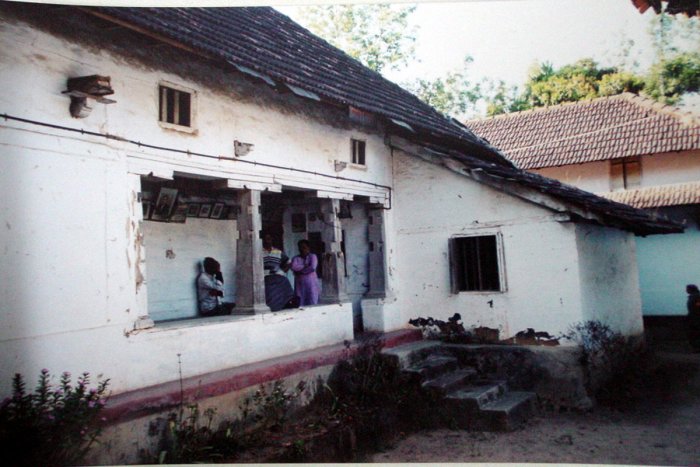
Ancient abode: The ancestral house of Mukkatira Ipanna, the sharpshooter, in Nalvathoklu village in Kodagu. Photo by Boverianda Chinnappa
Mukkatira Aiyappa of Bonda village in Kodagu had three sons: Muddayya, Ipanna and Bopayya. Muddayya became a Munshi (clerk) in the Diwan Kacheri (minister’s office). Linga Raja II was the ruler of Kodagu at that time. With his first queen, a lady from the Chowrira family, he had a son Chikka Vira Raja. His second queen, Palanganda Devaki, was his Pattada Rani (chief queen). They had two daughters Muddammaji and Devammaji.
In 1816, Linga Raja was on a hunt in Murnad, Kodagu. He was accompanied by Muddayya when they came across Ipanna. Linga Raja challenged him to shoot a bird off a bison’s back as he was a famed sharpshooter. The bison was at a long distance and a gunhad to be used. Ipanna shot it and impressed the Raja who summoned him to the court the next day.
The next day, Ipanna went to the court dressed in a white Kuppya (traditional coat). The Raja asked him the significance of the colour of his costume. Without any hesitation, he replied that a Kodava normally wore a white Kuppya on two occasions — in his wedding and then during his funeral. Those days, rarely one spoke boldly in front of the Raja. But the Raja was not displeased. Instead he surprised all by saying that he would get his elder daughter Muddammaji married to Ipanna.
Ipanna was converted into a Lingayat, since the Raja was one. Ipanna was given a new name, Chenna Basavappa. Muddammaji and Chenna Basavappa were married and gifted a farm. But Muddammaji fell sick frequently. So, this farm was exchanged with another farm which belonged to the Raja’s relatives in Appangala. However, Muddammaji died within two years after her marriage. The Raja then got his younger daughter Devammaji married to Chenna Basavappa in 1819.
In 1820, Linga Raja died. His queen Devaki committed suicide by consuming diamond dust. Chikka Vira Raja became the Raja. Chenna Basavappa and a few others were discontent with his rule. So they schemed to have him ousted. They failed in their in their endeavour and Chikka Vira Raja came to know of it. Chenna Basavappa and Devammaji were kept under house arrest.
In 1832, Chikka Vira Raja planned to have Chenna Basavappa executed. Devammaji and Chenna Basavappa learnt of this. On Shivarathri, they drugged the guards and escaped from Appangala on horseback. They crossed the borders of Kodagu and reached Mysore , where they headed to the house of the British Resident Casamajor and sought refuge. Meanwhile, the couple’s one-and-a-half-year-old son fell into the hands of the Raja’s men and was handed over to the Raja whose queen took care of him.
Muddayya was an intelligent and respected man. He had been promoted to become the Raja’s Khas Munshi (chief accountant). A favourite of the Raja, he was deemed to be a future Diwan. When Chikka Vira Raja first heard of Chenna Basavappa’s escape he got angry with Muddayya who was his elder brother. He then beat him up. His Diwan, Kunta Basava, got Muddayya executed. But, in truth, Muddayya was not aware of his brother’s plans.
Chikka Vira Raja demanded that the two fugitives should be handed over to him. But Casamajor forwarded this matter to the British East India Company Government. In 1833, the Government declared that the couple should not be surrendered to the Raja. Chenna Basavappa and Devammaji were moved to Bangalore and were given a pension. Chikka Vira Raja schemed with Nanda Lal Bharthi, a merchant from Mysore, to have Chenna Basavappa murdered. But these attempts failed.
In 1834, the Company invaded Kodagu. The Raja surrendered to the British and was exiled. Chenna Basavappa and Devammaji returned to Kodagu. Their Appangala farm was returned to them. Chenna Basavappa assumed the title of ‘Arasu’ (king). He petitioned the Company to provide him with one of the other palaces of the Raja. He also wanted the former Raja’s farm at Nanjarajapatna and be placed in charge of the Gaddige (the Rajas’ mausoleum). But the Company didn’t agree to this. Chenna Basavappa died in 1868.
source: http://www.deccanherald.com / Deccan Herald / Home> Spectrum> Spectrum Statescan / b y Mookonda Kushalappa / July 06th, 2019
WELCOME. If you like what you see "SUBSCRIBE via EMAIL" to receive FREE regular UPDATES.
Read More »