Coffee Board, No.1, Dr.B.R.Ambedkar Veedhi, Bengaluru-560 001 has invited applications for admission to the Post Graduate Diploma in Coffee Quality Management (PGDCQM) for the academic year 2021-22, instituted to support the requirements of the Indian coffee industry for trained personnel with the specific knowledge and skills required to function as coffee tasters.
Course content include Coffee cultivation practices, Post-harvest management and practices, Coffee Quality Evaluation, Roasting and brewing techniques, Marketing and Trade, Quality assurance systems (Theory and Practical sessions).
The course duration is 12 months in 3 trimesters conducted in English. Free accommodation will be provided only during the first trimester at CCRI, Balehonnur, Chikmagalur.
Admissions open to candidates from open category and preference is given to those sponsored by coffee industry. Selection will be based on academic record, personal interview and sensory evaluation test.
Eligibility: Applicants must hold a Bachelor’s degree with at least one of the subjects namely Botany, Zoology, Chemistry, Biotechnology, Bioscience, Food Technology, Food Science, Environmental science or a Bachelor’s degree in Agricultural sciences.
Application forms can be downloaded from www.indiacoffee.org or collected personally from Coffee Board, Bangalore.
Filled in application form along with a NEFT transfer details for Rs.1500/- payable to Coffee Board Account No. 64015049024, State Bank of India, IFSC – SBIN0040022, Dr.B.R.Ambedkar Veedhi, Bengaluru should reach ‘Divisional Head, Coffee Quality (I/c) Coffee Board, No.1, Dr.B.R.Ambedkar Veedhi, Bengaluru-560 001’ latest by 1st December 2021.
Foreign students admitted under open and sponsored categories should be well versed in the English language. Their admission is subject to the cclearance of Govt. of India.
Interview and selection will be held on 10th December 2021.
Course Fee is Rs.2,50,000/-. SC/ST applicants submitting caste certificate along with the application will get concession of 50% in course fee.
www.indiacoffee.org
source: http://www.english.mathrubhumi.com / Mathrubhumi / Home> English Education> News & Updates / November 28th, 2021
Coffee Board CEO and Secretary K.G. Jagadeesha, on Tuesday, visited the rain-hit coffee estates of Mudigere taluk and interacted with the coffee planters about the problems they had been facing in recent days.
Heavy rains in parts of Chikkamagaluru and Hassan districts have impacted the yield. The growers have not been able to harvest the yield. Those, who have harvested the crop, are finding it difficult to dry coffee beans.
The officer visited an estate at Balur, owned by B.R.Balakrsihna, president of Mudigere taluk of Coffee Growers’ Association. The growers also submitted a memorandum to the officer.
Karnataka Growers’ Federation president H.T.Mohan Kumar, former presidents D.B. Subbe Gowda, B.S. Jairam and others were present.
source: http://www.thehindu.com / The Hindi / Home> News> States> Karnataka / by Special Correspondent / Hassan – November 16th, 2021
Here is a chance for coffee growers to get additional cash from their plants throughout the year apart from income from the sale of beans. Mysuru-based Central Food Technological Research Institute (CFTRI) has developed a technology to prepare a value-added product from coffee leaves that packs in health benefits too.
Coffee is only harvested for a few months every year, depending on the country’s harvest season. This can leave a number of producers and workers without work (and income) for a significant portion of the year.
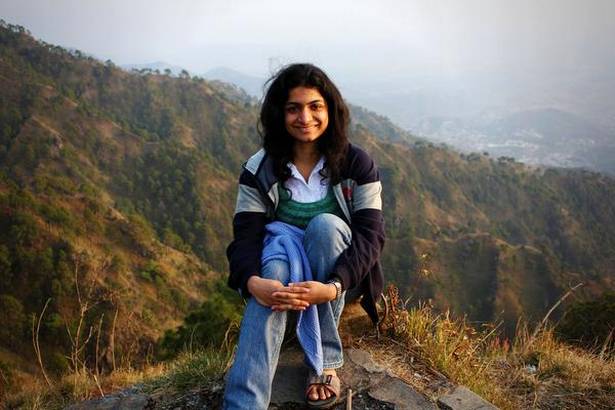
Pushpa S. Murthy
However, some producers have decided to diversify the crops that they grow and sell. As coffee leaves are constantly being produced, growers can harvest them in the off-season if there is demand, according to Pushpa S. Murthy, Principal Scientist (Spice and Flavour Science Department) of CFTRI.
This technology follows a CFTRI project on the development of value-added products from coffee leaves taken up in 2019. The project was funded by the Union Ministry of Food Processing Industries.
If farmers can use the leaves which can be harvested during the off-season or during pruning, without interfering with coffee bean growth, it will have a great impact on the social elevation of coffee farmers, she said.
Around 70 percent of the coffee industry is unemployed or underemployed during nine months of the year due to the nature of the growth cycle of the coffee beans. The project aimed to provide a year-round sustainable process for the coffee farmers.
With CFTRI technology, the brew can be prepared with water, allowed for a few minutes to steep, filtered and consumed. The institute has initiated the transfer of this technology to the coffee industry, and a few industry participants have already extended their consent, she said.
The leaf brew does not really taste like coffee, according to Murthy. “The brew is subtle with less caffeine compared to coffee or tea,” she said. On the nutritional value of the beverage, she said coffee leaves are rich in phenolic acids with potential health benefits. A coffee leaf contains around 17 percent more antioxidants than green tea. The beverage should be consumed plain.
The beverage accords health-promoting polyphenols like chlorogenic acid and mangiferin which help in reducing blood glucose levels, inflammation and blood pressure, she said.
Leaf drink ‘kuti’ and ‘kahwa daun’ popular in Sumatra, Ethiopia
Coffee leaf tea has been consumed in Sumatra, Ethiopia, Jamaica, Java and Sudan for centuries. From the 16th century to the 19th century, Ethiopian farmers set aside their harvested coffee for trade or consumption in special ceremonies. As a day-to-day drink, the Harari people in Ethiopia instead enjoyed ‘kuti’.
‘Kuti’ tea was made by boiling coffee leaves in hot water, sometimes with a pinch of salt or some sugar. It was generally boiled for at least 30 minutes, as it was believed that the longer the leaves were boiled for, the sweeter the resulting brew would be.
Coffee leaf tea bears some similarities to green tea, but it is more earthy and sweeter. It is lower in caffeine than green tea, and thanks to its high levels of antioxidants, it has historically been believed that it cures or relieves cold symptoms.
In the 19th century, Dutch colonists transported coffee plants to designated farming regions in Indonesia. Workers on the coffee plantations were forbidden from consuming the coffee they harvested, so they drank something called “kahwa daun” instead.
‘Kahwa daun’ was made by drying coffee leaves in the sun to reduce their bitterness. The leaves were then smoked and roasted for a few hours. Finally, they would be steeped in boiling water, and then served in a coconut shell.
source: http://www.starofmysore.com / Star of Mysore / Home> Top Stories / November 14th, 2021
Coffee lovers are in for a treat after the Coffee Board announced on Tuesday that chicory-free, pure coffee will soon be available for purchase online.
Bengaluru :
Coffee lovers are in for a treat after the Coffee Board announced on Tuesday that chicory-free, pure coffee will soon be available for purchase online. As per the Board, they are keen to launch the sale of Geographical Indication (GI) tagged coffee by the end of the year, and are in talks with various online merchant platforms for the same.
Board officials are setting up units in Bengaluru for product packaging, after which, it will be sent to domestic and international buyers. Hiring delivery personnel and packaging staff is in the works, to enable door-to-door supply to customers, and commercial units.
“There is the Board’s land in Nelamangala, which could be utilised as the packaging unit. The Board will sell all the types of GI tagged coffee in a phased manner. The sales will be in 250 grams, 500 grams and one kilogram packing. No instant coffee will be sold by the Board,” remarked K G Jagadeesha, CEO and Secretary Coffee Board.
A study on the impact of chicory on health, in collaboration with the Central Food Technological Research Institute (CFTRI), the laboratory under the aegis of Council of Scientific and Industrial Research, will be undertaken to increase awareness.
The decision to sell the coffee online has been well calculated by the Board, since they want to revive coffee sales in the domestic and international market. They also identified rising demand from customers on delivery of chicory-free coffee. The high-quality coffee beans will be taken directly from farmers and a portion of the sales will be given to them.
source: http://www.newindianexpress.com / The New Indian Express / Home> Cities> Bengaluru / by Bosky Khanna, Express News Service / November 03rd, 2021
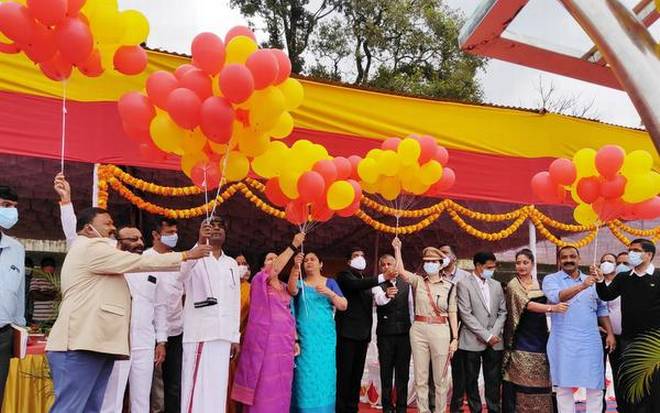
Minister in charge of Kodagu district Kota Srinivas Poojary and others at the Kannada Rajyothsava celebrations in Madikeri on Monday. | Photo Credit: Special Arrangement
Labs, libraries for 15 govt. schools: Minister
Minister in charge of Kodagu district Kota Srinivas Poojary on Monday said each household in the limits of 12 gram panchayats in Kodagu will be getting drinking water, 100 per cent segregation and collection of solid wastes, scientific handling of sewage generated daily besides the installation of solar projects and setting up of digital libraries in the respective villages.
All these works will be done as part of ‘Amrith’ Grama Panchayat programme which has been announced in the State identifying 750 GPs as part of platinum jubilee celebrations of Independence. The 12 GPs in Kodagu are Peraje, Kunchila-Kakkabbe, Maragodu, Kedamullur, Karmad, Nalkeri, Thithimathi, Koodumangaluru, Shirangala, Igooru, Haradooru and Dundalli, the Minister said in his speech during the Kannada Rajyotsava celebrations in Madikeri.
As part of the 75th independence daycelebrations, the State government has announced 13 special programmes and they include Amrith gram panchayat, Amrith rural housing scheme, Amrith farmer producer organisations, Amrith Nirmala Nagara, Amrith anganwadi centres, Amrith self-help micro enterprises, Amrith community development programme, Amrith health infrastructure upgrade programme, Amrith skill training programme, Amrith startup programme, and Amrith sports adoption programme.
As part of Amrith Rural Housing scheme which is being implemented in the district, housing will be provided to the homeless persons who will be identified in the 12 GPs in the coming days.
The Minister said farmers, fishermen and weavers will get financial support as the government has launched Amrith farmer producer organisations. Each organisation will get a sum of ₹30 lakh in a span of three years. Amrith Nirmala Nagar scheme has also been launched in the district where programmes will be taken up for maintaining hygiene in the limits of local bodies.
Amrith school scheme entails funding of ₹10 lakh to each identified school for developing buildings, labs, libraries, toilets and other facilities. The 15 schools identified in Kodagu are at Hodawada, Sampaje, Kadanga, Madapura, Kodlipet, Walnoor, Thagattur, Hebbale, Suntikoppa, Heggala, Pollibetta, B. Shettigeri, Thithimathi, Gonikoppa and Kutta.
In Kodagu, 25 anganwadi centres will be upgraded with each one of them getting a sum of ₹1 lakh under Amrith Anganawadi scheme.
The Minister said the government is committed to protecting Kannada and the culture of the land and expressed happiness that the use of Kannada language in digital mediums has been on the rise. Karnataka is rich in culture and tradition, he said, calling upon the youth to be part of the overall development of Karnataka.
He also called upon the people to adopt Kannada in their lives, showing interest in the language, literature, culture and art of the land, and become successors of the rich tradition of the land.
source: http://www.thehindu.com / The Hindu / Home> News> States> Karnataka / by Special Correpondent / Mysuru – November 01st, 2021
Government intervention sought to check cartels, say trade sources
With only a few weeks remaining for the coffee harvest to begin, a disparity in the prices of Robusta coffee in the international market and India has become a major cause for concern among growers in South India.
Though the price of coffee in India is usually based on international markets, especially the London market, a proportionate increase in the price of the produce overseas is yet to get reflected in the local market, according to trade sources.
While the price of Robusta coffee rose by about $70 a ton in the international market, the Indian market was yet to reflect the increase. According to Coffee Board data, the price of the produce (AB grade) in the international market was ₹165 a kg on October 29 but the growers here were getting only ₹140 a kg.
The trade sources contended that the likely reason for the disparity was ‘price cartelisation’ by some international buyers. Also, the number of buyers had been relatively low in India as the harvesting season here would begin only by the end of December, they added.
According to the board’s final estimates, the total coffee production in India during 2020-2021 stood at 3. 69 lakh tons, including 2.35 lakh tons of Robusta. Of this, a little more than 1.64 lakh tons were exported.
Recently, the Centre extended RoDTEP (Refund of Duties and Taxes on Exported Products) scheme to the coffee sector to boost exports. But the growers were not enthused, the sources added. Alleging that some international players were likely trying to enhance profits by not increasing the prices, the trade sources sought the Union Commerce Ministry’s intervention to stop such exploitation.
source: http://www.thehindu.com / The Hindu / Home> Business / by Staff Reporter / Kalpetta – October 30th, 2021
The past year has seen a spurt in speciality coffee offerings, as more local roasters get creative with the business of beans
When Divya Jayashankar set up Chennai’s first roastery, Beachville, back in 2018, the city was just beginning to look beyond traditional dark roasts and filter coffee. Back then, her imported small-batch roaster, grinder, and farm-sourced coffee blends with “no chicory, no robusta” were enough to take customers by surprise, she recalls.
Now, encouraged by adventurous customers, Divya is exploring naturally sun-dried coffee cherries as against washed Arabica, and the various ways they can be put to use. The latter, she says, “has what many consider to be a cleaner taste. But sun drying lets the flavour of the cherry leech into the bean with time, making it much more heavy-bodied and fruity: The market is moving towards more funky tasting coffees, and I want to experiment.”
Divya Jayaraman, founder of Beachville | Photo Credit: Special arrangement
She is not alone — a fraternity of coffee entrepreneurs alongside Divya are trying out a variety of processes, working with farmers, discoving different beans and playing with flavour profiles.
The growing competition is keeping him on his toes, admits Akshay Vaidyanathan who founded Kapi Kottai in 2019. While Divya looks into what she calls “the naturals”, Akshay’s latest product Hamir Kalyani is a test slow-controlled fermentation. “It’s a very technical process, but fermented coffee is definitely a trend now,” says Akshay, adding that his 2020 product named Curveball is double-fermented, resulting in an intensely fruity, admittedly polarising brew with a niche, but loyal, following.
These experiments are taking roasters into coffee estates, to the turf of growers and plantation owners, in an attempt to heighten flavours in coffee before they even take the form of beans. The latest in the fray, began their process plantation-first.
Kathryn Ahuja, founder of Kat & Kin Coffee Roasters | Photo Credit: Special arrangement
Kat & Kin Coffee Roasters was started by husband-wife duo Kathryn and Anek Ahuja in the middle of lockdown earlier this year. “I have been interested in coffee-making for 25 years, and was looking for a challenge,” says Kathryn.
They began with a visit to plantations in Chikmagalur after restrictions eased, where a patch of Ethiopian-origin heirloom coffee at MF Estate caught her fancy, “I knew I wanted to start with that bean”. The smooth-tasting floral coffee lends itself to multiple brewing styles, found the couple, making it the ideal launch for a new customer-base with varied preferences.
Then followed the investments: a roaster that took three months to be imported from Taiwan (“there are no roasting machines made in India,” says Anek), a commercial-scale grinder, and a years’ stock of coffee beans. “Harvest happens only once a year, so we must commit to the grower for that long,” explains Anek, adding with a laugh, “We burnt a lot of beans before we managed a good roast.”
Up ahead
Now, Kat & Kin offers six coffees, including the popular Monsooned Malabar and a naturally processed product named Iced Honey. The roasters have also left their imprint beyond city and state limits — “While most of our customers are in Chennai, we are also getting repeat orders from a few people in Bengaluru and Hyderabad,” says Anek, adding, “In Chennai, the community of people brewing coffee other than filter coffee is growing. Some look at the process as an art form; I know people who prefer slow pour overs just because they find it calm and therapeutic.”
Meanwhile, Kapi Kottai sells not only to individual customers, but also to cafes and restaurants around the country. The bread bar in Mumbai, Mearth cafe in Chennai, One Dollar Moffee in Raipur, Three Beans Coffee Bar in Nagpur and Pot Boiler Coffee House in Kolkata are part of Akshay’s clientele.
Beachville, on the other hand, is putting more energy into serving its local, post-lockdown customers at the cafe that opened in October 2020. “The current trend is towards finding more interesting coffees and interesting ways of processing them,” says Divya, “But right now, the experiential angle seems more important than the blends per se. In the past year, we have been experimenting with what we serve at the cafe: kinds of cold brew, espresso-based beverages like a coconut water, coffee and mint espresso drink, and other beverages with tonics.”
It is only in the upcoming harvest season that Divya really plans to get into naturally processed coffees, and also importing coffees from Ethiopia and Columbia. “It is usually difficult for a grower to maintain consistency when the process is natural, but there are some estates that are doing some really good work,” she says. She sees reason for optimism not only in the rising customer base, but also in the growing retail price of coffee, which is an indicator of how much people value speciality products and “green products”. In the end, she says, it all comes down to the relationship you have with those who grow coffee, and how much you are willing to pay them for their labour.
source: http://www.thehindu.com / The Hindu / Home> Life & Style> Food / by Meghna Majumdar / Chennai – October 27th, 2021
The joint study found bird species richness to be higher in shade coffee plantations that had 78 species than in open coffee plantations that had 55 species
‘Alteration of canopy, woody plant composition can influence pattern of functional composition of resident birds’
Verdant coffee and tea plantations are more than an ideal backdrop for photos; they support a thriving avian population. In a study that underscores the need to understand the patterns and drivers of bird species composition and diversity outside Protected Area (PA) networks to develop landscape-level conservation strategies, researchers found that they varied in differently-managed plantations.
The findings were the result of collaborative work by Kannur University, Kerala, Salim Ali Centre for Ornithology and Natural History, Coimbatore, Ashoka Trust for Research in Ecology and the Environment (ATREE), Bengaluru, and Ferns Nature Conservation Society, Wayanad. It was published in July 2021.
Focussing on the coffee plantations in the Western Ghats, which are an important agro-ecosystem and help maintain a significant portion of regional avian diversity, the researchers compared the composition and functional diversity of resident birds between shade and open coffee plantations.
They counted 3,846 birds of 87 species, and found species richness to be higher in shade (78 species) than in open coffee plantations (55 species). “Interestingly, 32 species were unique to shade and nine were unique to open coffee plantations, with 46 species found in both types of plantation. Species richness and abundance were higher in shade coffee,” the study says, adding that the results reveal that different farm management practices can affect functional bird richness and its abundance in coffee plantations. They have made a case for retaining shade-trees of native varieties in coffee plantations to support high functional diversity, richness, and abundance of birds in the coffee plantation of the Western Ghats.
The study, ‘Resident birds show different patterns in species composition and functional diversity in differently managed coffee plantations in the Western Ghats, India’, was published by the Ornithological Science journal in July 2021.
Speaking to The Hindu, Santhanakrishnan Babu, one of the authors, said the study was conducted between May and August, 2016, in the northern part of Wayanad district. “Wayanad is a major coffee producer, producing 90% of the Kerala’s coffee. Our study aimed to understand how resident birds respond to differently-managed coffee plantations – shade and open,” he said.
The Kerala government recently passed an order to chop all resident trees on private land except sandalwood. This will lead to extensive chopping of resident trees from the coffee plantations which will affect biodiversity, he added.
Another author Athira S. Variar and Mr. Babu said retaining shade trees of native varieties in coffee plantations is important for supporting high functional diversity, richness, and abundance of birds. “Shade plantations support several habitat specialists and range-restricted birds, and alteration of the canopy and woody plant composition can influence the pattern of the functional composition of resident birds. Since our study covered only one season, year-round study in these plantations may shed more light on the composition of resident, breeding and migratory bird species,” they said.
Conservation strategies
They have called for landscape-level conservation strategies. Author Anoop N.R. pointed out that the Forest Department has little authority over the plantations located outside forest areas, and trees in these plantations are increasingly being replaced with exotic trees such as Grevillea robusta. “To promote the protection of large native trees in coffee plantations, we recommend initiating programmes to provide financial incentives to private landowners. Education programmes will also help to improve community support for retaining texisting indigenous tree varieties and promote planting more of the same,” he recommended, adding that a framework needs to be developed with regard to which species can be planted and which must be maintained, or removed, from the plantations.
source: http://www.thehindu.com / The Hindu / Home> News> States> Karnataka / by K C Deepika / Bengaluru, October 04th, 2021
Deputy Commissioner Charulata Somal sips coffee at Raja Seat on Friday, on the occasion of International Coffee Day
Deputy Commissioner Charulata Somal said that the International Coffee Day celebrated in Kodagu, highlights the hard work of coffee growers, which is behind the taste of coffee.
She was speaking during the International Coffee Day programme observed by Rotary Misty Hills, at Raja Seat, on Friday.
The deputy commissioner added, “I got to know about every detail of coffee cultivation after I was posted to Kodagu. The dedication and effort by coffee growers in producing the best quality of coffee is commendable.”
Rotary Misty Hills president Anitha Poovaiah said that more than 1,500 visitors at Raja Seat were served coffee on account of International Coffee Day.
Rotary Deputy Governor H T Anil said that the quantity of coffee powder used by a person in India is 4 to 5 kg per year whereas, in a foreign country, a person uses 15 kg of coffee powder annually.
Therefore, there is a need to increase the usage of coffee in India, he added.
Misty Hills project director Devanira Tilak also spoke on the occasion.
Madikeri CMC commissioner Ramdas, horticulture department deputy director Sridhar, senior assistant director Pramod, Coffee Board deputy director Shivakumar Swamy and others were present.
‘Coffee export’
Kodagu Mahila Coffee Jagruthi Sangha distributed free coffee at various places in Madikeri on account of International Coffee Day.
The Coffee Day observed at Tadka House on Raja Seat Road was inaugurated by Kodava Samaja president K S Devaiah.
When the coffee industry was in distress women had started a unit to instil confidence in coffee growers in the district. The sangha has been promoting coffee consumption, said K S Devaiah.
Women have been actively engaged in managing coffee plantations and the industry. Kodagu’s coffee is known for its taste, he said.
Kodagu Coffee Growers’ Cooperative Society president M B Devaiah said the society is the largest coffee cooperative in Asia.
It is now mulling about exporting coffee and requires financial assistance from the government for exports, he added.
Advocate Pasura Preetham said the International Coffee Day is being observed since 2015.
Dr Mohan Appaji said that the consumption of coffee by those above 40 years is good for health.
Kodagu Mahila Coffee Jagruthi Sangha president Chitra Subbaiah, general secretary Anitha Nanda and others were present.
source: http://www.deccanherald.com / Deccan Herald / Home> State> Mangaluru / by DHNS, Madikeri / October 01st, 2021
Non-traditional coffee growing regions in India are having a moment in the sun
(Nathan Dumlao, Unsplash)
There was a time when coffee beans in India were assumed to have come from the South of India and the lush, verdant hills of Baba BudanGiri (regarded as the birthplace of coffee in India), Nilgiris and Kodagu in Karnataka that are known to be the key coffee producing regions in the country. Increasingly, places like Araku Valley near Visakhapatnam, Koraput in Odisha and Northeastern states such as Meghalaya and Nagaland as newer areas from where your favourite roasters have sourced their beans.
While coffee has traditionally been grown in South India and a majority of well-known estates continue to supply the bulk of coffee beans to roasteries across the country, the rise of these so-called non-traditional areas has been some time in the making. The coffee world took notice of this when Araku Coffee, that sources its beans from the eponymous valley comprising highlands of the Eastern Ghats, won the Gold Medal for the best coffee pod in the Prix Epicures OR 2018 Award in Paris, France, a first for any Indian coffee brand. The next year, a GI tag followed for Araku Valley coffee, giving its identity a permanent market and the scope to demand better price for its coffee.
What comes as a surprise is that just two decades ago, there was no Araku coffee and no market selling these coffees even though the region has a century-old relation to coffee plantation. Instead, tribals grew cash crops while the region was part of the Red Corridor for Naxal insurgency. This writer’s visit to Araku Valley by train in 2009 was suspended after major Naxal activity was detected the previous night with a high possibility of the tracks being blown apart, the station superintendent at the time informed.
Cooperatives like Girijan Co-operative Corporation and NGOs like Naandi Foundation worked with tribals in the region and over the years, a collective group effort with 10,000 farmers from 520 villages joined Araku’s coffee cooperative to cultivate 12,300 acres of land with world-class coffee. It has been described as the largest bio-dynamic coffee cooperative in the world.
“We empowered tribals to give us the best coffee and that led to a revolution in quality. Around 12 years ago, most coffees scored around 60 but today the score is over 85,” Manoj Kumar, CEO of Naandi Foundation and co-founder of Araku Coffee says. The widely accepted definition of specialty coffee is coffee scoring 80 points or above on a 100-point scale by the Speciality Coffee Association of America (SCAA).
To qualify as a specialty coffee, the beans have to be graded by certified coffee tasters known as Q graders. Coffee scoring 80–84.99 is graded Very Good, coffee that scores 85–89.99 is graded Excellent while Coffee scoring from 90–100 is graded Outstanding.
Araku’s success on the global stage set the stage for other places to bring out their coffees. Koraput, a region bordering Araku that finds itself in Odisha with issues related to Naxalism, has seen its fortunes rise as tribals engage in producing coffee that are wowing coffee lovers with its nuanced flavour profiles. “Coffee grown in forests like Koraput are semi wild grown coffees compared to coffee estates, which are a deliberate attempt to grow coffee. This biodynamic form of coffee is one of the key reasons coffee drinkers will find hints of Indian gooseberry and pepper that are also grown in the forest. This attribute has made Koraput coffee much sought after,” Debu Mishra, who started Tribe-O Koraput coffee and retailed with Mumbai-based Dope Coffee Roasters last year before expanding to other roasters says. When I tried this coffee last year, there was a natural acidity to the beans that can sometimes be difficult to discern with estate-grown coffees in my collection.
For its part, Dope Coffee expanded and bought 600 kilos of coffee from Durgamadhab estate in Koraput early this year after working with Tribe-O Project, Koraput. As Riyaaz Amlani, CEO of Dope Coffee says, “Customers today care where their coffee comes from. As roasters, it’s exciting to experiment with these beans that have great texture and density. Next year, we’re planning to help the estate with harvesting and post-harvesting processes as well.”
The Northeast, too, has seen local coffee brands grow. Meghalaya’s Smoky Falls Tribe Coffee sources the bean from farmers in the Jaintia hills and Khasi hills. Nagaland’s Été gets its beans from farmers in the state. Vivito Yeptho, co-founder and managing director of Nagaland Coffee Pvt Ltd, has found takers in his home state and few repeat customers across the country who buy their beans. “If you taste coffees from South India, they have distinct notes which are familiar to most. Then again, not everyone will enjoy Nagaland coffee that has a different taste profile with spicy notes,” he says.
Subko Coffee Roasters co-founder Rahul Reddy says: “The quality of the cup of coffee and its traceability is gaining traction. At Subko, we go by Lot numbers (specific quantities of beans collected from specific areas/portions, usually nanolots or microlots, on a coffee farm instead of picking all the coffee grown on the estate at one go) because everything is variable in coffee. The way I see it, as a roaster you are a curator of nuance,” adding that Garo Hills coffee from Meghalaya is among their highest-selling coffee.
The rise of coffee in non-traditional areas is still too small compared to overall coffee production in India. For example, of the 3,34,000 MTs of coffee produced in India in 2020-2021, only 11,500 MT came from non-traditional areas (comprising of North East, Odisha and Andhra Pradesh), according to the Coffee Board of India. However, coffee from these areas is projected to grow to 12,870 MTs for the 2021-2022 harvest season.
India’s most well-known roasters Blue Tokai has still to source coffee beans from these regions. Matt Chitharanjan, co-founder of Blue Tokai says that he would only consider selling coffees from non-traditional places if the coffee score crosses 82, which it hasn’t so far. “A coffee score below 82 is not unique for us. Then you’re just selling the coffee on its story. Araku is an exception but when we worked two years ago to elevate coffee scores in Andhra Pradesh we only saw a marginal improvement from 76 to 78. The real challenge is crossing that barrier.”
The rise of coffee in non-traditional areas is still too small compared to overall coffee production in India. For example, of the 3,34,000 MTs of coffee produced in India in 2020-2021, only 11,500 MT came from non-traditional areas (comprising of North East, Odisha and Andhra Pradesh), according to the Coffee Board of India. However, coffee from these areas is projected to grow to 12,870 MTs for the 2021-2022 harvest season.
India’s most well-known roasters Blue Tokai has still to source coffee beans from these regions. Matt Chitharanjan, co-founder of Blue Tokai says that he would only consider selling coffees from non-traditional places if the coffee score crosses 82, which it hasn’t so far. “A coffee score below 82 is not unique for us. Then you’re just selling the coffee on its story. Araku is an exception but when we worked two years ago to elevate coffee scores in Andhra Pradesh we only saw a marginal improvement from 76 to 78. The real challenge is crossing that barrier.”
Sunalini Menon, President, Coffeelab, Bengaluru says that the rise of coffees outside Chikmagalur can be attributed to a few reasons. According to her, “Talking about involving indigenous communities to produce coffee makes for a good story. Araku Coffee paved the way and made people realise that. The coffee from these regions has also seen simultaneous improvement. I am impressed with the how far coffee from Koraput has come. Finally, new coffee entrepreneurs need to stand out and sourcing coffees from non-traditional places is one surefire way of doing that.”
Beginner’s guide to buying coffee beyond Chikmagalur 1. Khar Single Estate Coffee from Nagaland Coffee 2. Durgamadhab Estate from Dope Coffee 3. Tribe Koraput Naturals from Dope Coffee 4. Garo Hills Experience Lot #2 from Subko Coffee Roasters 5. Tribe-O Project Koraput coffee from Marcs Coffees
Priyanko Sarkar is a Mumbai-based journalist and writer covering the beverage industry.
source: http://www.lifestyle.livemint.com / Mint Lounge / Home> Food> Drink / by Priyanko Sarkar / October 01st, 2021
WELCOME. If you like what you see "SUBSCRIBE via EMAIL" to receive FREE regular UPDATES.
Read More »