The issue was discussed, among other things, in an interaction of Commerce Minister Piyush Goyal with coffee growers, roasters, exporters and other stakeholders at Coffee Board Head Office, Bengaluru.
Commerce Minister Piyush Goyal. (File)
The government will relook at the coffee law to make it suitable as per the present needs of the sector and facilitate its growth, the commerce ministry said on Saturday.
The issue was discussed, among other things, in an interaction of Commerce Minister Piyush Goyal with coffee growers, roasters, exporters and other stakeholders at Coffee Board Head Office, Bengaluru.
Coffee growers expressed concerns over losing their lands in view of the notices issued by banks under the Securitisation and Reconstruction of Financial Assets and Enforcement of Security Interest (SARFAESI) Act.
source: http://www.indianexpress.com / The Indian Express / Home> India / by ENS, Economic Bureau, New Delhi / September 19th, 2021
Adverse weather, strict lockdowns because of the COVID-19 pandemic and severe logistical bottlenecks have disrupted the global coffee market making your morning brew dearer.
The global shortage is a blessing for India where FY21 output jumped 12%. India is the world’s seventh-largest coffee producer but not a major consumer, and exporters have better availability of containers compared with Vietnam and South America and are getting good prices (Image: Shutterstock)
Global coffee prices are soaring because of lower availability from the main producing countries, which has created a demand-supply mismatch in the international market for the beverage.
Adverse weather, strict lockdowns because of the COVID-19 pandemic and severe logistical bottlenecks have disrupted the global coffee market and raised prices to multi-year highs for both varieties of coffee — Robusta that has more caffeine and a stronger, bitter taste, as well as the Arabica grade that has a smoother and sweeter taste.
Moneycontrol looks at what is driving the international coffee market and what it means for India.
Sharply rising prices
Robusta coffee futures soared to more than $2,000 per tonne last week, having risen about 50 percent this year; while in July the Arabica grade had risen to the highest since November 2014, making the beverage more costly around the world. Robusta prices had been slightly lower than Arabica for more than a year but last week’s move brought them on par with Arabica.
Brazil ignited the coffee market
Coffee prices started rising because of adverse weather in Brazil, the world’s biggest producer of the bean for the last 150 years. Output in the country is expected to fall to the lowest in nearly two decades.
After erratic rainfall, the Brazilian crop was hit by extremely cold weather, which damages coffee plants. Many coffee plants in Brazil developed spots on their leaves as the cold weather was the worst since 1994.
The coffee crop is even more vulnerable to damage when a cold spell hits the plants that have already been weakened by a drought. The damage is so severe that some plantations in Brazil may need to plant a new crop, which will take years to mature.
Other major producers
Supply from Vietnam, the second-biggest producer, has been disrupted by lockdowns because of rising COVID-19 cases. The government has imposed a lockdown in Ho Chi Minh City, a coffee exporting hub, while movement of the beans from plantations to cities is also affected. As a result, Vietnamese coffee is unable to reach consumers around the world.
The third-largest producer, Colombia, also has problems. Supply was disrupted because of a series of anti-government protests in the country, which raised Colombian prices to a record in May this year and affected supply as well as the market sentiment globally.
Logistics adds to the woes
Like various other commodities and goods, coffee is also suffering from very high freight costs and shortage of containers. The problem is quite severe in South America and is raising the cost of Brazilian and Colombian coffee. There are several cases of vessels not being available despite being booked in advance, which creates sudden supply glitches.
Implications for India
The global shortage is a blessing for India, which is the world’s seventh-largest coffee producer but not a major consumer as the country’s favourite beverage is tea.
India produces mostly the Arabica variety of coffee, 70 percent of which is exported. Exporters are getting good prices and the output in 2020-21 increased by 12 percent, according to data from the Coffee Board.
Indian exporters also have better availability of containers compared with Vietnam and South America. This is because containers coming in with cashew imports are being used to ship out coffee, traders say. Indian coffee imports have increased about 10 percent so far this year.
Outlook
Prices may rise further as concerns about the weather continue to dog the market. Arabica coffee futures rose on August 30 because of forecasts of adverse weather, indicating more stress for beleaguered crops in top supplier Brazil, according to a Bloombergreport. Key producing regions in Brazil are forecast to face adverse weather in the coming weeks, it said. This can further increase global coffee prices.
(The author is an independent journalist)
source: http://www.moneycontrol.com / MoneyControl.com / Home> News> Business / by Himangshu Watts / September 01st, 2021
This week, Rage Coffee announced that it has raised $5 million in series A funding. A look at the company’s plans, including new launches, key markets and corporate tie-ups.
Bharat Sethi is the Delhi-based founder of Rage Coffee. He says that nearly 75% of the company’s sales are from parts of the country other than South India.
Rage Coffee has seen growth zoom during the pandemic, as people confined to their homes ordered and drank more coffee . Earlier this week, the New Delhi-based FMCG coffee startup announced that it had raised $5 million as part of its A series funding round led by Sixth Sense Ventures. In April 2021, it had raised an undisclosed amount from investors led by Refex Capital.
The company, founded in 2018, targets millennials. Around 75% of its sales come through online channels, and the rest through the offline route. It sells instant coffee, ground coffee and cold brew bags of coffee in flavours like Irish hazelnut, crème caramel and mint mocha.
In an interview, Rage Coffee founder and CEO Bharat Sethi spoke about the company’s growth during the pandemic period, development of new products including filter coffee, potential tie-ups and strategy to expand abroad. Excerpts:
How has the pandemic affected sales? Is Rage Coffee’s growth continuing after the second wave?
When the pandemic began, we were well positioned with quality coffee products using arabica beans. With more people ordering online, we doubled our marketing efforts paving the way to leapfrog the growth. From 2020-21 we grew ten times. From April to August this year, we have seen three times growth so far.
We are expecting a revenue of Rs 35 crore this fiscal compared to Rs 5 crore last year. The annualised recurring return will be much higher, in the range of Rs 65-75 crore.
Usually, instant coffee makers use robusta coffee beans. Has using the costlier arabica beans helped you in the domestic market, which, apart from South India, prefers tea to coffee?
The market is changing with availability of good products. Nearly 75% of our sales are from parts of the country other than South India. From our research, we knew that caffeine kick and sensory aspects like taste and aroma are equally important for a coffee drinker. So, we decided to use arabica beans that provide good flavour and aroma.
Our products provide 90 to 120 mg of caffeine in a single serving, compared with 30 to 40 mg of many other instant coffees available in the market. It is comparable to high-end roasted coffee. We use crystallised freeze-drying process to preserve the aroma… We source coffee beans from Coorg and Chikmagalur, and from Ethiopia.
South India prefers filter coffee mostly. Considering that majority of your sales are from outside the region, do you have plans to offer filter coffee?
Yes, we are planning to launch it by the first week of September. It will be a blend of robusta and chicory with a dash of bitterness. We believe that if made in the right manner, it will have demand in the entire country. It will be our first robusta coffee product and one more addition to the ground coffee category.
What is the size of your institutional sales? Do you have corporate tie-ups?
Of our institutional sales, 80% goes to the hotel, restaurant and catering (Horeca) segment. We are exploring the possibility of tie-ups with corporates. In most cases, we can’t come to an agreement on the prices. Many organisations have coffee-vending machines, a segment we have not ventured into yet. But we have plans to enter the coffee equipment business later. However, our products find increasing use in corporate gifting.
Are you looking at associating with airlines or railways?
Yes, we are in talks with Spice Jet and Indian Railways. Pricing is the issue. But we think we can offer products cheaply with some changes. We need to change the packaging and weight without compromising on the quality of the product. We may have to use plastic packets, which could help avoid damage during shipment. We can cover the risk of lower margin through huge volumes. At present, the company uses natural materials for packaging.
Do you plan to expand outside the country?
We have presence in the US and in the UK in Europe. The instant coffee segment in the US is growing rapidly because of convenience aspect. We sell through Amazon and through independent retailers and specialty stores. Europe is not as big a coffee drinking nation as America.
We are also starting out in the Gulf region through the UAE. The region has a mix of instant coffee and commercial coffee equipment drinkers. Instant coffee has a good market in Saudi Arabia, where we have signed up with a distributor, and are in the process of dispatching the consignment.
Any new products in the pipeline?
We are looking at coffee concentrates, chewables, snacking and supplement items. Right now, 75% of the coffee sales is controlled by a few multinationals. With some products we have and some we are planning to launch, we will be directly competing with them. We are also in the process of R&D for introducing new flavours.
source: http://www.moneycontrol.com / MoneyControl.com / Home> News> Trends> Features / by PK Krishnakumar / August 24th, 2021
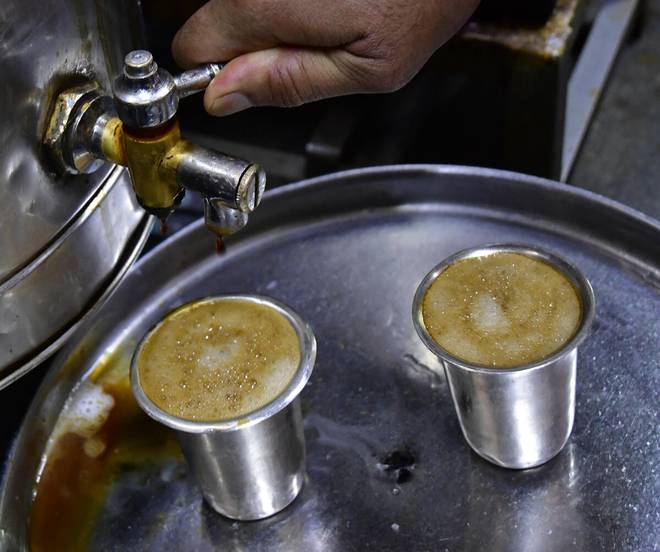
A file photo of a server collecting coffee from a container in a restaurant. | Photo Credit: K. Murali Kumar
‘Nations should jointly combat issues in coffee sector’
Coffee growing countries, India, Brazil, and South Africa, should collaborate to combat common challenges they face such as global price volatility, high cost of production, and labour shortage, suggested International Coffee Organisation (ICO).
At the opening session of the two-day IBSA Coffee Festival on Wednesday, ICO executive director Jose Sette said India, Brazil, and South Africa had several opportunities to work together to address common issues they face in the coffee growing, processing, and marketing fronts.
India produced over 3,20,000 tonnes of green coffee in the last harvest season that ended in March 2021. Karnataka alone accounts for over 70% of the country’s total coffee production, with Kodagu, Chikkamagaluru, and Hassan districts being the State’s coffee heartlands.
Coffee Board chairman M.S. Boje Gowda said, “It is great that we are joining hands with the international coffee community to improve the coffee scene of India and this exercise means a lot for coffee farmers across the country, and especially for an army of them in Karnataka.”
Suresh K. Reddy, Ambassador of India in Brazil, said coffee production had increased 34% in that country in the last two decades although the area under production had only reduced. Indian coffee community had to adopt cost-effective growing techniques and yield enhancing practices from Brazil, he recommended.
“We are also looking forward to collaborating with Brazil in enhancing domestic consumption of coffee in India,” said Mr. Reddy. India’s per capita coffee consumption is around 200 grams while it is 6 kg in Brazil.
Mr. Reddy further said time had come for the commodity apex body, Coffee Board, to position itself as a holistic organisation for the overall development, promotion, and growth of Indian coffee.
Jaideep Sarkar, High Commissioner of India in South Africa, said under the free trade agreements of WTO regime, it was tough for individual governments to promote their own coffees beyond a point and therefore working together was the best option for the global coffee growing community.
Andre Aranha Correa do Lago, Ambassador of Brazil in New Delhi, said, India was beginning to see a lot of speciality coffee coming via exports and this would open up newer opportunities for coffee entrepreneurs in India to process, value add, and re-export.
“We want to be part of the growing India coffee story and IBSA is an ideal platform for a unique partnership between these coffee producing countries,” Mr. Lago added.
source: http://www.thehindu.com / The Hindu / Home> News> States> Karnataka / by Mini Tejaswi / Bengaluru – August 05th, 2021
In what could be more financial stability for coffee growers in Odisha, Tata Coffee has agreed to procure coffee from the State. Announcing the development, Chief Minister Naveen Patnaik today informed coffee procured from growers in Koraput district by the Tribal Development Co-operative Corporation of Odisha Ltd (TDCCOL) will be sold by Tata Coffee across the country and abroad.
Patnaik further informed Tata Coffee has agreed to keep the uniqueness of Koraput Coffee intact while selling it in the market.
He hoped the cooperation of Tata Coffee will help the socio-economic development of coffee growers in the State. This will also ensure livelihood of tribals get secured, the Chief Minister added.
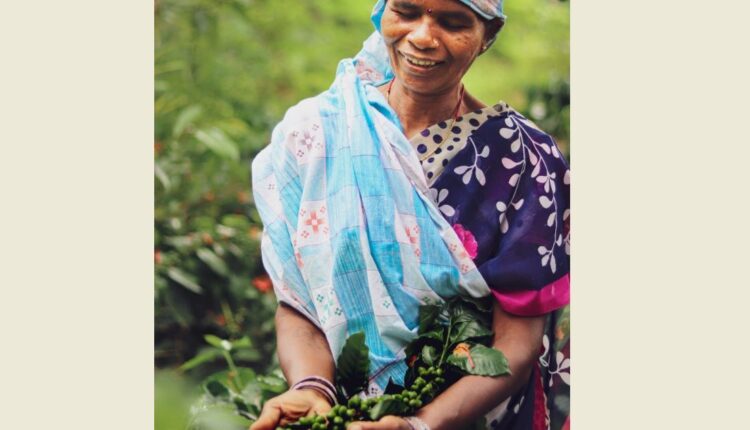
He heaped praised on Sulochana Khara from Kasamapadar village and said, “Khara has set an example for others as a successful coffee grower by selling over 200 kg coffee beans to TDCCOL. Her contribution in popularizing Koraput Coffee is commendable.”
The State government provided forest land rights of 46,000 acres to 30,000 families till June 2021. The TDCCOL procured 28,790 kg coffee beans from 193 tribal coffee growers in Laxmipur, Kashipur, Dasmantpur, Nandapur, Lamataput, Koraput and Pottangi blocks of Koraput district in 2020-21.
Official sources said the government targeted to grow coffee in 80 hectares more in 2021-22.
source: http://www.sambadenglish.com / Sambad English / Home> Odisha Latest / by Sambad English Bureau / August 08th, 2021
Venkatraman Srinivasan holds a Bachelor’s Degree in Commerce from the University of Bombay and is a Fellow Member of the Institute of Chartered Accountants of India since 1981.
Tata Coffee Ltd has informed that the Board of Directors has appointed Venkatraman Srinivasan as an Additional Director of the Company to hold office as Non-Executive Independent Director, with effect from July 28, 2021.
Venkatraman Srinivasan holds a Bachelor’s Degree in Commerce from the University of Bombay and is a Fellow Member of the Institute of Chartered Accountants of India since 1981.
He is a partner in V. Sankar Aiyar & Co., Chartered Accountants, since 1984. He is engaged in audit & assurance practice and direct tax & corporate advisory services since 1984, specializing in statutory audits of banks, mutual funds and financial companies, public sector companies, and advisory in the areas of direct tax, company law, competition law, the Foreign Exchange Management Act (FEMA) and Securities and Exchange Board of India (SEBI) matters.
He has a work experience of over 35 years. He was a special invitee on the Accounting Standards Board of the Institute of Chartered Accountants of India for the F. Y. 2020-21 and was a special invitee on the Ind AS Transition Facilitation Group Committee of the ICAI for the F.Y. 2019-20.
He has been Co-opted as a Member of the Expert Advisory Committee of the ICAI for the F. Y. 2021-22. He has also participated in the case study based governance program on “Audit Committees in this New Era of Governance” at the Harvard Business School.
At around 12:50 PM, Tata Coffee was trading at Rs212.35 apiece down by Rs2.4 or 1.12% on Sensex.
source: http://www.indiainfoline.com / IIFL Securities / Home> News> Top News / by India InfoLine News Service / July 29th, 2021
Tamil Nadu has exported $ 55 million worth of coffee in year 2020, says a survey by Drip Capital, a global trade finance firm. Most of the exports consist of instant coffee, the company said in a press release on Wednesday.
To retain the growth of their global market share, exporters should continue developing trends in the instant coffee market, the release said. Research indicates that many other States in the country could benefit by following Andhra Pradesh in setting up several coffee processing plants, it said.
While COVID-19 did stir things up in the sector, the survey shows the popularity of the Malabar coffee has increased and its volume of export grew at 7 per cent compound annual growth rate (CAGR) in the last decade ending 2020 with the value of exports rising at 11 per cent CAGR for the same period.
“The global appreciation for this variety of coffee in the market will help it command a higher price. Already taking advantage of the trend, certain micro coffee estates and roasters are currently trying to tap into this new opportunity on a small, experimental scale. With further aid from the Coffee Board of India and the government, coffee producers in the country could take this highly popular specialty coffee to greater heights, co-founder and CEO of Drip Capital, Pushkar Mukewar, said in the release.
source: http://www.freepressjournal.in / The Free Press Journal / Home> Business / by PTI / July 28th, 2021
Andhra Pradesh, the country’s second-largest exporter of coffee, exported coffee worth $142 million in the financial year 2020-21.
Vijayawada:
Andhra Pradesh, the country’s second-largest exporter of coffee, exported coffee worth $142 million in the financial year 2020-21.
The State government is encouraging the coffee production in Araku valley and other places during the past few years. The share of Andhra Pradesh accounts for more than 50 percent of India’s instant coffee exports.
The State possesses many manufacturing plants that process green coffee beans to instant coffee, which commands a 31 percent share in India’s coffee exports basket.
Drip Capital Inc, a global trade finance company, recently released a report examining the coffee trade across different regions of India. From analysing proprietary and publicly available data, getting insights from coffee exporters in the country, to understanding several emerging market trends brewing in the industry, the report speaks in-depth about the dynamics of the coffee sector.
The coffee exports from this region have been growing at a 3 percent over the past five years. The largest and the most famous coffee-growing region in Andhra Pradesh is Araku valley plantations.
According to the Coffee Board of India, on average, 3100 MT of (mainly) Arabica coffee is harvested from this region. Exports of instant coffee are rising from Andhra Pradesh due to increased export value realisation for the commodity.
Pushkar Mukewar, Co-Founder and CEO, Drip Capital, said, “as a commodity, instant coffee enjoys the product feature of convenience- a quality in high demand and vital to today’s global, fast-paced life. Hence, Indian exporters must stay abreast of developing trends in the instant coffee exports market. Also, to boost India’s overall coffee exports, many other States could benefit from mimicking Andhra Pradesh by setting up several coffee processing plants.”
source: http://www.thehansindia.com / The Hans India / Home> News> States> Andhra Pradesh / by Hans News Service / July 26th, 2021
Kolkata-based Country Bean has seen 200 percent growth compared to pre-pandemic sales. But competing with venture-backed D2C coffee brands and FMCG biggies is going to be a challenge.
When Aditi Somani Satnaliwala returned home after finishing her undergraduate course from the University of Warwick, England, in 2013, the one thing she missed about her stay abroad was her morning flavoured coffee.
“A good cup of coffee is so important for me and it was so accessible while I was studying abroad. In India, flavoured coffees were not easily available. Even if it was, a common person could not afford to have it every single day because of the prices,” Aditi tells YourStory.
She then started contacting a few suppliers in the UK, who would let her become the supplier of their flavoured coffee. “But that didn’t work out. Many didn’t trust me due to the lack of experience in the import and export field,” she says.
Aditi resorted to experimenting by adding flavours such as caramel and coconut to her instant coffees, and that’s where the wheels for Country Bean started rolling.
Launched in 2017, the Kolkata-based brand offers coffee flavours like caramel, hazelnut, and coconut. Recently, the startup has added more flavours like cocoa mint, berry, and cardamom to its portfolio.
“Some variants, including caramel and vanilla, are our permanent flavours. But we experiment a lot with different flavours during festive and other seasons of the year. Last year, during monsoon, we launched cardamom flavoured coffee, and our customers liked it so much that we ended up putting it on our permanent menu,” says Aditi.
After close to a year of the launch, Aditi’s husband Aneesh Satnaliwala, a former investment banking analyst from Goldman Sachs and founder of multiple startups, joined the direct-to-consumer (D2C) coffee brand as the co-founder.
The business
The startup gets almost 90 percent of its sales from online channels, including its own website, and ecommerce marketplaces such as Amazon and Flipkart, among others. The remaining 10 percent comes from selling through retail channels such as Future Group’s gourmet grocery store Foodhall.
Country Bean claims to have seen 200 percent growth in business from pre-pandemic levels, with its customer base reaching 2.5 lakh till date from 50,000 customers in the initial days of the business. However, the bootstrapped startup did not reveal the amount invested in the business so far.
Growth during the pandemic
The pandemic has been extremely beneficial for D2C brands as a whole. Locked in consumers had no choice but to shop through online channels, making new brand discovery much easier.
The sector leaders saw improved bottom lines, including cosmetic D2C brand Sugar, which saw its highest sales in November 2020, and D2C baby and mother care brand MamaEarth, which reached a valuation of $300 million after reaching a revenue run rate of Rs 700 crore.
Another Kolkata-based D2C skincare brand Dot and Key, which was launched in 2018, saw 30x growth in the last three years of the business.
Country Bean also saw its repeat purchases reaching 25 percent during the pandemic, and the average order value reaching between Rs 500 to Rs 1,000.
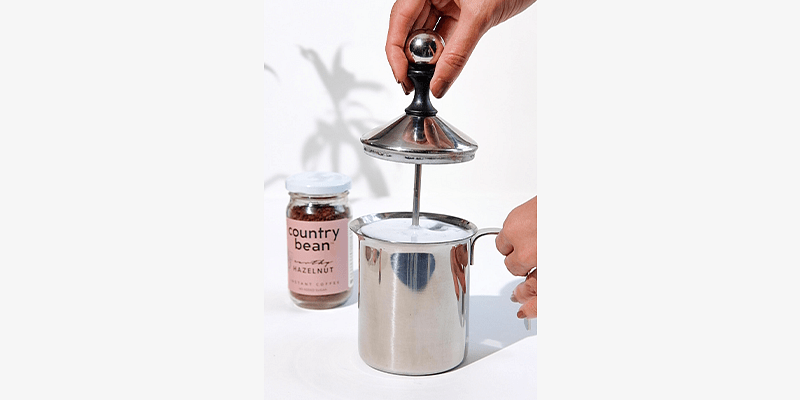
The brand has already started expanding its offerings with Hazelnut Latte and Dalgona spreads, and coffee accessories like milk frother and coffee mugs.
The market and competition
According to Statista, the Indian coffee and tea market grew to Rs 420 billion in 2017 from about Rs 252 billion in 2013.
Country Bean’s proposition might be a unique one, but the brand is operating in a space where the competition is growing consistently.
The flavoured-coffee brand sees competition not just from Rukam Capital-backed Sleepy Owl, Fireside Ventures-backed Slay Coffee, and Blue Tokai Coffee Roosters, but also from FMCG giants.
To capitalise on the increasing online shopping of niche brands, Tata Consumer Pvt. Ltd. launched a premium coffee brand called Tata Sonnets last year for high-income consumers.
While Aditi claims she does not take too much pressure about keeping strict product launch targets, the brand keeps working on five to six products at a time and aims to launch two to three products every quarter, with three to four potential products always in the pipeline. Currently, the brand is working on a few products, including coffee flavours and spreads to launch in the upcoming quarters.
The only way Country Bean can stay ahead in this crowded market is by keeping its offerings fresh and unique.
source: http://www.yourstory.com / Your Story / Home> Start Up / by Prasannata Patwa / July 10th, 2021
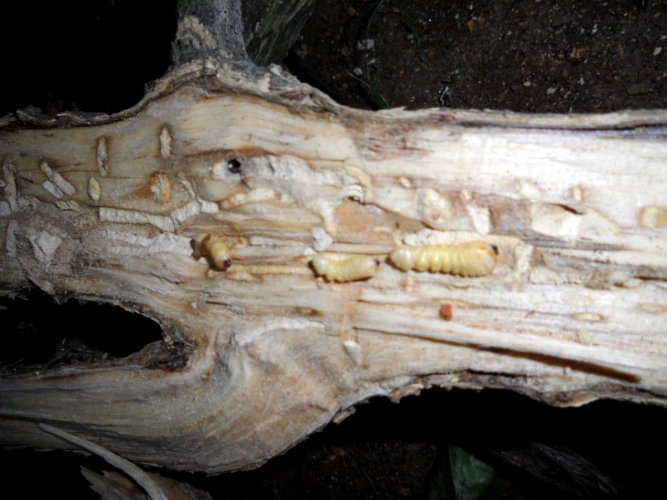
White stem borers destroying a coffee plant. Credit: DH Photo
Arabica and Robusta coffee varieties grown in Kodagu are known for their quality.
Robusta variety is grown mostly in Madikeri and Virajpet taluks, while Somwarpet is known for arabica coffee.
The weather of Somwarpet is the best suited for the arabica variety, say the growers.
However, there are a lot of challenges before arabica coffee growers, the major one being the infestation of white stem borer (Xylotrechus quadripes).
The adult borers feed on the stem of the coffee plant and lay eggs inside the stem. Their season of reproduction is the months of March and April. During this period, the stem borers lay eggs on all plants in the coffee plantation.
In Somwarpet taluk, coffee is grown on 28,540 hectares of land. Arabica coffee is grown on 22,940 hectares and robusta is grown on 5,600 hectares.
Many growers have been switching to robusta as arabica is infested by the white stem borer.
Fed up by the borer menace, the plantation owners themselves have been asking the workers to uproot the arabica coffee plants that were nurtured for many years.
A lack of proper control measures is also one of the main reason for the growers to destroy the plants.
The arabica variety of coffee requires more care as compared to robusta. Meanwhile, the labour cost and the production costs are increasing, among other expenses towards manure and fertilisers.
Adding to the problem, the market rate is also disappointing the farmers.
Control measures
Experts have come up with a technique to trap female borer, by using the artificial pheromones of male borer insects, say authorities of the coffee board.
B R Jayendra, a coffee planter from Bettadalli, said that the control measure of white borer is consuming a lot of time, in the existing methods available.
By the time the borers are controlled, almost all plants are destroyed. Effective control measures are needed to save arabica coffee.
Taluk Coffee Growers’ Association president Mohan Bopanna said that the coffee planters are going through difficult times.
Like the Kerala model, the Karnataka government too should announce support price for coffee growers. The loans of coffee growers who are facing difficulties should be waived, he added.
Another coffee planter S M D’Silva from Abburukatte said it is almost impossible to destroy the affected plants at a time.
The small grower will be hit hard if they destroy all coffee saplings in the plantation, he said.
source: http:///www.deccanherald.com / Deccan Herald / Home> State> Mangaluru / by DHNS, Somwarpet / June 28th, 2021
WELCOME. If you like what you see "SUBSCRIBE via EMAIL" to receive FREE regular UPDATES.
Read More »