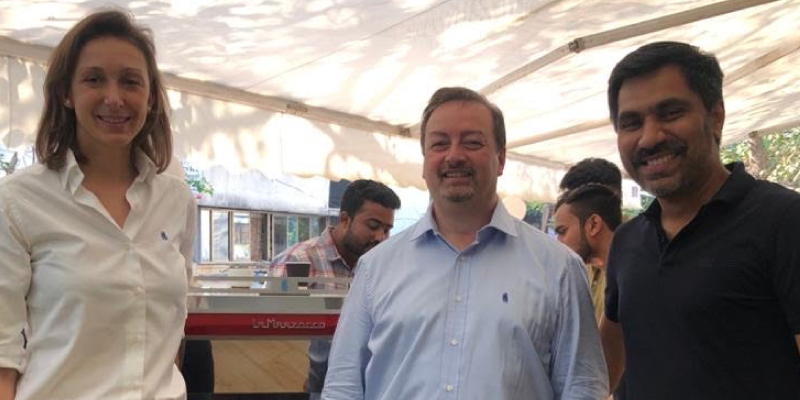
Dr. Pieter Vermeulen, left, and Neiba Kronu during an interaction with media persons on Wednesday in Kohima.
Kohima (EMN):
According to a coffee connoisseur, coffee from Nagaland has a ‘unique taste’ and if produced on a large scale, it has the potential to ‘achieve sustainable income for years as well as shape country’s economy.’
Nagaland coffee is grown in the jungles and absorbs a natural environment of forest filled with wild berries, rich soil, and trees, making the coffee flavour unique, said Dr. Pieter Vermeulen, a coffee expert from South Africa and founder of Naga Coffee Private Limited.
Interacting with media persons on Wednesday in Kohima, he said Nagaland coffee is coming in at the right time when production worldwide is decreasing. Due to Climate Change, a lot of coffee producing countries have opted for alternative plantations instead of coffee. Nonetheless, the demand for crop worldwide is “very high,” particularly in the European and Arab countries, Vermeulen said.
He urged farmers of the state to seriously take up coffee plantation as it will give a sustainable income from the next few years of their planting. Further, growing coffee will produce work for other people thereby creating employment opportunities. He called upon the educated unemployed youths to start coffee enterprises.
Unlike other perishable products from Nagaland, the lifespan of coffee is very long, he said. A raw coffee can be kept up to a year while the processed coffee can last for two years. As for the coffee, he said to have established infrastructure and had exported them as well. In fact, his company can process 20 tonnes of coffee per week. As a company, he said to be ready to receive coffee.
The only challenge is that there is not enough coffee in the state and the company needs more. Therefore, he encouraged people to start planting quality coffee.
Speaking on customers’ point of view, the coffee connoisseur said people look for specific things when buying coffee. Being organic and being sustainable and unique are some of the key qualities buyers look forward to. According to him, all these qualities are found in Nagaland coffee.
Unlike in South America where people cut forests to plant coffee, farmers in Nagaland preserve forest and plant coffee, which is sustainable and nature-friendly, he said. Concerning the variety of coffee in the state, he said each region has a different taste because of the climate differences.
Earlier, the minister for Planning and Coordination, Land Revenue, and Parliamentary Affairs, Neiba Kronu said Nagaland can produce “speciality grade coffee” and had encouraged people of Nagaland to grow coffee.
In the past, there were no experiments and farmers were asked to grow randomly, which at times discouraged farmers. However, the situation is different now; things are being experimented and studied, he added.
The Land Resource department of Nagaland in collaboration with the Coffee Board of India has assisted farmers to develop around 1816.2 hectares during 2019-20 in the state. Presently, the area that has coffee plantation stands at 7996.2 hectares covering eleven districts of Nagaland.
The Naga Coffee Private Limited, with its holding company Noble Cause Private Limited based in South Africa, was started in 2016. It has a standing Memorandum of Understanding with the Land Resources department of Nagaland to processes and export coffee to the global market for 30 years.
According to the department 27.5 metric tonnes of raw coffee beans were exported till 2019, while 18 metric tonnes of roasted coffee have been exported so far.
source: http://www.easternmirrornagaland.com / Eastern Mirror / Home> Kohima / by Eastern Mirror / March 06th, 2020
In a bid to give a fillip to tribal economy and enhance the market value of processed coffee, the Koraput district administration in association with the Coffee Board has distributed baby pulpers to beneficiaries, officials said.
Baby pulpers, also known as potable pulping machines, are used for wet processing of coffee and the extract which comes out from the machines is called plantation or parchment coffee.
“At present, over 70 per cent of coffee is processed through traditional dry method in the district which decreases the market value of the beverage. In this method, coffee beans are dried in sunlight,” said Ajit Kumar Rout, senior liaison officer, Coffee Board.
Through wet processing, the market value of coffee increases about 55 per cent more than the dry method, he said.
To begin with, as many as 20 such pulping machines have been distributed among tribal beneficiaries of the district on Friday, officials said.
Koraput Collector Maadhusudan Mishra said, baby pulpers will not only improve the quality of the variety of coffee grown in Koraput but also improve the condition of the tribal people engaged in coffee processing.
“When the market value of the coffee increases, it will fetch good price in the market which will subsequently improve the financial condition of the tribals engaged in coffee processing,” said Mishra.
According to a departmental survey, as climatic condition of Koraput is conducive for coffee plantation, it has been found that at least 1.45 lakh hectares in the district is suitable for coffee plantation. Currently, only 1,467 hectares is under coffee plantation in the district, the officials said.
PTI COR SKN MM MM
source: http://www.outlookindia.com / Outlook / Home / source: PTI / march 15th, 2020
In a tea-loving nation, Abhinav Mathur of Kaapi Machines is bringing coffee to the homes of regular households, and to workplaces of the tech-savvy Gen Z.
In an interview, he shared his insights into the world of coffee.
Did you know that espresso has just one-third of the caffeine content of a cup of regular coffee? Or that the density of a filter paper can bring about a vast difference in the taste and flavour of your coffee? And that 40 percent of the world’s coffee is produced by Columbia and Brazil?
Abhinav Mathur, CEO, Kaapi Machines has over 15 years of work experience, working with organisations which include Stovekraft, Indulge Beverages, Stanley Black & Decker, and Philips Consumer Lifestyle. As the CEO of Kaapi Machines, Abhinav has been instrumental in bringing in several new-age coffee equipment into India, including the Ripple Maker, PuqPress, and Nitron, and his objective has been to equip consumers with technology that will help them raise the quality of coffee in India.
In an exclusive chat with YS Weekender, Abhinav says, “Coffee is the new romance story that Indians are indulging in, and it is definitely here to stay.”
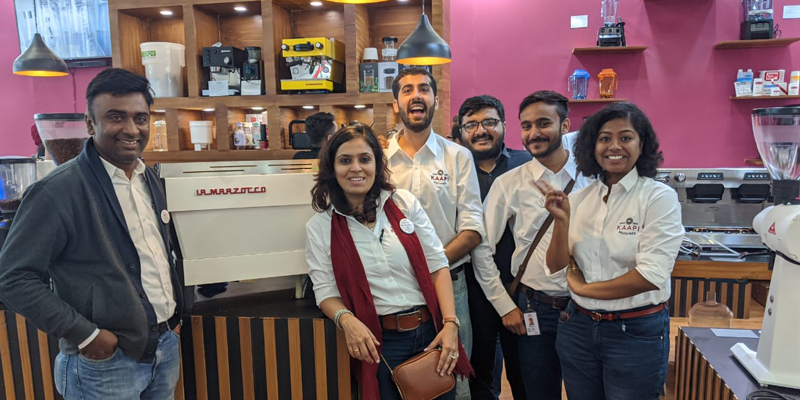
L- R: Julia, Modbar; Mike Khan, La Marzocco; Abhinav Mathur, Ceo, Kaapi Machines
Edited excerpts from the interview
YSWeekender: What do you think has changed for coffee over the years in India?
Abhinav Mathur: India is among the top 10 coffee-exporting countries in the world. As a nation that enjoys coffee, we have come a long way from exporting coffee outside India, to now having a modern generation of growers and roasters, creating artisanal speciality coffee for the local market.
Currently, we are in the third wave of coffee, where the quality of coffee is traced from the end beverage in the cup back to the actual coffee bean. Today, it has moved on from being merely filter kaapi or phenti hui coffee – to a scenario where consumers like to indulge in cold brews, nitro brews, and coffee cocktails.
With the increasing presence of local growers and passionate home-brewers taking interest in their morning cuppa, coffee has come a long way from simply being just another drink in a tea-loving nation. Further, the growing trend in consumption is a positive indicator of how India might become one of the largest coffee-producing countries in the world.
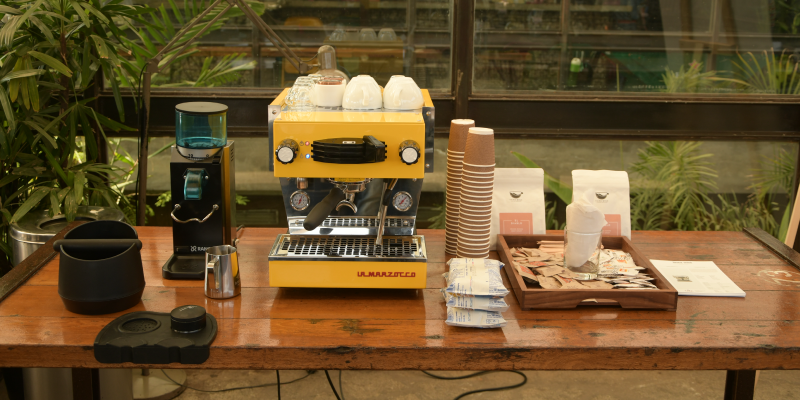
An espresso machine by La Marzocco which has partnered with Kaapi Machines.
YSW: How have the coffee flavours evolved in India?
AM: Coffee in India is no longer just a southern phenomenon or a market that is satisfied with instant coffee. With the advent of café-chains, an interesting new set of consumers emerged who were interested in tasting freshly brewed coffee and learning more about it. The new breed of coffee-entrepreneurs is bringing the joy of relishing coffee to the market. This coffee goes through different stages of roasting and grinding, where different flavours have been experimented with.
Coffee flavours can be distinguished, based on aroma and taste, besides acidity, bitterness, sweetness, and body. Many flavours are dependent on where the coffee is grown, how it is processed, and how it is roasted.
Roasters in India are trying to create interesting taste profiles to offer variety and raise the quality of coffee in India.
Currently, coffee flavours come in brilliant notes that showcase the conscientious zeal of the growers behind it. With coffee production not being restricted only to production, passionate artisanal coffee lovers are making it their playground to infuse innumerable flavours in the coffees.
This spectrum is huge – one can sip on flavours that boast of nutty-cherry flavour, notes of berries, or those with a sweet acidic taste and fruity notes. At Kaapi, we try and educate coffee-lovers and customers, not only on the basics of coffee tasting through our cupping sessions, but also helping them understand the entire coffee flavour wheel.
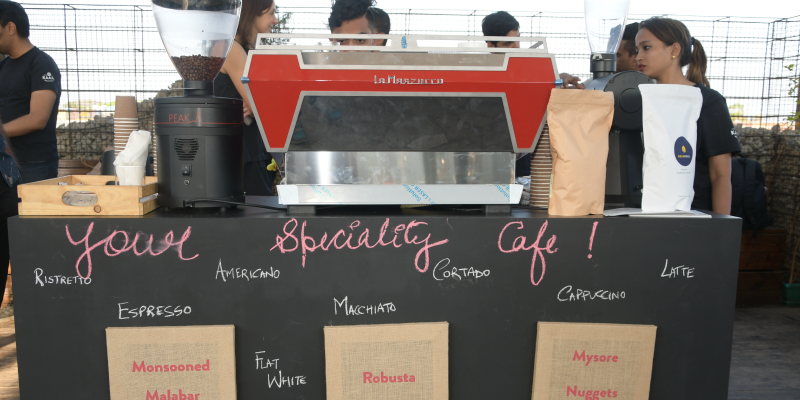
La Marzocco’s artisanal espresso machine on display, which has tied-up with Kaapi Machines.
YSW: What is your opinion on the niche micro-breweries? How are they faring?
AM: Micro-roasteries in India offers consumers a chance to see the entire coffee processing in one place. This was made famous internationally by Starbucks through its “Reserve Stores”, but now you can find roasteries in all major Indian cities, including smaller cities like Jaipur and Nagpur.
These roasteries are driving the consumption, awareness, and elevating the quality of coffee in India. They are also making coffee a preferred drink and not just a cool drink. While it’s early to comment on their commercial success, they are the torchbearers of quality coffee in the country.
Additionally, these places serve as vanguards of new experiments. They are pushing the café culture’s existence from a simple cappuccino to savouring black coffee.
Kaapi Machines has set up a number of such roasteries and our product range starts from coffee roasters and moves to coffee grinders, brewing equipment, and accessories.
We also engage with such roasteries for our coffee meet-ups to encourage the coming together of the coffee community.
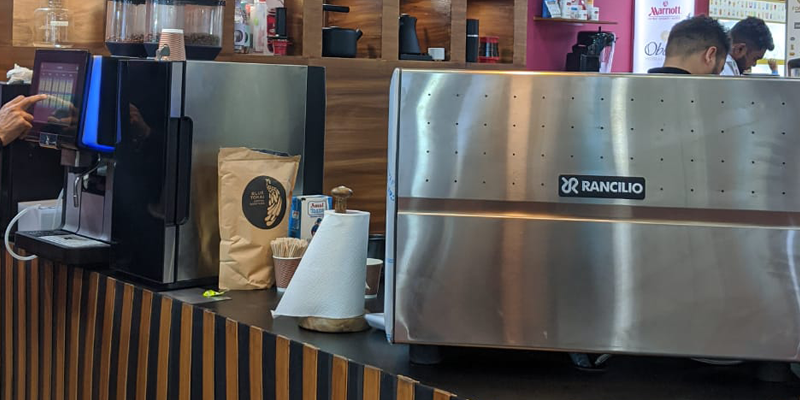
Kaapi Machines’ represents brands like Rancilio which provide equipment for coffee-making.
YSW: What is your opinion on artisanal coffee?
AM: At present, artisanal coffee is a celebration and rediscovery of regional flavours that are essentially Indian – from sourcing to packaging, or as often described as “from bean to the cup”.
The detailed attention on the right harvesting techniques or how the beans should finally be sourced – these have contributed to elevated coffee experiences.
Today, new-age artisanal brands like Blue Tokai, Third Wave Coffee Roasters, and Dope Coffee are making waves in this space in India, and we provide equipment to all of them
YSW: India is better known for its tea. Why do you think people have shifted to coffee?
AM: Coffee is not just a drink, but a ritual for many.
Undeniably, Karnataka and Tamil Nadu have been the key coffee production estates, but with the growing interest in coffee, many other regions in the country are producing coffee. The market is filled with appliances that homeowners can experiment with to enjoy their favourite cuppa in the morning.
One key reason for the growth of coffee is because of the inherent complexity of the beverage, as well as the varied methods for brewing.
YSW: A lot of health experts are divided on the health benefits of coffee. What is your opinion?
AM: There are mixed reviews on health and coffee, but we can only say good coffee should be enjoyed without milk and sugar, as this is definitely low on calories. I would say – have coffee, not because of health reasons, but because you enjoy it.
YSW: What are some of the varieties of coffees found in India and abroad?
AM: In India, mainly two types of coffees are found – Arabica and Robusta. The weather conditions are more apt for Robusta. However, we grow Arabica as well. India has three well-known specialty coffees – Kaapi Royal, Monsoon Malabar, and Mysore Nuggets.
Not a lot of international coffee makes its way to India due to high duties, and bigger markets like Europe, the US, and Australia which have a high consumption rate. However, several African, Asian, and South American countries are coffee growers.
YSW: Several Indian brands are offering speciality coffee which is priced very high. Are they really special and worth buying?
AM: Yes, we have several speciality coffee brands now in India. India’s tryst with speciality coffee began a few decades ago but has gained momentum only recently. Speciality coffee is distinguished based on its origin, cultivation, processing, handling, branding, and the final appearance.
Speciality coffee is not an easy feat for growers, roasters, and baristas, as all of them must follow standards defined by the Speciality Coffee Association (SCA) to maintain consistency and quality. The best of cherries to the best of beans are roasted and made by SCA certified roasters and baristas, so that the consumer can savour the best flavour profiles.
Most of the cafés serving specialty coffee prefer to procure and roast specialty coffee to maintain consistency and quality. Local coffee shops or the ones backed by artisanal coffee efforts are slowly introducing pour-over brewing devices and offering coffee as an experience and not merely another beverage.
The thirst for a great coffee or the inclination to try speciality coffee could be attributed to the thirst of the well-travelled consumer who is looking for local options across India.
Kaapi Machine employees and baristas posing with La Marzocco’s espresso machine.
YSW: What kind of equipment does Kaapi Machines have in its store?
AM: Kaapi Machines product portfolio offers options for roasters, automatic coffee machines, semi-automatic coffee machines, ice blenders, grinders, as well as new-age equipment for cold brew, nitro, and more.
YSW: How did you come up with the idea of Kaapi Machines?
AM: We decided to launch Kaapi Machines in 2005 when we realised that while the café segment was starting to grow, there was no competence in training, machines, and after-sales service to help coffee entrepreneurs launch coffee brands and cafes in India.
We brought together market-leading companies from Germany, Italy, and the US to form this organisation, under the guidance of coffee experts from India and abroad.
As the speciality coffee culture continues to grow, the need for trained baristas, roaster, and producers has never been so important. Understanding this need-gap, we have been closely working on training programmes for new café owners, café staff, coffee aficionados, baristas, and anyone who wants to learn what it takes to make a good cup of coffee.
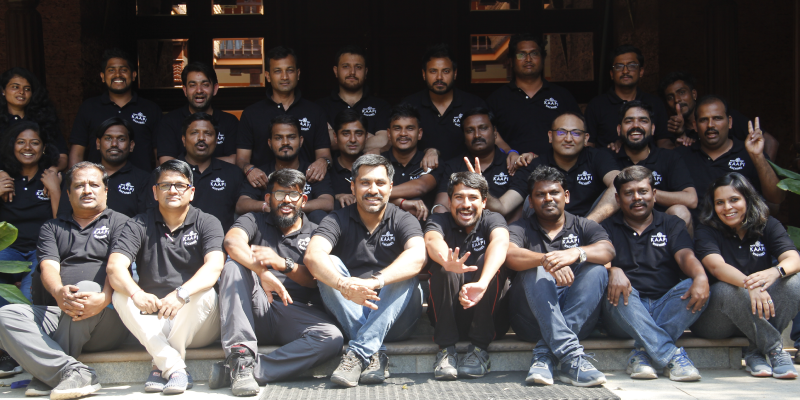
Team Kaapi Machines
YSW: What are your future plans?
AM: Today, the market gaps mainly include scattered coffee experience, multiple channels of information with no integrated credible expert voice. We want to create one destination for coffee and community, from training, events, machines, beans, and roasting, as well as access to industry coffee experts which the consumer can find under one umbrella.
We believe there is a lot of work to be done until each Indian consumer can truly experience a great cup of specialty coffee.
(Edited by Asha Chowdary)
source: http://www.youstory.com / YourStory.com / Home> YourWeekender> Food & Beverages / by Suman Singh / March 07th, 2020
Coffee growers are happy as the market rate of Arabica parchment has reached a record rate of Rs 10,000 for a bag of 50kg. The rate has been the highest in the last eight years.
As on Wednesday, a 50kg bag of Arabica Parchment coffee was sold between Rs 10,400 to Rs 10,500, which according to the vendors, is the highest rate for Arabica parchment.
The cost of Robusta Parchment has increased to Rs 7,000 per bag. The last time when Arabica coffee reached the highest rate was in 2014. It was Rs 9,600 to Rs 9,800 per bag then. Later, the price moved downward and had touched Rs 6,000.
Arabica cherry costs Rs 4,000 per bag while the rate of Robusta cherry is Rs 3,200 to Rs 3,400 per bag.
Growers in Kodagu, Chikkamagaluru and Hassan have expressed their happiness on the improved market rate of coffee, despite problems of shortage of labourers and feasibility issue in the maintenance of the plantation.
The vendors said that the rates of Arabica parchment might increase further. Expecting the same, the growers who have stored coffee in ABC and other curing centres have decided to sell coffee after it hits an all-time high.
The increase in the rate of coffee was due to a significant decrease in production in Brazil and Columbia. There was a plunge in the production of coffee in Chikkamagaluru, Kodagu and Hassan districts as well, owing to floods. This has created an increase in demand.
Even though the market rates have increased, the quantity of coffee production is significantly less compared to previous years. The growers who grew 50 bags of coffee in the past have ended up producing only 10 bags of coffee.
“The coffee plants have been damaged due to the water-logging of the plantation. It might take another four years to restore the coffee plantations to its original condition,” said coffee grower Nanaiah.
Coffee vendor Abdul said that around 60% of coffee growers have sold their coffee. Those who had stored coffee have reaped benefits.
source: http://www.deccanherald.com / Deccan Herald / Home> States> Mangaluru / by Adithya K A / Madikeri – March 04th, 2020
Visitors are encouraged to make their own blends, including weighing, mixing, roasting and grinding.
The plantations offer homestays and resort, perched on stilts. (Photo: The Tamara Coorg)
The lashing rain from the night before had simmered to a soft drizzle this morning. The clouds had parted, and the sundeck of our wooden cottage, perched high on stilts, afforded a resplendent view of coffee country Coorg. The freshly bathed dimpled-green Western Ghat hills rolled away as far as the eyes could see. Acres and acres of coffee and spice plantations dotted the landscape, intermingling with lush forests. The gushing sound of a waterfall drifted in from close by, blending with the rustling of leaves. Below us, as our resort’s plantation was waking up, we set out to witness first-hand the journey of coffee — from bean to cup.
With tall silver oak, teak, rosewood and other trees lending shade to coffee shrubs in the plantations, Coorg offers a gorgeous setting to observe the process of coffee production. Karnataka alone accounts for 70 per cent of the coffee produced in India, with the south-western districts of Coorg (locally Kodagu) and Chikmagalur producing the lion’s share. India, by some accounts, produces the finest shade-grown coffee.
Many of the plantations have homestays and resorts for anyone wanting to sample the plantation life. The deep dive into the coffee culture at our resort, sprawled over a 180-acre estate, begins right at check-in. You’re welcomed with steaming tumblers of delicious bellada coffee (Karnataka-style filter coffee with jaggery). The cottage-style wooden villas, in traditional Kodagu architectural style — sloping roofs, perched high on stilts — are placed at respectful distances from each other, for immersion into a planter’s private yet lavish lifestyle.
Umbrellas in hand, we follow our guide, through thick foliage and unending rows of coffee shrubs. Sharing interesting nuggets about the native flora that grows with wild abandonment, he points out the two main coffee varieties of Coorg — the hardy, disease-resistant Robusta and the better-quality, tastier, smoother and more expensive Arabica. A number of spices are often intercropped with coffee, such as peppercorn, cardamom, clove and nutmeg that help the coffee acquire lovely aromatics while adding a few prized cash crops in the planter’s kitty.
Each year, the life cycle begins with pearly white blossoms in February-March. Natural showers and sprinkler irrigation are crucial for their yield, which determine the amount of coffee harvested the following year. The blossoms turn into green berries and, then, a deep red when ripe, which are handpicked from November to February.
The walk is followed by a coffee-processing experiential programme at the little museum in the resort grounds. The ripe berries are dried and pulped to obtain the seed — aka coffee bean! The beans are sorted, blended and roasted in a traditional roaster. Encouraged to make our own blends, we weighed and mixed different percentages of the varieties according to our taste, put them in the roaster and hand-ground the divinely aromatic roasted beans into a fine powder — to be had as a hot brew right there, or carry back as a souvenir.
Back home, whenever I’d sip on my blend, I’d reminisce about the time I crafted it, and the scrumptious Coorgi lunch that followed, that rainy, misty afternoon.
Satarupa Paul is based in Delhi and writes on food and travel.
source: http://www.indianexpress.com / The Indian Express / Home> Eye / by Satarupa Paul / February 29th, 2020
Khadi and Village Industries Board (KVIB) Lamphel Chairman L Radhakishore conveyed that the board will be taking up the project of growing 10,000 acres of cotton in Jiribam district and substituting the poppy plants at hilly regions with coffee plantations.
He made this above statement during a calendar releasing function of KVIB in Lamphel today.
The Chairman continued that the calendar entails information about the achievements of the board and its upcoming projects.
He further stated that the N Biren led Government has taken up many initiatives and projects for revival and development of Khadi industries in the State.
The board had planted 15 acres of cotton in Jiribam district before, he said.
The State Government acknowledged the initiative of the board and recognised it as the pilot project of cotton plantation of Jiribam district.
Following this, the 10,000 acres of cotton plantation has been launched under the sponsorship of the State Government, added the chairman.
He stated that the cotton project will not be based only in Jiribam and explained that the district was chosen as the soil turned out to be compatible for cotton plants.
Maintaining that using imported clothing as well as yams has impacted the State’s economy, Radhakishore stated that people should start relying more on things which are produced in the State.
The cotton plantation project will help improve the State’s economic situation and the condition of the farmers as well, he added.
Conveying that coffee plantation will also help decrease unemployment of youths in the State, he said that KVIB had deliberated with the Chief Minister and his cabinet Ministers to start the coffee project.
Radhakishore maintained that so far, 2 lakh coffee seeds have been grown at hilly areas of the State and added that the board has set its target to plant seven lakh extra coffee plants.
He said that the board has received 100 kg of coffee seedlings from the Coffee Board of India and added that, as a pilot project, coffee seedlings nursery will be prepared and planted at Bishnupur and Jiribam districts.
source: http://www.e-pao.net / E-PAO / Home> Headlines / source: The Sangai Express / Imphal – February 12th, 2020
– Investors from Keiretsu Forum Chennai will also be participating
– Rage Coffee plans to expand its product line with the funding
– The company sells on ecommerce and 400 offline stores
New Delhi-based food & beverages brand Rage Coffee has raised funding in a round led by early-stage investment firm Refex Capital. Angel network Keiretsu Forum Chennai and some other “prominent” investors will also be participating in this round.
The list of participants include T.D Mohan, former joint MD of CavinKare; Dr Rajan Srikanth, co president of Keiretsu Forum Chennai and Singapore; Prakash Katama, former CEO of TVS Electronics; Uday Sodhi, former business head at SonyLIV, private equity investor Ajay Sarupria, actor Rannvijay Singh Singha; A. Kumar, Founder of Gemini Paints, and Sawan Gupta, MD at Spero Group.
Founder and MD of Wazir Advisors, Harminder Sahni, joined Rage Coffee’s board of advisors for the fundraise. Moreover, Sridhar Parthasarathi, who is the managing partner at Refex Capital, has also joined the Board.
With this funding, Rage Coffee will expand its product offering and omnichannel distribution, scale up production and strengthen its team. The company aims to “capture market share of the category devoid of any innovation – be it the ingredients, formulations, manufacturing techniques, packaging, distribution or use of data to be agile.”
Founded in 2018 by Bharat Sethi, Rage Coffee is a fast-moving consumer goods (FMCG) brand that deals in different varieties of coffee, without using any chemicals and is full of vitamins. The company claims to blend its coffee from plant extracts and natural compounds — Tea extract L-Theanine, fossil Ginkgo Biloba, L-Glutamine, and Panax Ginseng, among others.
Rage Coffee’s founder and CEO, Bharat Sethi, in a press statement, said, “Our approach to supply chain, sourcing, consumer segmentation, product R&D [Research and Development], D2C [Direct To Consumer] data-driven DNA combined with a hybrid distribution model and, most importantly, our close relationship with our customers places us in a great spot to build a brand that is truly poised to capitalise on the immense market opportunity.”
Rage Coffee retails its products through its website, other ecommerce platforms like Amazon and over 400 offline stores/touchpoints. The FMCG company plans to quadruple its sales and reach over 2000 outlets by the end of 2020. Rage Coffee will be banking on institutional and the foodservice industry — hotels, restaurants, cafe (HoReCa) business — to clock a significant chunk of sales.
To achieve its goals, Rage Coffee also appointed Arijit Mitra, former National Sales Head at Coke Beverages, as Director of Sales to grow the offline business in June 2019.
According to a Frost & Sullivan report, functional food & beverages in India is currently still in its initial stages growing at rate of 17.1% CAGR, expected to be valued at $4Bn in 2020. Some other players in this segment include Siliguri-based Udyan Tea, Mumbai-based Open Secrets and Bengaluru-based Hector Beverages with its brand Paper Boat.
In December 2019, Open Secrets raised funding in a round led by Matrix Partners India. Angel investors such as Paytm founder Vijay Shekhar Sharma, Snapdeal cofounders Kunal Bahl and Rohit Bansal and CEO of Godrej Consumer Products, Vivek Gambhir also participated in the round.
source: http://www.inc42.com / Inc42.com / Home> News / by Kritti Bhalla, Inc42 Staff / January 08th, 2020
Three-day event at Bangalore Palace to be organised by London-based International Coffee Organisation
Madikeri:
Bengaluru will host the fifth edition of the World Coffee Conference (WCC), a high-profile international event, between Sept. 7 and 9 in 2020. Earlier editions were held in the UK, Brazil, Guatemala and Ethiopia.
The three-day event that will be held at the sprawling Bangalore Palace will be put together by London-based International Coffee Organization (ICO), Ministry of Commerce and Industries, Coffee Board of India and India Coffee Trust (ICT), which is a forum for coffee growers and exporters.
The event is themed ‘Sustainability Through Consumption’ and will celebrate all things of coffee in an immersive experience with the conference addressed by international speakers, coffee exhibition, buyer-seller meets, competitions and awards, skill building workshops, amongst many others.
ICT President Anil Kumar Bhandari told reporters in Madikeri yesterday that the prestigious WCC coming to India for the first time means huge international recognition for Indian coffee. The Who’s Who from the world of coffee will be descending on Bengaluru for this event. This will give a fillip to the Indian cuppa in the global market. Over Rs. 15 crore is being spent to organise the conference, he added.
The participants will include the world’s leading coffee brands and café chains, retailers, roasters, equipment manufacturers, coffee organisations from round the globe, policy makers, industry captains, exporters, manufacturers and a whole host of players associated with the commodity.
Conference attendees
Around 3,000 international delegates from 80 countries, 2,000 Indian delegates, over 1,00,000 coffee growers and exporters, representatives of HORECA (Hotel/Restaurant/Café sector) and hundreds of coffee connoisseurs are expected. There will be more than 100 speakers, 150 exhibitors and over 300 business-to-business and business-to-consumer meeting.
Coffee being the world’s most favourite beverage with 2.5 billion cups consumed every single day is produced in about 70 countries most of them belonging to the developing countries like Africa, Latin America and Asia. India is the sixth largest producer of coffee in the world, accounting for about 5 percent of world coffee production.
Innovation to conference
At the conference, the Coffee Board of India and the International Coffee Organisation (ICO) will bring in innovation to the conference and expo by crowd-sourcing ideas from citizens. They will look at ways that will make Indian coffee a brand that is recognised worldwide and formulate ways to make India a sustainable destination for coffee.
Methods will be explored to make coffee farmers stakeholders in the value chain as this will have a positive impact on the 25 million families who depend on coffee cultivation the world over. “This is a great opportunity that India has got and the organisers will welcome to India participants from more than 80 countries for the expo and conference,” Bhandari said.
Connecting with growers
India is also emerging as the major coffee consuming country. The Government of India has also a strong focus on increasing coffee plantation and the global community also desires to connect with coffee growers in India and Asia and WCC-2020 offers an opportunity to explore India and Asia to the global coffee community.
Bengaluru is the coffee capital of India and produces nearly 70 percent of India’s coffee that is produced in Kodagu, Malnad, Hassan and Chikkamagalur. As the theme of WCC-2020 is sustainably through consumption because the world coffee production is increasing and having a negative impact on coffee prices, this can be offset by increasing consumption, therefore consumption is the key to sustainability. The focus will be on economic, agriculture, commercial, environmental, social and cultural impact.
source: http://www.starofmysore.com / Star of Mysore / Home> News / December 31st, 2019
The book constantly reminds you why we need coffee in our lives
Harish Bhat’s new book takes readers on an adventurous journey from the coffee plantations of Coorg to graveyards in Japan—to remind them of the joy a hot cuppa brings.
An Extreme Love Of Coffee is an adventure story running on a caffeine kick. It’s simple, fast paced and constantly reminds you why we need coffee in our lives, every day, maybe even every hour.
It’s also a tribute to Indian coffee blends.
After writing two books on business, marketing and consumer behaviour—The Curious Marketer: Expeditions In Branding And Consumer Behaviour and Tatalog: Eight Modern Stories From A Timeless Institution—Harish Bhat, the brand custodian of Tata Sons Pvt. Ltd and a Mint columnist, has published his first novel that blends coffee and magic, with enough servings of adventure and travel.
It follows a young couple, Rahul and Neha, who, after drinking a cup of “magic” coffee, are entrusted with a quest that promises to end in treasure. As they race from the lush green coffee plantations of Coorg to strange graveyards in coffee-loving Japan in search of the prize, they find Japanese assailants trailing them with swords, a friendly ghost and their passion for warm frothy concoctions and each other. A part of a poem by Neha sums up the spirit of the book: “Coffee love, do you rise like steam. Warm aromas that make my dream? With delicious magic by your side. On what carpet am I astride?”
The book reminds coffee-drinkers why they love the drink and gives non-drinkers enough reason to give it a try.
Write to us at businessoflife@livemint.compooja singh
source: http://www.livemint.com / LiveMint / Home> Explore / by Pooja Singh / December 17th, 2019
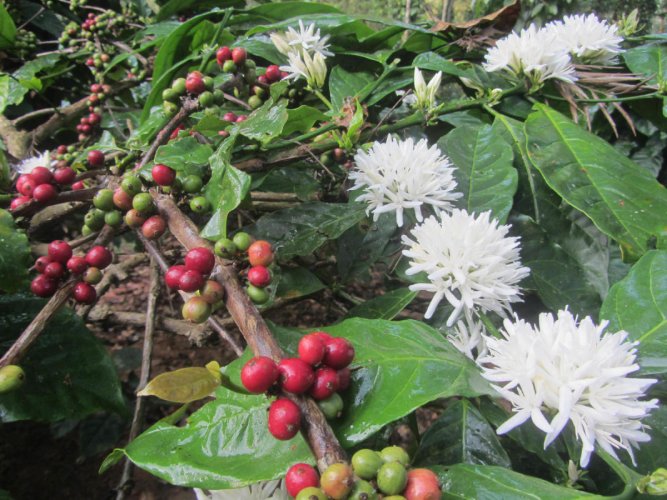
Coffee cherries and flowers. Photos by Author and Adithya K A
Coffee pervades the lives of people in Hassan, Chikkamagaluru and Kodagu districts. From the decades-old jaggery coffee to the current flavoured ones, coffee as a product has seen a huge transformation. What has remained unchanged is its association with almost anything momentous in our lives.
The journey of coffee to India is well- documented and etched in our memories through the story of Arab traveller Bababudan bringing seven coffee beans to Chikkamagaluru in 1670 AD. He sowed these seven seeds in Chikkamagaluru’s Bababudangiri hills (Chandradrona Parvatha). Today, India is world’s third-largest producer of coffee.
The earliest and most prominent coffee planters of the yesteryears in the country were the British. They introduced the system of check-rolls which is an attendance register of the labour. They maintained a diary which explained the daily activities in the estate to which the owner signed every day. These rather important systems are intact and in place even today, and any estate that you visit here will show you daily records from as back as 50 years ago!
These documents serve as important pieces of information for future generations. The British were particular about closing the accounts by the end of March wherein the savings and loans availed by the labourers were tallied. This tradition continues to this day.
Other customs that we have inherited are the practices of maintaining lush green and colourful gardens at our homes, rearing about half a dozen hunting dogs and possessing rifles and pistols for safety from wildlife.
Blossom shower
Coffee plantations receive blossom shower (rains) around March every year. Coffee estates that blossom with white flowers are a sight to behold. While this is a visual treat for us, this also guarantees a good crop for the coming year.The joyous mood is also seen before coffee picking when the entire family thanks god and prays before picking the berries.
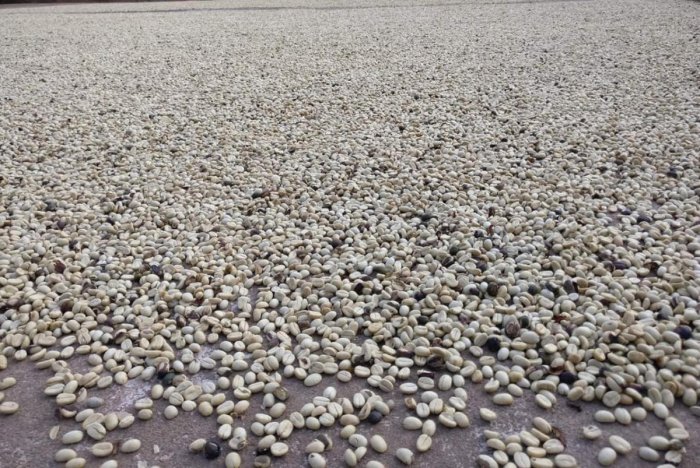
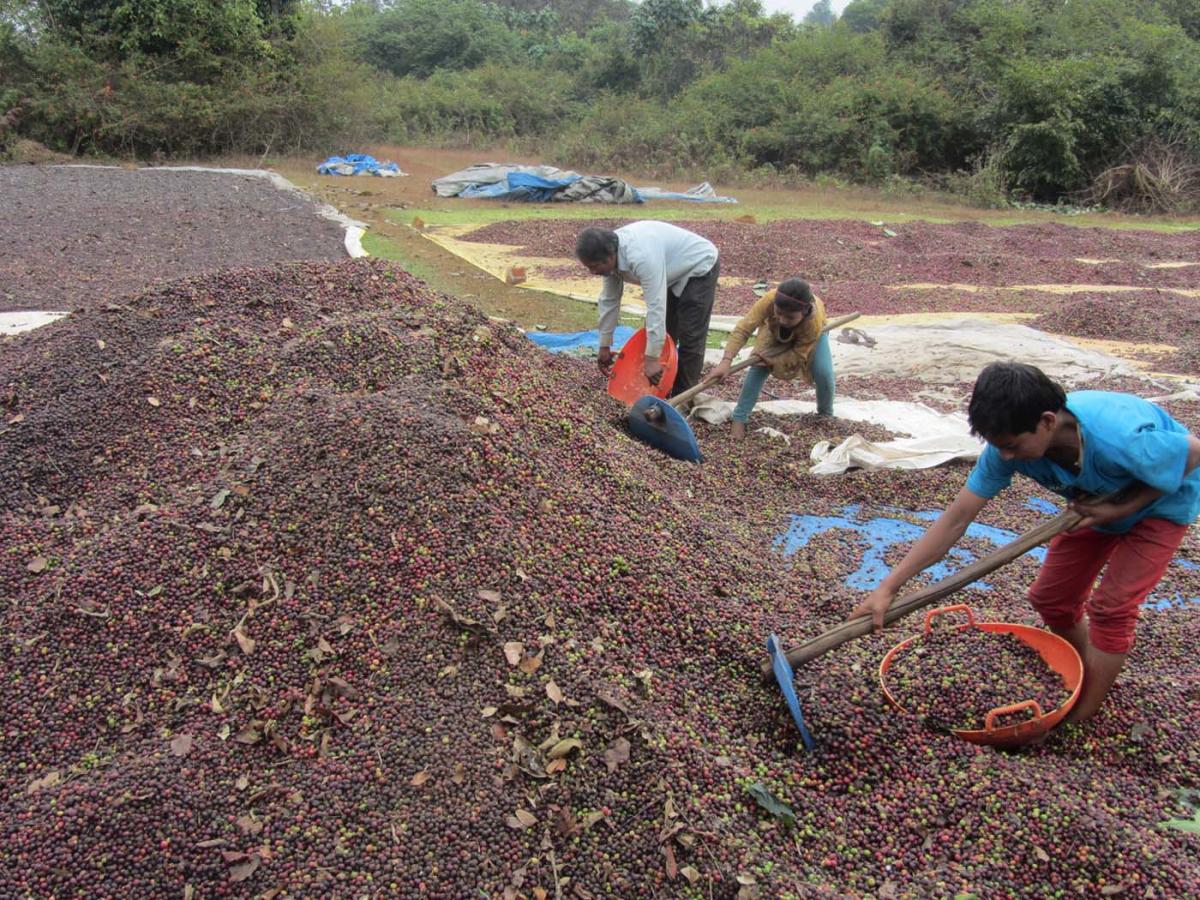
Cherries being dried
The book Bettadindha Battaligey by H N Nagegowda beautifully traces the history of coffee in India and also the culture associated with it.
Coffee estates coexist with thick and lush green forests in these Western Ghats districts. These estates are also home to a rich variety of endangered flora and fauna. Each year, hundreds of varieties of birds migrate to coffee estates. These plantations nurture forest species which act as nesting grounds for these birds.
Estate owners take an active interest in increasing the number of trees that they have on their lands. Artificial lakes and tanks in the estates quench the thirst of animals including elephants and tigers.
The vibrant culture of coffee land in the state could also be traced to the presence of major rivers such as Cauvery, Tunga, Bhadra, Nethravathi and Hemavathi.
A majority of the labour force in Karnataka’s coffee estates hails from Dakshina Kannada. Of late, a healthy influx of migrant labourers from Assam can be seen in the estates. The estate owners provide accommodation and healthcare facilities to the labourers.
The monsoons of 2018 and 2019 played unimaginable havoc in the lives of growers in the core coffee zones of Kodagu and Chikkamagaluru.
They lost all their lands overnight to mudslides and torrential rainfalls. Despite this, they are trying hard and not giving up in their quest to rebuild everything that they lost.
However, their spirit to endure and rebuild is shattered due to the failure of markets. Coffee growers are going through their worst crisis ever where they are not able to make ends meet because coffee prices have crashed to record lows.
Prices have collapsed to as low as what it was 26 years ago while the cost of inputs like fertilisers and machinery has skyrocketed.
Also, the price of spices like pepper which are grown as intercrops has fallen to 60% lower than the price received half a decade ago. As a result, the growers are saddled with neck-deep debts.
Key driver
There is a misconception that the consumption of coffee leads to health problems such as gastritis. This problem arises when one consumes coffee that is blended with a high quantity of chicory.
As per the Coffee Board of India statistics, coffee is grown in 4,00,000 hectares of land in the country. Karnataka grows 70% of the country’s total coffee production, with its annual production of up to 2.75 lakh metric tonnes. About 65% is robusta variety while 35% is of the arabica variety. The country exports 75% of the yield. India is home to 2,20,825 coffee growers of which 98.5% are small-scale growers. The economy of Kodagu, Chikkamagaluru and Malnad regions of Hassan district is heavily influenced and dependent on the coffee industry. It is the key driver of the economic activities of these regions.
Karnataka Growers’ Federation (KGF)which was formed in 1985 brings the coffee growers in one platform and works towards their welfare while also representing them in international platforms. This apex organisation is well networked with 21 regional organisations. KGF is headquartered at Sakaleshapura, Hassan district with a membership of 50,000 women and men.
U M Thirthamallesh, president of Karnataka Growers’ Federation said that the coffee price crash is mainly due to the surplus supply of coffee into India from international markets. Southeast Asia, he claims, has unfair market practices, low labour standards and excessive state subsidy which are all in violation to World Trade Organization norms while Indian Coffee growers follow all international norms by the book.
Coupled with this is excessive addition of the additive chicory into coffee which results in the substandard taste of the coffee. Labour shortage and disease are other problems that have affected the coffee industry.
Value addition
In an effort to overcome challenges, the coffee community is also paying attention towards the value addition of coffee. In the process, some brands have become popular. They’re involved in the preparation, marketing and sales of coffee powder; garlands made using coffee beans; coffee chocolates and coffee-based wine. In some areas, specialised coffees, like organic coffee and tribal coffee are also being tried.
Copsy Coffee Powder which is produced at Arehalli Co-operative Society and 7 to 7 Coffee which is produced by a group of women at Women’s Coffee Promotion Council, Sakaleshpura are some well-known local brands.
Another brand which has caught the attention of coffee connoisseurs is Talacauvery Eco-Coffee Works which is based out of Kodagu. This coffee is produced by an all-women self-help group called Sri Rajarajeshwari Self Help Group in Kargunda.
A vibrant culture has evolved around coffee in the last three centuries in the coffee land of the state rooted in self-reliance and innovation.
source: http://www.deccanherald.com / Deccan Herald / Home> Spectrum> Spectrum Top Stories / by Poornima Kanahalli / December 14th, 2019
WELCOME. If you like what you see "SUBSCRIBE via EMAIL" to receive FREE regular UPDATES.
Read More »