According to many historians, the English Enlightenment may never have happened were it not for coffeehouses, the public sphere where poets, critics, philosophers, legal minds, and other intellectual gadflies regularly met to chatter about the pressing concerns of the day. And yet, writes scholar Bonnie Calhoun, “it was not for the taste of coffee that people flocked to these establishments.”
Indeed, one irate pamphleteer defined coffee, which was at this time without cream or sugar and usually watered down, as “puddle-water, and so ugly in colour and taste [sic].”
No syrupy, high-dollar Macchiatos or smooth, creamy lattes kept them coming back. Rather than the beverage, “it was the nature of the institution that caused its popularity to skyrocket during the seventeenth and eighteenth centuries.”
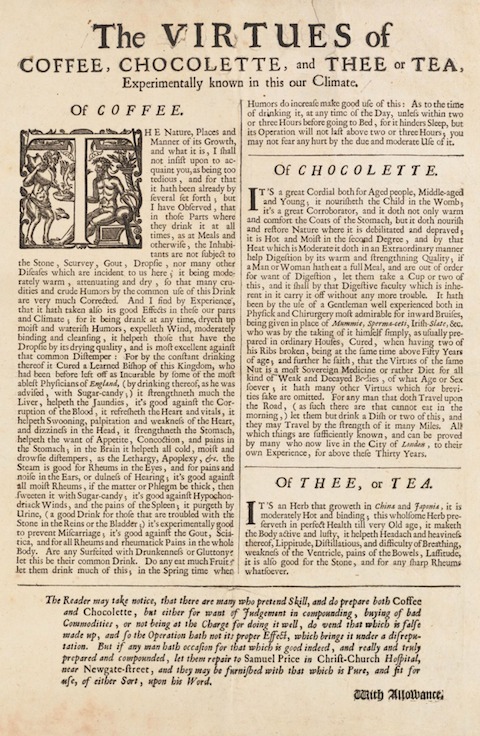
How, then, were proprietors to achieve economic growth? Like the owner of the first English coffee-shop did in 1652, London merchant Samuel Price deployed the time-honored tactics of the mountebank, using advertising to make all sorts of claims for coffee’s many “virtues” in order to convince consumers to drink the stuff at home. In the 1690 broadside above, writes Rebecca Onion at Slate, Price made a “litany of claims for coffee’s health benefits,” some of which “we’d recognize today and others that seem far-fetched.” In the latter category are assertions that “coffee-drinking populations didn’t get common diseases” like kidney stones or “Scurvey, Gout, Dropsie.” Coffee could also, Price claimed, improve hearing and “swooning” and was “experimentally good to prevent Miscarriage.”
Among these spurious medical benefits is listed a genuine effect of coffee—its relief of “lethargy.” Price’s other beverages—“Chocolette, and Thee or Tea”—receive much less emphasis since they didn’t require a hard sell. No one needs to be convinced of the benefits of coffee these days—indeed many of us can’t function without it. But as we sit in corporate chain cafes, glued to smartphones and laptop screens and mostly ignoring each other, our coffeehouses have become somewhat pale imitations of those vibrant Enlightenment-era establishments where, writes Calhoun, “men [though rarely women] were encouraged to engage in both verbal and written discourse with regard for wit over rank.”
via Slate
Josh Jones is a writer and musician based in Durham, NC. Follow him at @jdmagness.
source: http://www.openculture.com / Open Culture / Home> Food & Drink History / December 03rd, 2014
Cold coffee which will be called–Nitro Cold Brew marks Starbucks next chapter of coffee innovation through the newest take on its signature cold brew.
Tata Global Bev
Tata Starbucks, a 50-50 joint venture between the US-based Starbucks Coffee Company and Tata Global Beverages has been on an innovation spree of its products.
Starbucks today introduced a new generation of coffee for the first time in India infused with nitrogen.
Cold coffee which will be called–Nitro Cold Brew marks Starbucks’ next chapter of coffee innovation through the take on its signature cold brew.
Starbucks Nitro Cold brew is made after handcrafting the cold brew coffee and then infused with nitrogen. It is also available with vanilla flavour– vanilla sweet cream cold brew.
Starbucks cold brew will be available across all outlets in India, while Starbucks nitro cold brew is currently available in 5 stores across India namely–Mumbai-Kamala Mills, Bangalore-Jaya Nagar, Delhi-Green Park, Noida-DLF Mall of India, Kolkata, Park Mansions.
The company achieved a topline growth of 28 percent last year, supported by better in-store performance and growth through new stores.
Tata Starbucks recently made its maiden foray into Kolkata, the seventh city for the company in India. It plans three more stores there.
source: http://www.moneycontrol.com / MoneyControl.com / Home> News> Business / July 04th, 2018
Coffee saplings being distributed among farmers at a village in Kalimpong . File picture
Darjeeling:
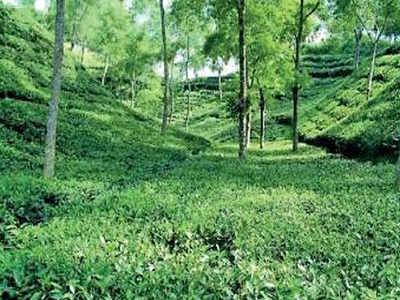
Coffee is set to make its debut in the Darjeeling hills which have so far been synonymous with tea.
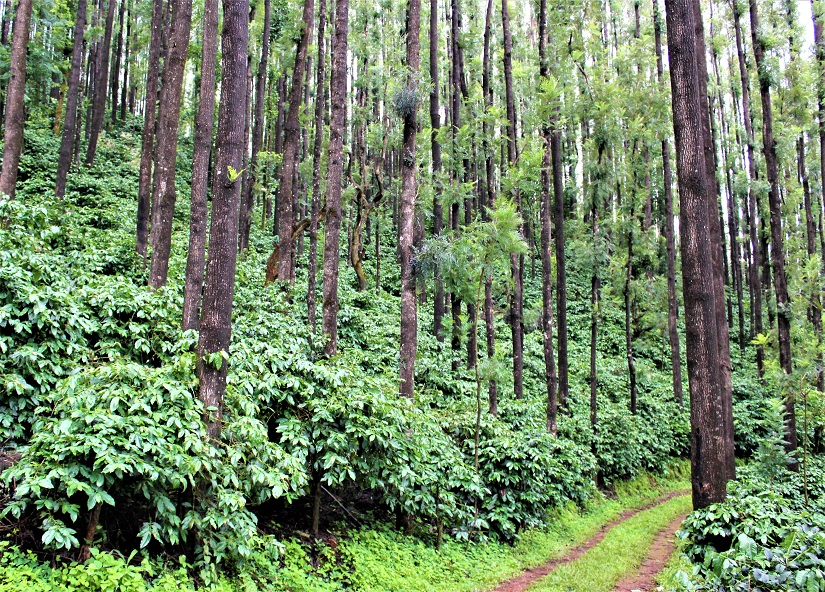
The Gorkhaland Territorial Administration has decided to give a thrust to coffee plantation in Kalimpong district and picked 407 farmers who have started growing coffee in an area spread over 345.72 acres.
The directorate of cinchona and other medicinal plants has been identified as the nodal agency and is collaborating with the agriculture and horticulture departments of the GTA.
“We plan to brand it as Kalimpong Coffee and the thrust is on organic cultivation,” said Samuel Rai, director, cinchona plantations.
Four village clusters, comprising 34 villages in Kalimpong 1 and Kalimpong 2 blocks, have been formed.
“They are named as Loley, Bhalukhop, Algarah and Gitabling clusters,” said Rai.
To start with, the villagers were selected on the basis of their willingness to grow coffee. “Traditional cash crops like ginger, cardamom, oranges are not doing well and we realised that coffee could be a good alternative. We first spoke to the villagers and identified 407 willing farmers,” said Rai.
The majority of the 87 tea gardens in the hills are concentrated in Darjeeling district. But only six estates can sell their produce as “Darjeeling Tea” and are located in Kalimpong.
“Kalimpong is ideal for coffee plantation as the plant needs a temperature ranging from 20 to 32 degrees Celsius. Coffee is being cultivated by few individuals successfully and we have conducted the trials,” said Madhav Chhetri, a senior scientific officer of the GTA horticulture department.
The GTA has ordered for 7.20 lakh coffee saplings from nurseries in Karnataka which are certified by Coffee Board of India. “About 1 lakh saplings have already arrived. We are planting Chandragiri variety, which is suitable in the area and is both trunk borer and coffee rust-resistant.”
“All the growers will be trained by experts from the coffee board and within the next few months, 40 farmers from the clusters will be taken to Karnataka for further training,” said Chhetri who was also sent to the southern state for a training recently.
The GTA is currently investing Rs 2 crore in the first phase of the project. “At the moment, we are distributing saplings and providing the farmers with 75 percent subsidy,” said Chhetri.
The GTA has decided to set up dry and wet processing units.
Coffee from Kalimpong was also sent to the coffee board for tests. “The results are encouraging and we only need to concentrate on the high moisture level during production,” said Rai.
The GTA officials said initial estimate suggests that a coffee plant bears 6 to 8 kg of green coffee that commands a price of Rs 20 per kilogram in the market.
“If we can hold on to this estimate, then we are looking at selling our produce for around Rs 8 crore. This would be a great start for a project where we are initially investing Rs 2 crore,” said Chhetri.
source: http://www.telegraphindia.com / The Telegraph,Calcutta,India / Home> West Bengal / by Vivek Chhetri / July 05th, 2018
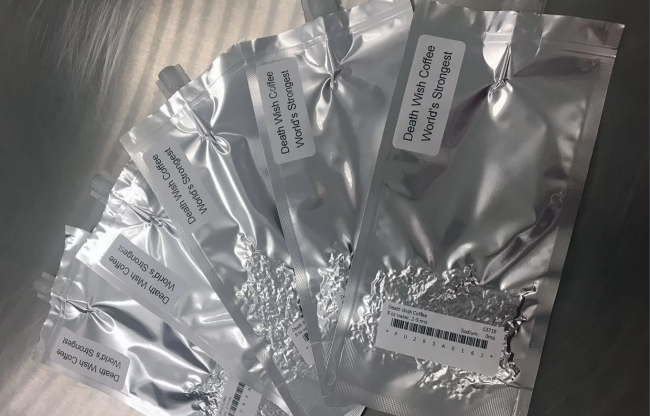
Death Wish Coffee is sending what is hailed as the world’s strongest coffee to astronauts at the ISS. The blend contains 200 percent more caffeine than standard coffee. ( Death Wish Coffee )
The world’s strongest coffee is headed to the International Space Station. It will launch into space on June 28 aboard SpaceX CRS-15.
Contains 200 Percent More Caffeine Than Regular Coffee
Death Wish Coffee is billed by its producer as the strongest coffee in the world for its high caffeine content and intense flavor.
The coffee company said that the blend contains 200 percent more caffeine compared with standard coffee, which could give astronauts the added punch that they need while working at the space station.
“Death Wish Coffee is the world’s strongest coffee with the highest-caffeine content available, resulting in a buzz that blows other coffees out of the water,” Death Wish Coffee described the product.
“And because we’ve taken the time to source fair-trade, USDA-certified organic coffee beans and refined our roasting techniques, we’ve created a high-caffeine coffee with low acidity that tastes good, too.”
Specially Packaged Death Wish Coffee For Astronauts Aboard The Space Station
The company is sending crew members of Expedition 56 a special freeze-dried version of the coffee packaged in the same foil packets used by astronauts for other beverages including normal-strength coffee.
Death Wish coffee is normally sold in 1-pound bags of whole and ground beans as well as in K-Cups, but the space-bound coffee is specially packaged by NASA in astronaut drink pouches.
Death Wish said that the coffee is designed to caffeinate astronauts aboard the ISS sans sacrificing the texture, flavor, and potency of the coffee.
Mike Brown, the founder of Death Wish Coffee, revealed about the plan to provide the world’s strongest coffee to astronauts aboard the orbiting laboratory in a statement dated June 6.
“We couldn’t think of a better way to showcase the smoothness and strength of our coffee than by providing the crew aboard the International Space Station with an easy-to-make blend that will keep them on their feet,” Brown said in a statement.
Coffee And Coffee Machine For Astronauts Working In Microgravity
Coffee is a staple aboard the ISS as early as 2000, the year the first batch of crews arrived at the orbiting lab.
Astronauts and cosmonauts can choose from caffeinated or decaf instant coffee. Kona blend with just sugar or powdered cream or both already mixed in are also available.
The space station received its first coffee machine in May 2015 with the arrival of the Lavazza and Argotec ISSpresso.
source: http://www.techtimes.com / Tech Times / Home> Science> Space / by Allan Adamson Tech Times / June 27th, 2018
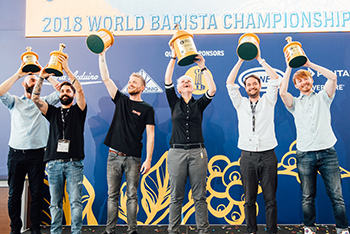
Image credit: World Coffee Events, SCA and Jeff Hann.
Agnieszka Rojewska of Poland has won the 2018 World Barista Championship (WBC). Agnieszka, a veteran of multiple coffee competitions across the globe, triumphed over 55 other baristas to become the first woman ever to win the title.
Lex Wenneker of The Netherlands was runner up, Mathieu Theis of Switzerland was third place, Michalis Katsiavos of Greece was fourth, Cole Torode of Canada was fifth place, John Gordon of New Zealand was sixth place, and Craig Simon of Australia finished in seventh place.
“I never thought I’d be in the final so the fact I [was] is the best experience,” Rojewska said post-performance. “This is like the craziest day of my life.”
Rojewska of Full Pro Coffee has been making coffee for more than 10 years. She started working in a coffee chain before starting her own cafe. Agnieszka now works mostly as a coffee trainer, but has spent the past four years competing in various coffee competitions, tackling almost every category of competition there is to win.
Rojewska is a three-time Polish Barista Champion and four-time Polish Latte Art Champion with a career high ranking of third in the world in 2017. Rojewska will compete in Poland’s Brewers Cup Championship on Sunday 1 July, and will attempt another world title when she competes in the World Latte Art Championship in Brazil from 7 to 9 November.
Last year, Rojewska placed Runner-Up in the Polish Brewers Cup competition and New York Coffee Masters, but this year has been one of first places, winning the London Coffee Masters competition in April, and now the WBC in Amsterdam.
For her 15-minute routine, Rojewska used a coffee sourced from Project Origin Coffee’s CM Selections lot in Mesina, Ethiopia, a new coffee growing area. Because of the fresh soil and young 10-year-old trees planted at 2300 metres above sea level, Agnieszka said the result in the cup would have “more intense yellow fruit characteristics” and “extraordinary sweetness”.
The Heirloom cultivar underwent washed carbonic masceration processing, a concept Ona Coffee Founder Sasa Sestic first presented to the WBC in 2015, the same year he won the event. With this process, the coffee is depulped, put into tanks and pressurised with carbon dioxide to remove all oxygen and encourage lactic bacteria. The coffee was roasted by 2017 Brewers Cup Runner Up Sam Corra of Ona Coffee.
Rojewska says she chose to use Ethiopian coffee because of how expressive it is, with flavours of yellow and red fruit that are easy to recognise. “It was the first coffee I have fallen in love with,” Rojewska told the judges.
To make her milk beverage exude strawberry notes, Rojewska prepared a more intense espresso using 23 grams in the basket and 36 grams out via the Victoria Arduino Black Eagle machine. She added three-and-a-half ounces of milk to help achieve notes of milk chocolate and warm strawberry jam. The full cream milk had a high fat content for a creamy texture and combined with a lower temperature, reminded Rojewska of slow-melted chocolate ice cream.
Despite her accomplished latte art skills, Rojewska poured a simple small heart in the centre of each cup to help stretch the milk, give more aromatics, and more intense strawberry flavours.
For her signature beverage, Rojewska used Ona Coffee’s O.C.D and Stem devices to produce her shots and made a passionfruit infusion. This was made adding 100 grams of passionfruit to 30 grams of coconut sugar, 50 millilitres of water, and cooked for three hours at 60°C for more natural tropical fruit notes. To replicate the same lactic acid bacteria used in washed carbonic masceration, Rojewska used 100 grams of warm milk and seven grams of citric acid in the form of lime juice, which she then let sit and separate for three hours before straining three times. The end result was 20 grams of ‘washed milk’ and a creamy mouthfeel in her signature beverage. She added 4 grams of this liquid to 100 grams of water infused for 20 hours at 120°C, and blended it together with her espresso shots at 20 grams in the basket, 35 grams out.
Lastly, Rojewska prepared her espressos using the same Ethiopian coffee. Despite her coach Sasa Sestic pointing out that she was 20 seconds behind in his Livestream commentary, Rojewska pushed on, using 20 grams in the basket and 45 grams out to achieve medium sweetness, medium bitterness, and flavours of orange, plum, and low intensity of peach. She used visual aids to describe the body and texture of the body and concluded with a simple message.
“It’s my greatest pleasure to bring this world stage coffee to you as my customers, and most importantly, my friends,” Rojewska said with one seconds remaining on the clock.
In the past week, thousands of coffee professionals gathered in Amsterdam for World of Coffee (WOC), one of Europe’s largest coffee trade show, and the host of the 2018 WBC. Just under 11,000 professionals from across Europe and around the globe registered to attend, breaking records for the event.
Next year, WOC heads to the German capital of Berlin from 6 to 8 June, 2019 at the Messe Convention Center.
source: http://www.gcrmag.com / Global Coffee Report / June 25th, 2018
With a large majority of coffee plantations having turned old and unproductive, coffee sector is seeking a Colombian-model re-plantation support from the government.
Abysmally low yield, lower price realisation and high levels of debt have been restraining the sector from taking up re-plantation on its own.
Re-plantation is long overdue for 65-70 per cent of India’s coffee farms. About 65 per cent of plants are more than 40 years old and for those varieties, the maximum yielding age of the plants is 35-40 years. Some of the better-yielding newer varieties have a shorter life of around 25 years and a good number of these newer varieties are also due for re-plantation, said AL RN Nagappan, coffee committee chairman of UPASI.
By retaining the older plants, both production and yield has been coming down. Coffee production, especially arabica production has been falling year-after-year in the past five years. From 120,000 tonnes, it has dropped below 90,000 tonnes.
The yield too is abysmally low. “We cannot even compare our yield with that of Brazil or Colombia. If an acre of coffee plantation provides 1.5 tonnes of coffee in Brazil, it would hardly produce 300 kg in India,’ said Nagappan. Inability to mechanise the plantations due to the hilly and rocky terrain also has been affecting the yield. According to Ramesh Rajah, president of the Coffee Exporters Association, coffee growers in the India are not in a position to take up the task of such large-scale re-plantation as most of the growers are incurring losses due to lesser price realisation and higher input cost.
“If the input cost on an acre is around Rs 70,000, the income would be around Rs 40,000 to Rs 45,000. The grower is incurring a loss of around Rs 30,000 on an acre of coffee plantation,” said Boje Gowda, chairman, Coffee Board of India.
The growers have been relying on the pepper vines to make up for the losses. “But the pepper prices too are down this year,’ added Nagappan.
According Gowda, almost 80 per cent of the growers have defaulted on their loans and the non-performing assets of the coffee plantation have become a burden for the banks.
In such a scenario, the sector is looking forward for support from the part of the central and state governments. “The government should take a leaf out of the re-plantation scheme being provided for growers in Columbia. The government has been providing financial support for the past few years and now the country has been able to enhance its production significantly,” said Rajah.
Since 2009, Colombia has been replanting around 85,000 hectares of coffee plantations every year. The government has been providing subsidy for the every replanted coffee.
“We have been requesting both central and state government to provide subsidies on the inputs like fertilizer electricity and machines,’ said Gowda.
As the grower has to forego the income during re-plantation, he also wants financial support during that critical period. “We are also expecting an interest waiver for the loans so that the growers can pay back at least the principal,” said Nagappan.
source: http://www.mydigitalfc.com / mydigitalfc.com / Home> Miscellany / by Sangeetha G
Sreeraksha Poornesh loves the product of his plantations over all other coffees from around the world. But this is neither boast nor an arrogant statement in the wake of serious success. It is simply his truth, born out of the sheer love for farming and the coffee at Baarbara Estate. “At the end of the day, I’m a farmer and my heart and soul always say that my coffee is the best.”
The 30-year-old is a fourth-generation coffee grower of the illustrious MG Plantations of Chikmagalur, owned and run by the Indavara family for over 120 years. Baarbara Estate gets its name from the Anglo-Indian lady who sold the plantation to Poornesh’s great-grandfather eons ago. And Poornesh attributes his success, first and foremost, to its location. “I’m very lucky to have been handed down an estate on Baba Budan Giri,” he says.
For those who don’t know, the mountain is named after the 17th-century Sufi saint Baba Budan, who is said to have introduced coffee to India when he brought seven beans from Mocha, Yemen, to the country and planted them across the range. In January, the Coffee Board of India submitted an application for the Geographical Indication (GI) tagging of Babu Budan Giri arabica. The GI tag is meant to protect the heritage and quality status of a particular product; according to the World Intellectual Property Organization, it’s a “sign used on products that have a specific geographical origin and possess qualities or a reputation that are due to that origin.”
However, that isn’t enough to stay relevant, and Poornesh, armed with an MBA from Alliance Business School in Bengaluru, has introduced several new measures to keep up the business. Apart from getting high cup scores every year, he is now inviting roasters to the plantation to process the beans as they like and take them back to their establishments. In light of the changing coffee scene in India and the wave of speciality roasters cropping up across the country, this move is bold and certain to pay off.
“A cup is a team show,” says Poornesh. “As farmers, we do 60 percent of the work to ensure that the coffee you drink is amazing. The process starts with us and ends with roasters.”
Last season, the first roaster Poornesh brought over was Mithilesh Vazalwar, India’s first AeroPress champion and one of the country’s only 25 coffee Q-graders. Their mutual interest in the best-quality beans and obsession with everything coffee lead to a high-grade product that discerning customers can’t wait to get their hands on.
“A certain trend has been set by traditional roasters in India over centuries,” says Poornesh. “I realised that so much of the beans wasn’t processed and handled well. Now, we’ve taken things to a decent level and most third-wave roasters in India get our beans.”
Sreeraksha Poornesh
Remarkably, having grown up with coffee, Poornesh wasn’t interested in joining the family business. After his MBA, he spent a couple of years working in Bengaluru before returning to Chikmagalur five years ago. He then began to study coffee in-depth, participating in workshops by the likes of Sunalini Menon (Asia’s first female coffee taster and expert) and attending lectures for coffee entrepreneurs at the Indian Institute of Plantation Management. He also did Kaapi Shastra, a coffee training programme by the Coffee Board of India.
“My goal is to dilute everything we grow into speciality coffee,” says Poornesh. Baarbara produces single-origin arabica at present. But he has no plans of expanding internationally, he adds. He has his sights firmly set on the Indian scene. “There’s a lot of potential here, a lot to do. I entered the business at just the right time.”
The brand Baarbara Berry’s status as one of India’s top-ranking coffees is also owed to Poornesh’s driven spirit. In the face of many challenges, including stiff competition, he is focused on getting higher cup scores every year. “You can’t be lax,” he says. “It’s not like you achieve a certain level and then let go. The crop is different every year, and it’s imperative that our cup quality is on the mark. Every year, in the beginning of the season, roasters test the quality, so consistency is very important.”
Now that Baarbara Berry has reached a certain level, Poornesh believes that the farmer-roaster interaction should progress too. Because harvesting and processing are intricate processes and significantly impact brew quality – flavour, texture, acidity, body – roasters can choose their methods for the kind of coffees they want.
Baarbara Berry offers green coffee as well as a range of roasted and ground beans. Owing to high elevation, around 5,000 feet, the ethically sourced and handpicked beans produce rich, full-bodied brews with balanced flavours and finish. MG Plantations is Rainforest Alliance Certified and UTZ Certified, for sustainable farming and better opportunities for farmers.
source: http://www.firstpost.com / FirstPost. / Home> Latest News> Living News> Living / by Tania Bhattacharya / June 25th, 2018
With hard work, it took only 18 months to get the money back.
CREDIT: Courtesy company
Imagine you’ve just had twins. You need to support your family and work. You’re exhausted constantly. (And from experience, I can tell you baby exhaustion really does feel somewhere between death and stupid.) What do you do to keep going?
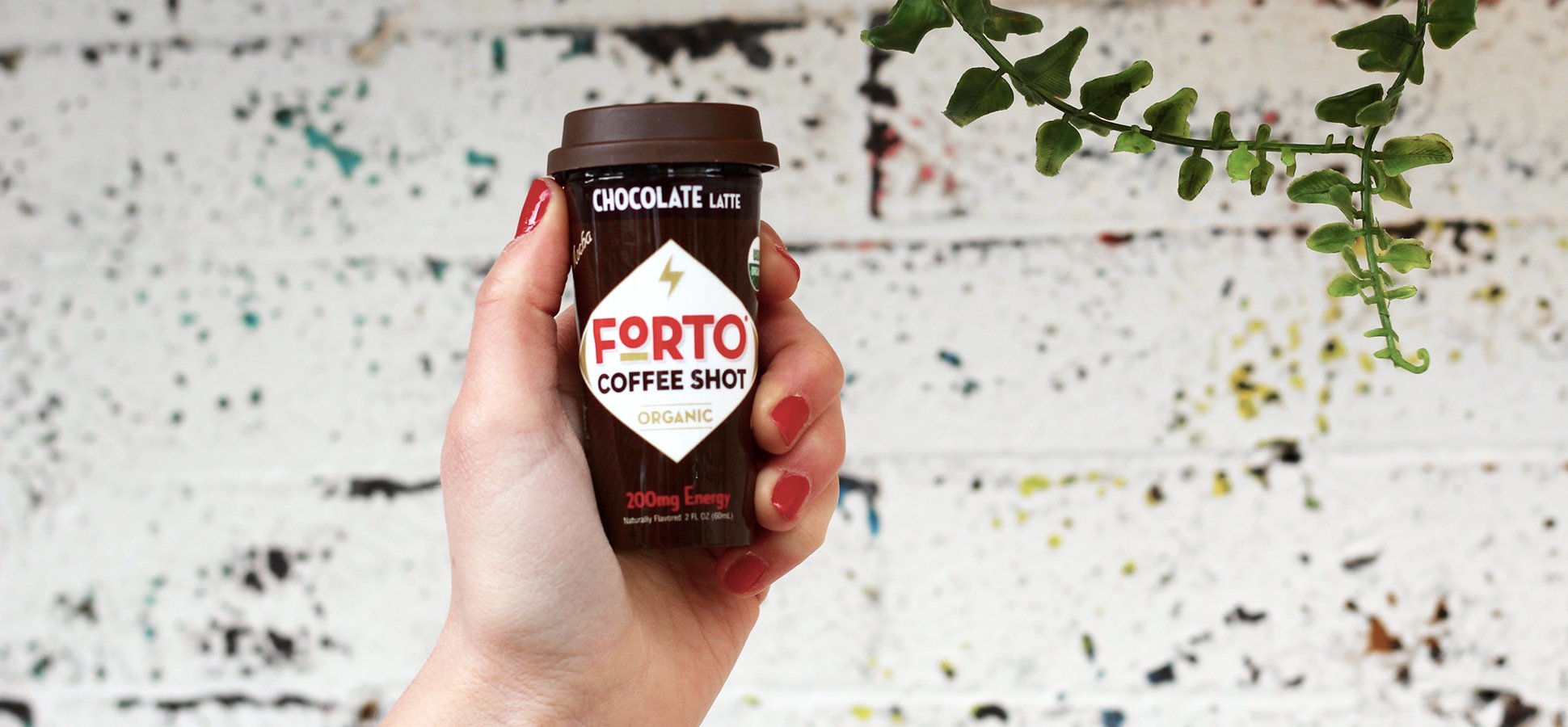
If you’re Neel Premkumar, you start concocting coffee shots in your kitchen, playing around with organic coffee beans and cold brewing. While the mad scientist behavior might have been born out of necessity (what innovation isn’t?), in a few months, Premkumar had found the ingredient and technique combination that worked. In fact, his creation worked so well, business bells started blaring in his brain.
The only problem? No money. (Cue the sad violins here.)
An option from inside the family
Fortunately for Premkumar, his father-in-law, Venkat Nemani, had some money–his life savings of $50,000. If Nemani would agree to give that and everything worked out, he wouldn’t lose anything and could even gain. But if things didn’t work out …
It was a huge risk. But Nemani had faith. The money–all of it–went to Premkumar. And what’s more, Nemani didn’t even haggle over details the way other investors or bankers would have.
“I never formally outlined a plan to pay him back,” Premkumar says, “past my good word that he’d be repaid!”
Premkumar recognized the trust. And, in return, he committed to the business full throttle.
“Failure was just not an option,” he says. “I named my company Dyla, which is a combination of my twin girls’ names. When I started, I thought to myself, ‘If I name this startup after my kids, there is no way I could let it fail.’ I think that as an entrepreneur, you just have to have a singular focus on success. What you’re trying to accomplish is hard enough in taking on industry giants. Self-belief is paramount to success.”
And so Forto was born. Premkumar started selling his coffee online, answering every customer email himself. He managed to find a base with the U.S. military, where the need for focus and energy is extraordinarily high.
“When Forto was selling well in every U.S. base, I realized this was going to be a big business,” Premkumar notes. “I also saw signs of big changes in both the energy drink and retail coffee markets, with buying patterns shifting and a new generation of consumers demanding great coffee, in a convenient format that saves them time. That is where Forto fits in and why it has such a loyal audience.”
Neel Premkumar’s twin daughters who inspired the Forto coffee shot.CREDIT: Courtesy company
From family loan to national brand
Even though having the money come from his father-in-law added personal stress, Premkumar’s initial product success and market observation told him that asking for the loan had been the right choice. And, by staying laser focused, he managed to pay the $50,000 back in just 18 months.
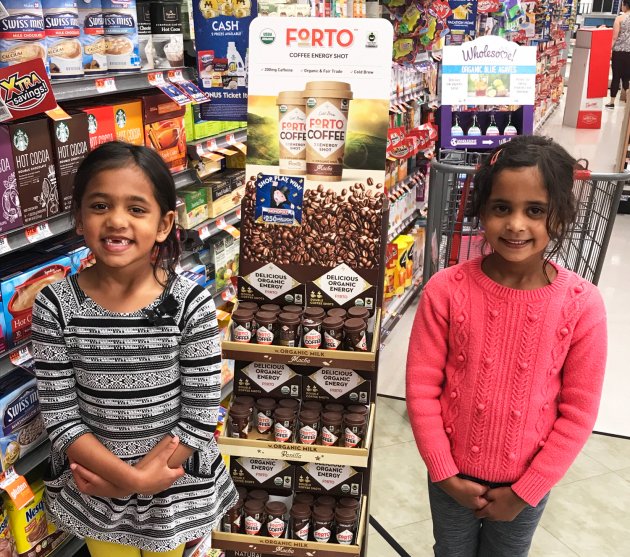
Forto has skyrocketed, earning 400 percent year-over-year growth. It was named the Inc. 500’s No 1 fastest-growing beverage brand in America for 2017. And while the shots are available in more than 50,000 retail stores, the company announced today that the product will also be on the regular coffee shelves at 3,700 Walmart locations. It’s a massive win for Premkumar, as the entire point of the business has been to help customers boost their energy in a more convenient and inexpensive way.
Should you take the same risk to innovate?
Premkumar says he has zero regrets about the experience. But he points out that much of what made Forto work was just being in the right place at the right time. He came up with the shots right when people were changing the rituals they had around coffee, putting him in the ideal position to meet an emerging demand. And he and his team were serious about examining early adopters to understand why and when they downed the coffee. That allowed Premkumar to find and connect with more individuals for whom Forto was a great fit. Lastly, he didn’t hire and scale until that consumer understanding–and the product message built on it–was solid.
“Everyone’s tolerance for risk is different,” Premkumar says. “For me, bringing Forto’s two-ounce coffee shots to market was worth the risk, because I thought it provided a necessary solution to an everyday problem–a convenient coffee energy boost. I think fundamentally an entrepreneur’s job is about risk mitigation. A startup begins with maximum risk, but every step you take building the company reduces your risk ever so slightly. I was never worried about the competition, more about my own ability to figure out how to meet the consumer need and communicate that correctly to them before the money would run out!”
As for specific money tips, Premkumar says you should borrow only from people you trust. Ideally, those people should be OK with losing the loan. You also shouldn’t aim too high. Raising too much money can be a huge temptation to overspend, waste money, and hire more than or before you need to.
“If you do raise your first round from family or friends,” Premkumar advises, “make sure they have nerves of steel like my father-in-law did. They might need it!”
source: http://www.inc.com / Inc. / Home / by Wanda Thibodeux, copywriter, TakingDictation.com / June 19th, 2018
Four hundred farmers from Kalimpong have been selected to cultivate coffee in the land of tea nearly two centuries after British civil surgeon Archibald Campbell started tea plantations in the Hills way back in 1841. Land of tea
Among them, 50 had been to the Coffee Research Institute at Chikmangalur in September. They will train the selected farmers.
Members of the Indian Coffee Board, agronomists who had come down to Kalimpong gave the goahead after preliminary soil tests and the weather conditions. A cool to temperate climate is ideal for coffee as it is for tea.
The Gorkhaland Territorial Administration had identified 400 acres of land in Kalimpong for coffee cultivation as a pilot project. The four such clusters are spread over Bhalokhop, Algarah, Gidbaling and Lolay Gaon, each having around 10-12 villages. Experts cleared the proposal for mass cultivation after the initial farming came out successful. “The idea is to develop a coffee brand, much like the Darjeeling tea. We have already advertised e-tenders for prospective agencies and will start the cultivation from June,” said Samuel Rai, director of Cinchona and Other Medicinal Plants in Mungpo. The land was lying idle for all these days after the state government shut the cinchona unit.
Experts have conducted workshops for five days with farmers and officials of the hill council. “Earlier, we had sent some farmers for training but the time was short. So we requested the Coffee Board to send experts to the hills to conduct workshop and interact with the farmers,” Rai said.
To maintain quality, GTA will only cultivate the Chandgiri variety of coffee beans. A central factory will also be set up in Kalimpong. “We will use the best quality seeds of the Arabic variety, which is more aromatic with less caffeine content. Also, the variety is suitable for the Hills. Roasting and grinding will be done in a centralized factory, but all other aspects, like peeling the skin, parchment and dehauling, will be done in the cluster level,” the Cinchona director said.
BV Suresh Kumar, deputy director (Research) Coffee Board, who was one of the team members, said: “Coffee cultivation in Kalimpong is in its infant stage. There is potential to be economically viable in the long run. The flavour is there but the yield has to be assessed,” he said.
source: http://www.timesofindia.indiatimes.com / The Times of India / News> City News> Kolkata News / by Deep Gazmer / TNN / June 05th, 2018
Following news earlier in the week that the World Coffee Championships in Dubai had been cancelled, World Coffee Events (WCE) announced it would move two of three events to Belo Horizonte, Brazil.
The Specialty Coffee Association and Dubai World Trade Centre mutually agreed on 24 May not to host the World Coffee Championships at GulfHost in September 2018.
GulfHost was to be the host event for the World Brewers Cup, World Cup Tasters Championship and World Coffee Roasters Championship.
WCE announced on 25 May that the first two events would move to International Coffee Week (ICW) in Brazil, taking place from the 7 to 9 of November, joining the World Latte Art Championship and World Coffee in Good Spirits Championship.
ICW is the largest coffee expo in Brazil. The sixth edition of the event will allow thousands of coffee producers to present the best of their harvest to buyers, roasters and international traders in Belo Horizonte, the capital of Minas Gerais State.
National coffee champions from more than 40 countries will attend ICW to compete in the four world championships.
The World Brewers Cup is the premiere event for manual coffee brewing, while the World Cup Taster Championship pits coffee cuppers against each other in lightning fast rounds. The World Latte Art Championship celebrates artistry with espresso and milk and the World Coffee in Good Spirits Championship recognizes the combination of coffee and alcohol.
The 2018 World Coffee Roasting Championship will also be moving to a new location, with details to be shared as soon as they are finalised.
source: http://www.gcrmag.com / Global Coffee Report / May 25th, 2018
WELCOME. If you like what you see "SUBSCRIBE via EMAIL" to receive FREE regular UPDATES.
Read More »