Category Archives: Coffee News

Asia’s first woman coffee taster was nearly ‘brewed’ out

SunaliniKF10dec2017
Bengaluru :

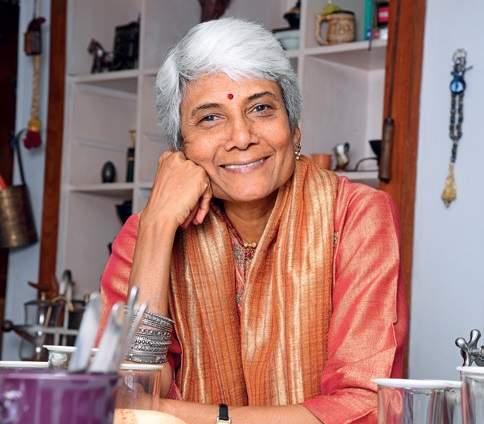
Asia’s first lady of coffee Sunalini Menon says she never planned on being a coffee-taster. She says that she decided on a course in Dietetics or a Phd. in Foods, when she chanced upon an advertisement calling for Assistant Cup tasters at the Coffee Board of India. “I had tried tea tasting as a child at an uncle’s tea estate in Munnar and the ad brought back happy memories of sipping, slurping, spitting and looking wise. I applied for the post and was called for the interview.”

She had to compete with eight men with more experience and qualifications, and that was her first job interview. Sunalini came first in the written and oral tests.

Sunalini, Asia’s first woman coffee taster, says, that the internal panel of examiners were not too keen to appoint her because she was young, had no knowledge about coffee and was a woman who could get married and give up the assignment. “But the then chairman of the Coffee Board was insistent that gender should not come in the way of a job and that as I had topped the interview, that I should rightfully be given the assignment.” Sunalini then joined the Coffee Board of India in 1972.

It wasn’t easy working at the Coffee Board of India, she says. She was the only woman at the officer’s cadre level in the Board then. “The staff working under me refused to accept my instructions or the schedule I had set for work, they were not used to taking instructions from a woman,” she says. “Fortunately, I had a chief who took me under his wing and advised me to first learn the subject and give them time to accept me. His parting words were ‘Tread slowly, but firmly’.”

The in-house training she was given was intense. Every day, she would taste washed arabicas, unwashed arabicas, washed robustas and unwashed robustas, to understand the various nuances in a cup.
Also, a founder trustee of the Women’s Coffee Alliance – India Chapter, Sunalini was present at the Coffee Santhe held recently at Karnataka Chitrakala Parishat. She says, “This is our annual fund raiser to help empower women coffee-plantation workers and their girl children.”

Coffee tasting is both a science and an art

While carrying out coffee tasting, there is a protocol that one needs to follow. The attributes that are evaluated in the cup are fragrance, which is the smell of the coffee powder in the dry state, and aroma, which is the smell in the wet state, when water is added to the powder. During the aroma evaluation, the crust (floating particles on the surface of liquor or the brew prepared for tasting and all the aromatic volatiles) is broken. With“Breaking of Crust”, fragrance, aroma and the other attributes are evaluated for flavour, aftertaste, acidity, mouthfeel, uniformity, balance, cleanliness, sweetness and, finally, the overall rating of the cup.

source: http://www.newindianexpress.com / The New Indian Express / Home> Cities> Bengaluru / by Akhila Damodaran / Express News Service / December 08th, 2017
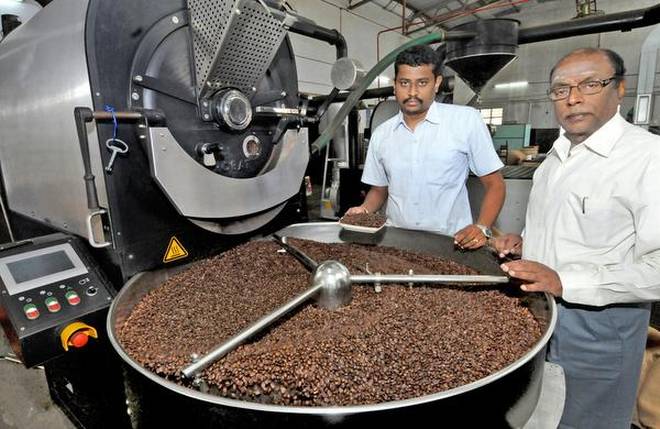
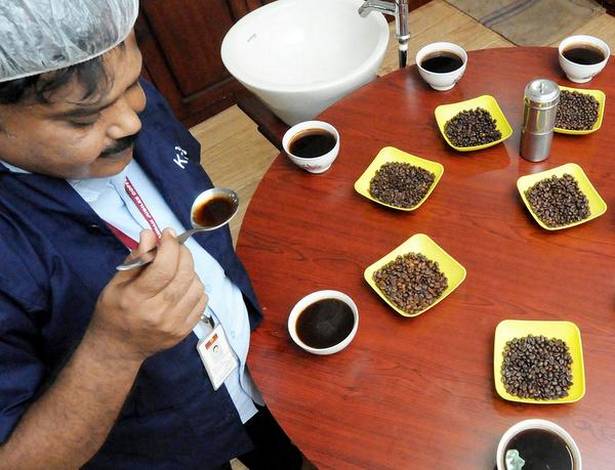
From bean to global shelves: on Kannan Jubilee Coffee

KananCoffee01KF02dec2017

Coimbatore-based Kannan Jubilee Coffee brand goes international

Smell. Sip. AK Jayakumar, founder of Kannan Jubilee Coffee, instructs and I obey dutifully. I hold the dark concoction to my nose, inhale the aroma, and then sip a spoonful… “Slightly bitter,” is my verdict.

Jayakumar says it’s a full-bodied Peaberry coffee. I drink freshly-brewed filter coffee, enjoying the uplifting scent of roasted coffee beans around me.

“I was 22 when I started in 1971,” he recalls, as we tour the coffee factory spread over 40,000 sq ft at Thudiyalur, in Coimbatore.

Recently, the over four-decade-old brand entered the international market. Kannan’s Kaapi Instanto, a premium range, is now available at stores in Dubai, Kuala Lumpur, Singapore, and Malaysia. Jayakumar’s son, Shanker Krishnan, says that the next big step is stand-alone cafés across the world, adding, “Our instant coffee is doing well in the international market. We have a steady customer base for filter coffee in Tamil Nadu and Andhra Pradesh. We have the volume, but we wanted to branch out.”

In the last five years, after Krishnan took over as partner, he introduced new products under Kannan’s Kaapi (from ₹1 instant coffee sachets to premium packs costing ₹1,200): Dgree Coffee (100% coffee), Instanto (with 20% chicory blend), Royal Cafe (with over 50% chicory, exclusively for the suburbs), a unique blend of Kannan Jubilee Peaberry Coffee that comes in butter paper packets, and Rich Cafe (with 20% chicory in standing packs).

Instant success

“Instant coffee was a big step. We reached out to corporates, hospitals and colleges, and introduced online sales on our website and on Snapdeal and Amazon. We sell about 80 kilograms online every month. Coffee is a global market. Taking on MNCs is not easy. I hired professionals to study the market. It took several months,” explains Krishnan.
KananCoffee02KF02dec2017

When Jayakumar started Kannan Jubilee Coffee (he added Jubilee as the year marked his parents’ 25th wedding anniversary), he would participate in auctions in Bengaluru and Coimbatore to buy coffee beans. Now, they go to the coffee estates.

“Karnataka is the hub,” he says, “Several tonnes of coffee are cultivated in The Nilgiris, Yercaud and Valparai. We buy Arabica, Robusta and Cherry Coffee beans from the coffee belt in Kushalnagar, Chikmagalur, Baba Budangiri, and Wayanad. We pick estates that meet the pre-requisites — an altitude of 2,000 feet above sea level, 16 inches of rainfall and four daily hours of sunshine. The crop season is between November and February. We buy uncured beans during this period.”

He shows me the curing process. The uncured beans go through a painstaking cleaning process first to remove dirt, pebbles and debris. A gravity separator removes defective beans, based on weight. Once the green beans are peeled, and polished, they are graded based on weight and size. A coffee seed godown stores the green seeds.

Let the magic begin

KananCoffee03KF02dec2017

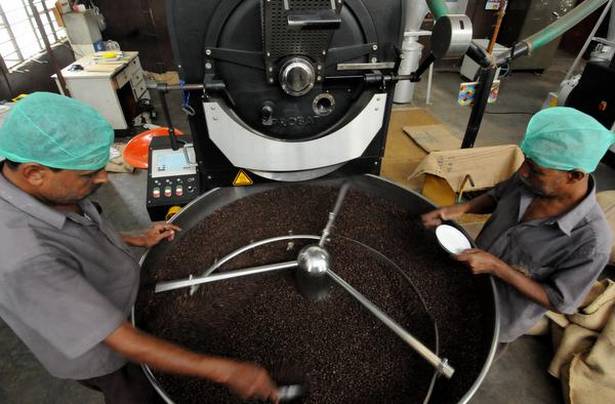
A Probat coffee roaster, imported from Germany, takes over the roasting process. The temperature is set at 214° Celsius for 16 minutes. “It is while roasting that the green coffee beans get their characteristic brown colour. Right temperature is the key. Once the machine empties the coffee beans, an automated process cools them down, after which they are collected for blending. Our production capacity is two tonnes, though we can go up to five tonnes,” says Jayakumar. The Swiss-made Ditting, with a capacity to grind 300 kilograms per hour, is in place.

Kannan Jubilee Coffee now has 38 retail outlets across Tamil Nadu and Kerala, and will soon be launched in Tiruchi, Bengaluru and Kumbakonam. The team is also experimenting with new products, like three-in-one instant coffee pouches (with milk powder, coffee and water), a travel pack (with a filter to make decoction), and chocolate bars in coffee flavours.

Jayakumar, who is a certified coffee taster, says one can never compromise on quality. “I set up the coffee-tasting lab in the factory to maintain quality. The coffee roaster roasts small quantities. I recommend a suitable blend after tasting it,” he says.

Says Krishnan, “Connecting with people has been our driving factor, our USP. My father shared a personal rapport and treated customers like extended family.” Recalling the days when he would cycle with coffee packets to sell them at retail stores in the city, Jayakumar says the growth has been gradual. “Slow, but steady.”

source: http://www.thehindu.com / The Hindu / Home> Life & Style> Food / by K Jeshi / November 30th, 2017

Get a whiff of coffee at GES

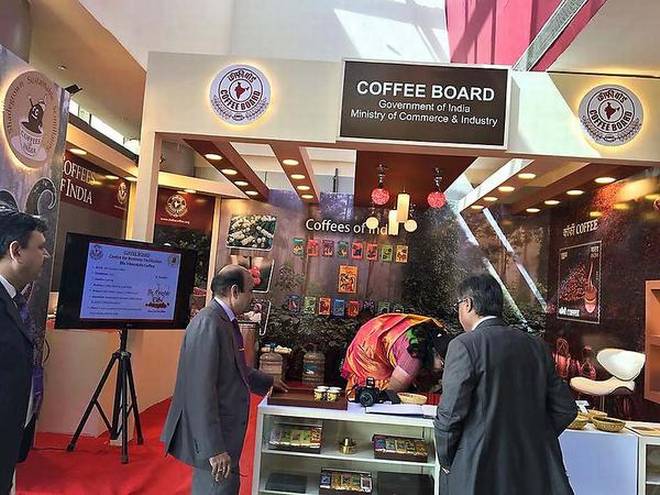
The stall set up by Coffee Board at the GES venue where Araku Coffee grown in the eastern ghats is also on display.

Coffee Board sets up stall to promote regional flavours

Coffee Board, a Government of India enterprise, has put up a stall at GES venue to promote various regional flavours of coffee mostly grown in the western ghats.

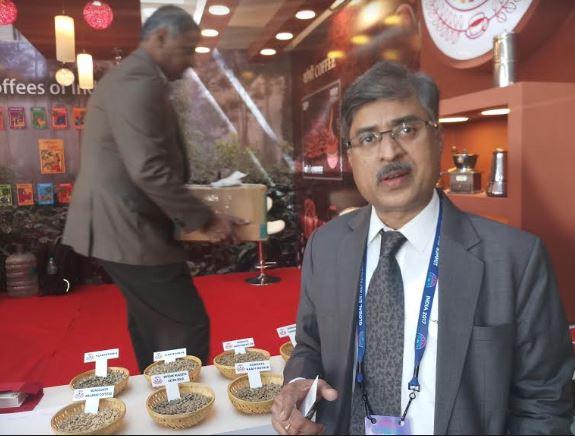
Though India is the sixth largest producer of coffee that’s mostly exported to Europe, not many outside Europe are aware of it. “This is our opportunity to promote Indian coffee among the global audience at GES,” says Raghuramulu, Director, Central Coffee Research Institute, Coffee Board.

The western ghats is one of the biodiversity hotspots in the world and coffee is grown as an integrated crop and in shade, Mr. Raghuramulu said. It is a way of rejuvenating greenery in the eastern ghats known for Podu cultivation. The income of tribals started going up after coffee plantation was promoted in Araku and Chintapalli areas in Visakha Agency, he added.

At the summit, Araku Coffee grown in the eastern ghats is also on display.

source: http://www.thehindu.com / The Hindu / Home> News> Cities> Hyderabad / by Special Correspondent / Hyderabad – November 28th, 2017

Coffee Board to promote entrepreneurship

Coffee winning the hearts of North Indians too

A stall put up by the Coffee Board to showcase different varieties of Indian coffee at the Global Entrepreneurship Summit (GES) being held in Hyderabad on Tuesday. (Photo: G Naga Sridhar)

Hyderabad :

The Coffee Board will be promoting entrepreneurship with a dual purpose of pushing self-businesses as well as coffee consumption.

Speaking to BusinessLine on the sidelines of the Global Entrepreneurship Summit (GES) which began here on Tuesday, Y Raghuramulu, Central Coffee Research Institute, said 34 entrepreneurs had successfully launched their businesses in the last one-and-a-half years.

According to B J Ashwin Kumar, Research Chair & Consultant (Promotion), Coffee Board, about 700 were trained in various aspects of coffee business so far.

“The advantage in business of coffee is that it will not need huge capital. One can take it off with even Rs. 1 lakh,” he said.

Steady growth in consumption

Consumption of coffee has been steadily growing at about 5 to 6 per cent per annum, Raghuramulu said.

He added: “While South India has been a predominant market, of late the number of coffee lovers in the North has been growing.”

About 3.25 lakh tonnes of coffee is produced by India. ” Efforts are to push coffee exports from India with a focus on special varieties,” he added.

Europe is a major destination for Indian shade-grown coffee followed by the US.

Domestic consumption is about 1 lakh tonnes which includes few imported varieties from countries such as Indonesia and Vietnam.

source: http://www.thehindubusinessline.com / Business Line / Home> Economy> Agri Business> Global Entrepreneurial Summit / by G. Naga Sridhar / Hyderabad – November 28th, 2017

Love coffee? Head to Bengaluru this December

The fourth Coffee Santhe is here

Coffee nerds, rejoice! The fourth edition of India’s unique coffee festival—Coffee Santhe—is back from December 1-3. The event—which will be held at Karnataka Chitrakala Parishath in Bengaluru—will showcase coffee in all its forms—beans, roasted and ground—from estates around India.

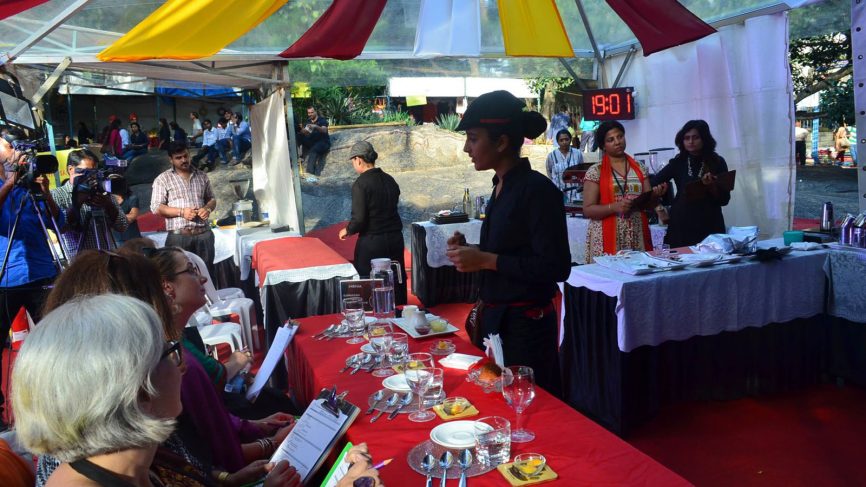
You can have all your burning questions answered–the coolest blends you can make, how to best pair your coffee-based beverages with your food, and find out about all the weird and wonderful strains of coffee you had no idea about. There will also be a Brewmaster championship where the best women baristas across the country will go up against each other. The winner will get the chance to train under some of the world’s best coffee specialists.

Women baristas showcase their brewing skills in front of an international panel of judges

This is the only event of its kind in India and the idea is to draw attention to the industry and the people who bring you your morning cup of joe. Organised by the Women’s Coffee Alliance, a group that works to ensure that the women that work on the coffee estates benefit from the coffee trade. The organisation helps raise money to educate the daughters of the women who work in the coffee fields in Bababudan, Chikmagalur, Coorg, Biligiris and Sakleshpur, provides food to supplement their diet and health insurance to the women working in the plantations. It also conducts regular health camps on site.

It’s time to wake up and smell more than just the coffee.

For more information call: +91 9900217029 / +91 9886577132

source: http://www.cntraveller.in / Conde Naste Traveller / Home> India> Food & Drink / by Raj Aditya Chaudhuri / November 22nd, 2017

Full of beans: Coffee grounds to help power London’s buses

A new biofuel, which contains part coffee oil, is being added to the London bus fuel supply chain where it can be used without the need for modification.

Transport for London has been turning to biofuels to curb carbon emissions, trialling a fuel made with used cooking oil from the catering industry.(Shutterstock)

Waste coffee grounds will be used to help fuel some of London’s buses, Royal Dutch Shell and clean technology company bio-bean said on Monday.

A new biofuel, which contains part coffee oil, is being added to the London bus fuel supply chain where it can be used without the need for modification, the companies said in a statement.

Bio-bean and partner Argent Energy have so far produced enough coffee oil to power one bus for a year, if used as a pure-blend for the 20 percent bio component and mixed with mineral diesel to form a B20 fuel, they said.

Transport for London has been turning to biofuels to curb carbon emissions, trialling a fuel made with used cooking oil from the catering industry, the transport operator said on its website.

Bio-bean said the average Londoner drinks 2.3 cups of coffee a day, producing over 200,000 tonnes of waste a year. It collects waste grounds from high street chains and factories, which are dried and processed to extract coffee oil.

“It’s a great example of what can be done when we start to reimagine waste as an untapped resource,” bio-bean founder Arthur Kay said.

The coffee fuel technology has been supported by Shell.

source: http://www.hindustantimes.com / Hindustan Times / Home> World / by Reuters, London / November 20th, 2017

Coffee to change Arunachal’s economy: Wangsu

Itanagar :

Coffee may soon replace tea in Kanubari if the present market trends continue as the tea growers are left at their receiving end, more so because the low price and shortage of laborers have seriously hit the farmers, said Chairman of Arunachal Pradesh State Council for Information Technology (APSCIT) and e-Governance Gabriel Denang Wangsu.

“Kanubari so far known for its lush green tea gardens may soon get recognition for coffee,” observed Wangsu, who is also the local MLA, while describing coffee as a suitable and sustainable alternative of the present day economy.

Addressing a team of officers from Coffee Board of India, State officials and public during various interactive sessions at Kanubari and Longhua village at Kanubari, the MLA said coffee offers scope for economic growth and helps in maintaining natural equilibrium, an official report stated.

Calling upon the people to seriously take up coffee farming as one of the sources of sustenance by following the farming techniques and procedures, Wangsu said that forest and horticulture departments too would soon raise coffee nurseries with the help of Coffee Board.

Joint Director of Coffee Board Dr C G Anand, who arrived at Kanubari from Bangaluru to study the feasibility of coffee cultivation, said that Kanubari area is suitable for growing robusta coffee and the success stories of other parts of India can be replicated in this region.

Describing the first coffee nursery raised by a local entrepreneur Lempho Wangjen as beginning of a new chapter, Dr Anand assured all technical support from his office. Necessary aids and advices for raising coffee plantation would be made available at the doorsteps of the farmers, he assured.

Deputy Director of Coffee Board, P P Choudhury said the 5-member team is here as a follow up of the initiation by the State Chief Minister Pema Khandu to encourage coffee cultivation in the State.

10-15 farmers would soon be selected to undergo on-field training outside the State before coffee saplings are distributed for plantation, he said.

“More than hundred farmers are already taking up coffee farming in Deomali area in Tirap district and many more are ready to venture into this cash crop,” he added.

source: http://www.sentinelassam.in / The Sentinel / Home> Arunachal News> Story / by The Sentinel, The Staff Reporter / November 15th, 2017

Coffee sector strives for US$6 billion export turnover

The coffee industry needed a big capital and comprehensive solutions to increase output and product quality. — Photo lehoicaphe.com

Hanoi :

The coffee industry should improve output, quality and added value for an export turnover target of US$6 billion by 2030, said Lương Văn Tự, chairman of Việt Nam Coffee and Cocoa Association.

Tự told the press meeting to introduce the first Việt Nam Coffee Day held in Hà Nội on Tuesday that the coffee industry has been growing impressively over the past three decades. Việt Nam’s coffee output made up just 1 per cent of world market shares in 1991, but that figure rose to nearly 20 per cent in the 2015-16 crop year.

However, the industry has been affected by climate changes. Last year, the sector suffered the most severe drought in the past 30 years. Meanwhile, the areas of old coffee trees, which need to re-plant in the next five years, was up to 160,000 ha. The re-farming progress has been slow in the Central Highlands region.

He said the industry should make great efforts to fulfil two main targets including maintaining its place as the second biggest producer and exporter of coffee beans in the world and stepping up the processing of instant and roasted coffee. These aim to increase export value from the current $3 billion to $6 billion by 2030.

The chairman added that the coffee industry needed a big capital and comprehensive solutions to increase output and product quality.

“If the investment speed in instant and roasted coffees is faster, time to meet the $6 billion target would be shortened. Currently, many foreign groups have been investing in Việt Nam’s coffee industry due to its abundant material areas and preferential tax,” he said.

For example, Indian Tata Coffee Limited invested in an instant coffee processing plant with a total investment of $60 million in the southern province of Bình Dương.

The organiser of Việt Nam Coffee Day said the first event is scheduled to take place in Đà Lạt City in the Central Highlands province of Lâm Đồng from December 9-11.

The event, featuring many products of Việt Nam’s famous coffee localities nationwide, is described as an opportunity to promote products to domestic and international consumers, raising the value of Vietnamese goods in the international market.

An international conference on the development of the coffee sector is scheduled to be held on the sidelines of the event, with the participation of representatives from coffee-producing countries and the International Coffee Organisation (ICO). — VNS

source: http://www.vietnamnews.vn / Vietnam News / Home> Vietnam News> Economy / November 15th, 2017

Coffee exporters wait for global prices to pick up before selling

With most of the coffee stock exhausted, exporters are waiting for the new crop.

Kochi :

Coffee exporters are not enthused with the early arrival of coffee beans this time, as global prices of the commodity are on a downswing following reports of a good crop in Brazil, its largest producer.

With most of the coffee stock exhausted, exporters are waiting for the new crop. But in a low-price situation, they fear they may not be able to take advantage of an early crop, particularly that of Arabica.

“As the prices are dropping, exporters are not selling, though buyers may be interested. We hope that prices will improve after a few months,” said MP Devaiah, business head of coffee at Allanasons, a major coffee exporter.

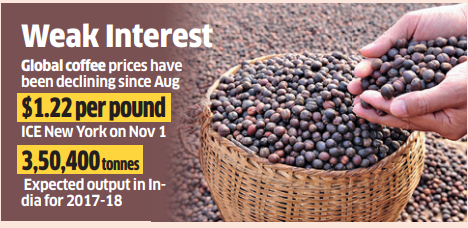
The price of coffee in the international market has been declining since August. Arabica futures prices at ICE New York stood at $1.22 per pound on November 1, down by 15-20% from earlier this year. Robusta prices, too, are showing a declining trend.

TrendsKF11nov2017

The picking of arabica beans, which normally start by the end of November, has already begun in the coffee producing states. “This time, it may be completed by the end of November, instead of in December,’’ said MM Chengappa, former chairman of Karnataka Planters’ Association. Harvest of robusta is expected to begin a month earlier, in December.

Coffee growers fear that the heavy rains last month have led to a fall of berries on a large scale.

Although the post blossom estimate of the Coffee Board projects an output of 3,50,400 tonnes for 2017-18, growers feel output will be less by a large margin. According to them, delayed monsoon will affect the robusta production.

“Total output will be about 3.12 lakh tonnes, similar to last year. Robusta will be around 2.10 lakh tonnes, against 2.47 lakh tonnes projected by the Board,’’ Chengappa said.

source: http://www.economictimes.indiatimes.com / The Economic Times / ET Home> Markets> Commodities> News / ET Bureau / November 03rd, 2017

Board of Tata Coffee approves change in directorate

With effect from 07 November 2017

The board of Tata Coffee at its meeting held on 07 November 2017 considered the following –

T. Radhakrishnan, currently Executive Director would relocate to Vietnam as Managing Director of Tata Coffee Vietnam Co, WOS of the Company from 1 April 2018.

TCVCL is in the process of setting up a 5000 MT Freeze Dried Coffee Plant in Vietnam.

Consequent to the above, the Board has accepted the resignation of T. Radhakrishnan as Executive Director, with effect from 7th November 2017.

The Board of Directors approved the appointment of L. Krishnakumar as an Additional (Non-Executive) Director of the Company, with immediate effect.

Powered by Capital Market – Live News

(This story has not been edited by Business Standard staff and is auto-generated from a syndicated feed.)

source: http://www.business-standard.com / Business Standard / Home> News-CM> Companies> News / Capital Markets / November 07th, 2017