Category Archives: Coffee News

Coffee industry seeks review of GST

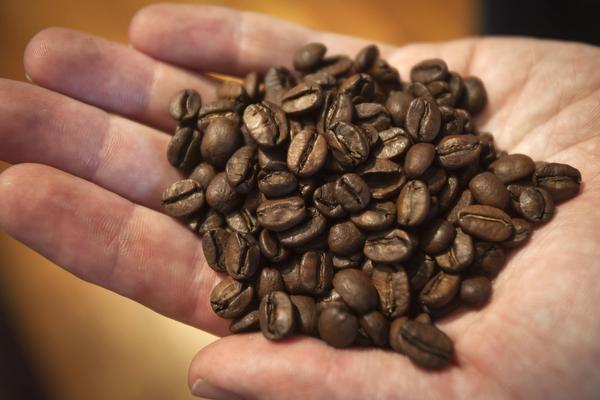
CoffeeBeansKF07nov2017

The high GST rate, besides bringing down instant coffee consumption, would also have a significant impact on the coffee farmers of South India

New Delhi / Bengaluru :

The coffee industry has sought a review of the GST rates on instant coffee and the curing process, while stating that such high rates would hurt consumption and, eventually, growers’ realisations.

Coffee growers are under pressure as the volatile trend in global prices, which directly influence local prices, has already kept their realisations in check.

The GST on instant coffee has been fixed at 28 per cent, while the curing or dry processing of the beans attracts a levy of 18 per cent.

Parity sought with tea

Making a case for reduction in GST on instant coffee, The India Coffee Trust, represented by various stakeholders from the sector, has appealed to the Prime Minister’s Office to bring it down to 18 per cent, on par with the instant tea.

Anil Kumar Bhandari, President, ICT, in a letter to the PMO, said the high GST rate, besides bringing down instant coffee consumption in the country, would also have a significant impact on the coffee farmers of Karnataka and South India, since instant coffee manufactures will source less raw coffee from them.

According to the ICT, of the 3.46 lakh tonnes of raw coffee produced in the country, about 2.78 lakh tonnes is exported, while the rest is consumed domestically.

Of the 0.78 lakh tonnes consumed domestically, about 50,000 tonnes is used in the form of roast and ground, while the remaining 28,000 is consumed as instant coffee.

South India accounts for the bulk of the coffee consumption, though off-take has picked up in the northern States in recent years.

The Trust said instant coffee is largely consumed by poor consumers and the cost per cup is lower when compared to the roast and ground.

It also said that higher tax would impede the development of the coffee habit in North and East India.

Seeking a cure

Meanwhile, the All India Coffee Curers Association has demanded the withdrawal of 18 per cent GST levied on coffee curing.

Curing involves dry processing and grading of green coffee beans.

As curing is an investment-intensive process, the majority of coffee growers normally outsource the dry processing of the green beans to curing works, where they are processed, graded and sorted.

“Any levy on curing would eventually hit farm-gate prices, thereby reducing growers’ realisations. The government should withdraw the levy,” said AN Devaraj, President of the All India Coffee Curers Association.

Farm-gate price worries

Coffee growers are concerned about how the impact of the GST levy on curing will influence farm-gate prices, even as the early harvesting of the arabica variety has begun in parts of Kodagu and Chikmagalur, the main growing regions.

“The GST on curing may impact farm-gate prices. With the season yet to start in full swing, it is too early to quantify the impact,” said HT Pramod, Chairman of the Karnataka Planters’ Association.

Arabica prices are hovering between ₹7,000 and ₹7,200 per 50-kg bag for the parchment, while arabica cherry prices are in the ₹3,700-4,000 per bag range, lower than last year.

“We are waiting for clarity on this issue. No sale of coffee from the new crop has taken place as growers are not in a hurry to sell as prices are low,” said N Bose Mandanna, a grower in Kodagu.

source: http://www.thehindubusinessline.com / Business Line / Home> Economy> AgriBusiness / by KR Srivats & Vishwanath Kulkarni / October 30th, 2017

Students encouraged to be self reliant

Secretary of Land Resources Development, Y Kikheto Sema, during visit to coffee farm in Zunheboto district on October 26.

Dimapur (EMN):

Expounding that the end of education is not to seek government job, Secretary of Land Resources Development, Y Kikheto Sema has urged the students to engage in self employment and pass on the experience and knowledge to others.

Kikheto said this to students from Mewar University, Rajasthan, comprising mostly from Eastern Nagaland who were on a three-month field visit to the coffee farms. Kikheto met the students during his visit to coffee farms at Litami New and Old and Phushumi villages under VK area of Zunheboto district on October 26.

“With less other means of sustainable economy in Nagaland, which is basically agro and allied, he urged the agriculture students to go back to the villages and teach the farmers about the farming techniques.

Kikheto along with officials from the Land Resources Department (LRD) made the visit to get first hand information about the progress of coffee cultivation since the department has been made as nodal department for coffee plantation.

During the interaction, farmers revealed that the yielding was lesser compared to earlier years to which the officers explained that it was due to global climate change and the problem of root rotting fungal infections and Stemborer pest infestations. In this regard, the department assured to give some tips to handle the diseases.

Kikheto informed the farmers that an MoU has been signed with a South African firm, wherein the latter has assured to buy the products on the spot at the same rate of New York and London Stock Exchange.

He encouraged the farmers to do multi-cropping along with coffee which could sustain the farmers to a huge extent. Some of the multi-cropping, according to him, included black pepper, betel nut, local chicken rearing and honey bee.

During the course of the interaction, the Secretary informed that the Coffee Board of India (CBI) has agreed to provide assistance to the coffee farmers for the initial two years for maintenance. While stating that the maintenance fund might not be sufficient in the management of the farm, he encouraged the farmers to take full advantage of the CBI assistance.

The secretary informed that the department had requested fund from the State government to assist the farmers who will directly get the benefits in their account. Besides, he stated that the department would distribute coffee saplings free of cost as well as nursery maintenance cost.

LRD Director, Hoto Yeptho, said the department would thoroughly study the diseases affecting coffee and accordingly advise the farmers. “Any problem can be tackled with research and experience. So do not worry about it,” he said.

Other officers including joint director, deputy director, DPOs of Kohima and Zunheboto were part of the LRD team visiting the coffee farms.

source: http://www.easternmirrornagaland.com / Eastern Mirror / Home> News> Nagaland / by EMN / October 28th, 2017

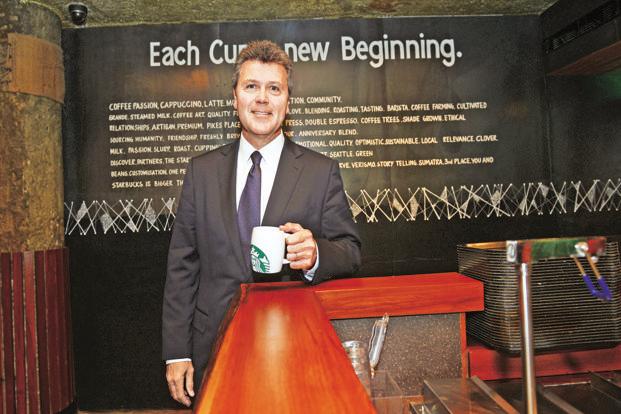
India will be one of Starbucks’ top five markets in long term, says John Culver

The success we have had in India over the last five years gives us great optimism over future growth potential, says John Culver, group president, Starbucks International.

John Culver, group president, Starbucks International. Photo: Ramesh Pathania/Mint

Mumbai:

It has taken US-based coffee chain Starbucks Corp. five years to open 100 stores in India. In comparison, the Seattle-based firm plans to open 500 stores per year in China, doubling its store count to 5,000 by 2021.

Nevertheless, John Culver, group president, Starbucks International, who was in Mumbai to celebrate the milestone of 100 stores, is optimistic that India would one day be among its top five markets. Edited excerpts:

How does India compare to other markets?

India has been our fastest growing new market. The success we have had here over the last five years gives us great optimism over future growth potential.

We believe that one day India will be one of the top five markets. I won’t put a time frame to it. It’s over the long haul. We will make the right investments along the way in the business to build out the stores and the footprint.

Not only do we see growth in terms of top line and bottom line, more importantly we see growth with our people and the investments we make in our people.

Today we are also announcing that 40% of our workforce will be female. Right now we are at 25%.

Starbucks remains a premium offering in India. Is this by design?

We have something that attracts all consumers to our stores. Not only do we have premium beverages we also have value.

My Starbucks rewards is a great example. We have 300,000 people as a part of this programme and they account for 25% of our overall transactions.

This is continuing to build and attract a wide variety of consumers regardless of income and class.

What will be your growth drivers?

There are 600 million people that sit in the middle-class (in India). That presents a huge opportunity. The other thing you are seeing is the growth in coffee consumption.

Over the last 10 years, coffee consumption in India is growing at 40%. This is an emerging market and Starbucks is at the forefront of delivering high-quality, great experiences to consumers that are unique. If we focus on that experience we can create something special.. similar to what we have seen in other markets.

In India, the emerging middle class is spread across at least 100 cities.

We see a huge opportunity in India in multiple cities over time. Today we have announced operations in our seventh city.

We will continue to go deep into those cities that we operate in and also look at new cities over time.

What next?

We will continue to introduce new coffee and coffee blends with our partner Tata Coffee.

We will also continue to provide new experience. We will also look at food that will fit consumers taste profile, continue our digital efforts, given the role digital is playing and look at various experiences outside our stores and sell our products through other grocers and e-commerce.

source: http://www.livemint.com / LiveMint / Home> Companies / by Sapna Agarwal / Tuesday – October 24th, 2017

Coffee Needs Better Branding For Higher Returns: Bakshi

Tura :

Coffee produced in the Northeast can bring remunerative returns if the beverage is properly packaged and branded.

This was pointed out by West Garo Hills deputy commissioner, Pravin Bakshi, while speaking at a daylong workshop on post harvest management and coffee marketing linkage at the Social Mobilisation Experimentation and Learning Centre in Dakopgre here on Tuesday.

Earlier, Bakshi inaugurated the workshop held with the objective to provide ideas and techniques to expand the coffee growing areas of the region and support farmers.

“The number of coffee growers is gradually rising in the region. Coffee, referred to as brown gold, is not bound by economies of market and depends on the quality of the beans. The beverage needs to be properly graded, branded and packaged for attracting higher returns,” the deputy commissioner said.

The workshop was jointly organised by the Coffee Board, Union ministry of Commerce and Industry, Meghalaya Basin Development Authority and Soil and Water Conservation department.

Delivering the keynote address at the inaugural function, V R G Gowda, the joint director (extension), Coffee Board, ministry of Commerce and Industry, spoke about the establishment of Coffee Board in the region in 1997 and the necessary requirements and climatic conditions required for growing coffee.

He informed that coffee was being cultivated in all the states of Northeast, particularly in Mizoram, Nagaland, Assam and Meghalaya. “There are about 1,700 coffee growers in Meghalaya,” he said.

R.R.B. R Thabah, the director (natural resources management), Meghalaya Basin Development Authority (MBDA), Meghalaya, informed the gathering about the purpose of the workshop and called upon the beneficiaries to work together as partners in order to promote agro-forestry in the region.

T N Gopinandhan, bio-chemist, Central Coffee Research Institute, Coffee Board, explained in detail about the methods of processing coffee beans for better quality.

Webstar D Shira shared his experience as a progressive farmer, talking about issues and challenges faced with regard to marketing linkages in the region besides introduction of multiple cropping in his farm land.

source: http://www.theshillongtimes.com / The Shillong Times / Home> Meghalaya / by Staff Correspondent / October 25th, 2017

Brewing Treasure

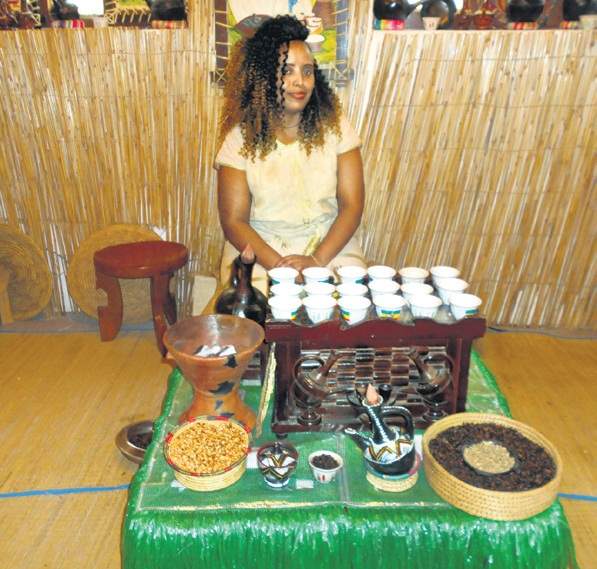
An Ethiopian woman roasts a pan of green coffee beans in their traditional technique

Stepping into a small unassuming villa on the backstreet of Al Fahidi district in Bur Dubai, I feel I am embracing the cultural ethos of several centuries. The aroma of freshly brewing coffee wafts in the air. I walk past a gift shop to reach the centre of a unique wind-tunnel house named the Dubai Coffee Museum, which was set up in October 2014. My journey into the history of coffee begins as soon as I enter the creator and owner of the museum, Khalid Al Mulla.

I accompany him on a round of the ground floor where each space provides a glimpse of different coffee-drinking cultures. As we step in his favourite zone, he says, “Here is the coffee from Ethiopia where coffee drinking reputedly began at first.” Here, a stylish Ethiopian lady is roasting a pan of green coffee beans in a traditional technique. Next to her is Egyptian barista Abdul, dressed in an Egyptian ‘galabeya’ and skull cap, standing guard on a customised silver and gold coffee machine.

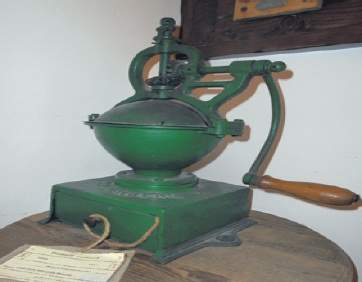
An ancient coffee grinder

The small exhibition rooms, where coffee beans from countries across the world are neatly stacked, are also home to coffee artefacts and antiques. Khalid’s collection is huge. Prominent among the pieces are distinctive 300-year-old jug-shaped clay coffee pots known as ‘jebena’ (the Yemeni equivalent is ‘jamena’), which were historically used by the Ethiopians .

Steps inside the museum lead up to a literature room displaying texts from 18th century to the present day. One such text, Johann Friedrich von Pfeiffer’s 1784 encyclopaedia, is believed to be the oldest printed text on coffee, with 177 pages dedicated to ‘kaffee’ as Johann would have called it. There is also a custom-built brew bar, where one can sip acup of caffeine powered rocket fuel brewed in the traditional Japanese siphon method.

The tour ends with a cup of Ethiopian coffee at a cosy Emirati-style ‘majlis’ on the ground floor, drunk in the local Bedouin coffee tradition. Khalid says, “As the director of Dubai-based coffee importers and roasters, Easternmen and Co., I participated in trade shows. I was surprised to see visitors’ interest in these objects, which forced me to create the first-of-its-kind coffee museum in Dubai. The concept is to showcase global coffee history.”

source: http://www.newindianexpress.com / The New Indian Express / Home> Magazine / by Sharmila Chand / Dubai, UAE – October 21st, 2017

Brewing Up Nagaland

September Edition, Special Story, NET Bureau, Sayantani Deb

Nagaland, even though is one of the most beautiful states of the Indian sub-continent, however, generally grabs the headlines for all the wrong reasons- especially due to the insurgency-related issues. Shedding off the negative colours, the state on July 27, 2017, made took a step forward when the Nagaland government signed a Memorandum of Agreement (MoA) with the South Africa-based Nobel Cause Company in order to promote the state’s coffee at an international stage. The initiative, in the next few years, is certain to alleviate Nagaland coffee to an all new height.

Chronicle of Coffee

Even though coffee development programme in the Northeast initially began in the 1960s, however, commercial cultivation of coffee began only in 1976. The main aim of initiating coffee plantation in the region was to wean out the age-old practice of jhum cultivation and prevent soil erosion. Jhum or shifting cultivation was mainly practiced among the various tribal groups of the region. In Nagaland, large scale coffee plantation was first introduced in 1980. The Nagaland Plantation Crops Development Corporation (NPCDC), in collaboration with the Coffee Board of India, was the pioneer agency to establish 2811 hectares of coffee- land in Nagaland in 1981. The initiative however failed due to lack of market avenues.

After the gap of over 35 years, the Nagaland government is again on its mission to revive its coffee sector. With Land Resource Department (LRD) as nodal department, government is taking up a number of coffee plantation drives in various districts of the state.

Nagaland produces two types of coffee— Arabica and Robusta. Arabica suits the higher altitude while Robusta (specie) suits in lower altitude areas. Over 760,000 coffees have been planted throughout the state with the target of another 700,000 in 2017.

Coffee Plantation in 1980s

In 1985-86 coffee cultivation was tried in Nagaland, but unfortunately due to lack of proper market linkage it could not succeed. Many villagers in all the districts have tried coffee plantation but they were discouraged as they couldn’t sell their product, also there was no motivation, they were not taught properly. As, a result many of the farmers destroyed their coffee plantation and went back to their jhum cultivation.

Coffee Board’s Version

Speaking to NET, Joint Director of Coffee Board of India (CBI) Extension, Guwahati Dr VR Gudde Gowda, said, “Nagaland is one of the first states in the Northeast to come forward in taking up coffee cultivation and thus gradually making a mark in world coffee map.”

According to Gowda, coffee cultivation will also protect forests and will conserve soil and water. “Coffee being a shade loving plant provides economic stability as alongside coffee other vegetables and crops could be easily grown,” says Gowda.

He also adds that he is quite hopeful that Nagaland will become a coffee producing state within a span of 4 to 5 years.

“Due to its default organic nature, Nagaland coffee has a huge scope. In this regard, we will see that Nagaland coffee gets recognition among coffee drinkers in the world. We will work out and do our best,” he added. Further getting candid, Gowda also shares the success story of Vietnam.

“In 1990s, Vietnam used to produce around 1 million ton of coffee per year. However, with various high-tech initiatives they went on to produce around 12 million tons in 2001,” he said. Presently Vietnam produces around 1,300,000 tons per year, which makes it the second largest producer of coffee in the world, only next to Brazil which produces about 2,249,010 metric tons of coffee per year.

Y. Kikheto Sema, DoLR Secretary

While speaking about the socio-economic impact of coffee plantation in Nagaland, LRD Secretary Y Kikheto Sema, says, “In Nagaland there is no possibility of large and medium scale industry. There is only possibility of agro-based industries.

“Nagaland is a blessed state. In spite of the fact that along with coffee, rubber cultivation in the state is also quite high, but interestingly the place where rubber is viable it is not viable for coffee, because rubbers grown in low altitude places while for coffee production high altitude are required,” Sema added.

In 2016, Nagaland earned around Rs 100 crores from rubber cultivation, and out of this around Rs 90 crores were collected from rural areas. Most of the rubber cultivators earlier were engaged in jhum cultivation. After switching the farmers are now earning far better and with this the transformation of socio-economic condition has been taken in rural areas.

Sema believes his transfer from Finance Secretary to LDR secretary was a blessing in disguise.

“I served Finance Secretary for 10 years, during a meeting with Chief Minister we came to know that the Land Resource Department of Nagaland was doing pretty well as compared to other departments. It was the wish of the Chief Minister TR Zeliang that the coffee plantation should be taken over by Land Resource Department from Horticulture department.”

In May 2016, Sema took over the charges of LDR secretary.

“During then, I was aware that this is a performing department and I also tried to motivate the officials, farmers through various trainings, awareness campaigns, visits etc,” he said.

During an interaction with officials Coffee Board of India (CBI), Sema requested them to provide technical assistance, seed coffees.

“Earlier, CBI provided us with 500 to 600kg seed coffee, but paying attention to our appeal, this year they have sent around 2400 kgs of seed coffee, these were distributed among the coffee farmers in all the 11 districts. Coffee seeds were mostly.”

Presently, LRD is maintaining a nursery of 2400kgs coffee seeds, which is giving over 60 lakhs saplings. The saplings will be planted in next May and will cover around 4200-4300hectares.

In order to encourage the coffee growers and provide them market linkage, Y Kikheto Sema on behalf of Nagaland government has signed a Memorandum of Agreement (MoA) with the South African based, Nobel Cause Company for a period of 30 years.

“Post completing all the formalities, around 7 metric tones which was purchased from coffee growers in Nagaland and stocked in Kolkata will offshore from Kolkata by September and is likely to reach Cape Town by November. Our main motto is to hit world market so that the Nagaland coffee receives the best price,” he said.

Planted and Bearing Area in the year 2016-2017

Planted Area
Arabica : 1751.65 H
Robusta : 223.90 HA
Total : 1975.55 HA

Bearing Area :
Arabica : 600 HA
Robusta : 50 HA
Total : 650 HA

Employment Opportunity

With the increase in coffee production, the employment opportunity will increase in the state, “Per hectare will direct give employment to at least 2 persons. According to CBI, soil and weather condition in Nagaland is very favourable for coffee production, so we feel that by 4th year coffee will start harvesting, which will generate employment to large number of young employed youths.”

LRD Secretary is also encouraging his officials to take up value additional crops, “Coffee is shade loving plants, Arabica requires about 60 percent of shades, we are also working out in the shade tree like black pepper, beetle nuts etc for sustainable development. We are hopeful that with this development there will be transformation in rural areas, living standards of the villagers will be improved, also will be able to give employment opportunity to educated youths.”

He further reveals that educated or semi educated Nagaland youths are now not interested in Jhum cultivation, but coffee is like a forest which can attract a lot of people.

Assistance from Coffee Board

• Expansion of coffee: To facilitate afforestation in Jhum lands and help the tribals on permanent footing, a subsidy of 50% were given to coffee growers. Normal unit cost is Rs 70,000 per ha.

• Consolidation of Coffee: To increase the productivity of the existing coffee holdings by gap filling, rejuvenation and improved cultivation methods like application of compost, bush management, shade management, pests and disease control, a subsidy of 50% were given to coffee producers. Normal unit cost is Rs, 40,000 per ha, while with subsidy cost is Rs 20,000 ha.

• Support for Group Nurseries: To provide the growers with good quality coffee seedlings to ensure proper establishment of plantation. Coffee board distributes per seedlings at Rs 5.

• Supply of baby pulpers at 75% subsidy. Actual cost of baby pulpers is Rs 16,000 per unit.

• Water Augmentation: To improve the productivity and quality of coffee by facilitating the creation of infrastructure for water augmentation for irrigation and wet processing of coffee.

source: http://www.northeasttoday.in / NorthEast Today / Home> Lifestyle / by North East Today / October 21st, 2017
Karnataka needs international coffee trade fairs

PTI file photo for representation.

The Coffee Board of India, under the administrative control of the Ministry of Commerce, Government of India, has to contribute to the coffee economy, which is in crisis with three years of near-drought, untimely rains and poor crop yields in Karnataka.

Coffee plantations also have pepper vines inter-planted among them to supplement income, which makes the crash in pepper prices since February this year, worsen the financial hardship of coffee planters.

Moreover, flaws in crop insurance and revenue protection insurance schemes have not really benefited 90% of the coffee-growers, who own plantations of 25 acres or below. The Rainfall Insurance scheme has been discontinued due to lack of adequate modalities in place. Moreover, the newly introduced Revenue Protection Insurance scheme which was initiated as a pilot project in Chikkamagaluru has not evinced much interest among the insurance companies. Therefore, the coffee plantation sector, which employs an estimated 11,00,000 skilled workers, finds that their livelihoods are at stake across the coffee districts of Kodagu, Hassan and Chikkamagaluru.

While coffee growers are confronted with high input costs in terms of labour wages and fertiliser prices, they have to endure low prices for coffee and pepper, which makes it financially unviable to manage plantations. If coffee plantations begin to suffer losses, then the coffee economy will become unsustainable and small growers will find it more remunerative to sell their plantations or convert them into holiday or health resorts — a development which has already taken shape over the last five to seven years. That will surely herald the beginning of the end of the coffee plantation sector and its related industries. Therefore, the Coffee Board needs to transform to a market support role in addition to its R&D functions.

Till the mid 1990s, the Coffee Board functioned in a regulatory role. However, the Coffee Board now needs to adapt to a free market economy since the 1991 economic liberalisation and transition to that of a facilitator. It would need to support the coffee economy through the organisation of trade fairs and help small growers and international buyers to comply with the various statutory requirements towards coffee trade and export.

The Women’s Coffee Alliance India, Bangalore, successfully conducts a vibrant Coffee Santhe or Coffee Fair in Bengaluru annually, and involves all the stakeholders of the economy. For instance, much like the Ministry of Defence organises Aero India at Bengaluru to connect foreign aeronautics majors with the domestic industry; the Ministry of Commerce can also conduct a coffee trade fair under the aegis of the Coffee Board.

The small coffee grower is unable to attend international coffee trade fairs overseas due to cost constraints of airline travel. Therefore, the Coffee Board should hold international trade fairs in Kodagu and Chikkamagaluru for buyers and sellers as a platform to interact with each other. The Coffee Board has large tracts of land with established infrastructure and research stations at Balehonnur, Chikkamagaluru and Chettalli in Kodagu, which can be utilised as centres for international coffee trade fairs and as integrated coffee parks.

Moreover, the boom in coffee tourism over the last decade has developed the hospitality and travel industry resources in these plantation districts to be able to hold the proposed trade fairs. Besides, the two international airports in the proximity are at Mattanur, Cannanore district in Kerala, which is a 90-minute drive from Kodagu and at Mangaluru, which is a two-hour drive away from Chikkamagaluru. As airline connectivity to these two coffee plantation districts, which are also internationally acclaimed biodiversity hotspots exists, these districts are ideal locations to organise trade fairs.

It will make the grower aware of the requirements of the discerning international consumer. The buyer will see for himself the journey of the Indian coffee bean from the plant to the cup. It will incentivise the grower to produce the kind of coffee that the buyer desires. Only a grower knows the trials and tribulations of coffee cultivation and only he can market his coffee with passion and obtain the best price possible for his crop.

Considering that 70% of the coffee grown in the country is exported, the small grower should market his coffee overseas. An important point to note is that Indian coffee is grown under shade, which uses ecologically sustainable methods and adoption of fair trade practices in the eco-sensitive zone of the Western Ghats, which can command premium prices in the international markets. To make Indian coffee competitive in the world market, the Coffee Board must publish a list of internationally-banned pesticides, which will also make the environment safe for plantation workers.

The outcome of such international trade fairs would lead to a demand for ‘Single Origin Estate Specific and Area Specific’ coffees, which will start to gain importance. Today, these fairs held at foreign locations are not inclusive of all stakeholders and have become the exclusive domain of a few elite coffee growers and traders. The Coffee Board should aim to democratise the sale of coffee and enable the small grower to export coffee to international markets rather than allow a select few to prosper at his expense.

(The writer is Chairman of Karnataka Planters Association, Chikkamagaluru)

source: http://www.deccanherald.com / Deccan Herald / Home> Supplements> Economy & Business / by Maneypanda Madaiah Chengappa / October 22nd, 2017

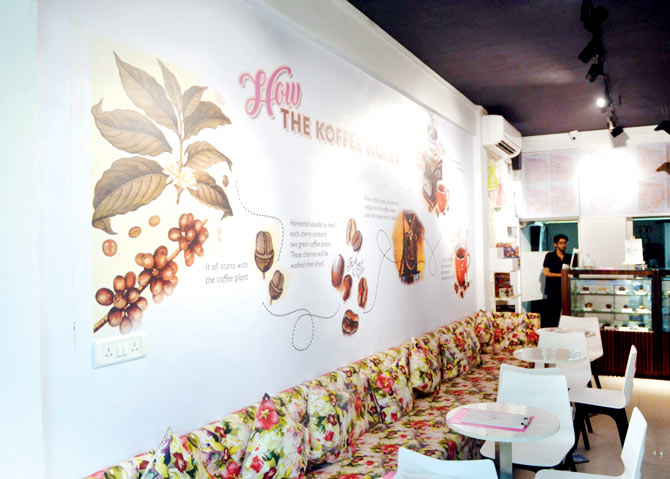
Mumbai Food: Try Experimental Coffees At Chembur’s All New Koffee Works

For someone trying to open a cafe in a city that doles out cappuccinos at every street corner, Ishanee Amar Haware knew she had her task cut out for her. Haware, born in Mangalore and brought up in Bengaluru, did not know either Hindi or Marathi when she moved to Mumbai three years ago. However, coming from the 13th generation of a family that owns a coffee plantation in Chikmanglur, she seems to know what they mean when they say ‘wake up and smell the coffee’.

With The Koffee Works, a café and bakery she has started in Chembur, Haware aims at ushering a serious coffee culture in Mumbai, a city, which she is told has a “largely chai soul”.

The 25-seater is done in shades of yellows, pinks and white, a departure from the sober blacks, greys and browns that tarnish most cafes

“Everyone told me that this is a city that loves its chai. Coffee, despite the number of cafes that continue to spring up, is still a fringe and a premium beverage. I realised that I could start catering to this segment through a boutique coffee experience.” The 25-seater could be a chip off your living room. Its vibrant shades of yellows, pinks and white is a departure from the sober blacks, greys and browns that tarnish most cafes. Quiet and cosy, this could be a perfect place to sit and read a book or work privately. That her family owns a coffee plantation came in handy for Haware, who wants to make the experience as artisanal and customised as possible. For starters, the coffee beans are ground only once an order is placed. “We import our coffee machines from Italy, and these are semi-automatic machines. How your coffee tastes depends a lot on who makes it, the art of the barista, the person who operates the machine. If the entire process is automated, then you have little control on how the beans blend and how they end up tasting.” The Koffee Works has developed its own blend in consultation with the Coffee Board of India and it has taken them several rounds to arrive at what everyone felt was perfect.

The Turmeric Latte
The Turmeric Latte

Besides the usual cappuccinos, lattes and Americanos, their experimental brews manage to cut through clutter. Take the Vietnamese Coffee, for instance. It’s a blend of Americano (black coffee) and condensed milk, served on the rocks. They also have the haldi-doodh’s modern interpretation, the Turmeric Latte. “But it’s a fun drink,” she adds.

Ishanee Amar Haware
Ishanee Amar Haware

The Koffee Works also has its own bakery that produces pastries, macaroons, cakes. “We have a centralised kitchen and none of what we serve here is outsourced. Even the coffee in your cup, right from picking the beans to their processing in our factory, to the coffee in our kitchen, the entire process is controlled by us. This, you could say, is our USP.” “We are the first privately owned coffee estate in the country. There was a time when my father controlled 40 per cent of the exports — we used to export to Coca Cola as well. This is the first time that we have chosen to have a retail outlet. My dream is to make them interested in coffee, and who knows, even convert people into coffee drinkers and coffee lovers.”

source: http://www.mid-day.com / Mid-Day / Home> Life an Style News / by Kusumita Das / October 12th, 2017

Rwanda Scoops International Coffee Award

Ambassador Valentine Rugwabiza poses for a photo with an award winner

Rwanda coffee has won one of the international coffee award conferred to the best coffee growers in the world.

“The second Ernesto Illy International Coffee Award 2017” was offered to Rwanda in the ceremony held in New York City, United States of America (USA).

Out of 27 contestants, three nationals; Jean Bosco Ngabonziza, Tumwamini Ndamwemera Jean Paul and Faustin Nzabarakize were awarded for their coffee’s unique aroma.

Their prizes were handed to Rwanda’s ambassador to the United Nations, Valentine Rugwabiza.

According to National Agricultural Export Development Board (NAEB) statistics, Rwanda exported 18.4 tons of coffee and earned $58.5 million in 2016-2017 fiscal year compared to 19.5 tons made $60.7 million in 2015-2016.

It is projected that there will be an annual average export growth rate of 29 per cent translating to $104.3 million by 2018.

The annual coffee event organized by Illy Family recognizes 3 best coffees from 9 most important producing countries; Brazil, Columbia, Costa Rica, Ethiopia, Guatemala, Honduras, India, Nicaragua and Rwanda.

Founded in 1933, the Ernesto Illy Family owns coffee business in 140 countries across the globe with estimated net worth $432.1 million in 2015.

Contact the Author: @nshimiyimanaleo

source: http://www.ktpress.rw / KT Press / Home> Business – Economy / by Leonard Nshimiyimana / October 18th, 2017

Lavazza launches Made-in-India premium filter coffee

Zaccareo said the company inaugurated Coffee Training Centre last year which was the first largest centre outside Italy.

Italian coffee brand Lavazza today announced the launch of its first made-in-India premium filter coffee “II Mattino Vivace”, produced at its manufacturing facility near here, a top company official said today.

The facility at Sri City in Tada began its commercial operations a few weeks ago, Fresh and Honest Cafe Ltd Managing Director Silvio Zaccareo said.

Fresh and Honest Cafe Ltd is a 100 percent subsidiary of Lavazza.

“The factory began commercial operations a few weeks ago. We are launching the Made in India product today..” he told reporters after unveiling II Mattino Vivace.

Zaccareo declined to reveal the size of investment made at the factory or the number of employees working in it.

II Mattino Vivace meaning ‘lively morning’ is made from blends of Arabica and Robusta coffees roasted for the “at home” segment.

The beans were sourced from plantations in Coorg and Chikmagalur in Karnataka. A 200 gm packet is priced at Rs 150, he said.

“Lavazza is known the world over for its expertise in art of blending for over four generations. II Mattino Vivace is a result of combining that expertise and our understanding of the unique consumer preferences in Indian market”, he said.

The domestic coffee market was around 70,000 tonne in which 80 percent comprises “at home” (residential) segment.

To a query, he said the coffee powder would be available in retail outlets across the country. “We are planning to complete first stage distribution by end of this month”.

Zaccareo said the company inaugurated Coffee Training Centre last year which was the first largest centre outside Italy.

The centre trains professionals, carries out research and explores new forms of taste. “We have trained more than 1,000 people,” he said.

source: http://www.moneycontrol.com / MoneyControl / Home> News> Business / by PTI / October 13th, 2017