Category Archives: Coffee News

Coffee Board pegs output for 2017-18 at record 3.5 lakh tonnes

CoffeeCropsKF06oct2017

Rise in bearing area of the bean attributed to the bumper crop

Bengaluru :

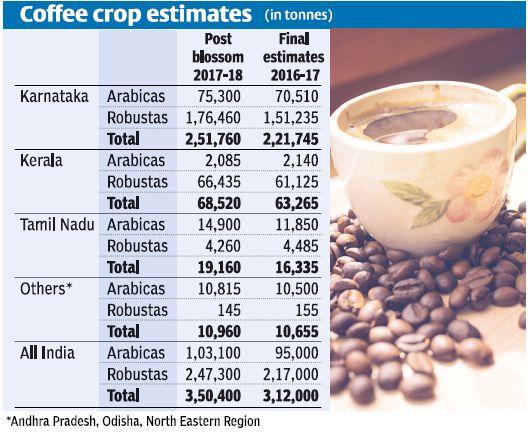
India is heading for yet another record coffee crop in the year 2017-18 starting October 1 on increase in the bearing area under the bean crop. State-run Coffee Board, which released the post-blossom or the initial estimates on Tuesday, has placed the 2017-18 crop at 3.5 lakh tonnes (lt) — an increase of 12.31 per cent over 2016-17’s final output of 3.12 lt.

Rise in acreage
The crop size of arabicas, the mild and premium bean variety, is seen rising by around 8.53 per cent in 2017-18 over the previous year, while the production of robustas is seen growing by around 14 per cent.

The projected growth in 2017-18 post blossom output is mainly on account on increase in bearing area of about 13,500 hectares in the traditional growing States of Karnataka, Kerala and Tamil Nadu. Though the Coffee Board had assessed the 2017-18 post-blossom crop size during May 2017, the estimates were released on Tuesday.

Crop losses, if any, after May 2017, will be taken into account at the time of post-monsoon estimation, the Board said in a statement.

India is the fifth largest producer of coffee and Karnataka accounts for about two-thirds of the coffee produced in the country.

State-wise crop size

The post-blossom estimate for Karnataka is placed at 251,760 tonnes comprising 75,300 tonnes of arabica and 176,460 tonnes of robusta. The post-blossom forecast represents a 13.5 per cent increase over last year. All the three main growing regions of Kodagu, Chikamagalur and Hassan districts are seen registering an increase in output over last year.

In Kerala, mainly a robusta producer, the post-blossom estimates for the year 2017-18 are placed at 68,520 tonnes, an increase of 8.31 per cent over the previous year’s final estimate of 63,265 tonnes. In Tamil Nadu, the post blossom forecast for 2017-18 is placed at 19,160 tonnes, up 17.29 per cent over last year’s 16,335 tonnes.

In the non-traditional areas of Andhra Pradesh and Odisha as well as in North Eastern Region, the post-blossom forecast is placed at 10,960 tonnes as against previous final estimate of 10,655 tonnes. The higher forecast has come mainly from Andhra Pradesh due to increase in bearing area.

The Board also said that the 2016-17 crop size had shrunk by around 10.34 per cent over the previous year to 3.12 lt mainly on account of poor rains last year.

In 2015-16, India had produced a record crop of 3.48 lakh tonnes.

(This article was published on October 3, 2017)

source: http://www.thehindubusinessline.com / Business Line / Home> Economy> AgriBusiness / The Hindu Bureau / October 03rd, 2017

Wake-cup to a new brew!

Paying homage to International Coffee Day, Café looks at the trend of a rise in knowledgeable consumption of coffee, doing a little trail of some places known to serve a good brew, in the process

BrewKF06oct2017

Coffee is probably man’s best friend, even ahead of canines.

Much like alcohol (although seemingly less sinister), it often guides many people through relationships, breakups, stressful times, late nights, early mornings…well, you get the drift. In more recent times, beyond the advent of the chains that glorify it with glitz, glamour, strange names and exorbitant price tags, there is a section of the population that craves it’s good ‘cuppa’, a section that has only been growing ever since quality of coffee available in Goa has improved.

But why look at this trend now, one might perhaps inquire. Simply put, International Coffee Day is an occasion to promote and celebrate coffee as a beverage, with events now occurring in places across the world. The first official date of October 1 was announced in 2015, as agreed by the International Coffee Organisation, and was launched in Milan. This day is also observed to promote fair trade coffee and to raise awareness for the plight of the coffee growers. So what better day to address this trend than today, with a little trail pointing out some of the places that provide quality coffee?

Formerly popular by the name of ‘Tamarin’, the new ‘gusto!’ delicatessen is setting a benchmark for itself by becoming the only stockist in Goa of the renowned ‘Black Baza’, 100% biodiversity-friendly, coffee. Set in the heart of Calangute’s ‘Gauravaddo’ at ‘Literati Bookshop’, the establishment has opted to work closely with this coffee because, as the good people at ‘gusto!’ say, Black Baza’s vision fits perfectly with their concepts. It’s a world where coffee farms conserve biodiversity, and all producers have secure and stable livelihoods. Working with over 200 farmers in the BR Hills and Kodagu, Baza is the largest specialty coffee collective in India.

Conservative agreements ensure that farms protect water sources, are chemical free, maintain 60% tree cover, reforest, are fair trade and have 100% traceability. As a result, ‘gusto!’ serves its own blend of Italian style beans and also retails Wanderoo/Otter/Fiscus/Black Baza. A variety of Arabica and/or Robusta beans and ground coffee are available to meet your specific tastes.

Also in Calangute is the new property that everyone is all abuzz about: ‘Le Meridien Goa’. There, at their outlet called ‘Longitude 73’, until October 3, people can satiate their coffee cravings with coffee flavoured cocktails, special éclairs, a latte-art workshop that can help you to impress your guests at your next hi-tea, and a series of other offerings. For art-enthusiasts, the coffee bean art-display at ‘Longitude 73’ is definitely worth a visit.

Another place that works closely with coffee offerings in Goa is ‘Caravela Café’, in Panjim. The little establishment is a breath of fresh air as far as independent cafés in Panjim go, since they serve and are distributors for the artisanal Flying Squirrel Coffee that comes from coffee estates in Coorg. All their coffee is micro-lot, handcrafted, and taken through some unique, creative and natural process for that perfect taste and aroma. Flying Squirrel is available in three variants: Aromatique, Sattva and Parama. Using speciality machines, ‘Caravela Café’ then churns these out in the form of cappuccinos or lattes, if you prefer your coffee with milk; or espressos or americanos, if you like your coffee without the additional flavour that milk adds to it. Only recently, ‘Caravela Café’, along with Flying Squirrel, organised a coffee appreciation session, where around 15 people increased their knowledge about the types and different tastes of coffee. The café has a charming environment for coffee drinking too, with its homely and quaint interiors.

‘The Chikoo Tree Project’ in Margao draws its roots from its founder’s ties to south India, which ensures that coffee is a subject that is always close to the heart. The establishment has partnered with popular brand Devi Coffee and as a result, serves gourmet coffee from the estates of Coorg and Chikmaglur, Mysore Nuggets AAA Arabica, Wayanad Robusta and Madagascar Vanilla. For those who need to beat the heat, there is also an interesting variant known as the Iced Jaggery Coffee on offer. Interestingly enough, the Devi brand grew in Goa itself, after Devika Dutt, MD of Sussegado Coffee India Pvt. Ltd. and an avid coffee consumer, along with her husband decided to retire from the financial world in 2010 and leave behind the business in Singapore. They opted to move to Goa and open a small café where they would freshly roast coffee. Today, they are busier than ever, and the small café became what is today known as the Devi brand.

At the end (or is it beginning) of the day, coffee is almost a way of life, a part of the daily routine. Whether Java, Colombian or French Roast, there is little doubt that every one of its flavours, you’re likely to toast. And on that note, may it be a good weekend, old bean.

source: http://www.heraldgoa.in / Herald / Home> Cafe / by Fernando Monte Da Silva – cafe@herald-goa.com / October 01st, 2017

More the forest trees, the better the coffee

Plantations with native trees produce more coffee which is also of better quality

Forest trees are good, not just for the environment but for your coffee too: having more forest trees in coffee plantations maintains tree diversity and also increases coffee production and quality, shows a study. This could be vital information as native trees are being replaced with exotics in coffee-growing landscapes to increase coffee production.

India, the world’s sixth largest coffee-producer, grows ‘shade’ coffee, under the canopies of naturally occurring native trees such as jackfruit, Black dammar (dhup) and Magnolia (champa) which are legally-protected. However, some planters now replace dead native trees with exotics like Silver oaks which are not protected and can be felled for timber. Silver oaks also serve well as pepper stands, and cultivating pepper on them supplements planters’ incomes. This ‘intensification’ – reducing and replacing native shade tree cover – contributes to forest loss in the tropics, where coffee is cultivated.

Scientists at ETH Zurich (Switzerland) and the College of Forestry (Kodagu) examined whether this intensification affects native tree biodiversity and coffee productivity in Karnataka’s Kodagu district, which produces more than one-third of India’s coffee. They studied tree species diversity in 25 coffee plantations varying in native shade tree cover, with some having only non-native Silver oaks as canopies.

The benefits

Their results, published in the journal Agriculture, Ecosystems and Environment, show that 95 native tree species offer shade for coffee in Kodagu; and intensification decreases this tree diversity. Some plantations, which still retained native trees, even had red-listed tree species (designated as threatened by the IUCN), and some of them in high numbers. The team found that such plantations produced more coffee, which was also of better quality . Silver oak-dominated plantations showed more single-seeded fruits and attacks by the Coffee berry borer, a major pest.

“This is likely due to reduced predators such as ants, birds, or parasitoids, in Silver oak-dominated plantations,” says lead author Maike Nesper (ETH Zurich). Protecting native trees could be crucial, she adds.

“Some regions are re-diversifying tree canopy cover in coffee agroforests, as consumers are increasingly interested in biodiversity conservation and ready to pay premium prices…but to gain the same level of native diversity by reforestation is nearly impossible, and it is crucial to diversity in the first place.”

source: http://www.thehindu.com / The Hindu / Home> Sci-Tech> Environment / by Aathira Perinchery / September 30th, 2017

Subsistence coffee farmers in India unite to transform lives

Speciality coffee products, support and shared value are key to success

Ten years ago, the residents of Kabada Boddaput — in southeastern India’s remote Araku valley — were impoverished subsistence farmers, living in mud huts and getting by on the millet, yams, pumpkin and greens they grew on their one- to five-acre plots.

Cash was scarce and emergencies meant borrowing from friends and family — debts that might take years to repay. “It was a very terrible situation,” recalls Sanyasi Gullela, a farmer. “There were not enough clothes and no money for cattle.”

But life has changed dramatically for Kabada Boddaput’s tribal farmers — along with around 13,000 others in the Araku valley — since they began cultivating coffee, encouraged by the Naandi Foundation, a Hyderabad-based philanthropic organisation.

Last year, Mr Gullela earned Rs105,000 ($1,640) from coffee, which he grows on 1.3 of his three acres of land, and additional funds from the pepper vines coiling around the surrounding shade trees. In recent years, these earnings have financed four cattle for ploughing and an auto-rickshaw for his son. His neighbour has purchased a second-hand tractor.

Daily life has improved, with the newfound cash used to buy more nutritious food, such as lentils, and new clothes. Some locals have upgraded their mud homes with cement and tiles. “Nowadays, I have a lot of choices,” says G. Tirupati Rao, who grows coffee on two of his 3.5 acres. “What we want we can easily buy from the market. Earlier, we had to compromise.”

While around the world coffee has developed a reputation for bringing few tangible benefits to those toiling to grow it, the view in the Araku valley is different. The crop — grown bio-dynamically without costly fertilisers or agrochemicals — has become an unlikely stepping stone to socio-economic progress for some of India’s most neglected and marginalised peoples. “Coffee has given dignity to farmers,” says Chiranjeevi Naidu, a board member for the Small and Marginal Tribal Farmers Mutually-Aided Co-operative Society, set up in 2006 to process the coffee grown through the Naandi project.

The Araku valley has a history of coffee production dating back to the colonial era, when British planters grew thousands of acres. After independence, India’s government-run Coffee Board took over the plantations, employing local people. And the board gave coffee seeds to farmers, although few flourished in the absence of other support.

But many Araku farmers were eager to keep trying. “They said: ‘Anything that was valuable in India, the British took control of, so coffee must be valuable’,” says Manoj Kumar, Naandi’s chief executive officer.

Naandi’s corporate donors were less enthusiastic, he recalls. “I’ve never heard of anyone coming out of poverty through coffee,” one told him. But Mr Kumar — who had rather stumbled into the coffee business when he was asked in 2004 to develop “livelihood projects” to help Araku farmers — was undeterred. Naandi promised technical support with cultivation and offered to market the farmers’ produce overseas.

Since then, Naandi’s agricultural experts have taught Araku’s novice growers to produce top-quality organic coffee, some of which is being sold as “speciality” coffee to select roasters and traders from Japan, Korea, and Europe. These high-end buyers — who taste and rate each lot before purchasing — are willing to pay up to Rs700 per kg for the best of the beans. The bio-dynamic agriculture practised by the Araku farmers is labour intensive but requires no costly cash inputs. Farmers enrich the soil through mulching, using leaves, fallen fruits and other freely available organic matter. They use inexpensive, herbal soil additives to enhance soil fertility and fight pests.

They have learnt the discipline of harvesting beans only when they are bright red and fully ripe. For these efforts, co-op members last year received a guaranteed price of Rs375 per kg of top quality, fully-ripened beans.

From that, the co-op — where the beans are processed within 12 hours of being harvested — deducts Rs90 per kg for transport and processing, with Rs280 per kg profit left for the farmer.

This compares with Rs90-Rs110 per kg that Indian farmers typically receive for bulk coffee to be sold on the New York Commodity Exchange.

“If you want to do sustainable coffee at scale, it has to be speciality coffee,” says Mr Kumar. “When they buy, they pay more than anyone else will pay.”

Problems remain, especially in finding enough buyers willing to pay a premium for all the high-quality coffee the Araku farmers can produce. Last year, co-op members grew 100 tonnes of coffee, but Naandi is working with another 7,000 farmers whose saplings will mature soon, and other villages are pleading to join the initiative.

Mr Kumar believes Araku’s coffee output could easily rise to 500 tonnes or more. But the total world market for speciality coffee was just 10m tonnes in 2011 — although it is said to be growing fast — and speciality coffee buyers tend to buy in small lots from diverse regions around the world. “I don’t have enough high-quality buyers,” Mr Kumar admits.

To expand the market for its own speciality coffee, Naandi recently raised $5m from its Indian philanthropists for Araku Originals — its dedicated, for-profit, coffee marketing arm — to market its wares in Europe.

Araku Originals has opened a flagship store in Paris and is also selling its coffee though 34 other gourmet food shops and other upmarket retail outlets across France. The coffee that does not make the grade as speciality coffee is sold as organic, fair trade coffee elsewhere in Europe. “We are a benevolent link to the international market,” Mr Kumar says. “It can’t just be procured and dumped.”

Despite the challenges, Mr Kumar is convinced that coffee can be made a sustainable cash crop for farmers — but only if those involved across the industry are willing to share the profits more generously.

“You need a very clear-cut, shared-value business model with the farmer,” he adds. “Otherwise, it won’t work.”

source: http://www.ft.com / Financial Times / Home> Agricultural Production / by Amy Kazmin / September 24th, 2017
Would you drink a Rs. 25,000 coffee if you knew what it was made of?

We can only wonder why the rich love this

CivetKF22sept2017

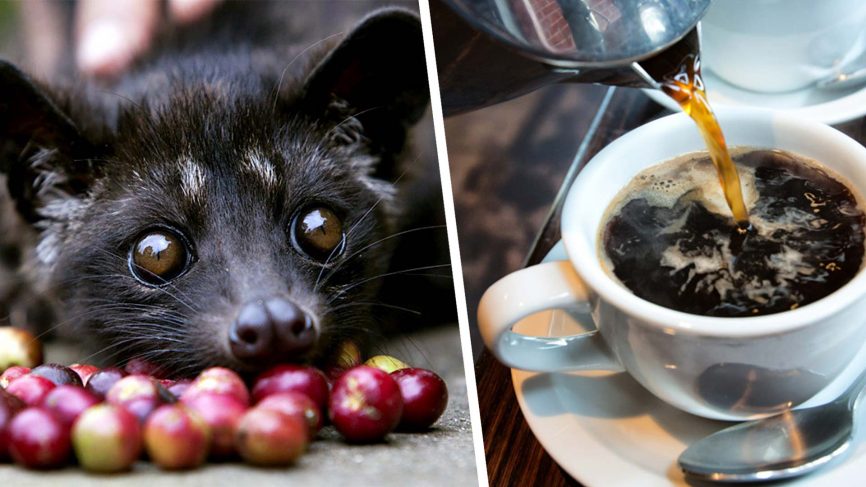
Before you take a sip of Civet coffee, the world’s most expensive coffee, there are two things you should know: 1) A single kilo of it costs between ₹20,000 to ₹25,000; for those who don’t buy their own groceries – that’s approximately 25 times (2500% more) of what your everyday brew retails at, and 2) It is made from the droppings of the Civet cat.

That’s right, droppings as in that smiley brown emoji you love sending your sibling.

Though it is a common drink of the elite in both the richest parts of the Middle East and Europe, you won’t have to go too far to take a sip. Civet coffee is made right here in India, in Karnataka’s Coorg and Chamarajnagar districts. Its high price comes from the uncommon (to say the least) method that is involved in its production.

There’s a reason why the most expensive coffee in the world derives it’s name from the civet cat, a largely nocturnal creature that resembles any child a raccoon and a cat may have some day. The end of the civet’s digestive process is the beginning of the coffee’s life cycle.

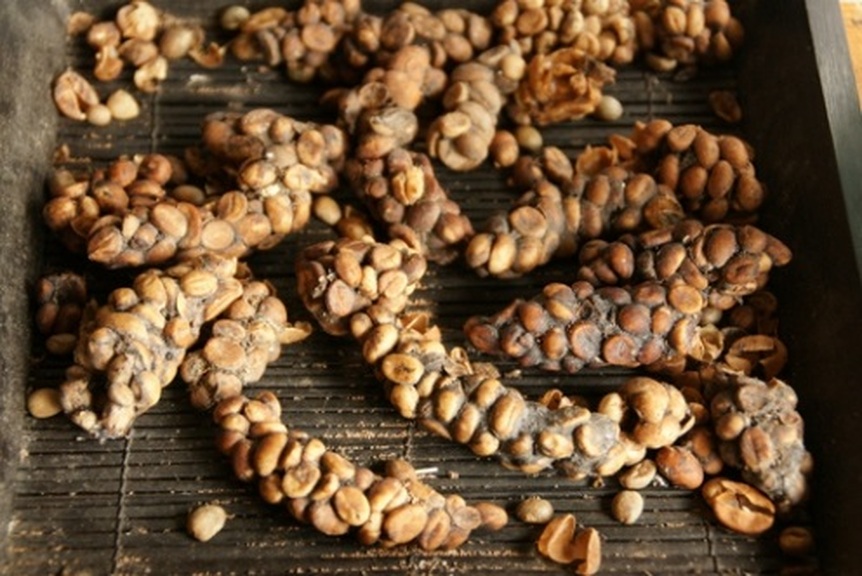
When the civet eats the flesh of the coffee cherries, the natural enzymes in the animal’s stomach enhances the flavour of the eaten bean within those cherries. The bean is then found in the poop of the civet, processed and, after a routine check, packaged. The fact that it has been through the civet’s digest tract is what apparently makes it nutritious and its steep price tag attributed to the high cost that goes into sourcing the animal and quality certification.

However, unlike other countries where civets are caged and fed forcefully, India uses a more natural method: the waste of wild civets is collected from coffee plantations that stand at the edge of the forests in Coorg and Chamarajnagar. That’s great news for farmers too because though we’re no coffee experts ourselves, we’re going to guess that locally sourced organic coffee bean-laden poop fetches a better price than the cage manufactured variety.

source: http://www.gqindia.com / GQ / Home> Live Well> Drink / by Tracy Ann / September 20th, 2017

With output rising, India is now a hub for instant coffee

Coffee Board to finalise estimates after consulting stakeholders
GenericCoffeeKF21sept2017

Coonoor :

India is becoming a manufacturing hub for instant coffee after Brazil and Peru, said Y Raghuramulu, Director of Research, Coffee Board.

In his presentation on coffee at the 124th UPASI annual conference here, he said the country is doing extremely well on the export front

The total volume of export between April and August this year stood at 1.78-lakh tonnes, up from 1.63-lakh tonnes in the corresponding period the previous year.

The country has moved from bulk exports to value-added coffee exports, he said. “We are consistently importing more for re-export. Imports are mainly for value-addition and re-exports by EOUs with duty free under FTP.”

Import volumes during 2015-16 stood at 65,618 tonnes and the re-export volume at 67,283 tonnes. This surged to 78,042 tonnes and 79,254 tonnes the following year. Value-wise, the imports were estimated at ₹927 crore (₹802 crore) in 2016-17 and re-export at ₹ 1,346 crore against ₹1,147 crore in the previous year.

Green coffee exports account for 70 per cent of the total export volume, with specialty green coffee exports inching its way from 3.20 per cent between April and August last year to 3.80 per cent during the corresponding months of this year. Value-added coffee exports have stagnated at around 25 per cent.

Reverting to production, Raghuramulu said: “USDA has forecast India’s production at 3.3-lakh tonnes, but the Coffee Board is yet to release the estimate for 2017-18. The board is in consultation with various associations for finalising the estimates. We do not want to release as in earlier years and come out with a revision.”

The board has undertaken a couple of fresh initiatives, such as the revamping of India Coffee House, brand ambassadors to promote Indian coffee and organising outreach programmes.

“We are looking to franchise at least 10,000 vending machines in the medium-term. Our initiatives will indirectly benefit small coffee growers. We have also initiated discussions with small growers to form producer organisations to help them achieve better returns.”

source: http://www.thehindubusinessline.com / Business Line / Home> AgriBusiness / by L N Revathy / September 13th, 2017

Eight O’Clock Coffee aims for younger drinkers with new infused blends

EightOClockCoffeeKF20sept2017

Dive Brief:

Eight O’Clock Coffee has expanded its line of infused Arabica coffees with three new products designed to appeal to younger and more adventurous java fans, according to a news release.

Joining its already established Relax Decaf and Alert Hi-Caffeine coffee blends is an offering blended with acai berries, another with turmeric and cinnamon, and a third featuring a fruit and herbal concoction rich in vitamin B6.

Established in 1859 as the house blend for the Great Atlantic & Pacific Tea Company, Eight O’Clock Coffee is now a subsidiary of India-based Tata Global Beverages, which also owns Tetley tea in the U.K. and Good Earth Tea in the U.S.

Dive Insight:

Eight O’Clock Coffee is far from the first coffee brand to offer infused and functional blends. There have long been various flavor-infused coffees in the marketplace, and now there are wine-infused and THC-infused coffees for that extra buzz. VitaCup produces a line of vitamin-infused coffees sold in pods for one-time use with specialized machines.

Tata Global Beverages has applied several marketing tools to reinvigorate its Eight O’Clock Coffee brand since acquiring it from Gryphon Investors in 2006. The former A&P grocery chain in-store coffee brand was sold to the private equity firm in 2003.

Tata pulled out all the stops last year with a marketing campaign promoting whole bean coffee to consumers, and in 2012 joined with Green Mountain to launch Eight O’Clock K-cups for Keurig coffee machines. That move is credited with helping Eight O’Clock Coffee take a 7% share of the single-serve market within two years.

The popularity of packaged coffee has been growing recently, primarily due to double-digit growth in the single-serve format. Ready-to-drink varieties are also becoming a popular choice and pose a challenge to the Eight O’ Clock brand as consumers increasingly prize convenience. It’s unclear if the health and flavor benefits of turmeric and cinnamon, or the trendy flavor of acai will win millennials over to taking the time to brew coffee.

Tata clearly plans to continue efforts to better position Eight O’Clock Coffee within the very competitive packaged coffee marketplace, and these infused products are one more example. Whether they will resonate with younger coffee drinkers — who are typically more receptive to trendy formulations and packaging — is something Tata along with other companies will closely follow in the months ahead.

source: http://www.fooddive.com / FoodDive / Home / by Cathy Siegner / September 19th, 2017

World’s costliest coffee made with cat-poop is now available in India. Here’s where you can get a hot cuppa

Take your love for cats to the next level by consuming their faeces. Yes, coffee made out of cat poop is now available in India.

What happens when you take your love for cats to the next level? You consume their faeces. Yes, you read that right. Civet coffee is the most expensive coffee in the world and is made from the excreta of civet cats. India has recently delved into the production of this purr-fect coffee and we’re pretty excited. The production will start at a very small scale at Coorg in Karnataka. Being the third largest producer of coffee, we gotta try out everything that’s out there, right. If you’re wondering what this coffee looks like, here you go:

CivetKF18sept2017

Here’s the icky part: The coffee is made by getting the civet cat to ingest coffee beans. Then the cat’s poop is collected and processed. Why would someone do that, you ask? And WHY is this cat-poop thingy the most expensive coffee on the planet? Well, this coffee is considered more nutritious than other varieties of coffee and there are a lot of certifications involved too. The cat eats the flesh off of the coffee berries and not the actual bean plus the enzymes in the cat’s stomach enhance the bean flavour and that’s why this coffee is such a big hit all over the world!

A startup called Coorg Consolidated Commodities is producing this cat poop coffee and they’ve also decided to open up a café to serve this coffee locally! This coffee is presently being sold locally under the name ‘Ainmane’ and is available only at the Club Mahindra Resort at Madikeri for Rs 8,000 per kg.

source: http://www.inuth.com / inUth.com / Home> Lifestyle> Food / by Fukres / September 14th, 2017

Sagada organic coffee wins award in Paris

SINCE time immemorial, Sagada, a town famous for its hanging coffins in Mountain Province, has been a producer of coffee and is now emerging as the country’s Arabica coffee capital. But one thing that is also worth noticing in this place is their produce called “Bana’s Coffee.”

Very recently, this Cordillera organic coffee won a medal and gained international recognition in Europe. This was during the third edition of the International Contest of Coffees Roasted in the Countries of Origin organized by the Paris-based Valorization of Agricultural Products (AVPA).

A non-government, non-profit organization, AVPA is composed mainly of coffee industry experts and taste enthusiasts.

“Our goal is promoting the value of agricultural products around the world and give recognition to the excellence of producers,” Philippe Juglar, AVPA president, stated.

Bana’s Coffee was first presented to AVPA by a team of three people namely Goad Sibayan, Butch Acop and Rich Watanabe.

Running Bana’s Coffee is Sibayan, who himself is a coffee farmer and roaster. Foreign and local tourists can find Sibayan in Sagada where he grows only Arabica coffee trees.

Sibayan said Bana’s Coffee’s win in Paris helped boost the country’s reputation of having among the best coffee in the world.

He said it was Juglar who gave the award to Consul Rapunzel Acop of the Philippine Embassy in Paris on behalf of the team that counts him, Acop and Watanabe, during the awarding ceremony that took place at the Embassy of Peru in Paris on June 28.

Some 60 coffee entries from 21 countries also received various awards from AVPA.

Watanabe said the entry of Bana’s Coffee into AVPA was a collaborative effort between the team and the Coffee Heritage Project (CHP), a non-profit private initiative dedicated to help farmers grow quality-focused coffee.

“We hope that with this recognition, we are able to highlight Philippine coffee and the great work of Filipino coffee farmers like Goad [Sibayan], growing one of the finest coffees in the world to be the true artisans of the Philippines’ coffee industry,” Watanabe said.

PhilMech contributions

The Philippine Center for Postharvest Development and Mechanization (PhilMech) in collaboration with farmers’ cooperative, the local government unit and the Sagada Arabica Coffee Council (SACC) have contributed a lot to the growing coffee industry in Sagada.

In 2014, PhilMech started deploying its technology that was adopted by the Sagada Arabica Coffee Growers and Processors Organization (SACGPO), which then initially maintained at least seven units of coffee depulper.

Assisted by PhilMech and the local government of Sagada in adopting postharvest technologies for coffee, SACGPO markets the “Sagada Gold” brand.

According to Helen Martinez, Muñoz-based PhilMech’s supervising science research specialist, the technologies they introduced in Sagada covered collecting, pulping, hauling and sorting.

PhilMech’s coffee depulper, which is undergoing improvement, has a capacity of 40 to 50 kilograms of coffee berries an hour and is operated by only one person.

The technology has greatly helped coffee farmers in Sagada and has been making known the municipality for its organic Arabica coffee,” Martinez said.

She said the technology is far better than the traditional mortar and pestle where a farmer can only depulp and dehull 40 to 50 kilograms of coffee berries in one working day.

“Using the coffee depulper, postharvest losses are reduced to less then 6 percent from as much as 16 percent using the mortar and pestle method,” Martinez said.

Also, she said, the quality of the processed coffee beans is greatly improved with the use of the coffee depulper, which in turn can make farmers demand better prices for their beans.

source: http://www.manilatimes.net / The Manila Times / Home> Business> AgriBusiness / by Leander C. Domingo, TMT / September 15th, 2017

Thanks to rains, arabica coffee set for an early harvest

Indian coffee exporters are eagerly waiting for the harvest of the arabica crop which is likely to set in early because of intense rains over the last few weeks in the arabica growing regions of Karnataka, the largest producer in the country.

Early harvest of arabica could be good for exports as the shipments of this variety have been down this year compared with robusta, which accounts for 70 per cent of the Indian coffee production.

“Usually, the arabica harvest starts by the end of November and goes into full swing in December. This time, it could be a bit early because of rains,” said Anil Bhandari, a major coffee grower. As per Coffee Board data for the period from January 1 to September 12, 2017, shipments are up by over 5 per cent compared with same period last year at 2,80,447 tonnes.

The increase has come from export of robusta cherry and parchment varieties.”We expected shipments to be sluggish in the second half of 2017. But improved availability of robusta has changed the calculations. We are getting a good supply of robusta from Kerala.The trend may continue for a few more weeks,” said Ramesh Rajah, president of Coffee Exporters Association of India.

But growers are not very optimistic about the crop, particularly robusta, for the next year.Prolonged dry weather early in the year has hit the robusta crop.”We expect around 3 lakh tonnes totally ­ 90,000 tonnes of arabica and 2,10,000 tonnes of robusta. With prices of black pepper also down, we have been robbed off our extra income,” said MM Chengappa, chairman of Karnataka Planters’ Association.Indian coffee production in 201617 stood at 3,16,700 tonnes.

source: http://www.economictimes.indiatimes.com / The Economic Times / ET Home> Markets> Commodities> News / by P.K.Krishnakumar, ET Bureau / September 14th, 2017