Category Archives: Coffee News

Coffee plantation being tried at Pachamalai

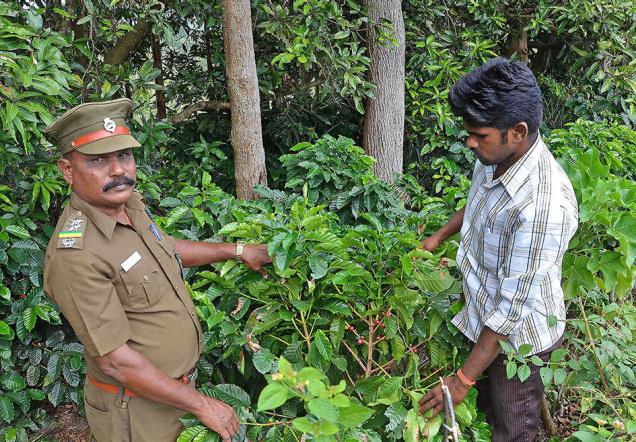
A forest official in Pachamalai at a patch of land where a coffee plantation is being raised.— PHOTO: B. VELANKANNI RAJ

600 fingerlings from Thanjavur being reared in ponds near Top Sengattupatti

As part of livelihood support initiative for tribal men and women of Pachamalai, a series of innovative income-generating activities have been taken up under the Integrated Tribal Development Programme being implemented by the National Bank for Agricultural and Rural Development through Hand-in-Hand, a non-governmental organisation.

Coffee plantation has been taken up on an area of 100 acres of land and the plants have been registering an appreciable growth in the last six months.

“Being a shade-loving plantation crop, coffee plants should be raised on areas with adequate shade,” said Kannan, coordinator of the Hand-in-Hand.

He said that the coffee plants of ‘Selection’ variety had been brought from Kolli Hills and had been given to tribal farmers after an initial exposure visit to the plantations there.

Based on the success of growth of coffee plants in Pachamalai, the Coffee Board had come forward to extend its support.

“In fact, the Board had gathered the details of tribal farmers cultivating coffee in the villages on the hills,” he added. Maximum advantage of shady areas at Pachamalai had been taken.

Fish ponds

For the first time, two fish ponds had been set up to benefit the tribal farmers.

A total of 600 fingerlings of katla, rohu, and mirgal varieties had been brought from Thanjavur and is reared at a couple of ponds set up at Puthur village near Top Sengattupatti.

The fishes which were let out in the pond two months ago, now weighed 200 grams. “The weight will increase up to one kg in four months or so, indicating an attractive revenue for the tribal farmers,” he said.

Desi bird rearing has been another innovative vocation in which six women had been imparted special training.

“With the desi birds being reared in the open at the backyard, as against the use of cages, the birds will fetch attractive returns,” Mr. Kannan said.

The women have been rearing ‘Asil 1’ and ‘Asil 2’ variety of birds which will fetch a monthly revenue ranging between Rs.1,000 and Rs.1,500.

All these vocations have been introduced to diversify the economic activities of tribal farmers who have been largely depending on the cultivation of tapioca and castor.

source: http://www.thehindu.com / The Hindu / Home> News> Cities> Tiruchirapalli / by Special Correspondent / Tiruchi – March 27th, 2016

Rwanda: How Agro-Tourism is Marketing Rwanda’s Coffee

Need is the mother of all innovations, goes an old adage. It is also true that solutions to most of our problems are always around us. So, when a Huye-based farmer sought sustainable ways to market local coffee and promote Rwanda’s unique tourism attractions to the outside world, the resources at hand came in handy.

The farmer created a ‘coffee experience tour’ hiking trail across the Huye Mountain Coffee plantation and the historically important Nyirankoko hill just above the plantation. Where does the coffee you drink at Ban Café or any other coffee houses come from? Or why would one visit a coffee or tea farm, or a cattle ranch? These questions are expounded on during the hike and, by the time one descends the hill, they are ready to roast and brew their first coffee as the hike takes you through all the stages of the coffee production process, right from planting to roasting and coffee brewing. The ‘coffee tour experience’ trail is unique in that it has created a synergy, promoting agriculture and tourism as one product.

This agro-tourism initiative is essential as the country seeks more products to market to the world and boost tourism receipts. It is even more important as it creates awareness about the two sectors, helping expand their markets and add value to clients’ experience in the process.

The approach has made it possible for farmers working with Huye Mountain Coffee to get a ready market abroad and better prices for their coffee. Besides, it strengthens efforts by the government and other stakeholders to create 200,000 off-farm jobs per annum under the second Economic Development and Poverty Reduction Strategy (EDPRS II). Innovative approaches like this one will play an instrumental role in helping the country realise this objective.

Agro-tourism, in simple terms, involves any agriculturally based operation or activity that brings visitors to a farm or ranch, according to Farm Concern international (FCI), an Africa- wide market development agency focusing on commercialisation of smallholder farmers and agro- pastoral communities.

Huye Mountain Coffee tour experience trail

When I visited the recent Made-in-Rwanda expo at Gikondo Show Grounds in Kicukiro, Huye Mountain Coffee was one of the exhibitors. A closer look at the brochures from the attendants at the stall indicated that the firm was more than just a coffee processor. I learnt from the brochures that they had recently introduced a new product targeting coffee lovers and buyers – the ‘coffee tour experience’. This was intriguing… so I was curious to go check it out.

About 10 days later, I hit the trail in company of other 10 visitors from the US. Our guide for the day was Aloys, or Mr Coffee, as he is fondly called, who took us through the trail on paper at the reception centre at Gako trading centre, explaining the various 12 stages of the coffee tour in preparation for the hike. After the briefing we boarded our vehicles for a two-kilometre ride on a rather bumpy and steep gravel road to the starting point. The trail begins at about 1,689 metres above sea level, with an introduction about coffee planting and the initial growing stages of the crop.

We went through other stages, and I learnt that the coffee tree life cycle is over 50 years. We also learnt of some of the enemies of coffee, like the berry bola disease, leaf rust disease, coffee bug that gives unpleasant potato taste. Mr Coffee says the firm mostly uses organic means to fight these enemies, including tobacco and pyrethrum organic pesticides. The harvesting stage comes next (during my visit it was off-season) that prepares visitors for the exciting coffee roasting (using Rwandan traditional means) at 1,870 metres above sea level. This is done under an acacia tree that provides much-needed shade (on day hot day like when I visited). It’s here that we introduced to the coffee roasting process using the Rwandan traditional technology.

One gets that sense of satisfaction roasting green coffee beans to a rich dark brown (colour) that makes for aromatic coffee distinct to Rwanda. And the aroma… Nothing beats the aroma of freshly roasted Rwanda coffee!

‘Tour of Rwandan culture and history’

The icing on the hike is when visitors embark on the second segment of the trail, which marks the ‘tour of Rwanda culture and history’ as visitors explore the breathe-taking Nyirankoko rock, just about a 100 metres from the coffee plantation.

Mr Coffee takes you through the history of Rwanda particularly during the era of the kingdom and inter-kingdom conflicts. He tells us that the hill’s name originate from an incident in 1348 following a confrontation with the then Burundi kingdom army. The name was given to Nyirarutenge by king Kigele I for her heroic acts in helping them defeat the Burundian army, according to legend.

Nyirarutenge was buried at the foot of the rock after she was killed by the Burundi kingdom soldiers. The rock and hill were to later be renamed Nyirankoko by the king in honour of Nyirarutenge.

“From then onwards, all Rwanda kings would hold planning meetings with their military advisors at the rock before any military operations with neighbouring kingdoms and communities to ensure victory,” Mr Coffee concludes the legend.

He notes that the rock, shaped like a meeting place at the top, is complete with a chairman’s chair, and ‘stairs’ leading up from the bottom of the rock’s upper side. Standing on top of the rock, one can see all the surrounding villages, terraced hill bellies, meandering roads and pathways in the lower valley and shinny tin roofed houses of communities surrounding the ‘holy’ mountain.

The final lap of the hike leads you to the hilltop. When here, you cannot ask more; this is the highest peak at 1,986 metres above sea level, but it’s almost flat. It hosts the ‘coffee tour experience’ trail monument and gardens, complete with tents and chairs. Those too tired can grab much-needed rest, relax, and stretch their aching muscles and bones.

Atop Nyirankoko mountain, one is able to see all the surrounding communities, Huye Mountain on the eastern side, Huye town, Nyanza town, Rugwogwe, Mount Simbi, as well as Sovu town and Gako trading centre.

The monument that tells of the history of the enterprise; the pedestal that has a pot and a coffee tree growing therein, also documents the humble beginnings of the leading coffee washing station in Huye District, from the time they were using wooden ‘bicycles’ to ferry red coffee cherries to their small washing station way back in the late 2000s.

The enterprise now operates a fully-automated washing station at the foothill. Mr Coffee says the coffee tree in the pot signifies the firm’s resolve to promote coffee drinking among Rwandans as part of the local culture.

He argues that since the country grows the beans, Rwandans should partake of the beverage as part of the daily menu besides earning foreign exchange from the beans. Mr Coffee believes the ‘coffee tour experience’ will greatly impact the competitiveness of Rwanda’s coffee, noting that most visitors write blogs about the hike when they return to their home countries.

“This is a plus for Rwandan coffee and for us; we are currently expanding potential and giving opportunity for others to join the sector,” adds David Rubanzangabo, the brain behind the venture and the Huye Mountain Coffee chief executive.

He told me later, that the ‘coffee tour experience’ was introduced partly to demystify the coffee production value chain because many coffee lovers, including Rwandans, don’t know much about the beverage, especially how it is made.

He adds that though the firm opened shop around 2011, “it was like something was always missing to make the enterprise more beneficial.” Rubanzangabo says the tour is also strategic marketing, noting that visitors who participate in the hike “will always remember Rwanda’s unique coffee and recommend it to others”.

“It (tour) is a big marketing tool for us… the agriculture-tourism mix helps hit multiple birds with one stone – we teach visitors about our coffee and its importance to Rwanda’s economy, they get to understand why it’s costly on shelves in their home countries, and we also showcase Huye and Rwanda tourism attractions to the outside world,” he explains. He argues that creating a synergy between the two sectors benefits every stakeholder, and gives more value to visitors and local products (tourist attractions and coffee).

Tourists narrate experience

Randall Diericks US citizen resident in Kigali, says the coffee tour opened his eyes to the realities about coffee farming, noting that he now understands ‘where my coffee comes from’.

He says the hike of the Nyirankoko hilltop after initial coffee processing tour gives a rich historical perspective of Rwanda, and adds value to trail, enriching the visitors’ experience. He says the Nyirankoko rock atop the hill is like that in the legendary “Lion King” kids’ cartoons. Przemek Praszcalek from the US, says it was fun learning about coffee and hiking. He says the traditional coffee roasting at the third stop on the hike was insightful, and the “roasted beans were aromatic and delicious”.

Advisory

The hike will take you under three hours, especially as Mr Coffee puts his charm to use explaining the making of Rwandan coffee, detailing all the processes from the garden to the cup. After hiking, tourists are taken through the coffee pulping process at the plant’s modern coffee washing station downhill.

From the reception centre in Gako town, one can use a bike or car to the starting point that’s about 2km away.

You are advised to carry fresh drinking water, sports shoes or jungle boots can suffice for the hike, and you need not carry warm clothing, especially during the dry season. Don’t forget that camera to capture the moments.

The hike is suitable for most people, including kids of five years of age, and grannies. The day I was there, there were about four kids (and they made it to the top effortlessly), and a granny who could be close to 80 years of age.

Challenge that birthed Huye Mountain Coffee

Rubanzangabo worked with two USAID-sponsored projects (PEARL and SPREAD) that were promoting coffee growing in the area in early 2000s.

He says when President Paul Kagame was launching one them in 2002[3], he challenged him, asking what would become of the initiative at the end of the projects. He said, “After these white men have left, will you be able to continue on your own.” That put the entrepreneur in him (Rubanzabagabo) to test, and vowed to carry on similar work as was being done by the two projects, giving birth to Huye Mountain Coffee brand operated by David and Family Company Limited, years later. The brand name derives from the fact that most of the coffee (70 per cent) processed by the firm is provided by farmers around Mount Huye. He says the firm works with over 600 farmers organised in 24 savings groups.

PPP model

The venture is a perfect example of how the country can use the private-public partnerships (PPP) model to promote investment and spur development initiatives across the country. Rubanzangabo says the firm is working with the local and central governments to promote the ‘coffee experience tour’ trail, especially among Rwandans.

Only about 10 local people have so far participated in the hike almost a year (nine month to be exact) since the trail and agro-tourism venture were initiated, according to Mr Coffee.

Mr Coffee says the majority of the tourists are from the US, Europe, Japan, Australia and China. Rubanzabagabo says Nyirankoko mountain belongs to the district but was given to the firm by the local authority for tourism and projects that benefit the community. As a result, people from the surrounding communities are not charged hiking fees, and 5 per cent of the tour earnings support community projects. Ironically, this incentive has not excited them to go hiking already! Both the local authority and central government provide security along the trail and on the plantation, and help promote the trail as a tourism product.

Rubanzangabo says that they are working with local leaders to promote the trail among the community and surrounding districts, and the general Rwandan population.

The firm sells most of its coffee to global brand; Stumptown Coffee Roasters of USA, Falcon Coffee Roasters (England), L Coffee of South Korea, UCC from Japan and Single Origin Coffee Roasters of Australia. The coffee is marketed under the Huye Mountain Coffee brand name, according to Rubanzabagabo.

source: http://www.allafrica.com / allAfrica / Home> The New Times / Opinion by Stephen Nuwagira / March 22nd, 2016
Baristas face off in Coffee Board championship

The final round of the National Barista Championship-2016, held recently here, saw baristas employed in various cafes competing to win in seven categories such as ‘Best Signature Drink,’ ‘Best Latte Art’ and ‘Best Communication Skills.’

There were 18 participants from the city. The ‘Platinum Winner’ of the championship will represent India in the World Barista Championship, to be held in Dublin, Ireland, on June 23. The contest, organised by Coffee Board of India, is aimed at identifying skilled baristas and focuses on promoting excellence in coffee value chain, strengthening and encouraging skill development, and promoting cafe culture in India.

source: http://www.thehindu.com / The Hindu / Home> News> Cities> Bengaluru / by Staff Reporter / Bengaluru – March 04th, 2016

Baristas showcase their skill at national championship

The winner, Paras Bindra, will take part in the World Barista Championship, which will be held in Dublin this year

Photo: Ramesh Pathania/Mint

Bengaluru:

If you are a coffee aficionado and haven’t tasted it yet, order the Kaapi Nirvana the next time you walk into a Café Coffee Day outlet. The iced espresso with its coconut undertones, laced with shards of dark chocolate and topped with whorls of light-as-air whipped cream is delightful. And I’m not the only one who thinks so: it won the silver medal at the 2002 World Barista Championship in Oslo.

Vikram Khurana, who was working with Café Coffee Day when he won the medal nearly 15 years ago and was a judge at the 2016 National Barista Championship held in Bengaluru on 25-27 February, says that the coffee culture in India has evolved considerably since then.

“We are the sixth largest producer of coffee, but only one-third of what we produce gets consumed here. However, recently I have noticed there are a lot more cafes opening up in tier 2 and 3 cities here,” he says, “It is a good thing—coffee helps people get more connected.”

The energetic wave of applause that greets 20-year-old Nahid Khan, one of the finalists at the competition, seems to confirm it. With a shy smile, she acknowledges the applause and says, “The people who grow and pick coffee are women, but those who make coffee at baristas are almost always men. This is for all the women behind coffee in India. I wanted to prove that a woman could make coffee well too,” she says, proceeding to do exactly that.

Out of 100% finely roasted Arabica beans, she prepares three sorts of coffee—an espresso, a milk-based beverage and a signature special coffee blend—which need to be made in 15 minutes without waste or spillage and served to the judges. Incidentally, there are eight of the judges around: four to focus solely on the tasting, while the other four hover around the contestant, grading the efficiency with which he/she makes the coffee. Obviously, coffee is taken very seriously here.

“The winner of this championship will attend the World Barista Championship, which will be held at Dublin, Ireland, this year,” says Aarti Dewan Gupta of the Coffee Board of India, which is organizing the national competition. “We hope to streamline the coffee industry and attract more girls and boys to it.”

Young talent is certainly not in short supply here. Take Sachin Krupakar, another finalist, whose signature drink had people in the audience clambering on to the stage to taste, “It has khus syrup, cheesecake with cream and coffee in three distinct layers,” he laughs, pointing out that the vermillion, white and green colour of the drink also bore a patriotic message.

“It is a great event that showcases the coffee industry in India,” says one of the judges, Sunil Pinto, who works with Tata Coffee, “It is a happening industry today. After all, coffee shops aren’t so much about the coffee as the experience.”

And it certainly has been a fantastic experience, agrees this year’s winner Paras Bindra, whose signature concoction of reduced orange juice, espresso and cinnamon will take him to Dublin this year.

“I have already started thinking about the flavours that I will take abroad. What works on an Indian palate may not necessarily work on a western one,” says the 30-year-old.

And we certainly hope he nails it.

As Khurana says, “No coffee-producing nation has ever produced a champion yet. I hope India will be the first.”

source: http://www.livemint.com / Live Mint / Home> Consumer / by Preeti Zachariah / Wednesday – March 02nd, 2016

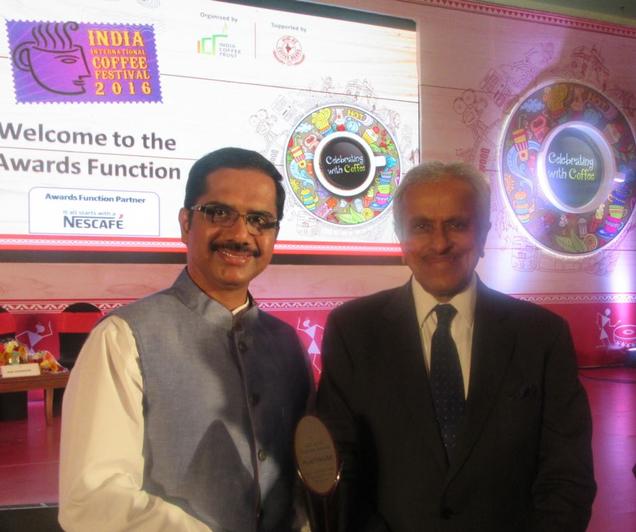
Bayar’s Coffee bags award

R Nagaraja Rao (on left), Executive Director, Bayar’s Coffee, with R K Krishna Kumar, Trustee of the Tata Trust.

Bengaluru :

Bayar’s Coffee, a leading coffee manufacturing company from Bengaluru, has bagged the ‘Best Roasters Platinum Award-2016’ instituted by the Coffee Board of India and the India Coffee Trust.

The award was presented for adoption of food safety standards, implementation of new technology, and for producing high quality coffee blends.

The award was given at a glittering ceremony held at Mumbai, presided over by Leena Nair, Chairperson of the Coffee Board. R K Krishna Kumar, Trustee of the Tata Trust, felicitated R Nagaraja Rao, Executive Director, Bayar’s Coffee, with the “Best Roasters Platinum Award-2016”.

Expressing his happiness over the award, Nagaraja Rao said, “We have introduced a variety of speciality coffee blends in tune with customer needs. We are happy that Bayar’s Coffee has bagged the award four times in a row. Our responsibility to provide high quality coffee to our customers has increased.”

source: http://www.thehindubusinessline.com / Business Line / Home> Companies / by Anil Urs / Bengaluru – January 27th, 2016

Is 100% FDI in coffee a boon or a bane?

Coffee growers in Kodagu, Chikkamagaluru and Hassan districts are, however, apprehensive.Many want to know the measures taken to protect small and marginal farmers, who constitute 90% of growers in Karnataka.

Bengaluru :

When coffee growers in Karnataka were going through a rough patch due to labour shortage, elephant menace and unprecedented fall in prices, the Centre in November last year allowed 100 % FDI in five plantation crops: Coffee, rubber, cardamom, palm oil and olive oil. The decision, meant to rejuvenate the sector, is expected to have a huge impact on Karnataka, which accounts for 70% of India’s coffee production.

As of now, 100% FDI is allowed only in tea plantation. “Relaxed FDI norms will help coffee and cardamom growers since it is expected to bring in big overseas investors and retail giants besides enhanced technology utilization, automation, research, management and production of value-added products. Permitting foreign investment will also boost India’s coffee exports offering better prices for growers here, ” says Coffee Board chairperson Leena Nair.

Coffee growers in Kodagu, Chikkamagaluru and Hassan districts are, however, apprehensive. Many want to know the measures taken to protect small and marginal farmers, who constitute 90% of growers in Karnataka. Some coffee growers’ associations are holding talks to oppose the move as they fear small growers would be forced to sell their estates to foreign investors. Their entry may prove detrimental for small coffee planters, who may not be able to match the wages and technology of foreign players.

“The Centre should have held consultations and allayed fears before allowing FDI. But they have done in it in a hush-hush manner and kept us in the dark, making us believe that there is a hidden agenda,” says NK Pradeep, a Coffee Board member from Chikkamagaluru. Former Coffee Board vice-chairman Sannuvanda Kaverappa says a parliamentary committee that visited Chikkamagaluru last year to interact with coffee growers left in a huff. Nair allays all fears of growers saying: “The small-grower segment need not worry as enough safeguards have been provided and the Centre and the state government can always reject any FDI proposal in their segment.”

A Coffee Board executive says FDI will benefit coffee growers. The measure is expected to make the coffee industry vibrant like the tea sector, which opened gates for foreign investments in 2002. “Rather than starting a new venture, foreign investors may partner with existing plantations or trading companies. FDI will help boost developmental activities such as replanting, rejuvenation and R&D that need huge funding. It may also help in upgradation, modernization and automation of coffee-processing, curing, marketing,” he adds.

source: http//:www.retail.economictimes.indiatimes.com / ETRetail.com / Home> Industry / February 12th, 2016

Rajpath redolent with the aroma of coffee country

CoffeeKODAGU05feb2016

Bengaluru :

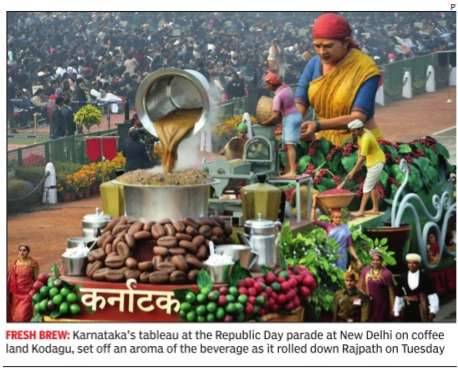
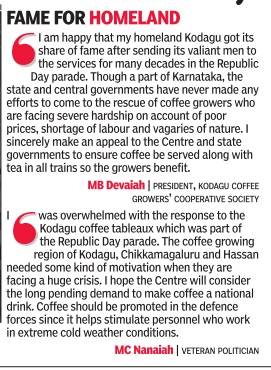
The flavour of Kodagu permeated the Republic Day parade in New Delhi as Karnataka’s tableau rolled down Rajpath. The tableau `Kodagu, The Land of Coffee’ was one of the star attractions at the parade.

The tableau didn’t just grab eyeballs, it filled the chilly Delhi air with the delightful aroma of freshly brewing coffee. This was done using a gas container to blow coffee essence into the air.

The tableau was a thematic presentation of litterateur HL Nage Gowda’s Kannada literary work `Bettadinda Battalige’, which means “from the hills to your cup”.

As it neared the VIP enclosure at the parade, Union minister DV Sadananda Gowda stood up to cheer, prompting wife Datty to join in. He was followed by minister HN Ananth Kumar and wife Tejaswini, who clapped loudly as it passed by. Eight women and two men from Kodagu danced, while a couple dressed in traditional Kodava attire walked along. Coffee plants, the harvest, grinding and mixing coffee at different levels of production, were some of the depictions.

HomelandKF05feb2016

source: http://www.timesofindia.indiatimes.com / The Times of India / News Home> City> Bangalore / TNN / January 27th, 2016

Flavour of Kodagu coffee at international contest

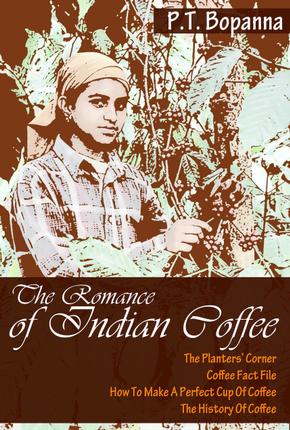
‘The Romance of Indian Coffee’ is the Indian entry to the Gourmand International (Book) Award this time

The jacket of the book ‘The Romance of Indian Coffee’ written by journalist P.T. Bopanna.

The Indian entry to the Gourmand International (Book) Award this time is on what until recently was a south Indian addiction: coffee.

With the coffee culture proliferating across India, thanks to chains like Starbucks, Barista and Café Coffee Day, the routine act of consuming the black decoction stirred in milk, as most people do, and with or without sugar – which again is a personal choice – has acquired an uber-cool image among the Gen Y.

Bengaluru-based journalist P.T. Bopanna has brought alive this unique trait in his book The Romance of Indian Coffee , now shortlisted for the Gourmand International Award, where it will vie for the top honours among coffee books from Brazil, France, China, Thailand, and the U.S., to name a few.

Hailing from Kodagu, which is the home of coffee in India, it was natural for Mr. Bopanna to feel inspired to write on the brew which has a universal appeal.

“My earlier works were Kodagu-centric, but I found a wider canvas in coffee which is also related to Kodagu,” said Mr. Bopanna.

“The book traces the history of coffee in India with interesting titbits about the brew and how its cultivation in the shade lends it a unique flavour, unlike coffee grown in the open in most other countries,” explained Mr. Bopanna, who believes that making coffee is an art. Notwithstanding the proliferation of coffee bars, the best filter coffee, he said, was still prepared in the bylanes of Chennai and elsewhere in Tamil Nadu.

The contribution of Ivor Bull, a British planter, who introduced intercropping and is a legend among the locals, has been highlighted in the book as also recipes for making coffee liqueur.

But ironically, he notes that Kodavas, who market home-grown coffee to the rest of the world and have spanned a coffee culture in India, have taken after the British and prefer tea!

There are entries from as many as 64 countries for the Gourmand awards, started in 1995 as a celebration of global cookbook and wine book publishing. The final results will be announced on May 28 at Yantai, China.

source: http://www.thehindu.com / The Hindu / Home> National> Karnataka / by R. Krishna Kumar / Mysuru – January 31st, 2016

Colombia Yields Record Coffee Crop In 2015

Bogota, Columbia :

The biggest producer in the world of mild washed arabica coffee had record production of 14.2 million 60kg. bags in 2015, the highest in the past 23 years. In December 2015, Colombia’s coffee crop grew 34% to 1.4 million bags, the highest in that month in the past 20 years. Colombian coffee production grew 83% in the past four years, from 7.7 million in 2012 to 14.2 million 60kg. bags in 2015.

“This is excellent news for all Colombian coffee growers and the result of the joint efforts of the coffee growers and the government, who were able to renew the national coffee growing industry and reposition Colombia as a main player in the international market,” said National Federation of Coffee Growers of Colombia chief executive Robert Velez Vallejo.

In line with production, the export of Colombian Coffee sustained high levels of growth. During 2015, external sales surpassed 12.7 million bags of 60 kilos, 16% more that 10.9 million 60kg. bags exported the previous year. In Decevenmber, 1.2 million of Colombian coffee bags were exported, representing 13% more than the 1.1 million bags a year earlier.

So far this crop year, 3.5 million 60kg. bags were exported, 14% above the 3 million 60kg. bags that were sold during the same period the previous year.

source: http://www.vendingtimes.net / Vending Times / Home / Issue Date. Vol. 6, No.2,February 2016 / posted January 29th, 2016 / Emily Jed – Emily@vendingtimes.net

Wake Up and Smell the Coffee

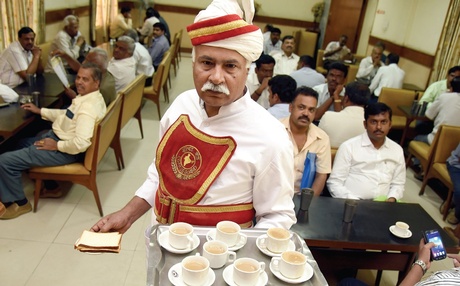
Coffee House in Bengaluru | NAGARAJA GADEKAL

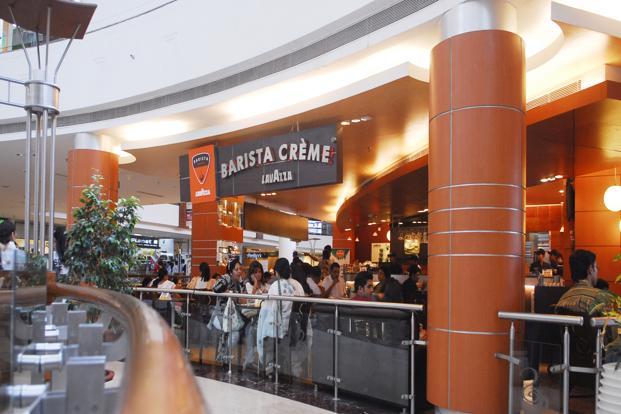
Chennai-based actress, model and ex-VJ Pooja Gallyot graduated from green tea to coffee last year and now is so hung up on the beverage that she is fast becoming an addict. On the other hand, Kolkata-based fashion designer Kiran Uttam Ghosh, a bona fide coffee lover, zeroes in on new cafes in the places she visits. For naturalist and wildlife conservationist Shrilekha, coffee shops present the ideal rendezvous to conduct business. It is these little tell-tale signs that have had coffee majors scent a business opportunity, even cleverly imparting magical qualities to the brew in that anything can happen over a cuppa. Truth be said, it’s a dramatic cultural switch that’s got the entire nation swaddled in its intoxicating embrace. According to the latest Technopak report, the chain café market, currently at Rs 1,820 crore, is growing at 20 per cent in value and commanding 27 per cent of the Rs 6,750 crore overall cafe market.

Coffee02KF24jan2016

Were it not for pilgrim Baba Budan’s temerity in smuggling a few coffee beans into Chickmagalur, Karnataka, we might never have got introduced to this refreshing drink. This history aside, coffee seems to be edging out tea in the social circuit with cafes being the perfect place to hang out, chat or simply relax. That certainly augurs well for business, with Café Coffee Day, popularly called CCD, the biggest player in the Indian market, competing with international brands such as Starbucks, Barista and Costa Coffee, not to mention the popular local hangouts.

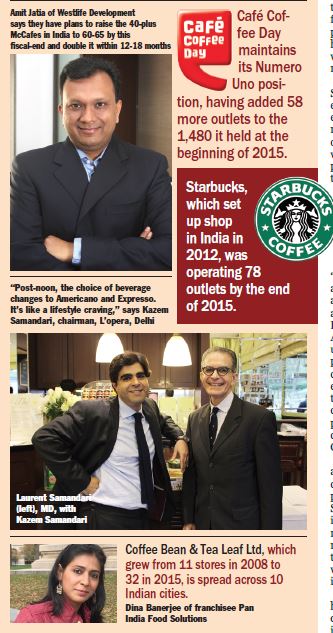
To date, CCD maintains its Numero Uno position having added 58 more outlets to the 1,480 it held at the beginning of 2015. CCD’s principal Coffee Day Enterprises set the stock market abuzz with the largest Initial Public Offering last year. It had fixed its public offer price at Rs 328 per share, taking the total proceeds to Rs 1,150 crore. But when the IPO closed on October 16, it was over-subscribed 1.81 times with a demand worth Rs 2,000 crore.

“Customers today are looking at a differentiated food experience along with their coffees at cafes. Which is why we have introduced a special food menu called the ‘SuperMenu’—a range of soups, sandwiches, burgers and desserts,” says a CCD spokesperson. “We have also started a home delivery service in Bengaluru as a pilot project.”

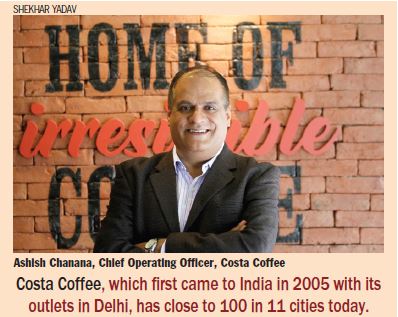
Costa Coffee entered India in 2005 when it opened outlets at Connaught Place in Delhi. Today, it has close to 100 in 11 cities across India. While a good number is present in metro cities such as Delhi, Mumbai, Chennai and Bengaluru, they’re spreading out in tier II cities such as Agra, Jaipur, Pune, Kochi, Ludhiana, Chandigarh and others. “While southern states have always had a strong culture of drinking coffee, over the past decade or so, the drink has penetrated to other parts too,” says Ashish Chanana, Chief Operating Officer, Costa Coffee.

Coffee03KF24jan2016

Another chain that is fast expanding is the US-based Coffee Bean & Tea Leaf Ltd, which tied up with Pan India Solutions to start a single outlet at Select Citywalk mall in Delhi. It has grown to 32 stores in 10 cities from 11 in 2008. “We source our coffee from seven different countries,” says Dina Banerjee, CMO, Pan India Food Solutions Pvt Ltd, Mumbai.

Though all eyes are on the newest entrant, US giant Starbucks, which joined hands with Tata Coffee Ltd to set up shop in India in 2012. By 2014, it had more than 60 outlets and the end of 2015 saw it operating 78. It had also managed to clock in Rs 171.2 crore, an 80 per cent jump from previous year’s Rs 95 crore.

Coffee shops have so much become revenue models that another giant has jumped on the bandwagon.

The most telling of entries is American fastfood chain McDonald’s McCafe in the country with its first cafe being launched in Mumbai. “The concept fits in well with what the Indian customer needs. Our plan is to increase the 40-plus McCafes to 60-65 by this fiscal-end and double it within 12-18 months,” says Amit Jatia, Vice Chairman, Westlife Development, franchisee of McDonald’s in South and West India.

There’s a good reason behind the dramatic rise of coffee cafes in India. Fashion designer Ghosh spends her holidays finding new cafes and spending her time reading, sketching and dreaming there. “Cafes across the world reflect the essence of its people and place,” she says, adding that the habit of going to cafes late at night with friends has earned them the moniker, ‘the owls’.

Coffee04KF24jan2016

Chanana is in agreement too. Says he: “Coffee shops have given people across all age groups—especially the young—a legitimate, safe and cool place to hang out. Youngsters can go on a date without burning a hole in their pocket. Friends can spend time together at a conveniently located place. We’re also seeing a lot of older couples taking time out to catch up with each other over a cup of coffee. At Costa, we have lots of customers who are by themselves.”

Gallyot is a big fan of Starbucks. “I have gotten used to their coffee as wherever I travelled, I came across an outlet. It’s become like a comfort drink for me,” she says. For 24-year-old MBBS student Anjali Reddy, Starbucks doubles up as a place for study. In fact, people have come to associate coffee concoctions with different times of the day. “Post-noon, the choice of beverage quickly changes to Americano and Expresso. It’s become like a lifestyle craving,” says Kazem Samandari, Chairman of L’opera, Delhi.

Besides cultivating friendships and fun, these places have become the haunt of many working people. Wildlife conservationist Shrilekha often frequents Chamiers, an upmarket café in Chennai. “As I work from home, I often meet business associates at cafeterias and I love Chamiers which while elegant has a lot of breathing space,” shares Shrilekha.

Visiting cafes has widened the horizon of Delhi-based interior designer Parull Mahajan’s social interactions. The caffeine rush helps her mind to stimulate her creativity. “I visit the two of my favourite cafes—Choko La and Starbucks—at least three-four times a week and cannot do without my standard two or three cups a day. It’s an addiction I have no intention of wearing off,” she says.

In keeping with the global trend, coffee shops have become de facto offices for consultants, entrepreneurs, and writers. “Some of our Costa outlets in Delhi, Bengaluru and Mumbai have had the privilege of hosting many start-ups, where the founders polished their business idea over several cups of coffee,” says Chanana. Work is also what takes Anitha KS, National Corporate Sales Manager at Vodafone, to Costa Coffee at the Lulu Mall in Kochi. “After meeting clients in the morning, I come here and carry on my work sipping on a cold coffee or cappuccino,” says Anitha. For his part, the outlet’s manager Anup Anand is delighted with the increased bottom line. “We have plans to open more outlets in Kochi and other cities of Kerala.” That’s significant given that Kerala is predominantly a tea-drinking state.

Coffee reigns with an aromatic fist even as south India leads in the production of coffee, with the drink dominating social interactions. Apart from the big players, there are a host of small and medium joints that gets people over for coffee and chitchat. In Bengaluru, which is the hub for rich traditional filter coffee, local brands such as Maiyas, Adigas, Shanthi Sagars, the SLVs, Hatti Kapi, Katte Kapi, Brahmin’s Coffee Bar and Coffee Board outlets are still going strong. Small joints rule the roost in Chennai too, courtesy Madras Coffee House, Leo coffee outlets (under brand Mylapore Mocha) and Kumbakonam degree coffee outlets.

Unique to the Bengaluru-Mysuru region is the ‘by-two’ coffee culture, a mini dose of coffee whose origins can be traced to some 100 years back during the literary and Independence movements. Then literary figures, freedom fighters and political leaders, with hardly any money in their pockets, gave impetus to this culture of having multiple servings of half a cup of coffee over endless discussions.

For many in the garden city, the small joints are the place to be. Marketing professional R N Prasad feels that the prominent coffee cafes are good only to conduct business with coffee being incidental. Each day, he drives some seven kilometres to have a cup of coffee at the Brahmin’s Coffee Bar. According to city historian Arun Prasad, tourists prefer the traditional filter coffee served at small joints.

In the grand theatre of coffee culture, there are the veterans—India Coffee House and Coffee Board outlets. K S Achyuthan, Kannada author and media professional, has been visiting the Coffee Board outlet near Vidhana Soudha in Bengaluru for more than 50 years. “This is a meeting point for many journalists and lawyers as well as musicians and guests who come to All India Radio. I have also seen many legislators, MPs and even celebrities in this place which has hardly changed all these years.” Kannada filmmaker and environmentalist Suresh Heblikar makes it a point to visit India Coffee House whenever he passes by the place.

The India Coffee House in Puducherry, a heritage structure, came close to being torn down in 2008 until INTACH and concerned citizens appealed against the move. With CM N Rangaswamy’s support and renovations later, it opened in mid-2014 and has begun to attract crowds. This outlet also finds a mention in Yann Martel’s Life of Pi.

Looks like the old and the new will exist side by side even as coffee aficionados seek out their happy place.

with Meera Bhardwaj, Ayesha Singh, Shevlin Sebastian, Jonathan Ananda and Suhas Yellapuntala

source: http://www.newindianexpress.com / The New Indian Express / Home> Magazine / by Sunita Raghu / January 23rd, 2016