The Ministry of Commerce and Industry, Department of Commerce, Govt of India, Coffee Board of India has released an employment notification, inviting interested and eligible candidates to apply for the positions of Junior Liaison Officer and Extension Inspector through direct recruitment.
Vacancy details
Total posts: 62
Name of the posts:
Junior Liaison Officer: 20
Extension Inspector: 42
Eligibility criteria
Educational qualification:
Junior Liaison Officer: The candidates interested in applying for this post should have done graduation in Agriculture or Horticulture preferably with specialisation in Agricultural Extension preferably M.Sc. (Ag) in Agricultural Extension.
Extension Inspector: The candidates interested in applying for this post should have done graduation in Agricultural or Horticultural Sciences or Graduation in Science with Botany or Zoology as one of the subjects.
Age limit:
Junior Liaison Officer: The age of the candidates applying for this post must not exceed 30 years.
Extension Inspector: The age of the candidates applying for this post must not exceed 27 years and must be minimum 18 years.
Relaxation in age will be provided as per the government norms.
Selection procedure
An interview will be conducted for selecting the candidates.
Pay scale
Junior Liaison Officer: The selected candidates will be getting a consolidated monthly salary of Rs 6,500 to Rs 10,500.
Extension Inspector: The selected candidates will be getting a consolidated monthly salary of Rs 5,200 to Rs 20,200 with grade pay of Rs 2,800.
How to apply
The candidates interested in these posts are required to apply online at ‘indiacoffee.org’ for these posts. No other mode of application will be entertained.
Important dates
The last date for applying online is November 11
The last date for paying the application fee is November 23
source: http://www.indiatoday.intoday.in / IndiaToday.in / Home> Education> Government Jobs> Story / New Delhi – November 03rd, 2015
Girls sit at the window of a Cafe Coffee Day outlet in Mumbai, February 25, 2015. The firm behind Cafe Coffee Day, India’s biggest homegrown coffee chain, is set for a market debut that could value it at almost $1 billion, even as the country’s burgeoning cafe culture draws global giants Starbucks and McDonald’s. Cafe Coffee Day, a cafe pioneer in India, aims to list a 20 percent stake, raising roughly $200 million, within the next quarter, sources with direct knowledge of the plans said. Picture taken February 25, 2015. REUTERS/Shailesh Andrade / @ Reuters
New Delhi (NewsRise):
The owner of India’s largest coffee chain received bids for 1.2 times the shares it offered in the nation’s biggest initial public offering in three years, indicating that investors remain bullish on Prime Minister Narendra Modi’s efforts to revive economic growth.
Coffee Day Enterprises, which runs the Cafe Coffee Day outlets, received 31.3 million bids for the 25.8 million shares it offered, according to provisional data on the National Stock Exchange. The company aims to raise as much $176 million via the IPO.
A slew of companies, including India’s largest discount airline, have filed for IPOs this year, betting that Modi’s reforms and easing interest rates will revive growth in Asia’s third-largest economy. As many as 16 companies filed their draft prospectus with markets regulator the Securities and Exchange Board of India between July and September, the highest quarterly filing in four years, Business Standard newspaper reported.
“Improvement in the economic situation means that the appetite will pick up,” said Deven Choksey, managing director at K.R. Choksey Shares and Securities. “If quality papers come at a reasonable price, investors will be more than happy to purchase.”
Until Thursday, Coffee Day Enterprises had received bids for 75% of its shares on offer. Demand picked up after a lukewarm response on Wednesday, the opening day for subscription, led by bids from the so-called Qualified Institutional Buyers that included local banks and insurance companies.
Discount carrier IndiGo’s parent InterGlobe Aviation is likely to open the 25 billion rupee ($385 million) initial public offer on Oct. 26, Economic Times reported. Mumbai-based L&T plans to sell 17.5 million shares, or nearly 11% of outstanding stock of unit Larsen & Toubro Infotech. L&T, which currently holds 161.25 million shares in the unit, plans to raise around 15 billion rupees via the share sale.
Coffee Day Enterprises has been expanding outlets in recent years, betting that rising disposable incomes and increasing coffee consumption in the world’s second-most populous nation will boost revenues.
Analysts had largely advised investors to be cautious about the company’s financials and its complex structure, which includes a range of businesses from real estate to software services. Coffee Day’s other businesses have a history of weak returns on capital, they said.
From January to September this year, 15 companies had raised $992 million through IPOs in India, compared with $197 million last year and $235 million in 2013. The market is still a fraction of what it was in 2010, when 64 firms raised $8.34 billion, according to Prime Database.
source: http://www.asia.nikkei.com / Nikkei Asia Review / Home> Markets> Equities / October 16th, 2015
Under Special Recruitment Drive for Persons with Disabilities, the Coffee Board of India has invited applicants to apply for six posts of Junior Assistants.
Interested and eligible candidates need to apply through prescribed application format before November 15, 2015.
Selection of the candidates would be made based upon performance of the candidates in the written test, typing test/skill test and personal interview round conducted by the concerned requirement authority.
Due to the World War during the 1940’s the state of Coffee industry was miserable in India and this is the time when the Government of India established the ‘Coffee Board’ though the “Coffee Act VII of 1942” under the administrative control of the Ministry of Commerce and Industry.
The board is responsible since its inception to develop the status of coffee marketing, finance, research and development.
Research and development undergoes in various substation and research centres of the Coffee Board around the nation to improve the quality and standards of the Indian Coffee.
Vacancy details:
Name of the post: Junior Assistant Total number of posts: 06 Pay scale: Rs. 5200- 20200/- with Grade Pay of Rs. 1900/- Eligibility: Educational qualification:
Candidates having passed 12th Class from any recognized board/institute along with a typing speed of 35 wpm in English or 30 wpm in Hindi on computer can apply for the post. Age limit: Candidates must be between 18 to 27 years age.
For official notification, click here. Selection procedure:
Selection of the candidates would be made based on the performance of the candidates in written test, typing test/skill test and personal interview round, conducted by the concerned recruitment authority. How to apply:
Interested and eligible candidates need to apply through prescribed application format which can be downloaded from the official website from October 14, 2015 onwards.
Candidates need to pay Rs. 100/- in the form of Indian Postal Stamp addressed to the Deputy Secretary (Adminstration), Coffeee Board, No. 1, Dr. B.R. Ambedkar Veedhi, Bengaluru- 560001, in order to get the application form by post.
Filled in application form along with all the requisite documents, certificates, passport size photograph and other testimonials should reach the “Deputy Secretary (Administration), Coffee Board, No.1, Dr. B.R. Ambedkar Veedhi, Bengaluru- 560001” before November 15, 2015.
source: http://www.prepsure.com / PrepSure.com / Home> Jobs> Government Jobs / by Editorial Team / October 15th, 2015
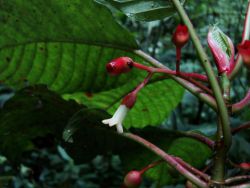
Amid the challenging terrain of north-western Honduras, where Dr. Kelly’s team faced rugged and steep forest areas cut across here and there by a few trails, a gorgeous tree with cherry-like fruits was discovered. Being about 10 metres (33 ft) high and covered with cream-colored flowers, it was quickly sorted into the Coffee family (Rubiaceae), but it was its further description that took much longer. Eventually, it was named Sommera cusocoana, with its specific name stemming from its so far only known locality, the Cusuco National Park. The study is available in the open-access journal PhytoKeys.
This is a branch of Sommera cusocoana showing flower and developing fruits Credit: A. C. Dietzsch
During a plant diversity study in the Cusuco National Park, conducted by Drs. Kelly, Dietzch and co-workers as a part of a broader survey by Operation Wallacea, an international organisation dealing with biodiversity and conservation management research programmes.
A couple of curious findings in the past decade provide a strong incentive to further work. The place turns out to be not only of high biodiversity, but to also contain rare and hitherto unknown plant and animal species.
For instance, the tree Hondurodendron (from Greek, ‘Honduras Tree’) and the herbaceous plant Calathea carolineae are another two endemic species discovered as a result of the Operation Wallacea survey.
In 2013, two individuals of another unknown, 10-metre high (33 ft) tree with cream-colored flowers and red, cherry-like fruits were found by Daniel Kelly and Anke Dietzsch from Trinity College, University of Dublin, Ireland. The two were aided by local guide Wilmer Lopez.
The multinational collaboration did not stop then and there. Although the scientists quickly figured that the tree belonged to the Coffee family, they needed some additional help to further identify their discovery. Thus, they were joined by two leading specialist in this plant group, first Charlotte Taylor from Missouri Botanical Garden and then David Lorence from the National Tropical Botanical Garden in Hawaii.
It was actually David who was the first to recognise the unknown tree as a member of the Sommera genus, a group of nine known species of trees and shrubs. Later, the team decided to name the new plant Sommera cusucoana to celebrate its singular locality, the Cusuco National Park.
“Sadly, there has been extensive logging in the vicinity in recent years, and we fear for the future of our new species,” the authors stressed. “According to the criteria of the International Union for the Conservation of Nature (IUCN), it must be regarded as Critically Endangered.”
“We hope that the publication of this and other discoveries will help to galvanize support for the conservation of this unique and beautiful park and its denizens,” they concluded.
source: http://www.yubanet.com / YubaNet.com / Home> Enviro / by Pensoft Publishers / October 13th, 2015
Colombia’s coffee production is predicted to fall 18% for the second half of the year amid water shortages caused by the “El Niño” weather phenomenon.
This warning comes as latest coffee production figures show an increase of 16% for September compared to the same month last year, with a total of 1 million 60-kg bags, reported Colombian Coffee Growers Federation, the FNC.
FNC chief Roberto Velez reported, “the subject of coffee, for many reasons has brought zero profits, or even negative, regarding revenues there have always been problems of climate change, labor and fertilizer, which generally increase the costs.”
Velez said that while coffee production levels so far this year have been strong, however, predictions are that 18% of coffee produced in the second half of the coffee will be lost due to “EL Niño.” The drought will also have negative effects on the quality of the beans produced.
The chief reported a “fragile equation” in the balance between costs of production and growth of coffee, something that most affects small and medium growers sensitive to changes in the market.
The “El Niño” weather phenomenon is affecting northern and western regions of the country since this February, and is set to reach new levels of intensity. The weather event has caused water shortages resulting in high losses for agriculture and livestock.
The FNC has worked aggressively since the late 1950s to bring Colombian coffee to the number two spot for global production, second only to Brazil. However, in recent times a booming business from Vietnam has overtaken the country and Colombia is now the third largest coffee producer in the world.
source: http://www.colombiareports.com / Colombia Reports / Home> Economy / posted by Emma Rosser / October 10th, 2015
The Indian coffee would get a better price if we stop depending on foreign countries and start using more coffee products of Indian origin, said Central Coffee Research Centre Director Dr Y Raghuramulu.
He was speaking at a programme organised at the Navodaya Vidyalaya in town as part of the International Coffee Day celebrations on Thursday.
“In America, the average consumption of coffee by a person is four to five kg a year. In India, however, it is barely 100 gm. The consumption is increasing by six per cent every year,” he said and added that Brazil had created awareness among children about use of coffee about 10 years ago. “As a result, Brazil stands second in the list of countries that are the highest consumers of coffee in the world,” he said.
The International Coffee Organisation (ICO) has called upon all coffee-growing nations to celebrate Coffee Day on October 1 every year, to protect the interest of coffee growers and nations. “From next year onwards, the day would be celebrated with road shows and various other programmes,” he said.
‘Chicory is good’
Dr Raghuramulu claimed that chicory is good for health and a maximum of 49 per cent of chicory can be added to the coffee powder.
“The carbohydrate content of chicory makes the coffee a bit thicker. Chicory is usually grown in some parts of Andhra Pradesh, Kerala and few other states. It is also used in the production of biscuits,” he said.
In his inaugural speech, Sahyadri Coffee Growers’ Association President M S Sundaresh Gowda said that the imagination behind Coffee Day would help the growers. The market for coffee can be extended by creating awareness about the drink in North India, he added.
Meanwhile, ‘Coffee Karma’, a 20-minute documentary on the birth of coffee was screened at Navodaya Vidyalaya hall. An exhibition was held as a part of Coffee Day on different coffee species, possible diseases, pesticides and other things. More than 1,500 people watched the documentary and free coffee was served to all.
Balehonnur JCI President Dayakar N Suvarna, Navodaya Vidyalaya Principal K Rameereddy, Coffee Board scientists were present.
source: http://www.deccanherald.com / Deccan Herald / Home> District / Balehonnur / DHNS – October 02nd, 2015
N. Dharmaraj, President and D.Vinod Sivappa, Vice – President
Mysuru :
N. Dharmaraj was elected as the President and D.Vinod Sivappa as Vice- President of United Planters’ Association of Southern India (UPASI) for the year 2015-16 at the Annual General Meeting of UPASI held on Sept.24 at Coonoor, Tamil Nadu.
Dharmaraj has over 41 years of experience in plantation business, working with companies like Brooke Bond, Unilever etc. He is currently the Chief Executive and Whole-time Director of Harrisons Malayalam Ltd.
Dharmaraj was Chairman of the UPASI Tea Committee and Chairman of the UPASI Commodities Exchange Limited. He was a member of the Tea Board of India and Founder-Convener of the Golden Leaf India Awards (TGLIA). He is currently a Member of Tea Council of South India constituted by the Tea Board as also a Member of the Core Committee of the Tea Board of India.
Vinod Sivappa, son of former President of UPASI (late) D. Sivappa in the year 1970-71, hails from a coffee growing family for more than 160 years. Vinod Sivappa was on the Committees of Codagu Planters’ Association and also was the Chairman of the Karnataka Planters’ Association. He is involved in many sporting activities. He is a Director of many organisations and various companies, according to a press release from Ullas Menon, Secretary General, UPASI.
source: http://www.starofmysore.com / Star of Mysore / Home> General News / September 27th, 2015
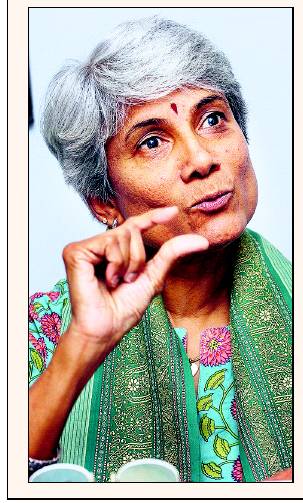
What would life be without spicy food, ice-creams, perfumes, fragrant flowers, late-night parties and alcohol? Ask Sunalini Menon, who swears by this regimen.
No, she’s not a health freak or someone prone to allergies. She’s been practising abstinence for the sake of her passion, which is also her profession.
Asia’s first and only woman professional in the field of coffee cupping (tasting), Sunalini has experienced the aroma of several thousands of coffee types and spent a considerable time in the fields. “I love ice-creams and soft drinks but they affect my taste buds. My profession requires them to be extremely sensitive. So, I steer clear of cold food items or beverages,” she said. The chief executive of Coffeelab, one of India’s largest coffee exporters, Sunalini spoke to TOI on the ocassion of Coffee Santhe, a three-day carnival hosted by Karnataka Chitrakala Parishath.
Restraint and discipline are core attributes of a good coffee cupper. “It is essential to preserve the palate, the instrument vital for coffee tasting. We’re advised to avoid spicy food. Alcohol and smoking are a strict no no. Late nights and poor health can be a hindrance to the job,” she explained.
Coffee cuppers have to perform regular tongue exercises not only to keep their taste buds active but also to pick up foreign flavours. “Cupping with experts from other parts of the world helps calibrate one’s potential and understand the coffee produce of other countries. One also needs to perceive through the eyes, nose and palate of other cuppers,” she said.
Habituated to taking a sip and playfully swirling the liquid in her mouth before spitting, Sunalini said her job doesn’t allow her to swallow the coffee, however aromatic and delicious it be. “Coffee can have the distinct enzymatic flavours of apples, apricots, peaches and berries; sugar-browning flavours of chocolate, caramel, honey or those of spices like clove and pepper. It is an inborn acuity of taste, knowledge, experience, memory and good communication skills which help the cupper differentiate one flavour from another,” she said.
Sunalini, who entered the male bastion decades ago, said her journey hasn’t been easy. “I wasn’t lucky enough to be handheld when learning the tricks of the trade. I had to learn on my own, especially the chemistry of the coffee bean. It took a long time for me to be accepted into the fold, but once there, you are in,” she said.
Cupping as a Career
There are certifications for coffee tasters issued by the Specialty Coffee Association of America (SCAA) and Specialty Coffee Association of Europe (SCAE). The SCAA issues two types of certificates. One is called the Licensed ‘Q’ grader and the other, the Licensed ‘R’ grader. The ‘Q’ grader licence is a certificate for proficiency in evaluating arabica coffees and the ‘R’ grader for proficiency in evaluating robusta coffees,” said Sunalini.
She admitted that coffee tasting as a career could have some limitations.
“To overcome them, one needs to perhaps complement tasting with other jobs such growing, roasting or marketing coffee,” she said.Coffee tasting is more of a passion; it may not help you financially, especially in the first 10 or 12 years. Credibility comes only through knowledge and experience,” Sunalini signed off.
source: http://www.timesofindia.indiatimes.com / The Times of India / News Home> City> Bengaluru / by Sreemoyee Chatterjee, TNN / September 26th, 2015
“Why Americans drink coffee: the story of an unlikely romance” is the title of this year’s James Neal Primm Lecture in History, set for 7 p.m. Sept. 14 at the Missouri History Museum. (Coffee image from the Missouri History Museum. Design by Wendy Allison.)
Like many people, Steven Topik’s coffee habit was formed in college. But it’s become a lot more than a caffeine fix to the historian in the years since.
“I experienced coffee as a site of sociability, a drug, an academic subject and a commodity,” says Topik, a professor of history at the University of California, Irvine, who is writing a world history of the popular beverage.
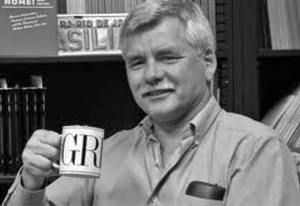
Steven Topik, a professor of history at the University of California, Irvine, is currently working on a world history of coffee.
He will discuss it in St. Louis Sept. 14 as a guest of the University of Missouri–St. Louis. Titled “Why Americans drink coffee: the story of an unlikely romance,” his address is this year’s James Neal Primm Lecture in History. Free and open to the public, the event begins at 7 p.m. at the Missouri History Museum (5700 Lindell Blvd).
Leading up to his visit, which is sponsored by UMSL’s Department of History and the Missouri History Museum, UMSL Daily caught up with Topik on all things coffee, history and St. Louis.
Your interest in coffee is obvious given the topic of your upcoming lecture, and the picture of you on the event flier suggests you enjoy drinking coffee as well as writing about it. Is that the case? And if so, how many cups a day do you drink on average?
I drink about two cups of coffee a day. Sometimes a little more.
How did you arrive at this intellectual exploration of coffee and its history?
My interaction with coffee started at home since my father, from Germany, and my mother, from Austria, drank coffee. Then when I was 12 years old my younger brother and I went with my mother to visit her mother in Vienna and lived for six months in her coffeehouse, so I experienced coffee as a site of sociability. But I only started drinking coffee in college when the stuff coming out of our percolator was more a drug to help us study than a tasty beverage.
In graduate school I decided to study the history of Brazil to understand its development. Since my area was political economy and Brazil has been the world’s leading exporter of coffee for over 150 years, it was a natural subject to study.
I also experienced coffee in its three most historically important geographic areas: the United States, Europe and Brazil. Since I became interested in issues of economic development and underdevelopment which led me to world history, coffee emerged as a wonderful vehicle to examine issues of exchange, development, colonialism, imperialism, the Cold War, national identity, public spaces, ecological issues and many more.
Without giving away too much of what you’ll discuss Monday evening, why is it that the story of America’s enthusiasm for coffee is “an unlikely romance” in your view?
I called it an “unlikely romance” because many coffee aficionados discuss coffee’s “romance” and tell stories of dancing goats, spies and military heroes to explain coffee’s global spread. Coffee’s global reach is often treated as something obvious that needs no explanation: people on every continent drink coffee because it tastes good. In fact, there were many barriers to coffee’s diffusion.
In the U.S. we have various stories about coffee’s ties to our national identity linking it to John Smith, colonial coffee houses, the Boston Tea Party, the westward movement and values like liberty, sovereignty, industriousness, battlefields and innovation. Some of that is historically true. Much of it, however, is more sales pitch than historically accurate portrayals.
The “romance” is unlikely also because coffee was not native to the U.S., it does not grow in the U.S., we had no important coffee colonies and most ex-British colonies favor tea over coffee. But I will explain that the U.S. becoming the world’s leading coffee importer does make sense in light of many other historical currents like trade in the Atlantic, immigration from Europe, anti-tax sentiment and coffee’s pharmacological effects.
What role has St. Louis played in the history of coffee?
While St. Louis is not as closely linked to the history of coffee in the U.S. as it is to the history of beer, or tea (British tea publicists claimed the first time iced tea was introduced was at the 1904 World’s Fair [though this is dubious]), it does have a significant role. Missouri was important in disseminating coffee in the U.S. because Independence, Mo., was the starting point of the Santa Fe Trail, and coffee for the Oregon Trail or the wagon trains to California set out from Missouri.
The coffee was imported from South America in New Orleans and then brought up the Mississippi River. By the 1860s-70s, St. Louis had seven coffee roasting companies, which made it a center of coffee roasting in the Midwest. The first commercial coffee roasting machine in the Midwest was worked by James H. Forbes in 1854. In 1911 the National Coffee Roasters’ Traffic and Pure Food Association was founded in St. Louis – a forerunner of first the National Coffee Roasters Association and then the Associated Coffee Industries of America. Coffee traders from St. Louis played significant roles in it. I’m afraid that’s as much as I know about the role of St. Louis in the coffee trade, though I’m hoping to learn more on my visit.
Looking at the history of commodities and the world economy, what lessons do you find for today?
The study of commodities and commodity chains are excellent means of understanding the Janus-headed relationship of coffee growing areas (and other agricultural ones) and coffee importing areas. It allows one to examine not just the economic dimensions of the spread of a global commodity and the international linkages it creates, but also the evolving and sometimes contradictory importance of natural endowment, religion, culture, technology, gender and racial relations to shaping history. It is a means of understanding why the export of commodities has historically created both development in importing countries and sometimes underdevelopment in exporting countries.
Short URL: http://blogs.umsl.edu/news/?p=58726
source: http://www.blogs.umsl.edu / UMSL Daily / by Evie Hemphill / September 09th, 2015
We Indians love our coffee, but do we really care where it is coming from? Is it organic, does it harm the biodiversity or conserve it? What kinds of practices are adopted? Come to think of it, considering the amount of coffee we consume, there could not be a better time than now, to start dwelling on these questions.
A coffee addict and a conservationist, Arshiya Bose, aware of the ecological footprint of each cup of coffee she consumes, started by not only being a conscious consumer but also initiated a similar change among others through her establishment, Black Baza Coffee — where wildlife conservation and incentivised shade-grown coffee production go hand in hand.
Having completed a PhD in Sustainable coffee certifications and Biodiversity conservation from the University of Cambridge, in the year 2014, Arshiya has come a long way in applying theories on ground.
“India is one of the few countries in the world where shade-grown coffee has been the norm for over 180 years. It’s now, in the recent past, that these practices have been compromised for quicker yields and better profits,” says Arshiya, who spent several years investigating the practices and challenges of coffee growers in Coorg. The coffee estates in the Western Ghats host several wildlife species — right from myriad species of migratory birds to small mammals.
While she understands the need to protect these species, Arshiya believes it can be best achieved by positively engaging coffee growers by incentivising best practices. She started her project with a few coffee growers in Kodagu, on three estates. “The process of engaging has been slow and yet fruitful. I approached farmers and explained the sustainable and long-term benefits of shade-grown coffee. The farmers agree to adopt certain practices and we buy their coffee in return and ensure improved economic returns. The practices don’t just help sustain wildlife, but improves the water and air quality, besides the health of the soil.”
Real picture
The farmers grow coffee under the shade of forest trees, keeping at least 60 per cent tree canopy cover — a minimum of 100 trees and 20 species of indigenous trees per acre. “We reforest farms by planting rare and endemic forest trees that provide critical habitat for a wide variety of wildlife. Streams, rivulets and ponds on farms and surrounds are protected from harmful effluents and of course, no chemical pesticides are used,” explains Arshiya.
Though a majority of coffee growers still ensure their estates harbour several species of native trees — the demand for quicker yields is pushing more farmers to plant exotic species like the silver oak (Grevillea robusta) that affect the condition of the land. Explains Arshiya, “The big exotic tree is silver oak, increasingly the most common shade tree especially for new conversions to coffee. An average plantation usually has 20-30 per cent shade cover, 60-80 trees per acre, where over 20 per cent of all trees are silver oak with less than 10 species of trees per acre. In our plantations, we have over 60 per cent shade cover, 100 trees per acre, and less than 20 per cent of all trees are silver oak. We plant over 22 species of different native trees per acre.”
Know your source
Talking about fair-trade market practices, Arshiya says, “Just certifying healthy practices won’t benefit farmers. The kind of market they are exposed to matters most. We want people to be more conscious of the kind of coffee they drink everyday and know more about the farmer who grows it for them,” she asserts.
Arshiya, through her enterprise, ensures that farmers are economically benefited for their practices and a coffee drinker feels proud to be involved in conservation by making right choices.
Arshiya has been monitoring the impact for the last few years, including camera trapping to document wildlife in the estates. “We measure the impact of our changed farming practices through monitoring the diversity of trees, birds, insects, mammals and all sorts of biodiversity. Our estates support a range of wildlife species.”
Many of these species may frequent several neighbouring coffee farms too, but Arshiya believes these protected patches of coffee estates can be potential roosting spots for several birds and a safe habitat for diverse small mammal and macro-life in the future.
source: http://www.deccanherald.com / Deccan Herald / Home> Supplements> Environment / by Gana Kedlaya / DHNS – September 08th, 2015
WELCOME. If you like what you see "SUBSCRIBE via EMAIL" to receive FREE regular UPDATES.
Read More »