Category Archives: Coffee News

Mumbai to host the 3rd Edition of “World Tea & Coffee Expo” ™ 2015

· International destination Mumbai ensures substantial participation of Indian & International companies
· Global Market for RTD Tea & Coffee growing at a healthy rate annually
· Buying delegations from Iran, Dubai, Nepal, Russia & UK planned

Mumbai, the commercial capital of India, shall host the 3rd World Tea & Coffee Expo 2015, India’s only International trade show dedicated to the Tea & Coffee Sectors. With over 100 exhibitors from 10 countries and dedicated country pavilions, this International Tea Coffee show in India promises an even bigger presence to provide the perfect environment for the hot beverage industry to meet face-to-face and develop real business opportunities. The 2015 edition is to be held at Bombay Exhibition Centre, Mumbai INDIA from 1st Oct to 3rd Oct 2015 and shall cater to a prospective visitor base of over 6000 buyers from across India and abroad – up from the visitor count of 4100 witnessed during the second edition held in Sept 2014.

In addition to a display of innovative and exotic products, machineries, accessories, technologies, vending machines and certifications from the entire gamut of the Hot beverage sector, additional activities planned at the Expo include: B2B match-making, Workshops & Championships, a High Level 2-day Conference by Industry leaders, academicians and policy makers, export/import guidance kiosks, Knowledge zone etc.

Says Priti M Kapadia, Director, Sentinel Exhibitions Asia P Ltd, the organizer of the show, “Mumbai is a city where the best and the most serious converge for doing business. Mumbai attracts the serious players from the length & breadth of India and also from aboard which results in high value deals and alliances. The 2015 edition of this unique trade fair will also see buying delegations from Iran, Nepal, Dubai, and Russia.

The stupendous success of the 2nd World Tea & Coffee Expo 2014 @ Mumbai, INDIA in September 2014, has established this Expo as the official Industry show with just two editions under its belt. This is India’s only International Trade Show dedicated to Tea & Coffee and is supported by Ministry of Commerce through Tea Board of India and leading associations and chambers from across the world have pledged their support to this important industry initiative.

The Expo offers huge potential for appointing Distributors, Bulk orders, joint ventures, franchising, networking, knowledge-sharing, meeting government officials, marketing alliances, and overall branding. WTCE has become the platform for the launch of new and exotic tea & coffee products. For a visitor, Workshops and seminars are the other important part of the event, which will help them to understand the depth of this industry, gain knowledge, understand benefits and also to taste the products on the spot. Skill development shall be the main theme of the workshops which will be conducted by experts in the field. Adds Kapadia, “For the International Tea & Coffee conference, we are in touch with a number of international speakers and some of them have already confirmed.”

The global market for RTD (Ready-to-Drink) Tea and Coffee is expected to reach $125 billion by 2017 with an annual growth rate of 11%. The Asia-Pacific region is the largest market and also showing maximum growth. To capitalize on the growth trend in the RTD Tea & Coffee, companies are investing heavily on modernization of machineries, Quality Up-gradation & Product Diversification as also branding, innovations and market expansion. The Upscale café culture has contributed significantly to the growth of both Coffee & Tea in India with exotic branding and packaging coupled with a dynamic product mix are driving the demand. Drinking habits and lifestyles have changed in the last 8 – 10 years and people are now willing to pay more for quality. India is the 2nd largest producer, 2nd largest consumer and 4th largest exporter of tea with a 23% share in global production, a 12% share in world tea exports and a per capita consumption of about 725 grams (2013-14 figures). The 6th largest producer of the coffee in the world, India exports more than 80% of its coffee presently but a rising domestic demand at 7% annually may change this scenario completely over the next decade or so. The trend towards health consciousness, coupled with increased competitive pressure, will further push new product development in the next five years, which will in turn boost industry demand. Most International companies which have entered India are doing brisk business and expanding their operations. The World Tea & Coffee Expo is the catalyst for International companies to target this huge market.

WTCE will determine trends, create awareness on optimization of product lines, enable networking with peers, industry stalwarts, academia and government officials. The vision of the World Tea & Coffee Expo is to facilitate and expand the Indian Beverage business by providing all sourcing requirements under one roof. Organized by Sentinel Exhibitions Asia P Ltd [SEA], a part of the Mumbai-headquartered Sentinel media group, WTCE is established as the VOICE OF THE INDUSTRY and as the Gateway to Indian markets.

For further information please log onto www.worldteacoffeeexpo.com or call on +91 22 28625133 or email to info@worldteacoffeeexpo.com
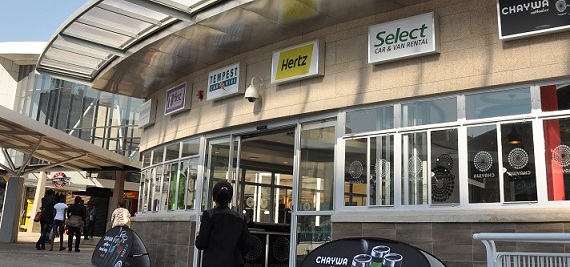

New Chaywa coffee shops in the train stations

ChaywaKF27jun2015

One of the Coca-Cola’s brands, Chaywa coffee shop, has opened two new coffee shops in Park Station and Pretoria Gautrain station.

Chaywa has developed a commercially viable On-The-Go coffee solution for rail and bus commuters designed to deliver convenient, quick service, for busy commuters on the go. Commuters are encouraged to Grab-a-coffee-and-go.

Located in prime positions within the PRASA/Metrorail-owned buildings with easy access to Gautrain stations, the Chaywa coffee shops are easily accessible to consumers travelling in and around Gauteng from Johannesburg Park and Pretoria Stations.

All Chaywa coffee is freshly brewed at the point of purchase and goes from bean to cup in approximately 30 seconds. Imported green coffee beans from South America, Asia and Africa are used to produce the finest tasting beverages and state of the art technology is applied to roast these beans to perfection and create deeper aromas and fuller flavours.

Bread and Butler will supply Chaywa choffee shop with all the food items on the menu such as self-serve sandwiches and individually wrapped confectionary such as muffins and doughnuts. Menus are created to allow for quick changes in consumer demands, trends and weather patterns.

source: http://www.mzansilife.com / Mzansi Life / Home / by Tumi Dzonzi / June 25th, 2015

Coffee pulp bacteria clears oil spills, finds Nitte college team

The bacteria extracted grows in a minimal medium supplemented with petroleum crude oil (PCO) in sea water indicating that this is a halophile (organisms that thrive in high salt concentrations) and can be used effectively to clear oil spills in seas.

Mangaluru :

Can bacteria extracted from coffee pulp waste help clear oil spills? It can, says the team from NMAM Institute of Technology, Nitte which has won the Best Project Award for ‘Microbial Bioremediation of Effluents’ at the Joy of Engineering, Design and Innovation (Jed-i) project challenge.

The bacteria extracted grows in a minimal medium supplemented with petroleum crude oil (PCO) in sea water indicating that this is a halophile (organisms that thrive in high salt concentrations) and can be used effectively to clear oil spills in seas.

The team – Aparna K Mohan, Sandhya Kamath, Sanjana Chiplunkar and Shiny Martis B, all BE Biotechnology students of the college- won the challenge beating 19 other finalists which included teams from IITs and NITs. The annual challenge, conducted by Jed-i in partnership with the Indian Institute of Science (IISc), Bengaluru, is designed to identify and showcase the best final year engineering project.

Sanjana, one of the participants, said: “Actually, this was our mini project in the second year. When we got good results we continued with it. The bacteria (Brevibacterium sp. MTCC10313) was previously isolated from coffee pulp ad our seniors had done work and found out that it had caffeine degradation ability. Since it had ability we thought it could tolerate other stressful conditions, then we thought of this.”

Can this be implemented at ground level? “We built a bio-reactor with some waste water and we inoculated the bacteria and got the same results as we got in our lab. This will work in the real world,” she said.

The second place was won by the team of Pradyumna S V, Prateek R, Kunal A Mehta, Mohit Kumar Basu from Reva Institute Of Technology & Management for their project ‘Design, fabrication and Analysis of A Remotely Piloted Vehicle’ while the project ‘Robotic Wrist’ by team of Harish Pawar, Raghuveer Sarma M S, Amit Inamdar, Pooja Ambannavar, Priya Burlabaddi from B V Bhoomaraddi College of Engineering and Technology won a special mention.

source: http://www.timesofindia.indiatimes.com / The Times of India / Home> City> Mangaluru / by Stanley Pinto, TNN / June 25th, 2015

India Set to Record Highest Coffee Production in 2015-16

Representational image

New Delhi :

Coffee production in India is expected to touch a new peak of 3,55,600 tonnes this marketing year starting October, as the crop prospects are encouraging due to adequate rains in most growing states, state-run Coffee Board said on Monday.

The country’s total coffee output has reached a record 3,27,000 tonnes in the ongoing 2014-15 coffee year, though slightly lower than the earlier estimate of 3,31,000 tonnes made for the same period, it said in a statement.

The coffee year runs from October to September.

Releasing the initial production estimate for 2015-16, Coffee Board said: “The post blossom crop forecast for the year 2015-16 is placed at 3,55,600 tonnes. This is an increase of 28,600 tonnes over the final crop estimate of 2014-15.”

Of the total, Arabica production is estimated at 1,10,300 tonnes in 2015-16 as against 98,000 tonnes this year, while that of Robusta production is pegged at 2,45,300 tonnes as against 2,29,000 tonnes in the said period, it said.

Arabica and Robusta are the varieties of coffee.

“Overall, the crop prospects of 2015-16 at post-blossom stage are quite encouraging with a promise of highest record crop thanks mainly to the timely and adequate blossom and backing showers in traditional areas and non-traditional areas,” it said in a statement.

According to the Board, much of the production gain is expected to come from Karnataka, where total coffee output is pegged at 2,56,500 tonnes in 2015-16, as against 2,33,230 tonnes in the current year.

“The main reason for increased crop forecast in the state is that all coffee growing areas have received timely and adequate blossom and backing showers during this year.

Additionally, prevalence of good prices encouraged the growers to adopt better husbandry practices which have helped to invigorate production,” it said.

The output in three coffee growing districts Kodagu, Chikmagalur and Hassan is estimated higher at 1,38,075 tonnes, 85,250 tonnes and 33,175 tonnes, respectively, for 2015-16.

Coffee production in Kerala is estimated to increase to 69,800 tonnes in 2015-16 from 67,700 tonnes this year, while the output in Tamil Nadu is likely to improve marginally to 18,800 tonnes from 17,875 tonnes in the said period.

In non-traditional areas, coffee production in Andhra Pradesh is estimated to increase to 9,700 tonnes from 7,425 tonnes, while the output in Odisha is expected to rise to 600 tonnes from 550 tonnes in the said period.

Coffee output in north eastern region is, however, expected to decline marginally to 200 tonnes in 2015-16 from 220 tonnes in 2014-15, the Board added.

Till last week, monsoon rains were 11 per cent more than the average. Monsoon rains are expected to be normal in June but may weaken in the next month, as per the Met department.

India accounts for only 4-5 per cent of the world’s output, but exports 70-80 per cent of its produce. Italy, Russia and Germany are the top three buyers of Indian coffee.

source: http://www.ndtv.com / NDTV / Home> Sections> All India / Press Trust of India / June 23rd, 2015

ExpoEspeciales 2015, the Most Important Specialty Coffee Expo in Latin America and the Caribbean

Bogota, Colombia (Marketwired via COMTEX) :

Under the motto, “Colombia, a renovated vision,” the 8th edition of the International Specialty Coffee Expo, ExpoEspeciales Cafe de Colombia, will be held from October 15 to 18, 2015 in Corferias, the most important exhibition and events center in Bogota, Colombia.

ExpoExpeciales Cafe de Colombia has become the most important international specialty coffee expo in Latin America and the Caribbean, due to the number of attendees each year, the high caliber of its academic agenda, the relevance of industry-related topics, and the opportunity to network at the highest level, thanks to its business matchmaking forum.

ExpoEspeciales is organized by the Colombian Coffee Growers Federation (FNC) as part of its value added strategy, in order to promote the production of the highest-quality coffees from different regions of Colombia, the country that produces the world’s best Mild Washed Arabica coffee.

ExpoEspeciales is also a propitious platform for consumers and coffee industry professionals that attend from different countries across Latin America, as well as buyers from Asia, North America and Europe.

ExpoEspeciales, which takes place every year in different cities of Colombia, integrates the entire coffee value chain and brings together farmers, traders, buyers, visitors and coffee lovers in one single place.

In addition to being an excellent showcase for coffees from different Colombian regions, this expo is also a platform to present and spread market trends and innovations on a national and global scale. It features spaces that facilitate commercial, cultural and academic exchanges, as well as sharing of experiences and knowledge between industry participants.

For the second time, the expo will host the business matchmaking forum, organized by the FNC and ProColombia (formerly ProExport, the Colombian government’s agency for promotion of non-traditional exports, attraction of foreign investment and positioning of Colombia as a world-class touristic destination).

Producers, suppliers and distributors of products and services will be able to get in contact with buyers and companies interested in learning about offers and business models that can make them grow within the coffee industry.

International Convention of the Women’s Coffee Alliance

This year, within the framework of ExpoEspeciales Cafe de Colombia, “Coffee & Trade Beyond Barriers,” the IV Convention of the International Women’s Coffee Alliance (IWCA), will be held. It is organized by the IWCA itself and the FNC.

This educational and networking forum, to be held on October 15 and 16, will attract more than 300 members of the international coffee sector, including producers, exporters, importers, roasters and baristas, as well as industry analysts and IWCA chapter members from around the globe. A broad selection of subjects that impact men, women and families involved in the seed-to-cup process will be explored.

“The IWCA represents coffee-growing women from producing countries to empower them, make them visible, get support programs and show the importance of women in the coffee value chain,” Ana Maria Lleras, coordinator of the FNC Coffee-Growing Women Program, explains.

10th Colombian Barista & 5th National Cup Tasters Championships

It is worth highlighting the 10th Colombian Barista Championship and the 5th National Cup Tasters Championship, two other events of great tradition that will take place within the framework of this important expo. The barista champion will represent Colombia at the 2016 World Barista Championship, which will be held in Dublin, Ireland.

The 5th National Cup Tasters Championship awards the professional coffee cupper who demonstrates speed, skill and accuracy to distinguish the taste differences in specialty coffees. The winner will represent Colombia at the World Cup Tasters Championship.

Varied Academic Agenda

A rich and varied academic agenda, with top-notch speakers, will allow attendees to familiarize themselves with relevant industry issues, such as the diversity of Cafe de Colombia, the FNC’s specialty coffees strategy and industry trends, among others.

Other events enriching the academic agenda include food pairing shows and the traditional Q meeting, co-organized by the FNC and the Coffee Quality Institute, as well as activities under the “Toma Cafe”, Colombia’s National Program to support coffee consumption led by FNC.

A bit of history

ExpoEspeciales was first held in 2008, in the city of Neiva, Huila, and was created to strengthen the industry and encourage greater dynamism in the coffee business.

With great success every year, this event promotes a coffee-growing region of Colombia. 2015 will mark the expo’s 8th edition, with a steadily growing number of attendees. Other cities that have hosted the expo include Ibague (2009), Pasto (2010), Bogota on two previous occasions (2011, 2013), Popayan (2012) and Medellin (2014). The 4th edition, which was held in 2011 in Bogota, brought together more than 19,000 people, as this event was held in conjunction with the World Barista Championship. In 2015, the Colombian capital will once again serve as the venue for the event.

This annual expo traditionally features the following exhibitors:

— Coffee growers and associated industry groups (cooperatives,
associations).
— Departmental Coffee Growers Committees.
— Manufacturers and distributors of machinery for the coffee
post-harvest processing, equipment and supplies for the industry
(threshers, roasters) and coffee shops.
— Threshing and roasting companies.
— Exporters.
— Non-governmental and industry supporting entities.
— Financial institutions.
— Certifiers, among others.

As visitors and buyers:

— Coffee growers.
— Representatives, managers and professionals of the coffee sector.
— Coffee roasters and traders.
— Cup tasters.
— International buyers.
— Academics.
— Professional baristas from establishments such as hotels, restaurants,
coffee shops and bars.
— General public.

For more information visit: www.expoespeciales.com

source: http://www.marketwatch.com / Market Watch / Home> Real Estate> Press Release / Marketwire LP / June 09th, 2015

Tata Global to make Map Coffee a power brand

To launch the brand in New Zealand and Indonesia

Mumbai :

Tata Global Beverages is planning to make its acquired coffee brand from Australia, Map, a power brand in its portfolio. After almost a year since the acquisition, it intends taking Map to New Zealand and Indonesia, but launching it in India remains a distant possibility.

“India is still not a big market for branded coffee. Even the big brands like Nestle and Bru do not have adequate size. We will take Map to New Zealand and Indonesia and it will be a power brand like Tetley and Tata Tea,” said Ajoy Misra, Managing Director & CEO, Tata Global Beverages.

While the beverage company is ruling out a branded play in India and insists on being a B2B player with its subsidiary Tata Coffee, it has tried to sample a few brands in the past. “We did have a few branded packs under Mr. Bean and Coorg Coffee, but it has not been a major attempt at branded play,” said Misra.

However, the company might extend Map into the food services segment in India, catering to the corporate and institution segments. “There could be a chance for Map to enter the food service business in India as it has corporate accounts in Australia. There could be further possibilities for the brand here as the market gets more organised in the food services segment,” said Misra. Map is present in roast, ground coffee, single serve coffee pods and machines in the food service industry.

The market leader in tea with a volume share of 24 per cent, Tata Global Beverages is now looking forward to the high growth green tea segment to shore up its profitability. “The price per cup is higher in green tea compared to black tea and we expect greater profitability from this segment,” he said. It has also dropped price points by 20 per cent with a new variant of green tea for the masses under ‘Acti Green’. “We are getting 30 to 40per cent growth from the green tea segment and it is a growth engine for the company,” he said.

Meanwhile, profitability is elusive for its acquired brands like Himalayan from Mount Everest Mineral Water and coffee retail business under the JV with Starbucks. “Starbucks has completed two years, but it takes time to get profitable in the QSR segment. While we have 75 Starbuck stores, it has to cross the critical level of over 100 stores before we can think of making money in this segment,” observed Misra.

However, the beverage major is still looking at inorganic growth opportunities to build its portfolio. “We gave not stopped looking at opportunities and we seek both organic and inorganic growth,” he added. Tea comprises 75 per cent of the company’s turnover while coffee contributes about 18 per cent while the balance incomes is from smaller categories like water and plantations business.

source: http://www.thehindubusinessline.com / Business Line / Home> Companies / by Purvita Chatterjee / Mumbai – June 01st, 2015

Coffee grows well in Hasanur

The scope for bringing Hasanur in the list of coffee regions has been explored successfully at Hasanur in a plantation spread over 30 to 40 acres.

Traditionally, the farming community in Hasanur area have been growing vegetables. It is, perhaps, due to the smallness of the holdings, according to Horticulture Department officials.

Hasanur is at an elevation of 1,100 metres above sea level, an altitude considered ideal for coffee cultivation. More or less, the climatic conditions are the same as in Gudalur where coffee is a dominant crop.

According to Coffee Board, Government of India, Ministry of Commerce and Industry, regions with high elevations are ideally suited for growing Arabicas of mild quality while those with warm humid conditions are best suited for Robustas. The climatic condition augurs well with regard to blossom showers and backing showers between February and April.

source: http://www.thehindu.com / The Hindu / Home> News> National> Tamil Nadu / by Special Corrrespondent / Erode – May 21st, 2015

Southern Comfort Moves Up North

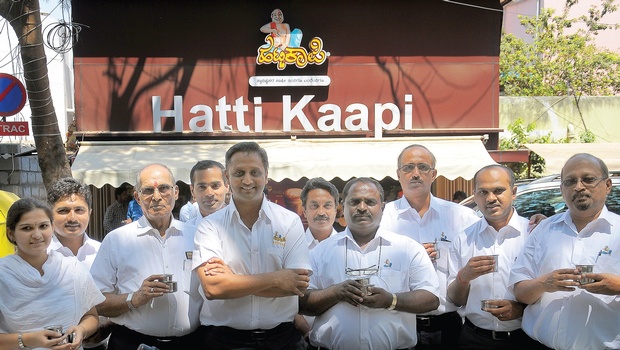
U S Mahendar (fifth from left) with his team members | JITHENDRA M

The engaging logo of the pot-bellied coffee maker juggling his classic steel tumblers is all set to invade tea drinking bastions in north of the Vindhyas under the brand Hatti Kaapi. Rooted in Bengaluru, the affordable and well-researched over-the-counter format is the brainchild of U S Mahendar, a small town coffee powder maker, hailing from Hassan district. Catering to office goers, tourists, shoppers and passersby, the distinctive little outlets dish up seemingly endless South Indian style cups of filter coffee. They almost serve 70,000 cups of coffee on a daily basis along with a small range of teas, milkshakes and snacks.

The Hatti Kaapi growth chart is impressive. It began as one tiny outlet in 2009 operating out of Bengaluru’s bustling Gandhi Bazar area and located under a stuffy staircase. Now 40 units are spread across street corners, tech-parks and more recently airports in Bengaluru and Hyderabad. At Rs 12, one can get a cup of hot filter coffee and khara bhath, while a cup of hot coffee costs Rs 5.

Mahendar himself sounds a tad bemused by their success and the several awards and recognitions they have won. “It was at 5.30 am on November 27, 2009, that we served our first cup of traditional filter coffee from our 40 sq ft counter in Gandhi Bazaar. We sold 3,000 cups at Rs 5 each the next day and haven’t looked back since,” he says, adding, “I came to Bengaluru with my mother, friend M L Gowda who is now a partner in Hatti Kaapi and with just Rs 2,000 in hand. My mission was to market our coffee powder to some of the big Udupi restaurant chains specialising in South Indian filter coffee. One particular brand insisted that we come in at 4 am each day , brew the coffee, serve it to customers and collect feedback on the quality.”

After three exhausting months of doing this, they were told that they were not good. In retrospect, that rejection turned out to be in their favour. Mahendar took it as a challenge and decided to start his own brand.

He attributes his success to his core team which includes a mix of Starbucks baristas, industry veterans like S Lakshmana Swamy from Hindustan Unilever, his head of operations Balaji A R and several others who have been around since its inception. “We are now taking on tea drinking areas up north—Delhi, Mumbai and Kolkata. My dream is to have a Hatti Kaapi presence in major international cities like New York and Paris,” says he. This does not seem impossible as word has it that they are developing ties with international super market chains like Carrefour although they currently have no plans to raise money externally or to dilute their stake.

“You cannot beat our price or our packaging. We serve you coffee in earthen pots, takeaway cups or old-fashioned steel tumblers,” says he. And to satisfy those hunger pangs they also have a no-fuss menu of samosas, rolls, South Indian rice- and lentil-based staples like idlis or Bisibele Bhath (hot rice-dal mixture), stuffed buns and bags of savoury dips. “Our biggest challenge is keeping our price low without compromising on quality. Since we started, we have only increased our prices by Rs 3 per cup in corporate campuses and Rs 5 elsewhere. Yet the quality of our coffee powder and milk is not compromised on. We want to be the quintessential neighborhood adda that everyone must want on their street corner,” he signs off.

source: http://www.newindianexpress.com / The New Indian Express / Home> LifeStyle> Food / by Jackie Pinto / April 04th, 2015

Tata Coffee Appoints Sanjiv Sarin as Managing Director, CEO

SanjivSarinKF29mar2015

New Delhi:

Tata Coffee on Friday appointed Sanjiv Sarin as managing director and chief executive officer CEO of the company for a period of three years.

Mr Sarin is currently working as CEO designate and will replace Hameed Huq, currently managing director of the company. Mr Haq will retire on March 31.

“The Board of Directors at their meeting dated March 27, 2015 has appointed Sanjiv Sarin, the present ‘CEO Designate’ as Managing Director & CEO of the company for a period of three years with effect from April 25, 2015,” Tata Coffee said in a filing to the BSE.

In December last year, the company’s board had approved the appointment of Sanjiv Sarin as CEO designate with effect from January 8 this year.

Mr Sarin has also held the position of regional president-South Asia of Tata Global Beverages from the past four years.

During his tenure, he has significantly strengthened Tata Global Beverages’ position in the country’s branded tea market. He has over 38 years of experience in a variety of significant roles.

Tata Coffee is a subsidiary of Tata Global Beverages and it produces more than 10,000 tonnes of shade-grown Arabica and Robusta coffees at its 19 estates in South India.

Its two Instant Coffee manufacturing facilities have a combined installed capacity of 8,400 tonnes.

source: http://www.profit.ndtv.com / NDTV Profit / Home> Corporates / by Press Trust of India / March 27th, 2015

Israel’s Strauss Group plans long-awaited IPO of coffee joint venture

Company says it filed confidential prospectus for share sale on Wall Street.

Strauss Coffee accounts for about half the group's total sales. Photo by Bloomberg
Strauss Coffee accounts for about half the group’s total sales. Photo by Bloomberg

A long-awaited initial public offering on Wall Street of Strauss Coffee, a multinational joint venture controlled by Israel’s Strauss Group and the Texas-based private equity fund TPG Capital, is finally moving forward, Strauss Group said on Monday.

Strauss, a maker of snacks, fresh foods and coffee, said it had submitted a draft confidential prospectus to the U.S. Securities and Exchange Commission. “There is no certainty that the IPO will indeed be finalized, and if it is, on which date,” Strauss said in a statement. There were no other details.

Shares of Strauss Group closed up 5.6% at 61.90 shekels ($15.61) on the Tel Aviv Stock Exchange on Monday.

The IPO comes seven years after TPG bought a 25% stake in Strauss Coffee for $293 million. Although Strauss Coffee grew through acquisitions to become the world’s fifth largest maker of ground and roasted coffee and No. 4 in instant coffee, the partnership has been stormy.

Strauss and TPG went to court after the U.S. fund sought to block Strauss’ ouster of Todd Morgan, the joint venture’s CEO and a former TPG employee. It lost the fight and Morgan was ousted early last year. The two also squabbled over fees that Strauss was charging the joint venture and disagreements over failed deals.

On Monday, Strauss Coffee reported 2014 net profit had fallen 13.6% to 265 million shekels ($66.756 million) as sales declined 3% to 3.8 billion shekels. The company paid out a huge dividend of 175 million shekels for the year, apparently in anticipation of the IPO.

A string of acquisitions and partnerships transformed Strauss Coffee into the No. 1 coffee seller in Brazil and the fourth-largest in the global retail coffee market and a market leader in Russia and in Central and Eastern European countries. In 2014, it accounted for almost half of Strauss Group’s total sales.

Nevertheless, Strauss Coffee didn’t develop as the two sides hoped it would when TPG bought its stake in 2008. That was just as world financial markets seized up and the world slipped into a deep recession, bringing merger and acquisition deals to a near halt.

Three years ago, TPG and Strauss tried to sell the coffee company’s Russian and Eastern European businesses in order to buy out TPG’s stake with the proceeds. After abortive talks with India’s Tata Coffee and Master Blenders, TPG urged an IPO.

That set off a dispute that ended up in court, along with the dispute over Morgan. Strauss contended that TPG sought to inflate Strauss Coffee’s value while TPG accused Strauss of deflating its value in order to block any chance of an IPO and buy out the private equity fund cheaply. The court dismissed TPG’s allegations.

Nevertheless, an IPO would enable TPG to reduce, if not divest, its Strauss Coffee stake. But The Wall Street Journal report a year ago said TPG valued its Strauss Coffee holding at just 10% more than it paid after holding it for nearly six years.

Meanwhile, Strauss Group, Israel’s second-largest food and beverage maker, reported Monday that it earned an adjusted 84 million shekels in the fourth quarter, up from 70 million shekels a year earlier, thanks to currency hedging transactions as well as lower tax expenses.

Sales edged up 0.3% to 2.08 billion shekels. Excluding the impact of changes in exchange rates, sales grew 2.8%. Coffee sales rose 2.4% to 1.03 billion shekels, led by a 4.8% increase in overseas coffee sales. Excluding currency effects, total coffee sales grew 9.4%.

source: http://www.haaretz.com / Haaretz / Home> Business> Israel News / by The Marker – March 24th, 2015