Category Archives: Coffee News

Women of the UAE: Dr Mona Al Bahar, the champion of the vulnerable

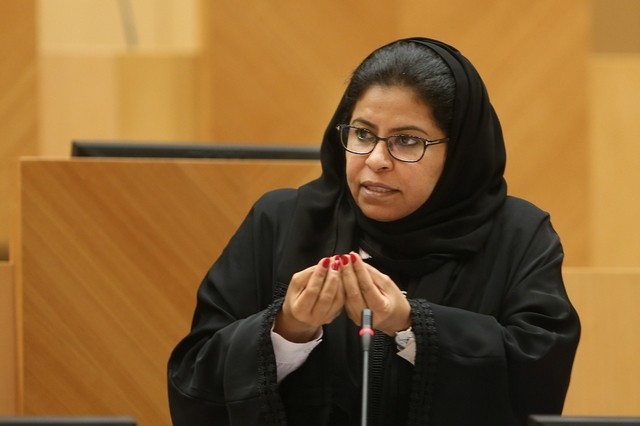
Dr Mona Al Bahar speaks passionately at an FNC session in Abu Dhabi. Delores Johnson / The National

Abu Dhabi :

Determination has been a major drive in Dr Mona Al Bahar’s career.

As a freshman at UAE University in the 1980s, she was keen to join the social services sector to help revive a profession where there was little or no enrolment of Emirati women.

And at age 18 established a society to assist Emiratis with special needs in Sharjah. Later she became the first Emirati social worker with a doctorate from a US university.

“There is a very negative view in the western world of Arab and Gulf women,” she said.

“They view women as opinionless and weak. I first felt this [while studying for her doctorate] at Ohio State University at the social service college.

“I felt they were all questioning if I could compete with other students as an Arab and a Gulf woman. Some asked me ‘Do you feel you can compete and continue?’ That was a big challenge and I took a decision to be an example and to prove not only myself, but the Arabic, Emirati women.”

In 1997, Dr Al Bahar obtained her doctoral degree and was awarded the Morris Cornell Distinguished Researcher Award. Her name was engraved at the university’s entrance alongside those of other winners.

Once back in the UAE, Dr Al Bahar returned to UAE University, where she worked as an assistant professor for several years.

Later, she returned to her home emirate of Dubai, where she joined the Dubai Foundation for Women and Children, which provides refuge and support to the most vulnerable.

In 2011, Dr Al Bahar then received an unexpected phone call. Sheikh Mohammed bin Rashid, Vice President and Ruler of Dubai, chose her as a Federal National Council member.

She is now one of the most vocal women on the council.

“Entering the FNC was a turning point in my career,” she said.

“It widened horizons and provided experience I would not have gained in any other entity or job.

“Working in the FNC carries its own challenges. And I, in all honesty, am thrilled with this experience because it helped me to discover sides of myself and my abilities I would not have been introduced to without this experience.”

She was one of the first to ask to join the council’s education, media and youth committee, where she was later elected chairwoman.

She also supported the country’s first children’s rights legislation and pushed the council to pass a controversial clause in the law allowing specialists unprecedented power to remove children from their homes if found to be in imminent danger. With the public, she has repeatedly tried to keep herself available to those who need her, even taking part in a public majlis to allow as many Emiratis to approach her as possible. As much as her profession has helped her in the FNC, her former students’ words serve as a testament to how important her decision to join her field was all those years ago.

“When a student comes to me and says ‘Thank you doctor, you changed a lot in my life’, I consider that a crown,” she said. “It is a drive and reassures me that my profession was the right choice.

“When I see a positive change in these students, either in their thinking or their personal life, that makes me love my profession more.” With her four-year term of office near its end, she is unsure of what life post-FNC will bring, but is confident it will involve academia and coffee.

“My passion for coffee drove me to establish a coffee museum with a few friends in Dubai,” she said.

“This project was an idea and a dream. With work, the dream became a reality.”

The museum is the first of its kind in the UAE and the second in the Middle East, in Al Fahidi, Bur Dubai, where visitors can learn about the origins of coffee.

source: http://www.thenational.ae / The National / Home> UAE> Arts & Lifestyle / by Ola Salem / March 07th, 2015

From Bean to Cup

The Coffee Board of India serves as the friend, philosopher and guide to the coffee sector in the country covering the entire value chain
CoffeeBeansKF12mar2015

The saga of Indian coffee began on a humble note, with planting of ‘Seven seeds’ of ‘Mocha’ during 1600 AD by the legendary holy saint Baba Budan, in the courtyard of his hermitage on ‘Baba Budan Giris’ in Karnataka. For quite a considerable period, the plants remained as a garden curiosity and spread slowly as back yard plantings. It was during 18th century that the commercial plantations of coffee were started, thanks to the success of British entrepreneurs in conquering the hostile forest terrain in south India. Since then, Indian coffee industry has made rapid strides and earned a distinct identity in the coffee map of the world.

The Coffee Board

During 1940s, the coffee industry in India was in a desperate state due to the World War II resulting in very low prices and ravages of pests and diseases. At this time, the Government of India established the Coffee Board through a constitutional act – Coffee Act VII of 1942 – under the administrative control of the ministry of commerce and industry. The Board comprises 33 members including the chairman, who is the chief executive and appointed by the Government of India. The remaining 32 members represent the various interests such as coffee growing industry, coffee trade interests, curing establishments, interests of labour and consumers, representatives of governments of the principal coffee growing states and members of Parliament.

After pooling was discontinued in 1996, Coffee Board serves as the friend, philosopher and guide to the coffee sector covering the entire value chain. The core activities are primarily directed towards research & development, transfer of technology, quality improvement, extending development support to growing sector, promotion of coffee in export and domestic markets. The activities of the Board are broadly aimed at (i) enhancement of production, productivity and quality; (ii) export promotion for achieving higher value returns for Indian coffee and (iii) supporting development of the domestic market.


Research and Export Promotion

Organised research in coffee was initiated during 1925 by the erstwhile Mysore Government by setting up the Mysore Coffee Experiment Station near Balehonnur in Chikmagalur district. After formation of the Coffee Board, the research station was brought under its administrative control. Presently the Research Department of the Board with its headquarters at the Central Coffee Research Institute and five regional stations has a sanctioned strength of 113 scientific personnel and is involved in development of improved varieties with tolerance to major pests and diseases and standardisation of technology for improving production, productivity and quality.
CoffeeAreasKF12mar2015

After liberalisation in 1996, the marketing functions were deregulated. The Coffee Board plays the role of facilitator and promoter of Indian coffee exports. However, registration of exporters is the responsibility of the Coffee Board. Under the Export Promotion scheme, exports of value added coffees in retail packs and export of coffee to high value far-off destinations are incentivised to offset the transaction costs to some extent and enable the Indian exporters to be competitive in the export market. These incentives provide opportunities to expand the footprint of Indian Coffee in higher value destinations like USA, Japan, Canada, Australia, New Zealand, etc on one hand and reinforcing presence in traditional markets i.e., European Union/ Russia and CIS etc.

Besides, the Board regularly participates in leading coffee trade shows/ exhibitions held in major consuming countries to promote awareness about quality of Indian coffee to the overseas roasters, traders and consumers. The Board also conducts Flavour of India – The Fine Cup competitions to select fine coffees and expose them to the export market. It also promotes coffee consumption in the country through 12 India Coffee Houses located in major cities across the country.

In India, coffee is traditionally grown in the Western Ghats spread over Karnataka, Kerala and Tamil Nadu. Coffee cultivation is also being expanding rapidly in the nontraditional areas of Andhra Pradesh and Odisha as well as in the North East states. Coffee is predominantly an export oriented commodity and 65 per cent to 70per cent of coffee produced in the country is exported while the rest is consumed within the country. Indian coffee industry earns a foreign exchange to the tune of about Rs 4000 crore. In the international market, Indian coffees earn a high premium, particularly Indian Robusta which is highly preferred for its good blending quality. Arabica Coffee from India is also well received in the international market.

Arabica is a mild coffee, but the beans being more aromatic, it has higher market value compared to Robusta beans. On the other hand Robusta has more strength and is, therefore, used in making various blends. India is the only country that grows all of its coffee under shade. Typically mild and not too acidic, these coffees possess an exotic full-bodied taste and a fine aroma.

India cultivates all of its coffee under a well-defined two-tier mixed shade canopy, comprising evergreen leguminous trees. Nearly 50 different types of shade trees are found in coffee plantations. Shade trees prevent soil erosion on a sloping terrain; they enrich the soil by recycling nutrients from deeper layers, protect the coffee plant from seasonal fluctuations in temperature, and play host to diverse flora and fauna.

Coffee plantations in India are essential spice worlds too: a wide variety of spices and fruit crops like pepper, cardamom, vanilla, orange and banana grow alongside coffee plants.


Training courses in coffee culture and management

The Central Coffee Research Institute, popularly known as CCRI, has grown as an internationally recognised, state-of-the-art research centre for carrying out research on all aspects of coffee cultivation. CCRI is committed to introducing emerging technologies and sustainable package of practices to benefit the coffee farmers. It plays an important role in the development and growth of the coffee agricultural sector. CCRI has 133 dedicated scientists working for the development of newer technologies in close association with a number of international institutes, reputed national institutes and pure science and agricultural universities.

The CCRI, apart from the development of new technologies, is involved in imparting training on scientific coffee cultivation to the benefit of all the stakeholders since 1953. The institute is recognised as an international centre of excellence for training in coffee culture by the FAO, Rome. Candidates from several coffee growing countries are being sponsored for these training programmers by the world

CHART

Coffee regions of India

Anamalais (Tamil Nadu): Wildlife sanctuaries in this region are the abode of spotted leopards,while the plantations are home to fine, high-grown Arabicas, including the exotic Kents.

Araku valley (Andhra Pradesh):
Home to colourful parrots, it is not unusual to see a flock of chattering red and green birds, darting through trees in this scenic valley.

Bababudangiris (Karnataka): Bababudan brought seven ‘magical’ beans from Yemen and planted them in the lofty hills of this region. Deer is often spotted, grazing alongside plantations abundant with full-bodied Arabicas.

Biligiris (Karnataka/Tamil Nadu):
Besides full-bodied Arabicas, this region is noted for the sambar – the largest Indian deer with huge antlers.

Brahmaputra: The mighty Brahmaputra which flows through the North Eastern states is the lifeline of this region which is home to the one-horned rhinoceros. This sturdy animal is found in large numbers at the Kaziranga National Park in eastern Assam.

Chikmagalur (Karnataka): Chikmagalur’s forests and wildlife sanctuaries are abundant with beautiful peacocks, India’s national bird. The peacock loves to show off its colourful feathers, especially during its elaborate courtship dance.

Coorg (Karnataka):
Lush coffee plantations are bustling with honeybees which yield the delicious Coorg Honey, collected by nimble-footed tribals

Manjarabad (Karnataka): Gentle sloping terrain with small streams and coffee plants provide a natural habitat for the jungle fowl. This yellow-headed bird with a red comb and multi-coloured plumage is generally seen in pairs, close to the coffee plantations.

Nilgiris (Tamil Nadu): The plantations are home to fine, high-grown Arabicas, including the exotic Kents.

Pulneys (Tamil Nadu): A well-known feature of this region is the bright, bluebell-like Kurinji flower that makes a dramatic appearance, once in 12 years. The high-grown Arabicas however, are a predominant sight, year after year.

Sheveroys (Tamil Nadu):
The magnificent Gaur or Indian bison is an embodiment of vigour and strength, much like the boldsized Arabicas grown here. This massive animal with its huge head and sturdy limbs grazes on the lower hill tracts of this picturesque region.

Travancore (Kerala): The national flower of India, the lotus symbolises purity and beauty. These bright, fragrant flowers with floating leaves and long stems, grow in shallow waters in this region noted for its Arabicas and Robustas.

Wayanad (Kerala):
Wayanad is home to the Indian tiger, India’s national animal – a symbol of valour and courage.

source: http://www.financialexpress.com / Financial Express / Food & Hospitality World / Home> Cover Story / March 05th, 2015
The Call of Coffee

Serving Indian and international clients its latest beverage equipment solutions, Vikram Khurana, CEO, Kaapi Machines, speaks about the company’s strength and brands it offers

KaapiMachinesKF07mar2015

Kaapi Machines, India’s first integrated beverage equipment solutions company, was started in 2007 as a joint venture between Mahlkonig GMBH, the master in grinding technology from Germany and McKinnon India, based in Coimbatore; an Indian manufacturer of green coffee processing equipment company to offer one stop solutions for coffee business. “We have earned a reputation for quality, reliability and professionalism,”says Vikram Khurana, CEO, Kaapi machines. He further adds, “Making a good coffee is a combination between good technology, quality coffee blend and the skilled hands of a Barista and we support our customers in achieving this combination right to serve a good cup of cappuccino at their cafes/ restaurants/ hotels.”

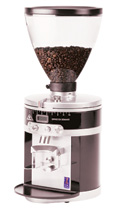
Serving our customers that include international and Indian hotel chains, café’s and QSR’s operating in Indian subcontinent, Kaapi Machines distributes and supports one of the largest range of coffee equipment brands available in India and the neighbouring countries. “Our portfolio includes traditional and automatic coffee machines, espresso grinders, retail and industrial coffee grinders, shop and industrial coffee roasters, coffee brewers, ice blenders and barista tools. Our company’s strength is its ability to offer a complete coffee solution and at the same time provide the highest level of customer service and equipment. the company has company sales offices/ demonstration centres in Bengaluru, Mumbai and New Delhi.

The company supports its customers with an effective after sales service that includes operational training and a one year warranty support followed by an AMC programme to ensure that the machines are always taken care by the right people. The company also supports customers in the following:

Blend development for Italian coffees (House blend)
Italian menu for hot coffees
Barista training on the following:
Understanding the grinder and your grind size
Brewing the perfect shot of espresso
Art of texturing the milk
Art of pouring the milk
Latte art techniques for making heart/ rosetta/ leaf on a cup of coffee.

Kaapi machines since inception has been actively engaged in coffee promotional activities including India international coffee festival, organising coffee programmes in different parts of India with coffee board of India to spread education on coffee cup quality using various brewing options.

Kaapi Shastra- a five day coffee education programme driven by coffee board of India in Bengaluru, organising and sponsoring the Indian Barista Championship under patronage of Coffee Board of India and recent achievement has been to set up India’s first dedicated Barista training academy for coffee lovers to learn professionally as how to make Italian espresso and cappuccino in 16 hours.

Kaapi Machines is the India exclusive distributor and/or service provider for the following brands: Probat, Astoria, WMF, Mahlkonig, Ditting, Anfim, Vita Mix, Bunn and Urnex.

Astoria

Since 1969, Astoria is a historic brand in the Italian tradition of professional Espresso machines. It offers different technologies from single boiler to multiple boiler machines for precision on espresso temperature stability, eco-friendly options and the recently introduced hybrid machines that suits customers’ requirements differing in capacity and price. Astoria has earned a reputation for delivering the machines with best performance to price ratio and the oldest Astoria machine installed in India is 24 years old and still operating well at an Italian restaurant in New Delhi.

Mahlkonig

For over 80 years MAHLKÖNIG is the world’s leading brand of quality professional grinders. The MAHLKÖNIG logo stands for quality leadership and innovation. Just under 90 per cent of MAHLKÖNIG products are used in the field of coffee grinding. The aim is to grind the coffee gently without loss of flavour and homogeneous with the outstanding quality to achieve a long life.

WMF Coffee Machines

WMF is the leading international manufacturer of professional coffee machines. This is due not least to the fact that even today they are only manufactured at the Geislingen site and thus can justifiably bear the ‘Made in Germany’ seal of quality. Certification of the WMF quality management system in accordance with DIN ISO 9001-2000 provides further proof of quality, efficiency and precision.

Vita Mix ice blenders

Built by hand in Cleveland Ohio, US, the ice blenders produced are well accepted by all the leading F&B retail chains due to its reliability, product engineering, total cost of ownership and extended warranty. Kaapi machines offers different Vitamix models that includes blenders with sound proofing, auto programming suitable for both beverage and food applications powered by 2 HP and 3 HP motors.

source: http://www.financialexpress.com / Financial Express / Food & Hospitality World / Home> Cover Story / March 05th, 2015
Coffee? Mr. President

OBAMA MENU: Jammu and Kashmir’s ‘Nadru Ke Goolar’; West Bengal’s ‘Mahi Sarson’; ‘Shatwar (Asparagus) Ka Shorba’; Sweet dishes ‘Gulab Jamun’, ‘Gajar ka Halwa’ and assorted fruits; ‘Shrimp Karavalli’ from coastal Karnataka; ‘Murg Neeza Kebab’ of the Mughlai cuisine; ‘Anannas Aur Paneer ka Soola’ — char-grilled cottage cheese with pineapple; ‘Nadru Ke Goolar’ (lotus stem kababs); ‘Kela Methi Nu Shaak,’ a Gujarati dish; Mixed Vegetable Kalonji; Gujarati ‘Kadhi’; ‘Matar Pulao’ and assorted breads; Bengali dish ‘Mahi Sarson’ and ‘Bhuna Gosht Boti’ — tender pieces of lamb cooked in tomato and onion masala; South Indian Coffee and herbal tea.

BallalKF0mar2015
by N.K.A. Ballal, Retd. Sr. Vice-President, ITDC

A look at the menu served to Barack Obama, the US President, on the eve of the official lunch hosted by Modi, our Prime Minister, at the Hyderabad House, made an interesting reading. If you glance at the last item on the menu, our own South Indian coffee was served to the President. Those of you, who are not aware, Hyderabad House is a palatial heritage building near India Gate where all the official sit-down banquets of visiting heads of States is held. The catering is always exclusively handled by ITDC through its Ashok hotel outlet from ages. The service is normally handled by junior executives and not regular waiters since it is imperative that the service should be soundless.

Talking about these State banquets, the invitations are co-vetted by all. The menu is designed keeping the preferences of the host and the guest. For example, if one has a look at the recent banquets after Modi has taken over, most of the times it will have a Gujarati flavour. These menus are planned at Ashok hotel and then sent for approval to the pmo. Some PMs like Indira Gandhi and Rajiv Gandhi were very particular about the menu. Rajiv Gandhi used to come to the venue half-an-hour in advance and check small details of seating etc. Even Vajpayee, who was fond of good food, used to scrutinise the menu to ensure that his choice of food was put up without fail. Otherwise it was left to some official in the pmo.

Most often the food is served once on the plate and refills are rarely asked for. On an average, two waiters serve five persons. Sometimes the meal is also served pre-plated and the entire service is strictly designed keeping in mind the preferences of the visiting head of the State. If he or she indicates that they have finished the meal, the plates of all others guests would also be removed, even if they were midway on their meal. These banquets are definitely not for foodies who relish and enjoy their food leisurely. The seating order is decided by the mea much in advance. Hence, a couple may find themselves sitting diametrically across.

Coming back to the story of coffee, it is said that coffee bean was brought to India by a Sufi mystic, Baba Budan, who smuggled seven beans from Yemen and scattered them on the hills of Chikkamagalur in around 1670 and the rest is history. The hills were later named after the saint as Bababudangiri. The history of coffee goes at least as far as the 13th century and it is said to have originated in East Africa, specifically Ethiopia. Some scriptures have indicated that the Arabs cultivated coffee in the 14th century but the earliest authenticated evidence of cultivation and drinking of coffee has originated from the Monasteries of Yemen. By 16th century, it had reached the rest of the Middle East, Persia, Turkey Balkans, Italy and the rest of Europe and finally to the Americas.

The word coffee is said to be borrowed from the Turkish “kahve,” which in turn is a derivative of the Arabic “qahwa,” which means “wine of the bean.” There are several legendary accounts of the origin of the brew itself which may or may not be true. But the story of one Omar, who was once exiled from the City of Mocha to a desert cave near Qusab, strikes a chord. Starving, Omar chewed some berries from a nearby shrub and found them to be very bitter. He then tried roasting the beans to improve their flavour and then boiled them and the resultant brew was consumed. This revitalised him so much that this brew became a miracle drug. Subsequently, it is said that he was made a saint for this discovery.

Anyway coming back to India, though there are about 30 strains of coffee all over the world, the two main varieties cultivated are arabica and robusta. As the word itself denotes, robusta is a very hardy plant and disease-resistant unlike arabica which requires a lot of attention. The robusta bean has much more caffeine but very less flavour and hence not preferred. 75 percent of the world’s production is arabica and only about 25 percent of the production is robusta. But more and more people are now cultivating robusta since it is economical, good for blending and used mainly by instant coffee producers. On an average, the productivity of arabica is about 810 kg per hectare and robusta about 1100 kg per hectare.

Why is there such a demand for Indian coffee? The reason is the monsoon-effect. Most of the crops in South India are dependent on monsoons and the beans develop a separate flavour, which is attributed to this. The bean would turn pale yellow and swell up and lose the original acidity resulting in a smoother brew, which is milder. This mellowing is called “monsooning.” Surprisingly, coffee cultivation at present is the main economic activity of many a country in the world, next to oil. Surprised?

Currently, Coorg is the largest coffee-growing district of India, an impressive 53 percent. The distinction for being the first British to start coffee cultivation at Coorg would go to Capt. Le Hardy. Many others followed him and by 1870, there were 134 British-owned estates in Kodagu. But the man who brought all the coffee estate planters together to form a consortium called Consolidated Coffee was none other than Ivor Bull.

Coffee growing is not restricted to Coorg alone. It is grown in two other regions of India, that is Kerala and Tamil Nadu too. The Coffee Board, located in Chikkamagalur town, oversees the production and marketing of all the beans cultivated in the country. But the biggest coffee grower of the world is still Brazil followed by Vietnam.

I do not want to bore my readers with much more stats but suffice to say that I felt very proud that our own South India kaapee was served to the US Prez. Many a connoisseurs swear by different combinations of beans for making of this kaapee. But the one taught by my father was 80 percent of arabica, 15 percent of robusta and 5 percent chicory, a root additive that gives an additional bitterness, which is liked by many a consumer. And one cardinal rule, never reheat the brew and the second rule, use cow’s milk. Do you agree?

[email:ananthballal@yahoo.com]
source: http://www.starofmysore.com / Star of Mysore / Home> Feature Articles / Thursday – February 26th, 2015

After a Storm Comes a Coffee

CappucinoKF28feb2015

Chennai :

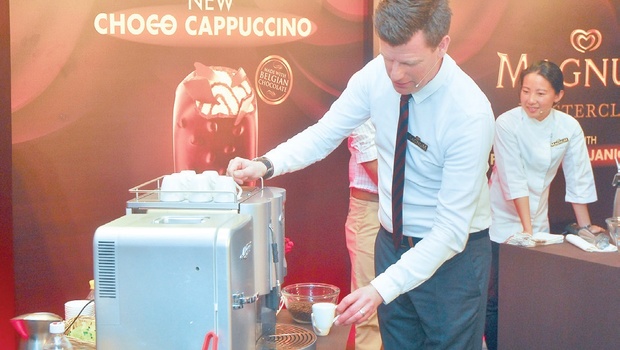
Complimenting what World Barista Champion Fritz Storm stands for, his hotel room almost seems perfumed with coffee. On the bed, while the rest of the suitcase sits unpacked, a giant packet of coffee powder sits neatly opened. “This coffee powder is from Guatemala, and freshly roasted. I wanted to de-gas it a bit before I can use it,” says the coffee expert and barista trainer, who was in the city for the launch of the new Magnum Ice Cream flavour that blends coffee with chocolate. Fritz, along with pastry chef Janice Wong, demonstrated creative ways of pairing the two ingredients for desserts and drinks, as part of the launch on Tuesday evening.

“I chose the coffee from Guatemala for the demo because it has a lot of chocolate flavour in it during the finish, besides the fruity taste. There is some acidity in the beginning, which leaves an interesting taste in the mouth,” says Fritz, who has travelled around the world, studying the coffee flavours of different countries. According to him, South African coffee tastes fruity and sweet, and in Brazil, which is the largest producer of coffee, the drink though doesn’t taste very special, has a wonderful base.

What about the local filter coffee? “I haven’t had the time to try it in Chennai, but I tried filter coffee from a street side shop in Hyderabad, and I found it nice. But it was extremely sweet, sweeter than ice cream,” he says with a laugh. “However, I don’t think there is anything like the best coffee in the world. It is a combination of the beverage — how it tastes and how it looks — and how the barista is serving it. He or she needs to have the personality, and say the right things while serving the drink,” he adds.

It’s likely those are the exact points that earned him the title of World Barista Champion in 2002. “It was all coincidence. I am an accountant by profession and I didn’t even drink coffee till my 20s. I guess as a young guy I just wanted to do something fun, so I started as a bartender. That’s when I drank Cappuccino for the first time in 1994,” recalls Fritz, who, today, cannot start his morning without a Cappuccino, or carry on with the rest of the day without his share of Expressos. “In a few years, I started hearing about various competitions of making coffee. In the first World Barista Championship held in 2000, my colleague competed, I tried in 2002 and won,” he adds with a smile.

Ever since then, Fritz has been training baristas for the Championship, and experimenting with coffee as an ingredient. He tells us about his invention — Almond Cappuccino, reminiscent of the lazy mornings he spent back home in Denmark dipping almond biscottis in coffee. “I thought, why not make a new flavour with it? So we soaked the biscuits for six to 12 hours and then made a Cappuccino,” says Fritz. Recently, he, along with Janice, made what they named Mocha Margarita. “We added chocolate, cinnamon, expresso, milk and caramel sauce with mocha to create something unique. And since we found only a Margarita glass to pour it, we named it Mocha Margarita!” he shares, with evident enthusiasm.

According to him, though the coffee industry is much older than wine industry, it is only now that we are slowly beginning to understand coffee. “People can differentiate the taste of different wines, and they know the basics, like white wine does not go with fish and so on. But it is only now that people are able to recognise the flavours of different coffees. Soon, they should be able to make a preference, in the sense of what brewing they like to have with a dessert, what would suit an ice cream, chocolate or cake. We haven’t reached there yet, but we are catching up really fast,” he says.

source: http://www.newindianexpress.com / The New Indian Express / Home> Cities> Chennai / by Naveena Vijayan / February 26th, 2015

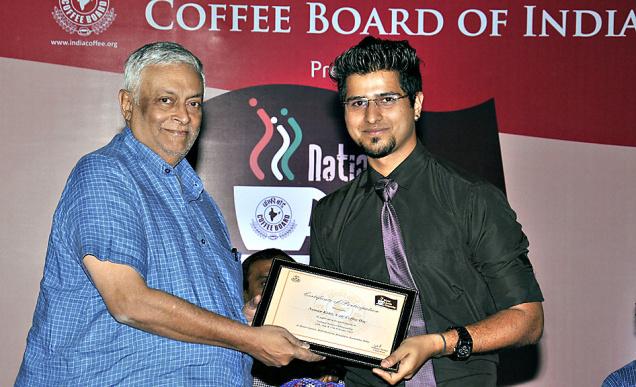
Noida-based barista brews his way to history

Naman Kohli claiming the National Barista Championship in Bengaluru on Friday.

A lot can happen over coffee and a 22-year-old Noida-based barista proved this as he brewed history on Friday. Cafe Coffee Day, Noida’s barista Naman Kohli became the youngest winner in the two-year history of the National Barista Championship, the finals of which were held here on Friday.

Naman’s signature brew ‘Pixel’, named after his pet dog, proved to be a gustatory delight, not only for the judges, but also veteran barista and World Barista Championship winner Vikram Khurana, who said, “The Pixel brew was nothing short of the magical brews of Rome and Milan, and could very well win the World Championship.”

Naman’s joys were compounded when Anil Kumar, Vice-Chairman, Coffee Board of India, announced that for the first time, the winner would be sent abroad to represent the country in the World Barista Championship. “I finally need to get a passport made,” said an ecstatic Naman.

The national championship commenced with the first round being held in New Delhi and Bengaluru, in which 12 of more than 55 baristas from the north and south regions were shortlisted to go neck-to-neck in the final round in the city. Each barista was given 15 minutes to brew four espressos, four cappuccinos and four signature brews of their choice.

source: http://www.thehindu.com / The Hindu / Home> News> Cities> Bengaluru / by Staff Reporter / Bengaluru – February 28th, 2015

MRC Nagar deal a shot in the arm for Tata Coffee

Chennai :

As the property earns a rental of 65 per sq ft per month, the annual returns on investment for Tata Coffee will be 10.8%, higher than the industry average of 10% returns for Grade A commercial space.

Sivasankaran is now under bankruptcy protection by an order of the Seychelles Supreme Court. Andhra Bank took possession of property after Siva Industries defaulted payment of Rs 42.7 crore loans.

“The company has invested in a commercial property consisting of four floors of office space in MRC Nagar in Chennai for a consideration of approximately Rs 65 crore through public auction,” Tata Coffee said. Sivasankaran could not be reached for comments.

Sivasankaran’s financial problems began when he was supposedly coerced into selling Aircel to Maxis by former Union telecom minister Dayanidhi Maran. His re-entry into the telecom sector through S Tel, and his investments in renewable energy and shipping backfired.

The serial entrepreneur applied for bankruptcy protection in a Seychelles court to ward off a claim by his Bahrain-based telecom partner Batelco, which won a court decree for its $212million claim on its investment in S Tel, for which Sivasankaran had stood personal guarantee. S Tel’s telecom licences in India were cancelled along with 121 other licences by the Supreme Court in the 2G case.

Since then, entities that were part of Siva Group have started selling or monetizing the group’s assets. His group headquarters–Sterling Towers on Anna Salai-has been sold.

Last month, Sivasankaran, agreed to sell Firhaven Estate, his 1.9 lakh sqft residence in MRC Nagar, to unknown buyers for nearly Rs 400 crore.

source: http://www.timesofindia.indiatimes.com / The Times of India / Home> Business> India Business / TNN / February 27th, 2015

Indian coffee turns costly for the world, exports down 20%

India’s coffee exports have declined 20% since the beginning of 2015 as high prices have made shipments uncompetitive in the global market.

The Arabica coffee shipments plummeted by as much as 50%, pulling down the overall coffee exports of India.

Widespread rains in the largest Arabica-producing nation Brazil have led to a 14% decline in global Arabica prices in the past two months.

The May futures at ICE New York closed at $1.48 per pound on Monday , down 3% from the previous close.

“At the current domestic prices, the exports are not viable. Arabica from Brazil and other origins is much cheaper,” said MP Devaiah, general manager of Allanasons, a major exporter.

The raw coffee prices of Arabi ca parchment in India are about . 10,300 per 50 kg.` Between January 1 and February 23, the Arabica parchment exports fell to 6,617 tonne, down by as much as 50% compared to the year-ago period. The Robusta cherry , which accounts for a major share of coffee exports from India, fell 15% to 16,012 tonne during the period of January-February .

CoffeeCupKF25feb2015

According to local growers, the Arabica crop has been lower than expected due to poor weather conditions and the attack of white stem borer pest. “The harvest is over and the output should be between 55,000 and 60,000 tonne,” said K Kurian, chairman of Karnataka Planters’ Association.

The growers earlier predicted 65,000 to 70,000 tonne of Arabica while the estimate of Coffee Board was much higher at 1,05,000 tonne.

But exporters said the drop in production is not as much as it is made out to be.

“The growers are holding the stock in anticipation of better prices. As a result, exporters are unable to enter new commitments,” said Ramesh Rajah, president of Coffee Exporters’ Association of India.

However, he added since the Robusta crop is predicted to be good, the current decline in exports could be made good in the next quarter.

Coffee Board’s forecast for Robusta is 2.39 lakh tonne and the growers’ estimate is only slightly less.

The production in Vietnam, the top producer of Robusta, is expected to be around 29 million bags (each bag of 60 kg), slightly lower than in the previous year.Therefore, Vietnam may not be able to lower the prices of what it has to offer globally.

source: http://www.economictimes.indiatimes.com / The Times of India / ET Home> Industry> Cons. Products> Food / by KrishnaKumar PK / TNN / February 25th, 2015

Instant coffee definitely a Kiwi brew

http://www.3news.co.nz/nznews/instant-coffee-definitely-a-kiwi-brew-2015011518#axzz3ThL3V3wq

As the debate over who invented the flat white rumbles on, it’s a good time to highlight that instant coffee was actually invented in Invercargill.

For over a decade a Japanese scientist was credited with the invention, but just recently it’s been revealed that Southland spice and coffee merchant David Strang was actually the first to develop a powdered form of coffee in the 1800s.

“His claim to fame is the invention of instant coffee, an invention he patented in 1890, and that’s the earliest recorded patent for instant coffee in the world,” says Tracey Wedge of Southland Museum.

But Mr Strang’s role in coffee history was basically forgotten, until memories were reignited a few years ago when the Historic Places Trust registered his son James’ house.

Since then the Southland Museum has built an exhibition around Strang memorabilia, including some very old tins of some of the first ever instant soluble powdered coffee.

“It revolutionised coffee consumption around the world. Instant coffee became a household product,” says Ms Wedge.

Mr Strang is believed to have invented the powder by blowing hot, dry air over liquid coffee until it reduced.

While he admits Mr Strang’s invention was ground-breaking, coffee connoisseur Arjun Haszard doubts it would have tasted any good.

“By using heat on that coffee you’d see a lot of flavour deterioration, a lot of over-extraction and very horrible flavours coming out,” says Mr Haszard.

But even so, Invercargill locals were surprised to hear their town had a new claim to fame.

“Wow, there you go, you learn something new every day, don’t you,” said one local.
“It’s very clever, isn’t it,” said another.

While Southlanders have produced a handful of inventions, instant coffee is the only one to have gone completely global.

3 News
source: http://www.3news.co.nz / 3 News / by Kloe Palmer, Reporter / Thursday – January 15th, 2015

Coffee Board to conduct National Barista Championship in Bangalore on Feb. 27

12 finalists to be selected from regional competitions; National champion to represent India at WBC at Seattle in April 2015

Coffee Board of India will organise the National Barista Championship (NBC) in Bangalore on February 27. Twelve finalists selected from the preliminary rounds from regional championships will compete for NBC. For the first time, Coffee Board of India organised two regional competitions for selection of finalists for the NBC. The first preliminary round of the NBC 2015 was conducted on February 12 and 13 at Delhi Institute of Hotel Management in New Delhi for participants from North and Western India. From 20 contestants, six were shortlisted for the NBC 2015 by jury. The preliminary round for the South and Eastern region will be held on 25th and 26th in Bangalore, one day prior to the National Barista Championship. The national champion will represent India at the World Barista Championship (WBC) happening at Seattle on April 9, 2015.

Coffee Board of India has taken the onus of organizing the NBC since last year. Prior to that the annual event was organised by Speciality Coffee Association of India (SCAI). India has been sending representative to the global event since 2003. Speaking on the occasion, Dr VR Gudde Gowda, Dy Director, Coffee Board of India said that the objective of the competition was to promote coffee culture and also to identify technically skilled Baristas. The competitions are conducted as per the guidelines and rules and regulations of WBC.

The participating Baristas has to prepare four espressos, four cappuccinos and four signature drinks within 15 minutes to four savoury judges. The competitions are judged upon four criteria – taste evaluation, beverage presentation, barista technique and personal presentation.

source: http://www.hospitalitybizindia.com / Hospitality Biz India / Home> News Track / by HBI Staff, New Delhi / Monday – February 16th, 2015