Category Archives: Coffee News

Coffee Board projects record crop next season

ChartKF13jul2014

Growers sceptical due to prolonged dry period, borer menace

Chennai :
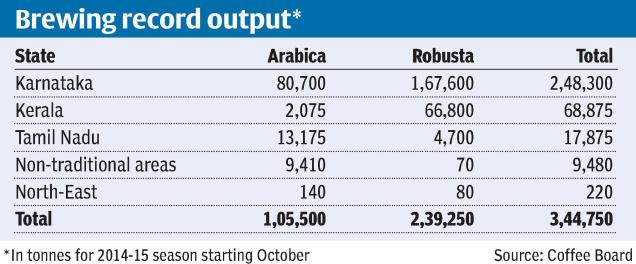
The Coffee Board has projected a record crop of 3.44 lakh tonnes (lt) for the new season beginning October, but growers are sceptical about the estimates.

According to the Coffee Board’s post-blossom estimate, Arabica output will be 1.05 lt and Robusta 2.34 lt. (The estimate of crop made after the coffee plant blossoms and spikes develop on the plant is the post-blossom estimate.)

This is against a revised estimate of 3.04 lt this season ending September (1.02 lt Arabica and 2.02 lt Robusta).

“I think this output could be difficult to achieve, especially with regard to Arabica. This is because even in best-maintained plantations, there is heavy infestation of the white stem borer,” said Anil K Bhandari, former president of the United Planters’ Association of Southern India, and an exporter.

Other opinions
“Such levels of production cannot come from the original area under coffee in the country. This year, most planters are complaining that their output will be down by at least 40 per cent as far as Arabica is concerned. In my own estates, the output will drop to 10 tonnes from 40 tonnes,” said Bose Mandanna, former Coffee Board Vice-Chairman and a planter in Kodagu, Karnataka.

Due to a prolonged dry season, the menace of the white stem borer, which has been wreaking havoc in coffee plantations over the past decade, is a serious threat this year.

“Maybe, the estimate put out by the Coffee Board was the situation prevalent during blossom. After that, there has been a tremendous loss in the estates due to the borer menace,” said Bhandari.

This year, coffee estates are reported to have received timely showers for blossoming of the coffee flower. Follow-up showers, required for growth of the plant, were also good before the borer menace spread panic.

According to the Board estimate, Karnataka will contribute 72 per cent of the coffee production next season, up from nearly 70 per cent this season. Output in Karnataka will be 2.48 lt (80,700 tonnes Arabica and 1.67 lt robusta) against 2.11 lt this season (78,440 tonnes Arabica and 1.32 lt Robusta).

Kodagu’s contribution will be 43 per cent with 20,150 tonnes of Arabica and 1.13 lt of Robusta (21,040 tonnes Arabica and 90,820 tonnes of Robusta). Last year, its contribution to the country’s coffee production was 36 per cent.

Fears of drought

“It is almost like a drought situation in Kodagu. It is unlikely that the district will provide so much coffee this year,” Mandanna said.

“It is likely that the Coffee Board could revise the estimate downwards after taking into account the effect of monsoon and other things. It should carry out another estimate later and put it out during October-November. That could perhaps reflect a correct picture,” Bhandari said.

According to plantation industry sources, for the last few years, the Coffee Board has been putting out a higher projection of the crop in its post-blossom estimate.

“This has been happening for sometime now. They come out with a higher figure and then revise it. Who gains from such estimates,?” a source wondered.

Last year, the Coffee Board initially estimated the crop at a record 3.47 lakh tonnes before pegging it finally at 3.04 lakh tonnes.

This season’s production estimate was lowered after heavy rains in the growing areas led to wet feet in coffee plants resulting in the roots growth freezing. This led to coffee berries falling off the plant, leading to loss.

“The Board has to revise its methodology in estimating the crop. Then, perhaps it could be nearer to reality,” the source said.

source: http://ww.thehindubusinessline.com / Business Line / Home> Markets> Commodities / by MR Subramani / Chennai – July 08th, 2014

Pera Museum invites art lovers for a ‘Coffee Break’

The Pera Museum in İstanbul has rearranged part of its permanent collection for the summer season, offering its visitors a fresh exhibition that focuses on Turkish coffee rituals and ceremonies from its vast collection of Kütahya ceramics and tiles.

“Coffee Break: The Adventure of Coffee in Kütahya Tiles and Ceramics” features 105 pieces from the museum’s Kütahya Tiles and Ceramics Collection. The collection dates back to the 1980s and originally consisted of over 800 artifacts representing various periods. A majority of the items in the collection are from the period between the 18th and 20th centuries.

The renewed concept of the show not only looks at routines and rituals centered on coffee, but also offers insight into Ottoman coffeehouses, which constituted an important element of the public sphere in Ottoman daily life. After the 16th century, coffeehouses increasingly functioned like the “social media” spaces of their times.

The Pera Museum is located on Meşrutiyet Caddesi, No. 65, in Tepebaşı. The museum is open 10 a.m.-7 p.m. Tuesday through Saturday and 12 p.m.-6 p.m. on Sundays. Admission is free from 6 p.m. to 10 p.m. every Friday. İstanbul Today’s Zaman .

source: http://www.todayszaman.com / Today’s Zaman / Home / Istanbul – Sunday, June 29th, 2014

Coffee Board to offer coffee courses to increase local coffee demand

SUMMARY
Indian Coffee Board is set to launch a program to train people to be coffee makers or baristas.

______________________________________________________________________________________________

Indian Coffee Board is set to launch a program to train people to be coffee makers or baristas. (Thinkstock)

In an effort to make coffee available and more popular across the country, especially in tea dominated northern India, the Indian Coffee Board is set to launch a program to train people around the country to be coffee makers or baristas. The ‘Barista training program’ of the Indian Coffee Board, involving a specially crafted syllabus will guide aspirants interested in coffee on the various aspects of coffee making, and will be launched in July according to the chairman of the Coffee Board Jawaid Akhtar.

Trainees will study the different types of coffee seeds, the right temperatures for roasting them, the best ways of grinding, and the right chemistry for a good coffee, says Akhtar who is also Chairman of the International Coffee Council. Trainees will be taken on a study tour to research centers of the coffee board, its coffee estates and will be given an internship opening at coffee chains. When they graduate from the program the coffee board with certify its trainees as qualified coffee makers, the Coffee Board chief said.

“Youngsters, especially those who have stayed abroad and have imbibed the global work culture are drawn to coffee in a significant way. Many see coffee making as a trendy thing to do. With coffee being affordable we want to create more interest in coffee making at home,” Akhtar said. In offering coffee courses for amateurs the coffee board is following in the footsteps of similar initiatives seen in emerging markets like China, Brazil, Russia and South Korea where coffee drinking has received huge impetus in recent times including home brewing.

The Indian Coffee Board’s Barista training program will allow aspiring coffee makers to train at its headquarters in Bangalore or the coffee board will depute its staff to conduct group classes in any part of the country, the head of quality control at the coffee board K Basavaraj said.
While the fee for the four-week training program has not been fixed the coffee board claims that it will run the program on a not-for-profit basis aimed purely at skill development and employment generation. “A similar program in a private institution will cost nothing less than a lakh,” a member of the coffee board faculty for the program said

“Indian coffee beans like Robusta and Arabica have earned fame the world over but very little is known about it in the Indian market. Consumers in cities like Mumbai, Delhi, Chandigarh and other parts.

source: http://www.financialexpress.com / The Financial Express / Home> Commodities / by Harsha Raj Gatty, Bangalore / June 17th, 2014

Coffee connoisseurs help drive Benugo sales

The hunt for the perfect cup of coffee drove sales at Benugo, the upmarket delicatessen that serves visitors to London’s V&A museum, the BFI Southbank and Edinburgh Castle in Scotland, 24 per cent higher in the year to December.

The company, which started as a bar in the capital’s fashionable Clerkenwell district in 1998, has 15 cafés in London railway stations and high streets in addition to its concessions in museums, galleries and historic buildings.

It has plans to expand further, opening six more of its New York-style delicatessens on the high street each year in London, Edinburgh and Oxford. It is also bidding for more museum and art gallery contracts, looking to sell its sandwiches throughout the UK and Europe.

Alastair Storey, chief executive and chairman of Westbury Street Holdings, the parent company of Benugo, said that the business was doing well from rare, “single-sourced bespoke coffee blends” in an increasingly competitive café market. The company’s emphasis on locally sourced food has also helped, he added.

“We’re seeing people looking for a simpler, less complicated dining experience. Five years ago 25 per cent of sales were sandwiches, and 15 per cent were salads and wraps,” he said. “Now that has completely reversed. People are wanting to eat less bread; fewer carbohydrates.”

The growth helped WSH to hire at its fastest rate since it was formed in 2000. The company created 1,800 new jobs, taking total employment at the company, which runs an extensive range of training and apprenticeship schemes, to nearly 14,400 staff.

Sales at Benugo grew from £56.5m to £70m in the year to December. WSH also owns catering brands Baxter Storey, Caterlink, Holroyd Howe and Portico. This week the company will report that operating profits rose 36 per cent from £18.2m to £24.6m on sales that grew 15 per cent to £530m in the year ended 27 December. Pre-tax profits fell from £6.2m to £2m due to an exceptional charge of £15m as a result of a debt restructuring in November.

WSH is the third biggest player by sales in the British catering league table, behind Compass and Sodexo.

Caterlink, its state schools catering division, which accounts for 12.5 per cent of WSH revenues, saw sales rise 20 per cent in the past year, as take-up of school meals became more popular amid a renewed focus on health.

The British government is committed to spending £600m a year on free school meals from September – increasing the market from 3.5m school meals a day to 5m a day – and Mr Storey said he expected to “mop up” some of this growth in business.

Sales at its main Baxter Storey contract catering brand, which accounts for nearly three-fifths of sales grew 12 per cent underpinned by 44 new client wins, including Reed Smith, Shell UK, Verizon and BAE Systems. But Mr Storey added that the corporate hospitality market had not yet recovered to pre-recession levels.

“It’s interesting just how severe the reduction in corporate hospitality has been,” he said. “It’s improved but its still not back to precession levels.”

Mr Storey set up the company in 2000 after 25 years at Sutcliffe Catering, later part of Granada Food Services. Since going it alone, he has expanded his business rapidly, acquiring independent rivals including Halliday Catering, BaxterSmith and Holroyd Howe.

http://www.ft.com/cms/s/0/d9548a5c-f173-11e3-9fb0-00144feabdc0.html#ixzz36WQGfjgB

http://www.ft.com/cms/s/0/d9548a5c-f173-11e3-9fb0-00144feabdc0.html#axzz36WQBxLCi

source: http://www.ft.com / Financial Times / Home / ft.com> Companies> Retail & Consumer> Food & Beverage / by Gill Plimmer / June 11th, 2014

How Starbucks and Cafe Coffee Day are squaring up for control of India’s coffee retailing market

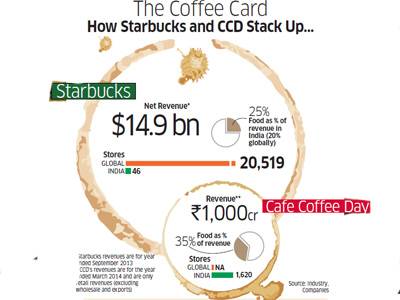
It is 5 pm on a weekday evening and the line at Starbucks in Indiabulls Finance Centre, a swish business complex in south Mumbai, is teeming with executives looking for their caffeine fix. With ties loosened and jackets casually slung over their arms, these men and women from the financial services, consumer goods and media firms housed in the towers of the complex are an ideal target audience for a range of beverages and snacks sold by Starbucks, the world’s largest coffee retailer; in 20 months of its inception in India — via a 50-50 joint venture with Tata Global Beverages — Starbucks has set up 46 such stores nationwide and has plans for dozens more.

Cut to Ulundurpet, far removed from the urbane chatter at Indiabulls. This town of some 400,000 people in southern Tamil Nadu is best known for being halfway between Chennai and Tiruchirappalli, an industrial and temple town some 320 km to the south. If Starbucks has embarked on its fastest-ever expansion globally in India, the homegrown leader Cafe Coffee Day (CCD) isn’t easily intimidated. India’s largest coffee retailer has launched some 150 stores in the past 12 months and plans a similar number in the next year. What’s more, it isn’t sticking to one format. In a bid to firm up its position, CCD has launched formats for malls, highways, an upscale offering called Lounge and a single-origin coffee destination called Square.
The world’s largest chain and India’s No. 1 retailer are squaring up for control of the country’s coffee retailing market.

VG Siddhartha, the reticent founder of CCD, is all beans when he speaks to ET Magazine. “Our dream is to be among the top three retail coffee brands in the world,” he says. Already, CCD is present in some 200 towns across the country (it is often the first and only coffee retailer in many locations) and is aggressively expanding its footprint. “We hope to grow our retail business at about 20% in 2014-15 [and] we hope to do a revenue of Rs 1,200 crore from retail sales and another Rs 350 crore from the wholesale and export business this year.”

Siddhartha is firmly stepping on the gas with CCD. “We want to have around 2,500 Cafe and Express outlets in three years…we will set them up wherever there are opportunities, including at educational institutions, hospitals, expressways and high streets.”


Bean There, Done That

Siddhartha, who pioneered the bean-to-cup concept in the coffee industry — his Amalgamated Bean Coffee owns the plantations where coffee is grown and processed and later served at CCD outlets — is now set to take his next big step. According to reports, CCD has initiated plans for an initial public offering, which may value the chain at $1 billion and provide PE investors such as KKR an exit. CCD and its investors declined comment on the possibility of such an IPO.

A war chest from such an IPO will help Siddhartha finance what is quickly evolving into a two-horse race for India’s coffee cafe mart. India’s No. 1 chain, which has spent the past two decades building up its business — and has been predominately unchallenged — will face up to its strongest challenge yet. The $15-billion Starbucks is preparing to raid its citadel, digging its heels in for a long, bruising brawl.
Coffecard01KF09jun2014


Coffee, Anyone?

India is predominately a nation of tea drinkers, with most chains struggling to keep business afloat. Siddhartha opened the first CCD in 1996 on Bangalore’s Brigade Road, initially to serve pricey cups of coffee and let customers experience internet, then a novelty. While he opened the first store based on visiting a similar store in Singapore, the internet novelty wore off and CCD gradually became a beverage and food retailer.

Over the past two decades, CCD and other chains have been trying to persuade more people to visit their outlets and drink coffee. For all the coffee drinking claims, India remains a relative lightweight. Scandinavians throw back, by far, the most amounts of coffee and, across the world, several other countries such as the US and China swill vastly more coffee than India (see A Tea Country Still).

Since inception, CCD (and several other chains) have scaled up the coffee drinking experience from crowded non-airconditioned cafes to far more luxurious outlets, offering clean cutlery, a refined ambience and, increasingly, a growing assortment of food. Indians have willingly signed up, with industry estimates pegging this segment’s growth at about 20% annually.

The advent of CCD and later a plethora of chains targeting this free-spending consumer catalyzed coffee sales. “Domestic consumption of coffee, which was almost stagnant in the 1980s and 1990s, picked up an impressive pace in the past 7-8 years,” says Jawaid Akhtar, chairman, Coffee Board. “We estimate the domestic consumption at about 115,000 metric tonnes a year now which is growing at about 5% a year…driven largely by consumption through branded coffee chains.”

CCD and Starbucks are both wrestling for a share of this fast-growing market — and elbowing out the strugglers in their slugfest.


Risky Business

CCD’s Siddhartha will be the first to admit that running a cafe chain can be a bruising business. For starters, real estate costs have hobbled and humbled many of CCD’s rivals, who’ve struggled to make costly stores in central districts viable.

According to industry estimates, rentals can account for 15-25% of the cost of running a cafe chain. Then, there’s the investment in making a store appealing to customers with its interiors, finding people to run them and building a food and beverage menu that’s hip enough to keep 18-24-year-olds — the target market for coffee chains — coming back for more. CCD has tried to find a way around this problem by entering into a revenue-sharing deal, paying 10-20% of a unit’s proceeds as a fee. “Store location is a prime factor to consider for these chains,” says Reteesh Shukla, associate director, food and agriculture, with Technopak, a business consultancy. “Retail space is becoming very expensive, but you need to balance the ever-increasing costs of this prime real estate by being in [relatively less expensive] areas frequented by the youth.”

CCD has been successful in India because of its beanto-cup business strategy, which gives it control over bean production and processing and greater efficiency from its back-end set up. While Starbucks does have similar strengths thanks to its Tata tie-up, industry watchers say its relative lack of size in India means it’s at a disadvantage in squeezing out similar economies of scale. Opening a new store isn’t just about finding a good location and dressing it up for a brand-conscious a u d i -ence. Instead coffee chains need to figure out a tricky supply chain — how to get food and beverage to these outlets quickly, while keeping quality high.

The others, who don’t have this backward linkage, have predictably struggled.

While the opportunity may be tempting, food and beverage outlets are dealing with a soft market, where consumers are cutting down on how often they eat out and reducing how much they order when they do. For cafes such as CCD or Starbucks, this is a blessing in disguise — consumers are reducing their spend on full-scale restaurant meals and instead scaling it down to a coffee and a snack.

Starbucks’ Advent

Since he started his coffee chain, Siddhartha is facing up to perhaps his biggest challenge. Starbucks, which opened its first store in 1971 in Seattle’s Pike Market, today operates 20,519 stores globally. In the US, the chain has become a byword for a quick, upscale cuppa (not just coffee, but increasingly tea too, with Teavana Oprah Chai launched with talk show host Oprah Winfrey), with Alist celebs and executives all having their personal favourites. Starbucks has attracted thousands of loyal customers to its My Starbucks loyalty programme and has even worked with tech start-up Square to pilot cashless transactions at its stores.

While Starbucks has till recently focused on its home market, it has changed tack in the past few years. For example, it announced ambitious plans to scale up its presence in China — it will open 700-odd stores this year — even as it looked to manage tough economic headwinds. In October 2012, the firm announced a JV with the Tata Group to launch some 50 stores in India. While Starbucks thought of initially going it alone in India (foreign direct investments in single brand retailing are kosher) it decided to lean on Tata Global Beverages’ experience in the coffee industry supply chain to give it additional leverage here.

Expanding faster in China and then India is financially prudent for Starbucks. Starbucks’ operating margin for the second quarter of financial year 2014 (ended March) was 32.8% for the China Asia-Pacific segment, 21.6% for the Americas and 5.7% for Europe, the Middle East and Africa.

While CCD had to build its brand from scratch in India, Starbucks hopes to leverage a globally familiar label with its target audience. When its first store opened in each city, winding queues were formed well before opening time. Familiar with its offerings in tall, grande and venti sizes, thanks to consumers who’d travelled overseas, either in real life or virtually, Starbucks’ India business got off to a rousing start.

Chinese Inspiration
ChineseKF19jun2014

Starbucks has shown some gumption going after opportunities overseas. For example, it has made a splash in the Chinese market, says Elizabeth Friend, an analyst with Euromonitor, a research and analysis firm. “Starbucks has done very well in a number of emerging markets…much of this has had to do with the brand’s very strong global reputation, which helped it to gain more immediate traction than other lesser-known chains,” she says.

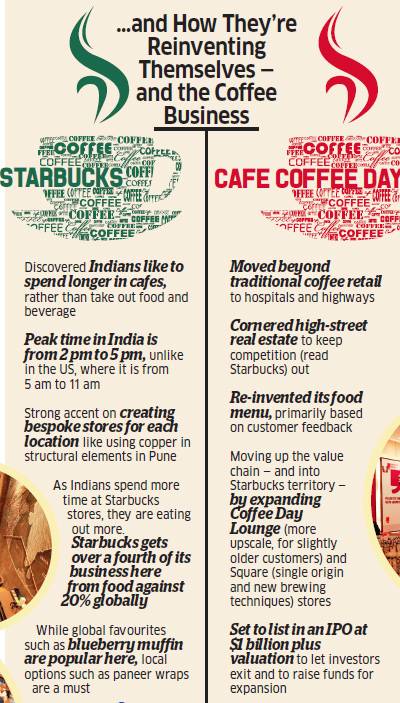
“They’ve also done a really great job tailoring their brand — through store design, menu innovation and even learning how local stores are operated — to best suit each individual market.” In China, this has included leaning toward larger store footprints that offer space to relax with coffee in the afternoon. The addition of beverages such as the red-bean
frapuccino and a broader tea-based menu have helped Starbucks make strong inroads into the Chinese market, says Friend.

Starbucks’ rise in China may provide many lessons for its India business. In a large country Starbucks has had to localize its menu to keep customers coming in — something it has done quickly in India too, with dishes such as chicken tikka panini. Starbucks had cornered over two-thirds of the coffee cafe market in China until 2010, estimates Euromonitor, even if aggressive domestic rivals have more recently cut its market share to 60%.

Friend of Euromonitor says Starbucks has been able to replicate some of this success in India, too. “Some of India’s new outlet launches have been among Starbucks’ most successful in its history,” she claims. “Starbucks has been steadily gaining on local leader Cafe Coffee Day, though the chain will continue to pose a significant threat.”

Slow Brew

Starting with its first store in Elphinstone Building in south Mumbai — the Tata’s iconic Bombay House headquarters is just a stone’s throw away — Starbucks has built its business steadily in India. In fact, the chain is behind its initial target of 50 stores — it has 46 operational currently — but has expanded to the National Capital Region, Bangalore and Pune as it seeks to take on CCD.

According to analysts, Starbucks has firmed up its presence as a premium coffee retailer, with some malls even using it as a carrot to attract free-spending consumers to its premises. “Having a Starbucks outlet is a guarantee to attract upscale customers to a mall and this in turn helps convince international labels to rent space there,” says Anand Sundaram, CEO of PPZ, a mall management firm which operates malls nationwide; RCity in Mumbai’s Ghatkopar suburb, for instance, houses a Starbucks store.

A 34-year-old Tata Administrative Services graduate is piloting Starbucks’ business in India. Avani Davda went from being an executive assistant to Tata Group veteran Krishna Kumar to helming the joint venture with Starbucks for India. Having tasted her first Starbucks Coffee in Seattle in 2011 (she counts Sumatra and India Estate Blends as her favourites), Davda thinks the chain has plenty of scope for growth. “India is one of the most exciting markets in the world…we believe we have a unique opportunity to deliver an unparalleled coffeehouse experience to Indian consumers,” she says.

“We firmly believe in our ability to build and grow the Starbucks brand in India and are confident in the opportunities that the Indian market offers for it to become one of the top five markets for Starbucks globally.”

Heady Growth India provides a fertile market opportunity for CCD and Starbucks. According to company executives and analysts, there is plenty of opportunity for growth. Euromonitor says the Indian coffee cafe market will grow from Rs 1,683 crore in 2012 to Rs 2,276 core in 2017.

“Growth of cafes in India is driven by many factors, including favourable demographics, rising income levels, graduation from mid-sized towns [to large metros] and the advent of global chains,” says Sunitha Barlota, a research analyst at Euromonitor International. “Cafes in India are considered a perfect place to socialize among college goers and working professionals.”

Others such as Asitava Sen, head of the food, agriculture research and advisory team at Rabobank Group in India, believe there is plenty of headroom for growth in this space, with cafes just starting out on a sharp growth curve. Sen estimates that there are around 2,000 coffee cafes across India and there is room for 5,000 or more nationwide. “The Indian market

is very different from the West … here a visit to a cafe is more a social occasion and less a quick visit…the opportunity for cafe owners is to try and get a greater share of wallet from these consumers,” he adds.

Starbucks has discovered over the past few months how different it is doing business in India. According to Manmeet Vohra, the Indian operation’s marketing and category chief, they discovered that peak hours in India were 2 pm to 6 pm (compared to 5 am to 11 am in the US, for example) and takeout orders accounted for barely a fifth of their business in India (compared to 80% in the US).

What’s more, as customers spend time in the cafes, they needed to design them differently. So the cookie cutter design gave way to customized spaces in each city — for example its store in Pune uses copper elements, in a nod to the heritage of the city. “After office and home, we want to be the firm favourite as a third place to hang out,” Vohra adds.

According to brand consultant Harish Bijoor, consumers have made their preferences clear — Starbucks is the more upscale hangout, while CCD is a budget option. “Both these brands have strongly defined identities and consumers identify with them,” says Bijoor, who worked for eight years at Tata Coffee (a subsidiary of Tata Global) between 1993 and 2001. By his estimates there are currently 2,350 cafes, while the potential is for as many as 6,440 such outlets.

Success Potion

According to analysts such as Euromonitor’s Barlota, there are three or four key ingredients that determine the success of a coffee cafe. Other than location — CCD’s success to date is determined by being located close to colleges, business complexes, high streets and malls — pricing can be a make or break factor. This is particularly crucial at the lower end of the market where budget-conscious buyers are wary of shifting from cheap restaurants (sometimes called Darshinis) to a CCD or Starbucks. Those that do make the shift and pay the premium can be demanding on quality of service and product.

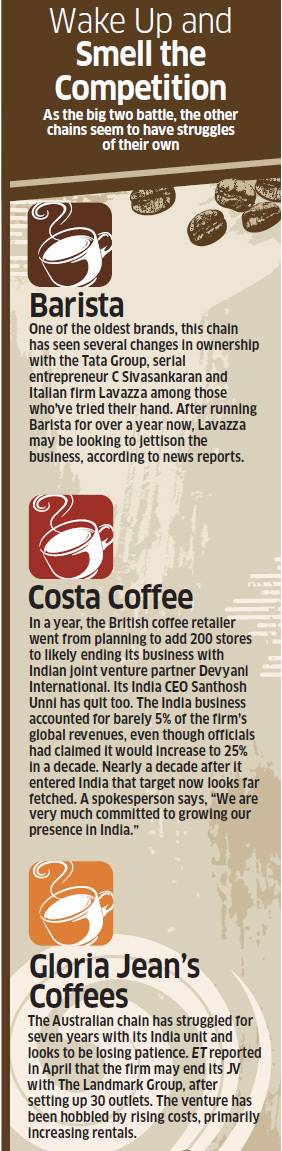
As consumers make their choices known, there seem to be strong indications that India’s coffee cafe market is going to consolidate. According to analysts, while CCD may be the mass market leader, Starbucks has occupied a strong position in the premium space, with plans to slowly but surely expand its presence. This means others in the market, including Costa Coffee, Baritsa and Gloria Jean’s, will struggle to attract and retain loyal custo mers. As the market gets polarized, CCD and Starbucks are expected to soon dominate the coffee cafe sweepstakes.

Some of these signs of strife are already visible. For example, Barista, the second organized retail chain in India after CCD, is on the market for a third time . While Ravi Deol, the chain’s first CEO, was tipped as a leading takeover candidate, his interest has faded in the past few weeks. Deol couldn’t be reached for comment. Italian owner Lavazza also declined comment.

Then, Costa Coffee, brought into India by Devyani International, is the subject of much wrangling between partners. Devyani, which runs the India business for the likes of KFC and Pizza Hut, has struggled for years with the Costa Coffee business. Virag Joshi, the CEO of Devyani, wasn’t available on the phone and didn’t respond to an email seeking comment.

Costa Coffee, however, doesn’t seem to have given up on India. “Costa is the world’s second largest coffee shop brand and is growing rapidly in its domestic UK market and globally adding over 300 stores a year,” says Kate Manning, a spokesperson for the chain. “We are very much committed to growing our presence in India.” While Costa has some 120 stores in India, she declined to enumerate the firm’s future plans. Costa’s India head, Santhosh Unni, has recently quit.

Third, Gloria Jean’s is also dealing with its own dose of bitter beans, with its joint venture with The Landmark Group on the rocks. Both sides didn’t respond to emails seeking comments, but real estate analysts said the chain was scaling back its presence in costly high-street locations to salvage the business.

However, CCD’s Siddhartha isn’t getting distracted by the woes of the competition. “All foreign coffee brands are looking at the top 5% of the Indian market — i.e. high income group consumers,” he says. “But we are focusing on the dynamic youth population. Roughly 70% of Indians today are below 35, and our goal is to reach out to them.”

Focus Matters
CompetitionKF19jun2014Experts argue that as a scale player, CCD has been able to escape much of the tumult in the sector because it has focused on its core proposition of affordable coffee, with comfortable surroundings, and steered clear of trying to tinker too much with a winning formula.

This is not to say that it has stood still in an evolving market. CCD, for example, gets around 35% of its business from food — an area it only focused on in the past 12-18 months.

“What stands out about Siddh artha and CCD is their ability to make strategic changes in response to customer demand and competition — expanding the food offerings or rationalizing store count to sustain growth and profitability are great examples,” says Sanjay Nayar, MD and CEO of KKR India.

“There is a great opportunity for CCD to leverage its large network to drive growth in a new direction,” he adds. In March 2010, KKR invested $210 million in Coffee Day Resorts, the holding firm which includes the coffee retailing business.

Venu Madhav, who has been with CCD since day one and got promoted as chief executive over a month ago, says the coffee retailer is streets ahead of the competition in understanding the Indian consumers’ needs.

“Cafes are social hubs, where coffee and conversation play a key role in the success of an outlet,” he says. “India is a value-conscious market and we see ourselves in the affordable luxury category of coffee retail.”

Madhav is keen to expand the reasons consumers stroll into a CCD — not just for a relaxed cuppa but for breakfast, lunch and dinner, too. It’s no surprise that CCDs on many highways are popular rest stops and the chain is focused on expanding its presence in the space.

Brand Battles

CCD is acutely aware that it takes little for consumers to switch loyalties — however good the coffee may be. To try to keep pace, CCD’s interiors are periodically updated to prevent its ambience from looking dated and jaded. “The look of our stores changes completely every couple of years,” avers Madhav.

While CCD continues on its rapid expansion path, Starbucks isn’t rushing to keep pace. According to industry sources, Starbucks could add a dozen or more outlets in the next year in India and is looking to expand its presence in the cities it is present in and consider going to second-tier metros, too.

“Each market comes with its own set of opportunities and challenges and our guiding principle across all markets continues to remain the same: to inspire and nurture the human spirit — one person, one cup and one neighbourhood at a time,” says Davda. And in the process she’d be hoping Starbucks coffee becomes most Indians’ cup of tea.

source: http://www.articles.economictimes.indiatimes.com / The Economic Times / Home> Industry> Services> Retail / by Rahul Sachitananad & K R Balasubramanyam, ET Bureau / June 08th, 2014
Sarajevo art museum gets boost from Italian coffeemaker

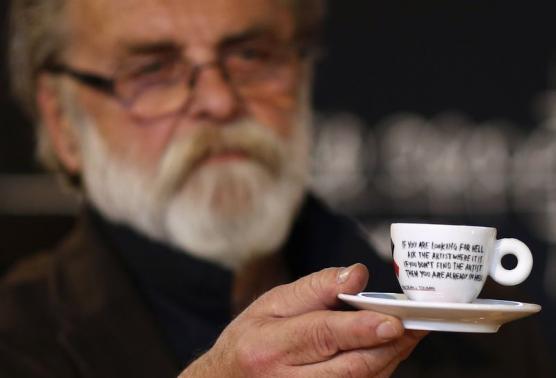
Sarajevo-born artist Dean Jokanovic Toumin, designer of a special edition illy coffee cup, holds up one of the cups, in the ARS AEVI museum of contemporary art in Sarajevo, June 4, 2014.  CREDIT: REUTERS/DADO RUVIC
Sarajevo-born artist Dean Jokanovic Toumin, designer of a special edition illy coffee cup, holds up one of the cups, in the ARS AEVI museum of contemporary art in Sarajevo, June 4, 2014.
CREDIT: REUTERS/DADO RUVIC

( Reuters) – It is hard finding a bright side to the museum scene in the Bosnian capital Sarajevo, where the Olympic Museum burned down during a 1992-95 siege by Serbian forces and the main national museum closed in 2012 for lack of funds.

But thanks to a grant from the Italian government and a plan by Italian coffeemaker illycaffe to sell designer coffee cups to support the project, there is hope for one man’s vision of creating a modern art museum for a city still suffering the aftershocks of the ethnic conflict of the 1990s.

“That night when the museum was burned down, a spontaneous idea emerged as a reaction to all those religious and ethnic divisions,” said Enver Hadziomerspahic, who directed the 1984 Sarajevo Winter Olympics opening and closing ceremonies.

The idea was “to invite world artists to form a collection of their own future museum of contemporary art which would become a symbol of a new Europe and an expression of international collective will”, he told Reuters in an interview.

Hadziomerspahic lobbied European museums and galleries to take part in the project even while the war, pitting Muslim Bosniaks against Orthodox Christian Serbs and marked by the longest siege in modern history, still raged in Bosnia.

Museums in Milan, Prato, Venice – all in Italy – and Ljubljana and Vienna became partners of his ARS AEVI collection. That helped persuade world-renowned artists such as Michelangelo Pistoletto, Marina Abramovic, Joseph Beuys and Janis Kounelis to donate works for a collection estimated to be worth around 20 million euros ($27 million).

Twenty-two years on, the collection of around 150 works is still homeless because of political bickering in the Balkan country, where rival ethnic elites cannot agree on any nation-wide cultural project.

But a temporary ARS AEVI exhibition depot was opened in Sarajevo in February after the Italian government contributed $1 million through UNESCO.

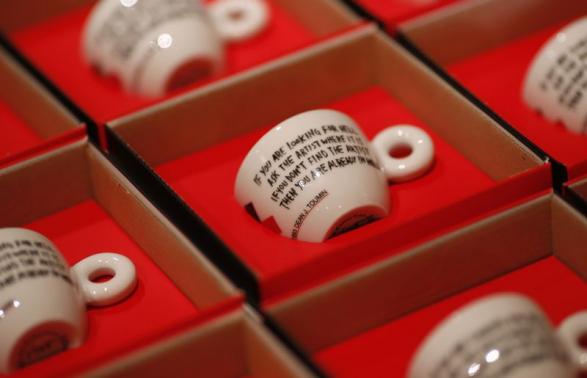
Special edition illy coffee cups are pictured in the ARS AEVI museum of contemporary art in Sarajevo June 4, 2014.  CREDIT: REUTERS/DADO RUVIC
Special edition illy coffee cups are pictured in the ARS AEVI museum of contemporary art in Sarajevo June 4, 2014.
CREDIT: REUTERS/DADO RUVIC

LIMITED EDITION CUPS

Last Thursday, Trieste-based illycaffe launched a limited edition of its art cups designed for ARS AEVI by Sarajevo-born artist Dean Jokanovic Toumin. The unique lines of cups, designed by top contemporary artists, have been sold around the world.

“The idea is magical, we think we can be the catalyst to bring other people,” Giacomo Biviano, illycaffe’s deputy general manager, told Reuters. “Through this cup we can let other countries know there is this museum in Sarajevo.”

A quotation written on the cups from an 18th century writer, Avigdor Pawsner, could very well apply to artists and cultural institutions in modern-day Sarajevo: “If you are looking for hell, ask the artist where it is. If you don’t find the artist, then you are already in hell.”

The arrival of the first private partner has raised hopes that the collection can find a permanent home in a museum building already designed – but not yet built – by prize-winning Italian architect Renzo Piano.

“We hope and we are working to get more private partners,” said Ruggero Corrias, the Italian ambassador to Bosnia who lured the Italian roaster into the ARS AEVI museum project.

“Our final goal remains to have a sustainable ARS AEVI so we can land into the Renzo Piano museum,” Corrias told Reuters.

With museums in Sarajevo barely surviving, Hadziomerspahic knows he is lucky. The National Museum closed in 2012 because of lack of support from any government institutions. It had survived two world wars and the Bosnian war in the 1990s.

“I am happy and sad at the same time, happy that we are moving forward but sad that Italy, and not our own politicians, should be behind the drive for promoting the project,” Hadziomerspahic said.

($1 = 0.7345 Euros)

(Reporting by Daria Sito-Sucic; Editing by Zoran Radosavljevic, Michael Roddy and Gareth Jones)

source: http://www.reuters.com / Reuters.com / Home / by Dario Sito-Sucic / Sarajevo, Monday – June 09th, 2014

“Coffee: The World in Your Cup” Pours into Bradenton

by Lucielle Salomon

Have you ever been interested on what goes into that morning cup coffee? You can find out tonight at the South Florida Museum in Bradenton.

Coffee has been at the center of our lives for centuries.The South Florida Museum presents “Coffee: The World In Your Cup,” revealing that there is much more in your cup of coffee than you think. Tiffany Birakis, the museum’s curator, shares how one of the world’s most traded products became the American national drink.

“Coffee has impacted the American culture since the Revoution,” she says. “The Boston Tea Party, after that happened, the tax on tea, Americans switched to coffee and we’ve really never looked back.”

She says coffee is often described as work of art. Whether you drink it for a morning energy boost, or simply like the flavor, Birakis says coffee will always be associated with sparking good conversation.

“And especially with coffee, there’s always that aspect of getting together, at a place like a coffee house,” she says. “That’s a social aspect with coffee that I think we’ll never lose.”

The reception starts tonight at 5:30 p.m.

South Florida Museum presents Coffee: The World in Your Cup, an exhibit that tells the story of one of the world’s most widely traded commodities and how it has affected cultures, economies, and environments across the globe. Learn about the impacts of caffeine, the world’s most commonly-used drug, on your body, discover coffee’s early controversial reputation as a “revolutionary drink,” and consider the culture that surrounds coffee in the twenty-first century.

source: http://www.wusfnews.wusf.usf.edu / Wusf News / Home> Culture / by Lucielle Salomon / Thursday – May 29th, 2014

India’s coffee exports up 9% in Jan-May

Shipments for the product stood at Rs 2,347.92 crore in the corresponding period last year

CoffeeKF07jun2014

India’s coffee exports increased by 9.32% in value terms at Rs 2,567 crore during the January-May period this year on better realisation in view of firm global prices, according to the Coffee Board.

Coffee shipments from India, the world’s fifth biggest exporter, stood at Rs 2,347.92 crore in the corresponding period last year.

In volume terms, however, the shipments fell marginally to 1,59,275 tonnes in January-May of 2014 from 1,59,295 tonnes in the year-ago period.

“Because of firm global price trend, we got average export realisation of Rs 1,61,160 per tonne. This is 9% higher than Rs 1,47,394 per tonne earned in the year-ago period,” a senior Board official said.

Global coffee prices have risen by more than 80% during the period – after having dipped sharply last year – on expectation of production fall in the world’s largest coffee producer Brazil, the official added.

According the Board’s latest data, the country exported 43,465 tonnes of Arabica coffee and 73,645 tonnes of Robusta coffee during the January-May of this year.

The Arabica shipments rose by 31% from 33,220 tonnes, while Robusta exports dropped by 15% from 86,736 tonnes in the said period.

The shipment of instant coffee rose significantly by 91% to 18,875 tonnes in January-May of this year as against 9,850 tonnes in the year-ago.

Total domestic output is expected to be in line with the Board’s estimate of 3,11,500 tonnes for 2013-14 crop year (October-September), down by 2.1% from 3,18,200 tonnes produced in 2012-13.

India exports coffee largely to Italy, Germany, Belgium, Jordan, Turkey and Russia, among others.

source: http://www.business-standard.com / Business Standard / Home> Markets> Commodities> Food & Edible Oils / Press Trust of India / New Delhi – June 02nd, 2014

Tata Global Beverages acquires Australian coffee firm Bronski Eleven

The company, which owns majority stake in public-listed Tata Coffee, has been looking to boost its presence in the coffee business and joined hands with Starbucks to help it launch in India.

Tata Global Beverages Ltd (TGBL), formerly known as Tata Tea, through its UK-based subsidiary, has acquired Australian firm Bronski Eleven Pty Ltd, for an undisclosed amount, as per a stock market disclosure.

“The investment is in line with the company’s strategic vision to become a leader in the good-for-you beverage segment in Australia and it also helps Tata Global Beverages to expand its portfolio to include high growth contemporary single serve business,” the company said in the filing.

Bronski Eleven is engaged in coffee business under the MAP brand, with presence in the roast and ground or R&G coffee and coffee in Pods (single service portions) segments in Australia.

We have contacted the company spokesperson for more details on the Australian firm and will update the copy as we hear from the firm.

Tata Global Beverages, the second-largest player in tea in the world, serves the consumers with its flagship brand, Tata Tea Premium and other brands like Tetley, Good Earth Teas and JEMČA. The firm originates over 65 per cent of the consolidated revenue from markets outside of India.

The company, which already owns majority stake in Tata Group’s public listed coffee company Tata Coffee, has been looking to boost its presence in the coffee business.

It had sealed a deal to bring Starbucks, the world’s largest coffee chain to India. The venture had rolled out outlets swiftly and has quickly emerged as one of the key players in the coffee chain business in the country. It competes with the likes of market leader Café Coffee Day, Barista Lavazza and Costa Coffee among others.

In another development, last November, Tata Global Beverages merged its packaged drinking water subsidiary Mount Everest Mineral Water Ltd, which operates through its premium brand Himalayan, with itself for increasing operational efficiency and better synergy between both businesses.

(Edited by Joby Puthuparampil Johnson)

source: http://www.vccircle.com / VC Circle / Home> M & A / by Bhawna Gupta / Monday – May 19th, 2014

Sunalini Menon bags Specialty Coffee Association award

Bangalore :

Sunalini Menon of Coffeelab India Limited has won the Alfred Peet Passionate Cup Award from the Specialty Coffee Association of America (SCAA) Seattle at the Washington State Convention Centre, Seattle, US.

The citation at the ceremony was read by Donald Schoenholt, one of the Founders and past President of the SCAA, who also presented the award to Sunalini Menon.

Sunalini Menon began her journey with coffee in 1971 and has been at the heart of India’s speciality coffee revolution since her early days as an assistance cupper at the Coffee Board of India.

In 1996 she set up a consulting service for the Indian coffee growers called Coffeelab Ltd.

Each year, the SCAA honours outstanding achievements in the speciality coffee industry and unique contributions to the association. Leaders have made contributions to the industry, resulting in the development and promotion of coffee excellence and sustainability.

source: http://www.thehindubusinessline.com / Business Line / Home> Markets> Commodities / by The Hindu Bureau / Bangalore – May 12th, 2014