Category Archives: Coffee News

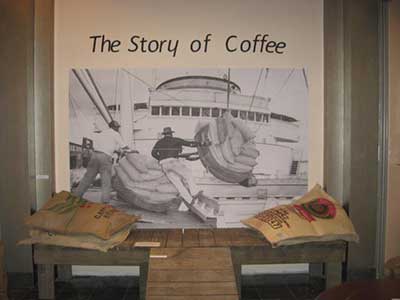
The Story of Coffee at Southern Food & Beverage Museum in New Orleans

The Story of Coffee at Southern Food & Beverage Museum in New Orleans. Do you love coffee and its culture? Then, don’t miss this place.

The Story of Coffee at Southern Food & Beverage Museum in New Orleans

New Orleans has a lot of interesting places and museums, result of a long and legendary history. But Yareah loves particularly Southern Food & Beverage Museum, a nonprofit organization dedicated to the discovery, and understanding of the food, drink and culture of the South of USA. They opened their doors on June 7, 2008 in New Orleans, Louisiana. Anyway and although the museum is in New Orleans, it celebrates all of the cultures that have come together through the centuries to create the South unique culinary heritage. Really different and of course, tasteful!

They have permanent exhibits and every year, they have different events and shows.

Among its permanent exhibits, we would highlight The Story of Coffee. The exhibition explores Coffee in Louisiana, from those days of steamships that braved the Mississippi river to bring exquisite coffee to the city of New Orleans from the tropics to our present. Because New Orleans remains the first coffee port in the USA and USA is the first coffee consuming nation in the world.

Definitely, if you love coffee, don’t miss this museum, Yareah friends. It’s worth!

Southern Food & Beverage Museum. Riverwalk, 500 Port of Orleans Place Suite 169, New Orleans, LA 70130

“Our culture runs on coffee and gasoline, the first often tasting like the second.” Edward Abbey.

See more in the Museum website http://southernfood.org/

source: http://www.yareah.com / Yareah Magazine / Home> Lifestyle> Food and Beverage / by Isabel del Rio

Coffee consumption to touch 125,000 tonnes

Domestic consumption growing at rate of 5-6% annually since 2010
CoffeeKF17oct2013
The Coffee Board of India has estimated consumption in India to be around 125,000 tonnes for 2013. Domestic consumption is growing at a rate of 5-6 per cent annually since 2010.

This is almost double the figure when compared with that of United States Department of Agriculture, which recently pegged the Indian consumption at 66,000 tonnes, while the International Coffee Organisation (ICO) has estimated it at over 100,000 tonnes. “We have commissioned a study to assess the exact consumption of coffee in India and the results of the study will be available by the end of December this year,” Coffee Board of India Chairman Jawaid Akhtar said. He said the domestic consumption was 58,000 tonnes in 1987 when the country’s population was 820 million. In 2011, the consumption crossed the 1,00,000 tonnes mark, while the population touched 1.21 billion. “About 7-8 years ago, the domestic consumption was growing very slowly and now, it is growing faster. South India is the largest consumer of coffee at almost 75 per cent of the total consumption. The Coffee Board is making efforts to push the consumption in western, northern and eastern parts of the country,” Akhtar said.

“The Board is organising events like India International Coffee Festival (IICF) to project Indian coffee as ‘good coffee’ and specialty coffee. In this direction, we organised our IICF at New Delhi in 2012,” he said.

Recently, the ICO stated that the consumption of coffee is growing rapidly in exporting countries like Brazil, Indonesia and India. It has pegged the Indian consumption at 114,000 tonnes, showing a growth of 4.8 per cent annually.

“Assuming that the consumption has grown only at 5-6 per cent year on year since 2010, the consumption in 2013 could be in the range of 125,000 tonnes,” Akhtar told Business Standard.

The Coffee Board has pegged the production of coffee for the year 2013-14 at 347,000 tonnes in its post blossom estimates. However, the chairman stated that it could come down by at least 10 per cent due to heavy rains between June and August this year, which resulted into ‘wet foot’ and ‘black rot’ diseases.

In an effort to increase awareness about drinking coffee and its health benefits, the Coffee Board in association with India Coffee Trust is organizing the fifth edition of IICF 2014 at Bangalore from January 21 to 25, 2014.

“The event provides avenues for enterprise development through value addition while simultaneously contributing to the creation of skill based jobs, particularly in non-conventional coffee drinking areas at the consumer end. To facilitate entrepreneurial development, the Coffee Board has been providing training sessions on coffee roasting, brewing among others,” Akhtar said.

IICF 2014 is expected to see participation of 1,000 delegates for the conference and workshops and over 10,000 visitors at the exhibition. National and international experts in the coffee industry including policy makers, exporters, manufacturers and planters are likely to attend this flagship event of the Coffee Board.

source: http://www.business-standard.com / Business Standard / Home> Markets> Commodities> Food & Edible Oils / by Mahesh R Kulkarni / Bangalore – October 14th, 2013

Bangalore to host International Coffee Festival from January 21

CoffeeKF11oct2013
The conference will be held from Jan 21-25, 2014. The previous edition of IICF was held in Delhi in 2012

Bangalore is set to host the fifth edition of India International Coffee Festival (IICF 2014), the flagship event of the coffee sector, from January 21-25, 2014. The Coffee Board of India is organising the event, which will showcase India as an emerging global coffee destination.

The previous edition of IICF was held in Delhi in 2012.

“The IICF 2014 will be all about in depth discussion on the latest in coffee market and retailing in India, on the cutting edge developments in coffee technology relevant to the Indian scenario with papers and demonstrations by world renowned experts,” Coffee Board said.

The event comprises conference and exhibition on the coffee sector. The conference aims to capture the changes taking place in the coffee sector and will discuss current trends related to production as well as take a close look at the prevailing market scenario. It will focus on issues such as changing role of Arabica and Robusta, health aspects of coffee, innovative and alternate channels of coffee delivery to consumer among others.

It will also lay stress on the changing patterns of coffee production including farm mechanisation, discuss parameters of good coffee and take a close look at sustainable production methods including prudent water management, the Board said.

The Expo of IICF will showcase latest technologies, new products and services and new coffees and blends.

There will be workshops on processing, brewing, roasting, espresso making, cooking with coffee, art on silk and coffee entrepreneurship.

source: http://www.business-standard.com / Business Standard / Home> Companies> News / by BS Reporter / Bangalore – October 11th, 2013

Invigorating cup of dancing goats’ find

It all started with the dancing goats of Kaldi, the 9th century Ethiopian goatherd. After eating berries from a certain tree they became so spirited that sleep eluded them all night. So goes the legend about the birth of your cup of coffee bursting with the aroma of arabica beans that reminds you first thing in the morning of all the fine things life has to offer. Folklore also says the Oromo people, an ethnic group of Ethiopia, would customarily plant a coffee tree on the graves of powerful sorcerers. They believed the coffee bush sprang up from tears that the God of Heaven shed on the corpse of a dead sorcerer.

All coffee in the world is grown in the bean belt, between the tropics from the species of an evergreen shrub of the genus Coffea. The Arab traders initially took coffee from Ethiopia to the Middle East and at present countries in South America, Southeast Asia and Africa are responsible for its cultivation. Brazil is the world leader and India stands 5th in global production.

Coffee was used in Sufi monasteries and was banned as a satanic invention in Europe. The first coffee house was opened in Italy in 1645. In 1675, the King of England banned coffee houses claiming people congregated there to conspire against him. With time coffee has been recognised as a human connection, not a luxury or indulgence, an axis around which social conversation revolves.

The kick of caffeine in the coffee lands squarely in the face. With the first few sips the magic begins, then the high and then the crash! The Oatmeal Shop advertising their Caffeine High Mugs say “drinking from one of these is like making out with a Pegasus”.

Now, coffee has many names and you should know what your coffeescope says. If you are an espresso enthusiast you are friendly and adaptive. If mocha, you are fun-loving and creative, iced coffee you’re assertive and outspoken, so on and so forth. While there are several chains of coffee cafes across the world the best known is the Seattle-based Starbucks where the barista with outstretched hand offers a cup of coffee and a lifestyle to match. Its mission is “to inspire and nurture the human spirit, one person, one cup, and one neighbourhood at a time”.

The Coffee Board of India with its tagline of “mystical blends, divine flavours” serves as the guide to our coffee industry. The board’s mascot for is the Coffee Swami. Born in 2006, a true connoisseur of coffee, a store house of coffee wisdom, someone who’s “bean” there, done that, seen it all. Guru of coffee gyan! The international coffee festival 2012 held in Delhi, the centre for the growing coffee culture, had a representation of 17 countries. An international festival where coffee is the only conversation.

As a college student I remember the coffee house in College Street, Kolkata, with its high ceiling and grimy walls and deafening student conversation, a rendezvous for artists, writers, and scholars. The adda sessions inspired many a literary talent and spawned cultural and political movements. So, here’s to the Cup!

source: http://www.newindianexpress.com / The New Indian Express / Home> Opinion / by Sudha Devi Nayak / October 03rd, 2013

Jawaid Akhtar Elected Chairperson of International Coffee Council

Jawaid Akhtar, the Chairman of Coffee Board of India, was elected as the Chairperson of the International Coffee Council at the meetings of the International Coffee Organization which took place on 9 September 2013 in Belo Horizonte, Brazil. The 111th session of the Council and the meetings took place from 9 September 2013- 12 September 2013.

At the same time, Conradin Rasi of Switzerland was elected as the Vice-Chairperson of the International Coffee Council. The Council also appointed Juan Esteban Orduz of Colombia as the Chairperson of the Consultative Forum.

About the International Coffee Organization (ICO)

• The International Coffee Organization was established in 1963 in London.
• It was initiated with the United Nations (UN) to increase cooperation among the nations which produce, distribute and consume coffee.
• The International Coffee Organization was formed as a result of the five-year International Coffee Agreement signed in 1962 at the UN in New York.
• Till the year 2011, it comprised of 39 members, which included 33 exporting nations, 5 importing countries and one importing community, i.e., the European Union.
• The highest body of the ICO is International Coffee Council. It meets two times a year and the Private Sector Consultative Board of ICO includes 16 representatives from coffee production and consumption industries.
• The members of ICO represent 97 percent of the world coffee production and more than 80 percent of the world consumption.

source: http://www.jagranjosh.com / Jagran Josh / Home> Current Affairs / September 21st, 2013

Flavour of India competition winners announced

Each year the Coffee Board of India (CBI) invites applications from the coffee growers of India for the annual cupping competition, The Flavor of India -The Fine Cup Award.

The competitions is held for Arabica (washed/unwashed), Robusta (washed/unwashed), and the Specialty coffees of Arabica and Robusta.

The outstanding coffees from the national level are chosen for the final cupping by the internationally jury consisting of eminent cup tasters from different countries.

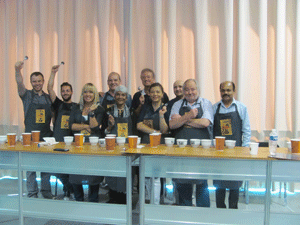
In this, the 12th year of competition, the CBI received a total of 221 coffee samples. Out of these, 40 samples were selected for cup quality evaluation by the international jury in the finals held at Nice, France on the eve of SCAE World of coffee prestigious three-day event held in June.
CoffeeAwardsKF23sept2013

The winner of Best Arabica was the Pedabayalu Estate’s Arabica Plantation SLN-4.

The Poabs Estates’ Organic Arabica SLN-9 took out the Best Specialty Arabica prize, while the prize for the Best Specialty Robusta went to Harley B Estates’ Old Robusta.

The Best Robusta category was won by Margolly Estates’ Robusta Parchment AB.

The full details of the winners in all categories and regions can be found on CBI’s website: www.indiacoffee.org.

source: http://www.globalcoffeereview.com / Global Coffee Review / Home / Monday – September 16th, 2013

Govt mulls branding Indian arabica coffee

Ministry willing to commit resources, expertise for purpose; discusses proposal with Coffee Board
CoffeeKF09sept2013
The Ministry of Commerce and Industry is considering creating an Indian mild arabica coffee brand for the promotion of arabica coffee in international markets. It had discussed the idea with the Coffee Board and was coming out with a brand initiative under the public-private partnership (PPP) model, said a senior ministry official.

“We don’t want Arabica coffee to die out because of the impact it has on the environment of the Western Ghats. The Indian mild arabica coffee is very highly priced. The only way to get better prices for our coffee is to brand it, package it and promote it in foreign markets,” said J S Deepak, additional secretary in the commerce ministry. Addressing the 120th annual conference of the United Planters’ Association of Southern India (Upasi) here on Tuesday, he said, “The ministry is willing to commit resources and expertise required for promoting an Indian mild Arabica brand.”

Planters participating at the conference feel the move is significant, owing to the dwindling acreage and production of arabica coffee in India. For 2013-14, production was estimated to decline to about 80,000 tonnes from 98,600 tonnes in 2012-13, said Nishant R Gurjer, chairman of the Karnataka Planters’ Association. Gurjer said the move to create an Indian brand for arabica would go a long way in preserving and promoting arabica coffee.

Deepak said the government was concerned about the white stem borer attack on arabica gardens and a solution to this would be found by the Coffee Research Institute soon. On Upasi’s demand for reconstituting commodity boards (coffee and spices), Deepak said the proposal was in the final stages and the new boards would be announced very soon. “The ministry has taken the suggestion of Upasi for including members of plantation associations on the new boards and it would make necessary changes in the new boards,” he said.

He assured the plantation sector the ministry would provide all help, including the help from Indian Brand Equity Foundation, for branding of Indian spices. On the delay in approving 12th Plan schemes for various commodities, he said the proposals were pending with the finance ministry. He expressed hope these would be approved by the end of September. “It is a matter of great concern for us. Most of the subsidy schemes will be continued in the 12th Plan,” he added.

source: http://www.articles.timesofindia.indiatimes.com / The Times of India / Home> Markets> Commodities> Other Commodities / by Mahesh R Kulkarni / Coonoor – September 03rd, 2013

Coffee Chains; A Growing Business In India

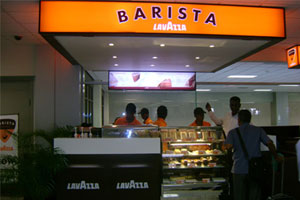
Barista opened its first coffee lounge in 2000 with headquarter in Okhla, New Delhi. Since then, it has been called as one of the best espresso bars in India. In 2007, Barista was acquired by Lavazza and started knowing as ‘Barista Lavazza’. ‘Barista Coffee Company’ is the leading force behind Barista Lavazza.
BaristaKF08sept2013
After one year of establishment, more than thirty-four percent of Barista’s equity stakes were sold to ‘Tata Coffee’ and the rest of the shares were bought by C Sivasankaran from the ‘Amit Judge-controlled Turner Morrison’ in 2004. Later in 2007, Sivasankaran’s ‘Sterling Group’ bought the stakes from Tata Coffee and in the same year, Barista was sold to the ‘Lavazza’ group. Since then, Barista changed its name to ‘Barista Lavazza’.
BaristaLavazzaKF08sept2013
Lavazza’s roasting firm, ‘Fresh and Honest’ supplies the coffee beans in Barista Lavazza. At present, Barista Lavazza has more than 225 outlets in India and has also became the fastest Indian brand to reach the top of the phenomenal companies that changed India. It also received the ‘Brand of the Year’ from ‘Times Group of Business’ in 2002. Barista Lavazza is estimated to have annual revenue of 200 crore.

source: http://www.siliconindia.com / Silicon India News / Home> News> Business / by Silicon India / Monday – May 20th, 2013

Sethuraman estate gets US certification for robusta coffee

Bangalore :

Indian coffee estates are moving slowly to gain US’ roasters interest.

As a first step, the Sethuraman Estates located at Magundi in Chikmagalur after showcasing its produce at various speciality coffee events in the US has now become the first Indian coffee estate to get ‘R Grade’ certificate.

‘R Grade’ certificate are given for washed robusta coffees by the Coffee Quality Institute (CQI) which is an arm of Speciality Coffee Association of America (SCAA).

GETTING PREMIUM

The SCAA recently tested Sethuraman Estate’s robusta coffee submission at the CQI and found to have all the required quality parameters. This certificate facilitates the estate to sell and charge a high premium in the US .

The certificate and recognition allows Sethuraman Estates to sell its entire submission of 15 tonnes speciality robusta in the US market spread over a year by using the CQI and SCAA logo.

“The ‘single-origin estate-branded’ coffee of Sethuram Estates has so far fetched a premium of over 30 per cent over the domestic market prices. Currently the domestic washed robusta coffees is trading at Rs 145 a kg,” said Nishant R. Gurjer, Managing Partner, Sethuraman Estates.

ENTERING US

“This certificate and recognition will allow us to enter the lucrative US café market as well,” he added.

The Sethuraman estate located at Chikmagalur began in operations in the 1950s. In the US market, the company is marketing estate-branded coffees – the Sitara Parchment Robusta and the Ne Plus Ultra of Robusta coffee brands.

The US, a traditionally arabica-consuming country, is slowly replacing it with robusta coffees and few companies have initiated moves to source from various countries for create blends.

SHIFT TO ROBUSTA

This has led to the Coffee Quality Institute, which used to certify only Arabica coffees, now has introduced separate certification for robusta coffees.

RATINGS

According to the institute’s finding of Sethuraman Estates, the following are the rating with baseline score of 7.14. Aroma 7.58 , flavour 7.42, aftertaste 7.42, acidity 7.83, mouth feel 7.42, balance 7.50, Uniformity 10, clean cup 10 Sweetness 7.42 cupper points 7.58.

Gurjer said, “We entered the US market in 2006 by exporting just two containers (36 tonnes) and so far have reached the level of 8 containers (144 tonnes) of speciality robusta coffees.”

source: http://www.thehindubusinessline.com / Business Line / Home> Industry> Agri-Biz / by Anil Urs anil.u@thehindu.co.in / Bangalore – June 21st, 2013

Coffee museum grounds for a visit

When thinking of museums in Cambodia, it’s usually ancient carvings and Khmer sculptures that come to mind. But there’s a new museum in town, and it doesn’t have even the slightest connection to Angkor Wat.

Instead, the Golden Mountain Coffee Museum is dedicated exclusively to celebrating everyone’s favourite pick-me-up: a good old cup of joe.

Perhaps an unexpected addition to Siem Reap’s caffeine scene, the one-month-old museum is owned by Kim Jong Yoon, a Korean coffee lover keen to share his passion with others.
“Most people drink coffee” he states, “But they don’t understand where it comes from, and the process of making it. I want to introduce people to the story behind coffee.”
And that’s exactly what the museum does.

Alongside artistic black and white photographs of all things coffee, the walls of the bright airy museum are covered in colourful displays detailing every step of the journey from bean to brew.

Visitors start by learning about how coffee is grown, selected, and harvested, before moving on to different types of coffee making machines.
Ever wondered how a French press or a vacuum pot actually works? Or perhaps how to brew traditional Turkish coffee? The answers are here.

Other displays give tips on grading, rating and roasting beans, infographics of coffee ingredients, and information on the allegedly many health benefits of drinking coffee.
And yes, ‘hangover cure’ makes the list.

Also on display is Yoon’s personal collection of coffee grinders. “They’re from all over the world” he says proudly. “I’ve always loved coffee, and have been collecting these grinders for years.” After all that learning this visitor was in need of a cup of coffee herself, and as luck would have it Yoon has opened a coffee shop beneath the museum.
“The idea is that visitors will take some time to learn about their favourite drink, and then come downstairs to taste it with a better knowledge of what they’re enjoying” says Yoon. “So far, it is working well.”

Aside from being an obvious addition to a coffee museum, Yoon wanted to re-create the stylish coffee shops he’d loved while living in Bangkok.
“I didn’t find anything like that here in Siem Reap” he says, “so I decided to build it myself.”Excitingly for the coffee addicts – and soon-to-be-experts –Yoon’s café stocks a vast variety of coffee beans from all corners of the globe.

“We offer coffee from eight different countries, including many in Southeast Asia. We import some coffee, but we also have five of our own blends from Vietnam, Thailand, Laos, Myanmar, and of course Cambodia. We roast and package them here so they’re fresh.”
That is right; Golden Mountain has its own purpose built “roasting room”, so that the coffee served up tastes as fresh as possible. Nosy guests will also be pleased to hear that a glass wall allows people to watch the entire process.

When asked about his best coffee, Yoon does not hesitate to recommend the “elephant dung” coffee that he imports from Chiang Rai in northern Thailand.
For the uninitiated, this coffee is made from coffee beans that elephants eat, digest, and then return to nature. They are then retrieved, cleaned, and readied for roasting.
“The elephant coffee doesn’t smell so good” he admits, “But the taste is naturally very sweet.” That may well be true, but at $10 a cup this is a caffeinated treat for the brave of palate and large of wallet.

But there are many other coffees available, including a strong black Dutch coffee served with ice and a little sugar syrup – a perfect choice for a typically humid day.
Yoon also has some interesting plans for his coffee shop.
“At the moment it is low season, but next year when there are more people in Siem Reap I would like to start offering tasting classes. Then my customers can learn even more about coffee.”

The Golden Mountain Coffee Museum is at the front corner of the Charming Tourist City complex, and opens daily from 8am-10pm.

Sourced: The Phnom Penh Post
source: http://www.tourismcambodia.com / Tourism of Cambodia / Home> News> Local Travel News / Saturday – June 27th, 2013