Brazil’s annual coffee production has surged from 30-35 million bags (of 60 kg) a decade ago to 50-55 million bags at present. / The Hindu Coonoor :
After visiting the plantations in Brazil and Colombia, coffee planters in India admit that the industry here would have to change the way of planting and look for better varieties and clones to compete and sustain in the market.
Karnataka Planters’ Association had organised a tour of Brazil and Colombia in July. A 35-member team from India (comprising coffee farmers and industry people) visited Brazil and 17 of them went to Colombia as well.
‘We can adopt simple things such as hedge-row planting. Our terrain may not be suitable for harvester, but drip irrigation should be possible here,’ said the Chairman of Karnataka Planters’ Association Nishant R Gurjer.
Sharing his experience, he said ‘coffee plantations in Brazil are highly mechanized. This has resulted in their over dependence on scarce and expensive labour. They have also put in place drip/ fertigation systems and water management technology, contributing to high productivity.’
Brazil’s annual coffee production has surged from 30-35 million bags (of 60 kg) a decade ago to 50-55 million bags at present. There has not been a corresponding increase in area, but they have improved in cultural practice and come up with better coffee varieties.
There is no such thing as ‘off-year’ and on-year’ any more. This year, despite being an ‘off-year’ Brazil’s coffee production has been estimated at 55 million bags.
Brazil planters have moved away from frost areas to newer areas. They grow sugar cane, soya, corn etc in these areas.
The varieties and clones that they have come up with are amazing.
Colombia is the hub of coffee, but there is no Robusta here. Here, there is massive replanting taking place, he said.
Are Indian coffee planters threatened? ‘Yes,’ he says, before admitting to the need for changing planting practices, opting for newer varieties and improving productivity per acre.
source: http://www.thehindubusinessline.com / Business Line / Home> Industry> Agri-Biz / by L N Revathy / Coonoor – September 02nd, 2013
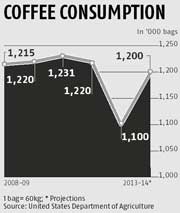
According to USDA, consumption in India has been hovering around 1.2 million bags for last 5 years; slipped to 1.1 mn bags in 2012-13
India’s coffee consumption is set recover to 1.2 million bags (72,000 tonnes) in 2013-14, a modest rise of nine per cent compared with 1.1 million bags (66,000 tonnes) in 2012-13, according to the United States Department of Agriculture (USDA). Before falling in 2012-13, average annual consumption in India stood at about 1.2 million bags through five consecutive years, USDA said in its latest report ‘Coffee: World Markets and Trade’.
Typically, USDA’s estimate is lower than the estimate provided by the Coffee Board of India, which is yet to publish the latest consumption figures. “Consumption of coffee in India is always debatable. The Coffee Board of India always projects a higher number, while it is low in the case of USDA,” said Ramesh Rajah, president, Coffee Exporters Association of India. Coffee consumption in India is growing at an average one-two per cent annually.
Compared to 2012-13, consumption has shown signs of growth. It is estimated consumption would rise despite near-flat production levels. USDA has pegged domestic coffee bean production at 5.2 million bags (312,000 tonnes) for the crop year starting October. On an average, India’s annual bean production stood at 5-5.2 million bags in the past three years.
For 2013-14, USDA has projected exports from India at 3.75 million bags, the same as that recorded last year. Of the estimated production of 5.2 million bags this year, the share of Arabica is pegged at a record high of 1.7 million, while that of Robusta is pegged at 3.5 million bags.
“World coffee production in 2013-14 is forecast at 146 million bags, down by 4.4 million bags from the previous year, primarily due to Brazil’s Arabica trees entering the ‘off-year’ of the biennial production cycle and, to a lesser extent, Central America and Mexico continuing to struggle with coffee leaf rust,” USDA said. Global bean exports are pegged below last year’s record, while consumption is expected to rise modestly.
“In India, higher input costs, along with the elimination of subsidies for fertilisers and diesel, have increased production costs for growers. Labour expenses, which could account for more than 50 per cent of the cost of cultivation, continue to escalate, while greater off-farm employment opportunities have created labour shortages,” USDA said.
Adoption of mechanisation has been slow and limited to a few plantations, primarily due to uneven terrain and small and fragmented growing areas.
source: http://www.business-standard.com / Business Standard / Home> Markets> Commodities> Food & Edible Oils / by Mahesh Kulkarni / Bangalore – July 15th, 2013
Tata Starbucks plans to open around 100 Starbucks cafes in the country by next year to match up to established rivals and is building a war chest for expansion by more than trebling its authorised capital to Rs 220 crore.
The 50-50 joint venture between US cafe chain Starbucks Coffee Company and Tata Global Beverages will increase its authorised share capital from Rs 70 crore by creating additional 150 million equity shares of Rs 10 each, amounting to Rs 150 crore, the unlisted firm said in a board resolution filed last week with the Registrar of Companies.
While Tata Starbucks said it does not release financial information or future store count, its spokesperson said the company is committed to India. “The joint venture will invest over time, based on the demands of the business and the requirements of our customers, to build a strong presence in the market,” the spokesperson said.
The US coffee chain has already signed two dozen properties, including in the suburbs of Mumbai and Bangalore, a real estate official aware with Starbucks’ expansion plans said.
Starbucks is displaying an urgency to scale up at a time when most quick-service restaurant operators including Jubilant Foods and McDonalds have reported slowing sales growth in the country due to a consumer slowdown.
Experts say Starbucks has been very selective in opening stores in the country.
“Starbucks has been opening stores only at locations where the catchment area can value its premium positioning,” Ruchi Sally, director at boutique retail consultancy Elargir Solutions, said. “For them, the key strategy is return on investment from their stores and not just scale at the moment.”
Starbucks, which entered the Indian market in October last, currently operates 18 stores in the country.
In comparison, rival Cafe Coffee Day has more than 1,500 stores while Barista Lavazza and Costa Coffee has more than 100 stores each. The Indian cafe market is estimated at $230 million, or about 1,400 crore, and is expected to grow about 13-14% a year over the next five years. Globally, most cafe consumers are attuned to a takeaway culture, which helps retailers add margins with very little cost.
In India, however, many office-goers and students go to cafe to relax and spend hours on coffee and snacks. Also, real estate costs are high in India, making it important for retailers that average price realisation per square feet of space.
Starbucks in India seems to have done well on the profitability front. During Tata Global Beverages’ quarterly performance presentation earlier this month, the company said Starbucks stores are already making cash profit. In a shopping mall in Mumbai the average monthly business of a Starbucks outlet is double the combined sales of two other coffee chains on the premises, an official of the mall operator said.
Starbucks CEO Howard Schultz had last year said that he expected India to be one of the top five markets for Starbucks. “India represents one of the most significant opportunities that we have in all of Starbucks. India should be one of the largest markets in the world for Starbucks. I would say one of the top five over time,” he had said in an exclusive interaction with ET late last year.
source: http://www.articles.economictimes.indiatimes.com / The Economic Times / Home> News> News by Industry> Services / by Sagar Malviya, ET Bureau / August 19th, 2013
Coffee’s rich history in India There is a world of spice growing alongside the coffee plantations in Coorg, and it is indeed a site worth seeing.
Cruising at an altitude of 35,000 feet, on a flight back to the U.S., I knew I had left a part of me in Madikeri, Coorg, India. I have never experienced the raw beauty of nature the way I did on this trip. I can go on about this for hours, but I will let the photographs speak for themselves. Get yourself a nice cup of steaming coffee, it is going to be a long post.
Click here for the Inside Look at India’s Coffee Growers (Slideshow)
http://www.thedailymeal.com/inside-look-indias-coffee-growers-slideshow
Supposedly, Turkish law in the late 1400s made it legal for a woman to divorce her husband if he failed to provide her with her daily quota of coffee. I’m not sure of the authenticity of this, but coffee has always been a serious beverage, which you do not want to mess up with. Perfect ripened beans are processed, dried, and then roasted at perfect temperatures to give us the cup of bliss that we enjoy every morning. (In my case, multiple cups of bliss.)
It was in the 17th century that coffee came to India, when Bababudan smuggled eight beans and planted it in the hills of Chikmagalur, Karnataka. Now, thanks to the British who helped cultivation of coffee in South India, both coffee Arabica and coffee Robusta are cultivated in Coorg. The rainforest provides a perfect canopy to grown coffee in shade. There is a world of spice growing alongside the coffee plantations in Coorg, and it is indeed a site worth seeing… pepper creeper embracing the tall redwood and silver oak, almost like green pillars towering the sky with cardamom bushes alongside. Picture this… and it is pouring because it is the monsoons, probably the wrong time to visit a rain forest. For me, there would have been no better time than this…
I managed to take some pictures between the long bouts of rain, but the picture of the wet rain forest that I carry in my memories could not be captured from a lens and is truly priceless. I cannot say I did justice to the beauty of this place; you have to see it to believe it.
Among all the different types of coffee I tasted there, “bella coffee,” or coffee made with jaggery, was indeed the best and I am not sure how many cups or gallons I had; my father-in-law was my partner in crime, looking at the rain pouring, the cloud playing hide and seek to reveal the rich mountains… and a cup of coffee. What more can anyone ask for?
Simi J. enjoys cooking and celebrating the pleasure that food brings to our lives.Visit Simi at Turmeric N’ Spice. http://www.turmericnspice.com/
source: http://www.thedailymeal.com / Home> Drink / by Simi, Special Contributor / August 14th, 2013
The Nicaragua Tourist Board has launched the Coffee Trail, a new tourist route that will give visitors an authentic experience of the northern region of the country.
The Coffee Trail covers five regional departments – Estelí, Jinotega, Madriz, Matagalpa, and Nueva Segovia – and aims to show visitors the diverse culture, food, scenery and tourism products of this area.
Visitors following the route will travel through several coffee and tobacco plantations and stay in charming rural hotels or guest farmhouses where they can take part in everyday activities. They can hike through nature reserves, visit picturesque villages and towns, and see how the locals produce beautiful handicrafts made of marble, clay or tusa (corn skin). The local gastronomy is another main attraction, including several corn-based dishes.
In Matagalpa, travellers can find out more about the history of tobacco and coffee production in the area at the National Coffee Museum. The department of Jinotega is the country’s main producer of coffee, renowned for its quality. In Estelí, visitors can choose amongst several natural parks – Cerro Tisey-La Estanzuela, Miraflores-Moropolente, Canta-Gallo, and La Patasta – to enjoy beautiful scenery. Madriz is famous for its ‘rosquillas’, or typical doughnuts, perfect to accompany a good cup of coffee. Nueva Segovia is known for its colonial and revolutionary history, and the typical handicrafts made by the local indigenous community.
The Coffee Trail offers visitors a combination of indigenous traditions, history, lush natural landscapes and a rich biodiversity, together with the warmest welcome from the locals, to provide an authentic experience of Northern Nicaragua.
The Nicaragua Tourist Board has launched the Coffee Trail, a new tourist route that will give visitors a unique experience of the northern region of the country.
The Coffee Trail covers five regions and aims to show visitors the diverse culture, food, scenery and tourism products of this area. Visitors following the route will travel through several coffee and tobacco plantations and stay in charming rural hotels or guest farmhouses, where they can take part in everyday activities.
The tour will also include hiking through nature reserves, visiting picturesque towns and villages, and seeing how the locals make handicrafts made of marble, clay or tusa (corn skin). The local gastronomy is another main attraction, including several corn-based dishes.
In Matagalpa, travellers can find out more about the history of tobacco and coffee production in the area at the National Coffee Museum. The region of Jinotega is the country’s main producer of coffee and is renowned for its quality. In Estelí, visitors can choose amongst several natural parks – Cerro Tisey-La Estanzuela, Miraflores-Moropolente, Canta-Gallo, and La Patasta – to enjoy stunning scenery. Madriz is famous for its ‘rosquillas’, or typical doughnuts, perfect to accompany a good cup of coffee, while Nueva Segovia is known for its colonial and revolutionary history.
The Coffee Trail will offer visitors a combination of indigenous traditions, history, lush natural landscapes and a rich biodiversity, as well as the chance to interact with the locals.
Further information and details of accommodation and tour companies offering the route will be available shortly on the Nicaragua Tourist Board’s website: www.visit-nicaragua.com.
source: http://www.iwantsun.co.uk / Home> Active Sun / Friday – July 26th, 2013
Most coffee lovers, including some south Indians, aren’t familiar with every secret of filter coffee. Two men are about to change that
What happens when a Bihari experiments with filter coffee? He thinks he can make the coffee without a filter.
That’s not funny. That’s blasphemous, if you are a Tam-Bram. (South sensation )
Arvind Srinivas finds it hard to hold back the chuckle when he recounts a conversation he recently had with TP Mishra, a customer from Kandivli (E), who had called him to order half a kilo of Kumbakonam coffee. “When I asked him if he had a filter brewer, he said, ‘I will add the powder to boiling water, let it simmer for a while and filter it’!”
Mehta is just the sort of client Srinivas, a creative director at a media firm, is looking for.
He finds time away from his day job to help Mumbaikars appreciate south Indian filter coffee, especially the famous Kumbakonam degree variety. The two-month-old business he runs with partner Parameshwar K R involves sourcing coffee powder from Kumbakonam, a temple town in Tamil Nadu that has been the hub of filter coffee since pre-Independence, delivering it to Mumbai homes and inculcating the art of appreciating good coffee.
“The locals would trickle into the main coffee centre as early as 5.30 am to get their first cup,” Srinivas says about the town, even as the aroma of a fresh brew wafts from the kitchen of his Kandivli home, where wife Savitri, an advocate at the High Court, is busy.
Degree coffee, he says, is nothing but coffee made mixing fresh, undiluted cow’s milk and the first batch of decoction. Of course, everything about the brew — starting from the beans — needs to be just perfect.
When the couple moved to Mumbai from Pondicherry in 1990, they spent a good part of their time hunting for authentic coffee powder. “I scoured Matunga stores, but my wife insisted it wasn’t good enough. Another brand available in Andheri, was according to her innu mosham (worse),” he says.
A quick call to a friend who owns a coffee shop on Kamakshi Josiyar Street in Kumbakonam, solved the problem. The beans for this powder, like any other, are sourced from the Coffee Board of India, which gathers stock from coffee plantations around Coorg and Ooty. What, however, makes this coffee special is the lack of chicory — powder of roasted tap root — which is usually mixed with the ground beans to add colour to the coffee. But it could end hampering the flavour. “Some coffee drinkers are so used to chicory because it makes the brew strong, they specifically ask for it. One customer from Thane asked me to source coffee powder with 21 per cent chicory; no more, no less,” Srinivas laughs.
“For years, we had been visiting Srinivas and realised that the coffee at his place tasted better than anywhere else, so we thought we should teach the rest of the city how to make a proper cup,” adds Parameshwar.
The other factor that differentiates great coffee from average is the method of roasting the beans. “Roasting them on a skillet isn’t enough. Traditionally, the beans were roasted in a closed cylinder that rotated constantly. A small opening on one side allowed grannies to check if the beans were ready before they were ground,” he says.
But, before you give him a tinkle for the coffee (Rs 550 per kg, delivered anywhere in Mumbai within seven days), figuring how to make the perfect cup is important.
Fill half the percolator in the stainless steel coffee brewer with the powder. “It can be more, but never less,” pitches in Savitri. Pour boiling water into the filter and place the lid to ensure the aroma and flavour don’t escape. The decoction should always be hot. “If by evening, it cools down, don’t heat it directly or after mixing it with milk — that kills the taste. Instead, place the decoction in a small vessel and slip it into a container holding boiling water. It will get warm without losing its essence,” he adds. Then, there is the slight detail of how to drink the coffee. Fancy mugs don’t work. It’s the davara-tumbler utensil combination you need to invest in, and pour the coffee back and forth before taking a sip. “It gives the coffee a good froth while enhancing its taste. It is essential to the coffee-making process,” Srinivas adds.
source: http://www.articles.timesofindia.indiatimes.com / The Times of India / Home> Life & Style> Food> Filter Coffee / by Gitanjali Chandrasekharan, Mumbai Mirror / August 04th, 2013
The brands that will be given a global push are Tetley, Tata Tea, Himalayan and Eight O’ Clock Coffee
The beverage arm of the $100-billion (Rs 6 lakh crore) Tata Group has prepared a blueprint that will see it devote its attention to four “power brands” in its quest to achieve a turnover of $5 billion (Rs 30,000 crore) in the next three years.
The list will include products such as Tetley, Tata Tea, Himalayan and Eight O’ Clock Coffee, which will be given a global push. At the same time, the Rs 7,271-crore Tata Global Beverages (TGB) will not take its eyes off regional products either, pushing these aggressively in their home markets. On this list are brands such as Kanan Devan, Chakra Gold and Gemini in South India, Vitax in Poland and Joekels in South Africa.
The blueprint, explains TGB Managing Director Harish Bhat, is in keeping with company Chairman Cyrus Mistry’s vision to invest significantly behind the firm’s brands. At the company’s recently-concluded annual general meeting in Kolkata, 44-year-old Mistry, who became chairman last year, said that the foundation for investment behind the firm’s products had been laid. “It is crucially important to grow our brands in India and overseas. There is also a need for innovations which need funds,” he said.
TGB derives 65-70 per cent of its revenues from international markets and the balance from India.
Tetley, one of the products on the global power list, already sells in a number of markets outside its home turf of the UK. This includes India, where it competes with Twinings and Brooke Bond Taj Mahal from Hindustan Unilever. Tata Tea, an Indian product, meanwhile, has been taken to markets such as Canada and West Asia, while plans are afoot to take Himalayan packaged water, also an Indian product, which was acquired in 2007 by the company, to Southeast Asia in the near term.
Bhat declines to indicate whether new products would be added to the global or regional list through new acquisitions. Outgoing Vice-Chairman R K Krishna Kumar, at the TGB AGM, had hinted that the company was looking at a new acquisition. He had said, “TGB will make a major acquisition and be a truly worldclass company, not in the tea or coffee space but in new beverages.”
As things stand, TGB derives nearly 70 per cent of its revenues from tea, 20 per cent from coffee and five per cent from water. The plan is to take the contribution of water and coffee to 10 per cent and 25 per cent, respectively, in the next three years, Bhat said. Tea’s contribution, on the other hand, would come down to about 60 per cent, he added.
TGB proposes to achieve this by pushing its joint ventures with PepsiCo and Starbucks aggressively in the next few years. “A total of 18 stores have been opened so far by Tata Starbucks in Mumbai and Delhi. This count will go up as we move forward,” he said.
On the joint venture with PepsiCo (called NourishCo), Bhat indicated that in-house brands Tata Water Plus and Tata Gluco Plus were doing well.
“Tata Water Plus has seen higher growth than Himalayan packaged water (in the June quarter). But this is in the markets of Tamil Nadu and Andhra Pradesh, where the brand is currently present. The plan will be to take it to other markets in the country,” he added.
source: http://www.business-standard.com / Business Standard / Home> Companies> News / by Viveat Susan Pinto / Mumbai – August 03rd, 2013
Board has projected an all-time high crop of 347,000 tonnes in current year
At 3,47,000 tonnes, the Coffee Board’s post-blossom crop forecast for 2013-14 has come as a surprise for planters and exporters in Karnataka. The board has projected a nine per cent rise in production, compared with the final estimate of 3,18,200 tonnes for 2012-13. Karnataka accounts for 70 per cent of India’s coffee output.
The board has pegged robusta production at 2,36,000 tonnes and arabica production at 1,11,000 tonnes—7.5 per cent and 12.9 per cent higher than the final estimates for 2012-13, respectively. In 2012-13, 98,600 tonnes of arabica and 2,19,600 tonnes of robusta were harvested.
According to the Karnataka Planters’ Association (KPA), the board’s estimates were too high, considering the growing regions were in the grip of a prolonged drought and high temperatures during the pre-blossom period of February-April. KPA has pegged production at 2,90,000 tonnes.
“There are three main factors affecting production this year. We have seen prolonged dryness, owing to very high temperatures in March and April and the occurrence of white stem borer in arabica plantations. Third, this is an ‘off-year’ for robusta. We cannot have two consecutive years of high production. As a result of the drought, bean development was low this year in major growing regions in the Chikmagalur, Hassan and Kodagu districts,” said Nishant R Gurjer, chairman, KPA.
In fact, robusta production would be 25 per cent lower this year, especially in Karnataka, he added.
Exporters, however, neither agree with the board, nor with planters. “If the Coffee Board’s estimates come true, it will be an all-time high production in India. But it is unlikely to happen, considering various factors. Robusta has seen good rains in April and this year’s crop would certainly be better than last year’s. I think a little over 3,30,000 tonnes looks reasonable,” said Ramesh Rajah, president, Coffee Exporters’ Association of India.
Gurjer said the incessant rains in most growing regions in the last three weeks would have an adverse impact on production. Many planters have already reported fruit dropping and rotting. “There are stray incidents of ‘kole roga’ (a rotting disease) in many areas due to heavy rains,” he said. This year, production could be 2,90,000-3,00,000 tonnes, he added.
The United States Department of Agriculture has projected India’s coffee production at 3,12,000 tonnes.
A Coffee Board official said sampling had been carried out in April-June and the post-blossom estimates were in accordance with the sampling. Realistic production figures would only be released when post-monsoon estimates were prepared in October, he said, adding, “We will take into account all factors, including the impact of heavy rains, when we prepare the post-monsoon estimates.”
source: http://www.business-standard.com / Business Standard / Home> Markets> Commodities> Food & Edible Oils / by Mahesh Kulkarni / Bangalore – July 25th, 2013
WELCOME. If you like what you see "SUBSCRIBE via EMAIL" to receive FREE regular UPDATES.
Read More »