
Category Archives: Coffee News

Coffee can reduce car crash risk – research

CoffeeCF21mar2013
Researchers linked drinking coffee to stay awake with a 63 per cent lower crash risk. Photo / Thinkstock\

Drinking caffeinated drinks like coffee significantly protects against crash risk for long-distance commercial drivers, new research suggests.

But University of Otago professor Jennie Connor warned that caffeine, while effective for short amounts of time, was not a solution to fatigue.

The research, published in the British Medical Journal, was undertaken in Australia between 2008 and 2011.

It compared 530 long-distance heavy vehicle drivers who crashed their vehicle on a long distance trip in the preceding 12 months, with 517 such drivers who had not crashed.

Researchers linked drinking coffee to stay awake with a 63 per cent lower crash risk.

“Long-distance commercial drivers who consume caffeinated substances such as coffee or energy drinks, to stay awake while driving, are significantly less likely to crash than those who do not, even though they drive longer distances and sleep less,” researchers said.

More than 40 per cent of drivers reported consuming substances containing caffeine for the sole purpose of staying awake.

Lead researcher Lisa Sharwood, from Sydney University, said the study suggested drivers were adapting their behaviour to manage fatigue.

“This may seem effective in enhancing their alertness, but it should be considered carefully in the context of a safe and healthy fatigue management strategy. Energy drinks and coffee certainly don’t replace the need for sleep,” she said.

That notion was shared by Professor Connor, head of preventive and social medicine at the Dunedin School of Medicine.

She had previously researched driver sleepiness and crashes in New Zealand, and said although caffeine was one of the most widely used substances by drivers to stay alert, its effect was short-lived.

“It has to be a substantial amount of caffeine to make a difference to alertness – about two cups of good coffee – and it wears off fairly quickly, after about 45 minutes. To make a significant difference to your ability to drive when sleepy, you need more than a cup of coffee.”

Drowsy drivers were impaired, like drunk drivers, even if they did not fall asleep at the wheel.

“That is to some extent reversible by caffeine for a short period of time. It will provide you with a little bit of extra alertness but it’s not the answer because an hour later you’re back in the same situation,” Professor Connor said.

source: http://www.nzherald.co.nz / The New Zealand Herald / Home> Life & Style> by Rosie Manins of the Otago Daily Times / Thursday, March 21st, 2013
Greek coffee may be the potion of long life

London , MAR 19:

A daily cup of boiled Greek coffee may hold the secret to long life and good health, scientists say.

In a new study published in journal Vascular Medicine, researchers looked at the elderly inhabitants of Ikaria, the Greek island, which boasts the highest rates of longevity in the world.

Researchers who investigated cardiovascular health believe that a cup of boiled Greek coffee holds the clue to the elderly islanders’ good health.

Only 0.1 per cent of Europeans live to be over 90, yet on the Greek island of Ikaria, the figure is 1 per cent. This is recognised as one of the highest longevity rates anywhere — and the islanders tend to live out their longer lives in good health.

Gerasimos Siasos, a medical doctor and professor at the University of Athens Medical School, Greece set out with his team to find out whether the elderly population’s coffee drinking had an effect on their health.

In particular, the researchers investigated links between coffee-drinking habits and the subjects’ endothelial function.

The endothelium is a layer of cells that lines blood vessels, which is affected both by ageing and by lifestyle habits (such as smoking).

The team homed in on coffee because recent studies suggest that moderate coffee consumption may slightly reduce the risks of coronary heart disease, and that it may also have a positive impact on several aspects of endothelial health.

From a sample of 673 Ikarians aged over 65 who lived on the island permanently, the researchers randomly selected 71 men and 71 women to take part in the study.

Medical staff used health checks (for high blood pressure, diabetes, etc) and questionnaires to get more detail on the participants’ medical health, lifestyles and coffee drinking, in addition to testing their endothelial function.

The researchers investigated all types of coffee taken by participants — but interestingly more than 87 per cent of those in the study consumed boiled, Greek coffee daily.

More importantly, subjects consuming mainly boiled Greek coffee had better endothelial function than those who consumed other types of coffee.

Even in those with high blood pressure, boiled Greek coffee consumption was associated with improved endothelial function, without worrying impacts on blood pressure.

“Boiled Greek type of coffee, which is rich in polyphenols and antioxidants and contains only a moderate amount of caffeine, seems to gather benefits compared to other coffee beverages,” Siasos concluded.

source: http://www.TheHinduBusinessLine.com / Home> News> Science / by PTI / London, March 19th, 2013

The right blend of coffee and tourism

Fascinating trails

Coffee lovers and those with wanderlust have something to rejoice over. Bangalore International Airport Limited (BIAL), in collaboration with the Ministry of Karnataka Tourism and Thomas Cook (India) Ltd, recently launched the Kaapi Trail, a tourism product which allows one to experience coffee in its homeland with a single click.

The trails will cover coffee regions like Coorg, Chikmagalur, BR Hills and Araku Valley and offer three types of tourism packages – heritage trail, wild trail and leisure trail.
Depending on the package chosen, travellers will visit coffee plantations, stay in carefully handpicked homestays, go for jeep safaris in the wild and on cycling tours and more importantly, experience the local culture, traditions and cuisine.

Interestingly, this project had its beginnings place last year itself, when the City airport was full of little kiosks selling different varieties of coffee for domestic and foreigners to get a taste of the South.

“Last year, the promotion began as a way of introducing people to the pleasures of coffee drinking and to strengthen the diversity of tourism attractions of the state. Trails like this have been successful world over. The Scotch trails, for example, combine scotch whiskey with the wonderful landscape of Scotland. This is our version of it with the common thread of coffee,” says Hari Marar, President, operations, BIAL.

For Jawaid Akhtar, chairman, Coffee Board, this move will make Bangalore the gateway to South India.

He points out the benefits of this trail – “This will not only increase the coffee grower’s income and the occupancy of the homestays in the coffee regions. But the microclimate in which Indian coffee is grown will be exposed to tourists,” he shares.

“We need to take this product to tour operators around the world and get it incorporated into brochures. This will ensure that tourists see it as a part of the Indian offering,” informs Madhavan Menon, managing director, Thomas Cook (India) Ltd. He adds, “We’re not trying to create a new genre of products but a new destination.”

In fact, this is the first time that tourism and coffee are coming together, and the convenience aspect of having a readymade travel plan is truly a big step forward.

“It’s great that this concept has germinated into a product. This is chance for Karnataka to show that coffee’s a way of life in this part of the world; it’s integrated in our culture. We live coffee, drink coffee and dream coffee,” wraps up Arvind Jadhav, additional chief secretary, Karnataka State Tourism.

source: http://www.DeccanHerald.com / Home> Supplements> Metrolife / DHNS / January 15th, 2013

Is promoting Indian coffee online

Want to savour a cup of home-brewed coffee, admired across the world, that has been delivered to your doorstep? Kunal Ross’s Theindianbean.com, a portal for selling coffee online, offers just that. Ross believes that India has a treasure trove of coffee plantations, yet people hardly get to enjoy the produce.

“Most of the good quality beans are exported — currently the figure stands at 60-80 per cent. The lack of 100 per cent pure Arabica coffee makes it harder to find the coffee we all crave,” he says. Which is why Ross travelled to the coffee estates of Kodaikanal and Coorg and tied up with farmers to supply him with single plantation beans. In August last year, he began spreading the word across social media. In November, he sent out his first shipment of coffee.

“We now have [coffee chains like] Starbucks and a Coffee Bean and Tea Leaf [in India]. But it is not financially feasible to go there everyday. The import prices of the beans make their coffee expensive,” adds Ross. “There is a huge gap in supply for Indians who wanted good quality Indian coffee. That’s where we come in.”

Single estate coffee is much like single malt whiskey — made in one estate to ensure quality, aroma and taste. The Indian Bean currently sells two varieties — Frowner’s coffee from Kodaikanal and Appa’s from Coorg. Frowner’s is a non-certified, organic coffee grown in the Pulney region on a single estate interspersed with fruit trees — avocado, jackfruit, orange, banana and berries. Appa’s, known as the “baap of all coffees”, is a certified non-organic variety. Soon, the website will also sell Watapi, a non-certified, organic coffee from Mysore. Each variety, says Ross, is distinct from the coffee beans grown in South Africa or southeast Asia.

A 250 gm pack of Appa’s costs Rs 270 while Frowner’s sells for Rs 350. Both are available in 500 gm packs too. The Indian Bean is one of the few ‘e-sellers’ of coffee; Delhi-based www.bluetokaicoffee.com was launched last year. The Indian Bean distributes coffee in Mumbai for free and accepts cash on delivery; Ross plans to deliver pan-India by the end of the month and accept netbanking, credit card and debit card payments as well.

Once acquired, the beans undergo quality control by Ross and his team and then a chemical analysis at the labs of the Coffee Board of India, where they are periodically sent for testing. On receiving an order, Ross ensures that the coffee is roasted according to the customer’s choice. This depends on how the coffee will be used — in an espresso machine, in a French press or in a percolator. The packs are delivered in two to three days. Since roasting is done only after the order is received, the fixed costs are minimum. Even then, the company needs daily orders of at least 20 kg on an average to break even by the end of this year. Currently, the order size is usually around Rs 300-Rs 400 from the eight or nine buyers who shop from the site daily.

With an investment of Rs 3-Rs 4 lakh, Ross has tie-ups with five farmers. He hopes to add at least 10 more this year, stick to his revenue target of Rs 36 lakh this year and around Rs 1 crore in the next. “With steep rents in Mumbai, fixed costs go up. But luckily, the farmers and I have a good rapport. They save the good stock for me,” he adds. The website encourages socially-conscious farming; Ross has been updating social media pages to promote home-brewing methods.

Currently, most of the website’s visitors are 30-40 years of age. Using social media and digital marketing, Ross is targeting a younger crowd. He also plans to make his presence felt in farmer’s markets, coffee expos and food festivals. Currently, Appa’s and Frowner’s are available only in Mumbai’s Leaping Windows (a comic-book library and cafe). It remains to be seen whether The Indian Bean can make a space for itself in a sector already teeming with options for a cuppa.

source: http://www.Business-Standard.com / Home> Beyond Business> People> People / by Sohini Sen, Mumbai / January 19th, 2013

Tata Coffee plans to relaunch Eight O’ Clock Coffee brand in US, Canada

India-based Tata Coffee plans to relaunch its Eight O’ Clock Coffee (EOC) brand as well as offer new products in US and Canadian markets.

The company plans to introduce ‘single serve’ coffees in collaboration with Green Mountain Coffee Roasters (GMCR), a US-based specialty coffee roaster.

In 2012, EOC and GMCR announced a multi-year agreement to make EOC, Tetley tea, and Good Earth tea available in different formats.

Tata Coffee managing director Hameed Huq said that the company is curently finalizing a plan to re-introduce the brand.

“We are coming up with the relaunch and will reposition the product completely by May or June this year for the US and Canada markets,” Huq added.

Tata Coffee acquired EOC for $220m from Gryphon Investors in 2006.

Last year, following a partnership with coffee manufacturer and chain Starbucks, Tata Coffee established a new roastery at Kushalnagar in Madikeri, Karnataka, with an investment of INR45m ($834,840). The plant has a production capacity of 375 tons.

source: http://www.hotdrinks.drinks-business-review.com / Home> Non- alcoholic / Hot Drinks News / by DBR Staff Writer / January 29th, 2013

Drought, a blessing in disguise for Karnataka coffee growers


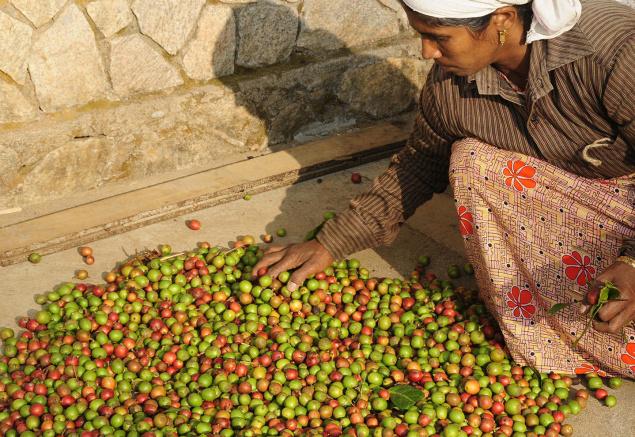
Harvested Arabica coffee berries drying in sunlight at a plantation.
Bangalore , JAN. 4:
The drought in neighbouring districts has helped Karnataka’s coffee-growing regions get sufficient labour for picking coffee. This is because farming has been affected in the drought-hit areas. Besides, the slowdown in sectors such as mining and constructions has helped. The coffee belt of Kodagu, Hassan and Chikmagalur are getting many more workers from Mysore, Tumkur Chitradurga and Davangere.

“Easier labour availability has made coffee-picking manageable this season. Availability of workers between December and February is crucial for us to pick coffee and this year there is no dearth of labour,” Bose Mandana, a senior coffee planter from Suntikoppa in Kodagu, told Business Line.

“This year, however, since the crop is lower than the original estimate, we may need less labour,” he said.

LOWER WAGES

Due to more workers being available, wages have fallen by Rs 50-100 a day per person. Coffee-growers are paying Rs 200-250 a day, depending on the nature of work.

Labour shortage in the last three years had forced coffee growers to pay workers between Rs 250 and Rs 300 a day.

“In the last two to three years, we had to literally run behind the contractors to get workers. But this year, it is their turn to knock on our doors for estate-related jobs. This season, I am getting 20 to 30 calls per day, asking if I need workers,” said Mandana. Marvin Rodrigues, former Chairman, Karnataka Planters Association (KPA) and a grower from Hassan, said: “This year, we are getting people slightly more easily than the last few years. We are paying around Rs 200-210 for temporary workers.”

Nishant Gurjer, Chairman, KPA, and a grower from Chikmagalur, said: “This year, labour supply is plentiful and people are coming to work on the estates.”

“We are also getting quite a few experienced workers, who had worked in the estates earlier but had moved over to the mining and construction sector. Since these sectors are not doing too well now, they have returned.”

anil.u@thehindu.co.in

source: http://www.TheHinduBusinessLine.com / Home> Industry> Agri-Biz / by Anil Urs / Bangalore, January 04th, 2013

Speciality Coffee Association Seeks To Carve Niche For Indian Coffee

Bangalore, September 8::

‘When the going gets tough, the tough gets going’ is a much abused cliche. But in the context of the present situation in the global coffee scene, there is no other way to describe the slew of initiatives launched by Speciality Coffee Association of India (SCAI) to create a niche brand identity for the Indian coffee.

An All India Barista Championship on the lines of International Barista Championship and SCAI-certified speciality coffee auction through Internet, revamping the SCAI website are some of major programmes planned by SCAI in the next one year. This is the first time such an event being held in the country.

Speaking to FE, SCAI chairman Ashok Kuriyan said, “We are working on the modalities of organising this event and also plans to promote the cafe culture in India through trained baristas.” As members of SCAI our vision is to promote varietal, organic, sustainable, geographic and estate-brand coffees, he added.

The association has also chalked out a detailed project to start SCAI- certified internet auction of speciality coffee for its members. “We plan to set up this by March 2003,” Mr Ashok Kuriyan added. Earlier, each member used to participate in the general auction on his own.

This initiative is expected to further strengthen the speciality coffee segment in the country.

Measures are already underway to revamp SCAI website. The new website will be activated with important information on a monthly basis, Mr Kuriyan said. SCAI members who lack own website will be allowed to put up a web page on their plantation coffee profile at a fees of Rs 1,000 per annum, he added.

SCAI also plans to participate in the speciality coffee association convention to be held in April 2003 in Boston, where it will showcase the Indian speciality coffee. SCAI also plans to extend its membership to foreign buyers, roasters and similar associations from other countries, said SCAI co-ordinator S Venkatesh. The membership will be further extended to roasters, brokers, retailers, traders, exporters, coffee shops, machinery manufacturers, curers, auctioneers and agri input suppliers in the future, he said. However, the association is taking a cautious step regarding this, he added. At present, the membership was open only to coffee growers and producers of monsooned coffee.

The association started with the purpose to promote the concept of special and speciality coffee in India in 2000 has around 17 members now. The association had recently held its AGM presided over by European Speciality Coffee Association president Trygve Klingenberg.

source: http://www.financialexpress.com / The Financial Express / Bangalore, September 08,09th, 2012

Tata Coffee to close ranks with Starbucks

To have one among the seven highly specialised global coffee roasteries.
Tata Coffee, the Bangalore-based publicly-held coffee bean supplier, is set to storm into the closely-knit roasteries group of Starbucks. The latter has just six roasteries (five in the US, one in Amsterdam) that supply to 17,000 Starbucks cafes across the world, and the roastery set up by Tata Coffee, at Coorg in the pristine Western Ghats in Karnataka, would be the next in line.

“The technology used in the roasteries for Starbucks is closely guarded and our roastery has been set up directly under Starbucks’ technical overview. The 375-tonne roastery was set up with an investment of Rs 4 crore, and will supply to the Starbucks cafes in India. Next on the agenda is to gradually start supplying to the cafes in South Asia, and eventually various other global cafes for Starbucks,” a senior management official of Tata Coffee told Business Standard. This is in line with the stated agenda that the Indian Espresso Roast will be the hallmark feature of all Starbucks stores in the market. As part of the agreement, Starbucks and Tata Coffee will work towards developing and improving the the profile of Indian-grown arabica coffees round the world by elevating the stature of Indian coffee. “However, it will be a while before Tata Coffee gets its place in mature global markets where Starbucks is present, as the processes are being fine-tuned to match the exacting standards,” the official added.

According to information available, Starbucks decided on the roastery with Tata Coffee after a series of rigorous checks on the various parameters at the Kushalnagar plant in Coorg.

An indication on the kind of ground work Starbucks does is visible in this fact when it scouted for its first roastery outside of the United States in Europe. “In the late 90s, when Starbucks considered its ambitious expansion plans for Europe, the Middle East and Africa, the company spent close to three years looking at various sites across Europe before they chose Amsterdam in the Netherlands for their first roastery outside the United States,” a Netherlands Government statement highlighted.

Ever since, Starbucks and Tata Coffee announced the pact during late January 2012, the stock of Tata Coffee has so far gained 23 per cent on the hope that there will be substantial uptake in volumes from Starbucks. The global major in coffee retailing bought over 428 million pounds of coffee in fiscal 2011 and it paid an average price of $2.38 per pound for premium green (unroasted) coffee in 2011 – up from $1.56 per pound in 2010.

Tata Coffee, a subsidiary of Tata Global Beverages, has been betting big on instant and specialty coffee to differentiate in the marketplace and is also the third largest exporter of instant coffee from India. Tata Coffee produces more than 10,000 metric tonnes of shade grown Arabica and Robusta coffees at its 19 estates in South India and its two Instant Coffee manufacturing facilities have a combined installed capacity of 6,000 metric tonnes. It exports green coffee to countries in Europe, Asia, Middle East and North America.

Tata Coffee for the second quarter of Fy13 has reported a healthy 109 per cent growth in its second quarter net profit to Rs 36.8 crore as compared to corresponding previous quarter riding on good growth in its instant coffee division and a sharp turnaround in its global subsidiary Eight O’ Clock Coffee. Total income at Rs 477 crore for the quarter was up 15 per cent.

source: http://www.afaqs.com / Home> News> / Category: Marketing / by Raghuvir Badrinath, Business Standard, Bangalore / October 25th, 2012

Tata Coffee: Standalone business is finding strength, accumulate

Investment rationale:

Standalone business is finding strength in rising commodity prices & instant coffee business.

– There is an increase in demand for Robusta bean globally. Demand for Robusta coffee is on a rise as demand from roasters globally increases in a bid to cut costs for blends. Demand from emerging markets as well as increasing demand for instant coffee are also key growth drivers for Robusta bean demand. ~ 75% of Tata Coffee’s produce is Robusta coffee which it exports globally. YTD Robusta prices are up by 6% vs. a 20% fall in Arabica prices. In India the current crop has suffered on account of weather and prices of Robusta have moved up by ~25-30%YTD.

– The company is taking initiatives to increase its Arabica production. The company has attained a series of quality certification and in turn increased sales focus of the same to command a premium in the market.

– Pepper & Tea, the other 2 major plantation crops for Tata coffee, are also witnessing higher realizations on the back of weather vagaries. Prices for orthodox tea are higher by 15% for the current fiscal while pepper prices are up ~40%.Tata coffee is the largest single producer of black & white pepper in India.

– Demand for soluble coffee is on a rise globally. Demand is stemming from emerging markets. Tata Coffee is investing Rs55 crs. in setting up a premium freeze dried plant with focus on new markets to drive growth.

– The tie-up with Starbucks to provide beans for their India operations to support growth in the future.

Eight o’ Clock( company’s branded whole bean brand in the US) business performance to improve on the back of launch of single serve cups & falling prices ofArabica Beans.

– The recent tie-up with Green Mountain Roasters to launch Eight o’ Clock coffee (also Good Earth & Tetley) in single serve K- cups to drive volumes.

– Cost savings on account of correction in international Arabica prices: Prices of Columbian Mild beans have corrected ~35% from the peak price and 21%YTD to 202 cents/lbs.

Valuation: The company’s coffee plantation business set to enjoy better realizations on the back of sustainable demand from new markets. Weather vagaries have reduced crop and increased realizations for other plantation crops – pepper & tea. Way2wealth beleives that there will be significant improvement in profitability of Eight o’ Clock coffee as Arabica prices correct substantially. The stock was significantly re-rated during the period of 2010 to 2012. At the CMP of Rs1012 the stock currently trades at 17 x its FY13 estimated EPS of Rs59.7. Accumulate

source: http://www.valuenotes.com / Article / Way2Wealth / October 12th, 2012

MNREGA, panacea for coffee plantations?


Extra hands needed: Shortage of quality labour has affected coffee plantations in the State. File photo: Sampath Kumar G.P. / The Hindu
Parliamentary panel recommends extending job scheme to overcome labour shortage

A Parliamentary Standing Committee on Commerce has recommended extension of the Mahatma Gandhi National Rural Employment Guarantee Act (MNREGA) to plantations to overcome labour shortage in the sector, particularly in Karnataka.

The 31-member panel, headed by Shanta Kumar, in its report titled ‘Performance of Plantation Sector – Tea and Coffee Industry’, suggested to the Union Commerce Ministry to extend the job scheme to coffee plantations to take up various works such as construction of water tanks, groundwater and soil management.

Coffee is a highly labour-intensive crop requiring about 400 man days per hectare per year for Arabica and 300 man days per hectare per year for Robusta.

The panel said, “There has been a serious shortage of workers in plantation areas due to employment opportunities generated by MNREGA and due to migration of work

source: http://www.TheHindu.com / Home> News> States> Karnataka / by Nagesh Prabhu / Bangalore, October 11th, 2012