Category Archives: Coffee News

Emerging prototypes of Indian coffee drinkers

The Kitty Party Ladies
They are women in all shapes and sizes, bumbling in post lunch, in tittering groups of 10-15. Mostly, they’ll troop in for a mocha or hot chocolate when they can combine retail therapy with a meal. Experts say safety is paramount for this category so location is
critical: a shopping centre or high-street channel. They usually stop by for a longish stint — lunch or high-tea and are generally not seen in the CCDs but in the Costas/Big Chills. “Coffee is a lifestyle, tea is a beverage. If the boss comes home, you’ll serve him coffee, but if a neighbour drops by, you’ll give him tea,” says Harish Bijoor

The Corporate kind

“The café culture in India is an exploding lifestyle for the young, upwardly mobile middle-class,” says Anil Bhandari of India Coffee Board. Easily spotted with their spiky gelled hair, formal/semi-formal attire and a cappuccino by the side, they typically hold business meetings with clients or work on their laptops. “The entrepreneur, who may not have a large office, uses the coffee shop as a meeting place given the certain quality of ambience,” says Costa’s Santhosh Unni. He/she frequents a café more than a casual customer for whom coffee is an ‘impulse’ category, say experts. This lot includes insurance and sales people making client pitches, office-goers taking a break, interviewers quizzing potential candidates and, in rare cases, those networking with other customers in the café. The corporate segment is key for a brand like Costa that targets the age group of 21-28.

Lovespotting

Move over parks, cafes are the new couple haven. Experts say food and beverages are incidental to this category — they choose cafés for the space and privacy. Even matrimonial meets have trickled in here as cafés turn into lounges. “The key difference in India is that they take espresso with milk, and spend time with their coffee. In Italy, you enter, have an espresso shot and leave,” says Lavazza’s Attilio Capuano. “In India, people like small sizes unlike in the west,” says Mohammad Feroz of The Coffee Bean & Tea Leaf.

Meet-Ups

These are the offline get-togethers — hobby groups, informal clubs/associations, bloggers, Tweet-ups etc — where members opt for cafés as the preferred hangout. Meeting schedules are made on social networking sites. Brands such as Costa are looking to cash in on this trend by designing activities such as performances, book-reading sessions, exhibitions, blog sessions, debates etc. These groups typically order more finger-food and a mix of hot/cold coffees. Also, in India, it’s more about food than beverage so most cafés prefer to localise tastes.

The Anna Wintour Latte

These fashion-conscious/socialites appreciate coffee and are particular about having it sans milk or sugar. Knowledgeable and westernised, the well-heeled have the relevant exposure and know their espresso from their filter. Incidentally, espresso is the least drunk version in India. “Of the total consumption, 57% is instant coffee while 43% is roast and ground (filter). Instant coffee consumption in non-south is growing,” says Bhandari. Some sections of the elite have even started installing espresso machines at home.

Coffee Snobs

The coffee snobs may ‘pish’ at the widely available variants. Mostly educated abroad, they get their gourmet coffees from other sources. In Delhi, Devan’s Coffee and Tea has been around for the last 50 years where the owner blends and roasts 10-12 varieties. Known by word of mouth, stores like these boast of a loyal clientele. “Coffee becomes a part of culture when it turns into a habit,” says Bhandari. Typically spotted with an espresso, macchiato or risotto, these snobs, clearly, are the
keepers of the high coffee culture.

‘Ek Chai Latte Lana’

Reading their HTs and Hindus, meeting old friends for a chinwag or just stopping by after a walk, the older generation that used to earlier perhaps meet at an udipi, now walks in for their mid-morning or evening break to a coffee cafe.
Sometimes a grandchild may accompany them for an odd treat or a math lesson. The elderly prefer a robust cup of masala tea or chai latte over coffee, says Unni, since “they don’t belong to the new coffee generation and don’t need to be snooty about their choice of
beverage”.

The Intellectual/Arty Ones

Generally found in off-beat cafes such as those in Delhi’s Hauz Khas Village and book cafes like Café Turtle. These include
writers, poets, journalists, artists, filmmakers etc… mostly seen smoking on the café’s balcony/terrace, discussing philosophy or art over a cup of cappuccino going cold. The category also includes the kurta-pajama-jhola type who prefer the simple and nostalgic hangouts such as Indian Coffee House in Delhi’s Connaught Place, Koshi’s in Bangalore etc say experts.

Smells Like Teen Spirit

“Fifteen years ago, a 20-something didn’t have a safe place to hang out in other than a pub. Today, the ones driving this café culture are the urban people aged between 16 and 40: university crowd, young professionals and entrepreneurs. Trendy in their lifestyle, education, travel and fashion, it’s the generation that’s driving the white goods market and Indian tourism outside of the country,” says Bhandari. An iPod, chewing gum, braces, colourful slippers and choice of an unusual flavour of beverage or coffee-dessert will mark out the teenage prototype. It’s the largest target group for most cafés. “Close to 25% of CCD’s clients are less than 25 years,” says Ramki. It’s an important segment for café brands given it’s the group’s first transition to a coffee shop, which in the next ten years is set to become fairly large when they start working.

The Expat

Backpack on an empty chair, a book in hand, either reading or observing people while sipping an espresso or macchiato in a quiet corner. Whether it’s a tourist or a sophisticated business traveller to India, he/she will generally seek out international café brands for their caffeine fix. A sense of comfort with certain processes and hygiene being in place drive this choice say experts. “Expats who are already settled in metros and/or are familiar with the city will venture to try home-grown book cafes such as Café Turtle,” says Unni. Keshav Devan of Devan’s Coffee and Tea adds that coffee is more of a winter beverage in India unlike in the west where people consume coffee 365 days a year, every morning. “The look and feel of our stores (Costa) is more vibrant than in Europe since India is a warmer country,” explains Unni.

source: http://www.HindustanTimes.com / Features / February 25th, 2012

Bean Here Bean There

As international coffee chains head to India, let’s not forget the humble filter kaapi, which started it all

The announcement about the arrival of Starbucks in India later this year has been greeted with a sense that the country of tea drinkers is finally set to wake up and smell the coffee. Nothing can be further from the truth. Of course, India consumes about 10 times more tea than coffee per capita and even Djibouti, Kiribati, Moldova and Lithuania drink more coffee per person than us.

India does not even figure in the top 100 coffee-drinking countries. But those nuggets of data only convey a part of the India coffee story. There is yet another statistic from the Coffee Board of India which puts this story in perspective: from the mid-1990s until 2010, India’s coffee consumption more than doubled to about 1,08,000 tonnes from 50,000 tonnes.

It would, however, be doing injustice to the wondrous brew to relegate its significance to mere numbers and ignore the romance behind it. Coffee came to India some 400 years ago and for large sections of the population south of the Vindhyas, filter kaapi is as much a religion as their rice, sambar and curd. Generations of moms have painstakingly brewed decoctions in steel filters every morning and evening and produced steel tumblers full of perfectly steaming hot and frothy servings of the bitter-sweet liquid, without which life would seem incomplete.

Restaurants and street-corner coffee shops added style to the cup by adding a slightly larger but shallow steel bowl to hold the tumbler and to mix and cool the brew before sipping it. Most of us loved the arrangement, especially when the coffee was slurped with a sound effect that would complete the sensory orchestra. One step higher in the pecking order was the restaurant that served coffee in white porcelain cups and saucers. This introduction of class did not ruin the experience. In fact, it could heighten it if the coffee was poured into the saucer and savoured slowly.

But this drink itself was mostly unidimensional. It’s called “filter” coffee as the liquid was brewed in a two-piece steel cylinder where the powder is put in the upper half and hot water poured onto it trickles through tiny holes and collects as coffee decoction in the lower half. The measures could increase or decrease depending on how potent the cup needed to be, with “strong coffee” being the popular keyword to a more bitter and acidic concoction, known for its powers to help defy sleep, to memorise tomes ahead of exams or fight the after-effects of a heavy meal.

That, however, was all the variation there could be, apart from the addition of chicory root powder to milder Arabica coffees to make it “stronger” at a lower cost. Brooke Bond was one major coffee powder brand, which had 70 per cent coffee and 30 per cent chicory. Dozens of regional coffee roasters played on the mix to cater to the taste buds of the more discerning consumers. And then came along Nescafe and Bru, soluble coffee powders, which could be mixed directly with water or milk, doing away with the filtering process. But they could never compare to the power of filter coffee and no self-respecting south Indian coffee home dared depend on them.

All that changed with the arrival of the modern coffee shop in the mid-1990s. The first of this avatar started off as a giant “cyber cafe” on two levels on Bangalore’s snazzy Brigade Road. Every half hour of browsing came with a complimentary latte, a big mug of milky coffee which connoisseurs eyed suspiciously. Contrast that with coffee shops offering free Wi-Fi internet and charging a bomb for a cuppa now and you realise the coffee-Internet story has come a full circle. Be that as it may, it is this outlet that spawned the successful Cafe Coffee Day or CCD chain which is today India’s largest, with more than 1,200 coffee shops.

CCD has been followed by Barista, Costa Coffee, Gloria Jean’s, Coffee Bean & Tea Leaf and several local chains, all of which specialise in a common range: the popular cappuccino (one part coffee, one part milk, one part milk foam), the latte (one part coffee and two parts milk), the espresso (one part coffee, consumed neat), the americano (one part coffee, two parts hot water) and the macchiato (espresso topped with just a spoon of milk foam). And then there are the cold coffees and ice coffees, which are just coffee-flavoured coolers. The cafes have also introduced us to toppings such as cinnamon, nutmeg or chocolate powder that can be sprinkled on cappuccinos or lattes to give them a sweet/spicy twist.

Much of the coffee in these outlets — barring the well-bodied espresso/macchiato crafted from the superior Peaberry — is uniformly unimpressive. A survey conducted four months ago by Harish Bijoor, a Bangalore-based independent consultant and former coffee professional, found 67 per cent of coffee sold at cafes in India were cappuccinos and lattes, or “dumbed down coffees” as he rightly calls them. Another 13 per cent were cold coffees and the remaining 20 per cent were espresso/macchiato/americano, or “real coffees”. But the cafes have been successful because they also offer other beverages such as teas, coolers and snacks, and more importantly have become a hip hangout for the young. Although the coffee is a bit incidental, it has gained because new consumers have been introduced to the beverage who have then pursued it at home and elsewhere.

The venerable Starbucks is set to join these worthies. Quite a few books have been written to explain the success of this Seattle-headquartered chain and while there may not be unanimity over the reasons, the rise of Starbucks coincided with the jump in coffee consumption in the US and the company rode that wave by rapidly expanding from coast to coast while maintaining the consistency of its coffees. I have been to less than half-a-dozen Starbucks outlets in different countries and have not found them any different from coffee shops at home. Friends in the US who have more Starbucks experience call their coffees “average”, “overpriced” or “over-roasted”, among others. Bijoor thinks the price point of Starbucks coffee in India will be a key factor in the chain’s success or otherwise. Price has been a critical element behind the success of CCD and the struggles of Barista, and in that sense, India has already woken up and smelt its coffee, even if it is the dumbed-down variety. Starbucks too can ride this wave if it can offer a bang for the buck.

Filter coffee

* Pick a mild, 100 per cent Arabica/Peaberry powder for a medium-body coffee or a 80-20/85-15 coffee-chicory blend for a darker, deeper flavour.

* Use 3-5 teaspoons (depending on strength desired) of the powder per cup and put the powder uniformly in the top half of the steel coffee filter after removing the plunger.

* Place the plunger atop the powder and pour 100 ml of freshly boiled water per cup onto it and close the filter lid.

* Allow the coffee to brew for 4-5 minutes and percolate into the lower half of the filter. If the powder is coarse, percolation may take longer.

* Pour the coffee decoction or liquor collected in the lower half into cups or mugs and add about 150 ml of freshly boiled milk from a reasonable height to produce a foaming cup.

* Add sugar to taste.

* Never reheat the decoction or heat the milk and coffee again after they have been mixed as the decoction tends to get bitter with reheating.

source: http://www.indianexpress.com / IE> Story / by Y.P. Rajesh / Sunday, February 12th, 2012

Entry of Starbucks in India is really the final stamp of globalisation

Harish Bijoor

And so, Starbucks is here! Well, almost here. The inking of the recent agreement between Starbucks and Tata Global Beverages, and the birth of Tata Starbucks Limited, is an interesting turning point in Indian coffee at large. The entry of Starbucks in India is really the final stamp of globalisation. In many ways, it says that India has arrived, and ready to be delivered. On a platter. With profits to share, sourcing arrangements to capitalise upon, and most certainly profits to repatriate to the mother company as well.

What’s different with the entry of Starbucks in India? After all, Coca Cola was in India for decades, was sent out in 1977, re-entered in 1993. And McDonalds’s unveiled their golden arches in India in 1996. KFC did it noisily in Bangalore in 1995. Why does Starbucks represent more?

Because it is the ultimate representative point of modern retail, which propitiates the “third place syndrome” dominantly. The chain offers, just as any other cafA© chain in the world does, a third place away from home and office, a third place away from school and home. And there are 17,000 plus of these sprinkled across street-corners around the world, making it the most ubiquitous point of retail in the world. Even more ubiquitous than the biggest chain of super-markets of the world.

Just as Coca Cola and McDonald’s, Starbucks represents the capitalist movement of a free world, where eating and drinking are flaunted, touted and branded aggressively at a price and a premium. In many ways these three brands have emerged as the trust-marks of the world. And all three are now in India. Well, nigh nearly there. And, curiously, none of them have needed 100% FDI in retail as a clause to make this happen. And every one of them has aggressive partners. Partners who have and will make money, create local jobs, create local sourcing opportunities and prosperity for all at the end of it.

Starbucks, for many around the world, represents the ultimate climb in the coffee value chain, while many of our Indian companies still struggle at the bottom of the value chain supplying to make the entire enterprise of coffee happen. Look keenly at the coffee value chain. Right at the bottom is the green bean. The coffee-grower sells most of what he grows as green bean. He defines his core-competence to be plantation activity. He defines for himself the tight lines drawn by agricultural practice, planting, nurturing, pruning and plucking. The value realisation for the green bean is therefore the lowest. The pricing is agricultural in its mindset.

Just one rung up in the value chain is the market for the roasted coffee bean. Roast & Ground coffee outlets that offer coffee in this form make more. They invest in a roaster, a grinder and a retail front. The coffee value-add process has begun. This segment is today dominated in south India by as many as 8435 small roasteries in a Dindigul, an Arokkonam and equally in the Holenarsipuras of India.

One rung higher is the terrain occupied by the Roast and Ground filter coffee marketers of this country. This space is dominated by the small and the big. As much as 62,000 tonnes of the coffee we produce in India is used up by the likes of HUL and Tata Coffee in the organised segment, and by a whole host of smaller players with a solid base of local brand equity such as Narasu’s and Leo’s in Tamil Nadu and Cothas in Karnataka.

As we climb higher in the value-chain of coffee, we discover instant coffee. The dominant brands of Nescafe and Bru are growing at a frenetic 18% per annum as the country discovers the joy of convenience coffee that doesn’t take ages to prepare with cumbersome devices such as the coffee filter and percolator.

Thus far the value chain of coffee has been of a solid avatar. Time to move the chain over to the liquid avatar. Out here are the vending machines that dispense coffee, the home and office coffee-maker and more.

In many ways the future is liquid, and not solid. Liquid coffee has this exciting habit of delivering bigger margins and bigger degrees of made-to-order satisfaction to consumers alike. And that’s a combination no one will ignore. Liquid coffee, through vending machines for outdoor locations, and home coffee makers for in-home and in-office locations, make coffee climb the value chain higher.

And that’s not the end of the coffee value chain journey. The sit-down and take-away cafes represent the ultimate peak in this value chain. Here, a coffee you could make at home for 2.60 per cup (with foam and froth and all), will cost you 50 or 100 or, in the future, even 150, if you will. The entry of Starbucks in many ways creates a caste system in the cafA© chains within India at large. You will have coffee that will come at 1$ a cup (CafA© Coffee Day), $2 a cup (Costa Coffee) and maybe at $3 a cup (Starbucks?).

With the entry of Starbucks in India, the coffee-value chain has touched the peak it has always wanted to. But never got to.

(The author is the Ex-VP, Tata Coffee Limited and ex-member of the Coffee Board of India)

source: http://www.economictimes.indiatimes.com / THE ECONOMIC TIMES / Home> Opinion> Guest Writer / February 04th, 2012

Tata Global Beverages Forms JV With Starbucks Group

Tata Global Beverages Limited through its subsidiary, Tata Coffee Limited has formed 50:50 JV – Tata Starbucks Limited with Starbucks group.

The first cafe will open by August-September and will be named – Starbucks Coffee – A Tata Alliance. The JV plans to open 50 outlets in the initial phase, beginning with Mumbai and Delhi and expand into other cities and Tier-II towns. The initial investment will be R400Cr ($80Mn).

Luthra & Luthra Law Offices advised Tata for the deal.

According to MOU, Starbucks will set up stores in the Tata group’s retail outlets and hotels, besides sourcing and roasting coffee beans from Tata Coffee’s Kodagu facility.

Starbucks, which runs over 16,000 stores worldwide, has been in talks with the Future Group, Reliance and Jubilant for an entry into India, but none of those discussions fructified.

Headquartered in Seattle, Starbucks operates in more than 50 countries. It has been sourcing coffee beans from India for the last seven years. Starbucks sells a wide variety of coffee and tea products with a range of complementary food items, primarily through retail stores.

Tata Global Beverages Limited engages in the development, marketing, and distribution of tea products. Tata Coffee Limited engages in growing, curing, manufacturing, marketing, retailing, and exporting coffee and tea in India and internationally.

The company produces more than 10,000 MT of shade grown Arabica and Robusta coffees at its 19 estates in South India and its two Instant Coffee manufacturing facilities have a combined installed capacity of 6000 metric tones.

It exports green coffee to countries in Europe, Asia, Middle East and North America. In 2006, Tata Coffee acquired Eight ‘O Clock Coffee Co., a segment leader in the US coffee retail market for US$ 220 million.

Last August, Tata Global acquired 31% stake in US-based Rising Beverages, which is known for vitamin water based products. It had also signed a MoU with Kerala Ayurveda to form a joint venture for product development.

In 2010, the company formed a joint venture firm with Pepsico – NourishCo Beverages, to produce non- carbonated ready to drink beverages.

In this segment major players include Barista (200 outlets), Cafe Coffee Day (1,040 outlets) and Costa Coffee and others (100).

source: http://www.dealcurry.com / Home> Category: Mergers & Acquisitions> Industry: Agro/ Food & Beverage / by Charmi Gutka/ January 31st, 2012

With 400+ attendees and Cooking with Coffee, IICF 2012 leaves lasting impact

The India International Coffee Festival 2012, organised from January 18-20, 2012, by the India Coffee Trust, an industry body in collaboration with the Coffee Board of India to promote coffee consumption in India, at New Delhi, received good response with over 400 participants from all over the globe in attendance.

The 3-day event held for the first time in New Delhi, apart from India, recorded participation from Australia, the United Kingdom, the Netherlands, Italy, Germany, the United States, Nigeria, Kenya, Norway, Sweden, and Belgium.

The event was inaugurated by union minister for commerce Anand Sharma, with Roberio Oliveira Silva, executive director, International Coffee Organisation (ICO), as the guest of honour. The event was sponsored Cafe Coffee Day, Tata Coffee, Nestle, Hindustan Unilever Ltd and Lavazza.

At the inaugural session, Anil Bhandari, chairman, India Coffee Trust, felt that the current mission of spreading coffee consumption all over the country would be a signal success.

Jawaid Akhtar, chairman, Coffee Board of India, attributed the rise in domestic coffee consumption in the country to the efforts of each member of the coffee fraternity in India who worked in tandem to spread coffee drinking across the country.

“Over the past few years, coffee has transitioned from being a traditional beverage consumed mainly in south India, to a beverage with national presence, consumed in several forms and retail formats. Between 2003 and 2008, coffee consumption has grown in the non-south regions at 42% annually, while it has grown at 3.5% per annum in the southern states,” he added.

The Coffee Board is actively involved in the promotion of beverage in non-traditional markets and training to develop entrepreneurs supporting movement up the value chain in roasting, grinding and packaging segments by subsidy support to prospective entrepreneurs and self-help groups and collectives among others. “The Coffee Board has been nurturing coffee industry for the past seven decades through its various activities like research, extension, export and domestic promotion and allied activities aimed at supporting coffee-growers across the country,” Akhtar stated.

The event was a combination of a conference, exhibition and workshops and included a session on Cooking with Coffee, conducted by noted chef and restaurateur Mark Sayers from Australia. The workshops were aimed at providing participants and prospective coffee professionals and entrepreneurs, an enriching and interactive learning opportunity with a special focus on roasting & grinding, and different techniques of brewing, cooking with coffee and were conducted by specialised and experienced instructors.

Mark Sayers, who demonstrated his signature recipes at the event, said that in India, with its diverse culture, the country saw its people willing to experiment with food menus. Coffee, as a sipping drink, was also being welcomed as a food ingredient world over, he said.

Roberio Oliveira Silva, executive director, ICO, said, “Coffee is the second-most traded commodity in the world after oil with an estimated value of over $80 billion annually. Through ICO, the industry has enhanced bilateral and multilateral trade between the producer and consumer countries. With growing demand for coffee in emerging markets like India, the ICO is enabling countries to increase production by assisting in deploying better reproduction technologies, market diversification, linkages/integration through partnerships and investments in research and development.”

source: http://www.fnbnews.com / Top News / by Nandita Vijay, Bangalore / Saturday, January 21st, 2012

Starbucks moving forward with MoU with Tata Coffee as government notifies 100 % FDI in single brand retail

New Delhi :
US-based coffee giant Starbucks today said it is moving forward with the memorandum of understanding (MoU) signed with Tata Coffee and hopes to make an announcement soon even as the government has notified 100 per cent FDI in single brand retail.

In an e-mailed response, John Culver, President, Starbucks (China and Asia Pacific) said: “We are moving forward with MoU (signed with Tata Coffee in 2011) discussions and planning, and hope to make an announcement soon”.

On January 10, the government allowed 100 per cent FDI in single-brand retail, paving way for global chains to have full ownership of their India operations.

The company had earlier signed an MoU with Tata Coffee for formation of a strategic alliance for sourcing of coffee beans. As per the MoU signed, the companies also agreed to explore the opportunities for opening coffee shops in India.

Culver further said: “We are excited about the great opportunities that India presents to Starbucks and look forward to offering high-quality coffee, handcrafted beverages, legendary service and the unique Starbucks experience to customers in India”.

However, the 100 per cent FDI in retail comes with a sourcing clause. It will be mandatory to source at least 30 per cent from the domestic small and cottage industries which have a maximum investment in plant and machinery of USD 1 million (over Rs 5 crore).

Starbucks said at this point the company does not have anything further to add.

Starbucks is the world’s biggest coffee chain, managing over 16,000 stores, and operates in more than 50 countries.

source: http://www.articles.economictimes.indiatimes.com / ECONOMIC TIMES/ News> News By Industry> Cons. Products / PTI / January 12th, 2012

Bean Brigade

In the film Casablanca, coffee is one of the things that Ingrid Bergman professes to miss the most about the city of Casablanca. Benjamin Franklin considered coffee to be one of the most valuable luxuries on the table. Black or frothy, sweet or bitter, this steaming cup has been the centre of numerous conversations, meetings and banters.

From being a traditional beverage consumed in South India, coffee has evolved into a trendy cuppa with a national presence. Keen to tap the widespread opportunities, the coffee industry in association with the Coffee Board of India will be hosting the three-day India International Coffee Festival 2012 in Delhi.

The fourth edition of the IICF will bring together the coffee fraternity. The last three editions were held in Bengaluru. “The festival will provide an opportunity for the industry to unveil outstanding coffees and blends, apart from showcasing products associated with the coffee industry,” says Anil Bhandari, president, India Coffee Trust, and member of the Coffee Board of India.
Apart from the exhibitors, workshops with coffee professionals at the IICF will aim at providing an interactive experience that deals with various aspects associated with coffee, from roasting to espresso-making and filter coffee brewing among others.

The IICF 2012 will be held from January 18 to 20 at The Lalit.

source: http://www.IndianExpress.com / Express Features Service/ Thursday, January 05th, 2012

Instant coffee exports surge on demand from Russia, East Europe

New Delhi, JAN. 2:

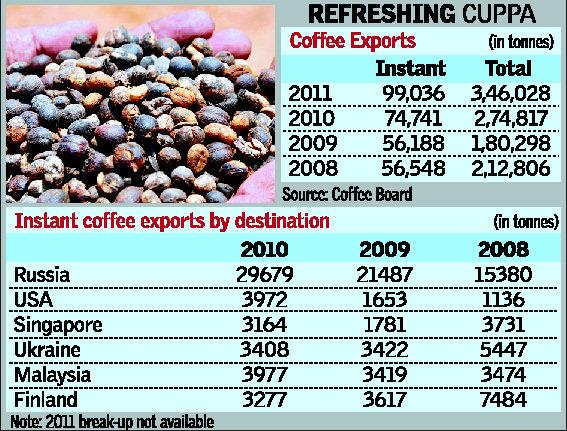
India’s instant or soluble coffee exports have surged by about three-fourths in the past three years on rising demand from the Russian Federation, Eastern Europe, South East Asia and the US. This is mainly on account of consumers in recession-affected Russia and Eastern Europe switching over to cheaper varieties of instant coffee, mainly white or private labels from the branded ones, to cut costs.

The Russian Federation is the largest market and accounts for a third of Indian instant coffees exports. Indian coffee is sold in bulk mainly to private labels in Russia and Eastern Europe. Companies, such as CCL Products (India) Ltd and Tata Coffee Ltd, are major exporters of the instant variety to these countries.

EXPORT PERMITS

For calendar 2011, the export permits for instant coffee issued by the Coffee Board till December-end marginally fell short of the one lakh tonne mark. Total coffee exports registered a 20 per cent growth in quantum to 3.46 lakh tonnes in calendar 2011, over 2010. In rupee value terms, exports grew 63 per cent to Rs 4,859 crore for 2011 over the previous year, while in dollar terms, they were up 65 per cent at $1.05 billion.

“There is a lot of demand for the low-priced instant varieties in Russia, East Europe and Asia,” said Mr Ramesh Rajah, President, Coffee Exporters Association. “Indian companies have been aggressive in pricing their products, which has helped them expand their reach in these markets,” he added

Indian firms import a lot of low-priced raw coffee, mainly the Robusta variety from Vietnam and East Africa to re-export them after converting them into instant coffee. The import of raw coffee for re-exports has shown 18 per cent growth in 2011 at 53,440 tonnes over the previous year. Besides, capacity addition by NKG Jayanti and Vayhan Coffee in recent years has aided the exports, he added.

MARKET SHARE

However, the challenge for Indian firms is to retain their share in these markets as competition grows from Brazil and Ecquador. “With rising costs, the Indian companies will have to fight hard to maintain current level. If they manage to retain their market share, it will be a fantastic achievement,” Mr Rajah said.

India’s instant coffee exports to Russia have close to doubled in the past three years, whereas these have more than trebled to the US.

However, in markets such as Ukraine and Finland, the Indian exports have come down in recent years.

vishwa@thehindu.co.in

source: http://www.TheHinduBusinessLine.com / Agri-Biz / by Vishwanath Kulkarni / New Delhi, January 02nd, 2012

Getting The Brew Right

The Tata Coffee chief gets the brew right to claim the No. 2 title
RANK 2 (MID SIZE COMPANIES)

RANK:2(MID-SIZE COMPANIES)
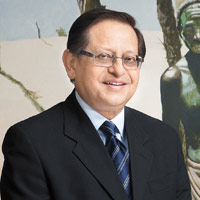
HAMEED HUQ, MANAGING DIRECTOR, TATA COFFEE (Jagadeesh NV)

On a cool November Sunday morning, a threesome waits to tee off on the first hole at the Karnataka Golf Association course in Bangalore. Hameed Huq is convincing one of his partners, a tea drinker, to shift to coffee: the one his company makes. The 60-year-old, Assam-born managing director (MD) of Tata Coffee has spent 35 years in the coffee business. Coffee is a passion, though he admits to drinking just 3-4 cups a day. He is also a Tata Group lifer; the past 13 in Tata Coffee. “For 10 years, growth stagnated,” says Huq. “It is a commodity business, where revenues and growth are volatile.” Tata Coffee is a B2B coffee business — branded coffees are owned by Tata Global Beverages — and subject to the vagaries of the commodity cycle. When he took over as MD in 2007, the company’s revenues from the plantation business were Rs 250 crore. Production cycles were unstable, and quality was not the greatest. His first steps: stabilising the cycle, improving quality and entering the market for specialty, gourmet coffee.

“Our buyers are mostly in the US, though the former Soviet Union countries are a big export market,” he says. His clients include Costa Coffee, Starbucks and Atlantic Coffee. As environmental sustainability is a big factor in developed country markets, green coffee is an area Huq has directed the company to get into; margins are anywhere between 6 and 20 per cent, he says. He is a great believer in technology too. That is only natural; he has studied the processes in Colombia, the world’s biggest coffee exporter.

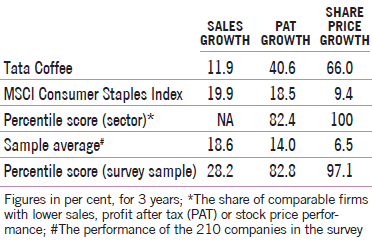
So how did his firm manage to do so well? “How do you drive a commodity business that has no consumer brand?” he asks. “You take out the volatility.” Tata Coffee, which has about 8,000 employees, bought Eight O’ Clock Coffee, the third-largest whole-bean coffee firm by volume in the US. The move has been good for the bottom line, besides giving Tata Coffee a foothold in the US, which contributes about Rs 800 crore in revenues annually. The other Rs 500 crore coming from domestic sales. Whatever Huq has done, it appears to have worked. Sales have grown three times since 2007 and the company’s market cap has grown five times.

The immediate future, however, looks a little grim. Revenues are sluggish, due to the 2008 crisis. Sales in the former Soviet Union countries do not provide high margins. “People are a problem,” adds Huq. “We still need workers, and too many are migrating out of plantations.” Tata Coffee is investing in its workers. For instance, it is ensuring that the living standards of workers and their families are at a level comparable with workers in developed countries. The next three years will be difficult. Recovery from 2008 is likely to be slow and long. If there is a 2011 European crisis, it might be longer. Huq may need to drink more than his 3-4 cups a day, and the coffee will have to be stronger.

(This story was published in Businessworld Issue Dated 26-12-2011)
source: http://www.businessworld.in / Home> Business> Corporate / by Srikanth Srinivas / December 17th, 2011

Ristretto | Tokyo Coffee


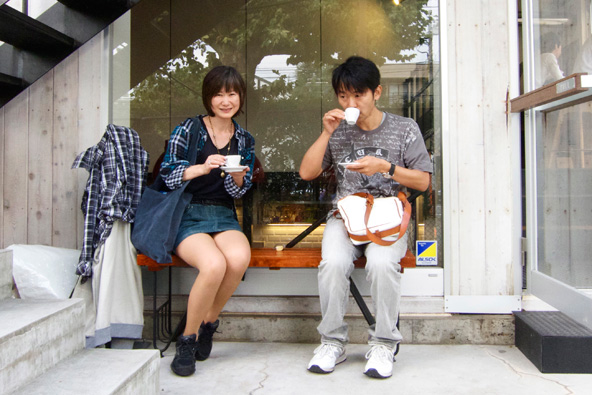
Patrons sit and sip outside Nozy Coffee in Tokyo.
Photographs by Oliver Strand

When I tell people that I went to Tokyo to check out the coffee, I get two reactions. One is bewilderment — as if I went to Denver for the surfing. The other is fascination: those who pay attention to coffee know that Japan is the world’s third-largest importer (after the United States and Germany), with obsessive buyers who regularly land the winning bids at Cup of Excellence auctions, and that it produces the coffee gear everybody wants.

Japan’s interest in coffee isn’t a fad. Dutch traders first introduced the drink a little more than 400 years ago, but it wasn’t until the port of Kobe was pried open in 1868 that coffee became widely available. Soon it was fashionable. Tokyo’s first kissaten, or coffee shop, opened in 1888; by the 1930s there were 3,000 in the city. The supply of beans was cut off during World War II, but once it returned in the 1950s there was another coffee-shop boom. According to Masanobu Kusunoki, director of the UCC Coffee Museum in Kobe, Japan had 160,000 kissaten by the 1960s.

Today, the kissaten are disappearing, replaced by Western-style chain stores and a growing market of home brewing. Still, there are around 80,000 kissaten left in Japan, which are easy to spot in Tokyo. They’re usually small and moody, and have the feel of a bar (stools at a long counter, sunlight kept to a minimum) or a diner (vinyl booths from another decade, lace curtains in the windows). Kissaten are not built for speed — you go to one to collect your thoughts, not for a quick caffeine hit. After you sit down, a waiter shuffles over and puts an ashtray in front of you, then wanders away to give you time to light up before coming back to ask for your order.

And the coffee? Most of what I tasted was dark and strong. Often it was a nel drip, and made with a thick cotton filter. Usually it had all the subtlety of a glass of Jack Daniel’s, which was fine. A kissaten is more about the experience than what’s in the cup.

But a few kissaten are known for the quality of the coffee and the theatricality of the presentation. One of the more regal establishments is Chatei Hatou, which occupies the low-ceilinged ground floor of a nondescript building on a side street in Shibuya.

Chatei Hatou is just a few steps away from Meiji Dori, one of the busiest arteries in Tokyo, but once inside the windowless room you lose all sense of the teeming traffic and L.E.D. billboards that turn the facades of skyscrapers into televisions. There’s classical music playing on vintage speakers, a towering flower arrangement, a wall with hundreds of cups and saucers that range from kitsch (the Beatles) to fine porcelain (Meissen). The best seats are at the bar, where you can watch members of the staff make each cup with the silent focus of a monk at prayer — it’s the posture, the breathing, the unflinching gaze as water is gently poured from a swan-neck kettle into a drip cone. The coffee is prepared with such intensity and grace that it feels as if time has stopped.

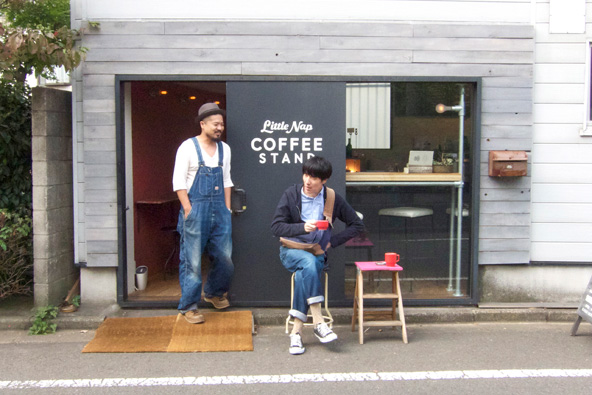
Little Nap Coffee Stand by Yoyogi Park in Tokyo.
Typically kissaten are not so hypnotizing, which could be why Japan’s new coffee generation is captivated by espresso drinks and steamed milk; the land of the rising sun is heavy into latte art.

One exception is Kayaba Coffee, a decades-old shop in a neighborhood behind Ueno Park with hilly streets and walled-in temples that was given a makeover by its stylish new owners. The kissaten is in a 100-year-old house with good midcentury touches — narrow tables and flattering lighting downstairs, tatami mats and Eames chairs on the second floor — and a clientele that ranges from post-university kids in skinny jeans to women of a certain age who have been coming to Kayaba for years. There’s coffee during the day, cocktails at night and video art on the wall.

Most of Tokyo’s notable coffee bars are found in the more fashionable neighborhoods that flank the city’s west. It’s the same story as in San Francisco, or London, or Oslo — they appear where where creative types work (Be a Good Neighbor in Sendagaya), shop (the Coffeeshop in Daikanyama) and live (Little Nap by Yoyogi Park). Some have international followings (Bear Pond Espresso in Setagaya, which was recently profiled in this column), and some soon will (Nozy Coffee in Setagaya).

Some share a storefront with another shop (No. 8 Bear Pond Espresso in Shibuya). And there are those that focus on espresso (Espresso Felice Roaster, in Zoshigaya). There are a handful of syphon bars (Cafe Obscura in Sangenjaya), and a few that put on a show (Streamer Coffee Company in Shibuya and Harajuku), while others are so elegant and pleasant that you don’t mind knowing that what’s in the cup could be better (Omotesando Koffee in Omotesando).

source: http://www.tmagazine.blogs.nytimes.com / FOOD, TRAVEL by Oliver Strand / December 16th, 2011