Category Archives: Coffee News

Freshly brewed: Premium segment fuels tea, coffee growth

MUMBAI:
Like many other consumer goods categories, the premium segment is clearly driving the growth of the Indian tea and coffee market as well. According to market research agency IMRB, the premium segment in tea grew faster in terms of reach and volume compared to non-premium tea this year even as instant coffee pushed the growth in the coffee market. Considering a category like tea, which has almost a hundred per cent penetration in India, consumers are now increasingly opting for value-added, flavoured offerings.

The IMRB data said premium tea grew 11% in terms of volume as opposed to a 4% growth clocked by the nonpremium segment during the January-October period this year compared to the corresponding period last year. On the other hand, instant coffee which is higher priced compared to conventional coffee, grew its volume by 9%. And as consumers upgraded, the volume of unbranded tea declined by 2% while the strong hold of regional players only increased.

“We are seeing that consumers are looking to experiment more with their daily cup of tea. This is where the value-added offerings are being lapped up by people. Tea bags have become commonplace today and niche brands are gaining traction. Expansion in the tea category is clearly coming from this segment,” said Damodar Mall, director, food strategy at Future Group, which runs the Big Bazaar stores. The growth in the tea market is being led by the bigger pack sizes unlike the instant coffee space which is largely dominated by the low unit packs. Premium tea penetration is still at 20% currently in India of an estimated Rs 8,000 crore market.

In the tea category, local brands have continued to rule the roost as they cornered another percentage point and stood at 38% of the overall market. “Regional brands are competing well as their overheads/expenses are less compared to the national brands,” said Piyush Desai, chairman & MD of Wagh Bakri, a strong regional player in the Indian tea market. Hindustan Unilever (HUL) and Tata Global Beverages (TGB), which are the two national players in the tea market, are losing ground to regional players like Wagh Bakri.

According to a recent research report by SBICAP Securities, “Local tea manufacturers like Wagh Bakri and Warren Tea in the hinterlands of India are better able to gauge the demand and cater to the regional taste more effectively than national players like TBG and HUL. Increasing distribution reach in the rural markets is becoming more expensive than in urban markets due to accessibility. Over the past two years, TGB and HUL have both lost 0.5% market share to smaller regional players.”

HUL’s Bru emerged as the single largest penetrated brand in the instant coffee market with a 10% reach driven by its growth in the household reach. Nescafe had a reach of 5% with its volumes growing at 14% during this year, according to IMRB. “The volumes in the premium segment are going up in both tea and coffee as consumers are not restraining from upgrading despite the talk of the slowdown. Instant coffee is growing very well as the in-home consumption reach has now gone up to 16% with a healthy growth rate of 7%,” said Manoj Menon, group business director at IMRB International.

HUL and TGB comprise 40% of the total consumption in India, while they handle 20% of the total tea volumes from the plantations. They sell at higher prices compared to bulk tea sold at auctions due to branding, packaging and distribution. While HUL has premium brands like Brooke Bond Lipton, TGB, an integrated beverage company, has evolved from a tea plantations company to marketing and brand focused organisation. The company has a strong portfolio of global and regional consumer brands like Tata Tea, Tetley, Eight O’Clock Coffee (EOC), Good Earth, Jemca, Grand, Vitax and Himalayan.

GROWTH SIP TEA (ALL INDIA URBAN + RURAL) Tea volume grows by 5% Premium segment grew its reach by 8% Growth driven by large packs Local brands have the highest share in the category at 38% (share grows by 1%) Unbranded tea has 33% volume share-down 2%

COFFEE (ALL INDIA URBAN + RURAL) Instant coffee driving the growth for coffee category Instant coffee has an in-home reach of 16% – growing by 7% Conventional (ground) coffee is stagnant in terms of reach For Bru, growth is coming from smaller packs but for Nescafe large packs are driving the growth Almost 87% of instant coffee volumes are from South alone

Period: Jan-Oct ’11 vs Jan-Oct ’10 Source: IMRB

source: http://www.timesofindia.indiatimes.com / Home> Business> India Business / by Samidha Sharma & Namrata Singh / TNN / December 08th, 2011

Lavazza brews big plans for India

The Italian coffee chain may find the going tough in an already crowded market.

To appeal to the crème-de-la crème, Italian coffee roaster Lavazza is here with a new format Espression. The first of its speciality format recently unveiled in Delhi, will be gradually extended to Bangalore and Mumbai. The company is targeting 30 such stores over the course of three years. Unlike the company’s other international retail formats like Caffe di Roma (Spain), Onda (Bulgaria) and Barista (India), with Lavazza Espression the ambition is to develop a global coffee retail brand.

In India, Lavazza Espression will continue to co-exist with Barista Lavazza and its premium extension Barista Crème. Capuano dismisses any cannibalisation with Barista’s premium format. “Unlike Crème, with Lavazza we will not adapt the taste to the Indian audience as we want to provide a truly international experience,” says Attilio Capuano, Asia and Pacific Director, Lavazza. With Espression, the offering in India will be similar to the menu in its 30 stores across the globe, and prices will be 15-20 per cent higher than Barista Lavazza. To ensure a consistency in taste, Lavazza will train staff at the Fresh & Honest (its coffee vending business acquired by Lavazza in 2007) training centre in Chennai.

According to Capuano, the most critical part of the Lavazza Espression strategy is to identify the right location for the retail footprint. Upscale locations within the metros and zones like international airports will help target expatriates and Indians who are exposed to coffee culture in the West. This will be significantly different from the locations of Barista Lavazza, who is primarily targeting youth. Technopak analyst Purnendu Kumar agrees location is key for premium coffee retailers. “Such retailers who are targeting the office going crowd need to be in close proximity to where the consumer is as these people do not prefer to walk a distance to pick up a cup of coffee,” he says.

For the Turin-based company, increasing retail presence is one of the ways Lavazza is trying to establish ground in India. Today, 65 per cent of the business in India comes from its Fresh & Honest, while 45 per cent comes from Barista and Barista Creme. However, with the new format, the revenue split might get skewed towards the retail business, believes Capuano.

However, making its presence felt is not going to be easy. For one, the market is already crowded with several players expanding their presence. While Tata Global Beverages is bringing the Seattle coffee giant Starbucks to India, the ambition of homespun chain Cafe Coffee Day with a network of 1180 cafes in the country is no less ambitious. It is experimenting with upscale coffee outfits like Coffee Day Lounge and Coffee Day Square. There are international chains like Costa Coffee, The Coffee Bean & Tea Leaf, Java Coffee and Gloria Jean’s Coffee which are ramping up presence in India.

Also, Barista’s track record in India, also might leave us hesitant. For one, the company has changed hands a few times, leading to an inconsistency in management policies. Founder Amit Judge of Turner Morisson sold 65 per cent to Sterling’s promoter C Shivasankaran and the rest to the Tatas. Later, Tatas too exited the business handing over the entire ownership to the NRI businessman Shivasankaran.

“The other worrying factor is that the company shut down close to 40 Barista stores across India, perhaps because they were not doing well,” notes an industry insider who does not wish to be named. “Barista Crème too has not done well, given the differentiation from the base chain was hardly there,” he adds. So, bringing in this new format, where there is higher level differentiation could perhaps put their past behind them.

Lavazza, on its part, is serious about India. This is evident in the fact that it is setting up a new production facility in the country, which will be up and running by 2012. At an investment of 120 crore, the facility, which will be the first one outside Italy, will allow the company better margins which will translate into price advantage for the consumer. Currently, there is 100 percent import duty on green and roasted coffee.

Once the manufacturing facility is up, the plan is to develop 100 per cent Indian coffee blends which can be sold through Fresh & Honest, and later exported to other markets.

source: http://www.business-standard.com / Home> Mgmt & Mktg / by Preeti Khicha & Dilasha Seth / Bangalore, New Delhi / November 23rd, 2011

3 more ICH in Thiruvananthapuram

THIRUVANANTHAPURAM:
Some things endure, like the Indian Coffee House (ICH) and its grand, turbaned bearers. Tough competition from slicker, medium-sized restaurants notwithstanding, the ICH is on an expansion mode here.
In the city, the India Coffee Board Workers’ Society – which operates ICHs – is planning to open three more new outlets in the immediate future. Two are to be opened shortly, at Peroorkada and at the General Hospital. A third one will target Technopark, and will come up on the Kazhakkoottam Bypass next year.

ICH has 11 outlets in the district now, counting the ones at the Kerala Legislative Assembly, the Secretariat and the Corporation. For some time now, as part of a survival plan, ICH has been preferring highways and suburbs as locations for new outlets. Two of the newer outlets are at Venjaramood, for instance.

“We’re moving out to the highways now. If you have an ICH near a busy place such as a hospital, you get a decent crowd. But small families are patronising our outlets more and more and they prefer a place with parking space. One reason why we are moving to the highways,’’ says V T Varghese, society secretary.

Loss-making outlets are readily closed down or shifted to a more profitable location in the same region. For instance, the old outlet in Attingal town was shifted to the nearby highway the other day.
ICH has also approached the government for alternative space at Shanghumugham Beach after the much-patronised open-air restaurant in the Sports Council building was shut for renovation. But it’s feared that the ICH will not be reinstated here once renovation is over.
ICHs offer up to 60 dishes, from ‘desi’ ‘masala dosai’ and ‘vada-chutni’ to carefully-trimmed sandwiches and double omelettes. And that strange dish which only ICHs seem to offer; beef omelette. But experimenting with newer dishes is not on the cards – at least for now, says Varghese.

“Recently, some of our canteens began giving yellow ‘masala’ for ‘poori’ since other restaurants offer it. But the customers made such a ruckus, we immediately moved back to the beetroot-red curry.’’

source: http://www.ibnlive.in.com/ Express News Services, The New Indian Express / Thiruvanthapuram, November 23rd, 2011 /

Indian coffee planters brewing profits

Coonoor (Tamil Nadu) :
Indian coffee planters and exporters are brewing profits like never before due to soaring prices and growing consumption of the aromatic beverage worldwide.

Riding on surging commodity rates globally, producers of the green bean, mainly from Karnataka, and exporters are making a killing as prices in international and domestic auctions rule at historic highs on growing demand despite competition from traditional and new players.

“Indian coffee growers and exporters are on cloud nine as their Arabica and Robusta bean varieties have regained ground and are competing with the best in the world for better prices on growing demand,” a representative of the planters’ body told IANS.

A decade after cyclical highs and lows and lifting of quotas under the World Trade Organization (WTO) regime, the Indian coffee sector is at the cusp of a new era as the latest trends indicate an upward bias in global demand and prices this year too.

“The Indian coffee sector’s export performance last fiscal (2010-11) was outstanding on all counts — quantity exported, value realisation and unit value,” D. Hegde, incoming president of the United Planters’ Association of Southern India (Upasi), said on the margins of its 118th annual meet here, about 70 km from the industrial city of Coimbatore in the plains.

Though production for the coffee year 2010-11 was a tad lower at 302,000 tonnes than the estimated 308,000 tonnes – but 4.3 percent higher than 289,600 tonnes in the previous year (2009-10) – export quantity zoomed to 319,892 tonnes, posting a whopping 63 percent (123,793 tonnes) increase from 196,099 tonnes in the previous year and helping producers to reduce inventory stocks.

Similarly, for seven months from April to mid-October this year, exports were up 20 percent to 201,570 tonnes from 167,624 tonnes in 2010.

The phenomenal increase in export volumes turned into a boom as value shot up by an unprecedented 80 percent to Rs.3,724 crore in 2010-11 from Rs.2,072 crore, an increase of Rs.1,652 crore year-on-year (YoY) as a result of unit value going up 10 percent to Rs.116 per kg from Rs.106/kg in the corresponding period.

In the first seven months (April-October) this fiscal year, export value zoomed to Rs.2,738 crore from Rs.1,681 crore.

“The astonishing increase in export quantity and value augurs well for further consolidation of gains, as prices of other milds (Arabica) are more than double that of Robustas in the auctions conducted by the International Coffee Organisation (ICO),” Hegde asserted.

The upward trend in price of other milds continued to touch 280 cents per pound (lb) during January-September 2011 from 184 cents/lb in 2010, an increase of 53 percent YoY, while that of Robusta rose to 114 cents in the same period from 80 cents in 2010, up 42 percent YoY.

Prices in the domestic auctions conducted by the Indian Coffee Trade Association (ICTA) reflected a similar trend during the first eight months (Jan-Aug) of 2011, with Arabica Cherry beans sold at Rs.199 per kg as against Rs.121 per kg in 2010 and Robusta Cherry at Rs.111 per kg as against Rs.77 in 2010.

With the state-run Coffee Board estimating post-blossom production to be 322,250 tonnes, including 217,725 tonnes of Robustas and 104,525 tonnes of Arabica varieties, the prospect of demand for Indian beans is brighter as consumption in traditional and emerging markets are encouraging.

A steady rise in domestic consumption (108,000 tonnes) notwithstanding, exports constitute over 70 percent of the coffee produced in the country, mostly (98 percent) from southern India, with Karnataka accounting for 71 percent (213,780 tonnes), followed by Kerala at 22 percent (65,650 tonnes) and Tamil Nadu 5.5 percent (16,650 tonnes).

In value too, of the Rs.4,041 crore revenue generated in 2010-11, Karnataka generated Rs.3,018 crore (73 percent), Kerala Rs.693 crore (17 percent) and Tamil Nadu Rs.305 crore (7.4 percent) from exports and domestic sales.

The aromatic beans are grown in the cooler climes of the bio-diverse Western Ghats (mountain region) that straddles across the three southern states.

(Fakir Balaji can be contacted at fakir.b@ians.in)
source: http://www.twocircles.net / by Fakir Balaji > IANS / October 23rd, 2011

Coffee Board to conduct study on consumption pattern

. BANGALORE, OCT. 14:

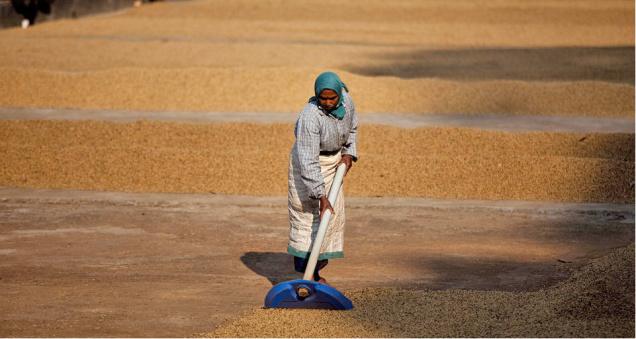
Market research: A labourer dries coffee beans in a field in Coorg, Karnataka. The Coffee Board has invited proposals from market research agencies to carry out a study this year on coffee consumption and attitude to coffee drinking.

The Coffee Board, with a view to capturing the fast changing demographics of coffee drinking in the country, is initiating a study ‘Coffee Consumption and Attitude to Coffee Drinking’.

“The board is planning to carry out a detailed market study with a help of reputed market research agency to understand the patterns of domestic consumption and the attitudes towards coffee consumption,” said a senior Coffee Board official.

“The proposed study titled ‘India coffee market study-2011′ is mainly to capture the key areas of consumption patterns in both urban and rural India with a deliverables of penetration, volumes consumed, and variety of coffee consumed, share of throat, socio-economic groups, awareness of additives,” he said.

As a step towards this, the board has invited proposals from reputed market research agencies to carry out the study this year.

Through the study, the board is expected to collect information from the instant coffee manufacturers, café chains and their growth pattern, roasters and retail segment.

The study comes in the light of increasing domestic consumption. According to the Coffee Board data, country’s coffee production for crop year 2010-11 stood at 302,000 tonnes and provisional domestic consumption for 2010 is estimated at 108,000 tonnes.

The official said: “This year along with other routine market data study, the image of the beverage in the minds of consumers with respect to quality, variety, price, additives, awareness of additives such as chicory, positive and negative associations related to consumption as well as drivers and barriers to coffee consumption is also to be captured.”

The Coffee Board has been conducting such studies since 2001 when it hired Brazilian coffee marketing consultant Carlos Brando to boost domestic consumption and its outcomes have been shaping domestic strategies, especially in non-coffee market areas.

source: http://www.thehindubusinessline.com / agri-biz / by Anil Urs / October 14th, 2011

Australia’s best coffee hit

Australia’s favourite food blogger, Not Quite Nigella, aka Lorraine Elliott, journeys to the Tablelands, travelling in the footsteps of the likes of Elizabeth Taylor and Lady Spencer.

So after my judging and eating hijinks in Port Douglas, where’s a girl to go but south, literally, in search of some of the Tablelands’ most well-known producers including two coffee plantations, a distillery, a Swiss Italian restaurant, a coffee museum, cheesemakers and a rainforest retreat.

Skybury Coffee Plantation

I always thought that one would have to travel overseas to see a coffee plantation but apparently I was so very wrong. We are at Skybury Coffee Plantation, Australia’s first and largest coffee plantation in the Atherton Tablelands in Queensland, which is about one-and-a-half hours drive from Port Douglas. We have just enough time to have a coffee (and a very good one as you would expect) before we get onto a bus to take a tour of the coffee plantation.

John, our guide, first drives us through the farm – which grows papaya and lady finger bananas as well as coffee beans…

We are soon onto where the coffee bean trees are growing. Coffee is a tropical plant and here they only grow arabica beans (as opposed to the robusta, which is an inferior bean used in less expensive coffees). This arabica coffee bean comes in both red and yellow and is best grown at altitudes of 500-1500 metres high (it is 525 metres here)…

We pluck one of the cherries and they are a rubied red and resemble small, hard berries. There is a thinnish but firm outer layer, like a thick grape skin and inside is a very, very sweet, thin juicy layer which is similar to a longan or lychee. Inside this is the actual coffee bean which is pale yellow in colour and covered in a slippery membrane called a mucosa.

To pick the beans they use an automated picker from Brazil that is very similar to an olive harvesting machine. Fibreglass rods rotate through the trees and the cherries fall off, with harvesting taking about two months in total. Per hectare they get about 1 tonne of wet cherries which are then dried out and lose 75 per cent of their weight to make 250 kilograms of beans. They then lose another 17 per cent in the final drying process to remove as much moisture as possible as moisture can cause mold.

They sort these first through water and the premium beans float to the top. Most of their beans are exported overseas to markets such as London, Paris, Berlin and even Italy and they export a special bean to Japan called a peaberry as the Japanese are drawn to its sweeter taste…

It’s lunch time and having missed breakfast, I’m starving. There is a café-style menu available incorporating a caesar salad with a twist – instead of offering it plain with bacon or with chicken, there is the option for salt and pepper squid. I take that option up along with a papaya shake and a slice of banoffee pie.

The drinks are not cheap but the papaya shake is delicious. It lacks that really strong papaya aroma that divides people and there’s just the right amount of creaminess. I rarely have more than a sip of a milkshake as they can be meals in themselves but I find myself drinking half of this.

The thing about travelling to other areas is seeing great ideas such as salt and pepper squid on a caesar salad and doing it at home. The squid and the salad go well together, but then again the anchovy component and caesar dressing go well with salt and pepper squid. There is also a generous amount of bacon among the cos lettuce leaves and cheese.

When asked if we were ready for dessert there was a resounding yes. We start with the pancakes which were said to be served with maple syrup but instead they put a butterscotch sauce and bananas. Delicious! Four bites later and I was still going.

The caramel and macadamia tart is very sweet, thick and rich and should best be attempted with low blood sugar levels (which never happens on these trips).

I wasn’t such a huge fan of the banoffee pie crust and there was an odd slightly tart chopped up fruit in the caramel part which I didn’t think worked. If they had used the caramel filling from the above tart then it would have been much better. But who’s quibbling, I’m back on the pancakes…

A royal dinner

We’ve arrived at our final destination for the day and our accommodation for the evening, Cedar Park Rainforest Resort, deep in the rainforest.

Christoph, the chef at the resort’s restaurant, has cooked for Elizabeth Taylor, Lady Spencer, Isabel Lucas and the Prince of Malta. Here they don’t do so much fine dining as their clientele is mainly locals who don’t necessarily want it, but it is simple and well executed cuisine.

Rosy and Christoph are excellent hosts and very accommodating and they tell us stories of when guest Daryl Hannah came to stay and how the other guests knew who she was but didn’t bother her as they understood the resort to be a place to escape to. The menu is a mix of European dishes along with some Asian dishes and as it has to cater for locals, they open up the restaurant to the public on Fridays to Sundays.

I’m not a huge eater of dukkah as I find it quite dusty tasting, but this one doesn’t have any ground cumin or ground coriander which usually contributes to the dusty aspect. Instead, this is full of toasted seeds and nuts which make it much more appealing. The ciabatta bread is soft inside and more like Turkish bread and is excellent dipped in the olive oil and dukkah. The chicken liver pate is slightly coarser than how I make it and it is topped with a layer of aspic. It has a great flavour and is so moreish that even though we don’t intend to eat much of it, we end up finishing it.

The pumpkin and coconut soup is served with feathering patterns and is divinely smooth with the right amount of coconut and seasoning. And it is nice to have a big bowl of hot soup because whilst it isn’t what one would call cold, it is chilly at night.

The pan-fried duck breast comes topped with an onion confit and a tangy but sweet balsamic jus served with a lemon risotto cake. It’s a sizeable serve and the duck is cooked right through.

Now what I didn’t quite budget on was the sizes of the dessert. In fact this half scallop shell dish was deep and large. There is a thin toffee crust and the brulee underneath is smooth and redolent with lime and ginger. All I can think is how Mr NQN would love this. It comes with a portion of dragonfruit, which reminds me of a mild kiwifruit (but in a vivid fuchsia shade) and a moreish vanilla butter cookie. The pistachio ice cream is more almond than pistachio (it’s that pistachio paste that is mixed with the almond I presume).

Using Swiss milk chocolate the chocolate mousse is boat-sized! It has swirls of airy, smooth chocolate mousse, whipped cream and a vanilla butter biscuit on top.

I’m a little fuller than I had intended and I soon retire to my room where there’s nothing but the sounds of silence.

source: http://www.businessspectator.com.au / Australia / by Lorraine Elliott / October 14th, 2011

Confessions of a Starbucks junkie

Thanks Ratan Tata! Starbucks in India is long, long, long overdue, I thought, while sipping my Starbucks and reading the morning paper. We were being told that Starbucks and Tatas are brewing up a JV and I was excited, relieved and slightly nervous. My life was set to change.

You see, what Hard Rock Cafe was to me as a teenager, Starbucks is to me as a young adult. It’s a profoundly significant part of Being Paarull and has been over the past six or seven years, I’d say, growing in importance every year. Let me explain.

Before Starbucks, fresh coffee was a treat to be had at a five star hotel. I grew up on the blend of chicory and coffee that was consumed as milky instant coffee in most middle class homes. It was coffee – but just about. Barista had barely arrived on the scene but it was Starbucks, on a trip abroad, that introduced me to freshly brewed, chicory-less coffee, sourced from exotic Indonesia or wherever else and roasted and ground by professionals who knew their stuff. I was hooked with my first cup and never looked back. Starbucks made me feel grown up, even a little affluent, considering the price of a cuppa.

What began as an indulgence turned into a ritual during a year spent in England and, before I knew it, I had become a full-fledged member of the global Starbucks cult. And I have stayed a faithful junkie. When I arrive in a new city, one of my first tasks is to locate the nearest Starbucks. I try and hold my meetings at a Starbucks. I spend much of my spare time either at a Starbucks or with a Starbucks. A Barnes & Noble or a JC Penney has to be found, so I can pick up Seattle’s Best coffee, part of the Starbucks group. I try and wrap up my trip to a Starbucks city with a final coffee there, and I make it a point to spend time at a Starbucks at the airport, if there is one, on my way out.

And then there’s Peet’s coffee, more difficult to find than Starbucks because there are fewer outlets in comparison, but which I heartily recommend. (I first got lucky with Peet’s in Portland, Oregon ). Peet’s is actually a smaller rival chain but I adore it because its founder was the one who advised the Starbucks’ founder trio to get into the coffee business! By the way, you’d have no trouble finding Starbucks in San Francisco. I can’t verify this (maybe it’s an urban legend) but apparently it has more Starbucks per square mile than any other city in the world! And apparently, they are no longer allowed to open another Starbucks there!

The drip coffee maker is a relatively recent addition to my life and it has converted an occasional indulgence into a soothing routine. My day begins with two mugs. My day usually ends with one more — call it a night cap if you will. Holidays mean consuming upto 5 mugs of Starbucks. I realise I’m lucky because I can afford to invest in a top class coffee machine and I have a very supportive family and friends. They go the extra mile in every continent, every city they might be in to get me my Starbucks – from Dubai, LA, Tokyo, London wherever. I too have gone through secondary screening at American airports because of freshly ground Starbucks in my hand baggage. No matter! It’s worth the effort!

But now, with Starbucks set to brew up in my home city, my life will change.

The good news is I’ll no longer be stacking up IOUs. I will be the master of my own coffee destiny. Starbucks will always be round the corner – Woo Hoo! Never ever will I fall short of it! Never ever will I be forced to drink the non-Starbucks stuff (ugh). Also, I think it’s very very cool Starbucks in India will brew me a Tata coffee. High quality Coorg beans, I’m betting, can give Indonesian java a run for its money.

And what about me chasing Starbucks abroad? That drill may be toned down. I’m now thinking of devoting time, effort and money to scouting Nespresso boutique bars.

source: http://www.ibnlive.in.com/blogs/paarul  / by  Twitter@paarul / Tuesday, October 11th, 2011


India witnesses rise in coffee exports

The Coffee Board of India has revealed that the country’s coffee exports in the 2010-11 coffee year have increased by about 34% to 3.58 lakh tons, compared to 2.68 lakh tons in 2009-10 coffee year.

The board has attributed the jump in coffee exports to the rise in global demand. According to the data from the board, Coffee exports in value terms increased to $1.048bn from $577.98m on higher realizations.

The coffee shipments of the country rose by 30% to 2.92 lakh tons, compared to 2.24 lakh tons in the corresponding period last year in the first nine months of the current calender year, reported Press Trust of India.

The exports from the country in the April-September period of the current fiscal also rose by 25% to 1.92 lakh tons from 1.53 lakh tons in the year-ago period.

India, which largely exports coffee to Italy, Germany, Russia, Belgium and Spain, accounts for 4.5% of the global coffee output, but exports 70% to 80% of this.

source: http://www.markets.drinks-business-review.com / by DBR staff writer/ October 04thy, 2011


Heads-up: Thursday is National Coffee Day! (in the U.S)

Take note that Sept. 29 is National Coffee Day, a day when we should all get really wired on free coffee, skip work and participate in bicycle races and pony rides.

OK, so maybe the free coffee is enough. Here’s where you can get it:

1. 7-Eleven. The chain is giving away free medium cups of java from 7-11 a.m. in your time zone.

2. Krispy Kreme. The stores are offering a free 12 oz. cup of House Blend Coffee all day tomorrow. Get on it!

source: http://www.content.usatoday.com / by Whitney Matheson/ USA TODAY / September 28teh, 2011

UCC Coffee Museum: Kobe, Japan

UCC Coffee Museum

This museum is arranged building from UCC Coffee Hall which was the one of the pavilions at Kobe Port Island Exposition from 1981. This is the only museum in Japan that has a theme of coffee. When the time of Expo, the coffee cup was motif of this building, but after the renewal of 1987, it changed to Islamic style that is looks like the mosque. There is main head office building of UCC is nearby that the museum is directory connected.

It has display process of coffee which starts from origin of coffee, plantation, marketing, and processing that has explained in chronological order. And introduction to the culture of the coffee how you enjoy, and the history of UCC in film and panel, and you can also see the CM and the coffee-can design that has used before. The name of UCC was in animation drama Evangelion New Theatrical Edition: Break that there is the display of commemoration panel which has autograph of director and the person in charge of 2D digital work of the animation. UCC has been producing the coffee with can design of Evangelion’s characters called Eva-cans that somehow they are related with Evangelion.
There is a coffee shop: Coffee Road where you can enjoy the coffee from all over the world, and the menu are special that you can only find in here. There are activities related to coffee that you can participate with the advanced reservation. The Coffee Seminars are held quite often that it is fun museum for coffee fans.

Click on the photo for enlarged view

Basic information

Hours Museum 10:00~17:00 (Last admission 16:30)

Coffee Shop 10:00~18:00 (Last order 17:30)

Closed

Every Monday( If the Monday falls on holiday, it will be opened and next day will be closed)
The following day of holiday
New year holiday
There might be some exceptional opening day.
Check the official site for more details.

Admission Fee

Adult 210yen
Child 100yen
Coffee Shop: Coffee Road (coffee shop doesn’t require admission fee)

Address

Minatojimanakamachi 6 chome 6-2,
Kobe Chuo-ku, Hyogo,
650-0046 Japan
TEL:078-302-8880
FAX:078-302-8824
Access

Kobe Shin-Kotsu Port Island Line: Minami-Kouen-eki

Website  http://www.ucc.co.jp/museum/

source: http://www.jin.jcic.or.jp / Home> Kobe Travel Guide /