Monthly Archives: August 2013

Coffee Board ups output forecast to 3.47 lakh tonnes

CoffeeBlossomKF03aug2013
‘Crop to drop by 20% due to weather-related problems’, says KPA
Bangalore :

Despite rampant white stem borer (WSB) menace and long days of dry period after blossom, coffee production is set to increase by 28,800 tonnes (9.05 per cent) over the final estimate of previous year 2012-13 (3,18,200 tonnes).

The Coffee Board, which released the post-blossom crop forecast, said for the year 2013-14, coffee production is estimated at 3,47,000 tonnes.

Of the total estimate, the arabica and robusta break up is 1,11,000 tonnes and 2,36,000 tonnes respectively. Arabica production has shown an increase of 12,400 tonnes (12.88 per cent) over the final estimate of 2012-13, while robusta increased by 16,400 tonnes (7.47 per cent).

By the states, the production gain has mainly come from Karnataka to the tune of 18,890 tonnes (8.21 per cent) and non-traditional areas (NTA) with 1,780 tonnes (28.57 per cent) while Kerala has shown an increase of 6,350 tonnes (9.89 per cent) and Tamil Nadu by 1,755 tonnes (10.10 per cent) compared to the previous 2012-13 season’s final estimate.

“Due to the drought like conditions (April-May), the crop setting in arabica and robusta has been severely effected. Also there were many incidences of WSB in arabica plantations.

The Karnataka Planters’ Assocation (KPA) estimates that there will be a drop of 20 per cent due to this weather-related problems, said Nishant R. Gurjer, Chairman, KPA.

In Karnataka, all the three districts recorded increase in production over the previous year with an almost equal share of arabica and robusta. Kodagu district recorded the highest increase of 14,420 tonnes (12.02 per cent) which is mainly accrued from robusta (11,620 tonnes or 11.77 per cent) and arabica gained by 2,800 tonnes (13.15 per cent).

Hassan district recorded an increase of 3,535 tonnes (10.84 per cent) which has come from both arabica (2,635 tonnes or 14.02 per cent) and robusta (900 tonnes or 6.52 per cent).

While Chikmagalur showed an increase of 935 tonnes from Arabica, the robusta production showed a decline of 2,940 tonnes (-7.30 per cent) over the previous year final estimate.

“Due to prolonged and unprecedented drought of over 50 days, there has been a spurt in the WSB pest that has devastated the arabica plants. We have also been unable to carry out the regular operations like spraying and manuring on time due to lack of rains in May. As for robusta, due to severe constraints of power and water resources, we were unable to cover our entire area for blossom and backing irrigation. We feel the blossom estimate may have to be revised further downward in view of prevailing conditions,” said Sahadev Balakrishna, Partner, Netraconda Estates, Chikmagalur.

“The arabica production regained in 2013-14 season in Karnataka mainly because of the biennial bearing nature of arabica as last year’s final estimate was low,” said the coffee board official.

The blossom showers are reported to be normal in all most all the coffee growing zones, while there was a delay in backing showers in certain pockets were reported. “In general good crop condition and better husbandry practices have helped to invigorate production in Karnataka. The crop forecast for Karnataka is placed at 86,735 tonnes of arabica and 1,62,380 tonnes of robusta totalling 2,49,115 tonnes,” the official explained.

Kerala coffee zones also have received adequate and timely blossom and backing showers. There was no adverse effect on crop was reported.

Accounting this, the post-blossom estimates for the 2013-14 is placed at 70,550 tonnes, which is an increase of 9.89 per cent (6,350 tonnes) over the previous 2012-13 final estimate of 64,200 tonnes.

Tamil Nadu post-blossom forecast is placed at 19,125 tonnes which also showed an increase of 1,755 tonnes (10.10 per cent) mainly in Pulneys and Shevroys region against the previous year final estimate of 17,370 tonnes.

In non-traditional areas of Andhra Pradesh and Orissa and north eastern region, the post-blossom forecast is placed at 8,210 tonnes against previous final estimate of 6,405 tonnes.

The higher forecast has come mainly from Andhra Pradesh and Orissa due to increase in bearing area.

2012-13 production was 3,18,200 tonnes

The final coffee production 2012-13 estimate is 318,200 tonnes, an increase of 2,700 tonnes (0.86 per cent) over the post monsoon estimate of 315,500 tonnes and an increase of 4,200 tonnes (1.34 per cent) over the previous year’s 2011-12 final estimate of 314,000 tonnes.

The Coffee Board, which released the final crop estimate for 2012-13, said of the total final estimate, the share of Arabica is 98,600 tonnes and that of Robusta is 219,600 tonnes.

The production of Arabica has shown a marginal decline of 1625 MT (-1.62 per cent) while Robusta increased by 4,235 tonnes (2.01 per cent) over the post-monsoon estimate made before crop harvesting in 2012. The loss in Arabica production and the production gain in Robusta has mainly come from Karnataka.

The final crop estimate for Karnataka is placed at 230,225 tonnes with a break up of 77,425 tonnes of Arabica and 1,52,800 tonnes of Robusta. The final production in Karnataka has shown a marginal increase of 3,020 tonnes (1.33 per cent).

The Arabica production has marginally declined in Chikmagalur (-1.32 per cent), Kodagu (-1.87 per cent) and Hassan of (-1.96 per cent) districts, while Robusta production shown an increase in Chikmagalur (8.33 per cent), Kodagu (1.15 per cent) and in Hassan (0.55 per cent) districts.

In Kerala, the final estimate of 2012-13 is placed at 64,200 tonnes with an increase of 375 tonnes (0.59 per cent) from the post monsoon estimate of 63,825 tonnes.

Tamil Nadu final production of 2012-13 is placed at 17,370 tonnes which is a marginal decline of 380 tonnes over the post monsoon estimate of 17,750 tonnes.

In the Non-Traditional Areas and North Eastern Region, the final estimate of 2012-13 is placed at 6,405 tonnes against post monsoon estimate of 6,720 tonnes which showed a marginal decline of 215 tonnes in Andhra Pradesh.

source: http://www.thehindubusinessline.com / Business Line / Home> Industry> Agri-Biz / by Anil Urs anil.u@thehindu.co.in / Bangalore – July 22nd, 2013
Mangalore University to offer five new courses

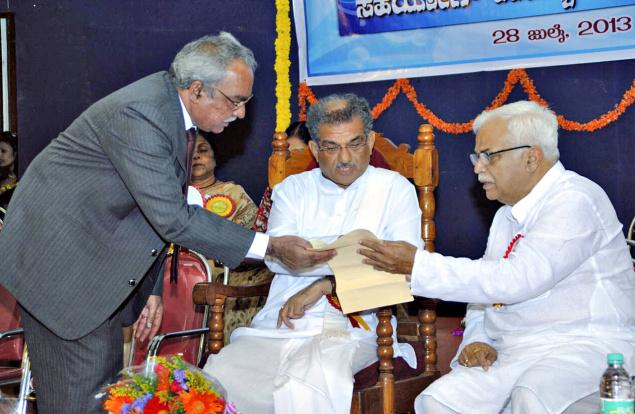
Vice-Chancellor T.C. Shivashankara Murthy, Dharmasthala Dharmadhikari D. Veerendra Heggade, and Higher Education Minister R.V. Deshpande at inauguration of a job fair at SDM Business Management College in Mangalore on Sunday. / Photo: H.S. Manjunath / The Hindu

Extend last date for admissions for the courses till August 15, says Minister for Higher Education and Tourism R.V. Deshpande

Minister for Higher Education and Tourism R.V. Deshpande said here on Sunday that the government has permitted Mangalore University to offer five new courses, including post-graduate, diploma and certificate, from the academic year 2013-14.

Addressing presspersons, the Minister said the university has been permitted to offer post-graduate courses in Bharatanatyam (Master of Arts) and Food Science and Nutrition (Master of Science), certificate courses in radioisotopes in biological science and visual arts, and diploma and post-graduate diploma courses in Kodava language and culture.

Field Marshal K.M. Cariappa College, a constituent college of the university at Madikeri, would offer the diploma and post-graduate diploma in Kodava language and culture. Any other colleges affiliated to the university can come forward to offer the two post-graduate courses. The certificate courses would be offered by the university.

Mr. Deshpande said that as the admissions for the current academic year at the university would close on July 31, he had directed the university to extend the last date for admissions for the five courses until August 15 as they were sanctioned recently.

According to P.S. Yadapadithaya, Registrar (administration) at the university, the University Science Instrumentation Centre (USIC) on the university campus would offer three-month certificate course in radioisotopes in biological science. N.G. Pavanje Chair in Fine Arts, an endowment chair, would offer a 16-week certificate course in visual arts. The diploma and post-graduate diploma in Kodava Language and Culture were of one-year duration each. The college would also offer a six month-certificate course in Kodava Language and Culture. The post-graduate courses were of two-year duration, but the university would not offer them in the current academic year.

Another official at the university said the university was yet to receive the formal approval letter to this effect from the government.

LOAN MELA

Mr. Deshpande said that 53 lakh students aged between 18 years and 25 years were out of higher education in the State and only 17 lakh were pursuing further studies. To increase the enrolment ratio of youth to higher education, the government would organise educational loan melas to provide financial support to youth to purse higher education. He did not make it clear when and how many such melas would be organised.

Earlier, he addressed a gathering at a job fair organised by the Department of Collegiate Education to graduates of government degree colleges of Dakshina Kannada, Udupi and Kodagu districts in the city.

source:http://www.thehindu.com / The Hindu / Home> News> Cities> Mangalore / by The Hindu, Special Correspondent / Mangalore – Julu 29th, 2013

Off the beaten track in Somwarpet

A nondescript town in the lap of the majestic Pushpagiri mountain, Kumarahally’s geography makes it the perfect place to look for some solitary adventures, writes B V Prakash

Not all those who wander are lost, said a great man once; it surely must be the love of adventure. During my latest visit to Coorg, I decided to give the usual sights a miss and filled with an urge to explore the unseen, I deviated towards Somwarpet to drive through the primitive villages spread across the mountain ranges of the majestic Pushpagiri.

The destination was the nondescript town of Kumarahally. Also called Kumarally (in short), this town has nothing to boast of as a tourist destination; it is just one of the many small towns with similar names such as Shantalli, Kundalli, Bidalli and Bachalli through which one has to pass. However, it serves as a good base from which you can foray into a couple of interesting and exciting locales.

Leaving Somwarpet by afternoon, I headed north-west, breezing past the lush coffee estates and the green fields shining bright in the afternoon sun. After about five kilometres, a deviation to the left led me to a rustic settlement. Named Abbi Matha, this settlement is a religious place where devotees come for worship. But for others, it is a popular picnic spot thanks to the presence of the Abbi Matha Falls. The two-tier cascade may not steal the show, but it is impressive in its austere simplicity — surely an interesting diversion to break the 20-km journey to Kumarally. A dilapidated mutt premises can be visited here. Getting back on the track, I continued my journey towards Kumarally; the remaining journey was covered in half an hour and before dusk, I had reached my destination. The homestay at Kumarally — there is only one — is the ideal place to spend the night before exploring the locales nearby.

The nearest and most sought after sight here is the enchanting waterfalls of Mallalli. If you take the kuchcha road that goes beside the homestay, within a little less than three kilometres, you reach the famed waterfalls. However, driving on the slippery muddy stretch into the valley is indeed a torture. Mornings are the ideal time to visit the falls which are a sight to behold during sunrise. So at dawn, while still dark, I headed for the falls. After driving two kilometres on the treacherous path, I chose to walk the remaining way which proved to be a pleasant experience thanks to the fresh air and the sweet call of the birds. As I reached the edge of the wide gorge, I was left dumbfounded by the sheer beauty of the white cascades rolling down gently. I had all the time in the world to admire its beauty and also walk down all the way to its base.

From the front, the two distinct falls, each with its own form, appeared even more charming. The river Kumaradhara, which flows from here, tumbles down over short drops at a couple of places before joining the Netravathi at Uppinangadi. Rejuvenated from the astounding beauty in front of me, the tough climb back hardly mattered. On the way, I remembered the suggestion of my host Ponnappa and traced a trail through the coffee estates to see an unknown little falls which he said was called the mini-Mallalli falls.

Back at the homestay, after relishing a typically Coorgi breakfast of Votti (rice chapathi) and a cup of refreshing coffee, I drove up to Heggademane, a sleepy town six kilometres away. These places are familiar to trekkers as the trek to Pushpagiri begins from here. But you don’t have to be one to enjoy the panoramic view of the tall rounded peak rising into the blue sky from a lush forest. The Shantamallikarjuna temple here is worth visiting. In recent times, it has undergone a thorough improvement. The 850-year-old Champaka tree in the backyard is something that must not be missed.

Another interesting spot nearby is a hilly tract called Pattepare, which has some strange heaps of stones. Placed in triangular cairns of pebbles with a small opening, these were used as hideouts by erstwhile soldiers in times of battles, according to Ponnappa. There are also caves with narrow entrances. Though the whole place looked bizarre, it did evoke a feeling of belonging to a bygone era. With the sight of the mountain peak, the charming falls, the temple and clusters of age old cairns, Kumarally had me captivated.

How to get there

Kumarally is 20 kilometres from Somwarpet which is well connected with other cities. Though buses go to Kumarally it is easy to visit the spots with own transport in a day. The only homestay here provides food and accommodation.

source: http://www.deccanherald.com / Deccan Herald / Home> Supplements> Spectrum / by B V Prakash, DHNS / July 30th, 2013