Monthly Archives: April 2014

Colours of Tibet in Bylakuppe

BylekuppeBF04apr2014
A serene Buddhist monastery, lush green forests and the river Cauvery seem to have charmed Chitra Ramaswamy. Join her on this placid journey.

Driving from Bangalore to Madikeri via Mysore, we digress a little at Kushalanagar, 40 km from Madikeri, to visit Bylakuppe, one of India’s oldest and largest Tibetan settlements, also known as Lugsung Samdupling when it was created in 1961.

As we turn off the dusty highway connecting Mysore to the lush hills of Coorg, we travel through narrow winding roads on undulating terrain flanked by paddy fields and come upon a mini Tibet, sans snow and the Himalayas. Burgundy-robed monks are everywhere about, on foot and bikes, laughing and chatting merrily in a little world of their own, far away from the humdrum of urban civilisation to which we city dwellers have become accustomed.

Despite the serene and spiritual atmosphere that prevails here, the residents of Bylakuppe remember the flutter created when tinsel town star Shah Rukh Khan arrived here in August 2001 before the October-release of his film Ashoka, to seek the blessings of the Dalai Lama.

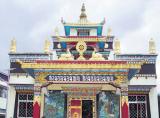
Divine sanctuaryThe foremost attraction of Bylakuppe, a compact world with its own value systems, is the massive Thekchog Namdrol Shedrub Dargye Ling or Namdroling Monastery as it is popularly known. The imposing golden spires of the monastery and the huge rainbow arch-like structure appear well before we actually come upon the edifice.

Namdroling is supposedly the largest teaching centre of the Nyingmapa lineage of Tibetan Buddhism in the world and was established in 1961 by Pema Norbu Rinpoche on land that the Indian Government had granted to Tibetan exiles. The story of the Tibetan settlement at Bylakuppe goes back to 1959 when the Dalai Lama fled to India, seeking political asylum. The monastery, according to the inhabitants of Bylakuppe, was consecrated and given its name by the Dalai Lama. While the village is home to about 50,000 Tibetans, the monastery itself houses nearly 5,000 monks and nuns whose living quarters circumscribe the golden temple. The architecture of Namdroling is a beautiful fusion of traditional Tibetan style built with modern materials.

The path to the monastery is flanked by well manicured lawns. 58 to 60 feet gold-plated idols of Guru Padmasambhava, Buddha Amitayus and Shakyamuni adorn the main sanctum sanctorum which is actually an expansive hall that contains smaller Buddha statues as well. Padmasambhava who was instrumental in spreading Buddhism to Tibet and Bhutan, we learn, is viewed as the Second Buddha while the Amitayus are celestial Buddhas.

Except for the sound from numerous shutterbugs, silence pervades as monks offer prayers and spin the large prayer wheels. The uniquely attractive Tibetan thanka paintings on the inner and outer walls of Namdroling, in bright bold colours narrate the life of the Buddhas.

The paintings, we learn, are based on mathematical calculations, exclusively a Tibetan cultural preserve. Further, the colours used in this art form are intense and the murals themselves represent various elements of Buddhist cosmology. Following several other tourists, we too rotate the several prayer wheels that line one end of the monastery, believing it would usher in good luck and prosperity.

While Namdroling in Camp 4 is the crowd puller, Bylakuppe is dotted with five distinct camps, each of them immaculately clean and housing several monasteries, temples and residential buildings.

The more popular of these include the Sera Mey and the Sera Jey Monastery, the latter having been modelled after the original Sera Monastery in Tibet, now in ruins.

Before we proceed to a couple of tourist spots neighbouring Kushalanagar, we visit Bylakuppe’s other big attraction, the Tibetan shopping complex with its array of colour ridden wares that include souveneirs, garments, handicrafts and artefacts, hand-made by Tibetans.

In addition, there are outlets selling freshly baked thupkas, the Tibetan bread and piping hot momos with a range of homemade Tibetan sauce.

Forest havenHaving deviated from our destination Madikeri, to visit Bylakuppe, we decide to digress a little more and hop over to Kaveri Nisargadhama, 3 km from Kushalanagar and the Harangi Dam, 8 km away.

We walk the rope bridge over the Kaveri River to enter the man-made, ecological island park of Nisargadhama, a picnic spot replete with facilities to entertain weekenders.

Verdant with bamboo, teak and sandalwood forests, and an orchidarium, the 64-acre sprawl is home to tree-top dwellings and guest houses operated by the forest department. We spot several families with children enjoying elephant rides and boating in the waters’ of the Kaveri.The ambience around Harangi is more mellow and calm with few picnickers strolling along designated paths.

The water deluge is refreshing and wonderful to watch as it constantly tumbles from a height of about 45 metres. Incidentally, the 846m long dam is believed to be the first dam built across the Kaveri River.

However, Bylakuppe remains the highlight of our trip and leaves us enchanted – with its pine trees, misty hills and tranquil environs, a distinctively Tibetan ambience and above all, its easy pace of life.

source: http://www.deccanherald.com / Deccan Herald / Home> Supplements> Spectrum / by Chitra Ramaswamy / March 25th, 2014
Madikeri: Mass Campaign on Transparency in Governance Kicks-off

Madikeri :

Rotary Club International (RCI) district 3180 – Right to Information Act Committee district president B Pundalika Marate Shirva offered motion for an awareness campaign on transparency in governance that was held at Madikeri Rotary auditorium, organized by RCI Misty Hills, here on Sunday March 23.

Pundalika also released a Kannada book – Governance by the people, for the people, authored by Harish Poovayya Kodagu, advisor of corruption-free governance for social service organizations functioning in India, Nepal, Sri Lanka, Zambia and Kirgizstan, on the same occasion.

RCI zone 6 assistant governor Ravindra Rai, RCI – Misty Hills president Dr Prashant, RTI activist Harish Poovayya, RCI secretary G R Ravishankar, office bearers of RCI, Lions Club International and heads of social service organizations were also present.

source: http://www.bellevision.com / Bellevision.com / Home / by Pundalika Marate, Bellevision Media Network / Madikeri – March 24th, 2014

‘Rajara Gadduge’ gets ` 20 lakh for renovation

Funds will be utilised for renovation and electrification
RajaraGuddigeKF04apr2014
The State government has released Rs 20 lakh for the renovation of Rajara Gadduge, one of the historical tourist spot near Banni Mantapa in Madikeri.

The State government has earmarked the funds for the renovation work in the last budget and has handed it over to archeological department.

The responsibility of the conservation of the Gadduge has been handed over to the archeological department. The department is getting ready to renovate three mausoleums. The funds have been deposited to the account of the department last month.

Tender was invited for the renovation work. However, no bidder had come forward to take up the work. Now, the department is thinking of taking up the work on its own or call for a re-tender. The decision on the same will be taken up after the Lok Sabha polls, said Archeological department Assistant Officer Sathish.

In the released amount, the work on electrification, painting and renovation of mausoleum of Raja Purohith Rudrappa situated on the left hand side of mausoleums of Chikkarajendra and his wife will be taken up, he said.

The Madikeri Urban Development Authority had laid a park at the Gadduge two years ago. However, owing to lack of maintenance, the park is crying for attention.

Visitors said “the park should be maintained well. Information boards should be installed at strategic locations in and around Madikeri city to furnish details on the Gadduge.”

On Gadduge

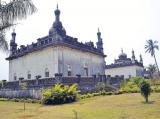
Rajara Gadduge is the mausoleum of the former kings of Kodagu namely Doddaveerarajendra, Lingarajendra and Rajaguru Rudrappa. Gadduge has two identical square structures, which are the tombs of the king Doddaveerarajendra and his queen.

They are close to each other, built in Indo-Sarcanic style, flaunting domes and pillars. There is tomb of Lingarajendra which was built by his son Chikkaveerarajendra in 1820. There is a tomb of Purohith Rudrappa which was built in 1834.

There are tombs of commander-in-chief Biddanda Bopu and his son Biddanda Somaiah, who were killed in their fight against Mysore Emeperor Tippu Sulthan.

source: http://www.deccanherald.com / Deccan Herald / Home> District / DHNS / Madikeri – March 23rd, 2014

A steady march

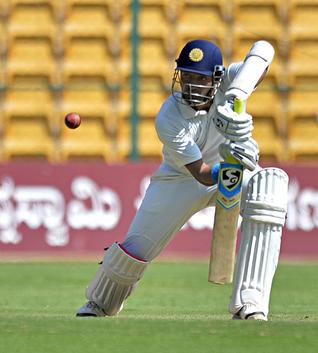
Between defence and aggression./  Photo: Bhagya Prakash K. / The Hindu
Between defence and aggression./ Photo: Bhagya Prakash K. / The Hindu

Robin Uthappa has found the midpoint between aggression and composure and the rewards in terms of runs, has been phenomenal.

The metamorphosis of Robin Uthappa has perhaps been the most riveting tale in Karnataka cricket in the recent past. Just like the many languages he speaks, Uthappa the cricketer has embraced multiple roles over the last decade and aptly his whatsapp status is: “I’m different, get over it.”

Uthappa has donned many avatars in his evolution as an aggressive opener: a slightly over-weight kid who donned the wicket-keeping gloves and biffed with his bat; a brash teenager who smote the ball hard and drew the appreciation of former India captain Dilip Vengsarkar; the youngster who turned out for India, sparkled briefly and then was resigned to be on the sidelines; the man who asked for the Karnataka captaincy because he believed he could deliver; and now an elder statesman though he is just 28, scoring runs by the ton, lending whole-hearted support to captain Vinay Kumar and also dreaming about wresting back the India cap.

It is an exhaustive list but the varied experiences have shaped Uthappa well. There is a sense of calm and a whole lot of perspective in the way he approaches the game and his life and all that has helped him individually besides lending stability to Karnataka’s batting. It is a point that has caught his State coach J. Arunkumar’s eye. “Robin is very composed now. Even when he talks, he thinks a lot before he says anything. Earlier, he wasn’t like that, he could snap. Now he is in a good space personally and that shows in his batting. To be honest, he is batting the best in the State and he is ready to play for India again, especially in the shorter formats,” Arunkumar says. During Karnataka’s recent Vijay Hazare Trophy triumph, Uthappa’s tons (133 vs Jharkhand and 132 n.o., vs Gujarat) helped Vinay Kumar’s men to extend their good form that has already yielded the Ranji Trophy and the Irani Cup. Uthappa’s merger of aggression with remarkable consistency, has been a work in progress.

Last season, he roped in former India batsman Pravin Amre as his personal coach. And in a lovely tandem that tided past egos and focussed on the larger goal of good cricket, Amre and Arunkumar, worked out an easy understanding between themselves which helped the player improve rapidly. “Pravin has led me when I played for India ‘A’ and I have a lot of respect for him. There are no egos here and it is all about helping a player become better as well as help his team,” Arunkumar says.

To Uthappa’s credit, he found a mid-point between his innate aggression, while also adapting to Amre’s Bombay school of batsmanship that paid its traditional respects to defensive batting. Arunkumar, who was an aggressive opener in his heydays, says: “I believe that if a ball is short and wide, you should cut it, no point in leaving it. I tell that to Robin and the others, the situation might be 30 for three but you should be alert to scoring runs. Yes, he did get a bit too defensive when the last season began and then I had a chat with both Robin and Pravin. Now the good thing is that he is neither too aggressive nor too defensive. He has found his balance.”

Many years ago, when asked about the defining influences in his life, Uthappa spoke about Him. The Him was none other than Jesus Christ and Uthappa’s spiritual leanings, which continues to this day, his strong sense of self-esteem that has not lapsed into arrogance.

The easy camaraderie he shares with his team-mates and his constant instrospection about his game, have helped him find his feet. Having played for India in the past, Uthappa has reiterated his credentials again. May be it is a matter of time before he joins the ‘Men in Blue.’

source: http://www.thehindu.com / The Hindu / Home> Features> MetroPlus / by K.C. Vijaya Kumari / Bangalore – March 23rd, 2014