Monthly Archives: December 2014

Rural Tourism : A suggestion to Mysuru-Kodagu MP

by N.K.A. Ballal, Retd. Sr. Vice-President, ITDC

Rural tourism is essentially an activity which takes place in the country-side. Unlike the conventional tourism, the rural tourism is experience-based, nature and environment-friendly and is strictly based on preservation of our culture, heritage and traditions.

The benefits of rural tourism is multi-folded. Along with the creation of alternate source of income, it also helps in the revival of the local arts and handicrafts. It helps women empowerment, poverty alleviation and improves the standards of living of the rural folk. That is the reason, Government of India is giving so much importance and emphasising on the development of this form of tourism and is offering lots of incentives and subsidies for the same. Almost 74 percent of the population living in rural India and with almost 7 million villages, India is ideally suited for this form of tourism. With all major cities in India becoming urban jungles, the people are on the look-out for escape route and this form of tourism would definitely help.

Another major advantage is that rural tourism can be an upmarket experience both for domestic and international tourists. This is one of the primary reasons that the Home-Stay concept introduced by Karnataka Tourism has been a resounding success with more that 3,000 Home-Stays in place. Coorg is overflowing with domestic tourists from all over India. And most of them prefer to stay in these homes amidst the coffee estates and be with the nature. A win-win situation both for the tourists and the estate owners.

“Stop. Take a deep breath and walk, fly or catch a train away from the city and into the world where the average pace of life is slower than slow. It is not down in any map, true places never are.” [Herman Melville].

I would like to enumerate some well-known rural tourism centres in India for the benefit of SOM readers:

1. Eco-sphere Spiti – high altitude rural tourism: The Spiti Valley is a lesser known alternate to Leh and Ladakh. Visits to Buddhist Monasteries, Yak safaris, treks to villages, village home-stays and cultural performances are some of the activities on offer.

2. Chhotaram Prajapat’s Home-Stay near Jodhpur: This home-stay has become very famous since its inception wherein one can stay in village dwellings [with western commode], learn the art of weaving and experience home cooked food, camel safaris, folk dances, village trekking etc.

3. Lakshman Sagar – luxury rural tourism in Rajasthan: Here one can experience rural tourism in luxury of well-made huts or tents. New attractions would be brick-making kilns, chilli drying and wholesale market, nature walks and horse safaris.

4. Rural tourism at Kutch, Gujarat: Here one can experience the vibrancy of Gujarat, culture, art and dances.

5. Farming in Punjab: This trip is for tourists who want to see and experience traditional farming, dances and Punjabi cuisine.

6. Tribal travels in North East: Here one can experience the pleasures of mountain rides, trekking in unknown territories and interacting with tribes like Naga and Bodo.

7. Kila Raipur – rural Olympics in Punjab: The famous bullock cart race which happens in February every year.

8. Rural tourism in Maharashtra: This includes ‘the story of rice’ which allows the tourists to experience the way rice is cultivated, lessons about the famous worli paintings or visit to a village in the month of June when millions of fireflies light up the hills of western ghats.

I have just enumerated some of the rural tour initiatives which have become popular in the international calender but alas, as usual we Kannadigas have missed the bus. In spite of having all the features mentioned above, we have not been able to encash upon this novel tourism idea so far.

Whether ploughing a field, harvesting rice, learning to make toys or pots, traditional jaggery making, teaching the tourist how silk worm is bred, riding in a bullock cart or simply sleeping under the stars, rural tourism initiatives are not just giving the city-dwellers a taste of life on the other side of the farm hedge; they are creating sustainable eco-systems which provide alternate source of income for the village dwellers without straining their existing resources.

Since our Prime Minister has asked our MPs to adopt a village and convert that into a model village, I have the following suggestion to our own MP Pratap Simha. Sir, you can choose a village near Mysuru which has some traditional artisans or folk dancers living there and try to develop the same as a rural tourism venture. You can also adopt another village at Coorg which can highlight the exotic culture, dress and cuisine of the Kodavas. Apart from the money you have at your disposal from your own fund, this form of tourism gets lots of incentives from the Ministry of Tourism and Rural Development, which can be tapped. The village council can be persuaded to make some traditional huts with western commodes so that the tourists can be made to stay and experience the real village life.

This form of tourism should strictly be upmarket to ensure that only quality tourist come in and not quantity. Of course, our Department of Tourism should actively and aggressively market it at all the trade marts abroad. Just like the Home-Stays in Coorg, this will catch on and will bring in prosperity to the village and the region. A point to ponder.

[Do write your comments to ananthballal@yahoo.com]

source: http://www.starofmysore.com / Star of Mysore / Home> Feature Articles / December 03, 2014
Kasturirangan report on ESZ: Public hearing in Madikeri tomorrow

Madikeri :

The State-level Expert team will be visiting Madikeri tomorrow to hold a public meeting with respect to the Kasturirangan Report, which recommends declaring 53 villages in Kodagu district as Eco-Sensitive Zones (ESZs).

The meeting is scheduled to be held at the Fort Mini Hall at the DC’s office at 3 pm.

There has been a wide range of protests by people of Kodagu and organisations demanding the State Government not to consider the Kasturirangan Report. The team is visiting Madikeri to hear public grievances on the issue.

Meanwhile, a few organisations under the banner of Kasturirangan Varadi Virodi Samithi have also planned to stage protests tomorrow.

Deputy Commissioner Anurag Tiwari said that it was an opportunity for the public to put forward their objections before the team. He added that the video recording of the meeting would be sent to State Government.

Tiwari has urged the people to maintain peace during the meeting and added that security would be beefed up around the meeting venue.

Kasturirangan Report also recommends for prohibition of mining and industrialisation, ban on chemical fertilisers and control over development works in areas declared as ESZs.

source: http://www.starofmysore.com / Star of Mysore / Home> General News / December 03, 2014

Annual get-together of Sri Kaveri Kodava Association held

‘Federation of Kodava Samajas belies promise’: KBG

KaveriKodavaBF01dec2014

Mysuru :

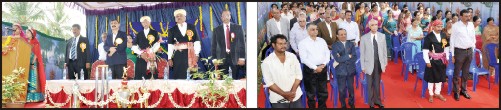
Sri Kaveri Kodava Association Mysuru-East, located at Vidyashankara Nagar, Mysuru, celebrated its annual get-together on Nov.23, 2014 at the premises of Kodagu Model School here in a grand manner.

Over 500 members attended this annual get-together function presided over by Pudiyokkada B. Madappa, President of the Association. Biddatanda S. Thammaiah, President of Kodava Sahitya Academy, Kodagu, was the chief guest while Biddatanda T. Pradeep, President of Kodagu District Congress Party was the special invitee.

Speaking on the occasion, B.S. Thammaiah, the chief guest, appreciated the efforts of Sri Kaveri Kodava Association in running a school for the benefit of the people residing in and around Vidyashankara Nagar and also its members. He urged the members to preserve the rich culture of Kodava community despite the changes taking place in this modern world in one’s lifestyle.

B. T. Pradeep, President of Kodagu District Congress Party, who also spoke, regretted the lack of unity among Kodavas and said this situation had affected the progress of Kodava community in their own land, district. He expressed concern about Kodavas losing political influence and power in Kodagu and said it was mainly due to the acknowledged, successful Kodava politicians not encouraging the bright and dynamic youngsters to shine in politics of Kodagu. He expressed apprehension that in the days to come, the political influence of Kodagu as a district and of Kodavas in politics would further diminish. And as an example, he mentioned that in the beginning, for many years Kodagu district had three MLAs which has now come down to two.

There was also a surprise speaker Kokkalemada Manju Chinnappa, District Convenor of United Kodava Organisation (UKO), who suggested that Kodavas residing outside Kodagu would do well to register their names for voting in their respective villages in Kodagu itself and exercise their vote either by making a patriotic visit to Kodagu or by post. He also said that his organisation was making all efforts to revive the time honoured tradition of assembling at the ‘Mandh’ (the common meeting place of villagers), where during the time of harvest festival known as ‘Huthri’, villagers would hold their traditional dances and related cultural activities. He said a number of such ‘Mandhs’ have been either encroached upon or simply abandoned giving up the tradition. He said his organisation would strive to restore this tradition in order to preserve the identity of Kodavas in their own land.

Another senior member of the Association, K.B. Ganapathy, who was requested by the President to speak on the occasion, made a plea to the chief guests to use their good offices to get the By-law of the Federation of Kodava Samajas established at Balugodu in Kodagu as an apex body of all Kodava Samajas either reviewed or suitably amended to enable it to serve the Kodava community more purposefully than it is doing now.

Ganapathy said this Federation should not end up as a ‘Super Kodava Samaja’ of all Samajas which would serve no purpose in fulfilling its avowed object of enabling the Kodavas to survive in their own homeland called Kodagu with honour and dignity under the present democratic political dispensation where political representatives are elected on the basis of majoritarianism.

Since in Kodagu district, the population of Kodavas is about 1,20,000, it has become a Herculean task for a Kodava candidate (assuming he gets a ticket to contest an election) from any political party to win the election. In this context, the Federation has its usefulness and significance. Unfortunately, Ganapathy said, the Federation does not seem to have engaged itself in tackling issues that have a political bearing on the lives and properties of Kodavas in their own homeland — Kodagu.

With a view to circumventing these existential problems of Kodavas, Ganapathy suggested that as in the case of some of the small ethnic communities in other parts of the country, the President of the Federation should always be a well-known person either in the country or someone who has held very high position in the Government service. As I know there are many Kodavas who have held such high offices. The elected office-bearers of the Federation, after identifying such a VIP, should approach that person and invite him to be the President of the Federation. This may be for a fixed period or as may be decided by the General Body. This will help the Federation to take the problems of the Kodava community led by its President directly to the powers-that-be whether in the State or at the Centre. And because of our President’s personal stature and connections, we will be heard. This is the only way today for Kodavas to show their solidarity and make their voice, nay cry, heard by the government.

The very purpose of the Federation will be defeated if it remains an apolitical body refusing to discuss problems related to the lives, properties, roads, forests, water, power, employment, benefits from government schemes etc.

Ganapathy requested the chief guests to consider the suggestion and take it forward with the help of all those so many Kodava organisations that are mushrooming in Kodagu today, sometimes working at cross-purpose.

On the occasion, Neravanda Nanaiah, retired Police officer and a senior member of the Association; Chayaa Nanjappa, Managing Partner, Nectar Fresh Foods and Kundranda Bhageerathi Thimmaiah, National Athlete, were felicitated.

The meeting was followed by luncheon and thereafter sports events were held for children. On the occasion, prizes were given to academic toppers in the examinations held last year. The prizes were sponsored by the munificent members of Sri Kaveri Kodava Association.

Association Vice-President Puliyanda Devaiah welcomed. Alamengada Greeshma Appaji and Kechettira Likitha Appaiah rendered innovation. Hon. Secretary Appachangada P. Motaiah proposed a vote of thanks.

Association Treasurer Koppira Ponnappa, Joint Secretary Mollera Kavitha, former President of the Association and Chairman of Building Committee Kanjithanda K. Aiyappa and Kodagu District Convenor of the Committee on Kasturi Rangan Report on Eco-sensitive Zone Theethira Dharmaja Uthappa were among those present.

source: http://www.starofmysore.com / Star of Mysore / Home> General News / Tuesday , November 25th, 2014