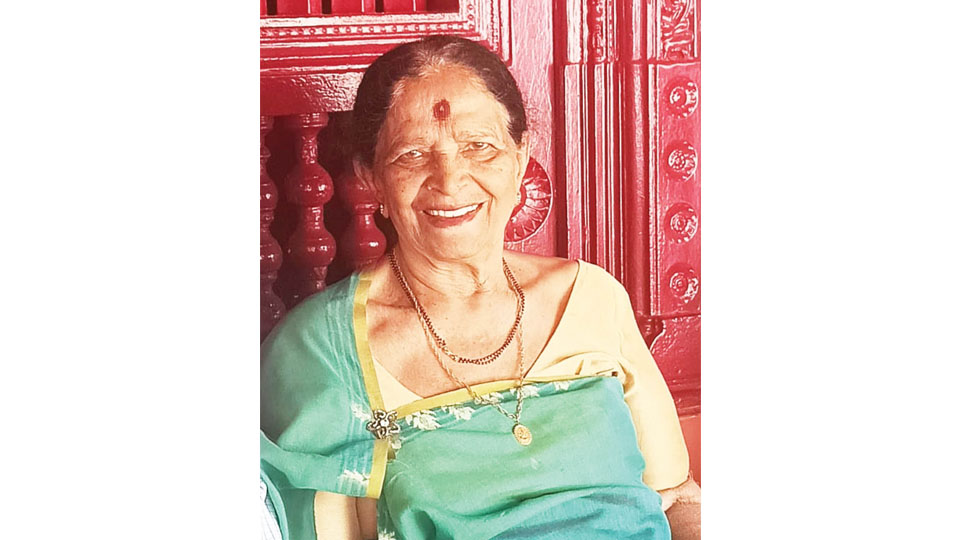
Kuppanda Pushpa Muthanna (Maletira), wife of Lt. Col. (Retd.) Kuppanda Muthanna, a long time resident of Vijayanagar in city and later settled in Virajpet, Kodagu, passed away in Virajpet this morning. She was 80.
She leaves behind her husband, one son and a host of relatives and friends.
Last rites were held at the Kodava Samaja crematorium in Virajpet this afternoon, according to family sources.
source: http://www.starofmysore.com / Star of Mysore / Home> Obituary / November 14th, 2022
Traditional clothes, jewels and accessories set the Kodavas apart.
Madikeri :
Rituals and culture narrate the history and ancestral beliefs of a community. Traditional attire binds a community and signifies their identity, while also promoting its culture. One such is the Kodava community, nestled in the picturesque district of Kodagu, and boasts of a unique culture and even more unique attire.
Anyone who has attended a Kodava wedding will be familiar with the traditional dress worn by Kodava men. A half-sleeved knee-length black wraparound coat, a silk sash girding the waist and headgear make up the attire, known as ‘Kuppya Chele’.
“In the Kodava language, ‘Kuip’ translates to heat, and ‘ya’ means absent. In simple words, the attire that protects one from heat is the ‘Kuppya’,” analysed Bacharaniyanda Appanna, a Kodava historian. To hold the ‘Kuppya’ in place, a cloth belt called the ‘chele’ is used. The ‘Kuppya Chele’ is accessorised with traditional weapons.
Kodavas are a native Dravidian race that settled amid the thick forests of the ‘Malayadri Sahyadri’ range and speak the original Dravidian language of Kodava. Ancestors wore ‘Kuppya’ made of indigenous plant fibre called ‘Bolakka Balli’.
“When clothes started coming in from Kerala through the barter system, the ‘Kuppya’ or knee-length coat was stitched in white cloth. However, when the British came to Kodagu in 1834, the priests of the Church had issues with this attire. Since the white ‘kuppya’ resembled the habit of Christian priests, the British passed an order to change the colour of the Kodava attire,” explained Apanna.
It is said that the elders voiced their resentment against the British for meddling with their culture. However, a mutual understanding was arrived at. “During this rift, serge fabric came to India from England. Black serge was imported in large quantities, and became more convenient as it rarely appeared dirty. The ‘kuppya’ was soon stitched in black serge, but to ensure the survival of ancestral culture, white ‘kuppya’ is mandated on special occasions. The bridegroom, temple head or priest, village head or ‘thakka mukyasta’ are mandated to wear white ‘kuppya’. Even a dead body is dressed in white ‘kuppya’,” explained Appanna.
The ‘chele’ also witnessed a touch of modernisation, and the 25-ft long strong multipurpose cloth has been replaced with fancy brightly-coloured silk cloth. “During war times, the ‘chele’ was used to tie enemies and for other purposes,” said Appanna.
A married youngster wears the Kodava saree adorned with ‘pathak’
The comfort sari The women of the community also wear unique attire, and a mythological story is intertwined around it. The Kodava women wear a sari that is pleated at the back and the ‘pallu’ or loose end is wrapped around the front. “According to mythology, seer Agasthya and Cauvery had a rift, and Cauvery left Talacauvery discreetly. She showed up after ten days at Bhagamandala, and then left towards Balamuri, where villagers stopped her and requested her to stay. However, she flowed with great force, which caused the saris worn by the women to turn backwards. She was then calmed and promised to show herself every year during the Cauvery Sankramana celebrations,” narrated Appanna.
This sari also has scientific symbolism. Since Kodava women participated in agricultural activities, the back-pleat saris were more comfortable, and women could even climb trees easily. These saris hold great significance for the community and are paired with headgear called the ‘vasthra’. “Both Kodava men and women wear the head cloth. Our ancestors believed that the sun’s rays should never fall behind the neck and they covered it with ‘vasthra’. However, the headgear has been modernised to suit current trends and has intricate artwork, especially those worn by women,” he explained.
Traditional jewels The traditional knife called the ‘peecha katthi’, which was used in self-defence during ancestral times, forms part of the men’s attire and symbolises the tribal and warrior culture of the community. The ‘peecha kathi’ or dagger, and ‘odi kathi’ or traditional sword, are accessories for men, while a variety of traditional jewels add a touch of cultural flavour to the women’s saris.
“‘Peecha kathi’ was fixed to the attire using the ‘chele’. Earlier, these daggers had handles of wood. Now, they are carved in silver and gold and shine brightly on the traditional attire,” Appanna said.
The women have seven types of jewels. “At Talacauvery, the seven seers or ‘sapta rishis’ meditated. One could also find seven ponds at the centre, which are now covered. As a sign of blessings from the seers, the Kodava tradition mentions seven types of adornments from head to toe. However, only a few jewels have stood the test of time,” he explained.
Among the jewels, ‘Pathak’ holds great significance for married women. “When a girl goes to her husband’s house, her parents pack ten essential items – mostly traditional brass items – to be sent with her. These items are given to help her lead an independent life in her husband’s house, and must not be brought back to the girl’s house unless the couple is separated. To protect these items, a jewel consisting of ‘Naga’ (snake) god’s incarnation is tied by the mother of the bride during the wedding ceremony, called the ‘Pathak’,” explained Appanna. This jewel holds symbolic significance and is similar to a ‘mangal sutra’, while other traditional jewels include the ‘joe maale’ and ‘kokke thaati’.
Primarily nature worshippers, the culture, traditions and rituals of Kodavas are unique and tribal in nature. While the size of the community has shrunk in the past, steps are now in place to revive the community’s rich culture.
source: http://www.newindianexpress.com / The New Indian Express / Home> States> Karnataka / by Prajna GR, Express News Service / October 30th, 2022
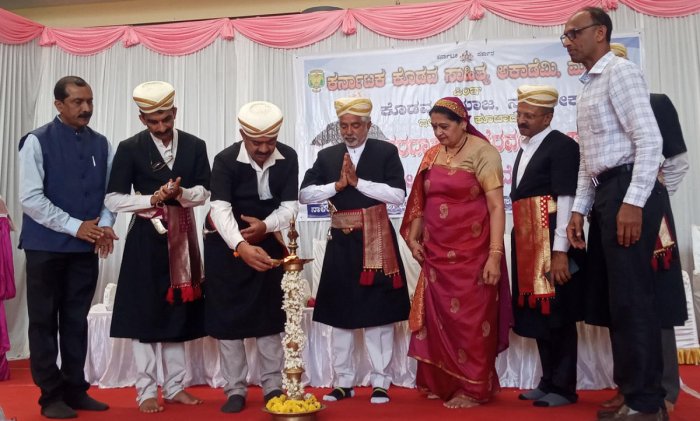
Kodava Samaja, Napoklu, president Appachettolanda Manu Muttappa inaugurates the 153rd birth anniversary celebrations of Appacha Kavi, organised at Appacha Kavi auditorium in Kodava Samaja, Napoklu.
The Ainmane, traditional house of Haradasa Appacha Kavi, the first poet of Kodagu, should be developed into a memorial, said Appachettolanda Manu Muttappa, president of Napoklu Kodava Samaja.
He was speaking during the 153rd birth anniversary celebrations of Appacha Kavi, organised by Karnataka Kodava Sahitya Academy and Napoklu Kodava Samaja, at Appacha Kavi auditorium, on Tuesday.
Manu Muttappa said that along with the residences of great poets and writers, their native places should also be developed.
“There is a need to introduce Appacha Kavi’s works to the present generation. Appacha Kavi had great knowledge of Kannada and Sanskrit. An education officer called Raghunatha Raya inspired Appacha Kavi to create literary works in the Kodava language, he said.
Speaking on Appacha Kavi, Rangayana, Mysuru, director Addanda Cariappa said that Appacha Kavi should be awarded the ‘Karnataka Ratna’ award.
Karnataka Kodava Sahitya Academy chairperson Dr Ammatanda Parvathi Appaiah, Academy registrar Ajjikuttira Girish, Appaneravanda Ainmane Development Committee president Appaneravanda Chummi Devaiah, Appaneravanda Ramu and Dr Manoj were present.
‘Ummattat’ and other cultural programmes were held on the occasion.
Folklore scholar Bottolanda Kashi Achaiah sang songs composed by Appacha Kavi.
source: http://www.deccanherald.com / Deccan Herald / Home> State> Mangaluru / by DHNS, Napoklu / September 21st, 2022
Coorg located on the Western Ghats around 180 miles from the hi-tech city of India Bangalore, in the state of Karnataka is admired for its enduring beauty. The recorded history of the area says that it was ruled by the Lingayat Rajhas who established their capital at Madikeri where they built a mud fort. The inhabitants of Coorg, Kodavas agitated the Mysore ruler Hyder Ali and Tipu Sultan in the course of random rebellions.
Eventually Tipu marched into Coorg with a large army in 1785 AD and overcome to their little kingdom. But just after four years, with the British assistance, Coorg take back their Kingdom and Raja Veerarajendra set about the task of reconstruction. Yet in 1834 AD, the British captured the Coorg and prosecuted the last Raja Chikkaveera Rajendra and expelled him. With its foggy mountains and opaque jungles, Coorg give the impression like a little corner of to the British and adopted a name as the Scotland of India.
The British left a legacy behind that is still an imperative source of national capital. The well laid coffee plantations by them in Coorg account for almost half of Karnataka’s coffee production and the state goes on with to be the major producer of coffee. Talakaveri, the origin of the River Kaveri is situated in the Brahmagiri hills of Coorg and this area is about 4,500 ft above the sea level. Hence, it is one of the scenic spot in Coorg. A temple and a big tank have been built near the kundike at Talakaveri; the pilgrims’ take bath in the tank prior to praying at the origin of the river.
There are two famous Hindu Temples dedicated to lord Shiva and lord Ganesha and both the temples are open to visitors. Coorg has many verdant hiking routes in the midst of forests and hills, and it’s better to visit in the months from October to February. Misty hills, lush forest, acres and acres of tea and coffee plantations, orange groves, undulating streets and breathtaking views are what make Coorg an unforgettable holiday destination. You can accompany cheap flights to India for exploring this marvelous destination that is definitely going to manage your travel budget in a way you will be able visit much more places of interest.
A breathtaking attraction of waterfalls known as abbey Falls is located at a distance of around four miles from Madikeri town, approaching this attraction is itself an excellent ride experience as the path that you drive on is very narrow with countless turns and twists, ups and downs with a ebullient mother nature greets you at each turn. This famous falls, situated on a private property, attracts a large number of tourists around the globe. There are other famous waterfalls to be explored such as Iruppu Waterfalls, Mallalli Waterfalls and the Chelavara Waterfalls. A nature lovers paradise Nisargadama, an ecological park, this romantic 64-acre island is reachable through a hanging bridge offering immense pleasure to all the Nature and Fun loving tourists to wander around the park. You can also visit various stunning attractions like Nagarahole, Dubare Forest, Harangi Dam, Chiklihole Reservoir, Omkareshwara Temple, Coffee Plantation Farm, Raja’s Seat and Madikeri Fort.
source: http://www.CheapFlightHouse.co.uk / admin> News> / August 28th, 2011
WELCOME. If you like what you see "SUBSCRIBE via EMAIL" to receive FREE regular UPDATES.
Read More »