‘Subahu e-beat’ launched for better patrolling in Kodagu

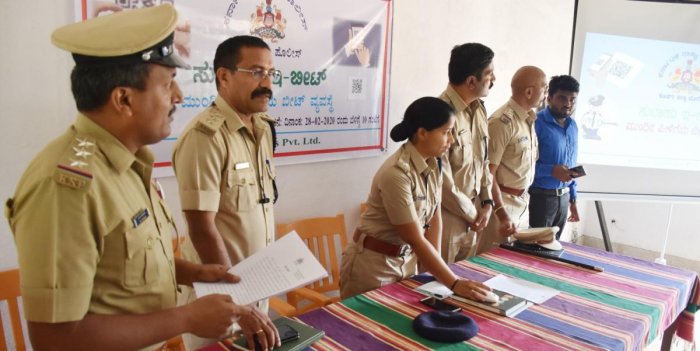
Superintendent of Police Dr Suman D Pennekar launches Subahu e-beat patrolling system in Madikeri on Friday.

Subahu e-beat system was launched by the police department in Kodagu, towards better patrolling.

Launching the e-beat system at police parade ground auditorium in Madikeri on Friday, Superintendent of Police Dr Suman D Pennekar said that in the e-beat system, patrolling will be monitored using ‘Subahu’ mobile phone application.

The system will improve communication between the police officials, the beat personnel and the residents.

Earlier, the details on the night beat were manually entered and signed by the beat police, in the log books. From here on, the personnel will have to scan the QR code from the locations of their beats, using ‘Subahu Beat’ application installed on their smart phones, said the superintendent of police.

Dr Suman further stated that Kodagu being a hilly region, internet connection is not available in some of the locations in the district.

“When the police personnel carry out beat patrolling in such locations, the application will save the information offline and will enable the senior officials to access the information using ‘Subahu Admin’ as soon as the device accesses internet coverage connection,” she said and also advised the general public to instal ‘Subahu Resident’ application on their smart phones to send SOS messages and related information to the nearby police station.

A pilot project has been implemented in Madikeri town, Somwarpet, Virajpet, Shanivarasanthe and Gonikoppa, to observe the efficiency of the software.

The software will now be launched in the jurisdiction of all 16 police stations, added the superintendent of police.

Mahendra, representative from Smart Secure, said that the application offers a user-friendly interface for the senior officials and beat personnel.

Virajpet DySP Jayakumar and Madikeri DySP Dinesh Kumar were present.

source: http://www.deccanherald.com / Deccan Herald / Home> State> Mangaluru / by DHNS, Madikeri / February 28th, 2020

Bean-to-cup coffee making in a Coorg plantation

Visitors are encouraged to make their own blends, including weighing, mixing, roasting and grinding.

The plantations offer homestays and resort, perched on stilts. (Photo: The Tamara Coorg)

The lashing rain from the night before had simmered to a soft drizzle this morning. The clouds had parted, and the sundeck of our wooden cottage, perched high on stilts, afforded a resplendent view of coffee country Coorg. The freshly bathed dimpled-green Western Ghat hills rolled away as far as the eyes could see. Acres and acres of coffee and spice plantations dotted the landscape, intermingling with lush forests. The gushing sound of a waterfall drifted in from close by, blending with the rustling of leaves. Below us, as our resort’s plantation was waking up, we set out to witness first-hand the journey of coffee — from bean to cup.

With tall silver oak, teak, rosewood and other trees lending shade to coffee shrubs in the plantations, Coorg offers a gorgeous setting to observe the process of coffee production. Karnataka alone accounts for 70 per cent of the coffee produced in India, with the south-western districts of Coorg (locally Kodagu) and Chikmagalur producing the lion’s share. India, by some accounts, produces the finest shade-grown coffee.

Many of the plantations have homestays and resorts for anyone wanting to sample the plantation life. The deep dive into the coffee culture at our resort, sprawled over a 180-acre estate, begins right at check-in. You’re welcomed with steaming tumblers of delicious bellada coffee (Karnataka-style filter coffee with jaggery). The cottage-style wooden villas, in traditional Kodagu architectural style — sloping roofs, perched high on stilts — are placed at respectful distances from each other, for immersion into a planter’s private yet lavish lifestyle.

Umbrellas in hand, we follow our guide, through thick foliage and unending rows of coffee shrubs. Sharing interesting nuggets about the native flora that grows with wild abandonment, he points out the two main coffee varieties of Coorg — the hardy, disease-resistant Robusta and the better-quality, tastier, smoother and more expensive Arabica. A number of spices are often intercropped with coffee, such as peppercorn, cardamom, clove and nutmeg that help the coffee acquire lovely aromatics while adding a few prized cash crops in the planter’s kitty.

Each year, the life cycle begins with pearly white blossoms in February-March. Natural showers and sprinkler irrigation are crucial for their yield, which determine the amount of coffee harvested the following year. The blossoms turn into green berries and, then, a deep red when ripe, which are handpicked from November to February.

The walk is followed by a coffee-processing experiential programme at the little museum in the resort grounds. The ripe berries are dried and pulped to obtain the seed — aka coffee bean! The beans are sorted, blended and roasted in a traditional roaster. Encouraged to make our own blends, we weighed and mixed different percentages of the varieties according to our taste, put them in the roaster and hand-ground the divinely aromatic roasted beans into a fine powder — to be had as a hot brew right there, or carry back as a souvenir.

Back home, whenever I’d sip on my blend, I’d reminisce about the time I crafted it, and the scrumptious Coorgi lunch that followed, that rainy, misty afternoon.

Satarupa Paul is based in Delhi and writes on food and travel.

source: http://www.indianexpress.com / The Indian Express / Home> Eye / by Satarupa Paul / February 29th, 2020

Status report sought on buildings

A report has been sought on the condition of buildings housing schools, colleges and anganwadi centres in Kodagu with only three months left for the onset of monsoon.

Deputy Commissioner Annies Kanmani Joy issued this direction to the authorities at a meeting convened by her in Madikeri on Wednesday to discuss the preparations to be made to counter the monsoon. Kodagu had witnessed its worst floods and landslides in 2018 and 2019.

She said North Kodagu and South Kodagu saw more devastation in 2018 and in 2019 respectively. “We focussed on North Kodagu following the damage in 2018 but the calamity struck most parts of South Kodagu last year. Therefore, we need to focus on all areas this year. In this connection, district-level officers would be deployed at the hobli level to attend to the works.”

The officers at the taluk level including the PDOs would be trained on handling the rescue situations. Funds under NDRF would be released in advance to the ZP CEO, tahsildars and the GPs for attending to the rain havoc.

District Fire Officer P. Chandan sought four more boats for attending to the rescue operations in case of floods.

source: http://www.thehindu.com / The Hindu / Home> News> States> Karnataka / by Special Correspondent / Mysuru – February 27th, 2020

‘Kodavas Are Living Like Aliens In Their Own Homeland’

Rangayana Director Addanda Cariappa makes a fervent plea to save Kodava language, culture

AddandaKF29feb2020

New Delhi:

Kendra Sahitya Academy Member and Rangayana Mysuru Director Addanda C. Cariappa has urged the Union Government to give Kodavas geo-political autonomy over their ‘Codava Land’, by including Kodava language under the Eighth Schedule of the Constitution and granting them the micro-minority community tag for a better future and a secure homeland.

He was presenting a paper at All India Tribal Writers Conference here on Feb. 24. The Conference dwelled ways and means of reviving tribal languages. Speaking at length about Kodavas and tribalism, Cariappa said that it was essential to revive and rejuvenate tribal languages like the Kodava language (Kodava Thakk) that is under threat of extinction, thanks to lack of Government support.

“With the onslaught of modern ways of life, tribal languages are suffering the most. Many tribal languages do not have their own script and the challenge with those languages is that they do not have their indigenous scripts and are not recognised in the Eighth Schedule of the Indian Constitution. Hence, languages like Kodava Thakk and many others which form the cultural connections among a sizeable population face the danger of disappearing as just household native tongues,” he said.

197 languages in India are endangered

Today, Kodavas are feeling insecure and are living like aliens in their own homeland. “Our rich culture and heritage have not been given due recognition owing to many oversights. We have been requesting the Governments to give us the due space in Eighth Schedule. To the United Nations, our plea has been that the UNESCO should include ‘Codavaame’ (Codavaism) as a traditional minuscule micro-minority Kodava tribe in Karnataka, on the list of intangible cultural heritage,” Cariappa opined.

In the past, a UNESCO report had revealed that 197 languages in India are endangered and five languages are almost extinct with a handful of people speaking them in different tribal communities. Once they are gone, the language dies a natural death. And with that, a whole discipline of indigenous culture, knowledge and history is wiped off the face of earth forever, he explained.

Languages dying slow death

“There has been a demand for about 46 languages including Tulu and Kodava Thakk to be included in the Eighth Schedule. But Governments so far have not paid heed to this request and as a result, many tribal languages have died a slow death. According to an estimate, nearly 1,300 tribal languages exist in India alone. They were born in the lush greenery of forests and are constantly disappearing as the forest cover is being plundered in the name of development, urbanisation and progress,” Cariappa regretted.

Highlighting the plight of writers of such languages, he said, “When the language itself gets buried with the passing of time, what would the writers do? A whole community loses its identity when a language disappears. Hence, someone has rightly said “f you want to finish a community, all you need to do is to kill their native tongue.”

Making a fervent plea to include Kodava Thakk in the Eighth Schedule, Cariappa said, “When a nation’s Constitution honours a tribal language with due recognition, they are used as mediums of learning, education and instruction. Languages can be saved from extinction when they use the existing scripts of other languages that are in their ecological surroundings to survive and thrive.”

source: http://www.starofmysore.com / Star of Mysore / Home> News / February 27th, 2020

Red Cross Bhavan to come up at a cost of Rs 1.3 cr in Madikeri

RedCrossMPOs

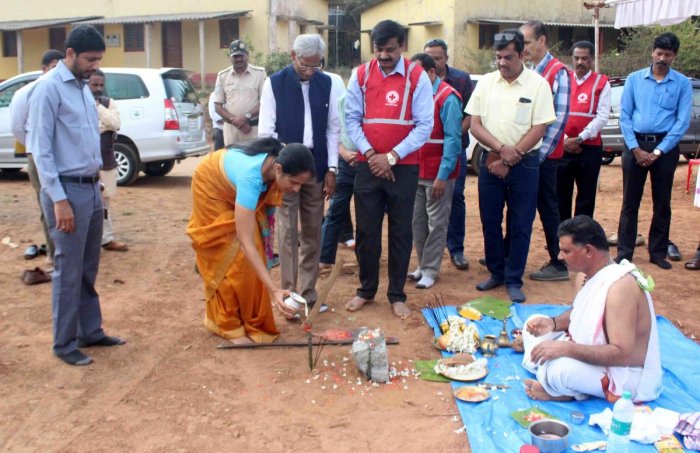
Deputy Commissioner Annies Kanmani Joy, who is also the chairperson of Indian Red Cross Society (IRCS) district committee, performed the ground-breaking for Red Cross Bhavan at Stewart Hill in the town on Thursday.

Speaking during the formal programme, IRCS State Committee Chairman Naganna said that the IRCS had always assisted in the relief measures, including the floods in Kodagu.

“The Red Cross Bhavan will provide timely assistance to the people affected by calamities”.

Naganna said that a grant of Rs 50 lakh was reserved by the IRCS district committee and Rs 25 lakh by the state committee for the Red Cross Bhavan.

Naganna said that a grant of Rs 50 lakh was reserved by the IRCS district committee and Rs 25 lakh by the state committee for the Red Cross Bhavan.

He said another Rs 10 lakh will be provided in the next phase by the IRCS state committee. Making use of the funds provided by elected representatives, a state-of-the-art auditorium, a warehouse and an office will be constructed, he added.

IRCS Kodagu head B K Ravindra Rai stated that the Red Cross Bhavan was planned to be constructed at a cost of Rs 1.30 crore on 12.50 cents of land, and the work would be carried out by Nirmithi Kendra.

IRCS Kodagu General Secretary H R Muralidhar said that the branch of the IRCS was commissioned in Kodagu in 1952, with the efforts of the then Chief Minister of Coorg state, C M Poonacha.

Former IRCS State general Secretary Ashok Kumar Shetty, Kodagu Institute of Medical Sciences Principal Dr Vishal, Nirmithi Kendra Officer Sachin, CMC Commissioner M L Ramesh and IRCS district Vice President H T Anil were present.

source: http://www/deccanherald.com / Deccan Herald / Home> State / Muhammad / by DHNS, Madiker / February 27th, 2020

Guddali Puja For ‘Vruddhashrama’ By Kodagu Mahila Sangha On Mar.1

The guddali puja for the ‘Vruddhashrama’ (Old Age Home) to be constructed by Sri Kaveri Kodagu Mahila Sangha, Mysuru, will be performed on Mar. 1 (Sunday) at 10.30 am.

The puja will be held at Ramu Dakshayani Layout, Survey No. 41/2, Lingambudhi village, near Maramma Temple (Thimmaiah Enclave), according to Sangha President M. Bollamma Kuttappa (99012-39798) and Founder President I. Parvathi Cariappa (89716-01824).

source: http://www.starofmysore.com / Star of Mysore / Home> In Briefs / February 27th, 2020

National Seminar On Tribal Languages

Kendra Sahitya Academy will be conducting a National Seminar on ‘Tribal languages’ at Ravindra Bhavan in New Delhi from Feb. 24 to 29.

Mysuru Rangayana Director Addanda C. Cariappa will present a paper on Kodava Tribal Language at 10.30 am on Feb. 25, the second day of the seminar.

The conference will be attended by tribal language writers and intellectuals.

The conference has assumed significance in the wake of demands that Kodava language be included in the Eighth Schedule of the Constitution.

source: http://www.starofmysore.com / Star of Mysore / Home> In Briefs / February 23rd, 2020

Information about Kariyappa Memorial Park in Hindi

CariappaParkKF27feb2020

Cariappa Memorial Park is located in the middle of Bangalore city as a component of the Parade Grounds on M.G Road. The Cariappa Park was set up in 1996 as a memorial to Field Marshall K.M. Cariappa of Karnataka.

The park is laid out in a section of the parade grounds amid M.G. Road and Cubbon Road. The park stretches over 22 acres. It has six segments including an entry plaza and a 7 foot massive memorial of Cariappa. It is a very well maintained memorial Park in Bengaluru.

Man-Made Waterfall, Pond & the Bandstand
The park contains a big artificial waterfall. There is a pond that charms birds towards the park. Every fortnight, 6 military bands perform at the bandstand which is a grand lawn. The lush dunes surrounding the bandstand offer relaxed seating for the visitors. The patch is preserved by different segments of the Army.

Park’s Play Area
A play area has been systematically created in military-style. This is to enhance bodily strength and mental skills of kids. Sandpits, Tarzan-swing, Burma Bridge, zigzag tunnels, a spider web, and balance bars are also in this park.

Walker’s Path & Variety of Trees
A walker’s path which is 1.8 km long is tiled with cobblestones. There are home-grown and imported 3000 species of trees and plants. There are lots of bamboo trees too.

No chemical fertilizers or pesticides are used for the growth or maintenance of the plants to encourage an eco-friendly approach.

Cariappa Memorial Park’s Timings
Cariappa Memorial Park can be visited by the public on Saturdays. The timings for visiting this memorial park are between 1 pm and 7 pm. On Sundays, it can be visited between 9 am and 7 pm. The rest of the days, it can be visited by the public between 5:30 pm and 8 pm.

‘Not Allowed’ Details
Snacks, drinks, and pets are strictly prohibited in the park.

Address Details
The Parade Ground amid M.G Road & Cubbon Park

Nagarathpete

Bengaluru

Pincode: 560009

Chief Details of the General Cariappa Memorial Park, Bengaluru
The main aspects of the General Cariappa Memorial Park, Bangalore are:

Main attractions: Play area, Military Theme activities

Entry Fees: Free

The time required: 2 Hours

Facility type: Outdoor

Is it a Picnic Spot: No, it is not a picnic spot.

Photography or video recording: Allowed

Food and water facility: Yes

Restrooms present: Yes

Parking Space Provided: Yes

source: http://www.newzsquare.com / Newz Square / Home> Education / by Sandra William / February 23rd, 2020

Ghosal, Joshna to lead teams in Asian squash c’ships

New Delhi

Saurav Ghosal and Joshna Chinappa will lead the Indian men’s and women’s teams, respectively, at the 20th Asian Team Squash Championships to be held in Kuala Lumpur, Malaysia, from March 25 to 29.

While Ghosal is a 13-time national champion and current world No. 13, Chinappa has won the national title 18 times and she is ranked 12th in the world.

The other members of the squad are Abhishek Pradhan, Harinder Pal Sandhu and Abhay Singh in the men’s section, and Tanvi Khanna, Sunayna Kuruvilla and Sanya Vats in the women’s category.

The national federation (SRFI) has appointed David Palmer as an event-based coach for the Indian team.

Palmer is a former world champion and a nine-time Commonwealth Games medallist (the most by any squash player). He will be in Chennai from March 16 and will fly out with the team for the championship. The costs for Palmer will be borne by SRFI, the federation said.

The Sports Authority of India (SAI) and Sports Ministry are yet to approve the concept of a short-term event-based coach for squash.

source: http://www.tribuneindia.com / The Tribune / Home> Sports> Briefly / February 26th, 2020

Calamity-hit Kodagu pins high hopes on state budget

A house that was damaged in the flood in 2019 in Kodagu district.

Chief Minister B S Yediyurappa will present State Budget on March 5 and the people in Kodagu are expecting a bonanza for the district.

During the coalition government in the state, the then chief minister H D Kumaraswamy had announced a few proposals to the coffee land and thereby had tried to win the hearts of the people.

The two BJP MLAs from the district have already submitted a list of basic facilities that require grant in the budget. The district requires a special package to rebuild the lives of natural calamity victims.

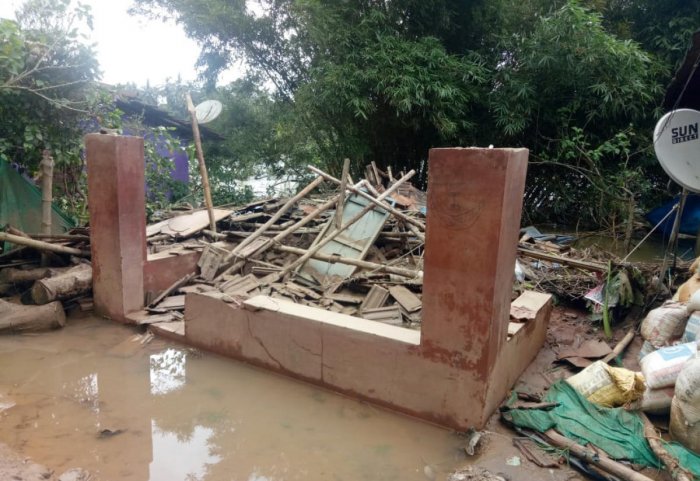
The district was hit by natural calamity in 2018 and also in 2019. Only 33 victims of heavy rain in 2018 have received houses. The rain victims of last year, who are still waiting for sites, are in the doldrums. The natural calamity victims are are expecting a few projects for their welfare in the budget.

In the pre-budget consultation meeting, coffee growers had impressed upon the chief minister on the need to solve their problems. They have demanded free electricity for pumpsets up to 10hp, complete waiver of loans borrowed by coffee growers, compensation for damage to coffee plantations hit by landslides and so on. The growers are expecting the fulfillment of at least a few demands in the budget.

Further, 35,000 labourers, who are working in coffee plantations, are shelterless in the district. The shelterless at Balagodu are already staging a protest demanding a roof over their head. The labourers are expecting announcement on providing either house or site in the budget.

The natural calamity that hit the district has also badly affected tourism in the region. The budget is expected to announce new projects to give a fillip to the tourism. There are possibilities of announcing Cauvery rejuvenation programme and river bank protection projects in the budget.

“New taluks of Kushalnagar and Ponnampet have not received any benefits. We have appealed to the government to announce grants for development works in the newly carved taluks,” activists of taluk associations said.

In 2018-19 budget, Siddaramaiah had announced promotion of cultivation of exotic fruits like Passion fruit, Rambutan, Durian, Dragon, Licchi, Butterfruit, Strawberry, Custard Apple and others, which has not been materialised so far.

Seeking additional grants, MLA K G Bopaiah has written a letter to the chief minister. The MLA has sought Rs 100-crore special package for the development of roads in the district.

Bopaiah has also sought Rs 1 cr for construction of outdoor stadium at Gonikoppa, Rs 1 cr for sports meets, Rs 25 crore for laying fences made out of train tracks, Rs 15 crore for the construction of Bhavans (community halls) of Kodava, Arebhashe, Okkaliga Billava, Bunts and other communities and free electricity for growers using pumpsets up to 10hp.

source: http://www.deccanherald.com / Deccan Herald / Home> State> Mangaluru / by Adithya K A / DHNS, Madikeri / February 25th, 2020