Popular serial Muddulakshmi has successfully completed 100 episodes.
The serial which has was started airing from January marked the debut of Actress Anu Poovamma in small screen.
The serial is currently being aired from Monday to Saturday at 7:30pm.
To mark the occasion, a special cake was by the serial team members.
The serial conveys the message of character and values of a person more important than skin color. Lead actress Ashwini suffers humiliation because of her skin colour. Despite all adversities, she fights against social stigmas. She was brought up by her step mother without showing any affection.
On the other hand, Dhruva who is a heart surgeon shows inclination to marry Ashwini. Dhruva’s role is being played by Charith.
Anu has plays the role of aspiring model Aishwarya. Another vital character Adi’s carries a twist from the 100th episode.
Actors Mico Shivu, Vanishree and N T Ramaswamy are seen in pivotal roles.
source: http://www.timesofindia.indiatimes.com / The Times of India / Home> News> TV> News> Kannada / June 14th, 2018
With hard work, it took only 18 months to get the money back.
CREDIT: Courtesy company
Imagine you’ve just had twins. You need to support your family and work. You’re exhausted constantly. (And from experience, I can tell you baby exhaustion really does feel somewhere between death and stupid.) What do you do to keep going?
If you’re Neel Premkumar, you start concocting coffee shots in your kitchen, playing around with organic coffee beans and cold brewing. While the mad scientist behavior might have been born out of necessity (what innovation isn’t?), in a few months, Premkumar had found the ingredient and technique combination that worked. In fact, his creation worked so well, business bells started blaring in his brain.
The only problem? No money. (Cue the sad violins here.)
An option from inside the family
Fortunately for Premkumar, his father-in-law, Venkat Nemani, had some money–his life savings of $50,000. If Nemani would agree to give that and everything worked out, he wouldn’t lose anything and could even gain. But if things didn’t work out …
It was a huge risk. But Nemani had faith. The money–all of it–went to Premkumar. And what’s more, Nemani didn’t even haggle over details the way other investors or bankers would have.
“I never formally outlined a plan to pay him back,” Premkumar says, “past my good word that he’d be repaid!”
Premkumar recognized the trust. And, in return, he committed to the business full throttle.
“Failure was just not an option,” he says. “I named my company Dyla, which is a combination of my twin girls’ names. When I started, I thought to myself, ‘If I name this startup after my kids, there is no way I could let it fail.’ I think that as an entrepreneur, you just have to have a singular focus on success. What you’re trying to accomplish is hard enough in taking on industry giants. Self-belief is paramount to success.”
And so Forto was born. Premkumar started selling his coffee online, answering every customer email himself. He managed to find a base with the U.S. military, where the need for focus and energy is extraordinarily high.
“When Forto was selling well in every U.S. base, I realized this was going to be a big business,” Premkumar notes. “I also saw signs of big changes in both the energy drink and retail coffee markets, with buying patterns shifting and a new generation of consumers demanding great coffee, in a convenient format that saves them time. That is where Forto fits in and why it has such a loyal audience.”
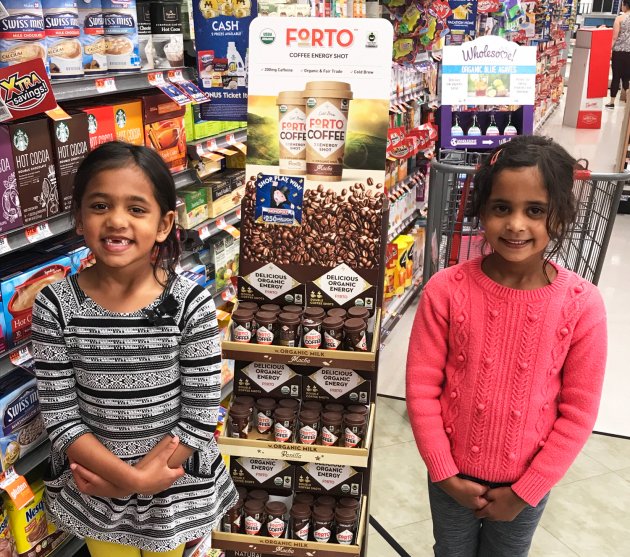
Neel Premkumar’s twin daughters who inspired the Forto coffee shot.CREDIT: Courtesy company
From family loan to national brand
Even though having the money come from his father-in-law added personal stress, Premkumar’s initial product success and market observation told him that asking for the loan had been the right choice. And, by staying laser focused, he managed to pay the $50,000 back in just 18 months.
Forto has skyrocketed, earning 400 percent year-over-year growth. It was named the Inc. 500’s No 1 fastest-growing beverage brand in America for 2017. And while the shots are available in more than 50,000 retail stores, the company announced today that the product will also be on the regular coffee shelves at 3,700 Walmart locations. It’s a massive win for Premkumar, as the entire point of the business has been to help customers boost their energy in a more convenient and inexpensive way.
Should you take the same risk to innovate?
Premkumar says he has zero regrets about the experience. But he points out that much of what made Forto work was just being in the right place at the right time. He came up with the shots right when people were changing the rituals they had around coffee, putting him in the ideal position to meet an emerging demand. And he and his team were serious about examining early adopters to understand why and when they downed the coffee. That allowed Premkumar to find and connect with more individuals for whom Forto was a great fit. Lastly, he didn’t hire and scale until that consumer understanding–and the product message built on it–was solid.
“Everyone’s tolerance for risk is different,” Premkumar says. “For me, bringing Forto’s two-ounce coffee shots to market was worth the risk, because I thought it provided a necessary solution to an everyday problem–a convenient coffee energy boost. I think fundamentally an entrepreneur’s job is about risk mitigation. A startup begins with maximum risk, but every step you take building the company reduces your risk ever so slightly. I was never worried about the competition, more about my own ability to figure out how to meet the consumer need and communicate that correctly to them before the money would run out!”
As for specific money tips, Premkumar says you should borrow only from people you trust. Ideally, those people should be OK with losing the loan. You also shouldn’t aim too high. Raising too much money can be a huge temptation to overspend, waste money, and hire more than or before you need to.
“If you do raise your first round from family or friends,” Premkumar advises, “make sure they have nerves of steel like my father-in-law did. They might need it!”
source: http://www.inc.com / Inc. / Home / by Wanda Thibodeux, copywriter, TakingDictation.com / June 19th, 2018
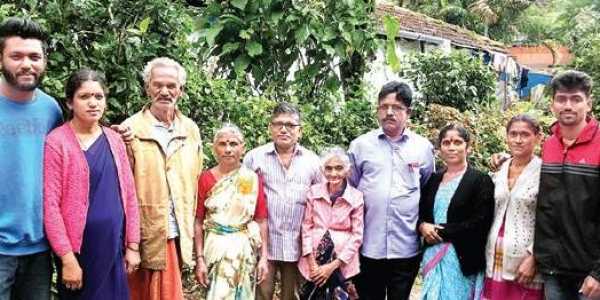
A family of six siblings has reunited after 33 years in Madikeri following an advertisement published in a district newspaper. Anand Nayar and Shekar pose for family reunion picture
Madikeri :
A family of six siblings has reunited after 33 years in Madikeri following an advertisement published in a district newspaper.The two estranged brothers had been living in Mumbai for the past 33 years, assuming that their parents had passed away. They were overjoyed to reunite with their 80-year-old mother who was in tears seeing her two sons after decades.
Anand Nayar, the oldest of six siblings, left Madikeri during the 1980s to find a job in Mumbai. He left behind his parents Kumar and Thangamma, who worked as daily wage labourers in an estate, and five younger siblings. The family had moved to Kodagu from Kerala 50 years ago. Finding a job at a construction company, Anand kept in touch with his parents and siblings via letters.
Shekar, the youngest among the siblings, ran away at the age of 12, following his brother’s footsteps and settled in Mumbai with him. While Anand wrote letters to his family, they became less frequent over time and later stopped altogether. Around the same time, the parents left their old job and moved to a different house.
With no internet or mobile accessibility, the communication between the two brothers and the rest of the family became impossible. Eventually, the two brothers married and settled in Mumbai.Meanwhile, their father Kumar passed away. On his death bed, he had expressed his desire to see his two missing sons. Telegrams were sent to Anand’s old address, only to be returned to the family stating that no such person lived there.
After 33 years of being away from family, Anand wanted to meet his siblings, assuming that his parents might be no more. He, along with Shekar, came to Madikeri two days ago and started looking for his family. “We left Madikeri when it was covered with forests. There were no proper roads, nor electricity. Now, everything has changed and we could not recognise the place we left behind,” said Shekar.
Helpless, they approached a district newspaper to post an advertisement. The advertisement was published following a police search complaint. The next morning, the editor of the newspaper woke up to Anand’s call, who was yelling with joy, “I can’t thank you enough; I have found my mother, brother and sisters because of your newspaper,” said Anand. He had received a call from his sister on a number he had posted on the ad.
Anand and Shekar were reunited with their family in a house near Madikeri Gowda Samaj. Their aged mother, with a joyous smile, said: “I am glad that they came looking for their family before I left this world.” With tearful eyes, she spoke about her two sons and said, “My life cannot get happier than this.” While posing for a family picture, the oldest brother Anand adoringly pulled his sister Prabha beside him and smiled for a family reunion picture.
source: http://www.newindianexpress.com / The New Indian Express / Home> States> Karnataka / by Prajna GR, Express News Service / June 20th, 2018
Devara Kadu, or sacred groves, are a binding force between families and different communities of Kodagu district. Of late, encroachments are depleting this forest cover
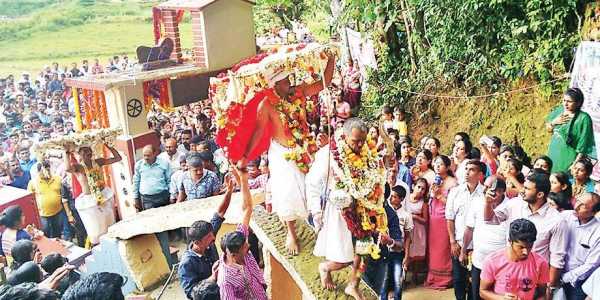
Rituals being conducted during a Devara Kadu festival
Mangaluru :
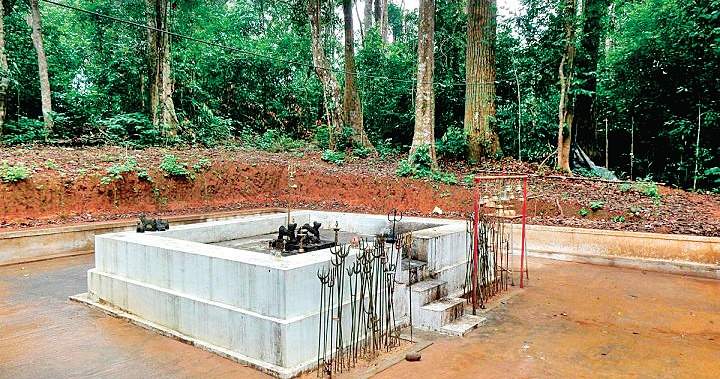
Rumbustious, uncut, proud, magnificent trees; a plinth on which idols of folk deities sit alongside miniature terracotta sculptures of cattle, a harmless silence taken over by tweets of birds and insects – welcome to Devara Kadu temples situated amidst thick, unkempt forests of Kodagu. Ecological havens in every village of the district, Devara Kadu or the sacred groves are a binding force between families and different communities of the district.
The Malnad region is dotted with such sacred grooves. While Devara Kadu fall under the protected forests, they are treated as sacrosanct by the people resulting in the prohibition of felling, lopping or clearing of trees and even weeds. Light, water, air, earth, wind – the five elements — are glorified at these abodes of nature and paganism (nature worship) is revered and celebrated once a year at these groves.
‘Kadu Aiyappa’ is one of the ancient deities worshiped at Devara Kadu. “He (Kadu Aiyappa) chose solitude and a simplistic life in the wild, which is why he is till date worshiped amidst the virgin forests,” explains historian Bacharaniyanda Appanna.
Kottialu Eshwara Devara Kadu at Garakeri
Bhadrakali, Bhagavathi, Naga, Aiyappa, Eshwara, Ajappa are the common deities worshipped in Devara Kadu and each deity has a folk story connecting them closely to the villagers. The folk deities are revered as protectors and guardians of villages they are nestled at. “The place of Hathur, which is on Gonikoppal-Mysuru highway, has been a witness to many accidents. But these accidents have not killed a single person as Goddess Vana Bhadrakali of Hathur Devara Kadu, has protected them all,” says Kokkanda Belliappa, a villager of Hathur who like others here believes in the power of the Goddess.
Currently, there are nearly 1,214 Devara Kadu in Kodagu covering an area of 4,614 hectares and, 18 native communities are involved in worshiping 165 folk deities. “There have been a lot of encroachments. The deities are not as feared as before leading to these encroachments. However, the forest department is vigilant towards these offenders and we have taken several measures against such encroaches,” explains DFO Manjunath.
Nevertheless, in the past decade, Devara Kadu have been reduced to less than 9,000 acres from the original 15,000 acres, according to a survey on Devara Kadu.The ‘Devara Kadu Habba’ or the sacred grove festival, which takes place mostly between April and July (some annually and others biannually), is helping preserve the groves. “The ‘Eeroli Bana’ at Thaaka village of Cherambane is a Devara Kadu of Lord Aiyappa and is spread over 800 acres. It is believed that Kadu Aiyappa Swamy had stayed at this grove for two days. The grove is highly revered by the villagers and the fear of god is still existent, which has prevented encroachments. During the annual Devara Kadu festival, the villagers take a holy dip at the stream flowing in the grove. Entry to this grove is banned otherwise. A team of medical students had visited the grove in 1982 to conduct some research, but they could not proceed into the grove after a certain point,” says Appanna, a villager.
During the Devara Kadu festivals, the virgin groves echo with the praise of the deities. The spirit dance, sacrifices, ex-voto offerings (an offering given in order to fulfil a vow), grandeur god dance are just a few highlights. Prema, a resident of Hathur village, enters the Devara Kadu of Vana Bhadrakali with a trident. She explains, “I am offering the trident to the goddess as a thanks-giving for granting my wishes. People offer cattle to the goddess too.” The spirits of the folk deities are invited into the human body and these spirits listen to the problems of the villagers and provide solutions. The spirits also offer guidance to the village heads to help lead the village towards betterment, the villagers believe.
Even though Kodagu has one sacred grove for every 300 acres, the highest in the state, the groves are still depleting. The pressure of economic returns from plantations has resulted in their depletion. Yet, to some extent, the spiritual connections with these ecological havens are keeping them alive.
History
Granting of sacrosanct status to forests dates back to the Indus Valley civilisation. In Kodagu, kings considered a stretch of forest sacred and cared for the folk deity who in return protected his land. Devara Kadu of Kodagu falls under the tropical evergreen forest belt
Beliefs
Felling, lopping, clearing of fallen branches, plucking of weeds, pruning or burning of trees is prohibited in Devara Kadus. It is believed that offenders will be punished with death by the folk deity. Spirit dance, sacrifice, ex-voto offerings are common practices followed during Devara Kadu festivals.
Depletion
In all, 15,000 acres of Devara Kadu have today reduced to less than 9,000 acres due to continuous encroachments reported in the past decade. Immigration and economic returns are seen as major causes for encroachments.
source: http://www.newindianexpress.com / The New Indian Express / Home> States> Karnataka / June 17th, 2018
Khadi Dupatta by Dastkar Andhra | Photo Credit: Special Arrangement
It is all about khadi at the Dastkar Andhra Exhibition
Khadi will be presented in all its glory with yardage, saris and dupattas at the Dastkar Andhra Exhibition at Serenity boutique from June 19 to 23. The yardage in khadi will be of two types — handspun or hand-woven and handloom, but contains mill-spun yarn and is hand woven. Dastkar Andhra uses natural and environmentally friendly dyes for its products.
“It is authentic, it is comfortable,” says Arati Monappa, of Serenity Boutique. “I am a textile designer. I also use it in my line. It is a beautiful product to work with. You don’t have to starch it. You can accessorise it, you can embroider on it, you can make any kind of embellishment. And it has some meaning behind it, and I think that makes a very big difference, apart from the comfort factor.”
Serenity is a not-for-profit venture that focuses on uplifting artisans and selling eco-friendly products. “We support Dastkar Andhra because their whole marketing strategy is democratic, participative and equitable. They guarantee 365 days of work to their weavers. The profits are equitably distributed. They are working with co-operatives. We don’t want to let this industry die; especially that of handwoven khadi.”
Latha Tummuru, who is organizing the event, works with Dastkar Andhra Marketing Association, which works with 22 cooperatives and over 500 weavers across 22 villages in seven districts in Andhra Pradesh and Telangana. For her, the importance of the exhibit is in promoting hand woven cloth to the urban customer. “We believe that these people are already skilled. We just need to provide them with employment so that they can use their skills sitting in the village. Otherwise, they migrate to cities and become unskilled. Our organisation intervenes to make sure products come in the form that people can use. The innovations are in the fabric and the dupattas. Traditionally, weavers only make saris and dhotis.”
She believes that the dupattas and the wide variety of yardage will be some of the popular products at the exhibition. The Ponduru Khadi sari is another product that is frequently asked about. “We look forward to popularising handlooms, which I have always been passionate about,” says Arati.
The Dastkar Andhra exhibition will take place at the Serenity Boutique in Jayamahal Extension from June 19 to 23. For details, call 4127 9127.
source: http://www.thehindu.com / The Hindu / Home> News> Bengaluru / by Priya Saraf / June 18th, 2018
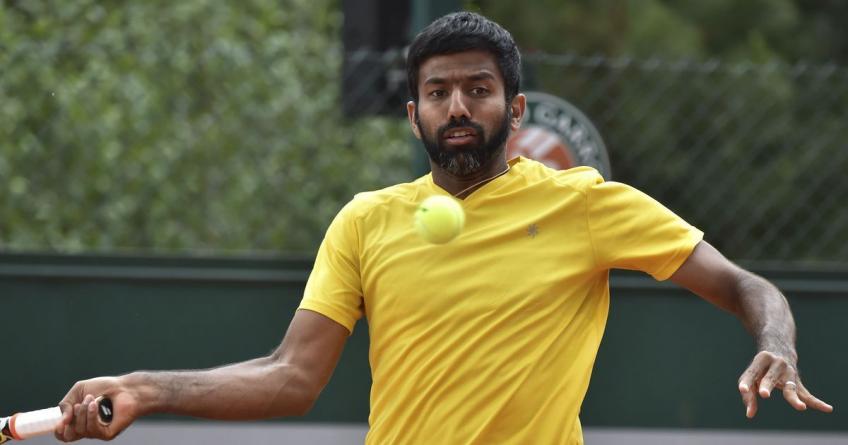
Tennis – Indian tennis ace Rohan Bopanna has received the ‘Sports Icon of the Year’ award at the Indian Oil Sports Conclave on Friday, according to The Hindu. The 38-year-old flew down from Paris where he was beaten in the quarter-finals of the French Open doubles event alongside partner Eduardo Roger-Vasselin.
Several other sports personalities were gathered to cheer on the tennis star receiving the award, including table tennis stars Sharath Kamal, Manika Batra, badminton coach P. Gopi Chand, shuttlers P. Kashyap, N. Sikki Reddy. Although disappointed at not winning his quarter-final match in Paris, Bopanna commented that his loss enabled him to receive the award in person.
Indian Oil also announced plans to provide financial assistance to budding champions and recruit more athletes in six new disciplines – volleyball, basketball, shooting, archery, wrestling, kabaddi and boxing – besides the ten existing games that they have been supporting.
source: http://www.tennisworldusa.org / Tennis World / Home> News / by Prakash / June 10th, 2018
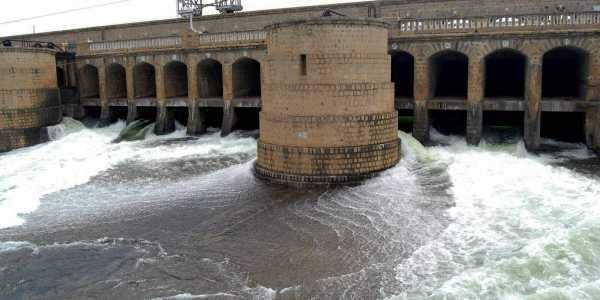
Kodagu district is the major watershed and catchment for the Cauvery and has witnessed rampant conversion of not just forest land but also wetlands and coffee plantations. Water flowing from a dam across the Cauvery river. (File | EPS)
Bengaluru :
With 2,800 acres of land converted for commercial purposes in the last decade in Kodagu district, environmentalists decry the continuing change in land use and say it has decreased the annual flow of water in the Cauvery.
Kodagu district is the major watershed and catchment for the Cauvery and has witnessed rampant conversion of not just forest land but also wetlands and coffee plantations.
The statistics revealed by the district authorities are shocking as between 2005 and 2015, more than 2,800 acres of paddy field, coffee plantations and highlands were converted to residential layouts, sites, commercial complexes and resorts.
Col C P Muthanna, president, Coorg Wildlife Society said, “We have received this data from the district authorities as a reply to our RTI application. This is a matter of grave concern as the tiny district is the lifeline of not only south Karnataka but also Tamil Nadu. The river’s catchment areas have made way for buildings … the district has also been losing its tree cover to infrastructure projects, high tension power lines and railway lines.”
The Coorg Wildlife Society has met the district authorities in this regard and submitted a memorandum highlighting how large scale conversion of wetlands/highlands without even getting a NoC from the gram panchayats have taken off and legalised later by paying bribes. They have requested the authorities concerned to carry out a site inspection in the three taluks and a proper assessment on conversions. Col Muthanna adds, “The DC has tentatively agreed to our request. Further, we have requested for a study on carrying capacity of tourism in Kodagu that may finally result in policy measures for sustainable tourism.”
Environmental activist Sundar Muthanna, who has started an online petition ‘Stop the two railway tracks to Kodagu and Save Cauvery River’ and addressed it to PM and 14 others says, “Implementing the two railway lines will involve cutting of lakhs of trees in the catchment region. Kodagu has already lost 54,000 trees for a high tension power line to Kerala and now hundreds of fresh applications for conversions are pending with the department. Land conversion seems to be the government term for ‘ecological suicide’.”
Railways and highways are being planned to promote tourism and business. “When tree-holding agricultural land is converted for commercial purposes, the trees are cut for construction activities. In river catchment area, less trees is … simply put … less river. The Cauvery went completely dry in Kodagu in March this year … we don’t seem capable of understanding the many warnings that nature is giving us,” Muthanna says.
Environmentalists say a study done by researchers of Indian Institute of Science has already revealed the decreasing water flows to the Cauvery from the catchment areas of the district. Prof T V Ramachandra, head of Wetland and Energy Research Group, IISc headed this study — Modelling Hydrologic Regime of Lakshmanthirtha Watershed, River Cauvery. The study outlines how change in land use in Kodagu has decreased the flows into Cauvery. The assessment showed that out of five watersheds, four had high deficiency of water for over three months.
Kodagu DC was not available for her comments.
source: http://www.newindianexpress.com / The New Indian Express / Home> States> Karnataka / June 13th, 2018
The entrance of the memorial will be dedicated to Kodava culture and will host various traditional artifacts including ‘peecha .kathi’, daggers and other arms
Bengaluru :
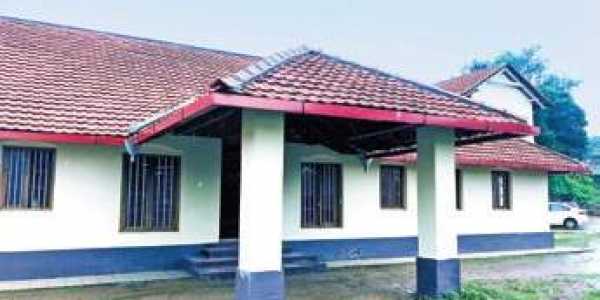
If you approach ‘Sunnyside’ in Madikeri town, you will be welcomed by a larger-than-life boot of a soldier and a battle tank at the door. “Sunnyside” was the residence of General K S Thimayya and had been waiting for a year for the renovations that have just kicked-off.
The house which previously housed the RTO office, is now being renovated and re-named as ‘General Thimayya Memorial’ with an aim to retell the story of the General, the hero of Kodagu and the nation and will depict each phase of his life.
The entrance of the memorial will be dedicated to Kodava culture and will host various traditional artifacts including ‘peecha kathi’, daggers and other arms. The other rooms of the house will depict the General’s childhood days, his lifestyle, and his days in the army. “The visitors will be welcomed into the memorial by an audio recording, dubbed by Belliappa, the grandson of General Thimayya, whose voice resembles his grandfather’s,” explains the memorial’s convener Major (retd) Nanjappa.
The project of renovating ‘Sunnyside’ has begun with work on the interiors currently in progress.
For the project, which will be completed in another six months, getting to this stage of renovation had not been smooth. Major Nanjappa, appointed as the convener a decade ago, has been constantly in touch with the authorities, that kept on changing over the years, to get the project moving forward.
Army General Bipin Rawat has promised to give two boffer weapons to the memorial.y
source: http://www.newindianexpress.com / The New Indian Express / Home> States> Karnataka / by Prajna GR, Express News Service / June 14th, 2018