The recitation of the episode of Kodava Jaya Bharata of Mandira Jaya Appanna by Monnanda Shobha Subbaiah will be telecast in DD Chandana channel on June 21 (Sunday) at 3.30 pm.
source: http://www.starofmysore.com / Star of Mysore / Home> In Brief / Saturday – June 20th, 2015
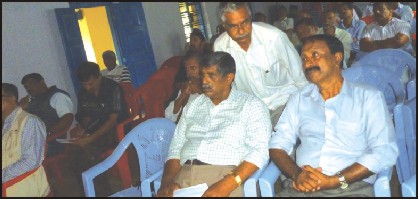
A section of coffee growers who attended the meeting in Ammathi, Kodagu, yesterday. Virajpet (Kodagu) :
The member-coffee growers of the defunct Mysore Coffee Curing Co-operative Society (MCCCS) Limited in Mysuru, who met at Ammathi here yesterday, have resolved to go to Court seeking its intervention not to allow the auction of 5 acres land belonging to the Society.
The meeting, held at Ammathi Vyavasaya Parivartana Sahakara Sangha Hall yesterday, also unanimously resolved to acquire the MCCCS land and take up restoration work for the benefit of coffee growers.
Sangha President Mookonda Bose Devaiah, addressing the members, said that the Government Liquidator’s decision to auction the MCCCS land was against the law of the land. The 10 acres land for MCCCS building was acquired in 1953 by the coffee growers of Kodagu, Hassan and Chikmagalur districts for coffee storage and marketing facilities, he added.
Devaiah also pointed out that in 1998, the State Government appointed a Liquidator, who sold 3 acres of the 10 acres MCCCS land and paid the salary dues to the employees.
Cheranda Nanda Subbaiah, a member-coffee grower, who also spoke at the meeting, called upon the coffee-growers to unite and strive to protect the MCCCS land from being auctioned.
Another member-coffee grower Hemachandra said that the coffee growers from the respective districts will try to bring a stay order from a Court against the arbitrary decision of the Government Liquidator to auction MCCCS land.
Reacting to this, another coffee grower Kolathanda A. Subramani said that the Government, which had acquired 1.13 acre land of MCCCS to recover the debt, had earmarked the land for construction of an Co-operative Academy.
Now, when the MCCCS is free of debts and has rented out 13 godowns, how can the Liquidator go ahead with the auction of MCCCS land, he questioned.
Presiding over the meeting, Kuttanda K. Appachu said that it was now inevitable for the coffee growers of the three districts to seek legal recourse to save the Society’s land as the said land was purchased from the proceeds received through sale of shares of MCCCS.
He also alleged that the move to auction 5 acres of Society’s land had been initiated under pressure from some vested interests.
District Maha Mandala President Iynanda Jappu Achappa called upon the coffee growers to gear up for a legal battle to protect the land.
The meeting also resolved to send copies of the resolution to all those concerned.
Coffee grower S. P. Prasanna of Somwarpet, Ex-Servicemen Association President Chendrimada Ganesh Nanjappa, Zilla Panchayat member Bond Ganapathy, K.M. Viju Chettiappa Mookonda Aiyappa, Bose Mandanna of Balele, P.M. Nanda of Halugunda, Mookachanda Arun Appanna, Patrapanda Raghu Nanaiah were among the coffee growers present at the meeting.
It may be recalled that the Liquidator of the MCCCS, Mysuru, in an advertisement published in Mysooru Mithra on June 18, 2015, had declared holding of a meeting of MCCCS in Ammathi was in violation of Section 73 of the Karnataka Co-operative Societies Act 1959.
source: http://www.starofmysore.com / Star of Mysore / Home> General News / Saturday – June 20th, 2015
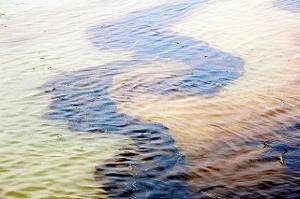
The bacteria extracted grows in a minimal medium supplemented with petroleum crude oil (PCO) in sea water indicating that this is a halophile (organisms that thrive in high salt concentrations) and can be used effectively to clear oil spills in seas.
Mangaluru :
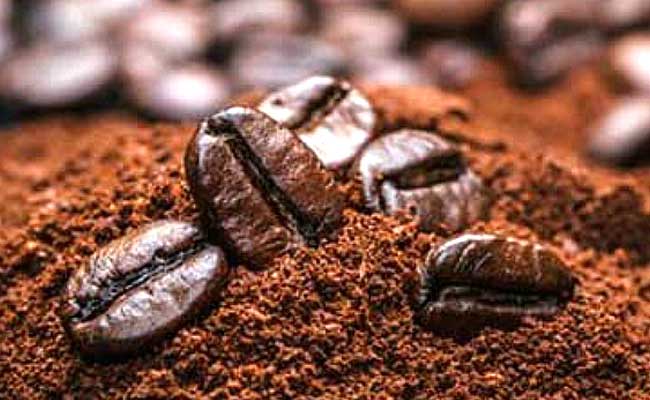
Can bacteria extracted from coffee pulp waste help clear oil spills? It can, says the team from NMAM Institute of Technology, Nitte which has won the Best Project Award for ‘Microbial Bioremediation of Effluents’ at the Joy of Engineering, Design and Innovation (Jed-i) project challenge.
The bacteria extracted grows in a minimal medium supplemented with petroleum crude oil (PCO) in sea water indicating that this is a halophile (organisms that thrive in high salt concentrations) and can be used effectively to clear oil spills in seas.
The team – Aparna K Mohan, Sandhya Kamath, Sanjana Chiplunkar and Shiny Martis B, all BE Biotechnology students of the college- won the challenge beating 19 other finalists which included teams from IITs and NITs. The annual challenge, conducted by Jed-i in partnership with the Indian Institute of Science (IISc), Bengaluru, is designed to identify and showcase the best final year engineering project.
Sanjana, one of the participants, said: “Actually, this was our mini project in the second year. When we got good results we continued with it. The bacteria (Brevibacterium sp. MTCC10313) was previously isolated from coffee pulp ad our seniors had done work and found out that it had caffeine degradation ability. Since it had ability we thought it could tolerate other stressful conditions, then we thought of this.”
Can this be implemented at ground level? “We built a bio-reactor with some waste water and we inoculated the bacteria and got the same results as we got in our lab. This will work in the real world,” she said.
The second place was won by the team of Pradyumna S V, Prateek R, Kunal A Mehta, Mohit Kumar Basu from Reva Institute Of Technology & Management for their project ‘Design, fabrication and Analysis of A Remotely Piloted Vehicle’ while the project ‘Robotic Wrist’ by team of Harish Pawar, Raghuveer Sarma M S, Amit Inamdar, Pooja Ambannavar, Priya Burlabaddi from B V Bhoomaraddi College of Engineering and Technology won a special mention.
source: http://www.timesofindia.indiatimes.com / The Times of India / Home> City> Mangaluru / by Stanley Pinto, TNN / June 25th, 2015
Rohan Bopanna and Florin Mergea ended runners-up at the ATP Gerry Weber Open following a surprise straight set defeat at the hands of Raven Klaasen and Rajeev Ram, here on Sunday.
Halle, Germany:
Rohan Bopanna and Florin Mergea ended runners-up at the ATP Gerry Weber Open following a surprise straight set defeat at the hands of Raven Klaasen and Rajeev Ram, here on Sunday.
The second-seeded Indo-Romanian pair lost the summit clash 6-7(5) 2-6 against the unseeded American-South African team in one hour and 12 minutes.Bopanna and Mergea had come into the event after wining the Mercedes Cup in Stuttgart, last week.
They had advantage, following an early break but lost the momentum as well as their grip over the contest as the match progressed. They could not force a Match tie-breaker as they were outplayed in the second set.
They won 300 ranking points each and shared 50,880 as prize money for their effort.
source: http://www.zeenews.india.com / Z News / Home> News> Sports News> Tennis / PTI / Sunday – June 21st, 2015
Coffee production in India is expected to touch a new peak of 3,55,600 tonnes this marketing year starting October, as the crop prospects are encouraging due to adequate rains in most growing states, state-run Coffee Board said on Monday.
The country’s total coffee output has reached a record 3,27,000 tonnes in the ongoing 2014-15 coffee year, though slightly lower than the earlier estimate of 3,31,000 tonnes made for the same period, it said in a statement.
The coffee year runs from October to September.
Releasing the initial production estimate for 2015-16, Coffee Board said: “The post blossom crop forecast for the year 2015-16 is placed at 3,55,600 tonnes. This is an increase of 28,600 tonnes over the final crop estimate of 2014-15.”
Of the total, Arabica production is estimated at 1,10,300 tonnes in 2015-16 as against 98,000 tonnes this year, while that of Robusta production is pegged at 2,45,300 tonnes as against 2,29,000 tonnes in the said period, it said.
Arabica and Robusta are the varieties of coffee.
“Overall, the crop prospects of 2015-16 at post-blossom stage are quite encouraging with a promise of highest record crop thanks mainly to the timely and adequate blossom and backing showers in traditional areas and non-traditional areas,” it said in a statement.
According to the Board, much of the production gain is expected to come from Karnataka, where total coffee output is pegged at 2,56,500 tonnes in 2015-16, as against 2,33,230 tonnes in the current year.
“The main reason for increased crop forecast in the state is that all coffee growing areas have received timely and adequate blossom and backing showers during this year.
Additionally, prevalence of good prices encouraged the growers to adopt better husbandry practices which have helped to invigorate production,” it said.
The output in three coffee growing districts Kodagu, Chikmagalur and Hassan is estimated higher at 1,38,075 tonnes, 85,250 tonnes and 33,175 tonnes, respectively, for 2015-16.
Coffee production in Kerala is estimated to increase to 69,800 tonnes in 2015-16 from 67,700 tonnes this year, while the output in Tamil Nadu is likely to improve marginally to 18,800 tonnes from 17,875 tonnes in the said period.
In non-traditional areas, coffee production in Andhra Pradesh is estimated to increase to 9,700 tonnes from 7,425 tonnes, while the output in Odisha is expected to rise to 600 tonnes from 550 tonnes in the said period.
Coffee output in north eastern region is, however, expected to decline marginally to 200 tonnes in 2015-16 from 220 tonnes in 2014-15, the Board added.
Till last week, monsoon rains were 11 per cent more than the average. Monsoon rains are expected to be normal in June but may weaken in the next month, as per the Met department.
India accounts for only 4-5 per cent of the world’s output, but exports 70-80 per cent of its produce. Italy, Russia and Germany are the top three buyers of Indian coffee.
source: http://www.ndtv.com / NDTV / Home> Sections> All India / Press Trust of India / June 23rd, 2015
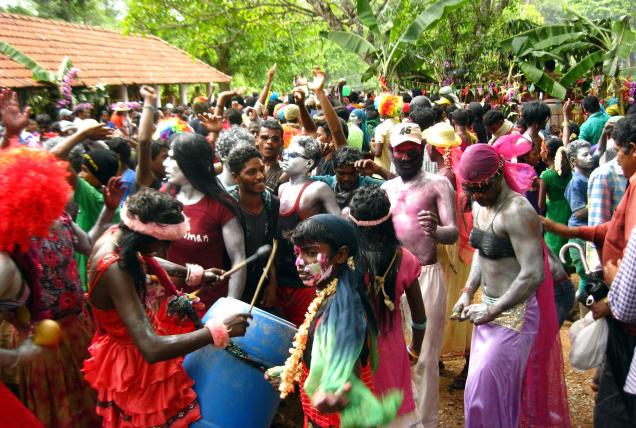
Visit Devarapura, a small village in Virajpet taluk of Kodagu district on the fourth Thursday of May and you can witness a unique festival known for the use of expletives. The festival of abuse brings tribal people living in different parts of the district together. A huge number of tribals belonging to Jenu Kuruba, Betta Kuruba, Yerava and other tribes from Kodagu and surrounding districts participate in the celebrations.
The tribal people dress fancily and wear unusual ornaments like jackfruit skin and empty plastic bottles. A strange mix of paint, powder and mud in different shades of black, white and other colours decorate their body.
The traditional festival known as “kunde habba” or “bodu habba” is celebrated with fervour. Legend has it that Lord Ayyappa fell in love with Bhagavati Devi and followed her in the forest. Tribal people who were waiting for his return felt betrayed. In a rage, they started abusing him to get back his affection. The tradition has passed on through generations and continued as an annual event. Tribals gather in the village a day prior to the festival.
On Thursday they go out on the streets shouting and scolding people and village deities using choicest obscenities. While doing so, they visit houses and shops, begging for alms. In the evening they worship the almighty, apologise for their act and offer the money collected to the deity. The unique festival draws a large number of people from nearby places.
“The outpour of emotions reflects the broad outlook of the community. It provides a platform for them to give voice to the mental dilemmas they undergo, fighting the injustice met to them and claiming an opportunity to uphold their rights. It is also indicative of their struggle against odds, both natural and social. It also appears to be a protest of the underprivileged,” opines litterateur and folk scholar Prof Kalegowda Nagavara.
source: http://www.deccanherald.com / Deccan Herald / Home> Supplements> Spectrum / by Nihar Madikeri / DHNS – June 23rd, 2015
Merry-making: The men dominate the festivities and take great pains to be in drag. Photo: Deepa Bhasthi At ‘Kunde Habba’, the tribal people of Kodagu get their chance to cuss and rant away the insults heaped on them by others
I see, to my utter delight, that the tree under which thousands of tribal people have congregated to rain abuses is the frangipani. The delicate white flower rimmed with yellow is called ‘deva-kanagile’ (god’s flower) in Kannada, a name as gorgeous as the flower itself. The tree decked with flowers is a heartening sight, especially after being subjected to a spate of the choicest abuses. Some friends and I are at ‘Kunde Habba’ or ‘Bedu Habba,’ the annual abuse festival of the tribal people of Kodagu in Karnataka. Held on the fourth Thursday of May in Devarapura village near Gonikoppal, 200-odd km from Bengaluru, this is one day when the tribal people let out their grudges and vent their anger against god and fellow men in some of the filthiest words in Kannada and other dialects.
Kodagu or, in travel agent parlance, Coorg is home to some two dozen tribes. Some are honey gatherers-turned-mahouts, a few are into hunting. But the majority works in the coffee estates that dot the district’s verdant landscape. Their days are spent in rigorous physical labour and the evenings in dulled stupor induced by cheap country liquor. For them, the ‘Kunde Habba’ is their one chance, once a year, to abuse and rant away the insults heaped on them by others.
Legend has it that Ayyappa, the god of the tribals, took a group of them into the forest for hunting. Deep in the jungle, he came across the beautiful goddess Bhagavathi, fell in love and eloped with her, leaving the hapless tribal people stranded. Angry at this betrayal, the tribal people reserve this day to abuse their god for his old mistake — for not bestowing the boons they prayed for, for dreams unfulfilled and wishes unheeded. Over time, the festival has grown to become an outlet for their anger against employers — often wealthy coffee planters — and others who have bothered them. The participants take great care in the way they dress for the festival. Handbags readily become hats and an onion sack is turned into a dress. The men, who dominate the festival activities, take great pains to be in drag. Their hardened muscles gleam with sweat and silver paint. They sport bras stuffed with rags and miniskirts balanced precariously around belted waists. Make-up, most often, is gaudy. A little boy in an underwear pins a white flower near his crotch. Save for their size, there is little difference in the way boys, young men and old men look on this day.
Music is a vital part of the celebrations. Fertiliser tins, mineral water bottles filled with stones and large blue storage bins become drums for the day. Upcycling and recycling are clearly the norm, even if they may have never heard of these new-age terms.
Out in Gonikoppal town, during a break for tea that is too strong, almost bitter, we are bombarded by men in dresses, skirts and tight tops, rattling bottles and beating their drums. There appears to be no method, yet a catchy rhythm ensues. The going rate to get them to leave you alone is ₹10. The men barge into shops, collect money and, towards afternoon, congregate at the temple at Devarapura, where a village fair comes up. Plastic toys, knick-knacks and eats line the stalls as tattoo artists settle in their seats. Crude images of hearts, tigers, even Ambedkar are cut into chappal soles and PoP. These are dipped in ink and pressed on to the skin, after which the tattooist goes to work using an incredibly crude tool to poke through the design, rubbing colour and antiseptic turmeric in the end. Tattoos are cheap, starting at ₹50, or ₹10 per letter for a name.
Meanwhile, dancing around the tree continues. Devotees who have promised sacrifice to the gods throw several shocked chickens into the crowd, those who catch them get to keep them. My friends are miffed at not catching any. The drums get louder and louder, reaching a crescendo, until all the drums merge into a dull relentless thud. Women get ‘possessed’ and run in circles (only to sit back and check messages on their phones a few minutes later) and the dance gets raunchier as the alcohol kicks in. After prayers, they will go back to their haadis or settlements for a feast and many more rounds of drink.
Heartily abused, we feel like we could use a drink too. But instead, the oddly catchy tune of the abuses sticks in our head. We make up words to go along and drive further into the district, for elsewhere.
(Deepa Bhasthi is a freelance journalist based in Bengaluru)
source: http://www.thehindubusinessline.com / Business Line> BLINK> Watch / by Deepa Bhashti / June 09th, 2015
Mysuru-Kodagu MP Pratap Simha has been nominated as a Member of the Press Council of India (PCI) for a period of three years by the Ministry of Information and Broadcasting, Government of India.
The PCI acts as a watchdog, particularly on print publications and was established in 1966.
PCI Chairman Justice Chandramouli Kumar Prasad, in a letter to Pratap Simha, has congratulated him over his nomination to the PCI.
Pratap Simha has thanked Prime Minister Narendra Modi, Union Minister for Finance, Information and Broadcasting Arun Jaitley and Union Urban Development Minister M. Venkaiah Naidu for having nominated him as PCI member.
source: http://www.starofmysore.com / Star of Mysore / Home> General News / Tuesday – June 16th, 2015
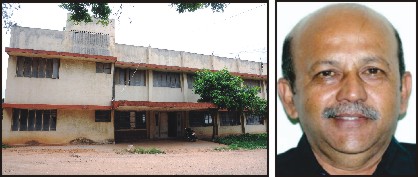
1) The Society’s office building standing on the Society’s land. 2) Bose Devaiah
Mysuru :
The State Government’s decision to auction 5 acres of land belonging to the Mysore Coffee Curing Co-operative Society (MCCCS) on KRS Road, near Gokul Theatre in Gokulam, here, has come as a shock to the coffee growers, who are members of the Society which is under liquidation.
On coming to know about the Government’s decision to auction the land from the press advertisement, the member- coffee growers have decided to launch an agitation soon to save and protect their property, sources said.
In order to discuss the issues, the Kodagu-based Ammathi Vyavasaya Parivartana Sahakara Sangha (MCPCS) President Mookonda Bose Devaiah has convened a meeting on June 19 in Ammathi at 10 am. This meeting will discuss about the land of MCCCS, revival of the defunct MCCCS, election of the President and office-bearers to pursue their objective.
When contacted by SOM, Devaiah said the meeting would pass a resolution and submit the same through Kodagu MLAs to the Government, urging handing over of the MCCCS land to its members. He alleged that some officials and influential representatives of the people have colluded to auction the MCCCS land.
MCCCS established in 1953
Devaiah pointed out that the coffee growers of Kodagu, Hassan and Chikmagalur districts got together in 1953 to establish MCCCS by procuring 10 acres land. MCCCS had been functioning normally for many years and had also constructed several godowns, he added. However, when the sale of coffee was freed from restriction and free-market was allowed, the Society began to incur loss.
The cash-strapped MCCCS which was into coffee marketing, was soon in debts, he said, adding the Society was unable to pay even salary to its employees.
In 1998, the State Government appointed a Liquidator, who sold 3 acres of the 10 acres land belonging to MCCCS and paid the salary dues to the employees, said Devaiah. MCCCS owed money to the Government and hence, 1.13 acre land was earmarked for construction of an Academy by the Government, he added.
Devaiah said, the rental money from the godowns is being deposited in the Liquidator’s account which should belong to the members. It is unfortunate now the Government has unilaterally decided to sell the remaining 5 acres of valuable land.
Several irregularities have been observed in the Government’s decision to auction the MCCCS land, opined Devaiah, saying the Liquidator should have properly ascertained the transactions of the Society before arriving at a decision to auction the land.
Devaiah said the Liquidator has no rights to sell the land of MCCCS and if a situation arises to sell the property, the Liquidator should convene a General Body Meeting of the Society to decide or on the Court’s order. The Society does not owe any money to the Government at present as all dues have been cleared, he said.
Coffee growers have been opposing the unilateral decision of the Government to auction the MCCCS land quite for some time now. But, the Government has not convened a single General Body Meeting of the MCCCS since 1998 and there is no communication about the rental amount collected from godowns. No notice has been issued to the members of the MCCCS to seek their opinion on auctioning the land. The coffee growers have been transporting their coffee products through the rail network available from the Mysuru Railway Station and have plans to construct modern godowns to store coffee products in the MCCCS land, Devaiah told Star of Mysore.
source: http://www.starofmysore.com / Star of Mysore/ Home> General News / Thursday – June 18th, 2015
Hoovaiah, an ex-serviceman, who is serving as a mobile tower operator with the BSNL, entered the Guinness Book of World Records for growing the tallest sugarcane in the world.
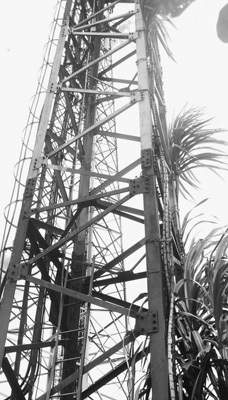
As of now, the sugarcane in Convent Junction in Madikeri is 42-foot tall.
The Sugarcane grown with the support of Mobile Tower in Convent Junction of Madikeri
During an interview to Express Hoovaiah detailed the uphill task and claimed that he had to be convinced to enter the Guiness Book.
Hoovaiah, brought a stem of black variety of sugarcane from Karike four years ago and wanted to eat it once it had grown. He nurtured it with cow dung and ash apart from watering it regularly.
But when it was found that in three years the sugarcane had grown 40-foot tall with the support of a mobile tower, his friends and others advised him to get Guinness Book recognition.
When Hoovaiah approached the Guiness Book officials for recognition they asked him to pay nearly Rs 4 lakh for visiting and verifying the sugarcane.
When Hoovaiah expressed his financial constrain they asked him to submit a 22-page application as it is certified by six gazetted officers, Hoovaiah said.
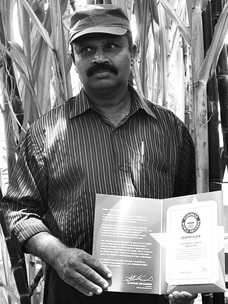
Hoovaiah with the Guinness Book of Records certificate
The team that verified the documents had advocate B B Ananda, Dr Renuka and Dr Tirmala Rao of Ex-servicemen Contribution Service Scheme hospital, Dr Rajashkear and Dr Ramakrishna from Agriculture Department and Dr Sreenivasaiah of Krishi Vignana Kendra Gonikoppa. They inspected the sugarcane and sent a report to Guinness Book of World Records in California of USA on June 21 last year.
After verifying with the records worldwide, they sent a letter of record holder on June 10 this year and asked him to pay Rs 2,593 if he needed an original certificate. After he made the payment, they issued the certificate, Hoovaiah said.
He pointed out that though he was told that the sugarcane will not survive due to the radiation from mobile tower nothing happens so far. He also acknowledge the support of his family, BSNL officials and others in protecting and caring for the sugarcane.
source: http://www.newindianexpress.com / The New Indian Express / Home> States> Karnataka / by B C Dinesh / June 15th, 2015
WELCOME. If you like what you see "SUBSCRIBE via EMAIL" to receive FREE regular UPDATES.
Read More »