Coffee? Mr. President

OBAMA MENU: Jammu and Kashmir’s ‘Nadru Ke Goolar’; West Bengal’s ‘Mahi Sarson’; ‘Shatwar (Asparagus) Ka Shorba’; Sweet dishes ‘Gulab Jamun’, ‘Gajar ka Halwa’ and assorted fruits; ‘Shrimp Karavalli’ from coastal Karnataka; ‘Murg Neeza Kebab’ of the Mughlai cuisine; ‘Anannas Aur Paneer ka Soola’ — char-grilled cottage cheese with pineapple; ‘Nadru Ke Goolar’ (lotus stem kababs); ‘Kela Methi Nu Shaak,’ a Gujarati dish; Mixed Vegetable Kalonji; Gujarati ‘Kadhi’; ‘Matar Pulao’ and assorted breads; Bengali dish ‘Mahi Sarson’ and ‘Bhuna Gosht Boti’ — tender pieces of lamb cooked in tomato and onion masala; South Indian Coffee and herbal tea.
BallalKF0mar2015
by N.K.A. Ballal, Retd. Sr. Vice-President, ITDC

A look at the menu served to Barack Obama, the US President, on the eve of the official lunch hosted by Modi, our Prime Minister, at the Hyderabad House, made an interesting reading. If you glance at the last item on the menu, our own South Indian coffee was served to the President. Those of you, who are not aware, Hyderabad House is a palatial heritage building near India Gate where all the official sit-down banquets of visiting heads of States is held. The catering is always exclusively handled by ITDC through its Ashok hotel outlet from ages. The service is normally handled by junior executives and not regular waiters since it is imperative that the service should be soundless.

Talking about these State banquets, the invitations are co-vetted by all. The menu is designed keeping the preferences of the host and the guest. For example, if one has a look at the recent banquets after Modi has taken over, most of the times it will have a Gujarati flavour. These menus are planned at Ashok hotel and then sent for approval to the pmo. Some PMs like Indira Gandhi and Rajiv Gandhi were very particular about the menu. Rajiv Gandhi used to come to the venue half-an-hour in advance and check small details of seating etc. Even Vajpayee, who was fond of good food, used to scrutinise the menu to ensure that his choice of food was put up without fail. Otherwise it was left to some official in the pmo.

Most often the food is served once on the plate and refills are rarely asked for. On an average, two waiters serve five persons. Sometimes the meal is also served pre-plated and the entire service is strictly designed keeping in mind the preferences of the visiting head of the State. If he or she indicates that they have finished the meal, the plates of all others guests would also be removed, even if they were midway on their meal. These banquets are definitely not for foodies who relish and enjoy their food leisurely. The seating order is decided by the mea much in advance. Hence, a couple may find themselves sitting diametrically across.

Coming back to the story of coffee, it is said that coffee bean was brought to India by a Sufi mystic, Baba Budan, who smuggled seven beans from Yemen and scattered them on the hills of Chikkamagalur in around 1670 and the rest is history. The hills were later named after the saint as Bababudangiri. The history of coffee goes at least as far as the 13th century and it is said to have originated in East Africa, specifically Ethiopia. Some scriptures have indicated that the Arabs cultivated coffee in the 14th century but the earliest authenticated evidence of cultivation and drinking of coffee has originated from the Monasteries of Yemen. By 16th century, it had reached the rest of the Middle East, Persia, Turkey Balkans, Italy and the rest of Europe and finally to the Americas.

The word coffee is said to be borrowed from the Turkish “kahve,” which in turn is a derivative of the Arabic “qahwa,” which means “wine of the bean.” There are several legendary accounts of the origin of the brew itself which may or may not be true. But the story of one Omar, who was once exiled from the City of Mocha to a desert cave near Qusab, strikes a chord. Starving, Omar chewed some berries from a nearby shrub and found them to be very bitter. He then tried roasting the beans to improve their flavour and then boiled them and the resultant brew was consumed. This revitalised him so much that this brew became a miracle drug. Subsequently, it is said that he was made a saint for this discovery.

Anyway coming back to India, though there are about 30 strains of coffee all over the world, the two main varieties cultivated are arabica and robusta. As the word itself denotes, robusta is a very hardy plant and disease-resistant unlike arabica which requires a lot of attention. The robusta bean has much more caffeine but very less flavour and hence not preferred. 75 percent of the world’s production is arabica and only about 25 percent of the production is robusta. But more and more people are now cultivating robusta since it is economical, good for blending and used mainly by instant coffee producers. On an average, the productivity of arabica is about 810 kg per hectare and robusta about 1100 kg per hectare.

Why is there such a demand for Indian coffee? The reason is the monsoon-effect. Most of the crops in South India are dependent on monsoons and the beans develop a separate flavour, which is attributed to this. The bean would turn pale yellow and swell up and lose the original acidity resulting in a smoother brew, which is milder. This mellowing is called “monsooning.” Surprisingly, coffee cultivation at present is the main economic activity of many a country in the world, next to oil. Surprised?

Currently, Coorg is the largest coffee-growing district of India, an impressive 53 percent. The distinction for being the first British to start coffee cultivation at Coorg would go to Capt. Le Hardy. Many others followed him and by 1870, there were 134 British-owned estates in Kodagu. But the man who brought all the coffee estate planters together to form a consortium called Consolidated Coffee was none other than Ivor Bull.

Coffee growing is not restricted to Coorg alone. It is grown in two other regions of India, that is Kerala and Tamil Nadu too. The Coffee Board, located in Chikkamagalur town, oversees the production and marketing of all the beans cultivated in the country. But the biggest coffee grower of the world is still Brazil followed by Vietnam.

I do not want to bore my readers with much more stats but suffice to say that I felt very proud that our own South India kaapee was served to the US Prez. Many a connoisseurs swear by different combinations of beans for making of this kaapee. But the one taught by my father was 80 percent of arabica, 15 percent of robusta and 5 percent chicory, a root additive that gives an additional bitterness, which is liked by many a consumer. And one cardinal rule, never reheat the brew and the second rule, use cow’s milk. Do you agree?

[email:ananthballal@yahoo.com]
source: http://www.starofmysore.com / Star of Mysore / Home> Feature Articles / Thursday – February 26th, 2015

Plantation Trails -Tata Coffee celebrates the ‘joy of womanhood’ this Women’s Day

This Women’s Day, Plantation Trails by Tata Coffee gives you the perfect reason to escape from the hassle of the monotonous life. Plan a much deserved holiday in the heritage bungalows of the Plantation Trails and treat yourself to the exquisite luxury.

Indulge in the delicious Kodava cuisine along with a cook and butler service. Dive into the tranquility of the coffee plantations and spend some quality time with yourself at theReading Zone. Get a glimpse into the Planter’s Lifestyle in the Bun to Cup Tour, Safari Jeep Drive along with the Bird Watching & Photography Tours.

For all the men, this could be that one opportunity to make the women in your life feel special. Gift the lady in your life a relaxing and a rejuvenating holiday with special offers handcrafted by Plantation Trails.

TataCoffeeKF04mar2015

Gautam Prakash, Head- Plantation Trails says “Women, these days, are independent and unbelievably successful in various fields of work while being superlative at guarding their families. This International Women’s day, Plantation Trails by Tata Coffee takes the opportunity to salute the women for who they are and what they do.”

source: http://www.bollywoodhelpline.com / Bollywood Helpline.com / Home> News & Gossip / by Siddharth Dhongle / Tuesday – March 03rd, 2015

When location is character

The lush green countryside of Coorg offered a great backdrop for the story.

Manu Warrier’s debut feature film is set in the plantations of Coorg and the story arc follows nature’s cycle culminating in the coffee blooming season

A love story set in the lush coffee plantations of Coorg, where love blooms when the coffee flowers bloom! And you have a Kodava protagonist in a Hindi movie! Co-written by Mumbaikar from Kerala, Manu Warrier, and Bengaluru man Sharath Parvathavani, Coffee Bloom is an indie that got inspired by the scenic plantation-swamped countryside in Coorg.

Speaking from Mumbai, Manu, who makes his directorial debut with the film said Coffee Bloomhe wanted the location to be an important part of the narrative. “My co-writer Sharath, with whom I have worked on a short film earlier in the U.S., is from Bengaluru and it dawned on us when we were working on the script that Coorg is just a night away from Bengaluru. Our story required a contained setting. We visited Elephant Corridor (a homestay in Siddapura where the film was eventually shot) owned by Viju and Nimmi Chengappa and they gave us a very detailed account of life on coffee plantations and about the phenomenon of the coffee blooms. We realised this could be a key factor in our story and we reworked the script around it, and adapted the story to Coorg, so that it doesn’t feel gimmicky — it’s not like the hero suddenly landed in Switzerland!”

Manu admits that till he visited the Chengappas, his knowledge of Coorg was limited to the photographs he had seen. “The first thing that occurred to me was that it’s splendid; it’s a visual delight for a photographer or cinematographer — it takes you in.”

Manu, a scriptwriter, says he’s averse to showing violence and frustration on screen. “I’m driven to work on plot-oriented subjects.” And so the story traces the life of Dev Anand, a self proclaimed wise man who finds comfort in being a loser, having given up on life as a result of a love gone wrong. A life-changing event takes him on a journey to a coffee plantation in Coorg, where he meets Anika, his long-lost love, and currently his boss. Love blooms in an idyllic setting; and much is at stake as the yearly bloom is round the corner.

Manu admits that he was lucky, when he started out wanting to make this indie, he was introduce to Bollywood producer Harish Amin by filmmaker Leena Yadav, who loved the story and decided to scale it up. He also brought on board Bollywood actor Arjun Mathur who has earlier starred in Luck by Chance, My Name is Khan, and Fireflies and Sugandha Ram who was a part of Jaane Tu Ya Jaana Na and My Name is Khan. The film also stars Mohan Kapoor and Ishavari Bose-Bhattacharya. Manu started writing the film in 2011 and shot it in February 2013. “The climax of the film was dependent on nature. We had to chase the seasons to maintain continuity of the look.” The film cost Rs. 1.5 crore, he admits. In 2014, the film premiered at the MAMI Mumbai Film Festival. At the NFDC Film Bazaar, it was marked for ‘Market Recommendation’.

It was while he was studying for his MBA in the U.S.A. that Manu seriously started getting engrossed in the world of cinema. “All the while I wanted to make films, but your middle-class upbringing doesn’t allow that career. But once I was in the U.S. I had this huge access to film libraries. I started reading, and started DIY filmmaking.” Even when he worked at motels or sold sandwiches, a TV showing films was a constant presence, he laughs. He worked in HR recruitment for a while and then decided to come home. When he moved back to Mumbai, he says he was naïve enough to believe that he would write scripts and films would be made off them. “But reality doesn’t work like that. So I started pitching myself as a scriptwriter, and as someone who would develop people’s content for them.” Things started opening up, but projects were also frustratingly shelved midway.

Manu says he had been going back and forth with Bollywood filmmaker Anurag Kashyap to collaborate on a script when another great opening came his way — “Anurag Kashyap suddenly called me late one night and said there is a writing project. He didn’t tell me any more details or who it involved. I think it was about being in the right place at the right time.” Manu landed a writing job, having being given the task to write the screenplay for four episodes of Yudh, the TV series starring Amitabh Bachchan, that Kashyap had created. “There was no pressure on me as such because I came into the scene where the storyline has already been mapped out, and Amitabh Bachchan’s character graph was also mapped out. But I was excited, and on a high.”

Talking of the kind of opportunities available now, and the possibilities of the indie film in Hindi cinema, Manu says there are people who make films on controversial subjects to get attention, there are others putting up their film online, unbothered by the industry. “But whatever you do, struggle is a part of the picture. I was a rank outsider. And it’s never easy. But after a point, you just want to be part of the picture, whether it’s rosy or not. But the indie scene is surely changing for the better — there are now benchmarks for a good indie and a bad indie,” says the 36-year-old filmmaker.

Coffee Bloom releases in India, U.S. and Toronto simultaneously on March 6. Bengaluru, Mumbai, Delhi, Jaipur and Kochi will be the India releases.

source: http://www.thehindu.com / The Hindu / Home> Features> MetroPlus / by Bhumika K. / March 02nd, 2015

MUDA chief appointment roils senior Congressmen

While Surayya Abrar assumed charge as President of Madikeri Urban Development Authority (MUDA) on Monday, several senior Congress leaders expressed their displeasure over the appointment.

Some members of city unit of Congress Party, decided to tender their resignation to the party positions, claiming that the post of MUDA President has not been given to native members of Congress. They claimed of the alleged involvement of a former MP behind the appointment of the new President. The former MP has taken the decision without the consent of the local leaders, they said.

Names of senior leaders T M Ayyappa, V P Suresh and Chummi Devaiah were apparently heard for the post of the MUDA President. But, the former MP has selected a candidate who had lost deposit in the CMC elections held last year, local Congress leaders said.

The position of MUDA President was lying vacant for two years, ever since Congress government came into power in the state. Local leaders in Madikeri unit of Congress had requested the senior partymen to appoint a senior Congress leader in Madikeri, to the post. A twelve-member committee was also constituted towards the selection of the posts of Presidents of other authorities, including Madikeri Urban Development Authority. The district Congress had recommended the names of T M Ayyappa, V P Suresh and Chummi Devaiah. But the list of the names was subject to changes in the last moment, due to the intervention of the former MP, they said.

Congress leaders said CMC President’s post has already been given to a lady belonging to a particular community and now, the MUDA President’s post has also gone to a lady belonging to the same community. The members belonging to other communities have been neglected, they added.

A Senior leader opined that the Congress has been giving priority to candidates from a particular community, to prevent erosion in its vote bank, as during last CMC elections, SDPI had earned much votes than Congress.

A discomfited aspirant said the current development will affect the results of the upcoming Gram Panchayat elections.

Delegation to KPCC

The Congress leaders in the city have been reportedly planning to take a delegation to KPCC, Bengaluru, to urge to withhold the new appointment and to give an opportunity to a senior leader from the party.

‘Discomfort is natural’

Speaking to reports, newly appointed MUDA President Surayya Abrar said it was obvious for Congress leaders to be disappointed and that things will be sorted out eventually.
She meanwhile thanked former M P H Vishwanath, district Congress unit President B T Pradip, Chief Minister Siddaramaiah and KPCC President G Parameshwar, who made possible her appointment for the MUDA President’s post.

source: http://www.deccanherald.com / Deccan Herald / Home> District / Madikeri – DHNS, March 02nd, 2015

Amend Constitution to protect regional languages: Manu Baligar

The Supreme Court’s verdict that the State can’t impose medium of instruction has had an impact on regional languages.

The only alternative before the State government is to exert pressure on the Centre and bring in an amendment to the Constitution, said writer and Kannada and Culture department retired commissioner Manu Baligar.

Speaking after inaugurating Somwarpet taluk Kannada literary meet here on Sunday, he said that elected representatives and officials should bring in an amendment to the Constitution to protect regional languages.

“We need to empower Kannada language. The Kannada software needs to be further developed. The State government should implement the recommendations of the committee headed by Chidananda Gowda. Kannadigas are not only those who speak Kannada as their mother tongue but also those who have respect for Kannada land, water and language,” he said.

In his presidential address, Bacharaniyanda P Appanna said the State government should initiate measures to provide 50 per cent reservation in government jobs for all those who have studied in Kannada medium up to 10th standard.

“Today, we have Kannada medium schools in villages with all basic facilities. However, the schools have failed to attract students. People are obsessed with English language. This fascination has reached such limits that Kannada medium schools are closing down. Kannada Sahitya Parishat should conduct various competitions to promote Kannada. Kannada books library should be opened in all gram panchayat offices,” he added.

He remembered the contributions of John Michael, William Reev, Herman Mogling, and Rev Kittel to the development of Kannada language.

Kannada schools were opened in Kodagu in 1837. The rich people in Kodagu were fascinated towards English. However, it was teachers and experts from Mangaluru and Mysuru who contributed to the growth of Kannada in Kodagu, he added.
DH News Service

source: http://www.deccanherald.com / Deccan Herald / Home> District / by Nelyahudikeri (Somwarpet Taluk) / DHNS – March 01st, 2015

Rohan Bopanna, Daniel Nestor win Dubai ATP title

Dubai:

India’s Rohan Bopanna and his partner Daniel Nestor grabbed their second ATP title of the season by subduing Aisam-ul-haq Qureshi and Nenad Zimonjic in the summit clash of the Dubai Duty Free championships on Saturday.

The fourth-seeded Indo-Canadian combine raced to a 6-4 6-1 win in just 50 minutes against the unseeded Serbian-Pakistani team. It was Bopanna’s 12th career ATP doubles title and second with Nestor.

Bopanna and Nestor saved an early break chance in the opening set and never looked back after that.

They broke the rivals at the first available opportunity to pocket the first set and just ran away with the second to wrap up the match in a jiffy.

Bopanna and Nestor had won their first title in Sydney, early in the season.

The winners split USD 149,170 as prize money and earned 500 ranking points each.

source: http://www.ibnlive.in.com / IBN Live / Home> IBN Live> Tennis / Press Trust of India / February 28th, 2015

After a Storm Comes a Coffee

CappucinoKF28feb2015

Chennai :

Complimenting what World Barista Champion Fritz Storm stands for, his hotel room almost seems perfumed with coffee. On the bed, while the rest of the suitcase sits unpacked, a giant packet of coffee powder sits neatly opened. “This coffee powder is from Guatemala, and freshly roasted. I wanted to de-gas it a bit before I can use it,” says the coffee expert and barista trainer, who was in the city for the launch of the new Magnum Ice Cream flavour that blends coffee with chocolate. Fritz, along with pastry chef Janice Wong, demonstrated creative ways of pairing the two ingredients for desserts and drinks, as part of the launch on Tuesday evening.

“I chose the coffee from Guatemala for the demo because it has a lot of chocolate flavour in it during the finish, besides the fruity taste. There is some acidity in the beginning, which leaves an interesting taste in the mouth,” says Fritz, who has travelled around the world, studying the coffee flavours of different countries. According to him, South African coffee tastes fruity and sweet, and in Brazil, which is the largest producer of coffee, the drink though doesn’t taste very special, has a wonderful base.

What about the local filter coffee? “I haven’t had the time to try it in Chennai, but I tried filter coffee from a street side shop in Hyderabad, and I found it nice. But it was extremely sweet, sweeter than ice cream,” he says with a laugh. “However, I don’t think there is anything like the best coffee in the world. It is a combination of the beverage — how it tastes and how it looks — and how the barista is serving it. He or she needs to have the personality, and say the right things while serving the drink,” he adds.

It’s likely those are the exact points that earned him the title of World Barista Champion in 2002. “It was all coincidence. I am an accountant by profession and I didn’t even drink coffee till my 20s. I guess as a young guy I just wanted to do something fun, so I started as a bartender. That’s when I drank Cappuccino for the first time in 1994,” recalls Fritz, who, today, cannot start his morning without a Cappuccino, or carry on with the rest of the day without his share of Expressos. “In a few years, I started hearing about various competitions of making coffee. In the first World Barista Championship held in 2000, my colleague competed, I tried in 2002 and won,” he adds with a smile.

Ever since then, Fritz has been training baristas for the Championship, and experimenting with coffee as an ingredient. He tells us about his invention — Almond Cappuccino, reminiscent of the lazy mornings he spent back home in Denmark dipping almond biscottis in coffee. “I thought, why not make a new flavour with it? So we soaked the biscuits for six to 12 hours and then made a Cappuccino,” says Fritz. Recently, he, along with Janice, made what they named Mocha Margarita. “We added chocolate, cinnamon, expresso, milk and caramel sauce with mocha to create something unique. And since we found only a Margarita glass to pour it, we named it Mocha Margarita!” he shares, with evident enthusiasm.

According to him, though the coffee industry is much older than wine industry, it is only now that we are slowly beginning to understand coffee. “People can differentiate the taste of different wines, and they know the basics, like white wine does not go with fish and so on. But it is only now that people are able to recognise the flavours of different coffees. Soon, they should be able to make a preference, in the sense of what brewing they like to have with a dessert, what would suit an ice cream, chocolate or cake. We haven’t reached there yet, but we are catching up really fast,” he says.

source: http://www.newindianexpress.com / The New Indian Express / Home> Cities> Chennai / by Naveena Vijayan / February 26th, 2015

Noida-based barista brews his way to history

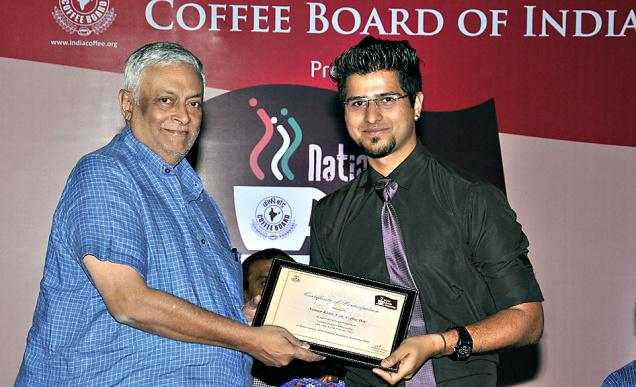
Naman Kohli claiming the National Barista Championship in Bengaluru on Friday.

A lot can happen over coffee and a 22-year-old Noida-based barista proved this as he brewed history on Friday. Cafe Coffee Day, Noida’s barista Naman Kohli became the youngest winner in the two-year history of the National Barista Championship, the finals of which were held here on Friday.

Naman’s signature brew ‘Pixel’, named after his pet dog, proved to be a gustatory delight, not only for the judges, but also veteran barista and World Barista Championship winner Vikram Khurana, who said, “The Pixel brew was nothing short of the magical brews of Rome and Milan, and could very well win the World Championship.”

Naman’s joys were compounded when Anil Kumar, Vice-Chairman, Coffee Board of India, announced that for the first time, the winner would be sent abroad to represent the country in the World Barista Championship. “I finally need to get a passport made,” said an ecstatic Naman.

The national championship commenced with the first round being held in New Delhi and Bengaluru, in which 12 of more than 55 baristas from the north and south regions were shortlisted to go neck-to-neck in the final round in the city. Each barista was given 15 minutes to brew four espressos, four cappuccinos and four signature brews of their choice.

source: http://www.thehindu.com / The Hindu / Home> News> Cities> Bengaluru / by Staff Reporter / Bengaluru – February 28th, 2015

Arjun Mathur mixing coffee with romance

ArjunMathurKF27feb2015

Mumbai:

A cup of coffee holds a lot of promise they say, but for Arjun Mathur, Coorg’s coffee plantations seem to be the key. The actor who was last seen in FIREFLIES AND ANKUR ARORA MURDER CASE, will finally be getting his chance to romance.

The actor who has left an impact with films like MY NAME IS KHAN, LUCK BY CHANCE, I AM AND BARAH AANA will be now venturing into the genre that all hindi heroes are meant to specialize in, romance!

The film is aptly titled COFFEE BLOOM, and will talk about romance blooming around the coffee plantations of Coorg, where the protagonist of the film, Mathur, has his past, present and future coming together in a romantic mesh. It sure looks like a cup of coffee that everyone would like to sip!

source: http://www.bollywooddhamaka.in / Bollywood Dhamaka.in / Home> Bollywood Dhamaka / by Abhi Kapoor / February 26th, 2015

MRC Nagar deal a shot in the arm for Tata Coffee

Chennai :

As the property earns a rental of 65 per sq ft per month, the annual returns on investment for Tata Coffee will be 10.8%, higher than the industry average of 10% returns for Grade A commercial space.

Sivasankaran is now under bankruptcy protection by an order of the Seychelles Supreme Court. Andhra Bank took possession of property after Siva Industries defaulted payment of Rs 42.7 crore loans.

“The company has invested in a commercial property consisting of four floors of office space in MRC Nagar in Chennai for a consideration of approximately Rs 65 crore through public auction,” Tata Coffee said. Sivasankaran could not be reached for comments.

Sivasankaran’s financial problems began when he was supposedly coerced into selling Aircel to Maxis by former Union telecom minister Dayanidhi Maran. His re-entry into the telecom sector through S Tel, and his investments in renewable energy and shipping backfired.

The serial entrepreneur applied for bankruptcy protection in a Seychelles court to ward off a claim by his Bahrain-based telecom partner Batelco, which won a court decree for its $212million claim on its investment in S Tel, for which Sivasankaran had stood personal guarantee. S Tel’s telecom licences in India were cancelled along with 121 other licences by the Supreme Court in the 2G case.

Since then, entities that were part of Siva Group have started selling or monetizing the group’s assets. His group headquarters–Sterling Towers on Anna Salai-has been sold.

Last month, Sivasankaran, agreed to sell Firhaven Estate, his 1.9 lakh sqft residence in MRC Nagar, to unknown buyers for nearly Rs 400 crore.

source: http://www.timesofindia.indiatimes.com / The Times of India / Home> Business> India Business / TNN / February 27th, 2015