Former Sandalwood actress Nidhi Subbaiah, who has acted in Kannada films Pancharangi and Krishnan Marriage Story among others, seemed a little flustered yesterday when she saw what she had scored on the Bangalore Times Most Desirable list. The actress, who was rated number 42 in the national list, appeared at number 6 on the regional list. (Nidhi Subbaiah )
Her comment on the list on Twitter began with, “These individual city polls are funny! I believe only in the national poll.. God bless small minded people! .. Tch.” The actress, who was last seen in the Bollywood film Ajab Gazabb Love opposite Jackky Bhagnani, went on to further add, “Also, nice to read em sometimes.. Get to know a lot about myself that I didn’t know!Like who’s dating who!No time to confirm? Double tch.”
The comments, however, has not gone down too well with fans, colleagues and friends. While one of her fans posted a snapshot of hers from the list congratulating the actress, Nidhi, reacted with a “hmmm no I don’t believe in this! False news.”
Actress Ramya, who topped the regional list, too could not help but react to Nidhi’s comments. “We may be small minded but we have a big heart. We mean good to others and of course we don’t forget our roots as much as we branch out,” Ramya tweeted.
source: http://www.articles.timesofindia.indiatimes.com / The Times of India / Home> Entertainment> Regional / by Parinatha Sampath, TNN / Monday – May 21st, 2013
‘The trick is to confuse the plant to think it is summer all along and make it bear apple through the year’
Though cheery and blithe in countenance, 74-year-old Chiranjit Parmar, a horticulture scientist from Himachal Pradesh, hopes to radically change the agricultural landscape of the region. After having observed the success of apple cultivation in Batu, Indonesia, Mr. Parmar wants to introduce the fruit, hitherto associated with cooler climes, in the tropical humidity of Karnataka.
“It is an experiment. And like all experiments, it can also fail,” he told the group of farmers who had assembled in the city on Saturday for his seminar on ‘Apple cultivation in Karnataka’.
The idea sounded incredulous to farmers who had travelled from as far away as Kodagu. Apple – whose mass cultivation is associated with regions on the foothills of the Himalayas such as Shimla and Kashmir — needs to have a chilly weather for it to bear fruit in the summer. How then was it supposed to survive in a region where temperatures rarely go below 12 degrees Celsius?
“The trick is to confuse the plant. The broad principle is that just after the sapling experiences chilling in Himachal or Kashmir, it is transported here. As there is not much of a temperature change here during winter, the plant thinks it is summer all along and bears fruit through the year,” Mr. Parmar told the befuddled farmers.
He illustrates this with a picture of cultivation in Indonesia, where, while half the apple orchard bears fruit, the other half is bare. “Crops can be regulated easily, as the leaves can be removed fully to stimulate winter. While in Himachal, we get six to seven tonnes of apple per hectare, in Indonesia, they get 65 tonnes and throughout the year,” he said.
So far, the experiment has seen small orchards set up in Tumkur, Somwarpet, Sringeri, and Uppinangadi – all through saplings sent by Mr. Parmar. In his first visit to the region, he said the results were encouraging, and in Tumkur, the plants were already bearing fruit within two years. “In Himachal, apple trees take five years to bear fruit. Here, it grows faster and incessantly into very tall trees as there is no crop fall or dormancy during winter,” he said.
Challenges
However, the tropical climate also brings with it a set of problems that is yet to be scientifically dealt with. For example, trees are susceptible to a variety of diseases and insect, while methods to reduce the tree height and grafting of trees needed to be worked out.
‘The trick is to confuse the apple tree to think it is always summer’
source: http://www.thehindu.com / The Hindu / Home> National> Karnataka / by Staff Correspondent / Mangalore – April 22nd, 2013
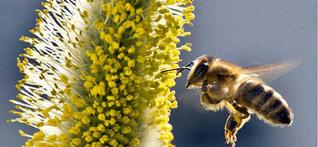
Tempting: Caffeine in nectar hooks bees.— photo: AFP
How did coffee become more popular in south India and tea in the north? History appears to give the reason. Legend has it that in the late 16{+t}{+h}century while Haji Baba Budan was returning from Haj through Yemen, he found people boiling coffee beans in water and enjoying the “decoction”. He then smuggled a handful of the (forbidden to export) beans with him and planted them on the Chikamagalur hills in Karnataka and the locals took to it with elan. Soon, coffee plantations appeared in Kodagu and the Nilgiris, and we all were hooked on to the morning coffee. Tea, on the other hand, was introduced later (early 19{+t}{+h}century) by the colonial British who copied it from the Chinese and planted it in Assam and Darjeeling. This colonial drink soon became popular among the subjects in the plains as well. Coffee and tea are thus external entrants into the Indian taste buds.
But why are we hooked on to coffee and tea? The answer comes from science, which tells us that they both contain the mood- altering and addictive drug caffeine. While this is a proximal answer, the ultimate question is why at all do these plants go to the trouble of making the molecule in the first place. After all, it takes metabolic energy to do so. The answer appears to be “to deter herbivores”, or as a defence chemical. Note that the raw bean or leaf is bitter to taste, and the animal would shy away, leaving the plant alone to grow and flourish.
Recent findings add another dimension to the tale. It has been found the caffeine is found not only in the bean or the leaves but also in the nectar that the plant produces and packs a drop or two in its flowers. And why it would do so and what this stored caffeine does in the flower nectar has been investigated by a group of researchers from U.K. and published in the March 8, 2013 issue of Science .
They note that while plant-derived drugs like caffeine and nicotine (the drug in the tobacco plant) are lethal in high doses, they do generate pleasant effects when taken in very low doses. But then why in the floral nectar? Is it in order to “hook on” bees and other pollinating insects? To understand this, the researchers first measured the levels of caffeine in the nectar of three plants, Coffee arabica , C. liberica and C. canephora , to which bees make a bee-line for (pardon the pun), and found the amounts to be less than a thousand-fold that of the sugar present in the bean — just a teasing touch.
They hypothesised that the caffeine in the nectar could affect the learning and memory of the foraging pollinators. Could it be that they would come to these flowers, enjoy the nectar and in the process take away and dispense the pollen, thus breeding these plants in preference to those that do not store caffeine in their nectar? In order to test this, the researchers took the trouble of training individual bees to associate a floral scent with sugar reward. In one set the bees would go to the containers with sugar solution, and in another set the sugar solution spiked with a bit of caffeine. And they found that the bees would consistently return to the caffeine sugar scent even three days later. In other words, caffeine acted as a memory enhancer. The bees were hooked onto caffeine.
The researchers went further ahead and investigated the biological mechanisms behind the mode of action of the caffeine. The bee brain contains what are called projection neurons or nerve cells that have a protein surface (a receptor) that normally binds to the molecule adenosine. When these nerve cells are adenosine-bound, the behaviour of the bee is one of quiet and calm. However when caffeine is brought in, it kicks out the adenosine and attaches itself to the receptors at the end of the sensory neurons. The effect is to stimulate the neurons, increase memory, and wake up and excite the insect.
In effect then, caffeine has two roles in the plant. One is defence against the predator goats and cows, while the other is to entice the pollinating insect by drugging it and tweaking its memory so that it pollinates this plant in preference to other pants that do not pack the drug in their nectar. The researchers conclude by stating that “our experiments suggest that by affecting a pollinator’s memory, plants reap the reproductive benefits arising from enhanced pollinator fidelity”.
In plainer English, one can say that the trick the coffee plants play is another example of the ‘selfish gene’ idea, namely, use any ruse to help propagate my genes over other competitors, and do so for generations; and if it takes caffeine to entice and tweak the memory of the pollinator, so be it.
source: http://www.thehindu.com / The Hindu / Home> Features> Sci-Tech & Agri / by D. Balasubramanian / April 18th, 2013
Sandalwood actress Harshika Poonacha, who was last seen Kavita Lankesh’s Crazy Loka, featuring Ravichandran and Daisy Bopanna, seems to be flooded with offers now.
The actress, who is working on eight Kannada films this year, is also doing her debut in Kollywood with the film Anandha Thollai. Harshika, who has been in the news lately for her upcoming special number in the film Case No 18/9, is excited about her first dance number. “On my way for the dance rehearsals:)My first dance number has to be outstanding!wish me good luck tweeps, I need lot ,” tweeted the actress recently. (Harshika Poonacha )
The Jackie heroine, in a recent voice update also says, “There’s some good news. I’m getting lots of song offers. I’ve even been offered two Telugu films. So, I might be flying to Hyderabad very soon. Your blessings should always be with me.” Though Harshika has a string of films lined this year, her first dance number sure has brought with it a lot more projects.
source: http://www.articles.timesofindia.indiatimes.com / The Times of India / Home> Entertainment> Regional> Kannada / by Parinatha Sampath, TNN / March 25th, 2013
The 10K marathon that took place in Bangalore today saw several celebrities from the Kannada film industry participating in it. Every year we see actors from Sandalwood participating in it. But this year several actors from the industry took part.
We had actors like Pooja Gandhi, Sharmiela Mandre, Aindrita Ray, Vinayak Joshi, dancer Madhuri Upadhya and model Shubra Aiyappa, among others participating in it. Actor Puneeth Rajkumar flagged the event. (Vinayak Joshi )
The popular RJ-turned-actor Vinayak Joshi, who once weighed as much as 121 kgs lost about 42 kgs once he took up to running. And with the actor out of Bigg Boss home, Vinayak began his new diet by giving up salt and sugar. With the TCS 10 k marathon scheduled for today morning, the actor energetically signed for the marathon today and participated in it. He tweeted, “It was an awesome run. #tcs10k was a good come back run for the running season waiting in the second half of the year. Thank u all.”
Dancer Madhuri also tweeted saying, “Ran #TCS10K ,very surreal experience!!! Thanks to @rjvinayakjoshi for introducing me to the world of running.”
source: http://www.articles.timesofindia.indiatimes.com / The Times of India / Home> Entertainment> Regional / by Sharanya CR, TNN / May 19th, 2013
M.R. Poovamma came up with a rare hat-trick of titles in the women’s 400 metres as India won 12 medals, including five gold, in the third and final leg of the rain-marred Asian Grand Prix athletics series in Colombo on Sunday.
India wound up with 13 gold, 10 silver and 11 bronze medals from the series.
Though the chase for the World Championship qualification proved elusive, Poovamma clocked 53.30 seconds in taking her third gold. She had run a personal best of 52.75 in the Federation Cup recently, when she missed the qualification by four hundredth of a second. She had clocked 52.97 in winning the first leg in Bangkok.
Arokia Rajiv came up with his second gold with a time of 46.63s in the men’s 400 metres, after the silver in the first leg. Jitin Thomas failed in his attempt to get his third gold despite scaling 2.21 metres in high jump. He was beaten by Manjula Pushpakumara of Sri Lanka by three centimetres. Nikhil Chittarasu also jumped 2.21m for the bronze.
Siddhant Thingalaya clocked 13.81s in winning the men’s 110m hurdles. In a photo finish, the JSW Foundation supported Thingalaya, who trains in Australia, pipped Rittidet Jamras of Thailand by one hundredth of a second. Thingalaya had hurt his hamstring in clocking a national record 13.65 seconds in Brussels in June last year while chasing the Olympic qualification standard of 13.60. Interestingly, the ‘B’ standard has been set at 13.50 seconds for the World Championship.
Arpinder Singh captured the gold in men’s triple jump with a leap of 16.70m. He had missed the qualification mark of 16.85m for the World Championship by one centimetre in the Federation Cup.
The results Indians unless specified): Men: 100m: 1. Al Harthi Barakat (Oma) 10.45; 2. Guo Fan (Chn) 10.45; 3. Yi Wei Chen (Tpe) 10.59. 400m: 1. Arokia Rajiv 46.63; 2. Seneviratne Kasun (Sri) 46.84; 3. Kalinga Kumara (Sri) 47.31. 5,000m: 1. Nitendra Singh 14:41.26; 2. Kheta Ram 14:41.91; 3. D.L. Samarajeewa (Sri) 14:43.15. 110m hurdles: 1. Siddhant Thingalaya 13.81; 2. Rittidet Jamras (Tha) 13.82; 3. Wan Sofian Rayzam Shah (Mas) 13.96. High jump: 1. Manjula Pushpakumara (Sri) 2.24; 2. Jitin Thomas 2.21; 3. Nikhil Chittarasu 2.21. Triple jump: 1. Arpinder Singh 16.70; 2. Roman Valiyev (Kaz) 16.42; 3. Renjith Maheswary 16.41. Shot put: 1. Wang Li Ke (Chn) 19.20; 2. Guo Yan Xiang (Chn) 19.03; 3. Grigoriy Kamulya (Uzb) 18.87; 4. Om Prakash Singh 18.20. Javelin: 1. Huang Shih Feng (Tpe) 75.85; 2. Sachith Maduranga (Sri) 73.99; 3. Jiang Xing Yu (Chn) 73.43; 7. Davinder Singh 69.33. 4x100m relay: 1. China 39.63; 2. Chinese Taipei 39.89; 3. Hong Kong 39.91; 5. India 40.14. Women: 100m: 1. Zyabikina Viktoria (Kaz) 11.69; 2. Khubbieva Guzel (Uzb) 11.70; 3. Klomdee Neeranuch (Tha) 11.90. 400m: 1. M.R. Poovamma 53.30; 2. Rakhmanova (Kaz) 53.85; 3. Anu Mariam Jose 54.63. 800m: 1. W.K.L.A. Nimali (Sri) 2:05.90; 2. Do Thi thao (Vie) 2:06.38; 3. Liliya Bazyaruk (Kaz) 2:06.68. 100m hurdles: 1. Anastasiya Soprunova (Kaz) 13.61; 2. Erawati Dedeh (Ina) 13.62; 3. Natalia Ivoniskaya (Kaz) 13.64. High jump: 1. Nadiya Dusanova (Uzb) 1.93; 2. Wang Yang (Chn) 1.89; 3. Sahana Kumari 1.79. Long jump: 1. Darya Rezmehnenko (Uzb) 6.34; 2. Yuliya Tarasova (Uzb) 6.20; 3. Katherine Kay Santos (Phi) 6.04. Javelin: 1. Lakmali B.L. Nadeeka (Sri) 58.41; 2. Chang Chunfeng (Chn) 54.05; 3. Lekamge Dilhani (Sri) 53.67; 6. Mukesh Kumari 48.34. Discus: 1. Liang Yan (Chn) 57.67; 2. Jiang Fengjing (Chn) 57.59; 3. Krishna Poonia 55.41. 4x100m relay: 1. Thailand 45.33; 2. China 45.41; 3. Sri Lanka 46.21.
source: http://www.thehindu.com / The Hindu / Home> Sports> Other Sports / New Delhi – May 13th, 2013
In the 17th edition of the Kodava Hockey Festival hosted by the Madanda family at the Kodava Sports and Cultural Grounds at Balugodu, Anjaparavanda team lifted the winner’s trophy in the final match played yesterday.
The Anjaparavanda team defeated Palanganda team — who were hat-trick winners of the trophy by 2-0 goals.
Anjaparavanda, which ruled the game from the beginning, succeeded in defeating the strong opponent Palanganda team, which drastically failed to convert six penalty corner options into goals.
The Hockey Festival ended on a colourful note with the valedictory programme marked by a music recital, followed by a body-builders’ show and Kolaat by Kodava artistes. Founder of the Kodava families Hockey Festival Pandanda Kuttani Kuttappa inaugurated the final match by hitting a silver ball with silver hockey stick. Virajpet MLA K.G. Bopaiah, MLC M.C. Nanaiah and other dignitaries viewed the final match in which 225 teams participated. Next year the festival will be hosted by Thathanda family.
source: http://www.starofmysore.com / Star of Mysore / Home> Sports News / May 13th, 2013
The top most popular song of last year Pyaar Ge Agbuttaithe….Namdhuke Jaan ge Hogbuttaithe….is widely heard and this particular song is also one of the significant factors for Pawan Wadeyar ‘Govindayanamaha’ getting good collections in the theatres for producer KA Suresh.
The song beginning words ‘Pyaar Ge Agbuttaithe’ is the title for popular comedy hero Komal Kumar next film that commenced song recording on Friday morning at Rajesh Ramanath ‘Sthyaayi Studio’. Komal Kumar
Tamil film director Kavin Bala makes debut in Kannada with story, screenplay and direction. Dharma Teja is music composer, Bala Barani is cameraman for this Rakshit Films. Shoba Prakash is the producer of this film that will be shot in Bangalore, Mysore, Madikeri, Sakleshpur, Udupi and others locations. Suresh Urs is editing this film.
The selection of heroine and supporting cast is in progress.
source: http://www.indiaglitz.com / India Glitz / Home / Saturday – May 04th, 2013
India’s former penalty corner specialist Len Aiyappa is in town to help the Project 2013 squad players improve on their penalty corner drag flicks.
The 34-year-old Len, of Bangalore, was one of the top penalty corner drag flickers in the world during his playing days from 1999 to 2005.
Len also trained the Spain National Under-21 drag flickers in 2010 and was also attached to Italian clubs for four years from 2007.
The defender, who plays for Air India in the Indian League, was also the top scorer in the Malaysia Hockey League (MHL) for three consecutive years in 2003, 2004 and 2005 – and for three different clubs (Ernst & Young, Bank Simpanan Nasional and Telekom respectively).
He was the last foreign player to win the MHL top scorer’s award in 2006.
Len, who arrived here on Wednesday, said that he was more than happy to help the Project squad drag flickers prepare for the Junior World Cup in Chandigarh, India, in December.
“Penalty corners are crucial during matches … a good drag flicker can help his team win matches. I am here to help fine-tune their flicks so that they are accurate and powerful,” said Len, who will be here for 12 days.
The five drag flickers in the Project squad are Mohd Shahril Saabah, Mohd Nor Aqmal Abdul Ghaffar, G. Kavin Kartik, Mohd Zulhairi Hashim and Mohd Aminudin Mohd Zain.
Len said he would return to KL “another four of five times” to train the Project squad drag flickers.
“My aim is to produce a good drag flicker for Malaysia for the Junior World Cup in December,” said Len.
Project squad coach K. Dharmaraj believes that Len is the perfect choice to guide and turn his youngsters into deadly penalty corner flickers.
source: http://www.thestar.com.my / The Star Online, Malaysia / Home> Sports / Friday, May 17th, 2013
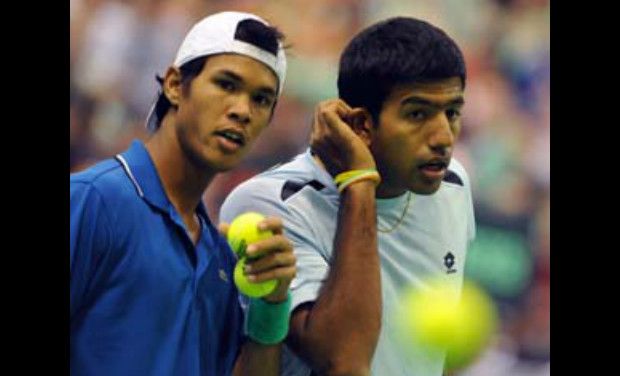
Somdev Devvarman and Rohan Bopanna — File Photo Bengaluru:
Indian tennis is playing out like a long-running soap opera.
Seasons have rolled by but the central characters have remained the same and so has the plot. A power-hungry negative but central character in the form of the All India Tennis Association and a group of protagonists, who although united in the cause of the sport, have for long differed in their opinions.
But come April 6, we could witness the end of the opera which in turn could usher a new beginning for the sport, which has a strong following in the country.
This Saturday, the newly-formed Indian Tennis Players’ Association will hold its first Annual General Body meeting in Bengaluru, following its launch in February.
The ITPA, by itself, is a model for sportspersons in the country who for long have been ruled by the whims and fancies of federation honchos, for most of whom players’ welfare is a very low priority.
Although the ITPA came into existence last month, the indications to the effect have been around for a while now. Until recently, unity was never a strong point of Indian tennis. Internal bickering and ego clashes have always been a part of the sport’s culture.
Last year, when Mahesh Bhupathi and Rohan Bopanna took on the men, who wield power and supposedly know what is best for the sport in the run-up to the London Olympics, a significant glimpse of unity in times of crisis proved to be shining beacon.
The next show of strength came when 11 players made themselves unavailable for the Davis Cup tie against Korea after the AITA chose not to take up the players’ suggestions.
The players are back in the fold, on their terms, and determined to bring about a positive change in the tennis scene in the county. But they take pains to maintain that they are not a rival body to the AITA, but a “forum for the players, by the players.”
Speaking about the players’ unity, one of the primary factors behind the formation of the ITPA, India’s singles ace Somdev Devvaraman said, “All the players are sticking together and that’s a positive sign and it’s not going to change anytime soon. It’s very evident to all of us that we are doing what is correct and what is right for the sport in the country.
“We are always going to support each other. It’s rare and it’s a beautiful group to be a part of,” said the undisputed leader of the young generation.
The 28-year-old pro, who is on a comeback trail, further stated, “It’s our right to voice our opinion, India is a free country where people have always voiced their opinion if we don’t like it, we’ll say it. That’s the way I have been brought up.”
While AITA may beg to differ, Bhupathi rightly points out that they have only the interest of sport in mind. “What we are trying to do is call for better process in tennis and make it a better sport for everyone.”
All these players show passion and commitment on the court and it’s no surprise the same comes out when they speak of the way forward for Indian tennis.
“The ultimate thing is a lot of players who have played in the past and most of the present players are all on the same page. One thing is for sure, all of us want the exact same thing as an outcome. We just want the best for the players and for the future of the game. I think all of us are tennis enthusiasts, and we just want the best for it,” said the strappy Somdev.
A new beginning beckons Indian tennis, and the fact that the ushers are men and women who are passionate about the sport may well bring the bang back into Indian tennis. We will have the AGM on Saturday. Trust me, we are going to be there in full force supporting the team during the Davis Cup tie and we will be there in full force to make sure what changes we set out to do in Indian tennis happens.”
Mahesh Bhupathi “I’m glad the ITPA is formed and I’m looking forward to the first meeting. It is great to have a platform where people who are truly connected to the sport have a chance to discuss the future and identity the best way forward for the sport.”
Modelled around the ATP (the Association of Tennis Professionals), the ITPA, a Section 25 Company, a non-profit association, is a body floated as a platform to represent the professional interests of tennis players across the country.
source: http://www.deccanchronicle.com / Deccan Chronicle / Home> Sports> Tennis / by Manjula Veerappa / DC / March 31st, 2013
WELCOME. If you like what you see "SUBSCRIBE via EMAIL" to receive FREE regular UPDATES.
Read More »