MP grants Rs.20 lakh for BVB GARWALE SCHOOL in Kodagu


Caption: MP A.H. Vishwanath being felicitated at a function held at the Bharatiya Vidya Bhavan (BVB) Garwale School in Madikeri yesterday. Others seen are (from left) BVB Kodagu Kendra Chairman K.P. Uthappa, BVB Mysore Kendra Vice-Chairman K.B. Ganapathy, BVB Karnataka Chairman N. Ramanuja and BVB Mysore Kendra Chairman A.V. Narasimha Murthy.

Madikeri, Apr. 9 (GG&KMC)
MP A.H. Vishwanath yesterday announced a grant of Rs. 20 lakh for the school adopted by Bharatiya Vidya Bhavan (BVB), located in Garwale, a remote village in Madikeri taluk, Kodagu district.

Speaking at a function held in his honour at the school, Vishwa-nath said that he would donate his collection of 16 volumes of Vachana Sahitya to the sch-ool’s library which he said was well-stacked with 5,000 books on different subjects and languages.

He also expressed gratitude to the Geejaganda family that donated 35 acres of their land for the school.

“The school, which had been closed for four years, has been fast developed into a model educational institution in a short span of time by the BVB Mysore Kendra,” said the MP and lauded the efforts of BVB Karnataka Chairman N. Ramanuja, BVB Mysore Chairman Prof. A.V. Narasimha Murthy, Vice-Chairman K.B. Ganapathy and Hon. Secretary P.S. Ganapathy.

Prof. Narasimha Murthy said in his welcome address that all the office-bearers of BVB Mysore have pledged to make the Garwale School into a model institution. “We have spent Rs. 1.80 crore on the school for its infrastructure development and intend to do more,” he said.

K.B. Ganapathy, Editor-in-Chief, Star of Mysore, speaking on the occasion, assured to lead BVB as per the vision of its Founder K.M. Munshi, as an Educational Trust. “Our objective is to build a quality educational institution for the people of Garwale and its surroundings, where basic amenities are still a pipe dream. We intend to raise the school’s standard to such a level that parents must voluntarily offer donations to admit their wards to the school,” he said.

BVB Kodagu Kendra Chairman K.P. Uthappa and others were present.

source: http://www.StarofMysore.com / General News / April 09th, 2012

Tributary tales

Lead review

Tracing the route River Kaveri takes through the southern states of Karnataka and Tamil Nadu, this book records the river’s rich history through stories that make up its past, writes Revathi Siva Kumar
The authors begin their book with the wry Tamil aphorism that the origin of sages and rivers — rishi mulam and nadi mulam — should not be probed. You are grateful indeed that the writers decided to disregard this sage advice, and instead have filled every line of this book with glittering ore. It Happened Along the Kaveri, by Padma Seshadri and Padma Malini Sundararaghavan, subtitled A Journey through Space and Time, is about the holy river that links and divides two southern states, as well as the earth and the
heavens.

The book traces the Kaveri’s roots in Talacauvery, and meanders up to its exit point, the ancient port of Poompuhar. However, the authors traverse much more than the termini. The route is not linear, but fans out into the huge states of Karnataka and Tamil Nadu.
The authors avoid contemporary industry, pollution and politics, except for a
serious note of warning in the appendix. Thus, the reader is drawn more into Kaveri’s dazzling historical beauty than its dark modern realities.

They explore the distributaries that run through the real as well as imagined history, socio-economic and political evolutions and compulsions, folklore, mythology, prose, poetry, songs, rumour, hearsay, religion, philosophy, flora, fauna, ecology and architecture. The more you dig the treasure trove, the more you unearth
invaluable gems.

There are interesting nuggets on the biographies and stories of the kings, leaders, saints, architects, poets and other luminaries who lived, loved and shaped the fortunes of the riparian areas for centuries –— starting from the era of the Vedic gods themselves.
Ancient kings and dynasties, such as the Hoysalas, Wodeyars, Hyder Ali and Tipu Sultan, Cholas, Nayaks and Marathas, the British and the French spring to life. While wars are recorded, the peace time activities of nation building and administration occupy more space and focus.

The mind boggles at the information overload, and it would be a struggle to read or remember too much of it at one sitting. At times, it does seem a bit of an onslaught on the understanding, especially as so much is completely new.

What saves the book is the careful structuring and classification, alternating fact with fiction and history with lore. Luminous stories interweave gently and seamlessly through the tough fibre of fact and history.

Hence, you learn for instance that Nandi, Shiva’s vaahana, was once so puffed up with
pride that Shiva was forced to crush her with a lock of his hair. At Kodagu, the family hockey festival was started in 1997 to encourage the sport among Kodavas — who have gifted seven Olympic players to the country — and by 2003, it drew 280 teams. By a remarkable coincidence, the numeric value of Hyder Ali’s name coincides with the year of his death. Fascinating details such as these are the breezes that blow your senses and understanding forward.

The authors’ struggle is not just to sift, sort and shuffle, but also to comment and overlay it with their own perspective. For instance, one story goes that Kaveri is a joint gift from Brahma and Vishnu to Kavera, the King of Vidarbha, while another calls her a gift of Siva to Sage Agastya. In true Hindu tradition, the authors concede the existence of contradictory elements, but advocate reconcilable stories. Hence, they cite the most amiable theory that opines: “First, she was the mind-born daughter of Brahma, then she became Kavera Raja’s child. Then again she was in the pot of Sage Agastya, and aided by him she became a flowing river.”

The prose is simple, straightforward and ambles like the river, with a gentle, meandering logic of its own. The authors remain objective about their facts, yet they give a quiet and understated value judgement on most of the events they document. For instance: “In a show of amity untouched by sectarian rivalry on Ramanavami, Rama is brought from his abode…”

There is a dry irony that lends a sparkle, such as: “Hyder assured them that Kunde Rao was his old servant and not only would his life be spared but he would be cherished like a parakeet. He was true to his word — Kunde Rao spent the rest of his life in an iron cage and was fed with rice and milk…”

One weak point in the book is the lack of illustrations and photographs. Although there are a few at the end — almost as an afterthought — a generous interweave of images through the narrative would have helped to illuminate and lighten the load of the reader.
However, you can overlook the aberration. Ultimately, the book leaves you with the breathless feeling that you are on an infinite, timeless journey that lasts 802 km and about 450 pages. Dive in then, to share its treasures!

source: http://www.DeccanHerald.com / Home> Supplements > Sunday Herald Books / April 08th, 2012

Darien’s 2-time state geography champ heads back to nationals

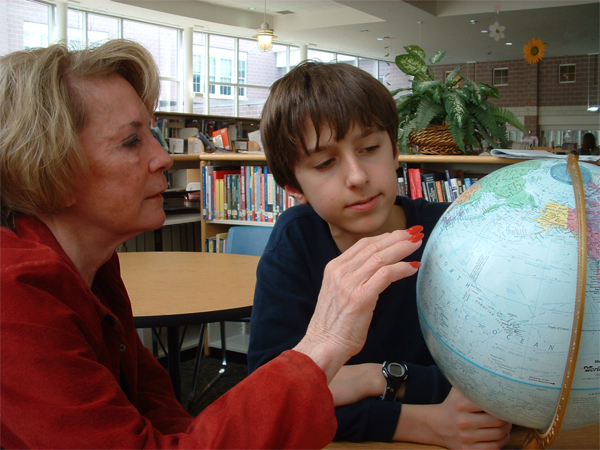
Seventh grader Andrew Borecki, two-time Connecticut Geography Bee champion, and Middlesex Middle School librarian Barbara Ivey meet three times a week to study geography. Andrew heads back to the national bee this year.

Darien, Connecticut, USA
There must be something in Darien’s water. For the second year in a row, seventh grader Andrew Borecki took home first place honors in the Connecticut Geographic Bee. This was his fourth year making the statewide event, and he’s also eligible to compete next year.

Michael bested roughly 100 students from across the state to earn $100 and a second chance to win the 24th annual national competition in Washington, D.C. at the end of May. This time around he missed two questions out of 20 — one about where the sport of ulama is now popular (Mexico), and one about the most recent Baltic country to join the eurozone (Estonia). Last year he only missed one — the capital of Morocco (Marrakesh).

“It was exciting to win,” Michael told The Times last year. Michael placed eighth in his first two trips to the states in fourth and fifth grade. His coach and mentor, Middlesex librarian Barbara Ivey, has met with Michael at least three times a week after school to help him hone his skills.

“You have to be a good listener,” Ivey said, adding that the questions often carry a clue within its wording.

Michael will compete against students from 49 states and five U.S. territories, and he is the fifth Darien student to win the state title, which is more than any other Connecticut town.

Jackson Hart, a fourth grader at Ox Ridge, and Nicholas Derby, a fourth grader at Tokeneke, each won the geography bees held at their respective schools and then competed at the state level with Michael after they passed a 70-question exam, scoring in the top 100 in Connecticut.

Perhaps some of Darien’s geography bee success can be attributed to an odd ritual that Ivey picked up while in Mercara, India — a sister town to Darien. One of her hosts decided to smash a coconut as an offering to Ganesh, the Hindu god of obstacles and new beginnings.

By smashing the coconut, they were symbolically smashing any obstacles that would impede them from achieving their goals. The ritual caught on with her students, and for the past six years Ivey and her team continue to crush the tropical fruit for a bit of luck.

Last year’s national winner, Texas seventh grader Tine Valencic, took home a $25,000 scholarship check by naming the country where the Tungurahua volcano sits (Ecuador), and the national park in Nepal where the southern part of Mt. Everest rises (Sagarmatha).

source: http://www.darientimes.com / The News of Darien, Connecticut / by David DesRoches / Wednesday, April 04th, 2012

Novel way for coffee planters to check the weather


Many of us look online or rely on the weather reports to find out what the climate and temperature is going to be like.

However, the coffee plants in the Kodagu region of Karnataka have apparently come up with a rather different way of doing things.

According to reports, they have decided to use an unusual means of working out what is happening: by using a balloon.

How does this weather prediction method work?

Apparently, the balloon is filled with helium gas and is equipped with instruments which are able to study the weather systems.

For instance, it is said that the equipment would be able to determine whether rain was likely within a period of around 4 days.

Of course, this information is vitally important to the coffee farmers.

The information will help them work out whether to incur the costs of using sprinklers to irrigate the coffee crops, for example.

The information which is collected by the equipment in the weather balloon would be used alongside information which is collected from the other automatic weather stations (there are about 25 of them) in Kodagu.

Further calculations will then be made by the Madhapur station and sent on to the Indian Space Research Organisation’s research section.

Why go to all this trouble?

Apparently, this way of monitoring the changing weather patterns is an attempt to get predictions which are as accurate as they can be.

The coffee planters have contributed towards the cost of the operation and the Indian Space Research Organisation has agreed to help out too.

source: http://www.WorldCoffeeNews.com / by Clive / Thursday, April 05th, 2012

Specialty food, beverage sales soar to $75 Billion

New York:
Consumer willingness try new foods and flavors helped propel U.S. retail and foodservice sales of specialty food and beverages to $75 billion in 2011, a 6.9% increase over 2010 sales, according to a new report from the National Association for the Specialty Trade (NASFT). Surging demand for yogurt, energy bars, nut and seed butters and coffee drinks helped drive sales to new highs for the second year in a row.

The report, “The State of the Specialty Food Industry 2012″ tracks sales of specialty food through supermarkets, natural food stores and specialty food retailers, and includes research from interviews with food retailers, distributors, brokers and others involved in the supply chain.

“Consumers are making better food a part of their lifestyle,” said Ron Tanner, vice president, communications and education, for the NASFT. “They are embracing new foods and flavors and are willing to choose top-quality even while they economize elsewhere.”

Cheese continues to dominate specialty foods, pulling in $3.44 billion in retail sales in 2011. The next largest retail sales categories are meats, poultry and seafood; chips, pretzels and snacks; coffee, coffee substitutes and cocoa; and bread and baked goods. Functional beverages are the fastest-growing segment, followed by yogurt and kefir.

While 2011 product introductions declined 6.2% a manufacturers focused on existing lines, there is positive momentum for the industry as the average transaction size for specialty food stores jumped 11.4% to $41.49.

Key takeaways from the report include:

Specialty foods represent 13.7% of all food sales at retail.

Kosher is the leading claim for new specialty food products, followed by All Natural.
Natural food stores are the fastest growing retail channel, with a sales increase of 19.8% from 2009-2011.
In 2011, 41% of specialty food manufacturers reported a sales increase of more than 20%.
Local is the most influential product claim today, according to 75% of retailers surveyed.
Latin is the fastest-emerging cuisine, retailers said. Importers report growth in cuisines from Eastern Europe and India.

Sources:
National Association for the Specialty Food Trade: Specialty Food Industry Hits New High
www.foodproductdesign.com / Home> News / April 02nd, 2012

New look for Kodava recipe website

Coorg’s first dedicated website for indigenous Kodava receipes, www.coorgrecipes.com started in 2007, has been redesigned to focus exclusively on Coorg cuisine.

While retaining most of the earlier features, a few new features have been added.

Commenting on the redesign, the promoter of the website, journalist P T Bopanna said: “Earlier, the recipe website had a section for ‘Coorg jewellery.’

However, I wanted to focus totally on food. With the creation of the new jewellery website www.coorgjewellery.in, it became necessary to redesign the recipes site.”

Chef Naren Thimmaiah, of the Karavalli restaurant of the Taj Gateway Hotel in Bangalore has contributed recipes for the ‘Recipe of the Month’ section.

Among the new additions, include a link to the blog of Canada-based Kodava food blogger Shalini Nanda Nagappa on her culinary adventures in ‘A Cookery Year in Coorg.’

Another new section called ‘Coffee with Priya Ganapathy’ deals with the making of the perfect cup of coffee and varieties of coffee liqueur.

Renowned cartoonist N.S. Ponnappa’s cartoons on the obsession of the Kodavas (Coorgs) with good food and hard liquor have been retained.

source: http://www.DeccanHerald.com / Home> District / DHNS, Mysore / April 03rd, 2012

Forestry students training at zoo

Mysore Zoo is organising training for the final year B.Sc. (Forestry) students of Ponnampet Forest College from April 8 to May 14.

It is proposed to create awareness and opportunity to learn about Zoo management and their activities.

The programme is designed to understand the importance of conservation education, captive breeding research, rescue and rehabilitation.

B U Chengappa, retd principal chief conservator of Forests will inaugurate the training programme on April 8 at 11 am at Mysore Zoo.

M Nanjundaswamy, Chairman, Zoo Authority of Karnataka will preside over the function. R S Suresh, member secretary, Zoo Authority of Karnataka will participate in the inauguration as chief guest, according to a press release from the zoo.

Animal adoption

Mysore zoo has announced that the following persons have adopted the noted animals under “Adoption of Animals” scheme by paying the adoption fee.

Dhananjay Patnakar from Koramangala, Bangalore has adopted the cheetah paying Rs 50,000 for a year from March 24, 2012, to March 23, 2013, while Vaanathi Paulvannan from Coimbatore has adopted a Russel Viper for a year, paying Rs 2,000 .

Sonam Sultana and Prajwal B R from Rayanakere and Hootagalli in the city have adopted a Love Bird and Red Avadavit, respectively paying Rs 1000 each for a year, according to a press release from the zoo.

source: http://www.DeccanHerald.com / Home> District / DHNS / Mysore, April 03rd, 2012

Cariappa takes charge as academy chief

Addanda C. Cariappa assumed charge as president of the Karnataka Kodava Sahitya Academy in Madikeri on Thursday.

Mr. Cariappa said he would work for the development of Kodava language, art, culture, folklore and literature with cooperation of other members of the academy. He would focus on publishing more works in Kodava by consulting experts, according to a press release issued here.

President of the Kodagu Zilla Panchayat Ravi Kushalappa, president of Sri Bhagandeshwara Temple Committee Manu Muthappa, president of the Madikeri Taluk Akrama-Sakrama Samiti Napanda Ravi Kalappa, editor of Shakti G. Rajendra, former president of the Kodagu District Kannada Sahitya Parishat T.P. Ramesh, and Kodagu District Commissioner of Scouts and Guides K.T. Baby Mathew congratulated Mr. Cariappa.

Members of the academy Nirmala Bopanna, Mittu Poonacha, Poovaiah, Thammaiah, Kasturi Govindamaiah, Sumi Subbaiah, N.A. Ramesh, and Uma Prabhu were present.

source: http://www.TheHindu.com / Home> National> Karnataka / by Staff Correspondent / Mysore, March 30th, 2012

Spending time with the tribals

Honey hives: In the forest
It was a day to remember when school kids danced with the Soliga tribals recently at the town hall.
A recent event in Mangalore brought school students closer to Soliga culture. Many of them joined the Soligas as they danced as part of a programme held in the city’s town hall recently.

The students were from Stds. VI and VII. There were 40 students from Government Higher Primary School, Parappade, and 70 students from Government Higher Primary School, Mullakadu.

Song and dance
Enjoying ethnic beats: With the Soliga tribe
The dance was part of a week-long celebration of dances organised by the Information Departments of all the 30 districts of the state.

Most of the students said that they were seeing the dances and songs of the Soligas for the first time.

The Soligas explained to the students about life in the forest. The students asked them several questions about their food, their way of worship and how they lived in the forest.

Telling time

Raghuvir, Std. VII, Government Higher Primary School, Parappade, said, “I liked the way they described how they collect honey and how they tell the time by looking at the blooming of a flower. They should be allowed to live in their forests.”

Nirmala, Std. VII, said, “Women in the tribe have freedom.” Hithesh, Std. VII was thrilled how they could detect a snake hidden in the foliage.

Dhanaraj, Std. VII admired the way they dressed, their views on animals, their ornaments made from what is available and the variety of their dances

Mamatha, honorary teacher, Government Higher Primary School, Parappade, was impressed by their marriage custom, where a girl can choose her life partner and the expense of the marriage came to only Rs.12.50.

The word Soliga means “people of the bamboo”, because they believed they originated from the bamboo. They live close to nature. This is seen in their local tribal laws. They harvest fruits and berries only from trees that has lots of flowers. They leave the overripe ones for the birds.

They cultivate land only for five to seven years. Then the land is left untouched for 50 to 75 years, so that the forest takes over again.

source: http://www.TheHindu.com / Life & Style> Kids / by Renuka Phadnis / April 02nd, 2012

Rally keeps racing buffs on their toes

Mysore:
Hundreds of bike and car enthusiasts on Sunday morning flocked to Roost Hotel off in Mysore-Hunsur Road to witness Rally de Mysore, a time speed-and-distance (TSD) motorsport rally.

SP R Dileep flagged off the rally, organized by Kodava Samaja Cultural and Sports Club (KSCS), amid fanfare, excitement and, of course, revving engines. Fifty-four teams on 40 cars and 14 motorbikes took part in the TSD rally spread over 10 hours. The 140-km rally covered Bilikere, KR Nagar and other places on the outskirts of Mysore. Besides 15 teams from Mysore, there were those from Coimbatore, Erode, and Bangalore too.

The revving of engines an hour before the commencement of the rally set the mood, while the spectators enjoyed watching customized cars, jeeps and bikes warming up for the big day. Each team had a rider/ driver and a navigator.

Speaking about the rally, organizer B Rathan Ponnappa said it comprised three classes in four-wheeler category — professional and novice classes and general category in bike class. “It’s a first-of-its kind of rally aimed at providing a platform for amateur racing youths,” he added.

Twenty-year-old S S B Arjun, who took part in the bike category, was all charged up for Rally de Mysore in the wee hours itself. He has participated in five rallies elsewhere, but was thrilled to take part in the first-ever rally of Mysore. “The roads and landscapes on the city’s outskirts are perfect for rally,” he opined.

Another participant, A Nagarjun, said the craze for wheels in on the rise among the city’s youths.

“This is an opportunity to test their capabilities, skills and to learn from noted racers. Instead of doing wheeling and speeding on public roads, race enthusiasts should participate in such events,” said the 23-year-old final year engineering student. Noted racers Satish Gopal Krishnan, Karthik Maruthi, Johnson and others took part in the rally.

Lohith Urs, international rally expert and in charge of the event, said TSD is a type of motor rally usually conducted on public roads, but at times, the track includes off-road too. “The main aspect of TSD rallies is to maintain precise time, average speeds on various segments on pre-defined rally route,” he said, adding: “Mysore is a hub for racers and rally buffs. This kind of rallies nurtures the basic skills of young aspirants.”

“TSD rally is not about speed, but it’s about timing, so navigator plays a vital role in this rally,” said Urs.

source: http://www.timesofindia.indiatimes.com / Home> City> Mysore / by Pavan M.V. / TNN / April 02nd, 2012