Awareness on road sense held

Mysore:

Teresian College Adventure Sport Club organized a traffic awareness programme for its students at its auditorium here on Tuesday. To bring awareness on safety measures on road use and dealing with traffic, Teresian College had arranged a seminar on traffic rules and regulations. Traffic official sub-inspector C Ravi Kumar talked about road-sense using a Power-Point presentation and on road signs, drunken driving etc. Over 550 students from primary, high school, PU college and first grade college, were present.

Trekking

The adventure clubs of Teresian College and SBRR Mahajana First Grade College (NCC) have organized a day-long trek to Thadiandamol, Virajpet on Wednesday. The adventure club committee students will be accompanied by club convener Anthony Moses and Lt BR Nikhil Coy Commander along with 55 NCC candidates belonging to SBRR Mahajana First Grade College.

source: http://www.articles.timesofindia.indiatimes.com / Home> City> Mysore / TNN / February 08th,, 2012

Plea for photos of Fd, ML. Cariappa and Gen. Thimayya in Sainik Welfare office

Mysore, Feb.2:

The newly-floated Ex-servicemen`s Consultancy Services (ECS), Narayan Shastry Road, has urged the Deputy Director, Dept. of Sainik Welfare and Resettlement, Mysore, to display the photographs of Field Marshal K.M. Cariappa and General K.S. Thimmaya at the Sainik Welfare Office in view of their remarkable achievements.

S. Somashekara, Chief Consultant of ECS, has stated in a press release that these two were the only two Kanndigas who had made it to the top in the Indian Army with Field Marshal Cariappa becoming the first Commander-in-Chief of Indian Armed Forces and General Thimmaya occupying the post of Chief of Army Staff.

Stating that Field Marshal Cariappa`s bust had been installed at the entrance of Sainik Welfare Head Quarters in Bangalore and his life size photogr-aph was displayed at the Sainik Welfare Director`s Office in Banga-lore, Somashekara has urged the officers concerned at the Sainik Welfare Office in Mysore to follow the precedent set by the Director of the Department.

He has also suggested the Dy. Director to display the photographs of valiant war heroes who are either born in Mysore District or studied and settled down in Mysore after being decorated with gallantry awards such as Veer Chakra, Param Veer Chakra and Maha Veer Chakra.

source: http://www.Mysoretrendz.com / via source: www.StarofMysore.com / February 02nd, 2012

Dilip Tirkey’s presence at camp is a boon: Sandeep Singh

New Delhi:

India hockey players feel the presence of former captain Dilip Tirkey and goalkeeper AB Subbaiah as part of the back-up staff is helping them prepare better for the 2012 London Olympics qualifiers to be held February 18-26.

Tirkey, a government observer in Hockey India (HI) selection committee, has been helping out the defenders on the essentials of tackling and recovery once beaten. Tirkey, who played in three Olympics (Atlanta 1996, Sydney 2000 and Athens 2004), was one of the most competent defenders in the world because of his tight marking skill near goal post.

Tirkey has also been assigned the task of analysing the strength and the weaknesses of all the participating team in the qualifiers.

As for Subbaiah, he has been with the Indian team on and off and the two goalkeepers skipper Bharat Chhetri and P Sreejesh have been exchanging notes with the former India goal tender as he is yet to join the camp at the Major Dhyan Chand National Stadium.

Senior player and ace drag-flicker said Tirkey’s experience is helping the team.

“Tirkey’s experience is helping us enormously as he has gone through the drill for a number of years, and we realise his knowledge of situational play is far more than what we have,” said drag-flicker Sandeep Singh.

“For instance, he has explained to us how to organise defence on a counter-attack and how to avoid panic tackling inside the striking area as a mistake there invariably leads to penalty-corner or even a more severe infringement,” he said.

“Defence is very important because of late we have conceded crucial goals under pressure. He is helping us on how to stop counters and what to do in pressure situations,” Sandeep added.

India coach Michael Nobbs said Tirkey is helping the players to fine tune with their skills.

“Dilip has joined the camp a few days back and he is taking care of the defensive line. We have brought him to fine-tune this area. In the next 4-5 days we will complete the analysis of all the participating teams,” he said.

“Penalty corner is a very important aspect in modern day hockey. They can win or lose you a game. We are getting better and better in penalty corners. We have 3-4 best drag-flickers in our team,” the Australian added.

Chettri said Tirkey’s experience is helping the team in handling pressure.

“Dilip is working hard with the defenders and his experience will be very handy. He is working on every aspect of defence,” he said.

Chettri said he is also in touch with Subbaiah.

“He is yet to join the camp but both me and Sreejesh we are in constant touch with him. We discuss the different techniques and how to keep ourself cool under pressure,” he said.

source: http://www.TimesofIndia.Indiatimes.com / Home> Sports> Hockey/ IANS / February 07th, 2012

CBS to be introduced by NABARD at district co-op banks in Karnataka

National Bank for Agriculture and Rural Development (NABARD) will assist four district central cooperative banks in Karnataka to adopt Core Banking Services (CBS). The banks situated in Kodagu, Kanara, Chikmagalur and Bijapur districts have inked an agreement with Tata Consultancy Services (TCS).

The Chief General Manager of NABARD, Mr. S. N. A. Jinnah said, “We are to play the role of an advisor and facilitator in the process and extend project management support during the roll out of the CBS.”
He also said, “By this, we ensure that the interests of the banks are protected throughout the implementation process.”

source: http://www.RupeeTimes.com / Home> News & Advice> Personal Loans / by Vaibhav Aggarwal / February 08th, 2012

Up to AITA to pick Olympic team: Bhupathi


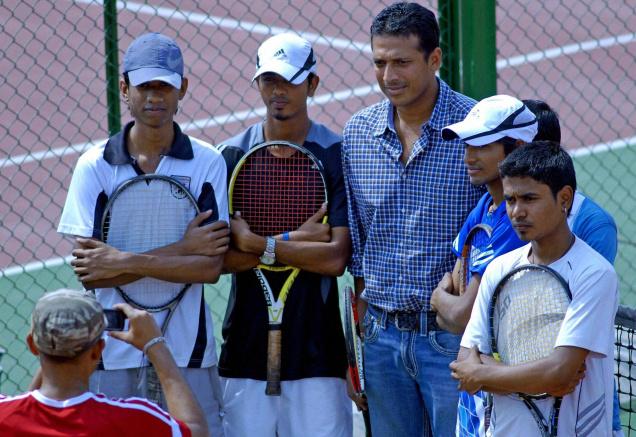
Mahesh Bhupathi poses for photographs with some of the trainees at his centre on the outskirts of Kolkata. / PTI
Mahesh Bhupathi says the selection of the team for the upcoming London Olympics is best left to the All India Tennis Association.

“The team selection is not something to be decided by us. The AITA has to decide the best team available for the Olympics,” Bhupathi said, while visiting his academy on the outskirts of the city on Wednesday.

No comparison

When asked about how significant an addition to his Grand Slam trophies an Olympic medal would be, he said the two ought not to be compared.

“I cannot compare the two as I am yet to win an Olympic medal. But I can say that if I miss an Olympic medal but do well in the Grand Slams, I won’t call it a bad year,” he said.

Terming his recent fatherhood “a life changing experience,” Bhupathi said he was “still sinking into the feeling.”

Bhupathi said that the news of Indian all-rounder Yuvraj Singh being diagnosed with cancer was very disturbing. “(Yuvraj) is a great fighter. He should continue his fight against the disease. We all are praying for him,” Bhupathi said.

Bhupathi also praised his current doubles partner Rohan Bopanna saying that the latter has already proved his ability at the highest level. “He (Bopanna) has proved himself, both as a singles as well as a doubles player,” Bhupathi said. “But we still have to adapt to each other’s game. We have a long season ahead.”

Impressed by Nagal

When asked to name the future prospects of the country, Bhupathi said Yuki Bhambri and Sumit Nagal were the two to look out for.

“Somdev Devvarman is doing well, but he is not young anymore. Nagal is the brightest young talent I have seen. At his age (14) I did not even think of winning an under-18 title (which Nagal did recently in an ITF junior event in Kolkata),” Bhupathi said.

source: http://www.TheHindu.com / Sports> Tennis / by Prinicipal Correspondent / Kolkata, February 09th, 2012

Support for Jwala, Ashwini, Diju to gain Olympic berths

Pune:
Giving a fillip to doubles specialists Jwala Gutta, Ashwini Ponnappa and V Diju in their bid to gain entry to the London Olympics later this year, four city-based entities have decided to support the three shuttlers.

Lakshya Institute, Avinash Bhosale Infrastructure Limited (ABIL), Shlok-Jairaj group and Panchashil have joined hands to support the trio, it was announced on Wednesday.

Jwala, a 13-time national women`s doubles champion, would be supported by ABIL. Shlok-Jairaj Group is to help Ponnappa while the Panchashil group has offered to support Diju, a media release said.

Jwala is ranked 13th in mixed doubles with Diju and 18th in women`s doubles with Ashwini. Jwala and Ashwini became the first Indian doubles pair to win a World Championship medal when the duo won the bronze last year in London.

“The probability of these players being selected for the London Olympics is very high with their current rank and achievements. We shall provide the three players with all the necessary facilities required to maintain their rankings and give their best shot for the country at the Olympics,” the release said.

“It is sponsorships such as these, I believe, (that) go a long way in contributing to the development of these young sports talent and also encourage them on the demanding path to the top. I personally love playing the game and that has fanned my interest to always do some more for the development of the game,” said Avinash Bhosale.

“Lakshya is a platform provided to young upcoming talented sportspersons from the society to do their best on the sports field without having to worry about other factors off it,” said its president Manish Jain.
PTI

source: http://www.ZeeNews.india.com / Wednesday,February 08th, 2012

At the summit of faith

Temple history

Kodagu’s Paadi Igguthappa temple became a prominent place of worship during King Lingarajendra’s reign. The temple, located atop a hill in a forested area in Kakkabe, has been in existence since 1153, writes C P Belliappa

Goddess Cauvery and Lord Paadi Igguthappa are the two presiding deities of Kodagu. If legends are to be believed, Igguthappa temple located atop a hill in a forested area in Kakkabe, in the southern part of Kodagu, has been in existence since 1153 AD. Legend also has it that Igguthappa is one of the seven divine siblings who chose Kodagu as his abode.
The temple became a prominent place of worship during Lingarajendra’s reign. Legend has it that in 1811, Lingarajendra came to the densely forested area surrounding the temple to hunt for elephants. Lingarajendra’s main source of income, besides taxes collected from his subjects, used to be cardamom and ivory. Every pod of cardamom grown and every tusk extracted from an elephant had to be surrendered to the raja at a price fixed by him!

Lingarajendra was camping at the nearby Nalknad palace and had instructed his dewan Apparanda Bopu to organise the hunt. Dewan Bopu arranged for machaans to be built on trees and had hunting dogs and drum-beaters to herd the elephants. On the appointed day Lingarajendra and Bopu sat on a machaan armed with powerful guns especially designed to shoot elephants.
In spite of all the drum-beating and dogs barking, not a single elephant was to be seen. The raja started getting restless and directed his ire at Bopu. Lingarajendra’s nasty temper was well-known and Dewan Bopu who was a devotee of Igguthappa started silently praying for some divine intervention. Suddenly a huge pachyderm with mammoth tusks appeared silently from the nearby bushes.
The elephant looked up at the machaan where Lingarajendra and Bopu were seated and started scratching itself on the tree trunk. The raja and dewan froze and were too petrified to shoot the beast. The action of the elephant shook the large tree so violently that they were about to fall off from their perch. This time around, Dewan Bopu prayed loudly to Lord Igguthappa to save him and the raja. Lingarajendra too joined Bopu in prayer. Suddenly the behemoth stopped, once again looked up, and gently sauntered away into the forest.

Lingarajendra, a Lingayat, was a worshipper of Shiva and had not visited Igguthappa temple which was dedicated to Vishnu. He made an exception and asked Bopu to immediately take him to the temple. It was a modest shrine. The head-priest welcomed the raja and advised him to perform various poojas including tulabhara (donation of grains equivalent to the weight of the devotee), to thank Igguthappa for saving his life.

After all these rituals, Lingarajendra asked the priest if he could do anything for the temple. The priest was quick to request for a punarnirmana (renovation) of the temple.

Lingarajendra immediately agreed and the temple was renovated and the approach improved. He also made grants of wet-lands in the vicinity, the income from which continues to be used for the upkeep of the temple. When the reconstruction was completed, he visited the temple again. At the temple, he had a sack full of silver coins brought. Lingarajendra dipped both his hands and scooped out three heaps of silver coins. He then ordered Dewan Bopu, who was present, to get an idol of an elephant made out of the coins. The coins weighed about three kilograms.

Silver elephant

The best silver-smiths from Mangalore were commissioned to craft an idol of an elephant. On the back of the idol is inscribed in halagannada (old Kannada), the year in which it was dedicated to Igguthappa for favours granted to Lingarajendra. This exquisite silver elephant is used daily in the poojas performed at the temple.

In 1835, the year after Lingarajendra’s son Chikka Veerarajendra was deposed by the British, Dewan Apparanda Bopu took it on himself to renovate the temple. The structure was reconstructed and was fitted with tiles replacing the earlier thatched roof. The temple once again went through reconstruction in 2008. Descendants of Apparanda Bopu along with other devotees have provided silver cladding for the entrance door.

Paadi Igguthappa is an important deity for the people of Kodagu. He is considered a provider of bounty and one who fulfills his devotee’s wishes. Iggu means grain and thappa means give.

Puthari, the harvest festival in Kodagu, is normally celebrated 90 days after Onam. Every year, paddy is first harvested in fields belonging to Lord Igguthappa. People of Kodagu celebrate the festival the following day. On a daily basis, those who visit the temple are served a simple but scrumptious lunch.

source: http://www.DeccanHerald.com / Home> Supplements> SPECTRUM/ February 07th, 2012

Entry of Starbucks in India is really the final stamp of globalisation

Harish Bijoor

And so, Starbucks is here! Well, almost here. The inking of the recent agreement between Starbucks and Tata Global Beverages, and the birth of Tata Starbucks Limited, is an interesting turning point in Indian coffee at large. The entry of Starbucks in India is really the final stamp of globalisation. In many ways, it says that India has arrived, and ready to be delivered. On a platter. With profits to share, sourcing arrangements to capitalise upon, and most certainly profits to repatriate to the mother company as well.

What’s different with the entry of Starbucks in India? After all, Coca Cola was in India for decades, was sent out in 1977, re-entered in 1993. And McDonalds’s unveiled their golden arches in India in 1996. KFC did it noisily in Bangalore in 1995. Why does Starbucks represent more?

Because it is the ultimate representative point of modern retail, which propitiates the “third place syndrome” dominantly. The chain offers, just as any other cafA© chain in the world does, a third place away from home and office, a third place away from school and home. And there are 17,000 plus of these sprinkled across street-corners around the world, making it the most ubiquitous point of retail in the world. Even more ubiquitous than the biggest chain of super-markets of the world.

Just as Coca Cola and McDonald’s, Starbucks represents the capitalist movement of a free world, where eating and drinking are flaunted, touted and branded aggressively at a price and a premium. In many ways these three brands have emerged as the trust-marks of the world. And all three are now in India. Well, nigh nearly there. And, curiously, none of them have needed 100% FDI in retail as a clause to make this happen. And every one of them has aggressive partners. Partners who have and will make money, create local jobs, create local sourcing opportunities and prosperity for all at the end of it.

Starbucks, for many around the world, represents the ultimate climb in the coffee value chain, while many of our Indian companies still struggle at the bottom of the value chain supplying to make the entire enterprise of coffee happen. Look keenly at the coffee value chain. Right at the bottom is the green bean. The coffee-grower sells most of what he grows as green bean. He defines his core-competence to be plantation activity. He defines for himself the tight lines drawn by agricultural practice, planting, nurturing, pruning and plucking. The value realisation for the green bean is therefore the lowest. The pricing is agricultural in its mindset.

Just one rung up in the value chain is the market for the roasted coffee bean. Roast & Ground coffee outlets that offer coffee in this form make more. They invest in a roaster, a grinder and a retail front. The coffee value-add process has begun. This segment is today dominated in south India by as many as 8435 small roasteries in a Dindigul, an Arokkonam and equally in the Holenarsipuras of India.

One rung higher is the terrain occupied by the Roast and Ground filter coffee marketers of this country. This space is dominated by the small and the big. As much as 62,000 tonnes of the coffee we produce in India is used up by the likes of HUL and Tata Coffee in the organised segment, and by a whole host of smaller players with a solid base of local brand equity such as Narasu’s and Leo’s in Tamil Nadu and Cothas in Karnataka.

As we climb higher in the value-chain of coffee, we discover instant coffee. The dominant brands of Nescafe and Bru are growing at a frenetic 18% per annum as the country discovers the joy of convenience coffee that doesn’t take ages to prepare with cumbersome devices such as the coffee filter and percolator.

Thus far the value chain of coffee has been of a solid avatar. Time to move the chain over to the liquid avatar. Out here are the vending machines that dispense coffee, the home and office coffee-maker and more.

In many ways the future is liquid, and not solid. Liquid coffee has this exciting habit of delivering bigger margins and bigger degrees of made-to-order satisfaction to consumers alike. And that’s a combination no one will ignore. Liquid coffee, through vending machines for outdoor locations, and home coffee makers for in-home and in-office locations, make coffee climb the value chain higher.

And that’s not the end of the coffee value chain journey. The sit-down and take-away cafes represent the ultimate peak in this value chain. Here, a coffee you could make at home for 2.60 per cup (with foam and froth and all), will cost you 50 or 100 or, in the future, even 150, if you will. The entry of Starbucks in many ways creates a caste system in the cafA© chains within India at large. You will have coffee that will come at 1$ a cup (CafA© Coffee Day), $2 a cup (Costa Coffee) and maybe at $3 a cup (Starbucks?).

With the entry of Starbucks in India, the coffee-value chain has touched the peak it has always wanted to. But never got to.

(The author is the Ex-VP, Tata Coffee Limited and ex-member of the Coffee Board of India)

source: http://www.economictimes.indiatimes.com / THE ECONOMIC TIMES / Home> Opinion> Guest Writer / February 04th, 2012
Nutrition food card to Jenukurubas

Madikeri, Feb 4, 2012, DHNS:
The state government has started a programme to distribute nutritious food for Jenukuruba and Koraga community members in the state.

Jenukuruba community members are found in Kodagu, Mysore and Chamarajanagar districts and find it difficult to carry out their living during monsoon. Hence, they are given nutritious food for six months in a year.

Every family is given 15 kg ragi, 2 kg tur dal, one kg horse gram, 2 kg jaggery, one litre oil and 30 eggs. There are 3,105 Jenukuruba families in the district. The nutritious food is given to 2,064 families in Virajpet and 1,041 families in Somwarpet. A sum of Rs 28 lakh is spent on Jenukuruba families in the district. The TDP officer Ganti said all the families are given a nutrition food card.

source: http://www.DeccanHerald.com / Home> Districts / DHNS / February 04th, 2012

Jalebee Cartel, Nikhil, Pearl to perform at Future Music Festival Asia

Mumbai:

Jalebee Cartel, Nikhil Chinappa and Pearl will represent India at the Future Music Festival to preimere in Asia this year. The fest is one of Australias largest dance music festivals, featuring renowned DJs world over.

The 12 hour music fest with over 40 acts is scheduled to take place on 17 March at Kuala Lumpur in Malaysia.

Speaking on the fest with Radioandmusic.com, Jalebee Cartel’s bass player – Gforce Arjun said, “Future Music Festival is a fantastic festival, It feels great to be a part of the line-up which boasts the like of ‘The Chemical Brothers’ and others. All of us are huge fans of the Chems… and have been fans for such a long time.”

The multi award winning festival will be headlined by the club music superstar ‘The Chemical Brothers’. Other international artistes to feature in the concert include American rap legend and DJ Grandmaster Flash, Chase & Status, The Wombats, Pendulum, Grand Master Flash, Sneaky Sound System, Cosmic Gate, John 00 Flemming, Super 8 & Tab, Zane Lowe, Alex Metric, The Potbelleez, Kid Sister, The Stafford Brothers, Ruby Rose, Andy Murphy, Shinic Osawa, Blink, Goldfish and more.

source: http://www.RadioandMusic.com / Home> Editorial> News / RnM Team / February 03rd, 2012