Ravi Kushalappa, chairman of Karnataka State Western Ghats Task Force, has suggested the State Government follow the court’s direction with regard to encroachment of forest areas in Shivamogga district.
In a meeting with officers at the Deputy Commissioner’s office in Shivamogga on Monday, Mr. Kushalappa said that the task force was committed to clearing encroachments of the forest areas and illegal activities within the forest limits. The court orders with regard to clearing encroachments should be acted upon.
Regarding the plantation activities, the chairman said the village-forest committees had to be active in protecting and conserving forests. The Forest Department had to spread awareness among the public in this regard. The Forest Department had to take up plantation activities with the active participation of rural people. The tribal communities, who had been residing in the forest areas, should be provided with basic amenities, he said.
Additional DC Dr. Nagendra Honnallli, Shivamogga DCF Shankar and others were present in the meeting.
source: http://www.thehindu.com / The Hindu / Home> News> National> Karnataka / by Special Correspondent / Hassan – May 16th, 2022
Government must study uniqueness of each district and frame laws: Kodagu Samrakshana Vedike
Mysore/Mysuru:
Concerned over the recent announcement by Revenue Minister R. Ashoka stating that agricultural land conversions across Karnataka would be approved within three days and the required amendments would be brought to the Karnataka Land Revenue Act, the Kodagu Samrakshana Vedike has said that this would be a disaster for Kodagu, the principal catchment area of River Cauvery.
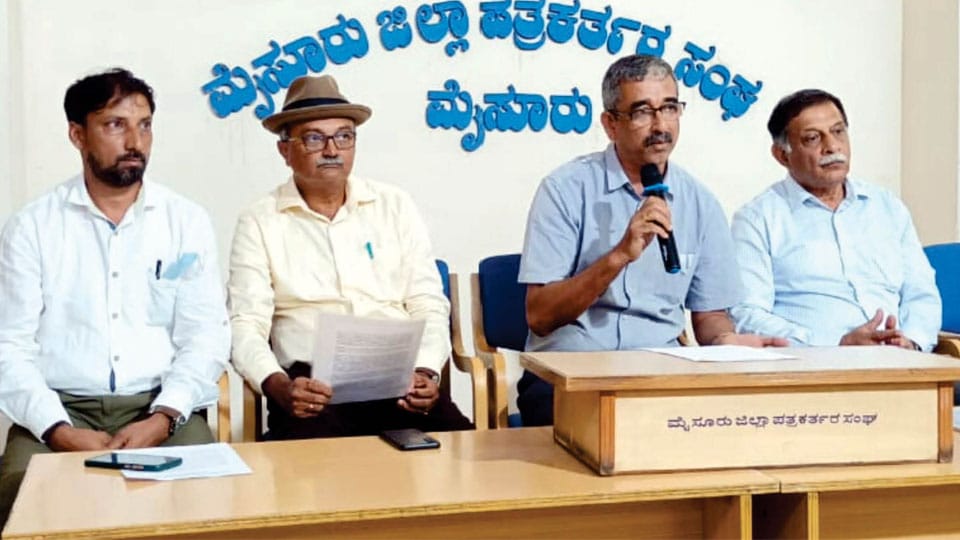
Addressing a press conference at Pathrakarthara Bhavan in city this morning, President of Kodagu Samrakshana Vedike Chottekmada Rajeev Bopaiah said that the Government move will destroy hilly terrains and ecologically-sensitive regions such as Kodagu.
“Large scale land conversion in Kodagu for sites and layouts will invite large numbers of people from outside the State into Kodagu and exert extreme pressure on potable drinking water and water for agriculture and industry. It will kill the River Cauvery that is a lifeline of Karnataka,” he said.
Accompanied by Vedike members Col. (Retd.) Cheppudira P. Muthanna, Jammada Ganesh Ayanna and Annira Harish Madappa, Rajeev Bopaiah said that the High Court had stayed the process of land conversions in Kodagu stating that the No Objection Certificate (NOC) for land conversions issued by the committee headed by the Deputy Commissioner is not valid to approve blanket land conversions.
Burning problems ignored; focus on new roads:Requesting support from Kodagu MLAs Appachu Ranjan, K.G. Bopaiah, MP Pratap Simha and MLCs Veena Achaiah and Suja Kushalappa, the Vedike appealed to them to save the birthplace of Cauvery from destruction due to rampant land conversions. “Unfortunately, the burning problems of Kodagu like human-animal conflict, land conversion, Pouthi Khata and electricity are ignored by the elected representatives and they are interested in only developing new highways, further destroying the landscape,” they said.
The Vedike demanded that the Government must act immediately to avoid destruction of Kodagu. “Unfortunately, many politicians and political leaders are involved in land conversion in Kodagu and those DCs who resist attempts to convert land are being transferred within three months and DCs who act favourably to the politicians are brought in,” Rajeev Bopaiah alleged.
“We have seen how Kodagu was ravaged by floods in 2018 and 2019 abetted by unbridled urbanisation and infrastructure development to promote tourism. Sale of agricultural land for non-agricultural purposes will have devastating consequences as reckless urbanisation has already caused a negative impact on the environment as evident in the floods and landslides,” he said.
Bearing on water: “The government move makes it easy for any individual, industrialist or real estate stakeholders to directly approach farmers and purchase land. It’s not just about land in Kodagu but this will also have a bearing on water and its implications will be felt in the downstream region of the State like Mysuru and Mandya, impacting food security and agriculture,” Rajeev Bopaiah added.
The Vedike has demanded that instead of passing land laws that are applicable across the State, the Government should study the uniqueness of each district and frame laws according to the local environment and ecology. “We will take our movement to the next level that will include a boycott of elections,” the Vedike has warned.
source: http://www.starofmysore.com / Star of Mysore / Home> News / May 11th, 2022
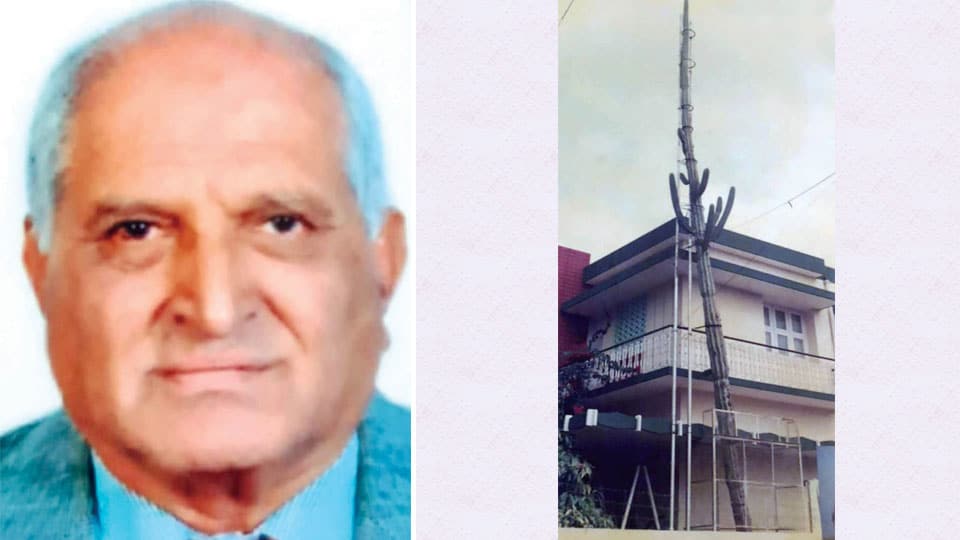
Accapanda Kashi Kuttappa (76), former Assistant Director in the Agriculture Department and a Guinness Record holder for tallest home-grown cactus, passed away at his residence in Siddarthanagar this morning.
He leaves behind his wife Jyothi, daughters Smitha and Neetha, sons-in-law and a host of relatives and friends. Last rites were performed at the foot of Chamundi Hill this noon, according to family sources.
The cactus Kashi Kuttappa
and his family members had grown reached a record height of 45.8 feet and had fetched him the Guinness Record. Kashi himself had said that it took him and his family 22 years to grow the cactus that towered above his home. It is of Cactus-Cereus Grandflora that belongs to the family of ‘cactaceae’. This cactus is widely grown in the tropics of dry tracts and suits the desert climate.
Several tourists and nature lovers used to frequent Kashi’s house at Siddarthanagar to see the wonder plant. In fact, the road to Kashi’s house was arbitrarily named ‘Cactus Road’ and he was famous as ‘Cactus Kashi’.
The plant was grown and nourished since 1978 when it was 2.5 ft. tall. The Guinness Book of Records authorities accepted the cactus as the tallest and issued a certificate for the first time on Jan. 20, 1993 when the cactus was 35 feet 1 inch. The Guinness Records authorities awarded the longest cactus certificate for the second time in 1998, when the cactus had grown to the height of 44 feet and 9 inches.
source: http://www.starofmysore.com / Star of Mysore / Home> News / June 27th, 2021
Full of natural beauty and a culturally rich spot, Coorg is one of the foremost tourist destinations in India. Located in southern Karnataka, the hill station abounds with green valleys, forests, several waterfalls and hills. It makes for a wonderful holiday spot for singletons and families alike, with its zigzagging roads, aromatic blossoms and cool climate. If you are planning a holiday to South India this year, we suggest booking one of the premium Coorg resorts and packing your bags.
Coorg: India’s treasure trove of natural wonders
Known as the ‘Scotland of India’ since the time of the British Rule, Coorg is known for several natural scenic wonders and the prettiest landscapes. On your list of places to visit in Coorg, you should include:
Abbi or Abbey Falls
Nisargadhama Forest
Iruppu Falls
Cauvery River
Talakaveri
Kote Betta
Brahmagiri Hills
Things to buy in Coorg
Most people head to Coorg to experience its hushed tranquillity, and you’ve already made a list of places to visit in Coorg . But shopping buffs are pleasantly surprised to find that the region produces several local items of superior quality. Chief among these is coffee, which is processed from the several coffee plantations in the area. You can buy coffee beans or powder from the plantations, or even the local markets. Next, you should stock up on locally produced organic honey which offers gentle sweetness and has a high medicinal value. You should also buy the region’s oranges to eat during your stay; these are best at staving off thirst and eliminating nausea. One of the significant buys, however, is essential or aromatic oils.
About aromatic oils from Coorg
Coorg is most famous for its coffee, but over the years, visitors to this hill station have discovered its other secret: aromatic oils. Coorg produces a number of aromatic essential oils that promote good health and healing. Chief among these are eucalyptus oil, tea tree oil, sandalwood oil and wintergreen oil. These are cultivated and produced locally and are of the highest quality. And you can buy them from most markets and shops in Coorg. Just ask your Coorg resort concierge about the best places to buy what you need, and you can get the best products to take home with you.
Uses and benefits of aromatic oils
Aromatic oils are the main component of the science of Aromatherapy, which aims to heal various aches and pains in the human body through aroma and the oil’s healing powers. Aromatherapy is an ancient science practised by cultures in Egypt, India, China and Greece, among other countries. It uses smell and skin absorption of the oil via creams, gels, soap, oil diffusers, lotions, bath salts, masks, compresses and inhalers. Aromatic oils are often used to manage pain, relieve stress and anxiety, ease digestive discomfort, improve sleep, improve palliative care, reduce inflammation and nausea, boost immunity and provide short term relief from chronic ailments like migraine and hypertension.
Some uses of popular aromatic oils are:
Tea tree oil: helps reduce acne, ringworm and Athlete’s Foot
Peppermint oil: eases headache, regularises digestive cycle, is a good anti-fungal and anti-microbial agent
Eucalyptus oil: clears nasal passages, relieves pain and reduces inflammation
Lemongrass oil: relieves stress, alleviates depression, and heals wounds
Wintergreen oil: improves blood circulation, reduces pain, promotes detoxification of the body, and soothes a cold or symptoms of flu
Lavender oil: treats anxiety, soothes inflammation, reduces stress and relieves the discomfort associated with menstrual cramps, eczema, nausea, etc.
Where to buy aromatic oils in Coorg
There are several markets and stores that retail aromatic oils in Coorg. The most popular ones are Coorg Greens, Aroma Coffee, Choco Coorg Spice, and Coorg Homemade Wine & Spices. Your Coorg resort concierge can recommend the best places to buy these oils; do look for products that are authentic, produced in Coorg and sold at a reasonable cost. Some retailers can even ship the oil you need online if they don’t have it in stock.
Why stay at Club Mahindra Madikeri, Coorg
Every Club Mahindra resort promises a lifetime of stupendous holidays, in the most stunning locations in India and abroad. As a Club Mahindra resort member, you and your loved ones can avail of annual holidays in over 100 domestic and international destinations, staying at the choicest resorts and affiliate properties that offer superlative rooms, best service, sumptuous food and excellent on-site activities.
How to book your holiday
That’s simple enough – just take a Club Mahindra membership and ready yourself for the best ever holiday experiences for over 25 years. Visit www.clubmahindra.com to know the Club Mahindra membership fee structure, how to pay the Club Mahindra membership fee, how to book the holiday you want, if you can choose a certain season every year for your trip, and so on.
source: http://www.mangalorean.com / Mangalorean.com / Home> Article / By EE / March 16th, 2022
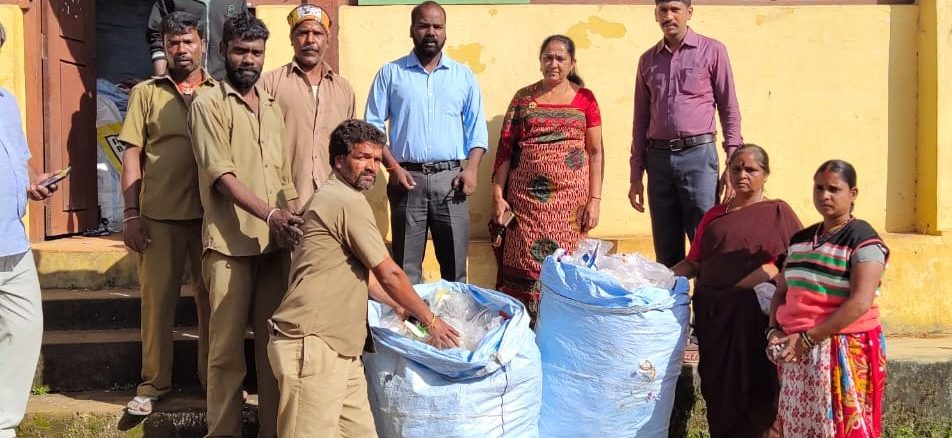
The Dry waste Collection Centre at Ponnampet Grama Panchayat, with collection from all the wards, became operational in January 2019. Pic courtesy: Clean Coorg Initiative
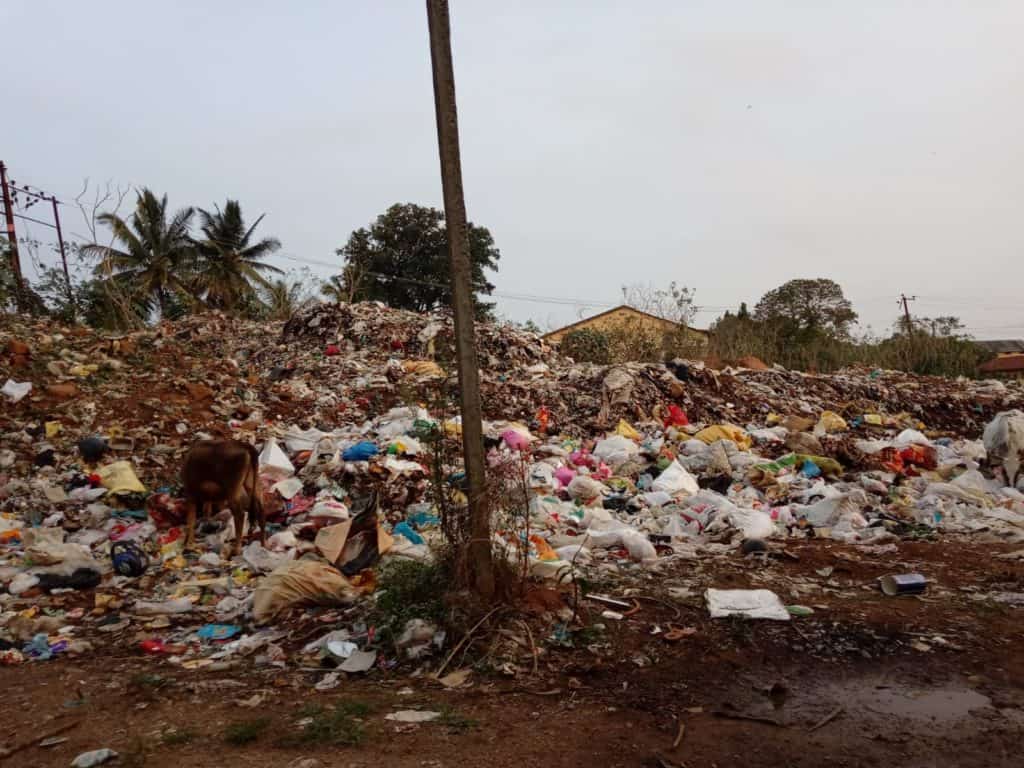
There is something about a hill vacation, travelling across narrow winding roads upwards, landscape dotted with lush green terrain, tantalising water streams, foggy foothills, chirping birds, the buzzing sounds of insects and clean air. But now, contrast this with unsightly scenes of rubbish by the roadside — styrofoam, plastic wrappers, bags and bottles, and more. The garbage keeps growing, competing with the hills, and becomes a monstrous man-made mountain in the midst of a landfill, laden with grotesque man-made objects that speak volumes about our use-and-throw culture and our complete lack of consideration for the environment.
Coorg, nestled in the Western Ghats, also known as the Scotland of India, and a popular tourist destination has, however, managed to make significant progress in fighting the waste menace. The town has demonstrated their commitment towards zero waste, with the closure of two landfills.
“Zero waste” is a concept that entails minimum or zero pollution to land, water and air due to solid waste management (SWM) practices and zero waste going to landfills. This initiative was a collaborative initiative by the volunteers of Clean Coorg Initiative, Hasiru Dala, the Gram Panchayat and the local government.
The 30-year old Ponnampet landfill as it stood in 2019. It would burn most of the time, the dump going down to nearly 40 feet./ Pic courtesy: Clean Coorg Initiative
How it all started
Alarmed that Coorg could soon degenerate into a dumping ground, in 2016, Prashanth Chinnappa, a local resident of Coorg brought several like-minded people together, to form ‘The Clean Coorg Initiative (CCI),’ a voluntary platform to promote a clean and healthy Coorg, with a core focus on promoting segregation of waste at source.
According to Pooja Uthappa, Volunteer at the Clean Coorg Initiative, “Waste is a relatively new phenomenon in this landscape. With rapid urbanisation, the quantum of garbage is also rapidly increasing. The other concern is around waste disposal practices. Dumping in one area or on the sides of the road and open air burning are common practices. Unfortunately some of the dumping areas are in the fringes of the forest areas, and the wild animals unknowingly consume them (the garbage dumped).”
Pooja also points out that Coorg residents depend primarily on groundwater; so when waste is dumped in open lands/ dumping grounds or landfills, it eventually contaminates water sources. But that’s not all. “Talakeveri, in Kodagu district, is considered the source of the river Cauvery and is an important lifeline for inhabitants in Karnataka and Tamil Nadu; incidents of indiscriminate garbage dumping adds to the problem downstream,” she says.
Pavan Aiyappa, Volunteer, CCI says, “We have a simple mission, which is to preserve the fragile ecology of Coorg for future generations, adopt sustainable initiatives, manage waste, promote responsible tourism, and preserve our natural resources”.
The group soon realised that clean up drives were a temporary solution, with no place for disposal of the litter collected, and that systemic changes were needed, along with on ground awareness. They started by undertaking a survey, observing practices, existing infrastructure and dumping spots. Savita Chengappa*, a volunteer from CCI, says, “We surveyed the entire stretch, till the Kerala border and we realised that we need somebody on the ground, who could go to the gram panchayat, create awareness and build capacities of the local team, using the Solid Waste Management (SWM) Rules 2016 framework. We also had to envision and plan the concept of stream-based processing of waste.”
The team also wanted to build on the success of Dry Waste Collection Centres (DWCCs) in Bengaluru, and wanted to understand the workings of the same in a rural set-up. Aparna, another active volunteer with CCI, says, “For us, all these were still theoretical and we needed to put these concepts into practice.”
Partnerships and initiatives
The group then decided to collaborate with the government and other organisations and approached Hasiru Dala, a social impact organisation working with waste pickers to assist with onground implementation and solutions.
Nalini Shekar, Co-founder Hasiru Dala, says, “Initially we were happy to support the group with necessary IEC and training, but soon realised that Coorg has a unique challenge, given its terrain. It has a large tourist footfall and considering the floating population, it is challenging to ensure that information and education programmes reach all of them. Secondly, while collection happens, there is no recycling industry in the area. Thirdly, there are limited workers in the solid waste management space, as most workers are employed in the coffee estates, agriculture and the tourism industry.” But given their expertise in dry waste management, it appeared that a system could indeed be put in place.
Pooja says, “Our first priority was capacity building for the municipal workers, the ASHA workers, the Self Help Groups (SHGs) and the officers, towards implementation of decentralised waste management. The training included the concepts of segregation of waste at source, the management of DWCCs, roles and responsibilities of officers, management of reject waste. For the general public, the sessions focussed on responsible disposal of waste through segregation at source.”
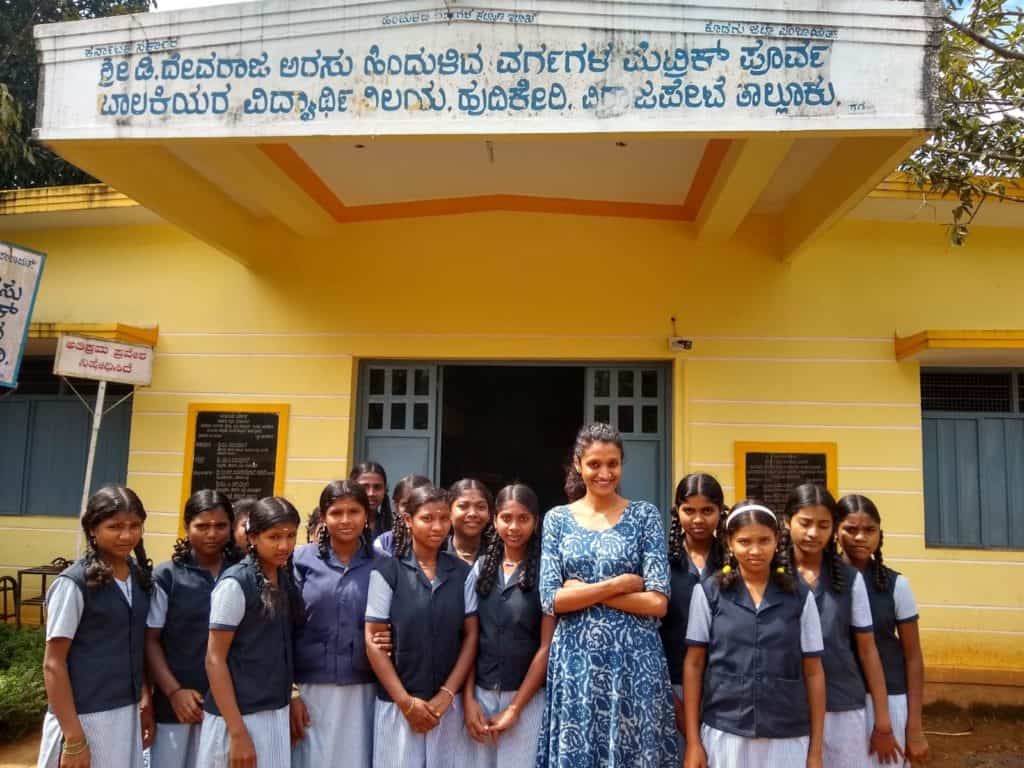
She shares that the group also conducted several outreach programmes like clean up drives, cycling awareness, sustainable menstruation and reached out to schools. CCI volunteers, in partnership with Wasteless Auroville, introduced a subject titled ‘Garbology’ as part of the school curriculum in Deviah memorial Preparatory School, Bittangala. Their outreach programme touched more than 800 government school children and teachers.**
CCI also hosted a Parivarthana Mela, to showcase sustainable lifestyle practices. This included composting workshops.
Awareness programmes were held in several schools in the region. Pic courtesy: Clean Coorg Initiative
Besides working on door-to-door awareness programmes, the team reached out to shopkeepers and explained the system of fines for non compliance. Pooja acknowledges the contribution of Kodava Koota from the United States of America, for supporting the outreach programmes.
Closing the landfills
The group then went on to streamline and simplify the waste collection process and a Dry Waste Collection Centre was set up. Puttaraju, Panchayat Development Officer ( PDO), Ponnampet who worked towards the closure of Ponnampet landfill shares, “After CCI and Hasiru Dala’s intervention, we felt the need for a decentralised set up and a DWCC. We zeroed in on the location and approached the Zilla Panchayat for permissions. They were very supportive and passed a resolution for the construction of the DWCC.”
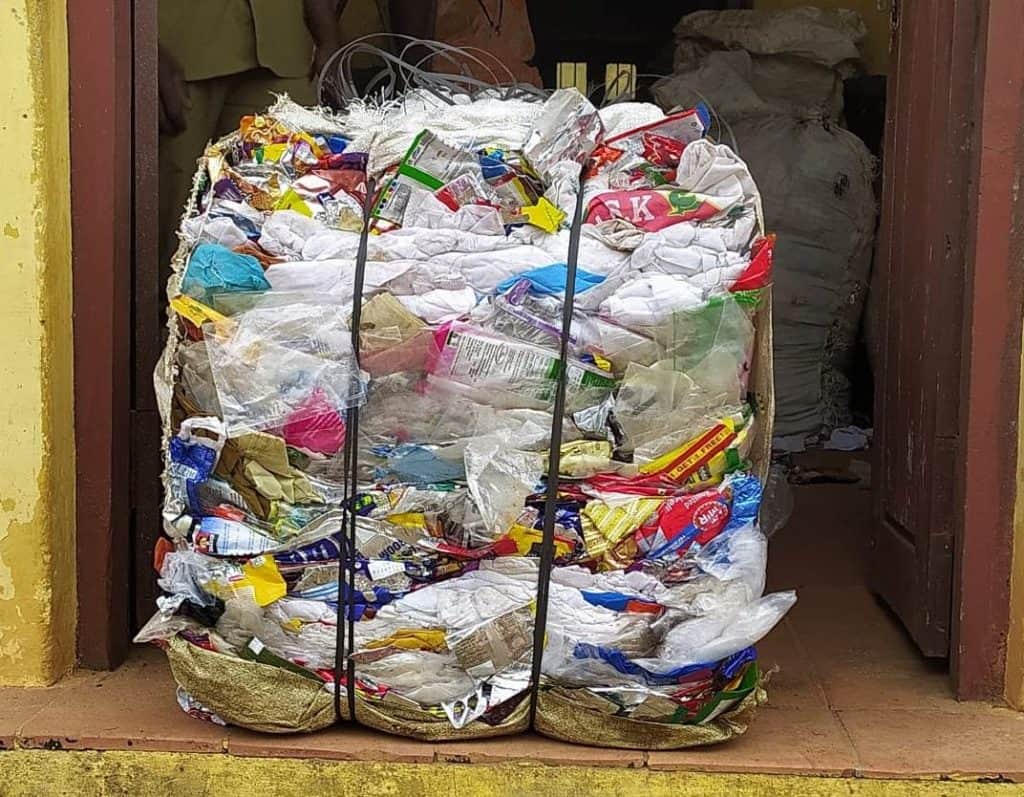
Hasiru Dala team also came up with a simple manual bailing system, which was then given to different GPs and this ensured that low value and multilayer waste could be sent for co-processing. Aparna, Volunteer CCI adds, “This process, then led to the natural question, do we really need dumping grounds or landfills?”
Aiyappa adds, “The rationale was much more than aesthetic beauty. We were also concerned about groundwater contamination and leachate from landfills, but also, given that the landfill was 30 years old and the waste was going about 30 feet down, we were also worried about landfill fires.”
The team then approached the GP, who in turn took to the implementation of the Karnataka Plastic Ban. The Panchayat passed a resolution on the plastic ban and introduced the “bring your own bag” concept, drawing in from the 2Bin1Bag concept and imposition of fines for littering, Aiyappa shares that thereafter, they went about methodically working with the GP to close the landfill in two areas, Ponnampet Taluk and Karmadu, Virajpete Taluk.
Hasiru Dala introduced Manual Baler to some of the Gram Panchayats in South Coorg, to pack the non-valuable materials through this and save money in transportation. Pic courtesy: Clean Coorg Initiative
Stiff penalties for violation
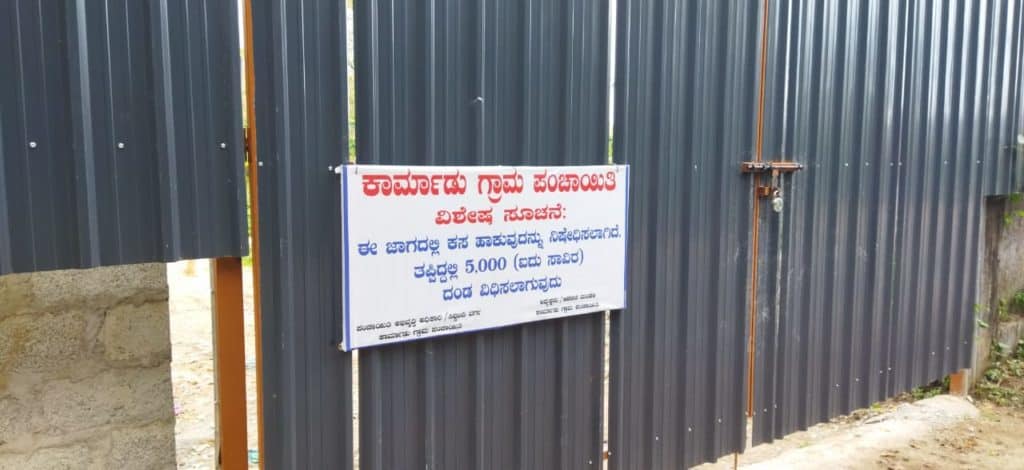
Niren Nannaiah, President, Karmadu Gram Panchayat, adds,“We had various meetings on the need for closure of the landfill. We have cordoned off the area with a metal sheet, installed CCTV cameras and put up a board notifying the penalty for dumping garbage in and around the place. We decided that it was futile to impose nominal fines of a hundred or couple of hundred rupees, so we fixed it at Rs 5000. We have penalised a few people. But that’s not all, we have also issued notifications on the need to use reusables or fibre cutlery at all events, especially marriages and functions.”
Nithin B S, PDO Karmadu, says the closure of the Karmadu landfill involved several stages: first sensitising people, then streamlining collection, seeking support of the elected representatives, passing resolutions and issuing the necessary notifications. But the most important was the imposition of fines.
The cordoned-off Karmadu landfill area. Pic courtesy: Clean Coorg Initiative.
We also made an announcement in the neighbouring gram panchayat that no dumping will be entertained, but they are free to drop segregated waste at our processing or dry waste centre. We spent about three lakh rupees in setting up the entire system, apart from separate investments in the installation of the CCTV camera,” said Nithin B S.
Finally an order was passed to close the landfill. The next question was, what do we do with the landfill site? The team then worked with the GP and proposed a design for a public park.
Mr. Suraj Ajiikutiria, SBM, Virajpet and Ponnampet Taluk, says, “ In order to actualise the vision of Swacch Bharat Abhiyan, we will need to close dumping sites in all 104 villages, plan for decentralised infrastructure and streamline collection just like we did in these Taluks.”
The most important takeaway from these experiences in Coorg is the need for a coming together of all stakeholders and a model that is both socially and environmentally inclusive, and which enables us to proudly proclaim, ‘landfills have no business.’
[The author wishes to acknowledge the contribution of Nirmala Shekar, Beula Anthony, Ramya K and Rohini Malur, for this article. ]
source: http://www.citizenmatters.in / Citizen Matters / Home> Waste Management / by Pinky Chandran / March 16th, 2022
After being deferred in January, the eighth edition of the Karnataka Bird Festival will be held in Madikeri from April 8-10, 2022.
Image used for representational purpose only. (Photo | Express)
Bengaluru :
After being deferred in January, the eighth edition of the Karnataka Bird Festival will be held in Madikeri from April 8-10, 2022.
The festival, organised by the Karnataka forest department and Karnataka Eco-Tourism Development Board, aims to draw attention of people to bird watching, spark interest among young wildlife enthusiasts, show people the bio-diversity of forests, and shift their focus from tiger-centric wildlife safari and tourism.
“Every year a different location, region, bio-diversity, and a different bird is focused upon to increase awareness and ensure better conservation measures.
This year, the mascot is Baza bird,” a forest department official said. Baza is a migratory bird from the eastern Himalayas, China and South East Asia. Forest officials of the region have reportedly sighted a couple of the birds now, in the onset of summer.
Kumar Pushkar, additional Principal Conservator of Forests and CEO of the Board told TNIE that the festival was postponed because of spike in Covid-19 cases. “We always wanted to host one is Kodagu because of its bio-diversity and the many species which can be sighted there. Baza was chosen because it is sighted in winters in this region.
There will be around six to seven different trails, which the deputy conservator of forest is finalising. The event will also cover Madikeri city, and will be inaugurated by forests minister Umesh V Katti,” he said. Experts from across the country will be brought to share their experience, knowledge.
source: http://www.newindianexpress.com / The New Indian Express / Home> States> Karnataka / by Bosky Khanna, Express News Service / March 14th, 2022
From an abandoned barren land to a green lush private sanctuary, author Pamela Malhotra recounts the transformation.
Bengaluru :
Pamela Malhotra’s From the Heart of Nature (`599, Penguin Random House) documents the story behind the creation of a private forest sanctuary in India. More than just the struggle, Malhotra also recounts how she connected with animals and trees both at a physical and spiritual level.
What was the turning point in your life?
My husband Anil and I shared that love of wildlife and that dream. This realisation initially came while living in the USA in the late 1970s and early 1980s, which is why we established our first small wildlife sanctuary on the Big Island of Hawaii in 1979. When we came to India in January of 1986, we were quite upset by the deforestation we saw, especially in the Himalayas. We had gone to Haridwar and fell in love with the Himalayas. So, we purchased land in the Uttarkashi region to help reforest that area.
How did you zero-in on Kodagu?
There were land ceiling laws in the state (then Uttar Pradesh – now Uttarakhand) that limited a family to owning just 12 acres of land. There was not enough land for establishing a forest wildlife sanctuary through reforestation. Also, we had visited Nagarhole National Park in Jan 1986, where the then-Wildlife Warden of the Park urged us to establish our forest wildlife sanctuary in his home district of Kodagu. As a result my husband Anil travelled throughout southern India to see what he could find, finally finding suitable land in Kodagu. Purchasing larger pieces of land was possible here if the land was deemed ‘plantation’ and the purchaser was an agriculturalist which my husband was.
What were the initial struggles that you faced?
Accessing the land. It was almost impossible to bring in any kind of building materials for our home in the beginning due to the poor roads. So, my husband put loads of rocks and other road material into these dirt roads to help give us drivable access which was also a big boon for the local people. Another major challenge was the legal maze encountered in the district since lands were divided into several different categories, often with different rules/laws applying to different categories in terms of purchase and ownership. Acceptance by the local people was also initially a challenge, although the older generation did understand the importance of maintaining forests and not killing off all the wildlife. The most distressing challenges have been illegal logging and poaching of wildlife.
The sanctuary is spread across 300 acres, what are the kinds of species that are found there?
Hundreds of species have made the sanctuary their full-time home and/or come visit frequently. A short list of species found here includes 100s of species of butterflies and birds including Great Indian Hornbills and Malabar Grey Hornbills, Bengal tiger, Asian leopard, Asian elephant, sloth bear, dhole (Indian wild dog), Gaur (Indian bison), species of deer (sambar, cheetal, muntjac/barking deer) etc. So diverse are the species found here that one Oxford scientist dubbed our sanctuary ‘Noah’s Ark’.
You first purchased the land for the sanctuary in 1992, to create a private sanctuary. How did you decide on writing a book?
I hope to sow the seeds of love of nature in the hearts and minds of all who read the book, and to create a sacred perspective when viewing and dealing with nature.
source: http://www.newindianexpress.com / The New Indian Express / Home> Cities> Bengaluru / by Monica Monalisa, Express News Service / March 02nd, 2022
Apart from Gadag, four districts of North Karnataka were also in the ‘Good’ AQI category — Hubballi (35), Bagalkot (23), Yadgir (30) and Bidar (41).
For representational purposes
Gadag :
With an Air Quality Index (AQI) value of 22 on Tuesday, Gadag in Karnataka stood at the second position among major cities in the country with good air quality, according to the daily bulletin of the Central Pollution Control Board (CPCB). Madikeri came first in the country with an AQI value 19.
Apart from Gadag, four districts of North Karnataka were also in the ‘Good’ AQI category — Hubballi (35), Bagalkot (23), Yadgir (30) and Bidar (41). Gadag was in first place across the nation on June 5 and July 6 this year. Since then, it has been in the ‘Good’ and ‘Average’ category.
Other districts of Karnataka which are in the ‘Good’ air quality category are Chamrajnagar (44), Chikkamagaluru (33), Davangere (23), Hassan (25), Koppal (46), Kolar (50), Mysuru (29), Ramanagara (40), Shivamogga (37) and Vijayapura (45).
India follows the 500-point scale of measuring the AQI value depending on the concentration of the major pollutants. The value 0-50 is considered as Good, followed by Satisfactory (51-100), Moderate (101-200), Poor (201-300), Very Poor (301-400) and Severe (401-500).
Gadag earning the ‘Good’ air quality tag can be attributed to the nearby hill range, Kappatagudda, and low number of industries around. Since a large percentage of villagers are into agriculture, it causes less air pollution.
Gadag and Dharwad district’s Environmental Officer Shobha Pol said, “We have been observing the AQI value and this time many districts in Karnataka are in the Good category. Hubballi is in the list which was not there earlier. Reasons cannot be predicted as it needs a detailed study and survey.”
source: http://www.newindianexpress.com / The New Indian Express / Home> Good News / by Raghottam Koppar, Express News Service / November 18th, 2021
The drive on clearing of encroachments at Keere stream which was started in full spirit has remained stagnant for the past two months.
After clearing the encroachment of the bypass road drain, the taluk administration had assured of clearing the encroachment in the Keere stream which is situated in the heart of the town. The sudden stoppage of the operation has given room for speculation.
Two months ago, the encroachment of the bypass road drain was cleared with police security. The structures were razed mercilessly.
The citizens of the town expected a similar operation with the clearing of encroachment in the Keere stream.
However, the expectations were not met as the operation was stalled all of a sudden.
Excavating machines are gathering rust in the banks of the Keere stream for the last two months, it is alleged.
Residents alleged that most of the people among those who have encroached on the Keere stream belong to the ruling party and are influential. Therefore, the officials of the taluk administration have kept silent.
The operation of clearing of encroachments was initiated by Ponnampet taluk in-charge Tahsildar Yogananda. Now, Ponnampet has got a full-time Tahsildar. However, the operation has been stalled now.
“If the encroachments in Keere stream are not cleared, a protest will be staged against the taluk administration,” residents Gangadhar, Purushottam, Fayaz and Ahmed said.
Tahsildar Prashanth said that regarding the clearing of encroachments, the High Court had given time before starting the clearing operation in the Keere stream. The time has lapsed and the operation will be started soon.
Taluk Akrama Sakrama Samiti president K B Girish Ganapathy said that the government land which had been encroached in the town should be cleared as per the law. The taluk administration should take immediate action.
Kaveri Jalamoola Samrakshana Horata Vedike, Gonikoppa, president Pulinjana Poovaiah said that the compound of a private school had encroached on the Keere stream. There were other structures that had been built after encroaching the stream. The encroachments had resulted in flooding of residential areas in the rainy season. Therefore, the encroachments should be cleared.
source: http://www.deccanherald.com / Deccan Herald / Home> State> Mangaluru / by DHNS, Gonikoppa / February 14th, 2022
The Kaveri flowing through Nisargadhama in Karnataka, Photo Credit: Shutterstock
The story of how the river Kaveri came to be.
The Kaveri (earlier known as Ponni, the golden maid, because of the fine golden silt deposits) flows through Karnataka and Tamil Nadu. The river originates at Talakaveri in the Brahmagiri Range in the Western Ghats, of Karnataka’s Kodagu district,1,341 m above sea level, and flows in a south-easterly direction for about 800 km before emptying into the Bay of Bengal. It reaches the sea in Poompuhar in Mayiladuthurai district. This is Tamil Nadu’s largest river, dividing the state into north and south.
The Kaveri is a sacred river and is worshipped as the goddess Kaveramma. Its name comes from the Sankethi word for river.
Myths and legends
The story of how Kaveri came to be begins with how the sage Agastya came south. A mountain called Vindhya had an inflated opinion of itself. However, when a person praised Meru, another mountain, right in front of Vindhya, Vindhya grew jealous. Wanting to be taller than Meru, it started growing skywards.
Soon, Vindhya would block the sun. The people, animals, and trees in the forests lying in Vindhya’s shadow stopped receiving any sunlight. No matter how high the sun rose, Vindhya grew taller and blocked his light. The pleas of the people, animals, and the forests fell on deaf ears.
As a last resort, the gods approached the powerful sage Agastya for help. On reaching Vindhya, the sage asked him to bend so that he could cross over to the south. Since Agastya was known for his wrath, Vindhya did not want to be cursed and agreed to bend. After Agastya had crossed over, he asked Vindhya to stay that way till he returned. Vindhya promised to do so. The sage wisely stayed back in the south, leading to much happiness among the people around the Vindhya.
With his yogic powers, Agastya collected the most beautiful parts of creatures in the forests he visited and put them together in the form of a beautiful infant. He now wanted someone to raise the child and decided to marry.
Meanwhile, king Kavera, who ruled in that region, had also prayed to Lord Brahma for a child. In a mythologically convenient coincidence, Lord Brahma had a daughter Vishnumaya, who craved to serve humanity.
Brahma blessed Kavera so that Vishnumaya was born to him as Lopamudra. In yet another coincidence, she was also the infant Agasthya created. Lopamudra became a beautiful woman, with her craving to serve humanity intact.
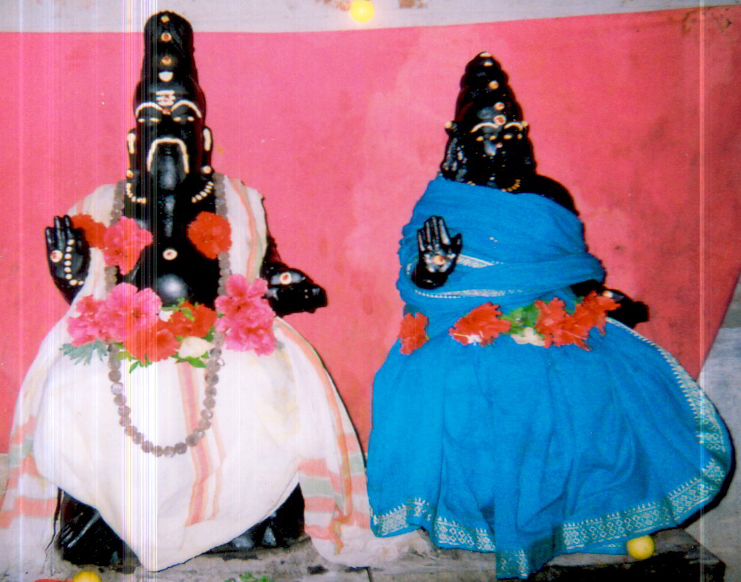
Idols of saint Agastya and Lopamudra / Photo Credit: Wikimedia Commons
On one of his many travels, Agastya met Lopamudra, and asked Kavera for her hand in marriage. He was already of advanced age, had gnarled looks, wore the clothes of a mendicant and his unkempt hair stood out. Yet, Lopamudra agreed to marry the sage on one condition—he was not to leave her alone for a great stretch of time. If he did, she would leave. Sage Agasthya agreed.
After the marriage, this unlikely couple settled down in sage Agastya’s ashram. Once, on his travels, the sage fell ill and fainted. Since no help was in sight, Lopamudra had to carry him home by herself. Somehow, the strong-willed Lopamudra began carrying him home. On the dark path home, Agastya’s dangling foot touched a sleeping holy man. Absolutely furious, the holy man cursed the owner of the foot that he would die at sunrise.
Lopamudra, however, thought that this was unfair. After all, she was the one carrying the sage and had not meant to humiliate the holy man deliberately. So, to prevent the curse from taking effect, she invoked: “May the sun not rise if I have been a good and chaste wife and helped my husband.”
The sun really did not rise and the earth was enveloped in darkness. Shaken, the gods came running to Lopamudra begging her to lift her ban on the sunrise. Explaining her reason, she offered to lift the ban only if they lifted the uncalled-for curse by the holy man. The gods did as told—sage Agastya lived and Lopamudra lifted her ban. The sun rose and all was well again on Earth.
Legend explains how Lopamudra became Kaveri. The people in the present-day Kaveri basin region were facing intense drought and crop loss. They prayed to Lord Ganesha, the remover of obstacles, for help.
Since Agastya would not part from Lopamudra, he turned her into water and left her in the kamandala he carried with him. Seeing an opportunity, Lord Ganesha took the form of a crow and toppled the kamandala leading Lopamudra to flow out as a river. The sage’s disciples tried to stop her, but she felt this was her way of serving people. Diving into the Earth, she reappeared at Bhagamandala. Much later, Agastya came looking for her and recognised her in the river she had become. This river came to be called Kaveri, as she was Kavera’s daughter.
Wanting to be the holiest river, she prayed to Lord Vishnu asking to be made holier than the Ganga. Vishnu explained that Ganga’s holiness could not be undermined as she originated from his feet. He offered Kaveri to be his garland, close to his heart—and therefore, more sacred. And that is how three of the holiest shrines of Vishnu—the Adi Ranga, the Madhya Ranga and the Antya Ranga—came to be at Srirangapatna, Shivanasamudra and Srirangam respectively. In each of these places, the temples are on islands with the Kaveri encircling it—just like the mythical garland.
From this legend comes another which says that the river Ganga herself comes, via an underground route, to bathe in the Cauvery and cleanse herself every year. Just as Vishnumaya had wanted, she flowed on Earth as Kaveri serving humanity.
Where to go
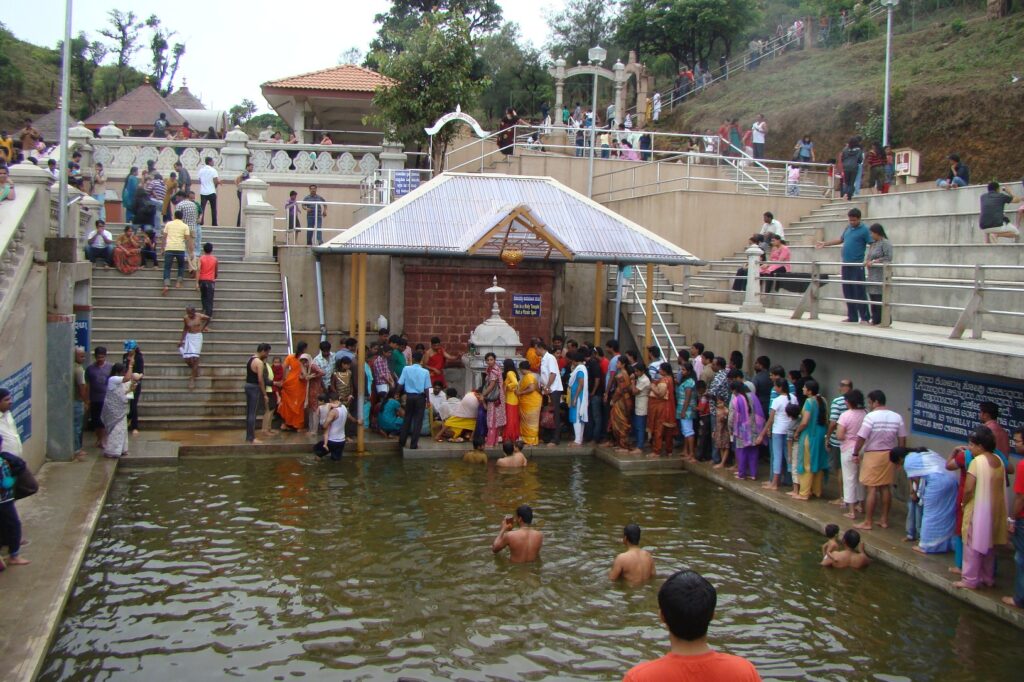
Located in the Brahmagiri Hills in Karnataka’s Coorg district, Talakaveri is generally considered to be the source of the Kaveri. A tank and a temple (in honour of the goddess Kaveramma) have been built at the spot the river is said to originate. The river itself feeds off a spring close to the tank. In normal times, thousands of Hindu devotees visit Talakaveri at the time of the Kaveri Sankramana, a festival that celebrates the annual emergence of the river. Talakaveri also offers excellent panoramic views of the surrounding Western Ghats.
Devotees flocking to and bathing at Talakaveri / Photo Credit: Wikimedia Commons
Then, there are the three river-island towns Srirangapatna—(in Karnataka), Shivanasamudra (in Karnataka) and Srirangam (in Tamil Nadu). These places house three of the holiest shrines, each dedicated to Ranganatha, an avatar of Lord Vishnu—the Adi Ranga, the Madhya Ranga and the Anthya Ranga, respectively. In each of these locations, mythology meets reality as Kaveri encircles these islands in the shape of a mythical garland.
Festival to attend
The aforementioned Kaveri Sankramana is perhaps the holiest festival associated with the river, celebrated usually in mid-October in Talakaveri every year. Another important festival is the Kaveri Pushkaram, observed once every 12 years in Mayiladuthurai in Tamil Nadu. It is marked by a ritualistic dip in the Kaveri’s waters and elaborate pujas on the Thula Ghat.
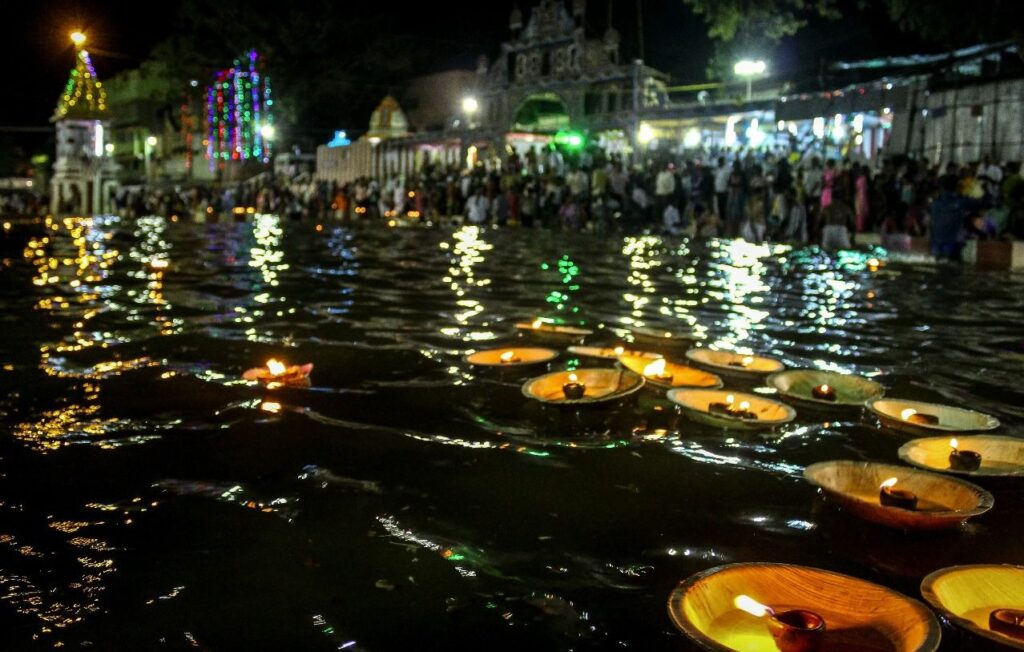
Lamps afloat in the river during Kaveri Pushkaram / Photo Credit: Wikimedia Commons
Two other festivals in honour of the Kaveri are Aadi Perukku and Kaveri Vellam. Aadi Perukku sees women worship nature and goddess Parvati by making rice and flower offerings. They also take a dip in the Kaveri at the several bathing ghats along the course of the river. Kaveri Vellam, on the other hand, is one of those rare festivals that celebrates floods. In the 12 districts that the Kaveri passes through in Tamil Nadu, people offer aartis in the flooded, overflowing river before moving to higher ground and safety. The belief is that the river will not harm the devout people and instead bless them with bountiful harvests.
source: http://www.outlookindia.com / Outlook India / Home> Outlook Traveller> Explore> Story / by OT Staff / February 05th, 2022
WELCOME. If you like what you see "SUBSCRIBE via EMAIL" to receive FREE regular UPDATES.
Read More »