Forces begin field work; to train people how to save themselves in case of sudden disaster
Madikeri:
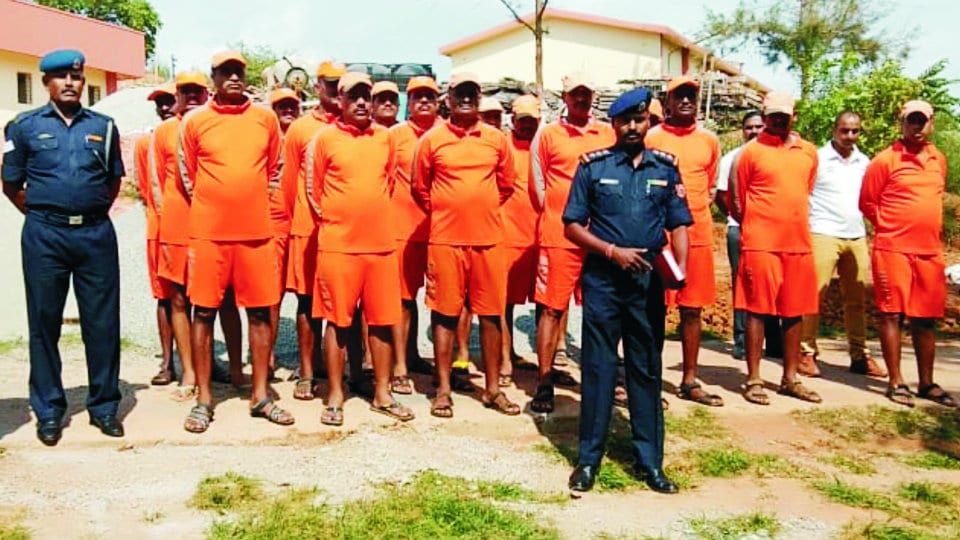
To instil confidence among people of Kodagu that the Central and State Governments will be with them in case of a repeat natural disaster this year and as a precautionary step even before the arrival of monsoon, a team of National Disaster Relief Force (NDRF) has already arrived in Kodagu.
The 25-member NDRF team from B/10NDRF Vijayawada in Andhra Pradesh is camping at Jawahar Navodaya Vidyalaya at Galibeedu in Madikeri. Along with NDRF, teams from State Disaster Response Force (SDRF), Army’s Dogra Regiment and Civil Defence are expected to reach Kodagu soon.
As of now, two NDRF teams have been deployed in Karnataka. While one team is already in Kodagu, the other team is stationed at New Mangalore Port in Mangaluru. In case of emergency like last year, the NDRF Mangaluru team can reach Kodagu in short notice.
The NDRF team is led by Commander Veluru Ramesh and also includes members from Bengaluru and Dharwad. Ramesh said that the Kodagu District Administration had requested the team to camp in Kodagu for at least three months as a precautionary measure. Their stay will be extended depending on the scale of the disaster.
Last year in August, the NDRF and SDRF teams did enormous relief and rescue operation though it took time for their deployment as the catastrophe was sudden and was in an unprecedented scale. Before the arrival of Central Forces, the District Police and the Fire Service Department had carried out rescue operations and they could do only small-scale rescue works as they are not well-equipped. Not taking any chances, this year, the NDRF team has been stationed even before the onset of Southwest monsoon.
On May 29, the NDRF team will visit flood and landslide-prone areas including Makkandur, Hebbatageri, Madapura, Hattihole, Kaloor, Jodupala, Monnangeri, Mangaladevinagar, Thantipaala and other areas and will train people to save themselves and their livestock in case of a disaster.
The team will start field work during monsoon on priority basis and according to Commander Veluru Ramesh, more teams will be deployed in Kodagu based on the intensity of floods and landslides.
“Before a natural disaster strikes, Nature will give signals of it that can be captured through scientific methods. People must be moved to safe areas and the loss of life can be minimised or eliminated,” Ramesh said.
Another member of the team, Doddabasappa, who hails from Dharwad, said, during the heavy landslides on Makutta Road connecting Kerala State, the team had cleared the fallen trees and rubble. He said his team had participated in the rescue operation during the Fani cyclone in Odisha. Joint mock rescue operations will be conducted alongside the local Departments as per the direction given by Kodagu Administration, he said.
Such disaster management teams are formed by picking people from the nation’s Paramilitary Forces and are trained to rescue people and livestock during natural calamities. Apart from ensuring the nation’s security, such teams also protect people from unforeseen circumstances, he added.
source: http://www.starofmysore.com / Star of Mysore / Home> News / May 26th, 2019
This is no doubt a one-stop point for anyone wishing to gather information on organic farming.
The farm is also frequented by gaur, deer, elephants and sometimes tigers and leopards which leave their pug marks.
Nature lovers, Satish Gowda and his wife Ganavi, both post-graduates in Coffee Quality Management from Coffee Board of India, are on a mission to promote organic farming in Chikkamagaluru. The farm maintained by Satish has inspired many to set-up organic farms on the same lines. It’s not only organic farming for which the farm has become famous, it is also the abode for numerous birds and grazing animals which go in search of fruits. Photographers love the place as they can easily sight the birds which perch on trees. The Organic farmers association has done its bit to popularise the spot by bringing foreign national to have a close look at the farm and learn the tenets of organic farming. M.B. Girish explores this unique farm which is any nature lover’s delight
The future is organic and who would know this better than Satish Gowda, a honorary wildlife warden in Chikkamagaluru and his wife Ganavi, who hails from a family of coffee planters? Their painstaking efforts spread across eight years, has created an eco-lovers’ paradise at Honnala village, Sirivase post in Chikkamagaluru where they have converted an area covered with wild shrubs into a lush green expanse by cultivating about a 1,000 fruit bearing trees. This is no doubt a one-stop point for anyone wishing to gather information on organic farming.
Organic farming is not all that this farm boasts of, it is also a bird lovers’ hallowed spot where they can film rare species which have made the farm their home.
Temple Tree Farm is spread across 7.15 acres and has a variety of fruit bearing trees including some from foreign countries which attract birds, butterflies and herbivores from the neighbouring Bhadra Tiger Reserve located on the banks of River Somavahini.
Satish and Ganavi were inspired to set up their organic farm after a visit to Navadarshanam, an eco-ashram in Bengaluru. They met Ananthu and his wife Jyothi and were inspired by their eco- sustainable way of living.
To make their dream of setting up an organic farm come true, Satish and Ganavi purchased land at Sirivase in 2011 and named it Temple Tree Farm because a Temple Tree is located right at the entrance of the farm.
The farm uses solar energy to pump water to every nook and corner and has several varieties of fruit bearing trees such as Rambutan, Java apple, mulberry, rose apple, pineapple, rampala, seethapala, lakshmanpala, hanumanthpala, papaya, cashew, guava, jack fruit, velvet apple, peach, carambola, kokum, avocado, chikoo, orange, musambi, mango, litchi, pomelo and mangosteen. Among the fruits grown at the farm, the Nakkare variety is unique as it should be eaten raw and not ripe as it tastes sweeter. Nakkare is used to make pickles and chutney.
Observing that many varieties of birds come to the farm to feed on the fruit, Satish Gowda has engaged a naturalist, Shivakumar of Chikkamagaluru to study the various species of birds and butterflies and make a note of it for documentary purposes. Shivakumar says he has sighted about 60 species of birds in the last three years including the Grey Hornbill, Malabar Trogon, Rocket Tail Dragon, Blue-fly Catchers, Asian Paradise Fly Catchers and Ruby Throated Bulbul among others. The fruits at the farm are not harvested to allow the visiting birds feast on them.
“I even see Otters in River Somavahini flowing close to the farm, the other place I get to see Otters is in the Bhadra backwaters,” says Shivakumar. Another rare species he has seen at the farm is the Flying Lizard. “I read about the Flying Lizard in writer Poornachandra Tejaswi’s book and was lucky to spot it at Satish’s farm.”
The farm is also frequented by gaur, deer, elephants and sometimes tigers and leopards which leave their pug marks.
Malnad Gidda, an indigenous cow was added to the farm and dung and urine from the cows are being used as plant nutrients and pesticide. Satish says milk from Malnad Gidda is highly nutritious and has medicinal properties. A fish pond is an artificial tank to collect rain water as the region receives copious rainfall during the monsoon. The pond has stocks of fish varieties such as Gowri, Rohu and Katla.
The chicken are fed paddy and dry paddy hay is used as fodder for cows. Goats and cows are also fed green grass. No dry fodder is bought from outside. Honey boxes are kept around the farm and help in a collection of over 25 kg of honey in a year.
Ganavi says visitors to the farm are amazed how an empty piece of land was transformed into a fully functional farm. Taking a cue from Satish Gowda, Partasarthy Wodeyar, a resident of Salagame hobli near Hassan city, is developing an eco-farm on the lines of Temple Tree Farm. He also plans to start an eco-tourism centre in an area of four acres and wants to serve organic food to visitors.
“I learnt a lot from Satish Gowda’s farm. It is difficult to maintain a farm like his and the effort put in by Gowda is worth appreciating,” he says.
Satish being an honorary wildlife warden, is also rendering a helping hand in mitigating human-animal conflict in and around Bhadra Tiger Reserve. He offers compensation for cattle killed by tigers or leopards. Besides, Anti-Poaching Camp personnel are given torches, water repellent coats and other accessories to enable them guard the forest areas from smugglers or poachers.
source: http://www.deccanchronicle.com / Deccan Chronicle / Home> Nation> Current Affairs / by M B Girish, Deccan Chronicle / May 19th, 2019
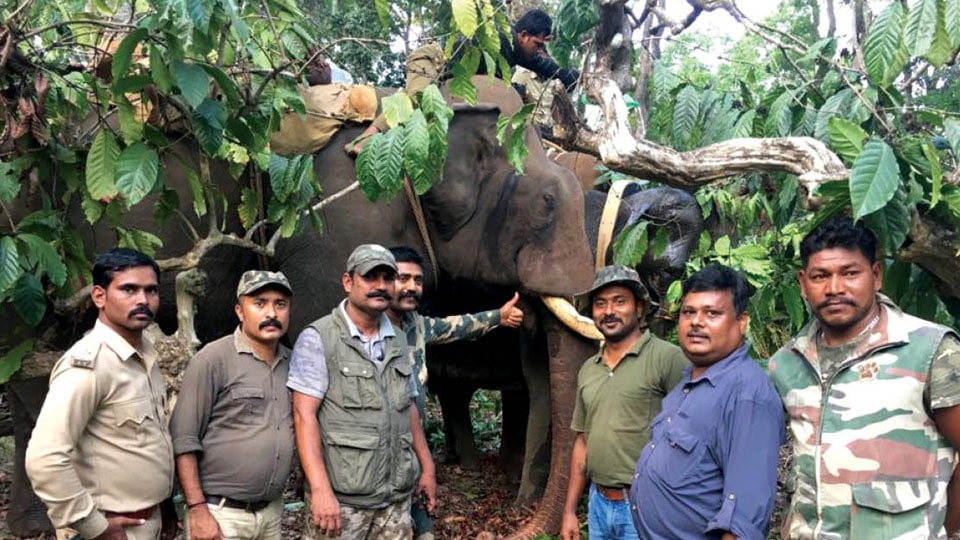
Concerned at the increasing instances of elephant-human conflict, the Forest Department, for the first time in Kodagu, has put radio collars on elephants to study their migration patterns.
The Department has decided to put radio collars on selected elephants so that their migration patterns can be studied. An analysis of their movements will help in avoiding human-elephant conflict that results in deaths of humans and damage to crops, said Department officials.
Accordingly, over six elephants that usually enter coffee estates and fields have been radio-collared in places including Virajpet, Madikeri, Kushalnagar, Maldare, Ammathi & Pollibetta. These areas have witnessed increased elephant attacks in the recent past.
The collars were fitted on the wild pachyderms with the help of tamed elephants including Bhima, Abhimanyu and Krishna. Last time, over four collars were fitted on the elephants and the Department staff was able to successfully track the elephant movements and prevented them from entering the human habitats.
Department officials said that radio collars could further strengthen the elephant corridor management strategy. It could also become an early warning system for villagers in order to avoid conflict with elephants as the collars could provide real-time information. Radio-collaring of animals is a tried and tested method of studying free-ranging wild animals that has been in practice for several decades. It is primarily used for tracking the movement and activity patterns of the tagged animal, with the signals being sent to a handheld device or to a computer via a satellite.
It is often the only method that is available for studying the movement and activity patterns of a secretive species like the tiger or a wide-ranging species like the elephant. Information obtained from the use of radio telemetry is of high scientific and conservation value. The GPS-enabled radio collars will provide updates in real-time about the location of a herd and help track them within the State as well as during migration. A tool embedded in the collar will send signals 24X7.
“Once we receive signals on the presence of the elephant herd near human habitation, the ground-level Rapid Response Team of the Dept. will be alerted on their mobile phones so that they can rush to the place and launch an operation to drive elephants back into the woods,” said District Forest Officer Maria Kristhu Raj.
The kumkis (tamed elephants) will infiltrate the herd and scatter the elephants. When the female leader is isolated, the experts perched on the nearest kumki will shoot her with a dart loaded with a tranquillising drug called xylazine. The dosage will be decided according to the size and strength of the matriarch. “After being hit, the elephant will walk like it is intoxicated for 10 minutes and then it will fall asleep. So, our men have a window of about 40 minutes to put the radio collar on the elephant,” he explained.
“In the 40 minutes the animal was under sedation, the team fixed the radio collar and activated it. Soon, veterinarians injected a drug to revive it. The entire operation was over in 50 minutes and the animal started heading back into the forests,” the DFO added.
source: http://www.starofmysore.com / Star of Mysore / Home> News / May 14th, 2019
The state government on Thursday revoked the temporary ban on conversion of land in the flood-hit Kodagu district.
The ban had come into effect after last year’s devastating floods washed away large chunks of land in the coffee district.
The Revenue Department on Thursday ordered tahsildars and assistant commissioners to allow conversion of land up to 15 to 20 cents for building houses by the locals after obtaining a ground report.
“Several people have been submitting applications seeking the conversion of land to build houses for a living. But since the floods, the government had ordered temporary ban on conversion of lands for non-agricultural purposes. But keeping in mind the public request, the government has directed to allow conversion of land up to 15 to 20 cents for building houses by the locals.”
The state government while revoking the temporary ban has also laid down certain conditions to prevent damages to the properties in future due to any natural calamity.
As per the conditions, no permission shall be given for construction of buildings in non-stable areas so identified by the Geological Survey of India (GSI) in its report; the buildings shall be at least 10 meters away from the rivers and rivulets and conversion shall not be allowed along the valleys and on those lands which had witnessed landslide in 2018.
source: http://www.deccanherald.com / Deccan Herald / Home> State / by Niranjan Kaggere, Bengaluru / May 09th, 2019
A lesser-known destination of Madikeri is Mandalpatti where sky-high hills are covered with magical mist. Sunrises and sunsets here are phenomenal, writes B V Prakash.
Mandalpatti
Often described as ‘Switzerland of India’, Coorg is a district known for its hilly terrain, dense forests, waterfalls and unique temples. There are at least half a dozen tourist spots like Bylakuppe Tibetan Monastery, Dubare Elephant Camp, Cauvery Nisargadhama, Abbey Falls and so on. But in recent times, a new charming destination is gaining popularity and is being listed as an important sight not to be missed. Mandalpatti Viewpoint, not far from Madikeri, is a thriving tourist attraction. Virtually little known for long, Mandalpatti shot to fame after the popular Kannada movie Gaalipata was filmed here. The place is also known as Mugilupete or ‘abode of clouds’, as it was named in the movie. Now, this spot has indeed become a star attraction for visitors.
Up, up & away
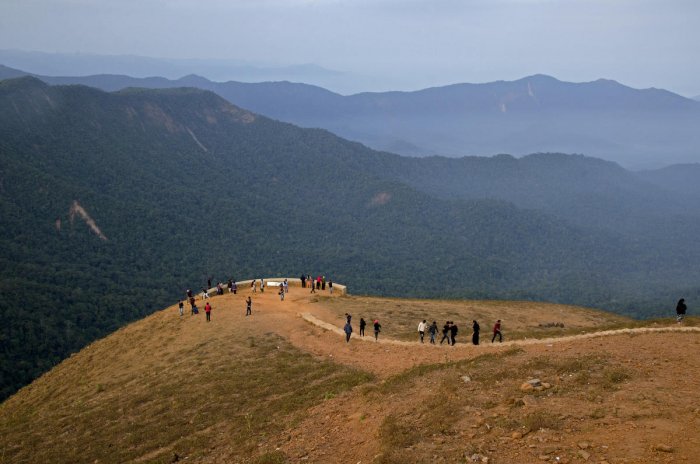
During our last visit to the town, we had earmarked an extra day to make it to Mandalpatti. Perched atop a range of rolling hills and deep valleys, Mandalpatti, at 4,050 ft, is the ultimate viewpoint offering a 360-degree view of the spectacular landscape. The highlight of the place is the blissful mood it gets into, particularly at sunrise and sunset. As such arriving in Madikeri by the night, we at once called up Harish, the jeep service provider, and fixed the programme for the next day. As per his suggestion, we would leave at 5 in the morning to be able to reach the spot, some 30 km away, in time. It was still dark and cold when the jeep arrived, we were on the way soon.
As had been informed beforehand, the road to Mandalpatti is anything but a ragged trail battered to the core. After the recent deluge, the huge landslides have left their scar and the driving is all the more backbreaking. Only jeeps and 4WDs can venture up this terrain. There are two approaches to Mandalpatti which lies to the north of Madikeri. We skipped the road via Abbey Falls having been to the place many a time. Also, the water would hardly be copious at this time of the year.
The other road passing through Makkanduru and Hattihole is slightly longer but better. Nevertheless, the journey shook us off from the sleepy mood. Reaching the parking lot, we quickly moved up the short trail to the hilltop duly paying the prescribed entry fees at the check-post. Hordes of people had already gathered and were scrambling up. At the summit, we were simply blown off our feet by the stupendous views that opened up all around. The popularity of the spot goes by the ethereal beauty the surroundings have with a sea of rolling hills and the white fluffy layers of mist like waves.
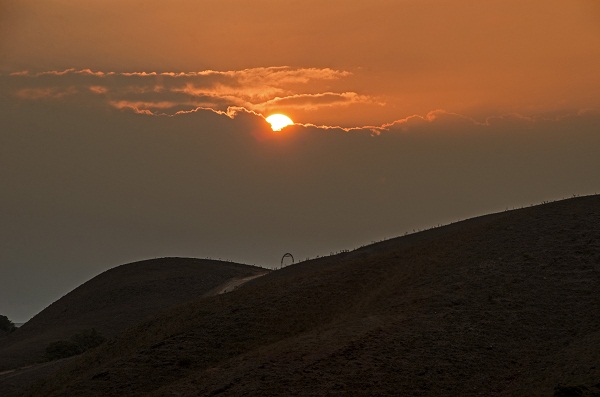
Sunrise at Mandalpatti.
Stunning beauty
The deep ravines that run down from the edge of the plateau are packed with seemingly impenetrable dense forests. In each direction, towering peaks soar with prominent ones like Kumara Parvatha or Pushpagiri, Kote Betta, Nishani Betta, etc. As the sun rose over the horizon, it was as if a huge light was lit over the whole valley. With the clouds painted with golden lines, it was truly an awesome sight. After a delightful experience of viewing breathtaking vistas and scrambling all over the place for a couple of hours, we made it back to Madikeri.
Nishani Motte
With half a day more at our convenience, we chose to climb the Nishani Motte Peak that loomed large in the northwest. Also called Nishani Betta, the 4,100-ft-high hill can be approached from different starting points each with its own difficulty level. The easiest route being from the town Gaalibeedu, 12 km away from Madikeri. We headed there in an auto. The driver was friendly and tried his best to leave us as near the foothills as he could, thereby reducing a third of the trekking distance which is 7 km to the peak. The initial path is a motorable road through coffee estates and a few houses. Soon, it was just the two of us with the trampling of the dry leaves being the only sound to be heard. At the top is a wide plateau with deep valleys to the east and west. As the sun went behind the distant hills, we retraced our steps.
Having visited a heavenly viewpoint and trekked up a beautiful peak, the experience was, for sure, pleasant and rejuvenating.
source: http://www.deccanherald.com / Deccan Herald / Home> Supplements> Travel / by B V Prakash / April 06th, 2019
Tribals of Hunsur have released what they call a ‘people’s agenda’ and have asked party leaders to respond to the same as protection of forests is fundamental to their existence.
A section of people in Kodagu district is taking the lead to set such an agenda
Will the opposition to ecologically destructive projects in Kodagu, coupled with issues related to Forest Rights Act (FRA), 2006, come to the fore in the elections in Mysuru Parliamentary constituency?
The environment has never been an issue in elections where caste and party affiliations play a major role. But a section of people in Kodagu district – in Mysuru Parliamentary constituency – are taking the lead in setting an agenda on environmental issues. There is a general consensus among the informed that the natural disaster that hit the district last August was due to environmental destruction that has taken place for decades under the pretext of development.
“Hence we will ask the candidates to spell out their views on the future course of development for Kodagu and speak to candidates not to push for such rail and road projects,” said Col. C.P. Muthanna of Coorg Wildlife Society.
That there is a groundswell of support for protecting the environment is evident in the strong opposition to the railway project linking Mysuru to Madikeri and extending it toThalassery in Kerala, a proposal which triggered massive rallies in Mysuru city too. But whether it will affect voting patterns remains to be seen. Mr. Muthanna said the rail link to Kushalnagar could be extended to Madikeri and the project envisages a 1.5 km underground tunnel through the Dubare forests which will accentuate conflict situations. “Environment has to figure in the elections and the imperatives of protecting the catchment of the Cauvery where large tracts of plantations that harbour forests are being converted to sites, have to stop,” said Mr. Muthanna.
Though political parties are yet to finalise their constituency-specific manifestos, tribals of Hunsur have already released what they termed a ‘people’s agenda’ and have asked the leaders to respond as protection of forests and environment is fundamental to their existence.
S. Sreekanth, of Development through Education (DEED) and convener of Karnataka Vikasa Vahini, said the candidates should spell out their stance on rejuvenating the Cauvery, Harangi, Hemavati, Kabini and their tributaries and the imperatives of conserving the environment.
The tribals have released an 8-point agenda that calls for taking up water conservation measures on a massive scale besides rejuvenating waterbodies in the command areas of these river systems. “Protection and conservation of Western Ghats is intrinsically linked with the conservation of rivers flowing through Kodagu and this has a direct bearing on the local culture which is rooted in nature,” he said.
Political parties have also been asked to make their stance clear on the implementation of the FRA and rehabilitation of 3,418 tribal families in the region who were evicted or displaced from Nagarahole.
source: http://www.thehindu.com / The Hindu / Home> News> States> Karnataka / by R. Krishna Kumar / Mysuru – March 23rd, 2019
Jaggery coffee may not be your cup of tea but expect the brown brew to be presented as a welcome drink at a resort in the middle of a large coffee plantation, such as the Cottabetta bungalow in Pollibetta, Coorg, south Karnataka. Nearly 130 years old, this plantation resort was once the residence of British planters. Owned by the Tatas now, it consists of a Kerala-style house with the bedrooms around the inner courtyard, offering the old-world charm and comfort.
On the hillsides, a dense forest of short and stunted trees bearing this exotic berry, in the shadow of the taller trees on which pepper creepers climb high, abounds. The soil here is good for a host of other spices, too. That’s what the traders from the west came looking for, and then settled down to rule our country.
A tour of this particular plantation gives an insight into the process of producing coffee. According to a tour guide, Udhav, a coffee plant starts yielding berries after seven years, and then goes on doing it for over 75 years. Initially the berries are red, but turn brown once they go through several stages of drying, pulping, roasting and grinding before landing on our tables as the brew with a heady aroma. Robusta is the variety that grows here. It’s the favourite of the elephants, too. Most plantations are surrounded by an electric fence to protect them from pachyderms (animals like elephants, hippopotamus and rhinoceros) but, says Udhav, “sometimes they find out how to switch it off. Generally, it is the matriarch of the herd who knows how”!
Monastery
In another direction from Madikeri, about five kilometres off the Bangalore road, lies a Buddhist monastery, Namdroling. This seminary imparts education in the Nyingmapa tradition of Buddhism. Over 3,000 students from the primary to postgraduate level, from the Himalayan regions and abroad, “chant and study, work and practice” here. His Holiness Penor Rinpoche set up this monastery in 1963.
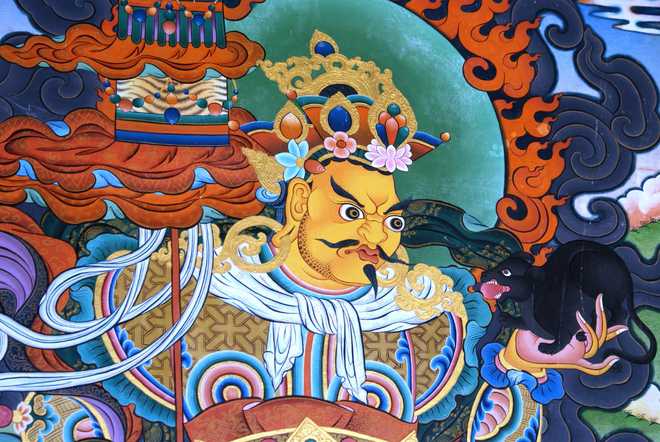
He “attained Mahaparinirvana” in 2009. The Dalai Lama consecrated it and christened it as Namdroling, though its full name is Thegchog Namdrol Shedrub Dargyeling (Land of increasing practice and teaching of the utmost yana that achieves spontaneous liberation). The centre is also known as the Golden Temple because of the three 40-feet high, gilded statues of the Buddhist icons. The entire complex has been elaborately decorated with the Tibetan-style paintings, murals and religious figures. Bylakuppe, a small town where this is located, is a far cry from Tibet in terms of climate and culture but it houses the second largest Tibetan settlement after Dharamsala.
Around 40km from Madikeri is Talakaveri, on the Brahmagiri hill, the source of the Kaveri river. A tank marks the source of the river, and a nearby temple is a popular place for pilgrimage. Not too far from Madikeri lies the Dubare elephant camp. It is located on the banks of Kaveri. Apart from watching big animals, one can do some still-river rafting close by. The best time to visit Coorg is soon after the rains when water cascades down the falls and mist rises up to shroud the mountains. Perhaps, that’s why it’s also known as the Scotland of India.
source: http://www.tribuneindia.com / The Tribune / Home> Spectrum> Travel / by Lalit Mohan / March 10th, 2019
Talakaveri in Coorg district is where the mighty River Kaveri takes birth. Chitra Ramaswamy traces its journey, all the while enjoying some scenic spots along the way… Talakaveri
The sky blushes a monochrome in blue tending to grey-black, with clouds that promise rain. Driving through the winding roads of Kodagu flanked by lush coffee estates and fields of spices, we bring our vehicle to a halt at Talakaveri, the birthplace of the sacred River Kaveri. We are as much awestruck by our surrounds as by the legends associated with the waterbody.
A river’s journey
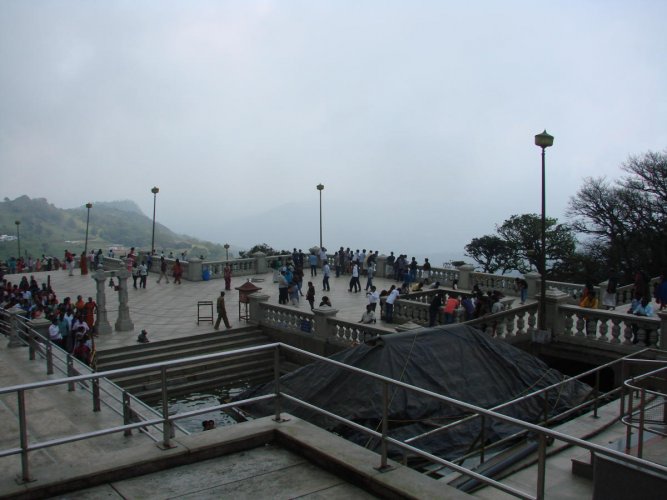
Kaveri, the sacred, easterly-flowing river of peninsular India, commonly referred to as Dakshina Ganga, was born here in the Brahmagiri ranges of the Western Ghats, at an elevation of 1,341 m. However, Kaveri is not visible as a river at Brahmagiri. Rather, she originated as a gurgling spring that to date feeds a tank built on the hillside by the Kodavas of Kodugu. We witness devotees fill pots and bottles with the holy water from the tank, while others take a dip in it. Kaveri miraculously bubbles up every year at an auspicious moment in rebirth, on Tula Sankaramana day, which falls between October and November. Pilgrims in hundreds of thousands flock here to cleanse themselves during this time.
A temple to Goddess Kaveri, that is also dedicated to Shiva as Agasthyeswara, and Ganesha, overlooks the tank and attracts devotees in droves throughout the year. Talakaveri’s importance as a place of veneration gained greater importance since it is believed that Sage Agasthya was blessed here by Brahma, Vishnu and Ganesha as he sat meditating under the ashwaththa tree. Legend also has it that the saptarishis or the seven great sages who are extolled by the Vedas performed their yajna or ritual sacrifices at Brahmagiri Peak.
After offering prayers at the tank shrines, we ascend a flight of steps leading up to the summit of the mist-kissed Brahmagiri Hill, which offers stunning glimpses of the valley below. It is from here that the shimmering body of blue gleefully begins her downward journey, only to disappear underground. However, Kaveri resurfaces in a steep tumble at Bhagamandala, located at the foothills of Talakaveri where she swells with pride as she unites with River Kannike, and Sujyoti, a mythical river. The trio of rivers forms the much venerated ‘Triveni Sangam’. A dip at this confluence is believed to purge one from all evil and negative influences. Believers proceed to Talakaveri after taking a dip at the sangam and performing rituals for their ancestors.
The entrance to Bhagamandala Temple
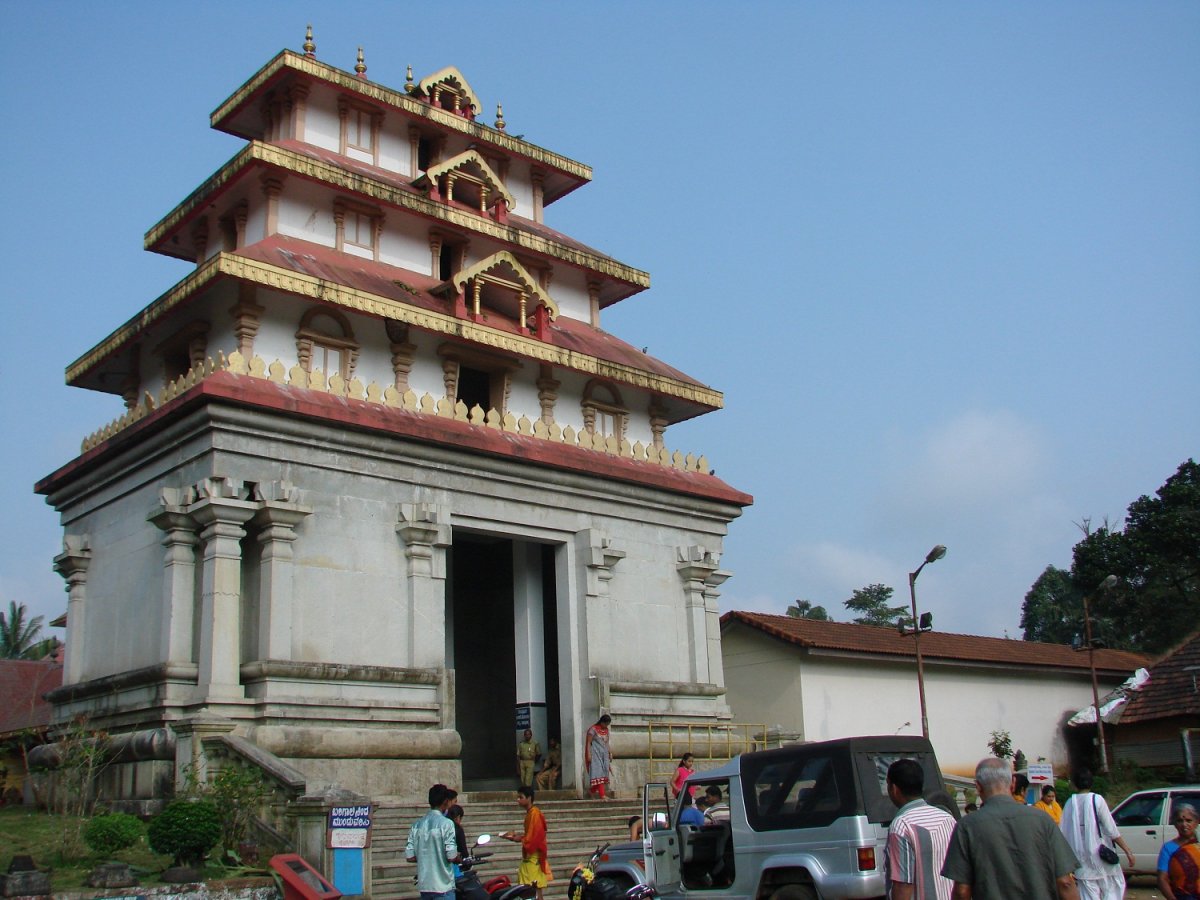
Our next halt then is Bhagamandala or Bhagandeshwara Kshetra which derives its name from the Bhagandeshwara Temple dedicated to Lord Shiva. Though the temple complex was built by the Cholas around the 11th century, it displays Kerala-style temple architecture with copper roofs that curve up at each corner, into rearing and hooded cobras. Shrines to Vishnu, Ganesha and Subramanya with rimmed brass doors dot the courtyard. Painted sculptures of the pantheon of Hindu deities, flora, fauna and men in battle adorn the ceilings.
An inscription in its premises refers to Bhagamandala as having been captured by Tipu Sultan in the 1780s. He renamed it as Afesalabad, and as a tribute to himself for the feat he had accomplished, Tipu placed the ‘Salam Kallu’, a stone on the way to Talakaveri. The stone bears testimony to the brutal bloodbaths that he caused. However, in 1790, in a fiercely fought battle, Dodda Veera Rajendra, the most famous of the Haleri rulers of Coorg, regained the territory. Further, he donated the stupika stupika and golden pinnacle of the temple’s cone-shaped shikhara.
Our Bhagamandala trip takes us to Karnataka’s only museum that exhibits objects related to bee-keeping. Bhagamandala is also home to Madhuvana, a bee-rearing and honey marketing centre.
Stuff of legends
A host of legends, most of which have their origins in the Puranas, are associated with Kaveri that has inspired several civilisations that have flourished on its banks. She is inextricably linked with Sage Agasthya, King Kavera and Lopamudra, a trio of puranic icons. The most popular tale associated with the river is that Lord Brahma sent his daughter Vishnumaya to earth as Lopamudra. He had twin objectives in doing so. One, to assist Lord Vishnu as the damsel Mohini, in his ploy to vanquish a demon. Secondly, to allow his daughter to fulfil her keen desire to serve humanity on earth. Brahma gave Lopamudra in adoption to King Kavera who meditated upon him to beget progeny.Pleased with the king’s worship, Brahma gave Lopamudra in adoption to him. As the king’s daughter, she was rechristened Kaveri, and she grew up to be a gorgeous maiden.
Sage Agasthya, who was meditating on Brahmagiri Hill, was entranced by the young Kaveri’s enchanting looks. He sought her hand in marriage. Kaveri accepted him, upon the condition that she would leave him for good if he left her alone for long, at any point in time. As fate would have it, Agasthya once became engrossed in a philosophical discussion and forgot his deal with Kaveri. She immediately left him, transfigured herself into a river, and began to flow in order to fulfil her own desire to serve mankind.
According to another popular myth, Sage Agasthya, by his yogic powers, turned Kaveri to water which he filled in his kamandalu or water pot, and kept it in his ashram. But on one occasion, when he entrusted the pot to his disciples and returned late from a debate, Kaveri used her divine powers to jump out of the kamandalu and emerge as a river to serve humanity. A variant of this version claims Lord Ganesha as having taken the form of a crow and toppling the water from the kamandalu.
Nalaknad Palace
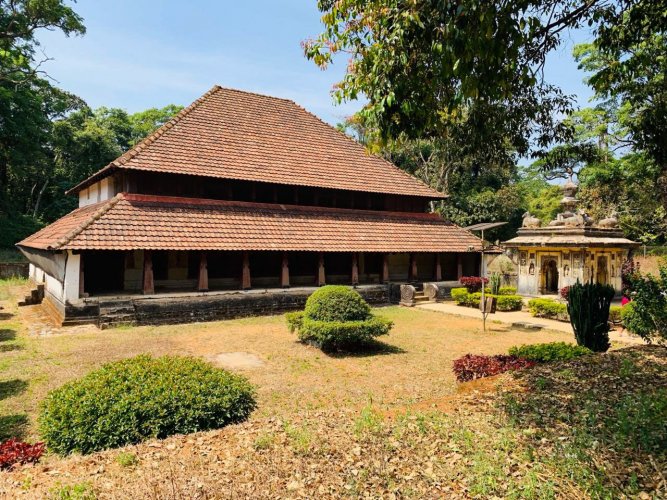
Having feasted our senses on the picturesque Talakaveri and Bhagamandala, we then explored the neighbourhood within a radius of 70 km. Igguthappa Temple, 26 km away, is one of them. After paying our obeisance to Igguthappa, the chief preceptor of the Kodavas, their god of rain and crops, we delight in the verdure surrounding Chelavara Falls, a natural waterfall formed by a tributary of the Kaveri, and Nalaknad Palace which is located at the foot of Tadiandamol, Kodagu’s highest peak. The edifice was built in 1792 by Dodda Veera Rajendra to celebrate his victory against Tipu. It is adorned with exquisite wall murals in various states of preservation. The twin-storeyed palace with a simple exterior has intricate wooden carvings, low conical roof, crested dome and pillared facade.
About 70 km from Bhagamandala, we visit the serene and breathtaking Nisargadhama, a 64-acre island surrounded by River Kaveri. A scenic spot accessed by a hanging bridge across the river, it is ensconced by foliaceous teak and sandalwood trees and bamboo groves. Uma Maheshwara Kshetra and Harangi Dam are our final halting spots on this explorative sojourn of Kodava land. Our hearts and minds fill with a sense of pride at belonging to the land of this holy river. In her 800-km-long long thrilling odyssey, Kaveri traipses amid varying landscapes of Karnataka, Kerala and Tamil Nadu, bounding over boulders, crisscrossing through clusters of expansive palm and paddy fields. She displays several shades of her whimsical nature on this jaunt — a young bride, serene and shy at once, a capricious and tempestuous prankster the next. The mirthful lass creates little and large waterways en route, joins forces with lesser streams, until she takes a final bow and loses herself in the fathomless depths of the Bay of Bengal.
source: http://www.deccanherald.com / Deccan Herald / Home> Supplements> Travel / by Chitra Ramasamy / February 09th, 2019
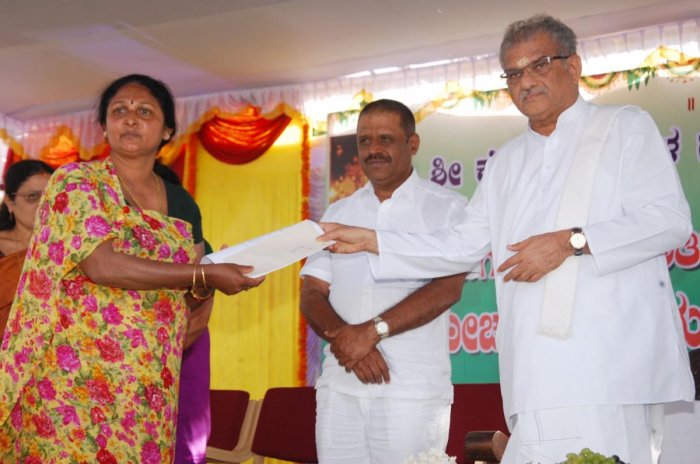
Dharmasthala Dharmadhikari D Veerendra Heggade hands over a cheque to a victim of natural calamity, as a part of the assistance programme under SKDRDP, in Madikeri on Thursday.
Dharmasthala Dharmadhikari D Veerendra Heggade launched a programme to assist flood victims through Sri Kshetra Dharmasthala Rural Development Project (SKDRDP) in Madikeri on Thursday.
He handed over cheques to those affected by the recent floods and natural calamities to assist the flood victims in rebuilding their lives.
Heggade urged the government to construct houses for the needy and to rebuild the infrastructure in Madikeri which was destroyed by flash floods and landslides.
“Loans up to Rs 450 crore have been released to Kodagu through IDBI bank. Monthly interest on the loans during the months when flood victims were rendered homeless and jobless was paid by the SKDRDP. There is a need to waive the interest during this period and bank officials should think and act in this regard,” stressed Heggade.
He said SKDRDP will encourage flood-affected women to become self-employed by providing training in the making of handicraft items and processed food among other measures.
SKDRDP executive director L H Manjunath said that every homeless and landless family will receive financial assistance of a maximum of Rs 65,000. The amount will be transferred to the bank accounts of 2,106 families within a week. A total amount of Rs 8 crore had been set aside. An amount of Rs 2 crore was also contributed to the Chief Minister’s Relief Fund, he added.
Veerendra Heggade visited the six flood-affected villages and listened to the woes of residents.
source: http://www.deccanherald.com / Deccan Herald / Home> State> Mangaluru / by Adithya K A / DH News Service, Madikeri / January 10th, 2019
New office-bearers have been elected for Coorg Wildlife Society.
Kambeyanda C. Biddappa has been elected as President, Ketolira A. Chengappa as Vice-President, Apparanda A. Cariappa as Secretary, Chendanda S. Poovaiah as Treasurer, Chendanda P. Aiyappa has been elected as Joint Secretary. Prof. Kambeyanda C. Belliappa, Iychettira M. Machaiah, Chendanda P. Jeffrey Muthanna, Bollera B. Chengappa, K.N. Madappa, B.A. Poonacha and C.K. Poovaiah have been elected as Executive Committee members.
source: http://www.starofmysore.com / Star of Mysore / Home> News / December 22nd, 2018
WELCOME. If you like what you see "SUBSCRIBE via EMAIL" to receive FREE regular UPDATES.
Read More »