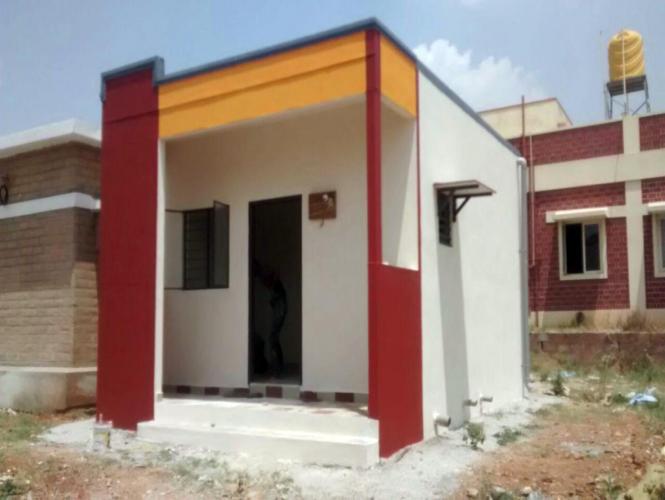
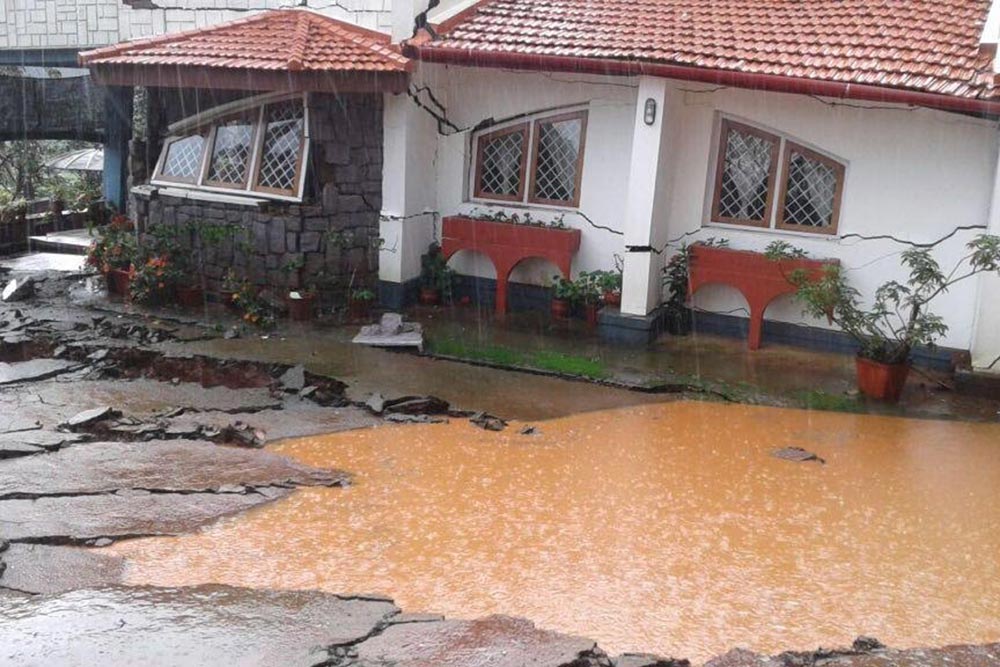
A house constructed using composite material near Chikkapetehalli near Yelahanka in Bengaluru
A former scientist from the National Aerospace Laboratories (NAL), Bengaluru, has come up with a proposal to construct light-weight, flood-resistant houses made of composite material in Kodagu district.
The material used in lightweight combat aircraft will be employed to build the houses, to replace brick and mortar as construction material.
Dr R Gopalan, the retired scientist from NAL, also the executive director and CEO of Society for Development of Composites, says structures constructed using brick and cement increases the load on the soil, which is not good for houses prone to natural disasters.
“Across the world, people are building houses using composite materials, which have high durability compared to traditional brick and cement. The weight of these houses is 1/100th of the traditional structures. Houses built using composite material can be constructed in just a few hours,” Gopalan said.
Referring to Home Minister G Parameshwara, who said pre-fabricated houses like Indira canteens will be promoted by the government, Gopalan said pre-cast cement slabs used in Indira canteens are very heavy and require use of cranes to construct homes. Knowing the soil condition of the flooded areas, it is advisable not to use heavy structures in Kodagu, the scientist said.
Light-weight material gives excellent thermal insulation unlike Indira canteens, which will be like a hot oven.
Gopalan, along with other scientists, travelled across the ravaged areas of Kodagu to assess the situation. The team met the incharge secretary and the incharge minister for Kodagu in this regard. The team has constructed 65 taluk hospitals in North Karnataka in a span of five months and has built houses in flood-affected areas of the region.
source: http://www.deccanherald.com / Deccan Herald / Home> State> Top Karnataka Stories / by Poornima Nataraj, DH News Services,Bengaluru / September 08th, 2018
Before the rains started, coffee planters in Coorg were talking of a good crop —the plants were well rested after a lean year and went through the process of blossoming and forming fruits. That settled, seasonal certainty is gone with the wind and merciless lashings of torrential rain.
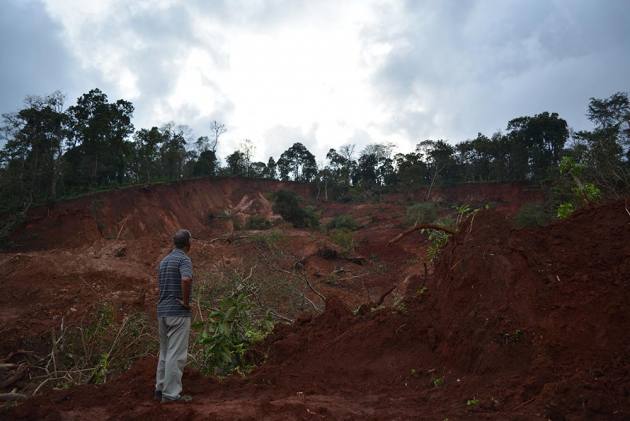
HELPLESS / A planter contemplates nature’s carnage where once existed a fecund patch / PHOTOGRAPH BY AJAY SUKUMARAN
A fully-done crossword puzzle is on the table next to Chitra Subbaiah who confesses that she could forego reading the newspaper, but not the crossword. We are in the cottage of a home-stay in Madapura, north Coorg, resplendent in the evening sun—the first day in two months that the rain has let up. It brings some relief from fear. Chitra, nearing eighty, recounts a painful experience with great fortitude. “You have to do some mental jugglery, you know. You can’t curse your fate.” She’s staying in a friend’s cottage because her home, in the neighbouring village of Hattihole, now lies beneath a pile of earth which slid down the hillside, burying everything she owned.
“Wiped out, totally. I don’t have one pin. There is nothing to say there was a house,” she tells Outlook. All she could reach out for in time were her spectacles, medicines and some gold the workers from her coffee estate had entrusted her with safekeeping. The workers’ quarters on her coffee estate too went down. Fortunately, they had time to move out. She points to others in the same situation. “At least I can rent a house and stay. What about so many others, who have nothing,” she asks.
Before the rains started this year, coffee planters in Coorg were talking of a good crop—the plants were well rested after a lean year and went through the process of blossoming and forming fruits.
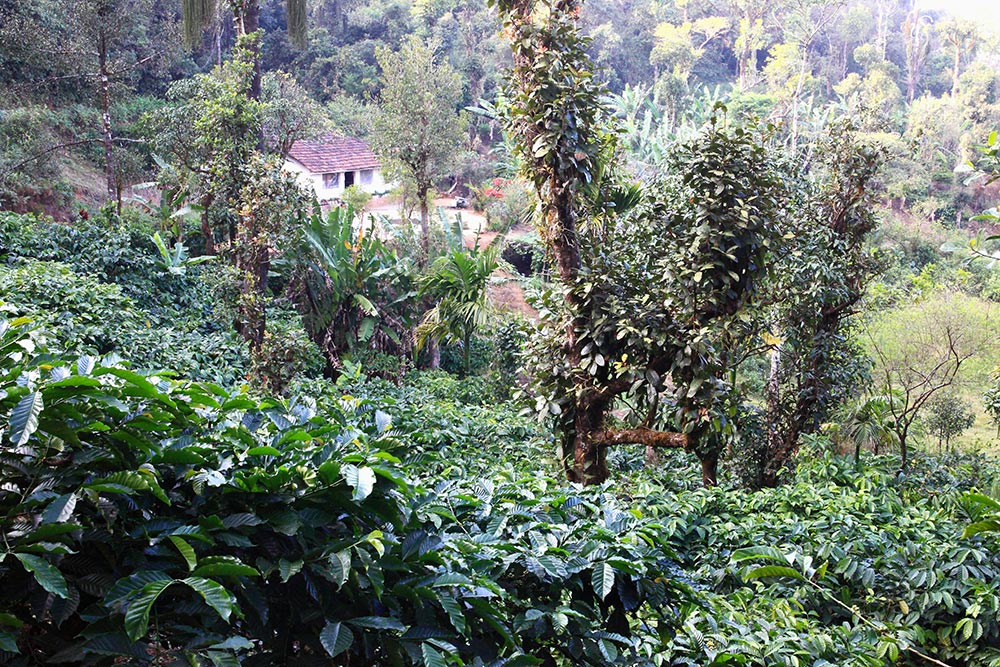
The scene at a typical Coorg coffee estate / PHOTOGRAPH BY GETTY IMAGES
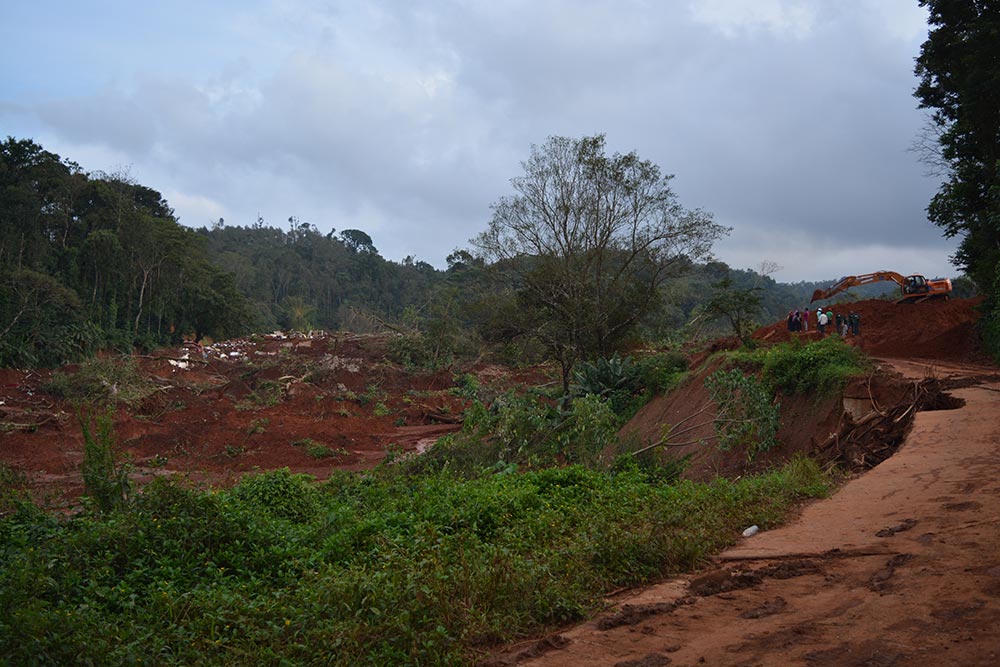
That settled, seasonal certainty is gone with the wind and merciless lashings of torrential rain. It rained heavily through July and August in this region of south Karnataka bordering Kerala. Then, in late August, came a series of punishing cascades of sodden earth. Now, there’s a trail of ruin in these charming hills, where landslides have swept off whole villages, re-arranged estates and shattered its economy. With immediate rescue measures tapering off, one question hangs limply in the air: where do you start picking up the pieces?
“I can’t plant anything now on my land, that’s for sure,” says K.U. Erappa, standing in his camouflage gumboots in a relief camp inside Madikeri’s old fort where, grouped with several families, he has been staying for days now. “All that’s left of my coffee plants are just stalks,” Erappa says. His ageing mother walks up to say, “We had a small house, but it was pretty.” Their grief is palpable. Erappa owned a few acres of coffee and paddy in Mukkodlu, one of the hardest-hit places in north Coorg, in the vicinity of district capital Madikeri. Much of Coorg is remote, away from the main-travelled roads. Like others, Erappa has been going back to salvage what he could. His three children, like most kids from his village, have been sent away to a temporary residential facility in a school in Ponnampet town at the southern end of the district. “We never dreamt Coorg would come to this,” says N. Bose Mandanna, a planter from Suntikoppa.
Right now, a full picture of the damage isn’t available, though it is being estimated. Planters like Mandanna reckon that at least 5,000-7,000 acres have been wiped off in the landslides. For the plants still standing, there’s the danger of wet feet and black rot—water-logging at the base of the plant that strangulates it, causing leaves to fall off. “When leaves are lost, next year’s crop is also lost,” says Mandanna. Coorg, with about one lakh hectares in cultivation, accounts for close to 40 per cent of India’s coffee production. The 2017-18 post-blossom estimate was 1,33,500 metric tonnes, most of which is exported, Italy being a top destination. To make matters worse, prices, say market watchers, have been at historic lows. Brazil is harvesting a good crop this year and so will Columbia and Vietnam.
The desolation on the spot after the landslide / PHOTOGRAPH BY AJAY SUKUMARAN
“International prices have gone (down) to levels last seen in 2006. We are getting a lot less now, if you factor in the inflation,” says Ramesh Rajah, president of the Coffee Exporters Association. Prices depend on the big three producers—Brazil, Columbia and Vietnam—which account for over 70 per cent of the global production. “Only if there are supply shocks in the big three will there be impact in international prices. India can lose one third or even half its production and the international market is not going to blink,” says Rajah.
In the mid-nineties, Coorg coffee saw a boom when prices rose because of a supply shortage in Brazil whose production, apart from being vulnerable to frost, was considered inefficient then. The boom years lasted a decade until trends began to reverse. Owing to hilly terrain, Coorg can’t mechanise the way Brazil did. So, it has been grappling with high labour costs. Nor can other crops be sown, as coffee plants need trees for shade. Many Kodavas, as Coorg’s natives are called, concede the difficulty in maintaining plantations. The symptoms, many say, have been showing—an ageing population, a younger generation that has been migrating to cities and bits of land being sold to meet expenses, the latter contributing to a social churn in the highlands. This devastating blow came on top of all this.
The future, many say, is bleak. First, the question of land lost, by no means an easy task, given the complexities that involve verifying claims, boundaries and so on. “Let the government acquire the property. See the record, settle them,” says planter Mittu Chengappa, who’s also a Karnataka Congress general secretary. His suggestion, that the government acquire private land ravaged by landslides for afforestation so that owners can begin afresh elsewhere, has been voiced by many. Unlike neighbouring Chikmagalur—where coffee was first grown in India—there are more small growers in Coorg, many owning only a few acres.
Chitra Subbaiah’s house in her estate in Hattihole village
Even for those who didn’t lose land, replanting will be a big financial burden, says Rajah. Besides the upfront cost, it would mean a five-year wait for yields. “So, how will they sustain themselves for five years? What does he do about infrastructure within the farm, workers’ houses, his house?” asks Rajah. Coffee planters have always weathered difficult years, but the destruction this year is unprecedented. “Some years, the crop yield is sharply lower because of lack of rain or excess rain. But this is the first time we have actually seen this sort of damage where infrastructure is damaged. It’s going to be very difficult in the short term,” reckons Rajah. In the long term, he says, every producing country is bleeding, so things can be pulled back to a degree by increasing efficiency. Of course, primary rehabilitation remains a priority; the process of replanting will take place slowly.
“The other thing is the labourers are not coming back. We are still in a state of flux, a dilemma as to what’s going to happen. There are a lot of issues, it’s very fluid,” says Nanda Belliappa, a coffee grower from Hattihole who has to now walk half a kilometre inside his property to reach his house, as the road leading to it is blocked. The Hatti, a stream outside his gate—where once a Malayalam film was shot—has beached fallen tree trunks ashore. “The neighbours’ coffee plants and trees are on our road…it’s unbelievable,” says his wife Anitha. In villages in these parts, the conversations go from rain to earthquake—many planters say they heard loud booms and felt tremors, but officials say no seismic event was captured.
Bose Mandanna too says he won’t be so pessimistic as to say that the coffee industry won’t claw back. But he’s doubtful about the prospects of a full recovery in North Coorg. “This area cannot come back in a hurry,” he says. Last weekend, as the evening drew on, Madikeri wore a deserted look—tourism has stalled and hotels are ordered not to take in travellers for some time. “Every night, there’s fear that the hill will come down on your head,” says Mandanna. The Kodava harvest festival Kailpodh, when they worship their guns, went by this week. Says Mandanna, “Nobody was interested in the festival. Coorg has become like a funeral parlour.”
source: http://www.outlook.com / Outlook / Home> The Magazine> Business / by Ajay Sukumaran / September 17th, 2018
An exploration geologist ruled out the claims of ecologists about Kodagu bearing the brunt of a calamity due to manmade causes.
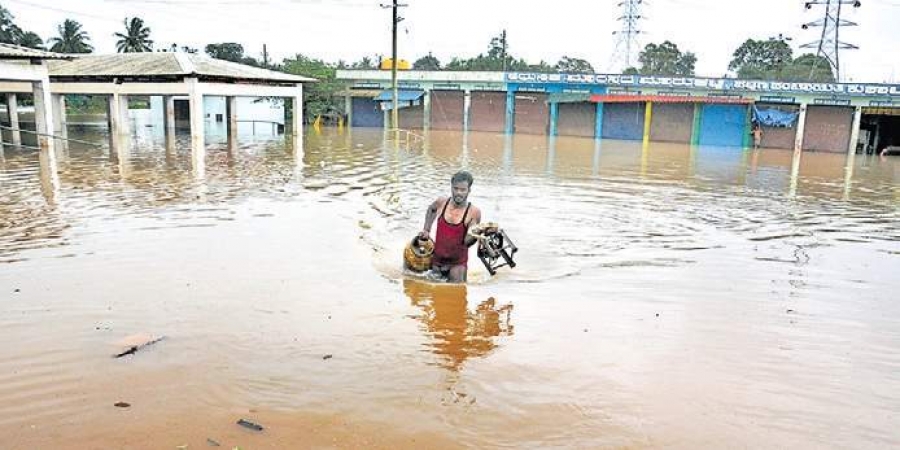
A man carrying an LPG cylinder and a stove wades through the flooded Kushalnagar-Hassan Road in Kodagu. (File | EPS)
Madikeri :
Amidst all the talks over indiscriminate exploitation of nature causing Kodagu disaster, an exploration geologist who has studied in New Zealand and is working in Australia ruled out the claims of ecologists about Kodagu bearing the brunt of a calamity due to manmade causes.
“Landslides in Kodagu are due to unprecedented rain in Pushpagiri Range and nearby region. What has happened to Kodagu is a natural calamity and not a manmade disaster,” said exploration geologist Iychettira G Machaiah, adding: “It is bizarre how some politicians and overnight ecological experts blame the same old timber mafia, sand mafia, forest encroachment, planters mafia as the cause for this disaster.” However, he says that the floods in the Harangi belt might be an induced disaster due to conversion of wet land and construction of layouts on the river bank and adds, “These organised layouts that have come up in recent years on wetlands are in serious violations of law.”
Nevertheless, the landslides in North Kodagu, he says, might happen once in 200 years and it is just a natural calamity. “Due to excess rainfall, the clay soil and laterite stone under the earth create a cave that starts to store water. And excess, unprecedented rainfall will result in their collapse, accompanied with a sound of breaking of earth’s plates. Western Ghats has a history of over 10 crore years and these disasters are natural to occur once in an occasion,” he stated.
He rubbishes statements of ecologists about deforestation causing such acts of nature and clarifies, “These landslides happen from the earth’s core and they will uproot the strongest trees. Mountains too could collapse during such a calamity. It is a nature’s freak event.”
source: http://www.newindianexpress.com / The New Indian Express / Home> States> Karnataka / by Prajna G R, Express News Service / August 31st, 2018
Old-timers and environmentalists blame tourism for the devastating floods in Kodagu
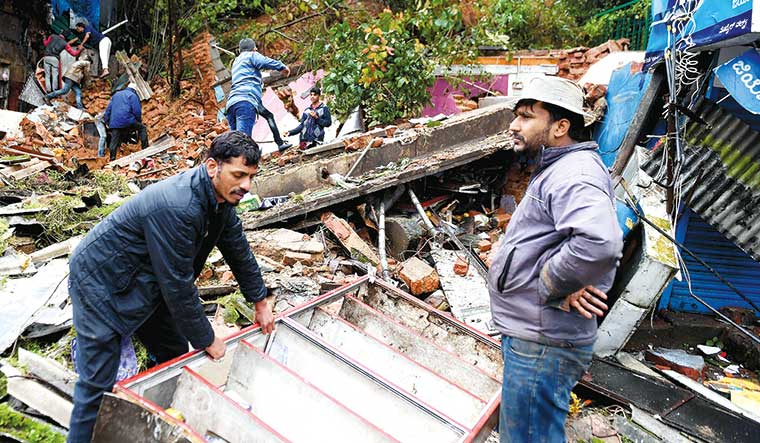
Shattered hopes: As many as 1,206 houses and 278 government buildings were damaged in the Kodagu floods | Bhanu Prakash Chandra
IF THE RAINS had not wreaked havoc in Kodagu, Karnataka’s coffee country would be preparing for ‘Kail Murta’, a festival in which the Kodavas worship their weapons. But, the district, which got battered by flash floods and landslides that took 12 lives and rendered more than 1,500 families homeless, is now left with just one weapon: resilience.
On the midnight of August 15, torrential rains started pounding Kodagu. The hills cracked up and tumbled down, and the rivers swallowed everything on their way—century-old houses, brand-new homestays, tiny tea shops, lush green paddy fields, vast stretches of coffee plantations, forests, livestock, bridges and vehicles. Incessant rains submerged low-lying areas in Kushalnagar, Somwarpet and Madikeri, pilgrimage centres like Talacauvery and Bhagamandala, and major bridges like Bethri, while landslides along the national highways turned those into death traps.
By the time the district administration launched rescue operations, the communication lines were cut off and most villages had become inaccessible. Heavy rains, tough terrain and scattered habitations made rescue operations a daunting task even for the armed forces and the National Disaster Response Force. Many people were hungry and exhausted when the rescue teams finally reached them.
Manu Madappa from Mukkodlu village said around 40 people took refuge in his homestay for three days. But with no help arriving, they decided to trek to Madikeri. “We covered a distance of 20km, walking in the rain on a muddied path, and made it to a relief camp in Madikeri,” he said.
As many as 51 relief centres have been opened across the district, sheltering 7,594 people as on August 22. NGOs have ensured an uninterrupted flow of relief material to these camps. The Kodava Samaj in Bengaluru and Mysuru are the nerve centres for organising relief material.
Local MP Pratap Simha, who was part of the rescue operations, said the devastation was unimaginable. “Incessant rains prevented airlifting of stranded people although three Army choppers were on standby. After I sent an SOS to Defence Minister Nirmala Sitharaman, the Army unit from Karwar was rushed in,” he said. “The relief centres are working well, and our next big challenge is rehabilitation. We will need huge cash donations to rebuild homes.” According to the Karnataka State Natural Disaster Monitoring Centre, 1,206 houses and 123 kilometres of roads have been damaged, 58 bridges and culverts have collapsed, 278 government buildings and 3,800 electric poles and transformers have been severely damaged.
Chief Minister H.D. Kumaraswamy, who conducted an aerial survey, said the infrastructure damage alone amounted to Rs 3,000 crore. “A team of engineers from the Border Roads Organisation and the Army engineering task force have been called in to clear roads and restore them,” said Kumaraswamy. “A team from the National Geophysical Research Institute, Hyderabad, is conducting geotechnical studies to ascertain the causes of landslides. We have deputed two IAS probationers to fasten the process of identifying the lands for rebuilding 2,000 temporary homes.” he said.
The government has promised Rs 3,800 per family, along with essential groceries as immediate relief. The chief minister has promised the affected people work under the National Rural Employment Guarantee Act and offered to issue provisional documents for those who have lost their Aadhaar and ration cards and title deeds. “Rs 5 lakh will be given to the family of the deceased. Special classes and books for children are also being planned,” said Kumaraswamy.
The rainfall was unprecedented, but old-timers and environmentalists said the alarming plight of Kodagu was the fallout of the booming tourism industry. G.S. Srinivas Reddy, director of the Karnataka State Natural Disaster Monitoring Centre, said Kodagu received 103 per cent more rainfall than normal this year.
U.M. Poovaiah, editor of Brahmagiri, a Kodava weekly, said he had never seen or heard of such devastation in the history of Kodagu. “This is the fallout of unregulated tourism that has razed down the hills to make roads to homestays. The riverbed has been encroached upon. Unplanned construction has pushed the district to the edge. The authorities are to blame for the influx of tourists and atrocities against nature in this once-pristine district. We want unlicensed homestays and construction activity to be stopped,” said Poovaiah.
The Coorg Wildlife Society, too, blamed the severe stress on Kodagu because of the change in land use and unbridled tourism. In a letter sent last May to Prime Minister Narendra Modi, the CWS wrote, “Kodagu provides almost 50 per cent of the total inflow into Cauvery, which is the lifeline of South India, and provides water to over 80 million people and 600 major industries across the region. The food, water and economic security of southern India hinges largely on Cauvery River. It is therefore in national interest to preserve the Kodagu landscape and protect its ecosystems.”
Colonel (retd) C.P. Muthanna, president of CWS and co-ordinator of the Save Kodagu and Cauvery campaign, said more than 2,800 acres of paddy fields, coffee plantations and highlands were converted to residential layouts, sites, commercial complexes and resorts between 2005 and 2015. “Kodagu’s fast-paced urbanisation will turn it into a slum,” said Muthanna. Earlier this year, he had urged the Karnataka government to regulate tourism in the region and demanded an audit of water and waste and sewage management in the resorts. “While Kodagu has a population of 5.5 lakh, the number of tourists goes up to 13 lakh,” he said.
A report by the Centre for Ecological Sciences, Indian Institute of Science, Bengaluru, said massive deforestation and monoculture plantations caused the landslides. “Trees hold the top soil and also absorb and regulate the flow of rainwater. But deforestation for construction of roads and power lines have resulted in soil erosion,” said T.V. Ramachandra of the centre. “If the government wants to avert disasters, it should not take up any mega projects.”
source: http://www.theweek.in / The Week / Home> The Week> Cover Story / by Prathima Nandakumar / September 02nd, 2018
Far beyond social-friendly drone footage, here’s a noble use of drones by an Indian company during flood rescue.
As the state of Kerala is observing its popular festival of Onam, the restrained celebration is a testament to the recent deluge witnessed by the state over the past week. Rehabilitation, rather than celebration, seems to be top priority of the people of Kerala. After a heartbreaking loss of over 300 lives, the state has come to a halt. But while, most of the world’s attention has been targeted at Kerala, the situation was equally grave in the neighboring state of Karnataka. The district of Kodagu, earlier known as Coorg, has been at the receiving end of heavy rains and resulting floods as well.
____________________________________
Highlights
August witnessed heavy rainfall in the Kodagu district of Karnataka, as well as Kerala
Although Kerala suffered loss of over 300 lives, the situation in Karnataka was equally sombre
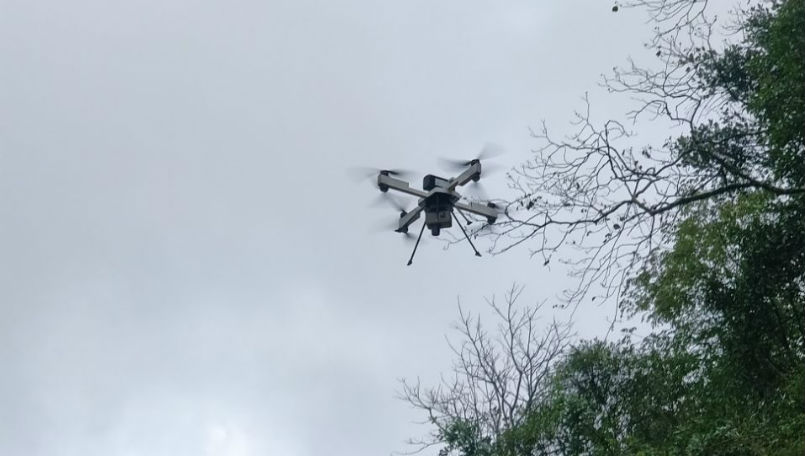
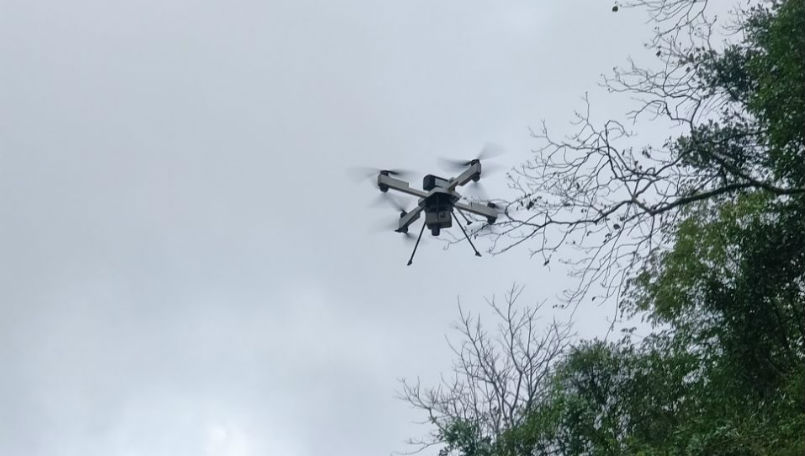
A Mumbai-based company that works with DRDO coordinated surveillance efforts with its indigenous drones
____________________________________
The relief operation
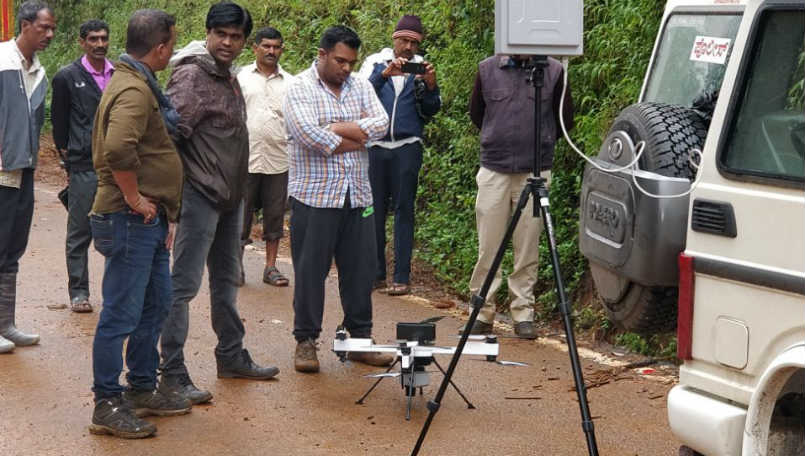
The crisis began immediately after Independence Day. On the 17th and 18th August, ideaForge reached out to the Governments of Kerala and Karnataka, respectively. The company had already begun internal efforts on August 16 to prepare for operations when needed
ideaForge team carrying out checks before embarking on its mission. Image: ideaForge
Since the situation in Kerala was worsening, the machinery was focussing on getting the defense forces active. Immediate need from Kerala was surveillance and supply drops. Typically in such disaster relief missions, surveillance refers to identifying and locating people stranded in inaccessible areas. Similarly, supply drops refer to airdropping medicines, food packets and other critical needs over inaccessible areas. For the mission, the company identified two of its products – Netra Pro and Q series.
Transporting drone batteries is a critical component of the whole operation. Since civil aviation rules do not currently allow transporting drone batteries, the company requested the two governments to allow transporting them through the military sorties that were being carried out from Mumbai.
The team reached Kodagu the next day on August 20. The team had received a request from the Kodagu district collector for drone surveillance to identify people stranded in remote places. The company sourced the relevant products, carried out necessary testing procedures and safety checks before embarking on the surveillance and airdrop mission.
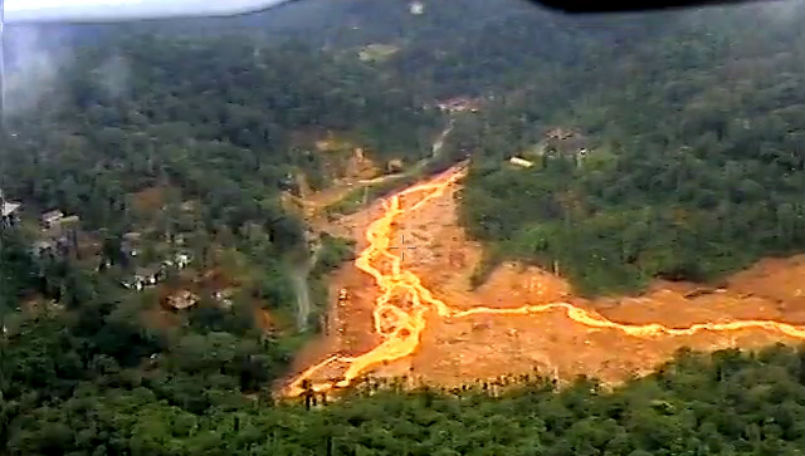
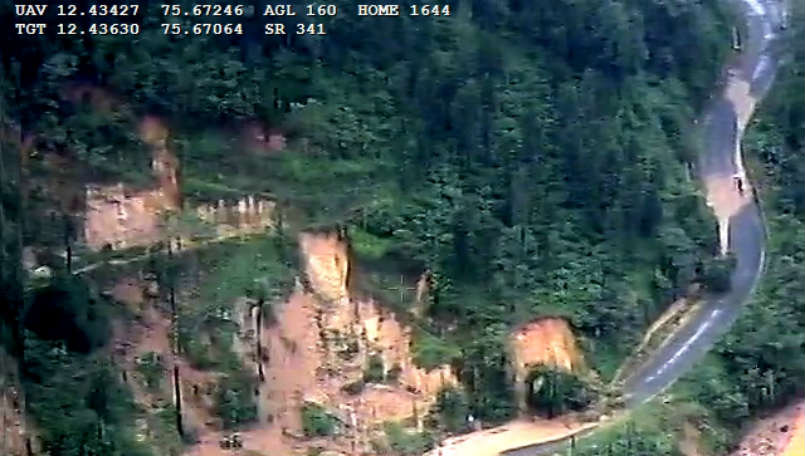
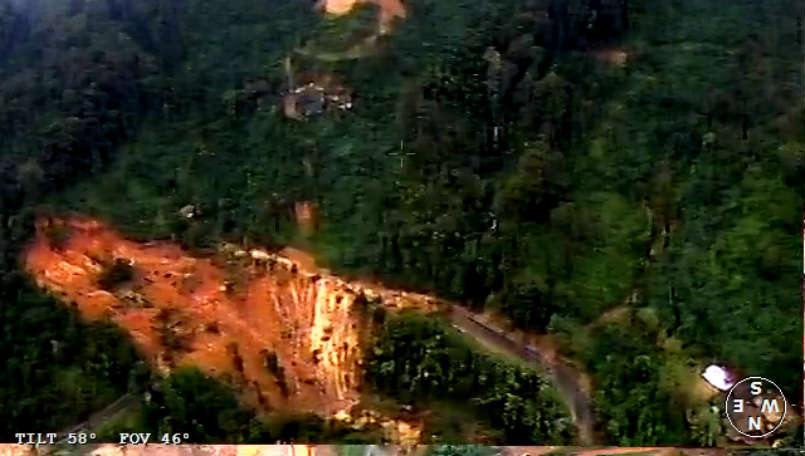
Meanwhile, the District Collector in Madikeri needed help with post damage assessment. The team reached Coorg on Monday, and sought permissions to fly. The team did a recce while on standby. After receiving permissions, they carried out their first surveillance and mapping operation on Wednesday, August 22. The Q Series and Netra Pro drones were used for this purpose.
The Netra Pro Drone Image: ideaForge
In less than a day, the report was submitted to the District Collector. Currently, the Karnataka State Police Department, Commissioner’s Office, National Highway Authority of India, Tribal Welfare Department and the local PWD are collectively using the images for rebuilding and rehabilitation operations. Over Friday, August 24 and as of writing this report, drones are carrying out operations in the deeper tribal areas to survey and rescue any stranded victims.
The Netra Q Series Image: ideaForge
According to Ankit Mehta, co-founder of ideaForge, “Being at the forefront of UAV technology, we will do our best to leverage this tech in times of need. For us it is about saving one life or at least helping one family in whatever way to recover from this natural disaster”
There’s more to drones than toying around
ideaForge develops drones that has been used by DRDO for its unmanned aerial vehicle program. It is led by Ankit Mehta alongwith Ashish Bhat and Rahul Singh who are alumnis of IIT Bombay. As students, they were part of the Innovation Cell at IIT Bombay, and took a special interest in foraging broken down bikes and scooters to create a hovercraft. The idea back then was to fly over the Powai lake situated near the IIT Bombay campus. After a couple of failures, and some significant mishaps that included connection cables getting chopped by the propeller, they finally managed to get a working prototype up and running.
Mehta is glad he didn’t cease his efforts there. After the initial disappointments, they got an opportunity to build a data loggers for UAVs from the Department of Aerospace at IIT Bombay. One thing led to the other, and the initial idea of flying over Powai lake gave birth to the company ideaForge, which was created at the Innovation Hub of IIT Bombay. Years later, ideaForge built and handed over the world’s smallest and lightest autopilot to DRDO. After an agreement was signed with the DRDO, ideaForge has worked with DRDO and NDRF for collaborating in rescue efforts during natural calamities. During the 2015 earthquake that rocked Nepal, drones made by the company aided with rescue efforts, relaying critical geographical and infrastructure status reports and information to the rescue team to plan out operations.
Far beyond viral video footage, we’re used to seeing on Facebook and YouTube, this is one novel use of drones that has resulted in saving critical human lives. The relaying of valuable information despite ground level challenges has been invaluable. The company has also mentioned its channel partner Arista Risk and Corporate Solutions in enabling necessary connections with government bodies and law enforcement authorities to seek necessary permissions.
source: http://www.bgr.in / BGR / Home> Features / by Nash David / August 25th, 2018
After rains, coffee planters in Kodagu are gripped by the fear of black rot disease and berry droppings. Spices like black pepper and cardamom produced in the coffee estates have also perished, beside paddy fields being washed away.
The district, which is known for its coffee production worldwide, may have abysmally low coffee and agriculture output this year. The coffee growers, especially small planters, will be hit by the black rot disease, increase in berry droppings and fungal disease to the crop.
Naj Chengappa, a coffee planter, said, “The disease will affect both Arabica and Robusta coffee due to excess rainfall. The most striking symptoms are blackening and rotting of the leaves and tender berries.”
The growers are already worried about falling coffee prices in the past two years. The diseases following the flood will add to their sufferings. Black pepper crop, grown extensively in coffee plantations in the district, also suffers from droppings and fungal diseases. Cardamom is grown in parts of North Kodagu. The crop has suffered heavy damages due to landslides and flood. “Since there is no proper sunlight in Kodagu for almost a month now, this will cause fungal disease to coffee, black pepper and cardamom grown particularly in the North Kodagu areas like Madikeri, Napoklu, and Somwarpet,” said Naj.
According to Kaibulira Harish Appaiah, president of Kodagu Growers’ Association, the rain this year has caused 60% loss for coffee and pepper crops in the district. “Due to rain-related disease to coffee, 98.5% small growers will be affected. The crop requires at least two years to recover from rain-related diseases.” “The government has to waive the loans of farmers and come out with relief packages to compensate for the crop damages,” he said. According to sources in the Horticulture department, an estimated 47,000 hectares of arecanut plantations have been affected due to heavy rain. Arecanut is majorly grown in DK, Uttara Kannada, Kodagu, Chikkamagaluru and Shivamogga. “The rain has caused fungal diseases in arecanut crop, which will affect the output this year,” said Y S Patil, horticulture department commissioner.
source: http://www.deccanherald.com / Deccan Herald / Home> State / by Darshan Devaiah B P, DH News Service / Bengaluru – August 22nd, 2018
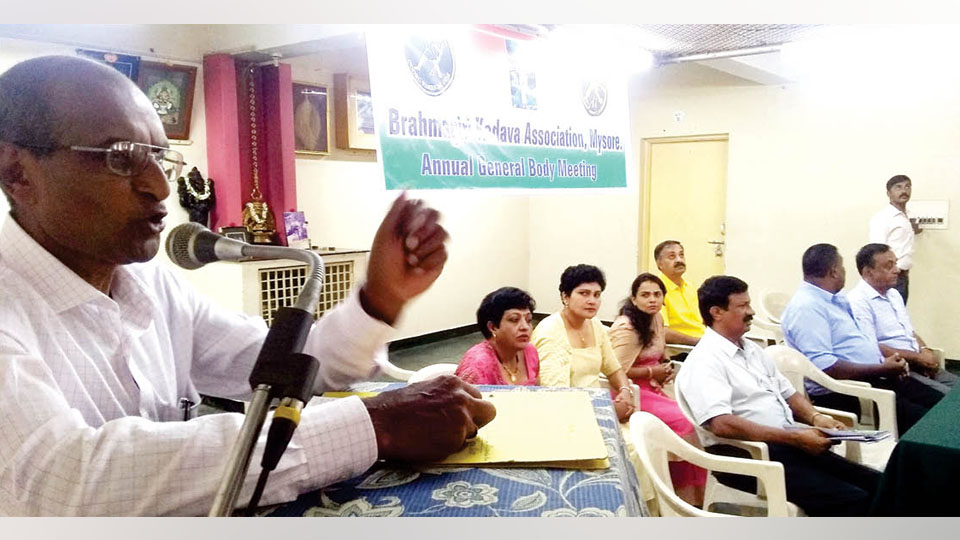
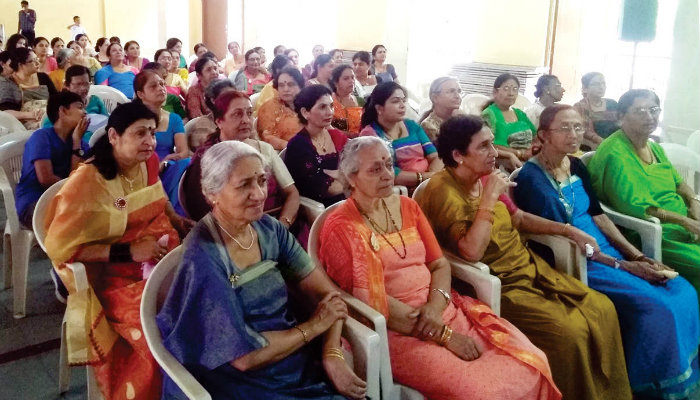
Brahmagiri Kodava Association, Vijayanagar (3rd & 4th Stages) held its Annual General Body Meeting and annual get-together function recently at Field Marshal K.M. Cariappa Community Hall in Kodava Samaja, Mysuru.
President of the Association, Ponnachanda Bheemaiah, addressing the members, said the objective of Brahmagiri Kodava Association should not limit itself only to the welfare of members and their family members but also aim at serving the society. He suggested them to plant a few fruit bearing saplings wherever feasible close to their houses and maintain them for a few years.
Stating that a few members of the Association urged him to create a ‘data base’ with the details of voluntary blood donors among the members in the age group of 18 to 55 years, he suggested the name as ‘Brahmagiri Blood Bank.’ He said that the aim of maintaining blood donors’ details is to locate voluntary blood donors who could immediately donate the required blood to any needy member of the Association in emergency cases.
The President of Brahmagiri Association also lauded the efforts of recently launched “Tree Lovers Club” in Vijayanagar, headed by Association member Mandetira N. Subramani (President) and Secretary of the Association Appachattolanda Bojappa (Secretary of Tree Lovers Club) for impressing upon the Forest Department in availing over 2,000 flower and fruit bearing tree saplings that were planted in Vijayanagar 3rd Stage and 4th Stage in the past one and a half month.
Those interested in joining the Club as Honorary members or to give their suggestions may send email to: tree.lovers@yahoo.com
During the get-together, various indoor games were organised for members and their family. Meritorious children of members were felicitated with cash awards to motivate them.
Kullachanda Vinutha rendered the invocation and welcomed. Treasurer of the Association Mundotira Changappa proposed a vote of thanks.
source: http://www.starofmysore.com / Star of Mysore / Home> News / August 14th, 2018
The 27th state-level open-to-all marshy field sports meet will be held at a field belonging to C D Bopaiah in Kaggodlu village in the taluk on August 11, said Zilla Yuva Okkoota President M D Harish.
Addressing reporters here on Monday, he said that the sports meet is being organised jointly by the district Youth Empowerment and Sports Department, Nehru Yuva Kendra, Youth Hostel Association of India and Zilla Yuva Okkoota.
The inaugural programme will be held at 10.30 am. MLA K G Bopaiah, District-In-charge Minister Sa Ra Mahesh, ZP President B A Harish and MP Pratap Simha are expected to take part among others.
The valedictory programme at 5.30 pm will be presided over by Hakattur Gram Panchayat President Sharada Ramakrishna. MLA Appacchu Ranjan, MLC Sunil Subramani, Superintendent of Police Sumana and others will take part.
Volleyball (for men), throw ball (for women), tug of war for high-school boys and girls, 50 metre race for primary school boys and girls, 100 metre race for higher primary school boys, 200 metre race for high school and PU college boys, 300 metre race for girls, open running race for men and women from general public will be conducted for the villages of Kaggodlu.
Volleyball, throwball, and tug of war teams should pay a fee of Rs 500 before August 10 at 2 pm.
The winning teams will get attractive prizes.
High school students who are willing to take part in the tug of war must bring a certificate from their respective heads of the institution.
The games will begin at 9 am on August 11. For details, you may contact: 94499 52008, 97404 04520
Youth Hostel Association of India President C B Devaiah, Secretary Ayyanna C A, Madikeri taluk Yuva Okkoota President Navin Derala and Taluk Yuva Okkoota Secretary Baladi Dilip Kumar were present in the press meet.
source:http://www.deccanherald.com / Deccan Herald / Home> State> Districts / by Adithya KA, DH News Service, Madikeri / August 06th, 2018
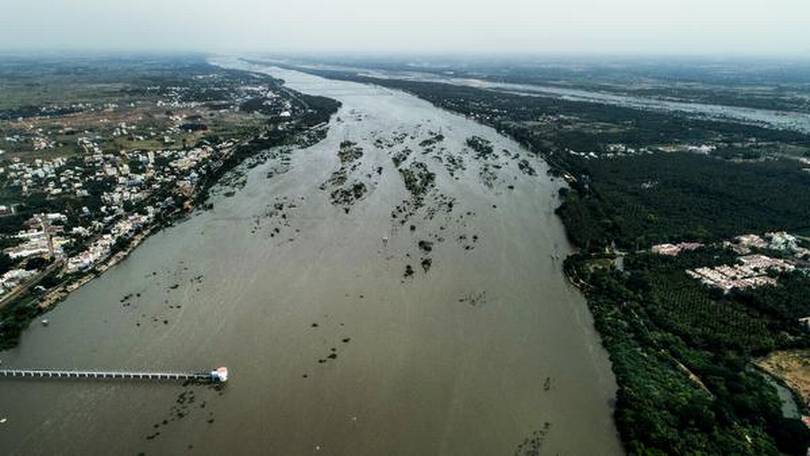
Side by side: The Cauvery (left) and the Kollidam at the Kambarasampettai check dam near Srirangam in Tiruchi. PHOTO: M. MOORTHY
Broad, menacing and gushing, the river has gained new life aided by a generous southwest monsoon
Originating as a small spring at Talacauvery in the Brahmagiri Hills of Kodagu district in Karnataka and through its 802-km journey before emptying into the Bay of Bengal at Poompuhar on the Coromandel coast, the Cauvery evokes strong emotions, both sublime and mundane. The generous monsoon this year has infused new life into the river. All the major dams in Karnataka (Krishnaraja Sagar, Hemavathi, Kabini and Harangi) are brimming over. With the combined rate of outflow from the reservoirs being 75,000 cusecs to 1,00,000 cusecs, the Cauvery, barely visible in summer, is now a river in spate.
Among the more popular sights on its course is the Abbey Falls in Madikeri, where a few natural streams jump off the cliff and join the river downstream. The Lakshmantirtha, a bigger tributary originating from Brahmagiri, jumps down the cliffs in a series of rapid falls from a height of nearly 170 feet to form the Iruppu Falls and snakes through the Nagarahole tiger reserve before merging with the Cauvery at the Krishnaraja Sagar. Meandering and gliding along through the rough and rocky terrain, the Cauvery splits into two and forms the riverine island of Shivanasamudra and presents the breathtaking sight of the Gaganachukki and Bharachukki segmented falls, plummeting from a height of 320 feet (and almost a 1,000 feet wide) with a deafening roar before hitting the rocky gorge below releasing clouds of vapour and foam.
It is at the Hogenakkal falls that the river tumbles down, after traversing for 64 km along the inter-State boundary. The river spreads into the Mettur Dam in Salem district, the largest in Tamil Nadu with a capacity of 93.47 thousand million cubic feet. From Mettur, the river proceeds south and turns eastward.
At the Upper Anicut, or Mukkombu (which is about 15 km above Tiruchi), the Cauvery splits into two, with the southern branch retaining the original name and the other, known as Coleroon (Kollidam in Tamil), and drains into the sea near Portonovo (Parangipettai) in Cuddalore district.
Text by R. Krishnakumar and T. Ramakrishnan
source: http://www.thehindu.com / The Hindu / Home> News> States> Tamil Nadu / July 29th, 2018
Apropos the letter titled ‘A Mysurean’s tryst with Kodagu’ published in Star of Mysore dated July 11, I want to narrate my experience of staying in Kodagu from 1962 to 1966 being a former native of Hunsur.
In 1962, I was directed to a school in South Kodagu by my College Professor whom I happened to meet on Sayyaji Rao Road, Mysuru. Since Kodagu is adjacent to Hunsur, I thought, as a fresher, that I can go and work there and teach English to students.
When I landed at Balele in Kodagu, I was mesmerised by the beauty of nature around the school which was situated amidst a coffee plantation dotted by orange trees. There wasn’t any other building near the school except an asphalted road on which buses used to ply from Gonikoppal to Balele – four or five buses used to ply on this road every day. It was a rare sight for us to see the buses so clean and punctual. The crew of the bus was so co-operative and social, that the passengers used to feel that all of them were the members of the same family.
There was a valley near the school and down below, there was a stretch of land which belonged to the school just like a part of the coffee plantation around the school. It was used to cultivate paddy and rain water was the only source of irrigation. The valley was so beautiful that we used to stand at the rim and enjoy the beauty especially during rainy season and winter amidst thick mist. There was an old house at the rim of the valley and from there we used to enjoy the beauty of the rising sun over a cup of piping-hot Coorg coffee.
Boys playing hockey was a feast to the eyes at the school field which was close to the valley. But that side rim was covered by trees and other vegetation.
This year’s rainfall reminds me of the continuous rain in Kodagu for about five days which locked us up in the school building which was our residence too. We spent our days playing carom, chess, hearing radio. There was no electricity and tap water during that time. I have gone to that place many a time even after leaving that place about 52 years ago to recapitulate the memory.
– Dr. Hunsur S. Raghavendra Rao, Retired Professor, J.P. Nagar, 12.7.2018
You can also mail us your views, opinions, and stories to voice@starofmysore.com
source: http://www.starofmysore.com / Star of Mysore / Home> Voice of the Reader / July 15th, 2018
WELCOME. If you like what you see "SUBSCRIBE via EMAIL" to receive FREE regular UPDATES.
Read More »